REVIEW 2 major objections 6 minor 52 references
Long-Duration Fully Autonomous Operation of Rotorcraft Unmanned Aerial Systems for Remote-Sensing Data Acquisition
T0 review · 2 major / 6 minor · reviewed 2026-08-14 · deepseek-v4-flash
Pith's one-line read A rotorcraft UAS with an on-board autonomy engine can run repeated data-collection flights and recharge itself without human intervention.
desk verdict A genuine outdoor field demonstration of repeated autonomous landing and recharging, backed by credible landing-accuracy data, but the 'operate indefinitely' claim is unsupported and should be tempered. read the letter →
The pith
A machine-rendered reading of the paper's core claim, the machinery that carries it, and where it could break.
The reading
What carries the argument
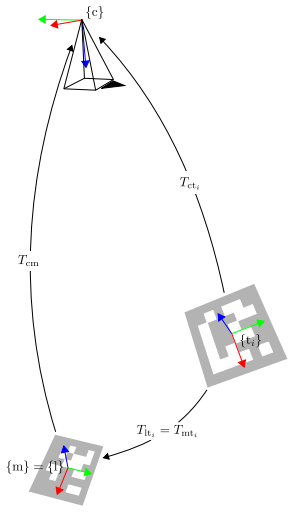
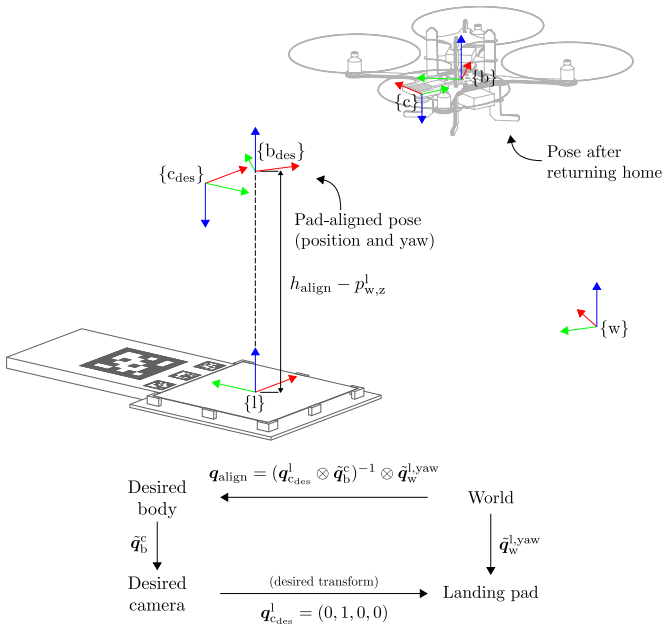
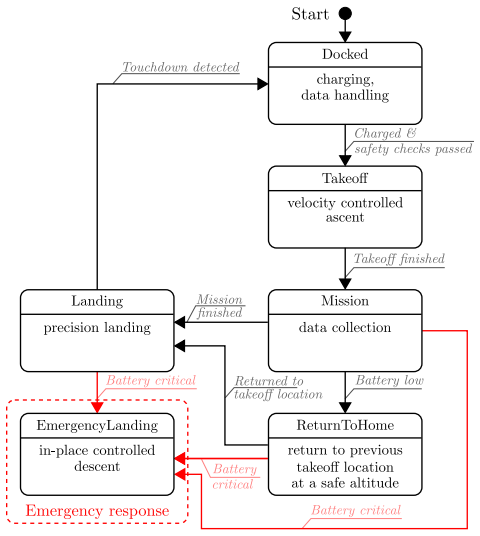
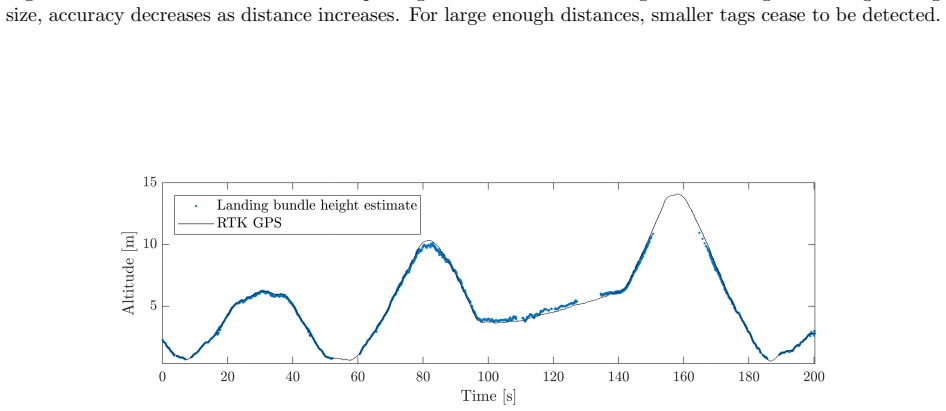
The load-bearing mechanism is the landing-pad pose estimator built on a bundle of AprilTag fiducials. A downfacing monocular camera supplies images to the AprilTag detector; detected tags are combined by a perspective-n-point solver into one bundle pose, and a recursive least-squares filter outputs a smoothed pad pose. Because the pad is assumed level, the filter outputs only a yaw quaternion, and the desired landing alignment follows from Eqs. (2) and (3). This pose estimate drives the landing autopilot and closes the recharging cycle. The second mechanism is the master/slave state machine hierarchy that coordinates takeoff, mission, landing, emergency landing, and health monitoring behaviors.
What would settle it
Place the charging pad on a surface tilted by a few degrees and run the outdoor mission; if the system still centers and connects reliably, the level-pad assumption is not load-bearing, but if it misaligns, fails touchdown detection, or misses charging contacts, the central claim of indefinite unattended operation is falsified for uneven terrain.
Extended reading notes
Core claim
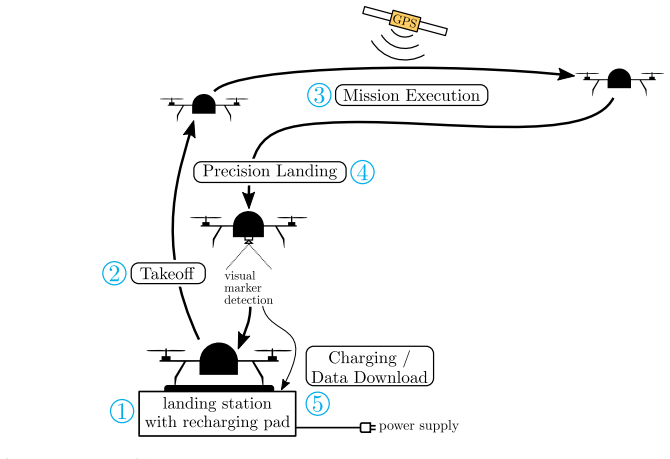
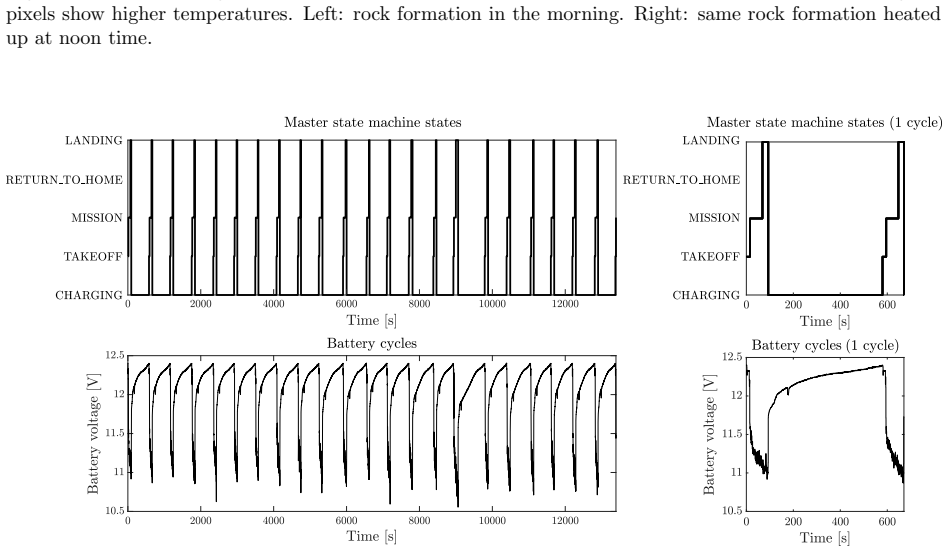
The central claim is that the loop of takeoff, waypoint mission, vision-based precision landing, recharging, and data download can be closed entirely on board, with no operator action after a start command. The paper reports 16, 48, and 22 fully autonomous flights in the three experiments, and states that this is the first published long-term outdoor quadrotor operation without human interaction. The discovery, if correct, is not a new sensing modality but a systems integration result: the autonomy engine, combined with a landing-pad pose estimator, makes sustained unattended rotorcraft sensing practical at the demonstrated scale.
Load-bearing premise
The system assumes the charging pad is perfectly level, so the vision filter ignores roll and pitch of the pad; if the real outdoor pad tilts, the landing alignment and touchdown detection can carry that error and the electrical contacts may not connect.
Editorial extensions
If this is right
- Repeated diurnal remote-sensing missions, such as monitoring plant water use over a full day, can be scheduled across many charge-discharge cycles without personnel on site.
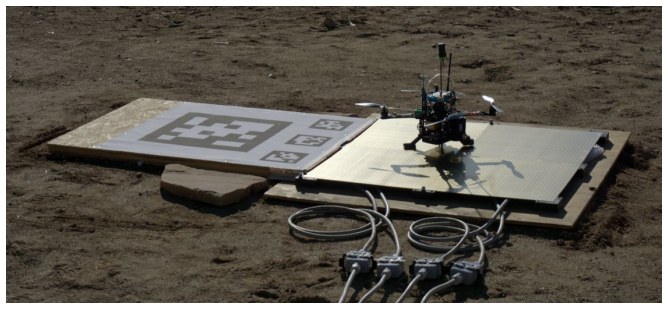
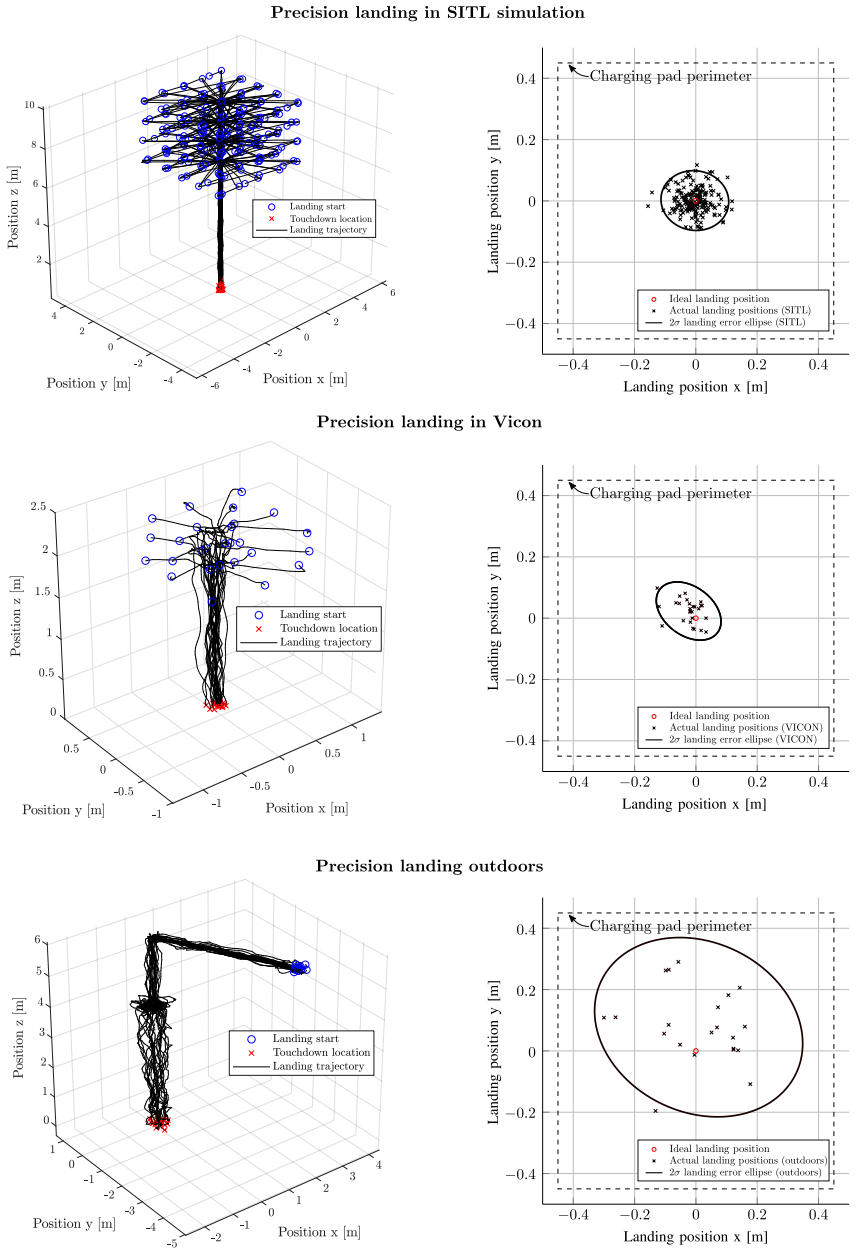
- The measured outdoor landing accuracy, with a 2-sigma lateral error below 0.37 meters, is sufficient for the 90 by 90 centimeter charging surface used in the experiments.
- The autonomy engine is modular enough that the same state-machine design can be ported to other rotorcraft with a downfacing camera and a compatible charging pad.
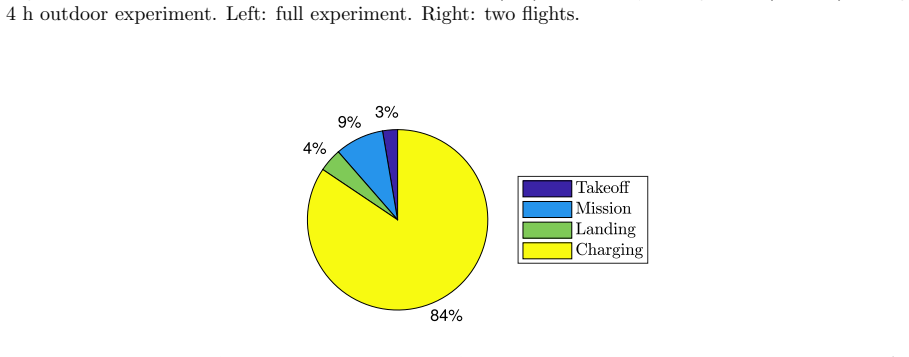
- The observed flight-to-charge time ratio of about 1 to 10 matches earlier work and is limited by battery and charger design, not by the autonomy logic itself.
- The full-cycle operation was demonstrated only over hours, not days, so longer unattended deployments remain an open extension of the same architecture.
Reading between the lines
- If the level-pad assumption were relaxed to estimate the pad's full six-degree-of-freedom pose, the same architecture could land on slightly sloped or even gently moving pads; the paper's own equations show that a tilted pad injects roll and pitch error into the desired landing alignment.
- The outdoor exposure problems the authors observed could likely be mitigated with event-based cameras, which they mention as a future option; a testable extension is whether such cameras improve landing accuracy under fast-changing cloud cover.
- The 4-hour outdoor run is short relative to the claimed indefinite operation, so a multi-day outdoor deployment would be the natural stress test; the paper's own lessons-learned list points to dust on charging contacts, GPS interference, and software stability as likely failure sources.
- The flight-to-charge ratio of 1 to 10 suggests that for practical precision agriculture use, the next bottleneck is energy density and charging speed, not autonomous decision-making.
Signed reviews
Editorial analysis
A structured set of objections, weighed in public.
Referee Report
Summary. The manuscript describes a rotorcraft UAS autonomy architecture for repeated remote-sensing missions without human operators. The system comprises a master/slave state-machine hierarchy coordinating takeoff, mission execution, vision-based precision landing, recharging, and data downlink, together with a landing-pad pose estimator based on an AprilTag bundle and recursive least squares filtering. The authors evaluate landing accuracy with 200 simulated, 27 indoor (VICON), and 21 outdoor (RTK-GPS) landings, and report long-duration experiments: 11 h (16 flights) and 10.6 h (48 flights) indoors and 4 h (22 flights) outdoors, all autonomously executed. The paper's stated central contribution is that the autonomy engine provides the logic and software-hardware interfaces needed to operate indefinitely without humans in the loop.
Significance. The reported integration is a useful systems-level demonstration. The landing-accuracy evaluation against independent ground truth is concrete, and the state-machine logs provide evidence that the full cycle of takeoff, mission, landing, and recharging can be repeated automatically for at least several hours, including outdoors. The bundle-layout study quantifies a genuine design tradeoff among tag size, detection range, and lever-arm error. If the claims are restricted to bounded-duration autonomy, this is a solid contribution to the long-duration UAS literature. The indefinite-operation claim, however, is not established, and the paper itself documents failure modes that would interrupt the loop and require human action.
major comments (2)
- [Section 1.2, 8.3.1, 9] The claim in Section 1.2 that 'once the autonomy engine is started, the system has the logic and software-hardware interfaces necessary to operate indefinitely without humans in the loop' is not supported by the reported evidence and is contradicted by the paper's own account. Section 8.3.1 reports that dust on the charging pad has 'at several points prevented a proper contact' and hence prevented recharging, and that the AscTec MAV framework 'frequently crash[es] after long periods of operation'; Section 9 states that the implementation is 'not robust to individual ROS node crashes' and that no supervisory restart mechanism has been implemented. Each of these failure modes requires human intervention to restore the autonomy loop, so the strongest supported claim is bounded-duration autonomy over the demonstrated 11 h, 10.6 h, and 4 h experiments. The authors should either remove the indefinite-operation claim or provide evidence of automatic recovery from these failure classes.
- [Section 4.1, Eq. (2), Eq. (5)] The landing-pad pose estimator deliberately returns only a yaw quaternion because the pad is assumed to be level. This assumption is load-bearing for the recharging cycle: if the outdoor charging surface is not flat, the alignment commands in Eqs. (2)-(3) inherit roll and pitch error, the touchdown detection in Eq. (5) may fire at an incorrect height, and the charging contacts may fail to connect. No experiment with a deliberately tilted or uneven pad is reported, so this failure mode is untested. At minimum, the paper should state this assumption explicitly as a scope condition and discuss its implications for the generality of the demonstrated autonomy.
minor comments (6)
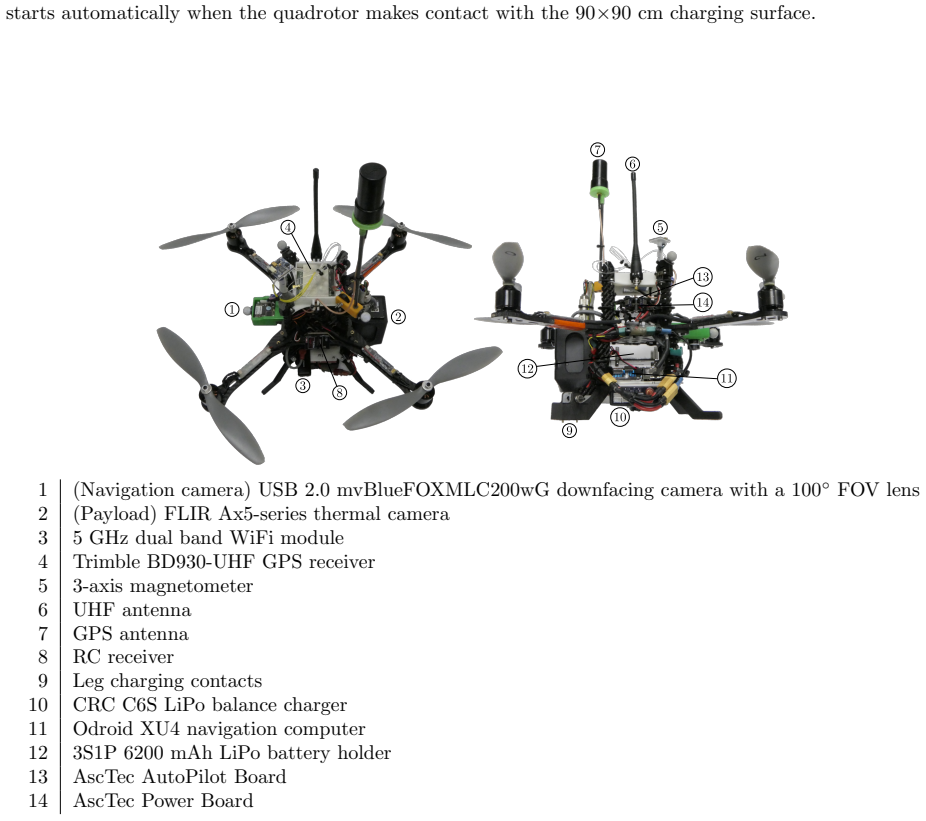
- [Section 1.1 and Figure 1] The caption describes a hexacopter platform, while the text at the end of Section 1.1 says the autonomy engine can be deployed on 'such a quadrotor'; please align the terminology.
- [Section 4.1 and Figure 8] The text states that the measurement frequency is approximately 7 Hz, while Figure 8 reports a median of 6.5 Hz; make these values consistent.
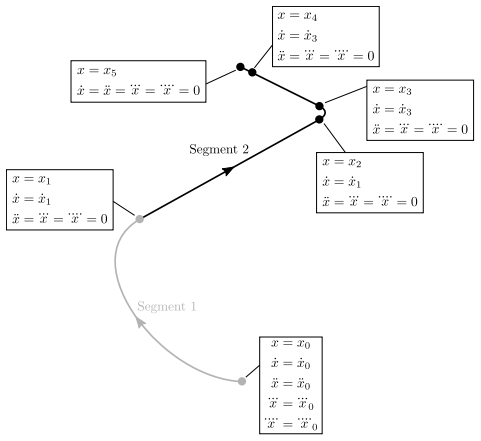
- [Section 5.2 and Figure 14] The description of the volatile trajectory element is hard to follow; a brief formal definition of when and why a volatile element is inserted would improve clarity.
- [Section 7.5, Eq. (5)] Please define explicitly the frames in which the quantities p-tilde-sub-w,z and p-tilde-sub-l,z are expressed, since touchdown detection depends on these thresholds.
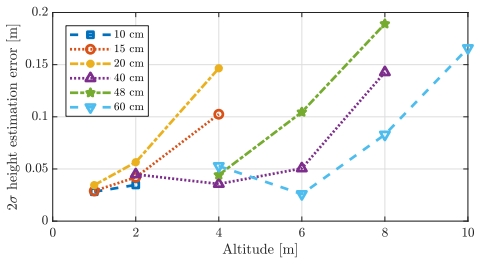
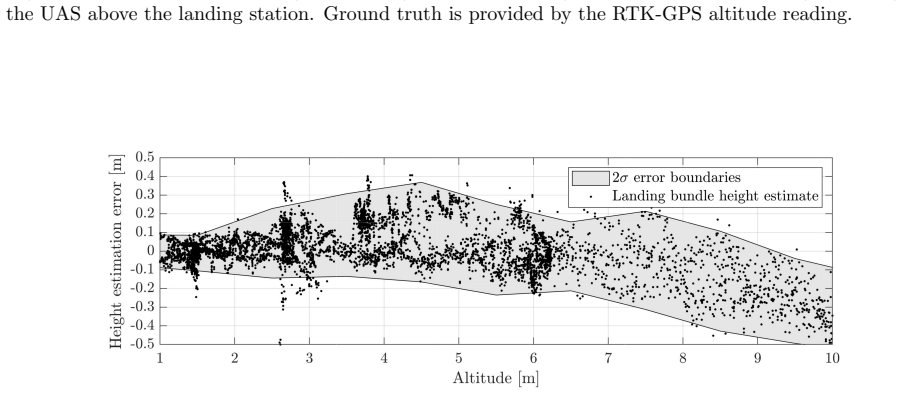
- [Section 8.1.1] The bundle-layout simulation evaluates only the height component of the measurement noise with zero off-axis angle; the paper should state clearly that the optimization is based on this reduced metric rather than full 6-DOF pose accuracy.
- [References] Several author names show rendering artifacts from missing diacritics, for example 'A¸ cıkme¸ se' in the reference list; please fix the LaTeX source.
Circularity Check
No significant circularity; landing accuracy is benchmarked against external ground truth and the self-citations are not load-bearing.
full rationale
The paper is an experimental systems/robotics paper rather than a derivation chain, so the standard circularity patterns do not apply. The landing-pad pose estimator (Section 4.1) is a standard PnP plus RLS pipeline whose accuracy is evaluated against VICON indoors and RTK-GPS outdoors (Figures 20-22), not against its own assumptions. The bundle calibration (Section 4.1.1, Eq. 1) uses a master tag plus statistical averaging, a conventional calibration procedure; it does not fit any parameter to the landing-error data that is later reported as a prediction. The bundle-layout optimization (Section 8.1.1) is a simulation-based design study, and the real-world results are honestly reported as larger than the single-tag prediction (Section 8.1), so no fitted input is disguised as a prediction. The paper does cite prior work by overlapping authors: 'Our approach is the same as that of (Brommer et al., 2018)' and computational details are delegated to (Malyuta, 2018), but these citations are not used to prove any empirical claim; the current paper's own flights, VICON/RTK ground-truth comparisons, and reported failure modes carry the evidence. The strongest caveat is not circularity: Section 1.2's claim that the system can 'operate indefinitely without humans in the loop' is contradicted by the paper's own Lessons Learned (Section 8.3.1: dust prevents charging contact; AscTec MAV framework 'frequently crash[es] after long periods of operation') and by Section 9 ('not robust to individual ROS node crashes'). That is an unsupported or overstated reliability/duration claim, not a claim that reduces by construction to its inputs. No circular step is identifiable under the required standard of quoting a specific reduction between equations or fitted parameters.
Assumptions & free parameters
free parameters (6)
- Approach altitude halign =
4 m
- Touchdown altitude threshold =
0.3 m
- Touchdown velocity threshold =
0.1 m/s
- Emergency landing velocity threshold =
0.1 m/s
- Motor RPM check tolerance =
400 RPM
- AprilTag bundle tag sizes =
48 cm master plus three 15 cm tags
assumptions (4)
- domain assumption The landing pad is level, so only yaw is estimated from the AprilTag bundle and pad roll/pitch are ignored.
- domain assumption AprilTag 2 detection and the perspective-n-point solver provide unbiased, sufficiently accurate pose measurements at about 7 Hz.
- domain assumption GPS provides bounded position error outdoors so the vehicle can return to the charging pad vicinity and the vision system can acquire the bundle.
- standard math Quadrotor dynamics are differentially flat, and the polynomial trajectories are dynamically feasible.
Cite this review
Pith. "Pith review of Long-Duration Fully Autonomous Operation of Rotorcraft Unmanned Aerial Systems for Remote-Sensing Data Acquisition." pith.science (2026). https://pith.science/paper/HI4DZPJ4
@misc{pith2026190806381,
  author       = {Pith},
  title        = {Pith review of: Long-Duration Fully Autonomous Operation of Rotorcraft Unmanned Aerial Systems for Remote-Sensing Data Acquisition},
  year         = {2026},
  howpublished = {\url{https://pith.science/paper/HI4DZPJ4}},
  note         = {Machine review of arXiv:1908.06381}
}
read the original abstract
Recent applications of unmanned aerial systems (UAS) to precision agriculture have shown increased ease and efficiency in data collection at precise remote locations. However, further enhancement of the field requires operation over long periods of time, e.g. days or weeks. This has so far been impractical due to the limited flight times of such platforms and the requirement of humans in the loop for operation. To overcome these limitations, we propose a fully autonomous rotorcraft UAS that is capable of performing repeated flights for long-term observation missions without any human intervention. We address two key technologies that are critical for such a system: full platform autonomy to enable mission execution independently from human operators and the ability of vision-based precision landing on a recharging station for automated energy replenishment. High-level autonomous decision making is implemented as a hierarchy of master and slave state machines. Vision-based precision landing is enabled by estimating the landing pad's pose using a bundle of AprilTag fiducials configured for detection from a wide range of altitudes. We provide an extensive evaluation of the landing pad pose estimation accuracy as a function of the bundle's geometry. The functionality of the complete system is demonstrated through two indoor experiments with a duration of 11 and 10.6 hours, and one outdoor experiment with a duration of 4 hours. The UAS executed 16, 48 and 22 flights respectively during these experiments. In the outdoor experiment, the ratio between flying to collect data and charging was 1 to 10, which is similar to past work in this domain. All flights were fully autonomous with no human in the loop. To our best knowledge this is the first research publication about the long-term outdoor operation of a quadrotor system with no human interaction.
Figures

Figures from the paper (25 more)










Reference graph
Works this paper leans on
-
[1]
Achtelik, M., Achtelik, M., Weiss, S., and Kneip, L. (2017). asctec mav framework. http://wiki.ros.org/ asctec_mav_framework. Accessed: 2017-12-10. A¸ cıkme¸ se, B. and Ploen, S. R. (2007). Convex programming approach to powered descent guidance for Mars landing. AIAA Journal of Guidance, Control, and Dynamics , 30(5):1353–1366
work page 2017
-
[2]
Aldhaher, S., Mitcheson, P. D., Arteaga, J. M., Kkelis, G., and Yates, D. C. (2017). Light-weight wireless power transfer for mid-air charging of drones. In European Conference on Antennas and Propagation (EUCAP). Amazon (2016). Amazon Prime Air’s first customer delivery. https://www.youtube.com/watch?v= vNySOrI2Ny8. Accessed: 2017-12-11. APRIL Laboratory ...
work page 2017
-
[3]
Bencina, R., Kaltenbrunner, M., and Jorda, S. (2005). Improved topological fiducial tracking in the reac- TIVision system. In IEEE Computer Society Conference on Computer Vision and Pattern Recognition (CVPR)
work page 2005
-
[4]
Bergamasco, F., Albarelli, A., Cosmo, L., Rodola, E., and Torsello, A. (2016). An accurate and robust artificial marker based on cyclic codes.IEEE Transactions on Pattern Analysis and Machine Intelligence , 38(12):2359–2373
work page 2016
-
[5]
Blackmore, L., A¸ cıkme¸ se, B., and Scharf, D. P. (2010). Minimum-landing-error powered-descent guidance for Mars landing using convex optimization. AIAA Journal of Guidance, Control, and Dynamics , 33(4):1161–1171
work page 2010
-
[6]
Borowczyk, A., Nguyen, D.-T., Nguyen, A. P.-V., Nguyen, D. Q., Saussi´ e, D., and Ny, J. L. (2017). Au- tonomous landing of a multirotor micro air vehicle on a high velocity ground vehicle. In 20th IF AC World Congress
work page 2017
-
[7]
Brescianini, D., Hehn, M., and D’Andrea, R. (2013). Nonlinear quadrocopter attitude control. Technical Report 009970340, ETH Z¨ urich, Departement Maschinenbau und Verfahrenstechnik
work page 2013
-
[8]
Brockers, R., Bouffard, P., Ma, J., Matthies, L., and Tomlin, C. (2011). Autonomous landing and ingress of micro-air-vehicles in urban environments based on monocular vision. In Micro- and Nanotechnology
work page 2011
Show all 52 references
-
[9]
Brockers, R., Susca, S., Zhu, D., and Matthies, L. (2012). Fully self-contained vision-aided navigation and landing of a micro air vehicle independent from external sensor inputs. In SPIE Unmanned Systems Technology XIV
2012
-
[10]
Brommer, C., Malyuta, D., Hentzen, D., and Brockers, R. (2018). Long-duration autonomy for small rotorcraft UAS including recharging. In IEEE/RSJ International Conference on Intelligent Robots and Systems (IROS)
2018
-
[11]
W., and Siegwart, R
Burri, M., Oleynikova, H., Achtelik, M. W., and Siegwart, R. (2015). Real-time visual-inertial mapping, re-localization and planning onboard MAVs in unknown environments. In IEEE/RSJ International Conference on Intelligent Robots and Systems (IROS)
2015
-
[12]
M., Wolcott, R
Chaves, S. M., Wolcott, R. W., and Eustice, R. M. (2015). NEEC research: Toward GPS-denied landing of unmanned aerial vehicles on ships at sea. Naval Engineers Journal , 127(1):23–35
2015
-
[13]
and Chen, C
Davuluri, P. and Chen, C. (2013). Radio frequency interference due to USB3 connector radiation. In IEEE International Symposium on Electromagnetic Compatibility . de Almeida, M. M. and Akella, M. (2017). New numerically stable solutions for minimum-snap quadcopter aggressive m...
2013
-
[14]
and Faugeras, O
Devernay, F. and Faugeras, O. (2001). Straight lines have to be straight. Machine Vision and Applications , 13(1):14–24
2001
-
[15]
Faessler, M., Falanga, D., and Scaramuzza, D. (2017). Thrust mixing, saturation, and body-rate control for accurate aggressive quadrotor flight. IEEE Robotics and Automation Letters , 2(2):476–482
2017
-
[16]
Faessler, M., Fontana, F., Forster, C., and Scaramuzza, D. (2015). Automatic re-initialization and failure re- covery for aggressive flight with a monocular vision-based quadrotor. In IEEE International Conference on Robotics and Automation (ICRA)
2015
-
[17]
Fiala, M. (2005). ARTag, a fiducial marker system using digital techniques. In IEEE Computer Society Conference on Computer Vision and Pattern Recognition (CVPR) . Food and Agriculture Organization of the United Nations (2009). 2050: A third more mouths to feed. http://www.fao....
2005
-
[18]
Forster, C., Faessler, M., Fontana, F., Werlberger, M., and Scaramuzza, D. (2015). Continuous on-board monocular-vision-based elevation mapping applied to autonomous landing of micro aerial vehicles. In IEEE International Conference on Robotics and Automation (ICRA)
2015
-
[19]
Forster, C., Pizzoli, M., and Scaramuzza, D. (2014). SVO: Fast semi-direct monocular visual odometry. In IEEE International Conference on Robotics and Automation (ICRA)
2014
-
[20]
Furrer, F., Burri, M., Achtelik, M., and Siegwart, R. (2016). RotorS – a modular gazebo MAV simulator framework. In Koubaa, A., editor, Robot Operating System (ROS) The Complete Reference , volume 1, chapter 23, pages 595–625. Springer. Goldman Sachs (2017). Drones: Reporting ...
2016
-
[21]
S., Weill, L
Grewal, M. S., Weill, L. R., and Andrews, A. P. (2007). Global Positioning Systems, Inertial Navigation, and Integration. Wiley, Hoboken, NJ
2007
-
[22]
Hast, A., Nysj¨ o, J., and Marchetti, A. (2013). Optimal RANSAC – towards a repeatable algorithm for finding the optimal set. Journal of WSCG , 21(1):21–30
2013
-
[23]
Jin, P., Matikainen, P., and Srinivasa, S. S. (2017). Sensor fusion for fiducial tags: highly robust pose estimation from single frame RGBD. In IEEE/RSJ International Conference on Intelligent Robots and Systems (IROS)
2017
-
[24]
Jin, S., Zhang, J., Shen, L., and Li, T. (2016). On-board vision autonomous landing techniques for quadrotor: a survey. In Chinese Control Conference (CCC)
2016
-
[25]
and Murray, D
Klein, G. and Murray, D. (2007). Parallel tracking and mapping for small AR workspaces. In IEEE and ACM International Symposium on Mixed and Augmented Reality
2007
-
[26]
and Howard, A
Koenig, N. and Howard, A. (2004). Design and use paradigms for Gazebo, an open-source multi-robot simulator. In IEEE/RSJ International Conference on Intelligent Robots and Systems (IROS)
2004
-
[27]
Kyristsis, S., Antonopoulos, A., Chanialakis, T., Stefanakis, E., Linardos, C., Tripolitsiotis, A., and Partsin- evelos, P. (2016). Towards autonomous modular UAV missions: the detection, geo-location and landing paradigm. Sensors, 16(11):1844
2016
-
[28]
Ling, K. (2014). Precision landing of a quadrotor UAV on a moving target using low-cost sensors. Master’s thesis, University of Waterloo, Waterloo
2014
-
[29]
W., Schoellig, A
Lupashin, S., Hehn, M., Mueller, M. W., Schoellig, A. P., Sherback, M., and D’Andrea, R. (2014). A platform for aerial robotics research and demonstration: the flying machine arena. Mechatronics, 24(1):41–54
2014
-
[30]
Malyuta, D. (2018). Guidance, navigation, control and mission logic for quadrotor full-cycle autonomy. Master’s thesis, ETH Z¨ urich, Z¨ urich
2018
-
[31]
and Kumar, V
Mellinger, D. and Kumar, V. (2011). Minimum snap trajectory generation and control for quadrotors. In IEEE International Conference on Robotics and Automation (ICRA)
2011
-
[32]
Morbidi, F., Cano, R., and Lara, D. (2016). Minimum-energy path generation for a quadrotor UAV. In IEEE International Conference on Robotics and Automation (ICRA)
2016
-
[33]
Mueller, M. W. and D’Andrea, R. (2012). Critical subsystem failure mitigation in an indoor UAV testbed. In IEEE/RSJ International Conference on Intelligent Robots and Systems (IROS)
2012
-
[34]
Mueller, M. W. and D’Andrea, R. (2013). A model predictive controller for quadrocopter state interception. In European Control Conference (ECC)
2013
-
[35]
W., Hehn, M., and D’Andrea, R
Mueller, M. W., Hehn, M., and D’Andrea, R. (2015). A computationally efficient motion primitive for quadrocopter trajectory generation. IEEE Transactions on Robotics , 31(6):1294–1310
2015
-
[36]
and Kumar, V
Mulgaonkar, Y. and Kumar, V. (2014). Autonomous charging to enable long-endurance missions for small aerial robots. In Micro- and Nanotechnology Sensors, Systems, and Applications VI
2014
-
[37]
Nissler, C., Buttner, S., Marton, Z.-C., Beckmann, L., and Thomasy, U. (2016). Evaluation and improvement of global pose estimation with multiple AprilTags for industrial manipulators. In IEEE International Conference on Emerging Technologies and Factory Automation (ETF A)
2016
-
[38]
Olson, E. (2011). AprilTag: A robust and flexible visual fiducial system. In IEEE International Conference on Robotics and Automation (ICRA) . OpenCV (2017). cv::solvePnP(). https://docs.opencv.org/3.3.1/d9/d0c/group__calib3d.html# ga549c2075fac14829ff4a58bc931c033d. Accessed: 2...
2011
-
[39]
Rapp, C., Suez, E., Perrad, F., Liscio, C., Arnold, T., and Krajcovic, G. (2017). SMC: The state machine compiler. http://smc.sourceforge.net/. Accessed: 2017-12-10
2017
-
[40]
Richter, C., Bry, A., and Roy, N. (2016). Polynomial trajectory planning for aggressive quadrotor flight in dense indoor environments. In Springer Tracts in Advanced Robotics , volume 114, pages 649–666. Springer
2016
-
[41]
Rublee, E., Rabaud, V., Konolige, K., and Bradski, G. (2011). ORB: An efficient alternative to SIFT or SURF. In IEEE International Conference on Computer Vision (ICCV)
2011
-
[42]
and Postlethwaite, I
Skogestad, S. and Postlethwaite, I. (2005). Multivariable feedback control: analysis and design . Wiley, 2 edition. Skysense (2018). Skysense charging pad. https://www.skysense.co/charging-pad-outdoor. Accessed: 2018-10-08
2005
-
[43]
Suzuki, K. A. O., Filho, P. K., and Morrison, J. R. (2011). Automatic battery replacement system for UAVs: analysis and design. Journal of Intelligent & Robotic Systems , 65(1-4):563–586
2011
-
[44]
Toksoz, T., Redding, J., Michini, M., Michini, B., How, J., Vavrina, M., and Vian, J. (2011). Automated battery swap and recharge to enable persistent UAV missions. In AIAA Infotech@Aerospace
2011
-
[45]
P., and Vian, J
Valenti, M., Dale, D., How, J., de Farias, D. P., and Vian, J. (2007). Mission health management for 24/7 persistent surveillance operations. In AIAA Guidance, Navigation and Control Conference and Exhibit
2007
-
[46]
A., and Gentilini, I
Vicencio, K., Korras, T., Bordignon, K. A., and Gentilini, I. (2015). Energy-optimal path planning for six-rotors on multi-target missions. In IEEE/RSJ International Conference on Intelligent Robots and Systems (IROS)
2015
-
[47]
R., Rebecq, H., Horstschaefer, T., and Scaramuzza, D
Vidal, A. R., Rebecq, H., Horstschaefer, T., and Scaramuzza, D. (2018). Ultimate SLAM? combining events, images, and IMU for robust visual SLAM in HDR and high-speed scenarios. IEEE Robotics and Automation Letters, 3(2):994–1001
2018
-
[48]
Vincent, J. (2017). Google’s Project Wing has successfully tested its air traf- fic control system for drones. https://www.theverge.com/2017/6/8/15761220/ google-project-wing-drone-air-traffic-control-tests . Accessed: 2017-12-10
2017
-
[49]
and Olson, E
Wang, J. and Olson, E. (2016). AprilTag 2: Efficient and robust fiducial detection. In IEEE/RSJ Interna- tional Conference on Intelligent Robots and Systems (IROS)
2016
-
[50]
W., Chli, M., and Siegwart, R
Weiss, S., Achtelik, M. W., Chli, M., and Siegwart, R. (2012). Versatile distributed pose estimation and sensor self-calibration for an autonomous MAV. In IEEE International Conference on Robotics and Automation (ICRA) . Wingtra (2017). How it works. https://wingtra.com/workfl...
2012
-
[51]
and Dudek, G
Xu, A. and Dudek, G. (2011). Fourier tag: A smoothly degradable fiducial marker system with configurable payload capacity. In Canadian Conference on Computer and Robot Vision
2011
-
[52]
A., and Zell, A
Yang, S., Scherer, S. A., and Zell, A. (2012). An onboard monocular vision system for autonomous takeoff, hovering and landing of a micro aerial vehicle.Journal of Intelligent & Robotic Systems , 69(1-4):499–515
2012
Reviewed August 14, 2026 · model on record in the stance chip above.
Discussion (0). Continue with ORCID to comment.