REVIEW 3 major objections 5 minor 43 references
Electron g-factor engineering for non-reciprocal spin photonics
T0 review · 3 major / 5 minor · reviewed 2026-08-14 · deepseek-v4-flash
Pith's one-line read A gate voltage can tune optical non-reciprocity by reshaping the electron g-factor in a magnetically doped InSb slab.
desk verdict Genuinely new mechanism on paper, but the gate-tunability chain breaks at the unjustified identification of the conduction-electron g-factor with the gyromagnetic ratio of the Mn moment system. read the letter →
The pith
A machine-rendered reading of the paper's core claim, the machinery that carries it, and where it could break.
The reading
What carries the argument
The machinery that carries the argument is the gate-tunable Rashba spin-orbit coupling parameter $\lambda_R$, inserted into a two-band Landau-level Hamiltonian. Diagonalizing that Hamiltonian for the $n=1$ Landau level gives the spin-split energies, and their difference over $2\mu_B B$ defines the effective g-factor that replaces the free-electron value. This g-factor enters the gyromagnetic ratio of the Landau-Lifshitz equation, whose solution yields the permeability tensor with off-diagonal entry $\kappa_{xy} = -\omega \omega_m/((\omega_0 + i\alpha\omega)^2 - \omega^2)$. The non-reciprocity of the medium, and hence the Kerr and Faraday rotations and the spin-dependent Purcell factor, all trace back to this single gate-controlled number.
What would settle it
Measure Faraday or Kerr rotation of a Mn-doped InSb slab at fixed magnetic field (e.g., 0.8 T) while sweeping the gate voltage; a null result — no shift in rotation angles across the predicted gate range — would falsify the paper's central claim. A more direct check would be to compare the g-factor inferred from the $n=1$ Landau-level gap (via magnetotransport or spin-flip Raman spectroscopy) with the gyromagnetic ratio extracted from ferromagnetic resonance; a mismatch would show the substitution in Eq. 2 does not hold.
Extended reading notes
Core claim
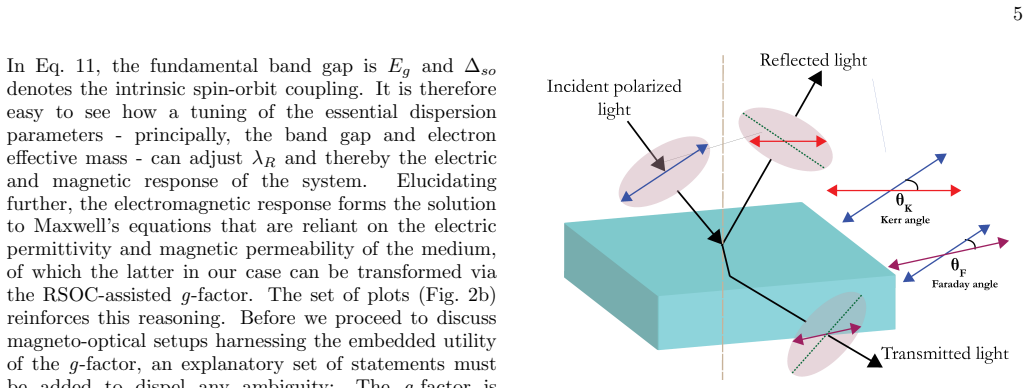
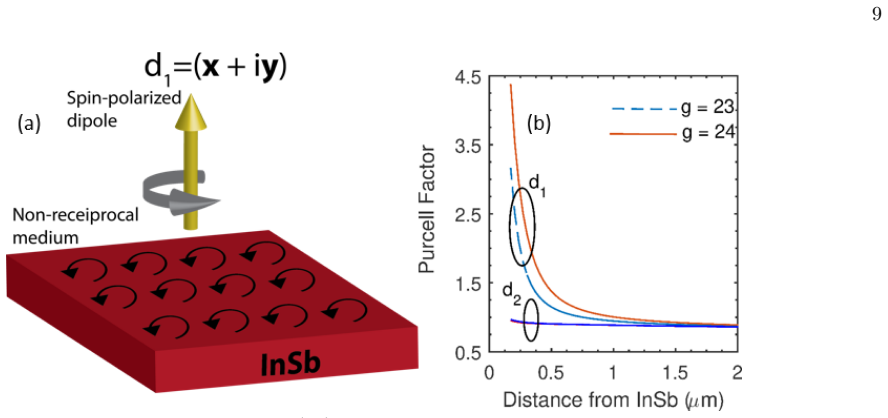
On its own terms, the central claim is that the Rashba spin-orbit coupling, tunable with an applied electric field, acts as a control handle on the magnetic permeability tensor through the electron g-factor. The paper computes the conduction-electron effective g-factor from the energy difference of the spin-up and spin-down $n=1$ Landau levels in an InSb quantum well under a magnetic field, treating the Rashba term as a linear-in-momentum spin-orbit coupling. That g-factor enters the gyromagnetic ratio $\gamma = g e/(2m^*)$ in the Landau-Lifshitz equation, which in turn fixes both diagonal and off-diagonal entries of the gyromagnetic permeability tensor. The paper then shows numerically that changing the gate field (and hence the Rashba parameter) shifts the Kerr and Faraday rotations of a 30 nm InSb slab and changes the Purcell factor of a right-handed circular dipole while leaving a left-handed dipole nearly unchanged, which it reads as electron-spin control of photon-spin-selective non-reciprocal response.
Load-bearing premise
The load-bearing assumption is that the gate-controlled conduction-electron g-factor is the same number that sets the gyromagnetic ratio for the magnetization of the ferromagnetically doped slab; if the magnetization is set by the dopant moments instead ($g \approx 2$), the gate dependence vanishes.
Editorial extensions
If this is right
- A single device can have its magneto-optical response reconfigured in situ by the gate voltage, replacing the need to change an external magnetic field.
- The spin-asymmetric Purcell effect means the same slab can selectively enhance the emission of one circular polarization of a nearby dipole, a directly testable signature.
- Because InSb quantum wells are grown by established molecular-beam-epitaxy methods, the architecture is compatible with on-chip integrated photonics, unlike garnet-based isolators.
- The frequency position of the Kerr and Faraday rotation peaks shifts with the gate field, implying that the operating band of a non-reciprocal device can be electrically tuned.
- The figure of merit for Faraday rotation can be optimized electrically, through the Rashba parameter, instead of by aligning the angular momentum states of magneto-optical ions with a magnetic field.
Reading between the lines
- If the conduction-electron g-factor indeed controls the magnetization dynamics, the mechanism is not limited to InSb: any narrow-gap semiconductor with strong intrinsic spin-orbit coupling and a large Rashba coefficient (for instance InAs or HgTe-based wells) should show the same gate-tunable Kerr and Faraday response, which is a testable prediction beyond the paper's scope.
- The paper restricts its g-factor to the $\Gamma_6$ conduction band and a scalar Landé factor; a more complete calculation including the $\Gamma_7/\Gamma_8$ bands and the anisotropy of the g-tensor could reveal an angular dependence of the Kerr rotation that the paper does not address.
- A direct experimental probe would be to measure ferromagnetic resonance (FMR) at fixed bias magnetic field while sweeping the gate voltage: the resonance frequency contains $\gamma$ and would shift if the conduction-electron g-factor governs the magnetization, whereas it would stay constant if the dopant spin system ($g \approx 2$) dominates.
- The spin-asymmetric Purcell enhancement suggests a future spin-controlled single-photon source, where an electric gate selects which photon helicity is emitted, but the paper does not discuss the quantum emitter integration details.
Signed reviews
Editorial analysis
A structured set of objections, weighed in public.
Referee Report
Summary. The paper proposes that in a magnetically doped InSb slab, a gate-tunable Rashba spin-orbit coupling (RSOC) modifies the conduction-electron g-factor, which is then inserted into the gyromagnetic ratio of the Landau-Lifshitz equation. This changes the off-diagonal permeability tensor, leading to gate-adjustable Kerr and Faraday rotations and a spin-asymmetric Purcell enhancement. The authors combine an eight-band k.p calculation (Appendix A) with an analytically solved two-band Rashba model (Eqs. 5-10) to obtain an effective g-factor, and use the resulting permeability tensor in a transfer-matrix calculation of magneto-optical rotation and a dyadic-Green's-function calculation of the Purcell factor. The central claim is that electric-field control of RSOC provides a new mechanism for reconfigurable non-reciprocal photonic devices.
Significance. If the proposed mechanism were correct, it would offer an intriguing alternative to magnetic-oxide-based non-reciprocal photonics, with the promise of gate-addressable Kerr and Faraday rotation and spin-selective Purcell enhancement. The paper contains concrete numerical predictions, and it uses standard formalisms for the permeability tensor, Fresnel coefficients, and dyadic Green's functions. However, the physical step connecting the conduction-electron Landau-level splitting to the gyromagnetic ratio of the ferromagnetic magnetization is not derived and is, as written, inconsistent with the standard picture of magnetization dynamics in a dilute magnetic semiconductor. Since all the device predictions are contingent on this identification, the significance is only realized if that central assumption can be justified, which the manuscript does not do.
major comments (3)
- [Section II, Eqs. (2) and (10)] The load-bearing identification is unsupported. The paper computes a conduction-electron g-factor from the n=1 Landau-level splitting (Eq. 10) and substitutes it into the gyromagnetic ratio gamma in Eq. (2) of the Landau-Lifshitz equation that governs the total magnetization M. In Mn-doped InSb, however, the magnetization and its ferromagnetic-resonance dynamics are carried by Mn 3d local moments, whose g-factor is near 2 and whose precession is not set by the Rashba-split conduction band. No microscopic derivation is given that the conduction-electron geff controls gamma for the collective magnetization, and Appendix A only derives a band-edge conduction-electron g-factor (Eq. A1), not the gyromagnetic ratio of the ferromagnetic resonance. If gamma remains set by the Mn moments, then the gate dependence of the permeability tensor in Eq. (4), and hence of the Kerr/Faraday rotations in Fig. 5 and the Purcell asymmetry in Fig. 6, disappears.
- [Section II.A, Eqs. (9) and (10)] Even as a conduction-electron quantity, the defined geff does not represent the Lande factor that enters Eq. (2). For lambda_R = 0 and the InSb parameters given in Table I (m* = 0.0135 m_e), Eqs. (9)-(10) yield geff = |g0/2 - m_e/m*| multiplied by 2? More directly, the splitting E_1 - E_-1 contains the orbital mass term (hbar e B / 2 m*) because the spin-up and spin-down components in Eq. (7) have different oscillator indices n-1 and n. With the stated parameters this gives geff ~ 73 at lambda_R = 0, whereas the known conduction-electron g-factor in InSb is approximately -50 (as the manuscript itself notes). The quantity in Eq. (10) is a cyclotron-level splitting, not the spin-only g-factor required for the gyromagnetic ratio in Eq. (2).
- [Figs. 4-6 and Sections III-IV] The numerical predictions do not provide independent support for the mechanism. The permeability dispersions in Fig. 4 are direct evaluations of Eq. (4) for arbitrarily chosen values of M = 0.3 T, alpha = 0.04, H = 0.8 T, and g = 22 and 25; the Kerr and Faraday rotations in Fig. 5 and the Purcell factors in Fig. 6 are then deterministic consequences of those choices. No comparison to magneto-optical or FMR measurements on InMnSb is made, no sensitivity analysis is provided, and no argument is given that the assumed parameter values are realizable in the proposed device. Since the central g-to-gamma substitution is not established, these plots do not substantiate the engineering claim.
minor comments (5)
- [Section II, opening paragraph] There is a typo: 'magnetic pemeability in vacuum' should read 'magnetic permeability in vacuum.'
- [Section IV, Eq. (19)] The notation G_scat(z0,d1) = G_scat(z0,d2) = G^T_scat(z0,d1) is confusing, since the scattered dyadic Green's function is a tensor and does not depend on the dipole orientation as a function argument. Please rewrite this equality in terms of the tensor and the dipole vectors.
- [Section IV, text near Eq. (18)] The sentence 'The quantitative prediction of PE, therefore, especially where emission-controlled design parameters are of importance' is grammatically incomplete and should be revised.
- [Appendix A] The sentence 'The g-factor formula (Eq. A1 must reflect this modification through terms of the form.' is incomplete; it appears to be missing the closing parenthesis and the referenced terms.
- [General / device model] The manuscript does not specify the Mn concentration, the Curie temperature, or the operating temperature of the magnetically doped InSb slab, although the assumed intrinsic magnetization of 0.3 T and the room-temperature device implications would depend critically on these parameters.
Circularity Check
No significant circularity: the optical outputs follow from the assumed g-factor but are never used to set it; the flagged weakness is a physical modeling assumption, not a circular reduction.
full rationale
The claimed derivation chain is one-way and feed-forward: λ_R(E) -> Landau-level spin splitting (Eq. 9) -> effective g-factor geff (Eq. 10) -> gyromagnetic ratio γ (Eq. 2) -> permeability tensor (Eqs. 3-4) -> Kerr/Faraday rotations (Eq. 17) and Purcell factor (Eqs. 18). Each link is either a definition, such as Eq. 10 defining the effective Landé g-factor as the n = 1 Landau-level spin splitting, or a standard constitutive relation such as the Landau-Lifshitz equation, the Polder permeability tensor, and the Fresnel/Green's-function formalism. The gate-dependent inputs are λ_R and the computed geff values used in Figs. 4-6; these are obtained from the Landau-level dispersion for two Rashba parameters, not fitted to the Kerr, Faraday, or Purcell outputs. The optical outputs are not fed back into the determination of geff, λ_R, B, or M, so there is no fitted-input-called-prediction or self-definitional reduction. The central weakness identified by a skeptical reader is the physical identification of the conduction-electron Landau-level g-factor with the gyromagnetic ratio in the Landau-Lifshitz equation for the collective magnetization of Mn-doped InSb. That is a modeling assumption whose validity is questionable, but it is not circular: no equation defines γ in terms of the permeability tensor or the Kerr/Faraday angles. The self-citation to Ref. 17 for the 8-band k·p discretization is a numerical-method reference; the band parameters are taken externally from Vurgaftman et al., and the k·p method is standard, so the self-citation is not load-bearing for the central claim. There is also an apparent cross-reference slip in Appendix A ('Ref. 10' instead of the numerical-method reference), but that is a citation-hygiene issue, not circular reasoning. Accordingly, no circular step can be exhibited, and the score is 0.
Assumptions & free parameters
free parameters (6)
- effective g-factor values =
22 and 25
- intrinsic magnetization M =
0.3 T
- Gilbert damping alpha =
0.04
- external magnetic field =
0.8 T
- InSb slab thickness =
30.0 nm (15.0 nm in Fig.2, 6.0 nm in Fig.7)
- Rashba parameter lambda_R =
not explicitly given
assumptions (6)
- standard math Magnetization obeys the Landau-Lifshitz equation with Gilbert damping (Eq.1).
- standard math The permeability tensor in Eq.4 follows from linearizing Eq.1 with a small ac field.
- domain assumption Conduction electrons in the InSb slab are described by a parabolic band with Rashba spin-orbit coupling and Zeeman splitting (Eqs.5-8).
- ad hoc to paper The effective g-factor geff computed from the n=1 Landau level splitting (Eq.10) is the g entering the gyromagnetic ratio gamma in Eq.2 for the magnetization dynamics of the ferromagnetic film.
- domain assumption The 8-band k.p parameters for InSb (Table I) and the quantum-well discretization from the cited reference are sufficient for the slab.
- ad hoc to paper Ferromagnetically doped InSb supports a magnetization of 0.3 T along the z-axis with no significant coupling between dopant spins and conduction electrons beyond the assumed g-factor pathway.
Cite this review
Pith. "Pith review of Electron g-factor engineering for non-reciprocal spin photonics." pith.science (2026). https://pith.science/paper/XEYRIB6G
@misc{pith2026190806393,
  author       = {Pith},
  title        = {Pith review of: Electron g-factor engineering for non-reciprocal spin photonics},
  year         = {2026},
  howpublished = {\url{https://pith.science/paper/XEYRIB6G}},
  note         = {Machine review of arXiv:1908.06393}
}
abstract
We study the interplay of electron and photon spin in non-reciprocal materials. Traditionally, the primary mechanism to design non-reciprocal photonic devices has been magnetic fields in conjunction with magnetic oxides, such as iron garnets. In this work, we present an alternative paradigm that allows tunability and reconfigurability of the non-reciprocity through spintronic approaches. The proposed design uses the high-spin-orbit coupling of a narrow-band gap semiconductor (InSb) with ferromagnetic dopants. A combination of the intrinsic and a gate-applied electric field gives rise to a strong external Rashba spin-orbit coupling (RSOC) in a magnetically doped InSb film. The RSOC which is gate alterable is shown to adjust the magnetic permeability tensor via the electron g-factor of the medium. We use electronic band structure calculations (k$\cdot$p theory) to show the gate-adjustable RSOC manifest itself in the non-reciprocal coefficient of photon fields via shifts in the Kerr and Faraday rotations. In addition, we show that photon spin properties of dipolar emitters placed in the vicinity of a non-reciprocal electromagnetic environment is distinct from reciprocal counterparts. The Purcell factor (F$_{p}$) of a spin-polarized emitter (right-handed circular dipole) is significantly enhanced due to a larger g-factor while a left-handed dipole remains essentially unaffected. Our work can lead to electron spin controlled reconfigurable non-reciprocal photonic devices.
Figures


Figures from the paper (4 more)



Reference graph
Works this paper leans on
-
[1]
author A. Eroglu , title Wave propagation and radiation in gyrotropic and anisotropic media ( publisher Springer Science & Business Media , year 2010 )
work page 2010
-
[2]
author A. Kamal , author J. Clarke , and author M. Devoret , journal Nature Physics volume 7 , pages 311 ( year 2011 )
work page 2011
-
[3]
author L. Bi , author J. Hu , author P. Jiang , author D. H. Kim , author G. F. Dionne , author L. C. Kimerling , and author C. Ross , journal Nature Photonics volume 5 , pages 758 ( year 2011 )
work page 2011
-
[4]
author M. V. Berry , journal Journal of Optics A: Pure and Applied Optics volume 11 , pages 094001 ( year 2009 )
work page 2009
-
[5]
author J. A. Kong , journal New York, Wiley-Interscience, 1975. 348 p. ( year 1975 )
work page 1975
-
[6]
author S. Pendharker , author F. Kalhor , author T. Van Mechelen , author S. Jahani , author N. Nazemifard , author T. Thundat , and author Z. Jacob , journal Optics express volume 26 , pages 23898 ( year 2018 )
work page 2018
-
[7]
author S. M. Barnett , journal New Journal of Physics volume 16 , pages 093008 ( year 2014 )
work page 2014
-
[8]
Horsley , journal Physical Review A volume 98 , pages 043837 ( year 2018 )
author S. Horsley , journal Physical Review A volume 98 , pages 043837 ( year 2018 )
work page 2018
Show all 43 references
-
[9]
Van Mechelen and author Z
author T. Van Mechelen and author Z. Jacob , journal Optical Materials Express volume 9 , pages 95 ( year 2019 a )
2019
-
[10]
Van Mechelen and author Z
author T. Van Mechelen and author Z. Jacob , journal Nanophotonics ( year 2019 b )
2019
-
[11]
Zhu , author Y
author L. Zhu , author Y. Guo , and author S. Fan , journal Physical Review B volume 97 , pages 094302 ( year 2018 )
2018
-
[12]
author M. G. Silveirinha , journal Physical Review B volume 95 , pages 115103 ( year 2017 )
2017
-
[13]
Khandekar and author Z
author C. Khandekar and author Z. Jacob , journal arXiv preprint arXiv:1905.02745 ( year 2019 )
1905 arXiv
-
[14]
Van Mechelen and author Z
author T. Van Mechelen and author Z. Jacob , journal Optica volume 3 , pages 118 ( year 2016 )
2016
-
[15]
author K. Y. Bliokh , author A. Y. Bekshaev , and author F. Nori , journal Nature communications volume 5 , pages 3300 ( year 2014 )
2014
-
[16]
Caloz , author A
author C. Caloz , author A. Al \`u , author S. Tretyakov , author D. Sounas , author K. Achouri , and author Z.-L. Deck-L \'e ger , journal Physical Review Applied volume 10 , pages 047001 ( year 2018 )
2018
-
[17]
Sengupta , author H
author P. Sengupta , author H. Ryu , author S. Lee , author Y. Tan , and author G. Klimeck , journal Journal of Computational Electronics volume 15 , pages 115 ( year 2016 )
2016
-
[18]
author R. f. Van Welzenis and author B. Ridley , journal Solid-state electronics volume 27 , pages 113 ( year 1984 )
1984
-
[19]
Chen , author P
author K. Chen , author P. Santhanam , author S. Sandhu , author L. Zhu , and author S. Fan , journal Physical Review B volume 91 , pages 134301 ( year 2015 )
2015
-
[20]
Kamenetskii , journal IEEE Transactions on Antennas and Propagation volume 49 , pages 361 ( year 2001 )
author E. Kamenetskii , journal IEEE Transactions on Antennas and Propagation volume 49 , pages 361 ( year 2001 )
2001
-
[21]
Lima , author T
author F. Lima , author T. Dumelow , author E. Albuquerque , and author J. Da Costa , journal JOSA B volume 28 , pages 306 ( year 2011 )
2011
-
[22]
Tang and author A
author Y. Tang and author A. E. Cohen , journal Physical review letters volume 104 , pages 163901 ( year 2010 )
2010
-
[23]
Z uti \'c , author J
author I. Z uti \'c , author J. Fabian , and author S. D. Sarma , journal Reviews of modern physics volume 76 , pages 323 ( year 2004 )
2004
-
[24]
Manchon , author H
author A. Manchon , author H. C. Koo , author J. Nitta , author S. Frolov , and author R. Duine , journal Nature materials volume 14 , pages 871 ( year 2015 )
2015
-
[25]
author P. N. Argyres , journal Physical Review volume 97 , pages 334 ( year 1955 )
1955
-
[26]
Novotny and author B
author L. Novotny and author B. Hecht , title Principles of nano-optics ( publisher Cambridge university press , year 2012 )
2012
-
[27]
Khosravi , author C
author F. Khosravi , author C. L. Cortes , and author Z. Jacob , journal Optics express volume 27 , pages 15846 ( year 2019 )
2019
-
[28]
Lakshmanan , journal Philosophical Transactions of the Royal Society A: Mathematical, Physical and Engineering Sciences volume 369 , pages 1280 ( year 2011 )
author M. Lakshmanan , journal Philosophical Transactions of the Royal Society A: Mathematical, Physical and Engineering Sciences volume 369 , pages 1280 ( year 2011 )
2011
-
[29]
Tserkovnyak , author A
author Y. Tserkovnyak , author A. Brataas , and author G. E. Bauer , journal Physical review letters volume 88 , pages 117601 ( year 2002 )
2002
-
[30]
author L. D. Landau , author J. Bell , author M. Kearsley , author L. Pitaevskii , author E. Lifshitz , and author J. Sykes , title Electrodynamics of continuous media , vol. volume 8 ( publisher elsevier , year 2013 )
2013
-
[31]
u bner , author S. D \
author J. H \"u bner , author S. D \"o hrmann , author D. H \"a gele , and author M. Oestreich , journal Physical Review B volume 79 , pages 193307 ( year 2009 )
2009
-
[32]
Nedniyom , author R
author B. Nedniyom , author R. Nicholas , author M. Emeny , author L. Buckle , author A. Gilbertson , author P. D. Buckle , and author T. Ashley , journal Physical Review B volume 80 , pages 125328 ( year 2009 )
2009
-
[33]
Winkler , title Spin-Orbit Coupling in Two-Dimensional Electron and Hole Systems , vol
author R. Winkler , title Spin-Orbit Coupling in Two-Dimensional Electron and Hole Systems , vol. volume 41 ( publisher Springer , year 2003 )
2003
-
[34]
Hermann and author C
author C. Hermann and author C. Weisbuch , journal Physical Review B volume 15 , pages 823 ( year 1977 )
1977
-
[35]
author C. E. Pryor and author M.-E. Pistol , journal Journal of Applied Physics volume 118 , pages 225702 ( year 2015 )
2015
-
[36]
Jacobs , author K
author S. Jacobs , author K. Teegarden , and author R. Ahrenkiel , journal Applied optics volume 13 , pages 2313 ( year 1974 )
1974
-
[37]
Sz \'e chenyi , author M
author G. Sz \'e chenyi , author M. Vigh , author A. Korm \'a nyos , and author J. Cserti , journal Journal of Physics: Condensed Matter volume 28 , pages 375802 ( year 2016 )
2016
-
[38]
Ishimaru , author S.-W
author A. Ishimaru , author S.-W. Lee , author Y. Kuga , and author V. Jandhyala , journal IEEE Transactions on Antennas and Propagation volume 51 , pages 2550 ( year 2003 )
2003
-
[39]
Da , author Q
author H. Da , author Q. Bao , author R. Sanaei , author J. Teng , author K. P. Loh , author F. J. Garcia-Vidal , and author C.-W. Qiu , journal Physical Review B volume 88 , pages 205405 ( year 2013 )
2013
-
[40]
author D. V. Bulaev and author D. Loss , journal Physical Review B volume 71 , pages 205324 ( year 2005 )
2005
-
[41]
Meier , author G
author L. Meier , author G. Salis , author I. Shorubalko , author E. Gini , author S. Sch \"o n , and author K. Ensslin , journal Nature Physics volume 3 , pages 650 ( year 2007 )
2007
-
[42]
Yan , author Y
author L. Yan , author Y. Yang , author Z. Wang , author Z. Xing , author J. Li , and author D. Viehland , journal Journal of Materials Science volume 44 , pages 5080 ( year 2009 )
2009
-
[43]
Bousquet and author N
author E. Bousquet and author N. Spaldin , journal Physical review letters volume 107 , pages 197603 ( year 2011 )
2011
Reviewed August 14, 2026 · model on record in the stance chip above.
Discussion (0). Continue with ORCID to comment.