REVIEW 4 major objections 6 minor 36 references
eSports Pro-Players Behavior During the Game Events: Statistical Analysis of Data Obtained Using the Smart Chair
T0 review · 4 major / 6 minor · reviewed 2026-08-14 · deepseek-v4-flash
Pith's one-line read The paper claims that a smart chair with inertial sensors can classify CS:GO players by skill level with about 77% accuracy, using movement reactions to kills, deaths, and shootouts.
desk verdict Honest extension of the smart-chair eSports work, but feature-selection leakage before the player-level split undermines the headline numbers; deserves major revision, not rejection. read the letter →
The pith
A machine-rendered reading of the paper's core claim, the machinery that carries it, and where it could break.
The reading
What carries the argument
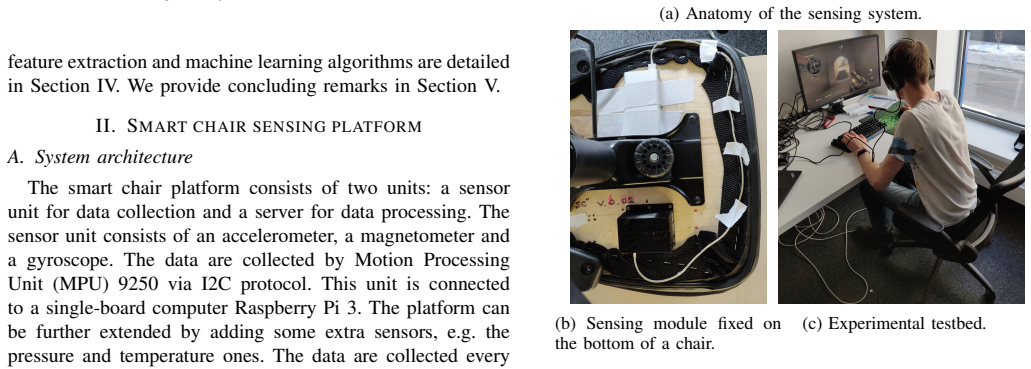
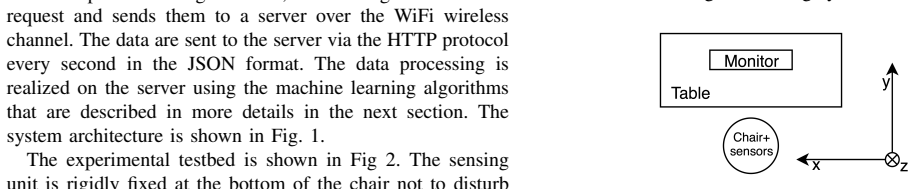
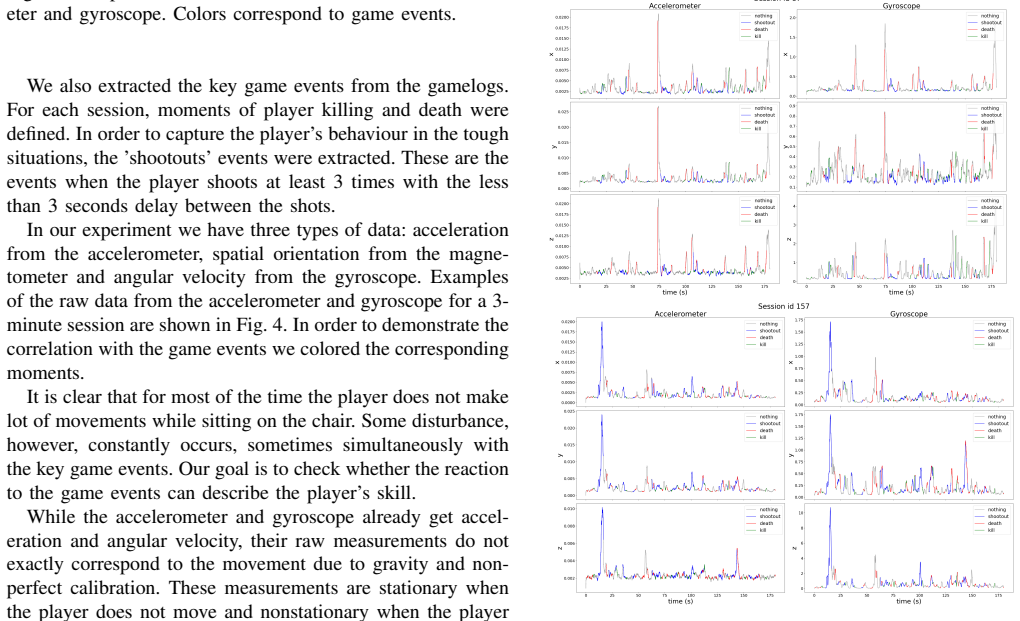
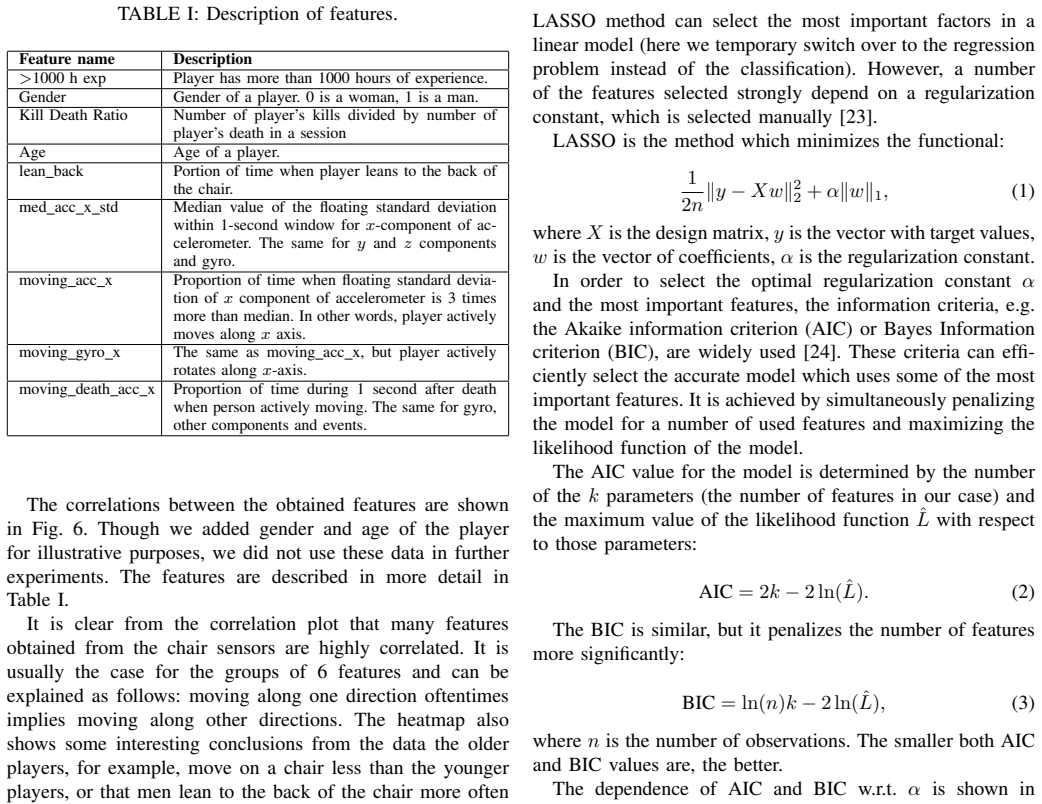
The central object is the smart chair sensing platform: an MPU-9250 inertial measurement unit (accelerometer, gyroscope, magnetometer) rigidly fixed underneath the chair, sampling at 100 Hz and streaming over WiFi to a server. The signal processing chain defines a 'movement' as a one-second window whose floating standard deviation exceeds three times its median, then aligns those windows with game events to build reaction features. Feature selection uses LASSO with AIC and BIC to reduce the feature set, and the classifier that carries the argument is a random forest of 100 trees of depth 2. This machinery converts raw physical motion into a compact skill signal.
What would settle it
Hold out several entire players, not just sessions, and train on the rest; if accuracy falls to near chance, the earlier scores came from memorizing individuals. A cheaper check is to shuffle the skill labels within each player's sessions and retrain: if accuracy stays high, the model is reading player identity, not skill.
Extended reading notes
Core claim
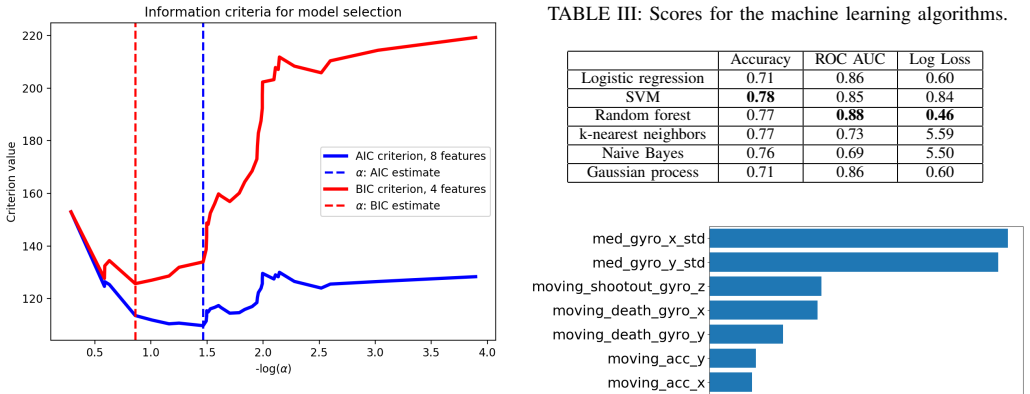
The central claim is that chair motion alone, combined with timestamps of game events, lets a machine learning model tell high-skilled from low-skilled CS:GO players. The paper reports 77% accuracy, 0.88 ROC AUC, and 0.46 log loss for a random forest trained on eight selected features and evaluated by holding out entire players. Compared with the authors' earlier smart-chair study that did not use game-event information (0.86 ROC AUC), the event-aligned features add predictive power. The selected features include how intensely a player wiggles toward the monitor (med gyro x std), how often the player moves along the table or toward the monitor, and how often the player spins or changes posture after dying; no kill-related features survived selection, which the authors interpret as all players reacting similarly to making a frag.
Load-bearing premise
The load-bearing premise is that the chair-movement differences separating the nine professional players from the ten amateurs reflect skill level rather than the personal sitting habits of these 19 individuals; if the classifier is memorizing each player's characteristic wiggle, the skill-classification claim collapses.
Editorial extensions
If this is right
- A three-minute chair recording can serve as an unobtrusive skill probe for CS:GO team scouting, since the classifier works on short sessions without interrupting gameplay.
- Event-aligned movement features add information beyond raw activity, because the 0.88 ROC AUC improves on the authors' earlier event-free chair classifier at 0.86.
- The negative coefficients for reactions after death and during shootouts indicate that lower-skilled players move more, and in specific ways, right after negative game events; this gives coaches a concrete physical behavior to watch.
- Because the features are built from standard inertial axes and game-log timestamps, the same approach transfers to other shooter games and other chair types without new sensors.
Reading between the lines
- A simpler deployment is suggested by the feature rankings: a chair-only model that ignores game logs might capture most of the skill signal, and the paper's own data could test this by ablating the event-aligned features.
- The same streaming 100 Hz signal could support real-time coaching feedback if the feature computation were moved onto the chair's local processor, which the paper does not attempt.
- The platform's event-alignment idea could be reused outside eSports, for example to study how office workers physically react to interruptions or stressful messages, since the sensing is generic.
Signed reviews
Editorial analysis
A structured set of objections, weighed in public.
Referee Report
Summary. The paper proposes a smart-chair sensing platform that records accelerometer, gyroscope, and magnetometer data from CS:GO players, aligns these signals with in-game events (kills, deaths, shootouts), and derives features such as movement proportions and standard-deviation statistics. Using data from 9 professional and 10 amateur players, the authors perform LASSO-based feature selection with AIC/BIC, then train six classifiers on a player-level train/test split. They report that a random forest achieves 0.77 accuracy, 0.88 ROC AUC, and 0.46 log loss, and conclude that chair-movement behavior during game events can distinguish high-skilled (>1000 hours of experience) from low-skilled players. The paper also ranks the selected features and compares the AUC to a prior work without event information.
Significance. If the central claim holds, the work would be a useful step toward unobtrusive physical-behavior sensing for eSports skill assessment, complementing in-game statistics. The study has several strengths: the skill label (>1000 hours) is external to the sensor data, the evaluation split is performed at the player level rather than the session level, and the comparison to the authors' earlier no-event baseline is a reasonable idea. The main contribution, a sensor platform plus feature-engineering pipeline, is plausible and the dataset is novel. However, the current analysis does not adequately rule out player-identity confounds or feature-selection leakage, so the reported accuracy and AUC should be treated as upper bounds on what the method can currently support.
major comments (4)
- [Section IV.C and IV.D] The feature selection step in Section IV.C is performed on the entire dataset before the player-level train/test split described in Section IV.D. LASSO with AIC/BIC uses all 171 sessions, including sessions from players who later appear in the validation half, to choose the eight features in Table II. This is selection leakage: the chosen features encode label information from the validation players, so the accuracy and AUC in Table III are optimistically biased. The analysis should be re-run with feature selection nested inside each training fold (or otherwise restricted to training players only).
- [Section IV.D and Table III] The central claim that chair movement reflects skill rather than individual habit is not adequately supported. With only 19 players and up to 10 highly correlated sessions per player, a classifier can memorize stable personal movement signatures (for example, wiggling intensity encoded by med gyro x std) rather than skill-related behavior. The player-level split mitigates this risk but does not eliminate it, and the 1000 random splits over the same 19 players are not independent and are not accompanied by confidence intervals or significance tests. The 0.02 AUC improvement over the no-event baseline reported in [32] is within the plausible noise of such repeated splits. Leave-one-player-out or external-validation results, and a report of per-player prediction variability, are needed before the skill interpretation can be accepted.
- [Section IV.B and IV.D] Several thresholds are introduced without sensitivity analysis: the movement definition (floating standard deviation at least 3 times the median), the 1-second moving window, the 1-second reaction window after kills and deaths, the shootout definition (at least 3 shots with less than 3 seconds between shots), and the 3-minute session length. The headline result depends on these choices, and the paper does not show that the classification performance is stable to reasonable variations of them. A sensitivity analysis or a principled justification for each threshold is needed to establish that the reported reactions to game events are robust features of skill rather than artifacts of the chosen parameters.
- [Section IV.D] The comparison to the earlier work [32] is not statistically grounded. The paper reports 0.88 ROC AUC versus 0.86 and states this is an improvement, but no confidence intervals, paired tests, or standard deviations are provided. Given that the models are evaluated on overlapping random splits of the same 19 players, the 0.02 difference may well be within sampling variability. The authors should provide uncertainty estimates for both models and, if possible, compare them on the same held-out folds with a paired significance test.
minor comments (6)
- [Abstract and Introduction] There are several typographical errors, including 'forster' (should be 'foster') and 'definetely' (should be 'definitely'), which should be corrected in a revision.
- [Section IV.C] The text says the authors 'temporary switch over to the regression problem' when applying LASSO, but it is unclear whether the target variable is the binary >1000 hours label or a continuous experience measure. This should be clarified.
- [Section IV.D] The log loss values for k-nearest neighbors and naive Bayes (5.59 and 5.50) are dramatically worse than those of the other classifiers; the paper does not discuss whether these are due to uncalibrated probability estimates or to other causes, and Fig. 8 would benefit from error bars or confidence intervals.
- [Section IV.D and Fig. 8] Feature importance is computed as mean impurity decrease, a measure known to be biased toward features with many split points; since all features are continuous this may be less of a concern, but the paper should acknowledge the limitation or use a permutation-based importance instead.
- [Section IV.A and IV.B] The class balance is stated to be approximately equal, but with 9 professionals and 10 amateurs and up to 10 sessions per player, the session-level class distribution could vary; reporting the actual number of sessions per class and per player would improve reproducibility.
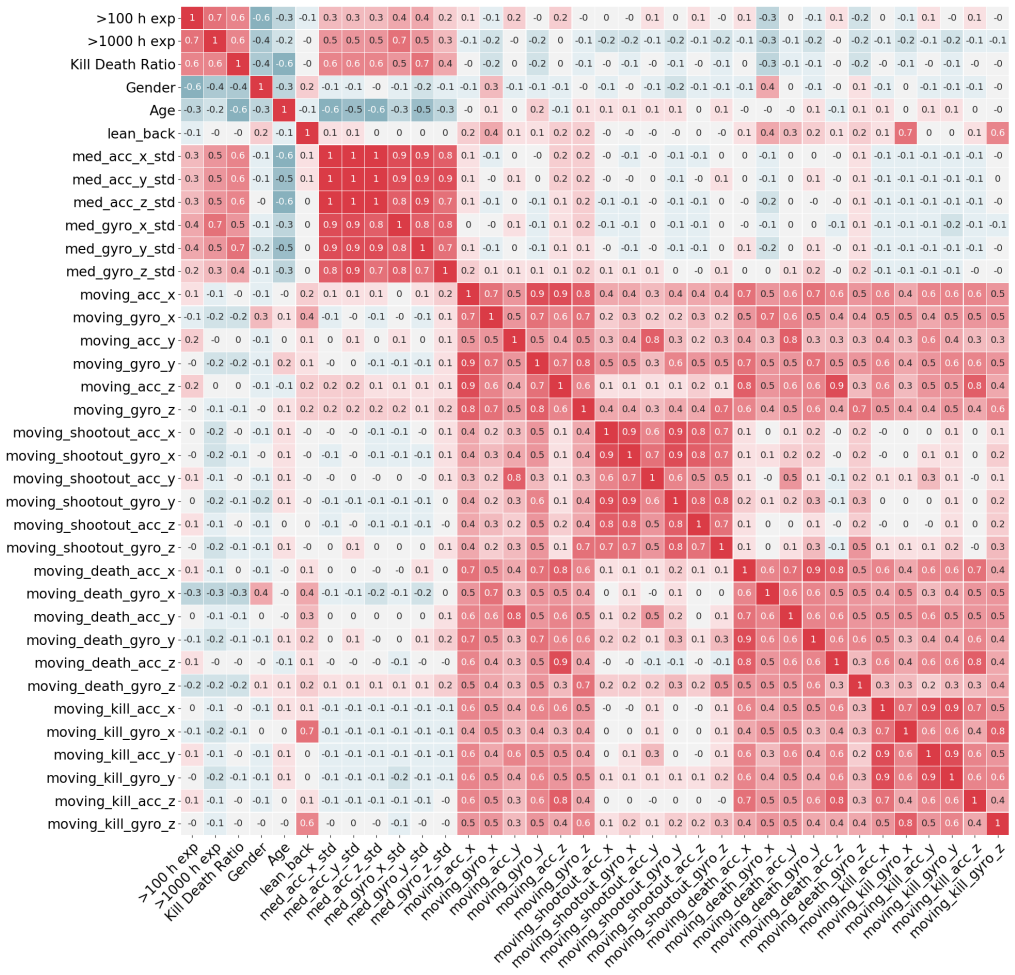
- [Section IV.B and Fig. 6] The observations that older players move less and men lean back more are based on visual inspection of the correlation heatmap without statistical tests; these claims should either be supported with a test or removed.
Circularity Check
No circularity: the skill target is external to the sensor data, features are derived from chair movement, and models are validated on held-out players.
full rationale
The paper's derivation chain is self-contained and does not reduce to its inputs. The target variable is the externally defined fact that a player has more than 1000 hours of CS:GO experience, which is independent of the chair-sensor measurements. The features are computed from accelerometer, gyroscope, and magnetometer signals plus game-event timestamps, not from the skill label. The ML models are trained on all sessions of one random half of the players and validated on all sessions of the other players (Section IV.D), so the central accuracy/AUC numbers are not forced by construction. The only self-citation is reference [32], used as a baseline for comparison ('0.88 ROC AUC score is an improvement as compared to 0.86 achieved in [32]'), and that baseline is not an input to the model or to the derivation of the reported result. The feature-selection step in Section IV.C is performed before the split and may introduce selection leakage, but leakage is a correctness and generalization concern, not a circularity concern: the selected features are not a fitted parameter renamed as a prediction, and the skill label is not defined in terms of the chair features or vice versa. Therefore no step in the paper's derivation is equivalent to its own inputs by construction.
Assumptions & free parameters
free parameters (8)
- Movement threshold multiplier =
3
- Standard deviation window length =
1 second
- Reaction window after events =
1 second
- Session length =
3 minutes
- Shootout definition thresholds =
3 shots, 3 s delay
- Random forest hyperparameters =
100 estimators, depth 2
- kNN k =
3
- LASSO regularization constant =
selected via AIC/BIC
assumptions (5)
- domain assumption The smart chair's accelerometer, gyroscope, and magnetometer measurements capture meaningful physical reactions to game events.
- domain assumption The binary target 'more than 1000 hours of CS:GO experience' separates high-skilled from low-skilled players.
- domain assumption Three-minute sessions provide independent, stationary samples of a player's behavior.
- domain assumption The 3x median threshold on floating standard deviation identifies active movement on the chair.
- standard math The floating standard deviation within a 1-second window approximates local signal variation.
Cite this review
Pith. "Pith review of eSports Pro-Players Behavior During the Game Events: Statistical Analysis of Data Obtained Using the Smart Chair." pith.science (2026). https://pith.science/paper/F3RVJWMY
@misc{pith2026190806402,
  author       = {Pith},
  title        = {Pith review of: eSports Pro-Players Behavior During the Game Events: Statistical Analysis of Data Obtained Using the Smart Chair},
  year         = {2026},
  howpublished = {\url{https://pith.science/paper/F3RVJWMY}},
  note         = {Machine review of arXiv:1908.06402}
}
read the original abstract
Today's competition between the professional eSports teams is so strong that in-depth analysis of players' performance literally crucial for creating a powerful team. There are two main approaches to such an estimation: obtaining features and metrics directly from the in-game data or collecting detailed information about the player including data on his/her physical training. While the correlation between the player's skill and in-game data has already been covered in many papers, there are very few works related to analysis of eSports athlete's skill through his/her physical behavior. We propose the smart chair platform which is to collect data on the person's behavior on the chair using an integrated accelerometer, a gyroscope and a magnetometer. We extract the important game events to define the players' physical reactions to them. The obtained data are used for training machine learning models in order to distinguish between the low-skilled and high-skilled players. We extract and figure out the key features during the game and discuss the results.
Figures

Figures from the paper (5 more)

Reference graph
Works this paper leans on
-
[32]
Understanding cyber athletes behaviour through a smart chair: CS:GO and monolith team scenario,
A. Smerdov, A. Kishkun, R. Shaniiazov, A. Somov, and E. Burnaev, “Understanding cyber athletes behaviour through a smart chair: CS:GO and monolith team scenario,” in 2019 IEEE 5th World F orum on Internet of Things (WF-IoT) (WF-IoT 2019) , Limerick, Ireland, Apr. 2019, pp. 973–978
work page 2019
-
[1]
Eeg spectral analysis in serious gaming: An ad hoc experimental application,
Z. Minchev, G. Dukov, and S. Georgiev, “Eeg spectral analysis in serious gaming: An ad hoc experimental application,” Bio Automation, vol. 13, no. 4, pp. 79–88, 2009
work page 2009
-
[2]
B. Meneses-Claudio and A. Roman-Gonzalez, “Study of the brain waves for the differentiation of gamers category between a newbie and a hardcore in the game dota 1,” in 2018 Congreso Argentino de Ciencias de la Informtica y Desarrollos de Investigacin (CACIDI) , Nov 2018, pp. 1–4
work page 2018
-
[3]
An affect detector model for gamers on a role-playing game through mouse movements,
M. J. C. Samonte, L. A. Vea, R. M. C. San Jose, A. John V . Lagoy, C. E. P. Manlapid, and A. Martyn P. Perez, “An affect detector model for gamers on a role-playing game through mouse movements,” in 2018 International Conference on Information and Communication Technology Convergence (ICTC), Oct 2018, pp. 489–494
work page 2018
-
[4]
An exploratory study of player and team performance in multiplayer first- person-shooter games,
K. J. Shim, K. Hsu, S. Damania, C. DeLong, and J. Srivastava, “An exploratory study of player and team performance in multiplayer first- person-shooter games,” in 2011 IEEE Third International Conference on Privacy, Security, Risk and Trust and 2011 IEEE Third International Conference on Social Computing , Oct 2011, pp. 617–620
work page 2011
-
[5]
Rapid skill capture in a first- person shooter,
D. Buckley, K. Chen, and J. Knowles, “Rapid skill capture in a first- person shooter,” IEEE Transactions on Computational Intelligence and AI in Games , vol. 9, no. 1, pp. 63–75, March 2017
work page 2017
-
[6]
Skill-based differences in spatio- temporal team behaviour in defence of the ancients 2 (dota 2),
A. Drachen, M. Yancey, J. Maguire, D. Chu, I. Y . Wang, T. Mahlmann, M. Schubert, and D. Klabajan, “Skill-based differences in spatio- temporal team behaviour in defence of the ancients 2 (dota 2),” in 2014 IEEE Games Media Entertainment , Oct 2014, pp. 1–8
work page 2014
-
[7]
Application context based algorithm for player skill evaluation in moba games,
M. Suznjevic, M. Matijasevic, and J. Konfic, “Application context based algorithm for player skill evaluation in moba games,” in 2015 International Workshop on Network and Systems Support for Games (NetGames), Dec 2015, pp. 1–6
work page 2015
Show all 36 references
-
[8]
An exploratory study of player performance, motivation, and enjoyment in massively multiplayer online role-playing games,
K. J. Shim, K. Hsu, and J. Srivastava, “An exploratory study of player performance, motivation, and enjoyment in massively multiplayer online role-playing games,” in 2011 IEEE Third International Conference on Privacy, Security, Risk and Trust and 2011 IEEE Third International...
2011
-
[9]
Effects of mentoring on player performance in massively mul- tiplayer online role-playing games (mmorpgs),
——, “Effects of mentoring on player performance in massively mul- tiplayer online role-playing games (mmorpgs),” in 2011 International Conference on Advances in Social Networks Analysis and Mining , July 2011, pp. 561–562
2011
-
[10]
Affective computing and sentiment analysis,
E. Cambria, “Affective computing and sentiment analysis,” IEEE Intel- ligent Systems , vol. 31, no. 2, pp. 102–107, Mar 2016
2016
-
[11]
Predicting skill learning in a large, longitudinal moba dataset,
M. Aung, V . Bonometti, A. Drachen, P. Cowling, A. V . Kokkinakis, C. Yoder, and A. Wade, “Predicting skill learning in a large, longitudinal moba dataset,” in 2018 IEEE Conference on Computational Intelligence and Games (CIG) , Aug 2018, pp. 1–7
2018
-
[12]
Inside the group: Investigating social structures in player groups and their influence on activity,
M. H. Schiller, G. Wallner, C. Schinnerl, A. M. Calvo, J. Pirker, R. Sifa, and A. Drachen, “Inside the group: Investigating social structures in player groups and their influence on activity,” IEEE Transactions on Games, pp. 1–1, 2018
2018
-
[13]
A sensing chair using pres- sure distribution sensors,
H. Z. Tan, L. A. Slivovsky, and A. Pentland, “A sensing chair using pres- sure distribution sensors,” IEEE/ASME Transactions on Mechatronics , vol. 6, no. 3, pp. 261–268, Sep. 2001
2001
-
[14]
Design and modeling of a textile pressure sensor for sitting posture classification,
J. Meyer, B. Arnrich, J. Schumm, and G. Troster, “Design and modeling of a textile pressure sensor for sitting posture classification,” IEEE Sensors Journal, vol. 10, no. 8, pp. 1391–1398, Aug 2010
2010
-
[15]
Care-chair: Sedentary activities and behavior assessment with smart sensing on chair backrest,
R. Kumar, A. Bayliff, D. De, A. Evans, S. K. Das, and M. Makos, “Care-chair: Sedentary activities and behavior assessment with smart sensing on chair backrest,” in 2016 IEEE International Conference on Smart Computing (SMARTCOMP) , May 2016, pp. 1–8
2016
-
[16]
What does your chair know about your stress level?
B. Arnrich, C. Setz, R. La Marca, G. Trster, and U. Ehlert, “What does your chair know about your stress level?” IEEE Transactions on Information Technology in Biomedicine , vol. 14, no. 2, pp. 207–214, March 2010
2010
-
[17]
Design and implementation of a smart chair system for iot,
M. Park, Y . Song, J. Lee, and J. Paek, “Design and implementation of a smart chair system for iot,” in 2016 International Conference on Information and Communication Technology Convergence (ICTC) , Oct 2016, pp. 1200–1203
2016
-
[18]
The influence of wearing a wallet in your sitting posture a quantitative study using an intelligent chair,
L. Martins, I. Marques, R. Almeida, J. Costa, C. Quaresma, and P. Vieira, “The influence of wearing a wallet in your sitting posture a quantitative study using an intelligent chair,” in 2017 IEEE 5th Portuguese Meeting on Bioengineering (ENBENG) , Feb 2017, pp. 1–4
2017
-
[19]
Experimental evaluation of the performance of chair sensors in an office space for occupancy detection and occupancy-driven control,
T. Labeodan, K. Aduda, W. Zeiler, and F. Hoving, “Experimental evaluation of the performance of chair sensors in an office space for occupancy detection and occupancy-driven control,” Energy and Buildings, vol. 111, pp. 195–206, 2016
2016
-
[20]
A new method for measuring the ballistocardiogram using emfi sensors in a normal chair,
T. Koivistoinen, S. Junnila, A. Varri, and T. Koobi, “A new method for measuring the ballistocardiogram using emfi sensors in a normal chair,” in The 26th Annual International Conference of the IEEE Engineering in Medicine and Biology Society , vol. 1, Sep. 2004, pp. 2026–2029
2004
-
[21]
An emfi- film sensor based ballistocardiographic chair: performance and cycle extraction method,
S. Junnila, A. Akhbardeh, A. Varri, and T. Koivistoinen, “An emfi- film sensor based ballistocardiographic chair: performance and cycle extraction method,” in IEEE Workshop on Signal Processing Systems Design and Implementation, 2005. , Nov 2005, pp. 373–377
2005
-
[22]
Smart chair based on multi heart rate detection system,
B. Ahn, Y . Noh, and D. Jeong, “Smart chair based on multi heart rate detection system,” in 2015 IEEE SENSORS , Nov 2015, pp. 1–4
2015
-
[23]
Regression shrinkage and selection via the lasso,
R. Tibshirani, “Regression shrinkage and selection via the lasso,” Jour- nal of the Royal Statistical Society: Series B (Methodological) , vol. 58, no. 1, pp. 267–288, 1996
1996
-
[24]
Aic and bic: Comparisons of assumptions and performance,
J. Kuha, “Aic and bic: Comparisons of assumptions and performance,” Sociological methods & research , vol. 33, no. 2, pp. 188–229, 2004
2004
-
[25]
D. G. Kleinbaum, K. Dietz, M. Gail, M. Klein, and M. Klein, Logistic regression. Springer, 2002
2002
-
[26]
Improving support vector machine classifiers by modifying kernel functions,
S.-i. Amari and S. Wu, “Improving support vector machine classifiers by modifying kernel functions,” Neural Networks , vol. 12, no. 6, pp. 783–789, 1999
1999
-
[27]
Classification and regression by randomfor- est,
A. Liaw, M. Wiener et al., “Classification and regression by randomfor- est,” R news , vol. 2, no. 3, pp. 18–22, 2002
2002
-
[28]
Nearest neighbor pattern classification,
T. M. Cover, P. E. Hart et al. , “Nearest neighbor pattern classification,” IEEE transactions on information theory , vol. 13, no. 1, pp. 21–27, 1967
1967
-
[29]
The optimality of naive bayes,
H. Zhang, “The optimality of naive bayes,” AA, vol. 1, no. 2, p. 3, 2004
2004
-
[30]
C. K. Williams and C. E. Rasmussen, Gaussian processes for machine learning. MIT Press Cambridge, MA, 2006, vol. 2, no. 3
2006
-
[31]
Understanding receiver operating characteristic (roc) curves,
J. Fan, S. Upadhye, and A. Worster, “Understanding receiver operating characteristic (roc) curves,” Canadian Journal of Emergency Medicine , vol. 8, no. 1, pp. 19–20, 2006
2006
-
[33]
A model of the functional state of participants of laboratory markets,
E. V . Burnaev and I. S. Men’shikov, “A model of the functional state of participants of laboratory markets,” Journal of Computer and Systems Sciences International , vol. 48, no. 6, p. 1002, Dec 2009. [Online]. Available: https://doi.org/10.1134/S1064230709060148
2009 doi
-
[34]
Conformal k-nn anomaly detector for univariate data streams,
V . Ishimtsev, A. Bernstein, E. Burnaev, and I. Nazarov, “Conformal k-nn anomaly detector for univariate data streams,” in Proceedings of the Sixth Workshop on Conformal and Probabilistic Prediction and Applications , ser. Proceedings of Machine Learning Research, A. Gammerman...
2017
-
[35]
Automatic construction of a recurrent neural network based classifier for vehicle passage detection,
E. Burnaev, I. Koptelov, G. Novikov, and T. Khanipov, “Automatic construction of a recurrent neural network based classifier for vehicle passage detection,” in Proc. SPIE , vol. 10341, 2017, pp. 10 341 – 10 341 – 6. [Online]. Available: https://doi.org/10.1117/12.2268706
2017 doi
-
[36]
Kernel regression on man- ifold valued data,
A. Kuleshov, A. Bernstein, and E. Burnaev, “Kernel regression on man- ifold valued data,” in Proceedings of IEEE 5th International Conference on Data Science and Advanced Analytics , 2018, pp. 120–129
2018
Reviewed August 14, 2026 · model on record in the stance chip above.
Discussion (0). Continue with ORCID to comment.