REVIEW 3 major objections 5 minor 32 references
Understanding Cyber Athletes Behaviour Through a Smart Chair: CS:GO and Monolith Team Scenario
T0 review · 3 major / 5 minor · reviewed 2026-08-14 · deepseek-v4-flash
Pith's one-line read A chair’s motion sensors can tell pro CS:GO players from amateurs
desk verdict A sound new-application pilot whose abstract overreaches: the data separate nine Monolith players from amateurs, not 'professional athletes' generally. read the letter →
The pith
A machine-rendered reading of the paper's core claim, the machinery that carries it, and where it could break.
The reading
What carries the argument
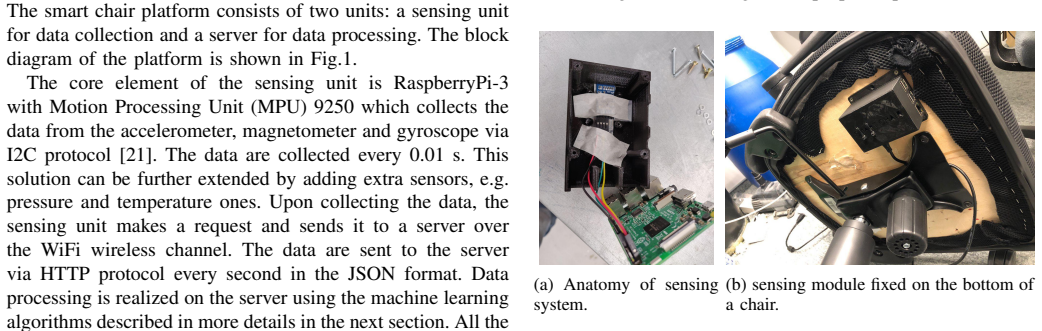
The load-bearing object is the smart chair sensing platform: an MPU-9250 motion-processing unit, containing accelerometer, gyroscope, and magnetometer, fixed under the seat and sampled every $0.01$ s. From the raw time series the authors build 13 hand-crafted features per 3-minute session: six “active movement” features measuring the fraction of time a sensor axis deviates more than three standard deviations from its mean, six “subtle oscillation” features measuring the mean dispersion during quiet periods, and one feature for the fraction of time the player leans back. These features are fed to logistic regression, support vector machines, k-nearest neighbours, and random forests; the linear models perform best, which the authors read as evidence that the skill-to-behaviour relationship is roughly linear.
What would settle it
Run the same data collection and SVM with professionals drawn from several different teams and venues, keeping the Monolith players out of both training and test; if the AUC on held-out non-Monolith professionals falls toward 0.5, the chair signal is team or setup specific rather than skill.
Extended reading notes
Core claim
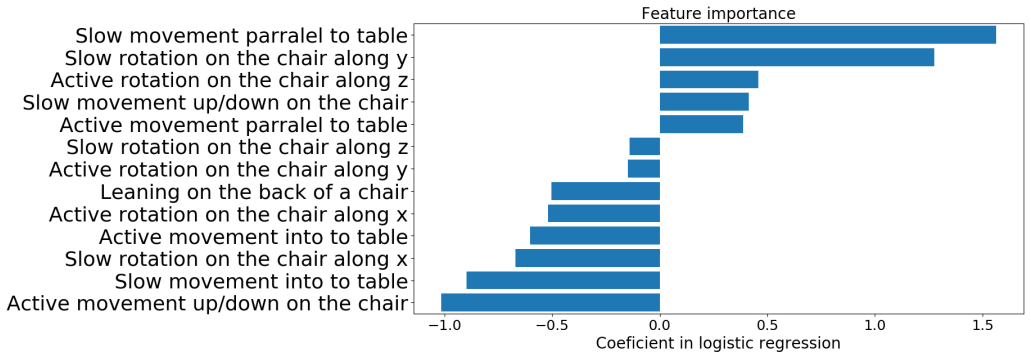
The central claim is that professional CS:GO athletes leave a recognizable physical signature in chair motion while playing. In this cohort, professionals make fewer large, active movements than amateurs, yet show more of the subtle oscillations captured by the sensors — notably side-to-side sway and left-right rectilinear motion — and spend less time leaning back against the chair. The authors interpret the reduced active movement as concentration on the game and the subtle motions as characteristic of trained players. The claim is supported by binary classification of skill from chair-derived features, with held-out-player evaluation: the best model, a soft-margin support vector machine, reaches mean ROC AUC $0.86$ across 100 repeated splits.
Load-bearing premise
The nine professional participants, mostly from one team, are treated as representing professional CS:GO players in general, so team-specific habits, chairs, or room setups could be what the classifier really detects.
Editorial extensions
If this is right
- A coach could assess a player’s engagement and posture during matches from the chair alone, without cameras or wearable sensors.
- Skill classification transfers to previously unseen players: the models were validated on held-out participants, so a new player’s level can be estimated from a few 3-minute sessions.
- The best performance of linear models suggests that simple, interpretable rules — less active movement, more subtle swaying — separate the two levels, rather than complex nonlinear patterns.
- Because the platform streams data over HTTP to a server, it can be extended to real-time monitoring and long-term training logs.
Reading between the lines
- Extension: a sharper test would be to record the same players on different chairs and in different rooms; if the AUC survives, the signal is player behaviour rather than hardware placement.
- Extension: the chair signal might separate from game score, so the same features could support in-game performance prediction, such as round or clutch outcomes, a step the paper only mentions as future possibility.
- Extension: the features resemble standard activity and vigilance measures, so the platform could plausibly track fatigue across a long tournament day, though the paper does not report such a test.
Signed reviews
Editorial analysis
A structured set of objections, weighed in public.
Referee Report
Summary. The paper proposes a smart-chair platform that records accelerometer and gyroscope data from CS:GO players, extracts ten features capturing active movement, subtle oscillations, and lean-back behavior, and trains machine-learning classifiers to predict player skill. Data were collected from 19 participants: nine professional athletes (primarily from the Monolith team) and ten amateurs, each playing a Retake match for about 35 minutes. Sessions were split into three-minute windows, yielding 154 sessions. The target is a binary self-reported low/high skill label. Models evaluated with leave-players-out cross-validation repeated 100 times give mean ROC AUC values of 0.85 (logistic regression), 0.86 (SVM), 0.80 (KNN with k=5), and 0.82 (random forest with depth 4). The authors conclude that professional athletes can be identified by their chair behavior.
Significance. If the central claim is valid, the paper offers a genuinely unobtrusive sensing approach for eSports performance analysis, with potential applications in training and coaching. Strengths include the use of real professional players, a clearly described sensing platform, and an evaluation protocol that respects player-level separation. The feature extraction is transparent and the comparison of multiple standard classifiers is useful. However, the current evidence supports a narrower claim: that the classifier discriminates between this particular Monolith-majority professional cohort and a convenience amateur group, using self-reported skill as the label. The reported 0.86 AUC is also likely optimistic because hyperparameters were selected on the evaluation data. With additional validation on independent teams and objective skill labels, the approach could become a solid contribution to human-computer interaction and eSports analytics.
major comments (3)
- [Section IV-B and Section V] The hyperparameters for KNN and random forest are explicitly chosen to maximize ROC AUC on the evaluation data: the text states 'we used the number of neighbours equal to 5, which provides the maximum ROC AUC' and 'According to experiments the optimal maximum tree depth in our problem is 4.' This constitutes tuning on the test set, which inflates the reported performance for those models and biases the overall comparison. The authors should use a nested cross-validation procedure or a separate validation set to obtain unbiased estimates of generalization performance.
- [Section II and Section IV-A] The professional class consists of nine players 'primarily from the Monolith professional team,' and the binary target is derived from self-reported low/high skill. Because all professionals share a team affiliation, the classifier may be learning team-specific chair behavior, equipment setup, or calibration rather than general professional skill. The evaluation does not include professional players from other teams, nor does it use an objective skill measure such as CS:GO rank, match results, or coach ratings. The abstract's claim that 'professional athletes can be identified by their behaviour on the chair' is therefore not supported beyond this cohort; external validation is required to rule out the confounding between skill and team.
- [Section V] The evaluation reports mean AUC and standard deviation across repeated splits, e.g., 0.86 ± 0.13 for SVM. With only 19 participants and unknown variance in session count per player, the difference between models is not shown to be statistically significant, and the uncertainty in the 0.86 estimate is substantial. The manuscript should report per-player results, standard errors or confidence intervals, and the number of sessions per participant to clarify the effective sample size and support the strength of the conclusions.
minor comments (5)
- [Throughout] The manuscript contains numerous typographical errors that impede readability, including 'conduced' (conducted), 'sesnsors' (sensors), 'collectes' (collected), 'thr' (the), 'shoukd' (should), and 'separete' (separate).
- [Section III-B] The data collection description is underspecified: the sensing unit samples at 10 ms intervals, but data are sent via HTTP every second; the manuscript should clarify the effective sampling resolution and how the per-second aggregated values are formed.
- [Section III-B and Table I] The description of the active-movement feature as 'deviating from the mean for more than 3 standard deviations' is not fully specified; it is unclear whether the mean and standard deviation are computed per player, per session, or per axis, and whether the threshold is fixed a priori.
- [Section V] The sentence 'The mean ROC AUC score for all of the algorithms is more or equal to 0.8, which means that the eSport athlete performance can be successfully predicted' is too strong given the reported standard deviations (0.13–0.16); a more cautious interpretation is needed.
- [Section V] The exact split procedure is ambiguous: 'all people except 4-5 out of 19' does not specify how many players are in the test set in each iteration; the authors should state this explicitly for reproducibility.
Circularity Check
Mostly self-contained empirical study; one minor model-selection circularity in KNN/RF hyperparameters does not affect the headline SVM result.
-
fitted input called prediction
[Section IV-B.3 and IV-B.4; performance reported in Section V, Table II]
"In our problem we used the number of neighbours equal to 5, which provides the maximum ROC AUC. / According to experiments the optimal maximum tree depth in our problem is 4."
The hyperparameters K=5 and tree depth=4 are selected by maximizing ROC AUC, and the same ROC AUC is then reported for these models as evidence that eSport athlete performance can be successfully predicted (Section V). Since no nested cross-validation or separate tuning/validation split is described, the reported AUC for KNN and Random Forest is the result of optimizing the evaluation metric itself, so part of these two scores is fitted rather than independently predicted. The headline 0.86 AUC comes from the SVM, for which no such tuning is described, so this circularity is minor and does not drive the central claim.
full rationale
The paper is an empirical machine-learning study with no first-principles derivation chain, so most circularity patterns (self-definition, uniqueness imported from authors, ansatz via citation, renaming known results) do not apply. The central claim rests on split-by-player evaluation: models are trained on all but 4-5 of 19 participants and validated on the held-out players, with scores averaged over 100 repetitions; this is a sensible internal evaluation. The reported SVM AUC of 0.86 is not described as hyperparameter-tuned, so the main claim retains independent content. The only concrete circularity is that K for KNN and tree depth for Random Forest are explicitly chosen to maximize ROC AUC and then evaluated with the same metric, without a nested procedure, making those two model scores optimistically selected. The self-reported low/high skill labels and the fact that the nine professionals come primarily from one team are real external-validity and construct-validity concerns, but they are not circularity: the chair features are independent of the labels, and the model is not defined in terms of the outcome. No load-bearing self-citations or uniqueness arguments appear; the cited prior work by the authors is limited to future-work tool suggestions. Overall score 2 reflects one minor fitted-input issue with the central result still independent.
Assumptions & free parameters
free parameters (5)
- active movement threshold =
3 standard deviations
- lean-back threshold
- session length =
3 minutes
- KNN k =
5
- random forest max depth =
4
assumptions (3)
- domain assumption Accelerometer and gyroscope readings from the chair accurately reflect player body movements.
- domain assumption Self-reported skill (low/high) is a valid binary indicator of professional level.
- domain assumption The Monolith team members are representative of professional CS:GO players.
Cite this review
Pith. "Pith review of Understanding Cyber Athletes Behaviour Through a Smart Chair: CS:GO and Monolith Team Scenario." pith.science (2026). https://pith.science/paper/DQBBKDTK
@misc{pith2026190806407,
  author       = {Pith},
  title        = {Pith review of: Understanding Cyber Athletes Behaviour Through a Smart Chair: CS:GO and Monolith Team Scenario},
  year         = {2026},
  howpublished = {\url{https://pith.science/paper/DQBBKDTK}},
  note         = {Machine review of arXiv:1908.06407}
}
read the original abstract
eSports is the rapidly developing multidisciplinary domain. However, research and experimentation in eSports are in the infancy. In this work, we propose a smart chair platform - an unobtrusive approach to the collection of data on the eSports athletes and data further processing with machine learning methods. The use case scenario involves three groups of players: `cyber athletes' (Monolith team), semi-professional players and newbies all playing CS:GO discipline. In particular, we collect data from the accelerometer and gyroscope integrated in the chair and apply machine learning algorithms for the data analysis. Our results demonstrate that the professional athletes can be identified by their behaviour on the chair while playing the game.
Figures


Figures from the paper (2 more)

Reference graph
Works this paper leans on
-
[1]
Design and implementation of a smart chair system for iot,
M. Park, Y . Song, J. Lee, and J. Paek, “Design and implementation of a smart chair system for iot,” in 2016 International Conference on Information and Communication Technology Convergence (ICTC) , Oct 2016, pp. 1200–1203
2016
-
[2]
Care-chair: Sedentary activities and behavior assessment with smart sensing on chair backrest,
R. Kumar, A. Bayliff, D. De, A. Evans, S. K. Das, and M. Makos, “Care-chair: Sedentary activities and behavior assessment with smart sensing on chair backrest,” in 2016 IEEE International Conference on Smart Computing (SMARTCOMP) , May 2016, pp. 1–8
2016
-
[3]
A sensing chair using pres- sure distribution sensors,
H. Z. Tan, L. A. Slivovsky, and A. Pentland, “A sensing chair using pres- sure distribution sensors,” IEEE/ASME Transactions on Mechatronics , vol. 6, no. 3, pp. 261–268, Sep. 2001
2001
-
[4]
Design and modeling of a textile pressure sensor for sitting posture classification,
J. Meyer, B. Arnrich, J. Schumm, and G. Troster, “Design and modeling of a textile pressure sensor for sitting posture classification,” IEEE Sensors Journal, vol. 10, no. 8, pp. 1391–1398, Aug 2010
2010
-
[5]
What does your chair know about your stress level?
B. Arnrich, C. Setz, R. La Marca, G. Trster, and U. Ehlert, “What does your chair know about your stress level?” IEEE Transactions on Information Technology in Biomedicine , vol. 14, no. 2, pp. 207–214, March 2010
2010
-
[6]
Intellichair: An approach for activity detection and prediction via posture analysis,
T. Fu and A. Macleod, “Intellichair: An approach for activity detection and prediction via posture analysis,” in 2014 International Conference on Intelligent Environments, June 2014, pp. 211–213
work page 2014
-
[7]
An emfi- film sensor based ballistocardiographic chair: performance and cycle extraction method,
S. Junnila, A. Akhbardeh, A. Varri, and T. Koivistoinen, “An emfi- film sensor based ballistocardiographic chair: performance and cycle extraction method,” in IEEE Workshop on Signal Processing Systems Design and Implementation, 2005. , Nov 2005, pp. 373–377
2005
-
[8]
Smart chair based on multi heart rate detection system,
B. Ahn, Y . Noh, and D. Jeong, “Smart chair based on multi heart rate detection system,” in 2015 IEEE SENSORS , Nov 2015, pp. 1–4
2015
Show all 32 references
-
[9]
Smart chair,
S. S. Sodhi, A. S. Kunwar, K. Dhingra, and G. Suganya, “Smart chair,” in 2017 International Conference on Inventive Computing and Informatics (ICICI), Nov 2017, pp. 139–148
2017
-
[10]
Smart self position aligning chair for a modern conference room,
F. Anzum, F. Ahmed, M. S. Azim, M. Hossain, S. Zaman, F. Hasib, and S. A. Ahsan, “Smart self position aligning chair for a modern conference room,” in 2018 IEEE/ACIS 17th International Conference on Computer and Information Science (ICIS) , June 2018, pp. 263–268
2018
-
[11]
Rapid skill capture in a first- person shooter,
D. Buckley, K. Chen, and J. Knowles, “Rapid skill capture in a first- person shooter,” IEEE Transactions on Computational Intelligence and AI in Games , vol. 9, no. 1, pp. 63–75, March 2017
2017
-
[12]
An exploratory study of player and team performance in multiplayer first- person-shooter games,
K. J. Shim, K. Hsu, S. Damania, C. DeLong, and J. Srivastava, “An exploratory study of player and team performance in multiplayer first- person-shooter games,” in 2011 IEEE Third International Conference on Privacy, Security, Risk and Trust and 2011 IEEE Third International Con...
2011
-
[13]
Skill-based differences in spatio- temporal team behaviour in defence of the ancients 2 (dota 2),
A. Drachen, M. Yancey, J. Maguire, D. Chu, I. Y . Wang, T. Mahlmann, M. Schubert, and D. Klabajan, “Skill-based differences in spatio- temporal team behaviour in defence of the ancients 2 (dota 2),” in 2014 IEEE Games Media Entertainment , Oct 2014, pp. 1–8
2014
-
[14]
Skill rating method in mul- tiplayer online battle arena,
N. Prakannoppakun and S. Sinthupinyo, “Skill rating method in mul- tiplayer online battle arena,” in 2016 8th International Conference on Electronics, Computers and Artificial Intelligence (ECAI) , June 2016, pp. 1–6
2016
-
[15]
Application context based algorithm for player skill evaluation in moba games,
M. Suznjevic, M. Matijasevic, and J. Konfic, “Application context based algorithm for player skill evaluation in moba games,” in 2015 International Workshop on Network and Systems Support for Games (NetGames), Dec 2015, pp. 1–6
2015
-
[16]
An exploratory study of player performance, motivation, and enjoyment in massively multiplayer online role-playing games,
K. J. Shim, K. Hsu, and J. Srivastava, “An exploratory study of player performance, motivation, and enjoyment in massively multiplayer online role-playing games,” in 2011 IEEE Third International Conference on Privacy, Security, Risk and Trust and 2011 IEEE Third International...
2011
-
[17]
Modeling player performance in massively multiplayer online role-playing games: The effects of diversity in mentoring network,
——, “Modeling player performance in massively multiplayer online role-playing games: The effects of diversity in mentoring network,” in 2011 International Conference on Advances in Social Networks Analysis and Mining, July 2011, pp. 438–442
2011
-
[18]
Internet of things: Vision, applications and research challenges,
D. Miorandi, S. Sicari, F. D. Pellegrini, and I. Chlamtac, “Internet of things: Vision, applications and research challenges,” Ad Hoc Networks, vol. 10, no. 7, pp. 1497 – 1516, 2012. [Online]. Available: http://www.sciencedirect.com/science/article/pii/S1570870512000674
2012
-
[19]
Cognitive management framework for internet of things: a prototype implemen- tation,
S. Sasidharan, A. Somov, A. R. Biswas, and R. Giaffreda, “Cognitive management framework for internet of things: a prototype implemen- tation,” in 2014 IEEE World Forum on Internet of Things (WF-IoT) , March 2014, pp. 538–543
2014
-
[20]
Wireless multi- sensor gas platform for environmental monitoring,
D. Spirjakin, A. Baranov, A. Karelin, and A. Somov, “Wireless multi- sensor gas platform for environmental monitoring,” in 2015 IEEE Workshop on Environmental, Energy, and Structural Monitoring Systems (EESMS) Proceedings, July 2015, pp. 232–237
2015
-
[21]
MPU-9250 Product Specification Revision 1.1 , InvenSense Inc, October 2016
2016
-
[22]
Johnson, J
R. Johnson, J. Hoeller, K. Donald, C. Sampaleanu, R. Harrop, T. Risberg, A. Arendsen, D. Davison, D. Kopylenko, M. Pollack et al., The spring framework–reference documentation, 2004
2004
-
[23]
P. Webb, D. Syer, J. Long, S. Nicoll, R. Winch, A. Wilkinson, M. Overdijk, C. Dupuis, and S. Deleuze, Spring boot reference guide , 2013
2013
-
[24]
Pollack, O
M. Pollack, O. Gierke, T. Risberg, J. Brisbin, and M. Hunger, Spring Data: modern data access for enterprise Java. ” O’Reilly Media, Inc.”, 2012
2012
-
[25]
Cs229 lecture notes,
A. Ng, “Cs229 lecture notes,” CS229 Lecture notes , vol. 1, no. 1, pp. 1–3, 2000
2000
-
[26]
Svm soft margin classifiers: linear program- ming versus quadratic programming,
Q. Wu and D.-X. Zhou, “Svm soft margin classifiers: linear program- ming versus quadratic programming,” Neural computation , vol. 17, no. 5, pp. 1160–1187, 2005
2005
-
[27]
Nearest neighbor pattern classification,
T. M. Cover, P. E. Hart et al., “Nearest neighbor pattern classification,” IEEE transactions on information theory , vol. 13, no. 1, pp. 21–27, 1967
1967
-
[28]
Understanding receiver operating characteristic (roc) curves,
J. Fan, S. Upadhye, and A. Worster, “Understanding receiver operating characteristic (roc) curves,” Canadian Journal of Emergency Medicine , vol. 8, no. 1, pp. 19–20, 2006
2006
-
[29]
A model of the functional state of participants of laboratory markets,
E. V . Burnaev and I. S. Men’shikov, “A model of the functional state of participants of laboratory markets,” Journal of Computer and Systems Sciences International , vol. 48, no. 6, p. 1002, Dec 2009. [Online]. Available: https://doi.org/10.1134/S1064230709060148
2009 doi
-
[30]
Conformal kernel expected similarity for anomaly detection in time-series data,
A. Safin and E. Burnaev, “Conformal kernel expected similarity for anomaly detection in time-series data,” Advances in Systems Science and Applications, vol. 17, no. 3, pp. 22–33, 2017
2017
-
[31]
Ensembles of detectors for online detection of transient changes,
A. Artemov and E. Burnaev, “Ensembles of detectors for online detection of transient changes,” in Proc. SPIE, vol. 9875, 2015, pp. 9875 – 9875 – 5. [Online]. Available: https://doi.org/10.1117/12.2228369
2015 doi
-
[32]
Aggregating strategies for long-term forecasting,
A. Korotin, V . V’yugin, and E. Burnaev, “Aggregating strategies for long-term forecasting,” in Proceedings of the Seventh Workshop on Conformal and Probabilistic Prediction and Applications , ser. Proceedings of Machine Learning Research, A. Gammerman, V . V ovk, Z. Luo, E. S...
2018
Reviewed August 14, 2026 · model on record in the stance chip above.
Discussion (0). Continue with ORCID to comment.