REVIEW 4 major objections 4 minor 49 references
TDAM: a Topic-Dependent Attention Model for Sentiment Analysis
T0 review · 4 major / 4 minor · reviewed 2026-08-14 · deepseek-v4-flash
Pith's one-line read The paper introduces TDAM, a hierarchical attention model that injects a shared global topic embedding into a modified Gated Recurrent Unit, and claims this improves both sentiment classification and the extraction of polarity-bearing…
desk verdict TDAM is a modest but honest architecture paper with a small sentiment gain; its unsupervised aspect-sentiment claim is plausible but needs clustering stability checks. read the letter →
The pith
A machine-rendered reading of the paper's core claim, the machinery that carries it, and where it could break.
The reading
What carries the argument
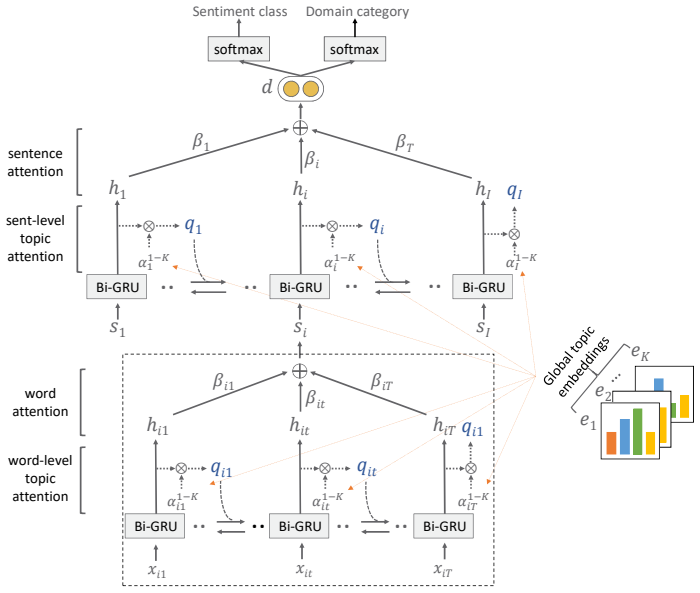
The central object is the global topic embedding matrix $\mathbf{E} \in \mathbb{R}^{K \times n}$, a set of $K$ trainable topic vectors shared across all documents. At each word and sentence position, the model computes a topic attention vector $\alpha_{it} = \mathrm{softmax}(u_{it}^{\top} \mathbf{E})$ and a local topic embedding $q_{it} = \sum_k \alpha_{it}^k e_k$, which is then inserted into the GRU update equations as an extra input alongside the current word and previous hidden state. This mechanism lets the recurrent unit carry topic information forward while the hierarchical attention layers aggregate words into sentences and sentences into documents. The local topic embeddings are also the output representation used for topic and aspect-polarity extraction, so the same vectors serve both classification and interpretation.
What would settle it
Use the trained TDAM model and cluster the local topic embeddings directly in their original $n$-dimensional space (for example, with K-means on the raw $q_{it}$ vectors) and compare aspect-polarity coherence to the t-SNE-based clusters; if coherence drops sharply, the extraction result depends on the projection rather than on the learned topic embeddings. Alternatively, set the local topic embedding $q_{it}$ to zero for all positions and retrain; if classification accuracy and aspect-polarity coherence stay the same, the topical mechanism is not what carries the results.
Extended reading notes
Core claim
On its own terms, the paper's central claim is that a global topic embedding matrix shared across all documents, when combined with attention to form local topic embeddings that are fed into a modified GRU, lets one model learn sentiment and domain jointly and extract topics that are aligned with sentiment polarity. On Yelp18, TDAM with multi-task learning reaches 84.5% accuracy and on Amazon 79.1%, compared with 83.7% and 78.4% for the HAN baseline, and it leads the aspect-polarity coherence evaluation on SemEval restaurant and laptop data. The distinctive discovery is that the local topic embeddings, computed as attention-weighted combinations of the global topic vectors, encode enough aspect and polarity structure that simple projection and clustering yields coherent aspect-sentiment clusters without aspect-level supervision.
Load-bearing premise
The aspect-polarity evaluation assumes that the t-SNE projection followed by K-means preserves the semantic and polarity structure of the local topic embeddings, so the reported cluster coherence reflects the model's representation rather than artifacts of the projection and clustering choices.
Editorial extensions
If this is right
- Sentiment classification on user reviews can be improved slightly over hierarchical attention baselines by making the recurrent unit topic-aware, with the gain coming mainly from the topical attention rather than from multi-task learning.
- The same network, trained only on ratings and domain categories, can produce clusters of sentences that share both an aspect and a polarity, providing a form of weakly supervised aspect-based sentiment analysis.
- Topic coherence scores for TDAM are competitive with or better than those of supervised topic models such as S-LDA and Scholar, suggesting that neural attention weights can serve as a topic extraction mechanism rather than only an interpretability tool.
- Because no aspect-level labels are needed, TDAM could reduce the annotation cost for aspect-based sentiment systems, a direction the authors explicitly point to as a bootstrap for training such detectors.
Reading between the lines
- A natural test the paper does not run is to replace the t-SNE projection with direct clustering of the local topic embeddings; if coherence drops sharply, the reported aspect-polarity results may reflect the projection geometry rather than the learned representation itself.
- The shared global topic embedding suggests a transfer setup in which topics learned on one review domain are reused for a new domain with only the classification heads retrained; the paper does not explore this.
- Because the model separates polarity-bearing topics without aspect labels, its local embeddings could serve as pseudo-labels for training an aspect-based sentiment model, effectively turning TDAM into a data-generation step rather than an end system.
Signed reviews
Editorial analysis
A structured set of objections, weighed in public.
Referee Report
Summary. The paper proposes TDAM, a hierarchical attention model that injects global topic embeddings into a Bi-GRU via an internal topic-dependent attention mechanism, and trains it with multi-task learning on sentiment and domain classification. The authors evaluate on Yelp18 and Amazon review subsets for sentiment accuracy, on Palmetto topic coherence, and on the SemEval 2016 Task 5 data for unsupervised aspect-polarity cluster coherence, reporting accuracy on par with or slightly above HAN and improved coherence and cluster quality. The central claims are that TDAM jointly models topics and sentiment, and that it can extract coherent polarity-bearing aspects without aspect-level annotations.
Significance. If the claims hold, TDAM provides a useful architectural pattern for incorporating corpus-level topic structure into sequence encoders, and the unsupervised aspect-sentiment extraction would be a practical contribution for bootstrapping aspect-based sentiment analysis. The paper makes code and data publicly available, and it evaluates on external benchmarks (SemEval annotations and Palmetto coherence), which is a strength. However, the most distinctive claim, unsupervised aspect-polarity clustering, rests on a stochastic t-SNE + K-means pipeline whose stability is not demonstrated, and the state-of-the-art sentiment comparison omits transformer-based baselines and significance testing. These issues are load-bearing for the paper's conclusions, so the contribution is currently only conditionally supported.
major comments (4)
- [Sections 3.4 and 5.4] The central claim of unsupervised aspect-sentiment extraction rests on the t-SNE + K-means pipeline in Section 3.4, but the paper provides no evidence that this pipeline is stable. t-SNE is stochastic and not designed to preserve global cluster geometry, K-means is initialization-dependent, and the cluster count k is tuned in Section 3.4 by maximizing the same topic-coherence metric later reported in Section 5.3. Please report results across multiple t-SNE seeds and perplexities, multiple K-means restarts, and an alternative clustering approach (e.g., K-means on the original q vectors or agglomerative clustering), and clarify whether the sentence clusters in Table 4 also pass through the t-SNE projection. Without such robustness checks, the aspect-polarity coherence results do not yet establish that the clusters reflect the model's representation quality rather than artifacts of the projection.
- [Section 5.1, Table 2] The reported accuracy gains of TDAM over HAN are small (84.5 vs. 83.7 on Yelp, 79.1 vs. 78.4 on Amazon), and no statistical significance tests are reported. Given that the paper claims performance 'on a par with the state-of-the-art,' please provide paired significance tests (e.g., McNemar or bootstrap across folds) and multiple random initializations. In addition, the comparison omits transformer-based encoders despite citing BERT in the related work; to support a state-of-the-art claim, a BERT or similar baseline should be included or the claim should be narrowed.
- [Section 3.1, Eqs. (1)-(7)] The bidirectional formulation is unclear and potentially circular. Equation (3) defines the local topic embedding q_it from h_it, the concatenation of forward and backward hidden states, while the modified GRU update in Eqs. (4)-(7) uses q_{t-1}. In the backward direction the recurrence should depend on q_{t+1}, and computing q_t from the backward hidden state requires future q values. Please specify the exact order of computation, for example whether separate topic embeddings are computed per direction or whether q is derived only after both directional passes, and correct the equations or pseudocode accordingly.
- [Section 5.3, Table 3] Topic coherence scores are reported without variance or significance testing, and the differences between TDAM/TDAM-Mtl and Scholar-R are small and non-monotonic across topic numbers (e.g., on Amazon with 100 topics, TDAM-Mtl gives -9.12 vs. Scholar-R -9.09, while with 200 topics TDAM-Mtl gives -9.01 vs. Scholar-R -9.17). The text states that TDAM-Mtl generates the best coherence results on 2 out of 3 settings, but without error bars or a significance test this is not established. Please report standard deviations over multiple runs and a suitable significance test, or temper the claim.
minor comments (4)
- [Table 4] Table 4 contains apparent typos, such as '0.8' and '0.0' in the Laptop blocks, which should likely be '0.08' and '0.00', and some entries are missing closing parentheses. The table would also benefit from a caption that explicitly defines the bracketed values as aspect-only coherence and the unbracketed values as aspect-polarity coherence.
- [Section 5.4] In the paragraph following Table 5, 'TADM phrases are rather coherent overall' should read 'TDAM phrases,' correcting the typo in the model name.
- [Table 1] The reported token count for Amazon, ~8.5×10^3, is implausible given 75,000 documents with an average of 6.7 sentences and 16.7 words per sentence; this appears to be a typo (likely ~8.5×10^6).
- [Eq. (2)] In Eq. (2), softmax is taken over the K topic scores, but the equation as written applies softmax to a scalar. Please make explicit that the softmax is over k = 1,...,K and that α^k_it denotes the k-th component of the resulting vector.
Circularity Check
No circular derivation: TDAM's claims are tested against external benchmarks and do not reduce to fitted inputs or self-citations.
full rationale
The paper's sentiment-classification claim is evaluated on Yelp and Amazon against HAN and other baselines (Table 2), with accuracy computed from held-out labels; the gain over HAN is an external comparison, not an artifact of the model definition. Topic coherence (Table 3) is measured with the Palmetto implementation of Röder et al. (2015), an external metric, and includes non-TDAM baselines (HAN, S-LDA, Scholar) under the same extraction procedure. The aspect-polarity clusters (Section 5.4) are evaluated against SemEval 2016 Task 5 gold annotations that the paper explicitly states are not used for training, so the reported coherence is not fitted to the evaluation target. The local topic embeddings q_it (Eq. 3) are a novel architectural component, not defined in terms of the evaluation metric. No load-bearing claim is justified by a self-citation: the cited HAN, t-SNE, K-means, GloVe, and Palmetto are all external. The only mild methodological concern is that the number of clusters k for K-means is chosen by maximizing the same topic-coherence measure later reported (Section 3.4), which could inflate the absolute coherence numbers; however, this is standard hyperparameter selection on an external metric, not a case where a prediction equals its input by construction, and it does not affect the benchmark comparisons or the held-out sentiment results. Overall, the derivation and evaluation chain is self-contained, so no circularity is found.
Assumptions & free parameters
free parameters (5)
- global topic embedding matrix E =
learned during training
- K (number of global topic vectors) =
50, 100, 200
- topic vector size gamma_t =
50 to 200
- k (number of K-means clusters for topic extraction) =
50, 100, 200
- learning rate and dropout =
lambda in [0.01, 0.1], delta in [0, 0.6]
assumptions (5)
- standard math Softmax attention and GRU recurrence are valid differentiable building blocks.
- domain assumption A fixed-size global topic embedding matrix shared across documents can capture the corpus-level topical semantics.
- domain assumption GloVe 200-dimensional embeddings provide a reasonable semantic initialization.
- domain assumption Topic coherence measured with Palmetto (Roder et al., 2015) is a valid evaluation of topic quality.
- domain assumption The SemEval 2016 aspect and polarity annotations are reliable gold labels for clustering evaluation.
Cite this review
Pith. "Pith review of TDAM: a Topic-Dependent Attention Model for Sentiment Analysis." pith.science (2026). https://pith.science/paper/ULFKSLSC
@misc{pith2026190806435,
  author       = {Pith},
  title        = {Pith review of: TDAM: a Topic-Dependent Attention Model for Sentiment Analysis},
  year         = {2026},
  howpublished = {\url{https://pith.science/paper/ULFKSLSC}},
  note         = {Machine review of arXiv:1908.06435}
}
read the original abstract
We propose a topic-dependent attention model for sentiment classification and topic extraction. Our model assumes that a global topic embedding is shared across documents and employs an attention mechanism to derive local topic embedding for words and sentences. These are subsequently incorporated in a modified Gated Recurrent Unit (GRU) for sentiment classification and extraction of topics bearing different sentiment polarities. Those topics emerge from the words' local topic embeddings learned by the internal attention of the GRU cells in the context of a multi-task learning framework. In this paper, we present the hierarchical architecture, the new GRU unit and the experiments conducted on users' reviews which demonstrate classification performance on a par with the state-of-the-art methodologies for sentiment classification and topic coherence outperforming the current approaches for supervised topic extraction. In addition, our model is able to extract coherent aspect-sentiment clusters despite using no aspect-level annotations for training.
Figures


Reference graph
Works this paper leans on
-
[1]
write newline
" write newline "" before.all 'output.state := FUNCTION n.dashify 't := "" t empty not t #1 #1 substring "-" = t #1 #2 substring "--" = not "--" * t #2 global.max substring 't := t #1 #1 substring "-" = "-" * t #2 global.max substring 't := while if t #1 #1 substring * t #2 global.max substring 't := if while FUNCTION word.in bbl.in ":" * " " * FUNCTION f...
-
[2]
write newline
" write newline "" before.all 'output.state := FUNCTION n.dashify 't := "" t empty not t #1 #1 substring "-" = t #1 #2 substring "--" = not "--" * t #2 global.max substring 't := t #1 #1 substring "-" = "-" * t #2 global.max substring 't := while if t #1 #1 substring * t #2 global.max substring 't := if while FUNCTION word.in bbl.in ":" * " " * FUNCTION f...
-
[3]
write newline
" write newline "" before.all 'output.state := FUNCTION n.dashify 't := "" t empty not t #1 #1 substring "-" = t #1 #2 substring "--" = not "--" * t #2 global.max substring 't := t #1 #1 substring "-" = "-" * t #2 global.max substring 't := while if t #1 #1 substring * t #2 global.max substring 't := if while FUNCTION word.in bbl.in ":" * " " * FUNCTION f...
-
[4]
write newline
" write newline "" before.all 'output.state := FUNCTION n.dashify 't := "" t empty not t #1 #1 substring "-" = t #1 #2 substring "--" = not "--" * t #2 global.max substring 't := t #1 #1 substring "-" = "-" * t #2 global.max substring 't := while if t #1 #1 substring * t #2 global.max substring 't := if while FUNCTION word.in bbl.in ":" * " " * FUNCTION f...
-
[5]
write newline
" write newline "" before.all 'output.state := FUNCTION n.dashify 't := "" t empty not t #1 #1 substring "-" = t #1 #2 substring "--" = not "--" * t #2 global.max substring 't := t #1 #1 substring "-" = "-" * t #2 global.max substring 't := while if t #1 #1 substring * t #2 global.max substring 't := if while FUNCTION word.in bbl.in capitalize ":" * " " *...
-
[6]
write newline
" write newline "" before.all 'output.state := FUNCTION n.dashify 't := "" t empty not t #1 #1 substring "-" = t #1 #2 substring "--" = not "--" * t #2 global.max substring 't := t #1 #1 substring "-" = "-" * t #2 global.max substring 't := while if t #1 #1 substring * t #2 global.max substring 't := if while FUNCTION word.in bbl.in capitalize ":" * " " *...
-
[7]
write newline
" write newline "" before.all 'output.state := FUNCTION n.dashify 't := "" t empty not t #1 #1 substring "-" = t #1 #2 substring "--" = not "--" * t #2 global.max substring 't := t #1 #1 substring "-" = "-" * t #2 global.max substring 't := while if t #1 #1 substring * t #2 global.max substring 't := if while FUNCTION word.in bbl.in capitalize "" * " " * ...
-
[8]
write newline
" write newline "" before.all 'output.state := FUNCTION n.dashify 't := "" t empty not t #1 #1 substring "-" = t #1 #2 substring "--" = not "--" * t #2 global.max substring 't := t #1 #1 substring "-" = "-" * t #2 global.max substring 't := while if t #1 #1 substring * t #2 global.max substring 't := if while FUNCTION word.in bbl.in capitalize ":" * " " *...
Show all 49 references
-
[9]
, author Shamsuddin, S
author Abdi, A. , author Shamsuddin, S. M. , author Hasan, S. , & author Piran, J. ( year 2019 ). title Deep learning-based sentiment classification of evaluative text based on multi-feature fusion . journal Information Processing & Management \/ , volume 56 \/ , pages 1245 -- 1259
2019
-
[10]
, author Cho, K
author Bahdanau, D. , author Cho, K. , & author Bengio, Y. ( year 2015 ). title Neural machine translation by jointly learning to align and translate . In booktitle 3rd International Conference on Learning Representations, ICLR 2015, San Diego, CA, USA \/
2015
-
[11]
( year 2017 )
author Bengio, Y. ( year 2017 ). title The consciousness prior . journal CoRR \/ , volume abs/1709.08568 \/
2017 arXiv
-
[12]
author Blei, D. M. , author Ng, A. Y. , & author Jordan, M. I. ( year 2003 ). title Latent D irichlet A llocation . journal Journal of Machine Learning Research \/ , volume 3 \/ , pages 993--1022
2003
-
[13]
, author Tan, C
author Card, D. , author Tan, C. , & author Smith, N. A. ( year 2018 ). title Neural M odels for D ocuments with M etadata . In booktitle Proceedings of the 56th Annual Meeting of the Association for Computational Linguistics, ACL 2018 \/ (pp. pages 2031--2040 ). address Melbo...
2018
-
[14]
, author Sun, M
author Chen, H. , author Sun, M. , author Tu, C. , author Lin, Y. , & author Liu, Z. ( year 2016 ). title Neural sentiment classification with user and product attention . In booktitle Proceedings of the 2016 Conference on Empirical Methods in Natural Language Processing, EMNL...
2016
-
[15]
, & author Cardie, C
author Chen, X. , & author Cardie, C. ( year 2018 ). title Multinomial adversarial networks for multi-domain text classification . In booktitle Proceedings of the 2018 Conference of the North A merican Chapter of the Association for Computational Linguistics: Human Language Te...
2018
-
[16]
e nboer, B. , author G \
author Cho, K. , author van Merri \" e nboer, B. , author G \" u l c ehre, C . , author Bahdanau, D. , author Bougares, F. , author Schwenk, H. , & author Bengio, Y. ( year 2014 ). title Learning phrase representations using rnn encoder--decoder for statistical machine transla...
2014
-
[17]
, author Ballas, N
author Cooijmans, T. , author Ballas, N. , author Laurent, C. , author G \" u l c ehre, C . , & author Courville, A. ( year 2017 ). title Recurrent batch normalization . In booktitle Proceedings of the 2017 International Conference for Learning Representations, ICLR 2017 \/ . ...
2017
-
[18]
, author Chang, M
author Devlin, J. , author Chang, M. , author Lee, K. , & author Toutanova, K. ( year 2019 ). title BERT: pre-training of deep bidirectional transformers for language understanding . In booktitle Proceedings of the 2019 Conference of the North American Chapter of the Associati...
2019
-
[19]
author Dieng, A. B. , author Wang, C. , author Gao, J. , & author Paisley, J. W. ( year 2017 ). title Topic RNN : A recurrent neural network with long-range semantic dependency . In booktitle Proceedings of the 2017 International Conference for Learning Representations, ICLR 2...
2017
-
[20]
author Feng, V. W. , & author Hirst, G. ( year 2012 ). title Text-level discourse parsing with rich linguistic features . In booktitle Proceedings of the 50th Annual Meeting of the Association for Computational Linguistics, ACL 2012 \/ (pp. pages 60--68 ). address Jeju Island, Korea
2012
-
[21]
author Hermann, K. M. , author Kocisky, T. , author Grefenstette, E. , author Espeholt, L. , author Kay, W. , author Suleyman, M. , & author Blunsom, P. ( year 2015 ). title Teaching machines to read and comprehend . In booktitle Advances in Neural Information Processing Syste...
2015
-
[22]
, & author Schmidhuber, J
author Hochreiter, S. , & author Schmidhuber, J. ( year 1997 ). title Long S hort- T erm M emory . journal Neural C omputation \/ , volume 9 \/ , pages 1735--1780
1997
-
[23]
, author Luo, X
author Jin, M. , author Luo, X. , author Zhu, H. , & author Zhuo, H. H. ( year 2018 ). title Combining deep learning and topic modeling for review understanding in context-aware recommendation . In booktitle Proceedings of the 2018 Conference of the North American Chapter of t...
2018
-
[24]
, author Imran, A
author Kastrati, Z. , author Imran, A. S. , & author Yayilgan, S. Y. ( year 2019 ). title The impact of deep learning on document classification using semantically rich representations . journal Information Processing & Management \/ , volume 56 \/ , pages 1618 -- 1632
2019
-
[25]
author Kingma, D. P. , & author Ba, J. ( year 2015 ). title Adam: A method for stochastic optimization . In booktitle Proceedings of the 2015 International Conference for Learning Representations, ICLR 2015 \/ . address San Diego, USA
2015
-
[26]
, author Qiu, X
author Liu, P. , author Qiu, X. , & author Huang, X. ( year 2016 ). title Deep multi-task learning with shared memory for text classification . In booktitle Proceedings of the 2016 Conference on Empirical Methods in Natural Language Processing, EMNLP 2016 \/ (pp. pages 118--12...
2016
-
[27]
, author Qiu, X
author Liu, P. , author Qiu, X. , & author Huang, X. ( year 2017 ). title Adversarial multi-task learning for text classification . In booktitle Proceedings of the 55th Annual Meeting of the Association for Computational Linguistics, ACL 2017 \/ (pp. pages 1--10 ). address Van...
2017
-
[28]
, & author Lapata, M
author Liu, Y. , & author Lapata, M. ( year 2018 ). title Learning structured text representations . journal Transactions of the Association for Computational Linguistics \/ , volume 6 \/ , pages 63--75
2018
-
[29]
, author Pham, H
author Luong, T. , author Pham, H. , & author Manning, C. D. ( year 2015 ). title Effective approaches to attention-based neural machine translation . In booktitle Proceedings of the 2015 Conference on Empirical Methods in Natural Language Processing, EMNLP 2015 \/ (pp. pages ...
2015
-
[30]
, author Li, S
author Ma, D. , author Li, S. , author Zhang, X. , & author Wang, H. ( year 2017 ). title Interactive attention networks for aspect-level sentiment classification . In booktitle Proceedings of the 26th International Joint Conference on Artificial Intelligence, IJACI 2017 \/ (p...
2017
-
[31]
, & author Hinton, G
author Van der Maaten, L. , & author Hinton, G. ( year 2008 ). title Visualizing data using t-SNE . journal Journal of Machine Learning Research \/ , volume 9 \/ , pages 2579--2605
2008
-
[32]
, author Targett, C
author McAuley, J. , author Targett, C. , author Shi, Q. , & author van den Hengel, A. ( year 2015 ). title Image-based recommendations on styles and substitutes . In booktitle Proceedings of the 38th International ACM SIGIR Conference on Research and Development in Informatio...
2015
-
[33]
author Mcauliffe, J. D. , & author Blei, D. M. ( year 2008 ). title Supervised topic models . In booktitle Advances in Neural Information Processing Systems 20, NIPS 2008 \/ (pp. pages 121--128 ). address Vancouver, Canada
2008
-
[34]
, author Socher, R
author Pennington, J. , author Socher, R. , & author Manning, C. ( year 2014 ). title Glove: Global vectors for word representation . In booktitle Proceedings of the 2014 Conference on Empirical Methods in Natural Language Processing EMNLP 2014 \/ (pp. pages 1532--1543 ). addr...
2014
-
[35]
, author Neumann, M
author Peters, M. , author Neumann, M. , author Iyyer, M. , author Gardner, M. , author Clark, C. , author Lee, K. , & author Zettlemoyer, L. ( year 2018 ). title Deep contextualized word representations . In booktitle Proceedings of the 2018 Conference of the North American C...
2018
-
[36]
, author Both, A
author R\" o der, M. , author Both, A. , & author Hinneburg, A. ( year 2015 ). title Exploring the space of topic coherence measures . In booktitle Proceedings of the Eighth ACM International Conference on Web Search and Data Mining, WSDM 2015 \/ (pp. pages 399--408 ). address...
2015
-
[37]
author Saxe, A. M. , author McClelland, J. L. , & author Ganguli, S. ( year 2014 ). title Exact solutions to the nonlinear dynamics of learning in deep linear neural networks . In booktitle Proceedings of the 2015 International Conference for Learning Representations, ICLR 201...
2014
-
[38]
, author Miller, T
author Stab, C. , author Miller, T. , author Schiller, B. , author Rai, P. , & author Gurevych, I. ( year 2018 ). title Cross-topic argument mining from heterogeneous sources . In booktitle Proceedings of the 2018 Conference on Empirical Methods in Natural Language Processing ...
2018
-
[39]
, author Qin, B
author Tang, D. , author Qin, B. , & author Liu, T. ( year 2015 ). title Document modeling with gated recurrent neural network for sentiment classification . In booktitle Proceedings of the 2015 Conference on Empirical Methods in Natural Language Processing EMNLP 2015 \/ (pp. ...
2015
-
[40]
( year 2014 )
author Van Der Maaten, L. ( year 2014 ). title Accelerating t- SNE using tree-based algorithms . journal Journal of Machine Learning Research \/ , volume 15 \/ , pages 3221--3245
2014
-
[41]
, author Shazeer, N
author Vaswani, A. , author Shazeer, N. , author Parmar, N. , author Uszkoreit, J. , author Jones, L. , author Gomez, A. N. , author Kaiser, . , & author Polosukhin, I. ( year 2017 ). title Attention is all you need . In booktitle Advances in Neural Information Processing Syst...
2017
-
[42]
, author Feng, S
author Wang, W. , author Feng, S. , author Gao, W. , author Wang, D. , & author Zhang, Y. ( year 2018 ). title Personalized microblog sentiment classification via adversarial cross-lingual multi-task learning . In booktitle Proceedings of the 2018 Conference on Empirical Metho...
2018
-
[43]
, author Yang, N
author Wang, W. , author Yang, N. , author Wei, F. , author Chang, B. , & author Zhou, M. ( year 2017 ). title Gated self-matching networks for reading comprehension and question answering . In booktitle Proceedings of the 55th Annual Meeting of the Association for Computation...
2017
-
[44]
, & author Huang, Y
author Wu, F. , & author Huang, Y. ( year 2016 ). title Personalized microblog sentiment classification via multi-task learning . In booktitle Proceedings of the Thirtieth AAAI Conference on Artificial Intelligence AAAI 2016 \/ (pp. pages 3059--3065 ). address Phoenix, Arizona
2016
-
[45]
, author Ba, J
author Xu, K. , author Ba, J. , author Kiros, R. , author Cho, K. , author Courville, A. , author Salakhudinov, R. , author Zemel, R. , & author Bengio, Y. ( year 2015 ). title Show, attend and tell: Neural image caption generation with visual attention . In booktitle Internat...
2015
-
[46]
, author Zhang, H
author Yang, C. , author Zhang, H. , author Jiang, B. , & author Li, K. ( year 2019 ). title Aspect-based sentiment analysis with alternating coattention networks . journal Information Processing & Management \/ , volume 56 \/ , pages 463 -- 478
2019
-
[47]
, author Yang, D
author Yang, Z. , author Yang, D. , author Dyer, C. , author He, X. , author Smola, A. , & author Hovy, E. ( year 2016 ). title Hierarchical attention networks for document classification . In booktitle Proceedings of the 2016 Conference of the North A merican Chapter of the A...
2016
-
[48]
, author Xiao, L
author Zhang, H. , author Xiao, L. , author Chen, W. , author Wang, Y. , & author Jin, Y. ( year 2018 ). title Multi-task label embedding for text classification . In booktitle Proceedings of the 2018 Conference on Empirical Methods in Natural Language Processing EMNLP 2018 \/...
2018
-
[49]
, author Chen, J
author Zheng, R. , author Chen, J. , & author Qiu, X. ( year 2018 ). title Same representation, different attentions: Shareable sentence representation learning from multiple tasks . In booktitle Proceedings of the Twenty-Seventh International Joint Conference on Artificial In...
2018
Reviewed August 14, 2026 · model on record in the stance chip above.
Discussion (0). Continue with ORCID to comment.