REVIEW 3 major objections 4 minor 45 references
Coherence induced work in quantum heat engines with Larmor precession
T0 review · 3 major / 4 minor · reviewed 2026-08-14 · deepseek-v4-flash
Pith's one-line read The paper claims that off-diagonal quantum coherence supplies mechanical work in an isolated Larmor-precession stroke, so a rotating-field Otto engine delivers net positive work at finite driving speed.
desk verdict A clean exact solution for a spin in a rotating field, but the cycle energy accounting mixes the lab frame and the instantaneous eigenbasis; the reported net work is not established. read the letter →
The pith
A machine-rendered reading of the paper's core claim, the machinery that carries it, and where it could break.
The reading
What carries the argument
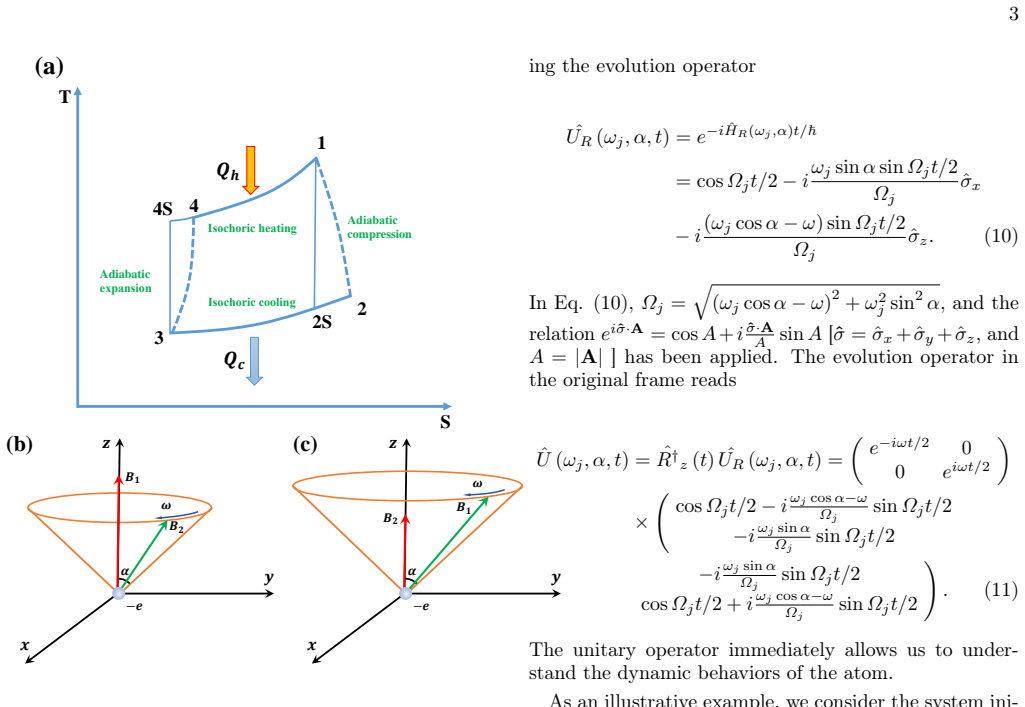
The central object is a spin-1/2 in the magnetic field $\mathbf{B}_j(\alpha,t)=B_j[\sin\alpha\cos(\omega t)\hat{x}+\sin\alpha\sin(\omega t)\hat{y}+\cos\alpha\hat{z}]$, whose exact dynamics are solved by transforming to the rotating frame, where the effective Hamiltonian is time-independent and the evolution operator is a product of rotations with frequencies $\Omega_j = \sqrt{(\omega_j\cos\alpha-\omega)^2+\omega_j^2\sin^2\alpha}$. The argument is carried by identity (4), which for any isolated unitary process equates the diagonal population-change sum to the off-diagonal coherence sum; this is what forces $\dot Q = 0$ on the precession stroke and elevates the coherence sum to the status of work. The closed-form expression (15) for $W_L$ turns that general accounting into a quantitative prediction for the engine.
What would settle it
During the isolated precession stroke, record the electrical power fed to the coils that generate the rotating magnetic field and compare the time-integrated energy with Eq. (16). If the measured energy equals only the sudden-shift part $W_S$ and not $W_L + W_S$ at half-integer $\lambda$ (where $W_L$ is maximal), the coherence term is not mechanical work; if it matches the full expression, the paper's accounting is confirmed at the level of the drive itself.
Extended reading notes
Core claim
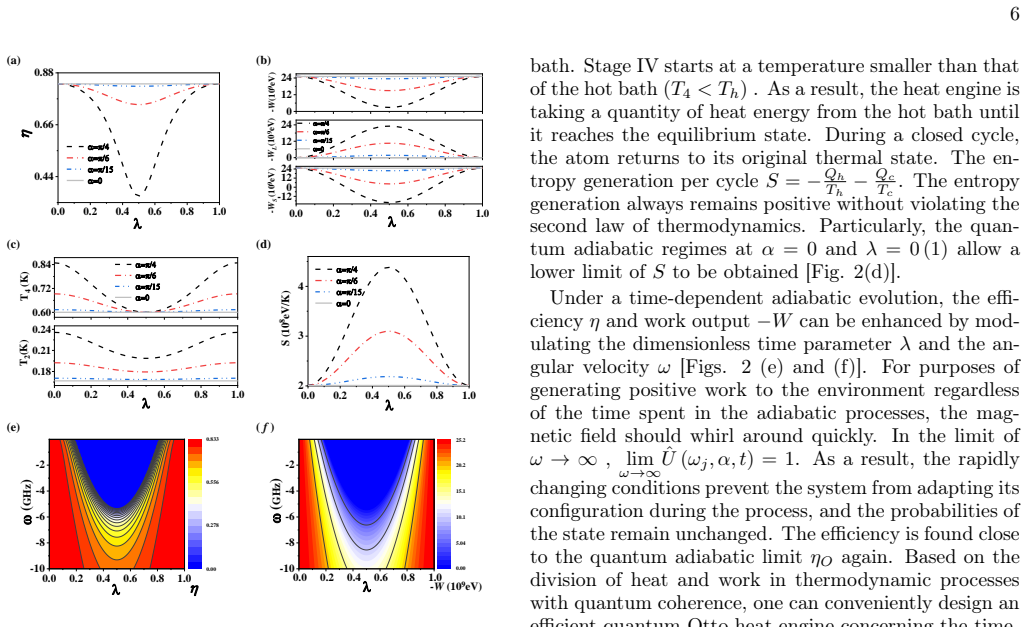
The paper's central claim is that during an isolated precession stroke the coherence term $\sum_{n\neq m}\rho_{nm}\langle m|\partial H/\partial t|n\rangle$ is mechanical work, not heat. For the spin Hamiltonian (5), whose instantaneous eigenvalues $\pm\hbar\omega_j/2$ are constant in time, the identity (4)—derived from the von Neumann equation—makes the population-change term exactly equal to the coherence term, so the heat flux vanishes and the stroke is thermodynamically adiabatic. Integrating the coherence term over the stroke gives the closed-form Larmor work $W_L(\omega_2,\omega_1,\alpha,\beta,t) = \frac{\hbar\omega\omega_2^2\sin^2(\Omega_2 t/2)\sin^2\alpha\tanh(\beta\hbar\omega_1/2)}{2\Omega_2^2}$, and the cycle's net work is $W = W_L + W_S$, where $W_S$ collects the sudden-shift contributions. For the chosen parameters the net work is positive for a wide range of driving times and rotation speeds, and the efficiency $\eta = 1 + Q_c/Q_h$ reaches the Otto limit $\eta_O = 1 - \omega_2/\omega_1 = 5/6$ at $\alpha = 0$ and at $\lambda = 0$ or $1$.
Load-bearing premise
The load-bearing premise is that the off-diagonal coherence term in the heat/work split of Eqs. (1)–(2) should be counted as work rather than heat; under the alternative standard convention—heat as the population-change contribution alone—the isolated precession stroke has nonzero heat and zero work, and the coherence-work effect disappears into bookkeeping.
Editorial extensions
If this is right
- At $\alpha = 0$, or whenever the adiabatic stroke times are integer multiples of $2\pi/\Omega_1$ and $2\pi/\Omega_2$ ($\lambda = 0$ or $1$), the engine runs at the Otto efficiency $\eta_O = 1 - \omega_2/\omega_1 = 5/6$ for the paper's parameters.
- For $0 < \alpha \leq \pi/4$, the coherence work output $-W_L$ grows with $\alpha$ and keeps the net work $-W$ positive even where the sudden-shift contribution $-W_S$ is negative, so coherence is the part that sustains the engine.
- In the limit of rapid field rotation, the evolution operator approaches the identity, the populations stay fixed, and efficiency again approaches the quantum adiabatic limit, so very fast driving does not spoil the cycle.
- Entropy production per cycle, computed as $-Q_h/T_h - Q_c/T_c$, remains positive for all $\alpha$ and $\lambda$, with a lower limit at the quantum adiabatic operating points.
Reading between the lines
- Because identity (4) holds for any isolated unitary process, the same coherence-work accounting should apply to any driven closed quantum system; the Larmor model is an exactly solvable special case, and the magnitude of $W_L$ would be a testable prediction in other driven two-level systems such as superconducting qubits.
- A clean experimental discriminator is the energy delivered by the field source during the precession stroke: if the integrated drive power matches Eq. (16) including $W_L$ for all $\lambda$, rather than only $W_S$, the paper's assignment is the operationally faithful one.
- Reversing the hot and cold baths in the same four-stroke cycle would turn the device into a refrigerator; the $\lambda$-periodic structure of $W_L$ would then predict an oscillating cooling power, a consequence the paper does not explore.
Signed reviews
Editorial analysis
A structured set of objections, weighed in public.
Referee Report
Summary. The paper proposes a four-stroke quantum Otto engine whose working substance is a spin-1/2 atom driven by a rotating magnetic field, using the exactly solvable dynamics of Larmor precession. The authors define heat and work with additional coherence terms in Eqs. (1)-(2), show that for isolated unitary evolution the heat flux vanishes by the identity (4), and derive a closed-form "coherence work" WL for the precession stroke in Eq. (15). Adding sudden-switch work WS, they write the stroke work as W = WL + WS, define efficiency in Eq. (22), and present numerical results claiming positive work output for finite-time driving, with the efficiency recovering the Otto limit at zero tip angle or at integer precession periods.
Significance. If the derivation were correct, the paper would provide a simple, exactly solvable model in which off-diagonal coherence performs mechanical work in a quantum Otto cycle, with a closed-form expression for the coherence contribution and a transparent limit recovering the standard two-level Otto result at alpha = 0. The exact propagator in Eq. (11) and the verification at alpha = 0 are genuine strengths, and the proposed NMR-type implementation is plausible. However, the central derivation contains a state-identification error that affects Eqs. (14)-(20) and therefore the reported work, efficiency, and entropy production. The qualitative idea is salvageable, but the manuscript in its present form does not establish its quantitative claims.
major comments (3)
- [§III, Eq. (13)] The density operator defined by Eq. (13) is not the time-evolved state of the Larmor Hamiltonian. Since U(0)=1, Eq. (13) gives ρ(0)=S(α,0)ρ_th(ω1,β)S†(α,0), which for α≠0 is not the post-quench thermal state ρ_th(ω1,β) that remains unchanged after the sudden switch at t=0. The actual state evolves as Uρ_thU†, so the extra S factors in Eq. (13) mean that all subsequent quantities, including WL and WS, are computed for a different process. If ρ* was intended to be the density matrix in the instantaneous eigenbasis, it should be defined as ρ* = S† U ρ_th U† S, not as U ρ_th U†.
- [§III, Eqs. (14)-(15)] For the exact unitary evolution Uρ_thU†, the coherence term — equivalently the work rate Tr(ρ ∂H/∂t) because the eigenvalues are time-independent — evaluates to ℏ p ω ω2^2 sin^2α sin(Ω2 t)/(2Ω2), with p = tanh(βℏω1/2). This differs from the printed expression in Eq. (14), which is proportional to sin2α. The printed expression vanishes at α=π/2, where the exact term is nonzero, and it overestimates the exact term by a factor of 2 at α=π/4. Consequently Eq. (15) for WL is quantitatively incorrect, and the numerical results in §V that use WL are not reliable.
- [§IV, Eqs. (16)-(22)] Because the stroke work in Eq. (16), the cold-bath heat in Eq. (18), and the hot-bath heat in Eq. (20) are all evaluated with the misidentified density matrix from Eq. (13), the reported net work W, efficiency η, and entropy generation do not correspond to the physical four-stroke engine described in the text. The abstract's claim that coherence guarantees positive work output is therefore not established by the manuscript as written; it must be re-derived using the exact state Uρ_thU† and the correct coherence term with sin^2α.
minor comments (4)
- [Fig. 2] The axis labels in panels (b)-(f), such as "-W (10^9 eV)" and "S (10^8 eV/K)", are dimensionally implausible; the plotted values are presumably in units of 10^-9 eV and 10^-8 eV/K. Please correct the labels and verify the scales.
- [§III, Eq. (13)] The notation is confusing: ρ* is first defined as UρthU† and then described as the matrix in the instantaneous eigenbasis. These two statements are incompatible unless the definition is corrected to ρ* = S† UρthU† S; please clarify.
- [§II, Eqs. (1)-(2)] The text should state explicitly that the classification of the coherence term as work is a convention inherited from Ref. [11]; under the standard Alicki split without coherence terms, the isolated strokes would have nonzero heat and zero coherence work, although the total energy balance is convention-independent.
- [§IV, Eq. (22)] The sign convention for Qh and Qc should be stated clearly; in Eq. (18) Qc is negative, while Eq. (22) is written as η = -W/Qh with Qh positive. A short sentence defining the signs would remove ambiguity.
Circularity Check
Coherence work is built into the heat/work definition; the adiabatic-stroke and WL conclusions are consequences of Eq. (4), an identity true for all unitary evolution.
-
self definitional
[Section II, Eqs. (1), (2), (4); Section III, Eq. (15)]
"Replacing the operator in a matrix form, we are capable of reaching the equality ∑_n ˙ρ_nn E_n = ∑_{n≠m} ρ_nm⟨m|∂H/∂t|n⟩, (4) which indicates that ˙Q = 0. ... We use W_L(ω2,ω1,α,β,t) = ∫_0^t ∑_{n≠m} ρ_nm(ω2,ω1,α,β,t′)⟨m|∂H(ω2,α,t′)/∂t′|n⟩dt′ = ... (15) to describe the work performed on the system due to the Larmor precession."
By Eq. (1) the off-diagonal coherence term is subtracted from ˙Q, and by Eq. (2) it is added to ˙W. Equation (4) is a general identity for any unitary evolution, not a special property of Larmor precession; it follows from the von Neumann equation and the Hellmann–Feynman relation. Hence ˙Q=0 for every isolated stroke by construction, and the integrated off-diagonal term, Eq. (15), is via Eq. (4) exactly ∫∑_n ˙ρ_nn E_n dt. Calling this 'coherence work' and declaring the stroke 'thermodynamic adiabatic' is therefore the paper's own heat/work convention, not an independent first-principles prediction. The total energy change is convention-independent, but the specific claim that coherence performs work and ensures positive work output is equivalent to the chosen split.
full rationale
The paper contains no fitted parameters, and its cycle energy balance is a self-contained exact calculation: W1, W2, Qc, Qh, η are explicit functions of ω1, ω2, α, βh, βc, τ1, and τ2, so there is no 'fitted input called prediction' and no externally benchmarked quantity is being inverted. The self-reference to Ref. [11] supplies the heat/work split, but Eq. (2) is also credited to the independent Ref. [12], and the definitions are stated explicitly in the text, so the citation itself is not the only load-bearing support. The circular element is the conceptual claim: Eq. (4) is a general algebraic identity for any unitary evolution, so the paper's conclusion that the isolated Larmor stroke has ˙Q=0 and that the off-diagonal term is 'coherence work' is fixed by the chosen definitions (Eqs. (1)-(2)) rather than derived from the physics. The closed-form Eq. (15) then simply evaluates the term that was already defined as work. The net cycle work and efficiency numbers are not themselves determined by that convention; they follow from energy conservation and the exact unitary dynamics, so the circularity is partial, not total. An apparent basis mismatch in Eqs. (16), (18), and (20), where lab-frame Hamiltonians are traced with the rotated-frame ρ*, is a correctness concern rather than a circularity and is not counted in this score.
Assumptions & free parameters
free parameters (7)
- Th =
1 K
- Tc =
0.1 K
- omega1 =
6 GHz
- omega2 =
1 GHz
- omega (rotation frequency) =
-6 GHz
- alpha (tip angle) =
pi/15, pi/6, pi/4
- lambda (dimensionless stroke time) =
scanned in [0,1]
assumptions (5)
- domain assumption Energy changes during driving strokes are classified by the eigenbasis split of Eqs. (1)-(2), assigning the coherence term to work.
- domain assumption Isochoric strokes thermalize the spin exactly to the Gibbs state rho_th(omega_j, beta) at the bath temperature.
- domain assumption The spin is perfectly isolated during the two driving strokes; evolution is exactly unitary under Eq. (5).
- standard math Exact rotating-frame solution of the driven two-level problem, Eqs. (9)-(11).
- standard math Algebraic identity (4): for unitary evolution, the population-change term equals the coherence term.
Cite this review
Pith. "Pith review of Coherence induced work in quantum heat engines with Larmor precession." pith.science (2026). https://pith.science/paper/453ZON32
@misc{pith2026190806443,
  author       = {Pith},
  title        = {Pith review of: Coherence induced work in quantum heat engines with Larmor precession},
  year         = {2026},
  howpublished = {\url{https://pith.science/paper/453ZON32}},
  note         = {Machine review of arXiv:1908.06443}
}
read the original abstract
The impacts of quantum coherence on nonequilibrium thermodynamics become observable by dividing the heat and work into the conventional diagonal part and the other part relaying on the superpositions and the time derivative of Hamiltonian. Specializing to exactly-solvable dynamics of Larmor precession, we build a quantum Otto heat engine employing magnetic-driven atomic rotations. The coherence induced by the population transition guarantees the positive work output when the control protocol is time dependent. The time-dependent control of a quantum heat engine implements the correspondence between the classical and quantum adiabatic theorems for microscopic heat machines.
Figures
Reference graph
Works this paper leans on
-
[11]
Boukobza and D
E. Boukobza and D. J. Tannor, Phys. Rev. A 74, 063823 (2006)
2006
-
[12]
S. Su, J. Chen, Y. Ma, J. Chen, and C. Sun, Chin. Phys. B 27, 060502 (2018)
work page 2018
-
[1]
(17)-(21), we obtain the expression of the efficiency as η =−W Qh = 1 + Qc Qh
Using Eqs. (17)-(21), we obtain the expression of the efficiency as η =−W Qh = 1 + Qc Qh . (22) V. RESUL TS AND DISCUSSION To build the complete descriptions of a quantum sys- tem in thermodynamic processes, it is important to ex- plain how to differentiate between the quantum and ther- modynamic adiabatic processes. For a quantum adia- batic process, if a s...
-
[2]
R. Dann, A. Tobalina, and R. Kosloff, Phys. Rev. Lett. 122, 250402 (2019)
work page 2019
-
[3]
W. Niedenzu, V. Mukherjee, A. Ghosh, A. G. Kofman, and G. Kurizki, Nat. Commun. 9, 165 (2018)
work page 2018
- [4]
- [5]
- [6]
Show all 45 references
-
[7]
Geva and R
E. Geva and R. Kosloff, J. Chem. Phys. 96, 3054-3067 (1992)
1992
-
[8]
Rezek and R
Y. Rezek and R. Kosloff, New. J. Phys. 8, 83 (2006)
2006
-
[9]
Kosloff, J
R. Kosloff, J. Chem. Phys. 150, 204105 (2019)
2019
-
[10]
Boukobza and D
E. Boukobza and D. J. Tannor, Phys. Rev. Lett. 98, 240601 (2007)
2007
-
[13]
Brandner, M
K. Brandner, M. Bauer, and U. Seifert, Phys. Rev. Lett. 119, 170602 (2017)
2017
-
[14]
Klatzow, J
J. Klatzow, J. N. Becker, P. M. Ledingham, C. Weinzetl, K. T. Kaczmarek, D. J. Saunders, J. Nunn, I. A. Walms- ley, R. Uzdin, and E. Poem, Phys. Rev. Lett. 122, 110601 (2019)
2019
-
[15]
Ronzani, B
A. Ronzani, B. Karimi, J. Senior, Y. Chang, J. T. Pelto- nen, C. Chen, and J. P. Pekola, Nat. Phys. 14, 991–995 (2018)
2018
-
[16]
Karimi and J
B. Karimi and J. P. Pekola, Phys. Rev. B 94, 184503 (2016)
2016
-
[17]
J. P. Pekola, Nat. Phys. 11, 118–123 (2015)
2015
-
[18]
R. J. de Assis, T. M. de Mendonça, C. J. Villas-Boas, A. M. de Souza, R. S. Sarthour, I. S. Oliveira, and N. G. de Almeida, Phys. Rev. Lett. 122, 240602 (2019)
2019
-
[19]
Batalhão, A.M
T.B. Batalhão, A.M. Souza, L. Mazzola, R. Auccaise, R.S. Sarthour, I.S. Oliveira, J. Goold, G. De Chiara, M. Paternostro, and R.M. Serra, Phys. Rev. Lett. 113, 140601 (2014)
2014
-
[20]
M. O. Scully, M. S. Zubairy, G. S. Agarwal, H. Walther, Science, 299, 862-864 (2003)
2003
-
[21]
H. T. Quan, P. Zhang, and C. P. Sun, Phys. Rev. E 73, 036122 (2006)
2006
-
[22]
M. T. Mitchison, M. P. Woods, J. Prior, and M. Huber, New J. Phys. 17, 115013 (2015)
2015
-
[23]
Roßnagel, O
J. Roßnagel, O. Abah, F. Schmidt-Kaler, K. Singer, and E. Lutz, Phys. Rev. Lett. 112, 030602 (2014)
2014
-
[24]
Klaers, S
J. Klaers, S. Faelt, A. Imamoglu, and E. Togan, Phys. Rev. X 7, 031044 (2017)
2017
-
[25]
X. L. Huang, T. Wang, and X. X. Yi, Phys. Rev. E 86, 051105 (2012)
2012
-
[26]
Zhang, F
K. Zhang, F. Bariani, and P. Meystre, Phys. Rev. Lett. 112, 150602 (2014)
2014
-
[27]
Zhang, F
K. Zhang, F. Bariani, and P. Meystre, Phys. Rev. A 90, 023819 (2014)
2014
-
[28]
A. Mari, A. Farace, and V. Giovannetti, J. Phys. B: At. Mol. Opt. Phys. 48, 175501 (2015)
2015
-
[29]
Verley, M
G. Verley, M. Esposito, T. Willaert, and C. V. den Broeck, Nat. Commun. 5, 4721 (2014)
2014
-
[30]
Campisi, J
M. Campisi, J. Phys. A: Math. Theor. 47, 245001 (2014)
2014
-
[31]
Pietzonka and U
P. Pietzonka and U. Seifert, Phys. Rev. Lett. 120, 190602 (2018)
2018
-
[32]
Bauer, K
M. Bauer, K. Brandner, and U. Seifert, Phys. Rev. E 93, 042112 (2016)
2016
-
[33]
H. Wang, J. He, and J. Wang, Phys. Rev. E 96, 012152 (2017)
2017
-
[34]
Q. Liu, J. He, Y. Ma, and J. Wang, Phys. Rev. E 100, 012105 (2019)
2019
-
[35]
Ou and S
C. Ou and S. Abe, Europhys. Lett. 113, 40009 (2016)
2016
-
[36]
von Neumann, Mathematical foundations of quantum mechanics, Princeton, Princeton University Press (1955)
J. von Neumann, Mathematical foundations of quantum mechanics, Princeton, Princeton University Press (1955)
1955
-
[37]
T. D. Kieu, Phys. Rev. Lett. 93, 140403 (2004)
2004
-
[38]
D. J. Griffiths, Introduction to quantum mechanics, 2nd Ed., New Jersey, Prentice Hall (2005)
2005
-
[39]
Y. Ma, S. Su, and C. Sun, Phys. Rev. E 96, 022143 (2017)
2017
-
[40]
H. T. Quan, Phys. Rev. E 79, 041129 (2009)
2009
-
[41]
G. A. Barrios, F. Albarrán-Arriagada, F. A. Cárdenas- López, G. Romero, and J. C. Retamal, Phys. Rev. A 96, 052119 (2017)
2017
-
[42]
M. V. Berry, J. Phys. A: Math. Theor. 42, 365303 (2009)
2009
-
[43]
C. P. Sun, J. Phys. A: Math. Gen. 21, 1595-1599 (1988). 8
1988
-
[44]
H. T. Quan, Y. Liu, C. P. Sun, and F. Nori, Phys. Rev. E 76, 031105 (2007)
2007
-
[45]
J. He, J. Chen, and B. Hua, Phys. Rev. E 65, 036145 (2002)
2002
Reviewed August 14, 2026 · model on record in the stance chip above.
Discussion (0). Continue with ORCID to comment.