REVIEW 3 major objections 5 minor 35 references
Image Formation Model Guided Deep Image Super-Resolution
T0 review · 3 major / 5 minor · reviewed 2026-08-14 · deepseek-v4-flash
Pith's one-line read This paper shows that a deep super-resolution network can be made to obey the known blur-and-downsample image formation model by replacing, at each cascade stage, the pixel values at un-decimated positions with the corresponding…
desk verdict Solid SR paper with a real but modest empirical gain; the 'strictly satisfies' claim only holds for the assumed kernel, which does not match the benchmark degradation. read the letter →
The pith
A machine-rendered reading of the paper's core claim, the machinery that carries it, and where it could break.
The reading
What carries the argument
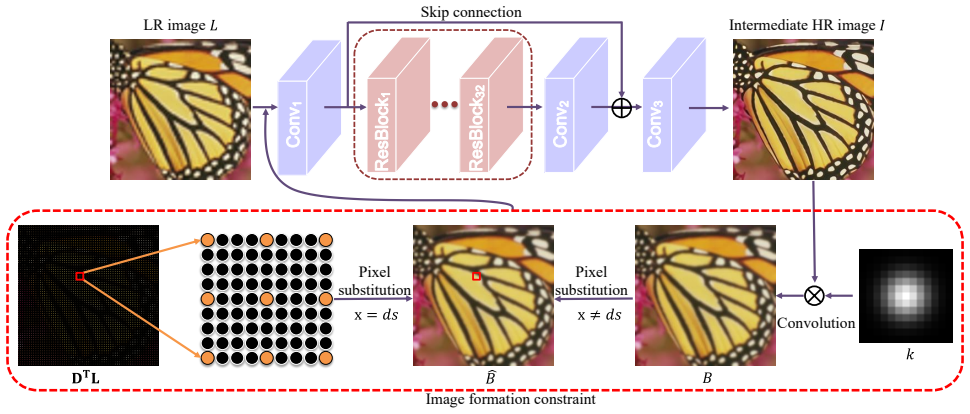
The load-bearing object is the pixel substitution rule together with the selection matrix D^T D derived from the downsampling operator D. At each stage, the network estimates an intermediate HR image I; the machinery blurs it to B = KI, then overwrites B at un-decimated positions (x = ds) with the corresponding values from the upsampled LR image D^T L. This makes the updated image strictly satisfy the formation model at those pixels before the next network pass. It converts a global constraint into a local, differentiable data-injection step.
What would settle it
Take a test image, degrade it with a Gaussian kernel whose width is half the paper's setting, upsample by 4, and run the method with its default kernel: if the PSNR of the pixel-substitution result is lower than the same network run without substitution, then the method actively hurts when the kernel is slightly wrong, confirming that the reported gains are strictly conditional on kernel fidelity.
Extended reading notes
Core claim
The central discovery is that the image formation constraint L = DKI can be enforced pointwise during a deep-network SR pipeline by substituting observed low-resolution values into the blurred intermediate estimate at exactly the pixel positions that the downsampling operator keeps. Writing D^T L = D^T DKI, the matrix D^T D selects the un-decimated positions; the paper's update rule sets B̂(x) = D^T L(x) at those positions and B(x) elsewhere. Because the substituted image satisfies the equality at the selected positions by construction, the cascaded refinement has a self-consistent anchor that feed-forward regression lacks. The paper further shows that this hard substitution outperforms both an unconstrained cascade of the same network and a soft image-formation loss added to the training objective.
Load-bearing premise
The paper's whole benefit rests on the assumption that the blur kernel used in pixel substitution matches the degradation that actually produced the low-resolution image; if it does not—as the paper itself shows for JPEG-compressed inputs—the substituted pixels inject inconsistent values and can worsen artifacts.
Editorial extensions
If this is right
- Any existing feed-forward SR architecture can be wrapped in this cascade and, according to the paper's experiments, gain reconstruction quality on standard benchmarks without changing the network's internal design.
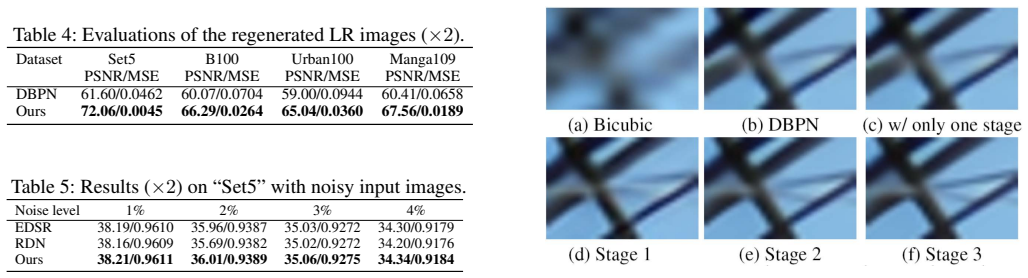
- The method's outputs satisfy the image formation model far more tightly than feedback baselines: regenerating LR images from its HR outputs yields PSNR around 72 dB on Set5 (×2), versus about 61 dB for DBPN.
- The performance gain comes from the constraint itself, not from added capacity: a plain cascade of the same network without pixel substitution gives almost no improvement, and a soft image-formation loss does not consistently help.
- The hard-substitution loop is computationally cheap relative to feedback networks, running about three times faster than DBPN and only modestly slower than the feed-forward EDSR baseline.
Reading between the lines
- The paper does not test this, but the residual between the blurred network output and the observed LR at un-decimated positions is a ready-made diagnostic for kernel mismatch; plotting this residual across a test set would show where the assumed Gaussian diverges from the true degradation.
- A natural extension the paper leaves implicit is blind SR: estimate the blur kernel from the LR image, then use it in the substitution step; the paper's fixed Gaussian would then be a special case and its reported gains a lower bound for well-estimated kernels.
- Because the substitution rule depends only on a selection matrix and observed pixel values, the same idea should transfer to other inverse problems with known forward models, such as demosaicing, inpainting, or burst fusion, but the paper does not demonstrate this.
Signed reviews
Editorial analysis
A structured set of objections, weighed in public.
Referee Report
Summary. The manuscript proposes a cascaded single-image super-resolution (SR) framework that combines a deep feed-forward network, similar to EDSR, with a hard image-formation constraint. At each stage, the network estimates an intermediate HR image; this image is blurred by a Gaussian kernel, and the blurred image's values at the un-decimated positions are replaced by the corresponding LR values (Eq. 5), producing a substituted image that is fed to the next stage. Training is performed stage by stage with an L1 loss, and inference uses T = 3 stages. The paper reports PSNR/SSIM comparisons on Set5, Set14, B100, Urban100, Manga109, and DIV2K (validation), along with ablations, a robustness test to noise, and a self-consistency check of the formation constraint. The source code and trained models are publicly released.
Significance. The idea of enforcing the image formation model by pixel substitution inside a deep SR pipeline is simple and potentially useful; if the mechanism is confirmed, it could serve as an architecture-agnostic refinement step for existing SR networks. The paper has several strengths: it releases public code and models, evaluates on standard benchmarks, includes an ablation that separates the pixel-substitution effect from mere network cascading, and explicitly discusses limitations. However, the empirical gains over strong baselines are small (for example, +0.07 dB on Set5 at x2, +0.04 dB on DIV2K at x2, and +0.01 to +0.02 dB on B100), and the central mechanistic claim is not validated under the degradation model actually used to generate the benchmark data. The contribution is interesting but not yet fully substantiated.
major comments (3)
- [Section 5.1 vs. Section 3] The formation model in Eq. (1) assumes a blur kernel K, and Eq. (5) imposes the constraint L = D K I at the un-decimated positions. However, Section 5.1 states that the LR images used for training and testing are generated by bicubic downsampling, while K is chosen as a Gaussian kernel 'with the same settings used in Shan et al. 2008'. Thus the hard constraint enforced by pixel substitution does not correspond to the actual degradation of the benchmark data. To support the claim that the algorithm uses known blur kernels and that enforcing the true formation model produces the reported gains, the authors should add experiments in which the LR images are generated with the same Gaussian blur followed by downsampling (matching K), and compare those results with the bicubic-degraded setting. Without this comparison, the reported gains may reflect an interaction between the Gaussian substitution and bicubic inputs rather than correct enforcement of the formation model.
- [Abstract and Section 4.2, Eq. (5)] The claim that the 'output of the pixel substitution process strictly satisfies the image formation model' is stronger than what is implemented. Eq. (5) only constrains the substituted blurred intermediate image at the un-decimated positions; it does not guarantee that the final high-resolution estimate I_T, after the cascaded network refinements, satisfies the global constraint D K I = L. The conclusion in Section 7 phrases this more carefully, but the abstract and Section 4.2 should be qualified. If the intended claim is about the intermediate substituted image, that should be stated explicitly; if it is about the final output, a proof or direct verification on the final output is needed.
- [Section 6, Table 4] The self-consistency check in Table 4 is performed relative to the assumed Gaussian formation model, not the bicubic degradation that produced the benchmark LR images. Moreover, because pixel substitution directly places the LR values into the un-decimated positions, regenerating LR images via the same Gaussian model is partly a check of the substitution construction itself. The authors should report the formation-constraint error on the non-substituted positions and, more importantly, measure consistency with the actual bicubic degradation (for example, D_bicubic(I_T) versus L). Without these numbers, Table 4 does not establish that the estimated HR images satisfy the image formation model of the data.
minor comments (5)
- [Table 2] The entry 'MemNe' should be 'MemNet', and the VDSR x4 SSIM value '0.0726' is clearly a typo; the value should be around 0.883. Please correct these errors.
- [Section 6] The word 'downsmapling' appears in the first paragraph of Section 6 and should be 'downsampling'.
- [Section 5.2] The word 'featrues' appears in the comparison with DBPN and should be 'features'.
- [References] The reference list contains two 2008 Shan et al. entries with different co-author sets; the in-text citations do not disambiguate which one is the source of the pixel substitution idea, making attribution hard to verify.
- [Equation (4)] The notation x = y = ds in Eq. (4) is ambiguous because d is a vector-valued index; please use explicit coordinate notation to clarify the set of un-decimated positions.
Circularity Check
No circularity: pixel substitution is a constructive constraint, and evaluation is against external benchmarks with standard degradation.
full rationale
The paper's derivation chain is self-contained rather than circular. The image formation model is defined in Eqs. (1)-(3), and the pixel substitution rule in Eq. (5) is an algebraic consequence of that model, not a fitted parameter masquerading as a prediction. The claim that the substituted intermediate image 'strictly satisfies the image formation model' is a construction built from the model equations, which the paper explicitly presents as the mechanism, not as an empirical discovery. The Gaussian blur kernel is a stated modeling choice adopted from Shan et al. 2008 (Section 5.1), and the benchmark LR images are generated by standard bicubic downsampling (Section 5.1), so the comparisons in Table 2 are external and not forced by the paper's own assumptions. The self-citation to Pan et al. 2018 appears only in related work and is not load-bearing for the proposed algorithm. The limitation discussion (Section 6, Figure 8) explicitly acknowledges that the assumed formation model can mismatch real degradation such as JPEG compression, which is a robustness caveat and not a circular step. Table 4 verifies consistency under the assumed Gaussian model; although this is a self-consistency check rather than a fully independent test, the evaluated output is the cascaded network result, not merely the substituted image, so it is not a definitional identity. No fitted input is renamed as a prediction, no uniqueness theorem is imported from the authors' prior work, and no known result is merely renamed. The central empirical claim is therefore supported by independent benchmark evaluation.
Assumptions & free parameters
free parameters (2)
- Number of cascade stages T =
3
- Gaussian blur kernel settings =
not specified, inherited from Shan et al. 2008
assumptions (4)
- domain assumption The LR image is generated by a convolution with a blur kernel followed by downsampling: L = DKI.
- domain assumption The blur kernel used in the network is known and approximates the true degradation.
- domain assumption The cascaded pixel-substitution iteration converges to better HR estimates.
- standard math D^T D is a selection matrix and the substitution (5) enforces D B_hat = L.
Cite this review
Pith. "Pith review of Image Formation Model Guided Deep Image Super-Resolution." pith.science (2026). https://pith.science/paper/ZRQQSXHQ
@misc{pith2026190806444,
  author       = {Pith},
  title        = {Pith review of: Image Formation Model Guided Deep Image Super-Resolution},
  year         = {2026},
  howpublished = {\url{https://pith.science/paper/ZRQQSXHQ}},
  note         = {Machine review of arXiv:1908.06444}
}
read the original abstract
We present a simple and effective image super-resolution algorithm that imposes an image formation constraint on the deep neural networks via pixel substitution. The proposed algorithm first uses a deep neural network to estimate intermediate high-resolution images, blurs the intermediate images using known blur kernels, and then substitutes values of the pixels at the un-decimated positions with those of the corresponding pixels from the low-resolution images. The output of the pixel substitution process strictly satisfies the image formation model and is further refined by the same deep neural network in a cascaded manner. The proposed framework is trained in an end-to-end fashion and can work with existing feed-forward deep neural networks for super-resolution and converges fast in practice. Extensive experimental results show that the proposed algorithm performs favorably against state-of-the-art methods.
Figures

Figures from the paper (4 more)


Reference graph
Works this paper leans on
-
[1]
Bevilacqua, M.; Roumy, A.; Guillemot, C.; and Alberi - Morel, M. 2012. Low-complexity single-image super-resolution based on nonnegative neighbor embedding. In BMVC , 1--10
work page 2012
-
[2]
Bulat, A.; Yang, J.; and Tzimiropoulos, G. 2018. To learn image super-resolution, use a GAN to learn how to do image degradation first. In ECCV , 187--202
work page 2018
-
[3]
Dong, C.; Loy, C. C.; He, K.; and Tang, X. 2014. Learning a deep convolutional network for image super-resolution. In ECCV , 184--199
work page 2014
-
[4]
Dong, C.; Loy, C. C.; and Tang, X. 2016. Accelerating the super-resolution convolutional neural network. In ECCV , 391--407
work page 2016
-
[5]
Han, W.; Chang, S.; Liu, D.; Yu, M.; Witbrock, M.; and Huang, T. S. 2018. Image super-resolution via dual-state recurrent networks. In CVPR , 1654--1663
work page 2018
-
[6]
Haris, M.; Shakhnarovich, G.; and Ukita, N. 2018. Deep back-projection networks for super-resolution. In CVPR , 1664--1673
work page 2018
-
[7]
He, K.; Zhang, X.; Ren, S.; and Sun, J. 2016. Deep residual learning for image recognition. In CVPR , 770--778
work page 2016
-
[8]
Huang, J.-B.; Singh, A.; and Ahuja, N. 2015. Single image super-resolution from transformed self-exemplars. In CVPR , 5197--5206
work page 2015
Show all 35 references
-
[9]
Irani, M., and Peleg, S. 1991. Improving resolution by image registration. CVGIP: Graphical Model and Image Processing 53(3):231--239
1991
-
[10]
K.; and Lee, K
Kim, J.; Lee, J. K.; and Lee, K. M. 2016a. Accurate image super-resolution using very deep convolutional networks. In CVPR , 1646--1654
-
[11]
K.; and Lee, K
Kim, J.; Lee, J. K.; and Lee, K. M. 2016b. Deeply-recursive convolutional network for image super-resolution. In CVPR , 1637--1645
-
[12]
P., and Ba, J
Kingma, D. P., and Ba, J. 2014. Adam: A method for stochastic optimization. CoRR abs/1412.6980
2014 arXiv
-
[13]
Lai, W.-S.; Huang, J.-B.; Ahuja, N.; and Yang, M.-H. 2017. Deep laplacian pyramid networks for fast and accurate super-resolution. In CVPR , 624--632
2017
-
[14]
P.; Tejani, A.; Totz, J.; Wang, Z.; and Shi, W
Ledig, C.; Theis, L.; Huszar, F.; Caballero, J.; Cunningham, A.; Acosta, A.; Aitken, A. P.; Tejani, A.; Totz, J.; Wang, Z.; and Shi, W. 2017. Photo-realistic single image super-resolution using a generative adversarial network. In CVPR , 105--114
2017
-
[15]
Lim, B.; Son, S.; Kim, H.; Nah, S.; and Lee, K. M. 2017. Enhanced deep residual networks for single image super-resolution. In CVPR , 1132--1140
2017
-
[16]
R.; Fowlkes, C
Martin, D. R.; Fowlkes, C. C.; Tal, D.; and Malik, J. 2001. A database of human segmented natural images and its application to evaluating segmentation algorithms and measuring ecological statistics. In ICCV , 416--425
2001
-
[17]
Matsui, Y.; Ito, K.; Aramaki, Y.; Fujimoto, A.; Ogawa, T.; Yamasaki, T.; and Aizawa, K. 2017. Sketch-based manga retrieval using manga109 dataset. Multimedia Tools Appl. 76(20):21811--21838
2017
-
[18]
Pan, J.; Liu, Y.; Dong, J.; Zhang, J.; Ren, J. S. J.; Tang, J.; Tai, Y.-W.; and Yang, M.-H. 2018. Physics-based generative adversarial models for image restoration and beyond. CoRR abs/1808.00605
2018 arXiv
-
[19]
Sajjadi, M. S. M.; Scholkopf, B.; and Hirsch, M. 2017. Enhancenet: Single image super-resolution through automated texture synthesis. In ICCV , 4491--4500
2017
-
[20]
Shan, Q.; Li, Z.; Jia, J.; and Tang, C. 2008. Fast image/video upsampling. ACM TOG 27(5):153:1--153:7
2008
-
[21]
Shan, Q.; Jia, J.; and Agarwala, A. 2008. High-quality motion deblurring from a single image. ACM TOG 27(3):73:1--73:10
2008
-
[22]
P.; Bishop, R.; Rueckert, D.; and Wang, Z
Shi, W.; Caballero, J.; Huszar, F.; Totz, J.; Aitken, A. P.; Bishop, R.; Rueckert, D.; and Wang, Z. 2016. Real-time single image and video super-resolution using an efficient sub-pixel convolutional neural network. In CVPR , 1874--1883
2016
-
[23]
Tai, Y.; Yang, J.; Liu, X.; and Xu, C. 2017. Memnet: A persistent memory network for image restoration. In ICCV , 4539--4547
2017
-
[24]
Tai, Y.; Yang, J.; and Liu, X. 2017. Image super-resolution via deep recursive residual network. In CVPR , 3147--3155
2017
-
[25]
V.; Yang, M.; Zhang, L.; and et al
Timofte, R.; Agustsson, E.; Gool, L. V.; Yang, M.; Zhang, L.; and et al. 2017. NTIRE 2017 challenge on single image super-resolution: Methods and results. In CVPR Workshops , 1110--1121
2017
-
[26]
D.; and Gool, L
Timofte, R.; Smet, V. D.; and Gool, L. J. V. 2014. A+: adjusted anchored neighborhood regression for fast super-resolution. In ACCV , 111--126
2014
-
[27]
Tong, T.; Li, G.; Liu, X.; and Gao, Q. 2017. Image super-resolution using dense skip connections. In CVPR , 4799--4807
2017
-
[28]
Wang, Z.; Liu, D.; Yang, J.; Han, W.; and Huang, T. 2015. Deep networks for image super-resolution with sparse prior. In CVPR , 370--378
2015
-
[29]
Yang, C.-Y.; Ma, C.; and Yang, M. 2014. Single-image super-resolution: A benchmark. In ECCV , 372--386
2014
-
[30]
Zeyde, R.; Elad, M.; and Protter, M. 2010. On single image scale-up using sparse-representations. In The 7th International Conference on Curves and Surfaces , 711--730
2010
-
[31]
Zhang, K.; Zuo, W.; Gu, S.; and Zhang, L. 2017. Learning deep CNN denoiser prior for image restoration. In CVPR , 2808--2817
2017
-
[32]
Zhang, Y.; Li, K.; Li, K.; Wang, L.; Zhong, B.; and Fu, Y. 2018a. Image super-resolution using very deep residual channel attention networks. In ECCV , 286--301
-
[33]
Zhang, Y.; Li, K.; Li, K.; Wang, L.; Zhong, B.; and Fu, Y. 2018b. Image super-resolution using very deep residual channel attention networks. In ECCV , 294--310
-
[34]
Zhang, Y.; Tian, Y.; Kong, Y.; Zhong, B.; and Fu, Y. 2018c. Residual dense network for image super-resolution. In CVPR , 2472--2481
-
[35]
write newline
" write newline "" before.all 'output.state := FUNCTION fin.entry add.period write newline FUNCTION new.block output.state before.all = 'skip after.block 'output.state := if FUNCTION new.sentence output.state after.block = 'skip output.state before.all = 'skip after.sentence '...
Reviewed August 14, 2026 · model on record in the stance chip above.
Discussion (0). Continue with ORCID to comment.