REVIEW 2 major objections 3 minor 67 references
Time dynamics with matrix product states: Many-body localization transition of large systems revisited
T0 review · 2 major / 3 minor · reviewed 2026-08-14 · deepseek-v4-flash
Pith's one-line read This paper argues that TDVP time evolution with insufficient bond dimension makes systems in the many-body localization crossover look spuriously delocalized, and that correcting this shifts the critical disorder of large Heisenberg…
desk verdict The TDVP entanglement overshoot at small bond dimension in the MBL crossover is a real, benchmarked finding worth knowing; the paper's specific Wc≈4.2 estimate is too threshold-dependent to settle the disagreement with the earlier Wc≈5.5. read the letter →
The pith
A machine-rendered reading of the paper's core claim, the machinery that carries it, and where it could break.
The reading
What carries the argument
The central objects are matrix product states of bond dimension $\chi$ evolved by two algorithms: tDMRG, a TEBD variant using the Sornborger-Stewart decomposition that grows the bond dimension and truncates by singular values, and TDVP (one- and two-site), which projects the Hamiltonian onto the tangent space of the MPS manifold. The load-bearing mechanism is the different error accumulation: tDMRG's truncation discards the most entangled components, systematically underestimating entanglement entropy, while TDVP's tangent-projection error in disordered systems biases the state toward delocalized-looking dynamics and overestimates entanglement entropy at long times when $\chi$ is insufficient. Exact Chebyshev propagation for L=26 serves as the benchmark that reveals which method is trusted.
What would settle it
Compare the long-time imbalance decay for L=26 at W=3.5 using exact Chebyshev propagation out to t≈$10^{4}$ with a large number of disorder realizations and perform a formal model comparison between power-law and logarithmic fits; if the logarithmic fit is preferred, the β-threshold definition of Wc loses its foundation. Alternatively, run L=50 TDVP at χ=512 and check whether the entanglement entropy still exceeds the tDMRG lower bound for t>350, which would confirm the overestimation mechanism.
Extended reading notes
Core claim
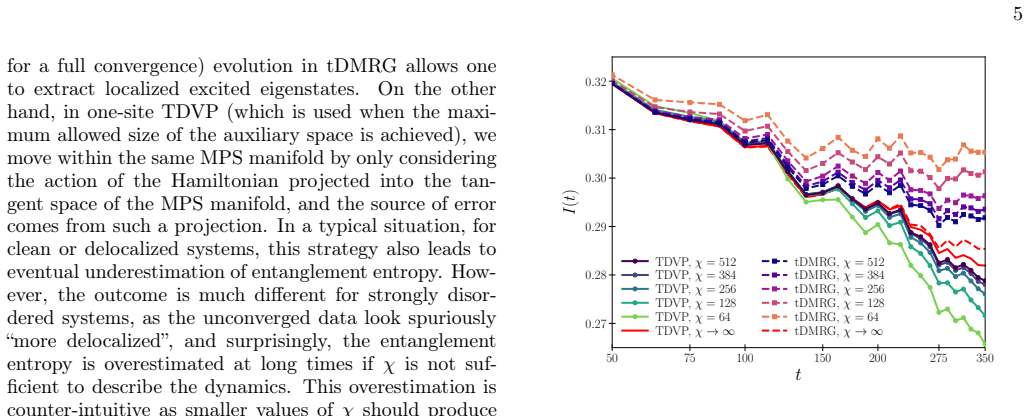
The central claim is that unconverged TDVP results in the MBL crossover are qualitatively wrong in a specific direction: with insufficient bond dimension $\chi$, the imbalance decays faster than the exact result while the half-chain entanglement entropy overshoots the true value at long times, so the data look "more delocalized" rather than simply under-resolved. tDMRG, by contrast, converges monotonically and its entanglement entropy serves as a lower bound. On this basis the paper revisits the earlier L=100 TDVP study, showing that its $W_c \approx 5.5$ estimate is inflated by the combination of insufficient $\chi$ and a permissive $\beta$ threshold, and estimates $W_c = 4.2 \pm 0.3$ from imbalance decay for L=50 and L=200, with only weak system-size dependence. The paper also reports that open boundary conditions shift the level-statistics critical disorder to $W_c = 3.29(9)$, and argues that level-statistics and finite-time dynamics probes need not yield the same transition point.
Load-bearing premise
The estimate $W_c = 4.2 \pm 0.3$ rests on the assumption that the imbalance decays as a power law $t^{-\beta}$ on the delocalized side; the paper concedes this form has no real theoretical foundation, and a logarithmic decay would shift the inferred transition toward larger disorder.
Editorial extensions
If this is right
- In the MBL crossover, TDVP results must be checked for bond-dimension convergence before drawing physical conclusions; a single $\chi$ value can place the system on the wrong side of the transition.
- The critical disorder of the disordered Heisenberg chain, as inferred from finite-time imbalance dynamics, is near $W_c \approx 4.2 \pm 0.3$ and depends only weakly on system size between L=50 and L=200, contrary to the strong size dependence reported previously.
- Because power-law and logarithmic fits of the imbalance are nearly indistinguishable on accessible time scales, critical-disorder estimates from curve fitting carry an irreducible ambiguity that should be reported.
- tDMRG's entanglement entropy is a reliable lower bound, so bracketing the true entropy between tDMRG and converged TDVP data gives a practical convergence test.
- The flowing-$\beta$ analysis indicates that W=4.5 is already on the localized side, supporting imbalance saturation in the thermodynamic limit.
- Existing TDVP-based studies of entanglement growth in the MBL crossover may overestimate growth exponents if their bond dimension was insufficient; re-analyzing published data with tDMRG lower bounds could revise reported exponents.
- The strong boundary-condition dependence of the level-statistics critical disorder (3.29 with open boundaries versus 3.72 with periodic boundaries) suggests that open-boundary finite-size scaling is not a clean thermodynamic probe, which may explain some discrepancies between level-statistics and dynamics-based transition estimates.
- A direct test of the paper's convergence picture would be to compute operator spreading or density propagators with both methods at matched $\chi$; the method-dependent direction of error should carry over if the mechanism is general.
Editorial analysis
A structured set of objections, weighed in public.
Referee Report
Summary. The paper compares two matrix-product-state time-evolution algorithms, tDMRG and TDVP, on the disordered Heisenberg chain, using exact Chebyshev propagation for L=26 as a benchmark. It reports that TDVP is more accurate than tDMRG in the delocalized regime, but that in the MBL crossover tDMRG gives more predictable, controllable errors, while TDVP with insufficient bond dimension can spuriously accelerate imbalance decay and overestimate the long-time entanglement entropy. The paper then studies larger systems (L=50, 200) and, from power-law fits of the imbalance decay in t∈[100,200] with a hand-chosen threshold β=0.02, estimates Wc≈4.2±0.3, arguing that the previous Wc≈5.5 estimate of Ref. [41] is affected both by insufficient bond dimension and by the β cutoff. It also reports an open-boundary-condition level-statistics estimate Wc=3.29(9) and argues that time-dynamics and level-statistics estimates need not coincide.
Significance. If the algorithm-comparison result holds, it is a valuable caution for the many TDVP-based studies of MBL dynamics: unconverged TDVP data in the crossover region are biased in a counter-intuitive direction, making the system appear more delocalized, and the entanglement entropy can be overestimated at long times. The benchmark against exact Chebyshev evolution for L=26 with multiple bond dimensions is a clear strength, as is the authors' explicit discussion of the fitting ambiguities in the transition-point estimate. The quantitative claim Wc≈4.2±0.3, however, is not on the same footing as the algorithm comparison, because it depends on an assumed power-law decay and a hand-chosen threshold whose sensitivity the authors themselves demonstrate.
major comments (2)
- [V, Fig. 15] The central quantitative claim that the transition lies at Wc≈4.2±0.3, contradicting the Wc≈5.5 estimate of Ref. [41], is not supported by the analysis as presented. The threshold β=0.02 is chosen by hand, and the text explicitly states that using the β≈0.01 cutoff of Ref. [41] shifts the apparent Wc close to 5 even for the L=26 Chebyshev data. Since Fig. 13 shows that a logarithmic fit matches the power-law fit to within RMS error up to t=1000, and the authors state that the power-law decay has "no real theoretical foundation," the difference between Wc≈4.2 and Wc≈5.5 is dominated by the fitting convention rather than by the corrected convergence behavior of TDVP. The quoted error bar ±0.3 does not include this systematic uncertainty. The manuscript should either remove or substantially weaken the quantitative Wc claim, report a range that explicitly includes the threshold sensitivity (e.g., roughly 4 to 5), or provide an objective, data-driven criterion for β_c.
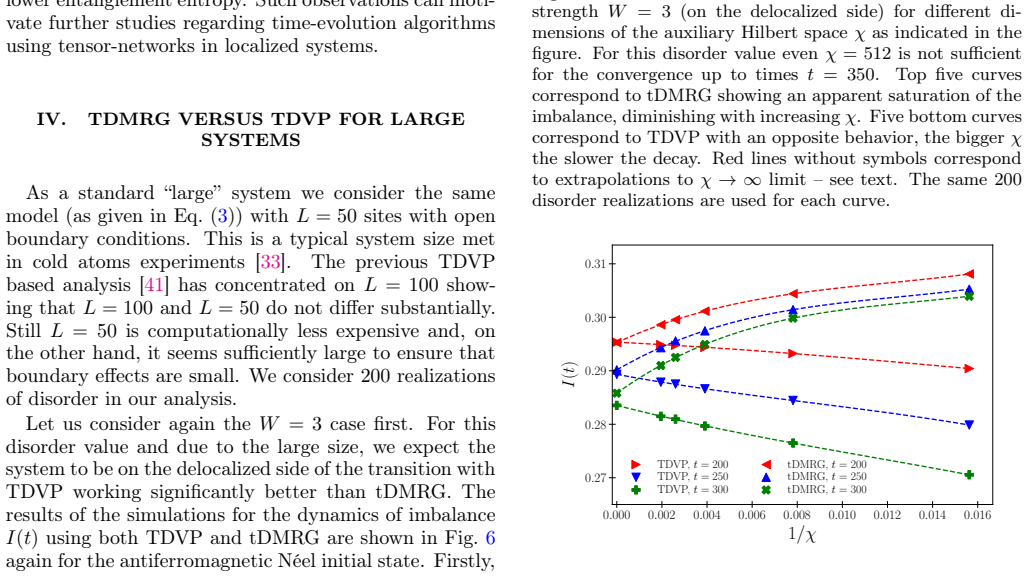
- [IV, Figs. 7–10 and 16] The χ→∞ extrapolation used in the flowing-β analysis is uncontrolled. A third-order polynomial in 1/χ is fitted to five data points with no stated uncertainty for the extrapolated value, and the authors note that at W=3 the TDVP and tDMRG extrapolations agree only up to moderate times and deteriorate at longer times. The flowing-β analysis in Fig. 16, which is used to argue that W=4.5 is above Wc, relies on these extrapolated data up to t=450. Please provide a systematic error estimate for the extrapolation (for example, testing higher-order fits or varying the set of χ values included) or restrict the conclusions to statements that do not depend on the extrapolated regime.
minor comments (3)
- [Abstract and I] "state-of-art estimate" should read "state-of-the-art estimate" in both the abstract and the introduction.
- [IV, Fig. 7 and Fig. 10 captions] The statement "Fitting errors are less than 10^-10" is unclear: if this refers to the residual of the polynomial fit in I(t), the value is implausibly small for a five-point fit, and if it refers to the extrapolated value, the basis should be stated. Please clarify or correct.
- [V, Fig. 14] The main text says "Shaded regions are discrepancies appearing in the delocalized regime," while the Fig. 14 caption says the exact Chebyshev data lie within a shaded area for L=26; please reconcile these descriptions.
Circularity Check
No significant circularity: the algorithm-comparison claims are benchmarked against exact Chebyshev dynamics, and the Wc estimate rests on an openly disclosed fitting threshold rather than a circular reduction.
full rationale
The paper's central technical claims about TDVP versus tDMRG are validated against an external, independent method: exact time evolution via Chebyshev polynomial expansion for L=26. The statements that TDVP at insufficient bond dimension overestimates the entanglement entropy at long times and makes the data look spuriously delocalized are supported by direct comparison with those exact results (Figs. 2-5), so they are not circular. The Wc≈4.2±0.3 estimate is derived by fitting the imbalance decay to a power law and reading off where the exponent β crosses a chosen threshold β=0.02. This is an openly described fitting procedure, not a hidden parameter renamed as a prediction. The paper explicitly flags the limitations: it states there is 'no real theoretical foundation' for the power-law conjecture, it admits the ambiguity of power-law versus logarithmic fits on the available time windows, and it acknowledges that 'a small shift of the fitted curves' or a different β cutoff would shift Wc, explicitly noting that β≈0.01 would move the apparent critical disorder close to 5. Those are limitations and sensitivity statements, not circular reductions. The self-citations present in the reference list are not load-bearing for the main derivation; the previous TDVP study [41] with which the paper disagrees is by a different group, and no uniqueness theorem or ansatz is smuggled in via self-citation. The paper is therefore self-contained against external benchmarks, and no circularity step can be identified from the quoted equations or text.
Assumptions & free parameters
free parameters (4)
- Critical decay threshold βc =
0.02
- Gaussian width σ̃ in flowing-β analysis =
60
- Time fit window =
Jt ∈ [100,200] (and [100,500] for Chebyshev)
- 1/χ extrapolation polynomial degree =
3
assumptions (4)
- domain assumption The disordered Heisenberg spin chain Hamiltonian (Eq. 3) is a valid model of the MBL transition.
- domain assumption Chebyshev polynomial expansion of the time-evolution operator is a numerically exact reference for L=26.
- ad hoc to paper Imbalance decay on the delocalized side follows a power law t^{-β} in the fitted time window.
- ad hoc to paper Finite-χ results extrapolate to χ→∞ as a third-order polynomial in 1/χ.
Cite this review
Pith. "Pith review of Time dynamics with matrix product states: Many-body localization transition of large systems revisited." pith.science (2026). https://pith.science/paper/BOMKKWFC
@misc{pith2026190806524,
  author       = {Pith},
  title        = {Pith review of: Time dynamics with matrix product states: Many-body localization transition of large systems revisited},
  year         = {2026},
  howpublished = {\url{https://pith.science/paper/BOMKKWFC}},
  note         = {Machine review of arXiv:1908.06524}
}
read the original abstract
We compare accuracy of two prime time evolution algorithms involving Matrix Product States - tDMRG (time-dependent density matrix renormalization group) and TDVP (time-dependent variational principle). The latter is supposed to be superior within a limited and fixed auxiliary space dimension. Surprisingly, we find that the performance of algorithms depends on the model considered. In particular, many-body localized systems as well as the crossover regions between localized and delocalized phases are better described by tDMRG, contrary to the delocalized regime where TDVP indeed outperforms tDMRG in terms of accuracy and reliability. As an example, we study many-body localization transition in a large size Heisenberg chain. We discuss drawbacks of previous estimates [Phys. Rev. B 98, 174202 (2018)] of the critical disorder strength for large systems.
Figures



Figures from the paper (9 more)



Reference graph
Works this paper leans on
-
[41]
claiming that the critical disorder corresponding to MBL transition strongly depends on the system size. We also analyse this issue in this work, but first we com- pare the performance of tDMRG and TDVP in systems close to localized regime. Surprisingly, we have found in- dications that when non-ergodic features in the dynam- ics become pronounced (as at t...
-
[1]
Schollwöck, Annals of Physics326, 96 (2011)
U. Schollwöck, Annals of Physics326, 96 (2011)
2011
-
[2]
Orús, Annals of Physics349, 117 (2014)
R. Orús, Annals of Physics349, 117 (2014)
2014
-
[3]
S. R. White, Phys. Rev. Lett.69, 2863 (1992)
1992
-
[4]
S. R. White, Phys. Rev. B72, 180403 (2005)
work page 2005
- [5]
-
[6]
Vidal, Phys
G. Vidal, Phys. Rev. Lett.91, 147902 (2003)
2003
-
[7]
Vidal, Phys
G. Vidal, Phys. Rev. Lett.93, 040502 (2004)
2004
Show all 67 references
-
[8]
S. R. White, Phys. Rev. B48, 10345 (1993)
1993
-
[9]
S. R. White and A. E. Feiguin, Phys. Rev. Lett. 93, 076401 (2004)
2004
-
[10]
A. J. Daley, C. Kollath, U. Schollwöck, and G. Vidal, Journal of Statistical Mechanics: Theory and Experi- ment 2004, P04005 (2004)
2004
-
[11]
Vidal, Phys
G. Vidal, Phys. Rev. Lett.98, 070201 (2007)
2007
-
[12]
Orús and G
R. Orús and G. Vidal, Phys. Rev. B78, 155117 (2008)
2008
-
[13]
M. P. Zaletel, R. S. K. Mong, C. Karrasch, J. E. Moore, and F. Pollmann, Phys. Rev. B91, 165112 (2015)
2015
-
[14]
Verstraete, Phys
J.Haegeman, J.I.Cirac, T.J.Osborne, I.Pižorn, H.Ver- schelde, and F. Verstraete, Phys. Rev. Lett.107, 070601 (2011)
2011
-
[15]
Koffel, M
T. Koffel, M. Lewenstein, and L. Tagliacozzo, Phys. Rev. Lett. 109, 267203 (2012)
2012
-
[16]
Haegeman, C
J. Haegeman, C. Lubich, I. Oseledets, B. Vandereycken, and F. Verstraete, Phys. Rev. B94, 165116 (2016)
2016
-
[17]
Time-evolution methods for matrix-product states,
S. Paeckel, T. Köhler, A. Swoboda, S. R. Manmana, U. Schollwöck, and C. Hubig, “Time-evolution methods for matrix-product states,” arXiv:1901.05824
1901 arXiv
-
[18]
Quantum thermalization dynamics with matrix-product states,
E. Leviatan, F. Pollmann, J. H. Bardarson, D. A. Huse, and E. Altman, “Quantum thermalization dynamics with matrix-product states,” arXiv:1702.08894
-
[19]
Kloss, Y
B. Kloss, Y. B. Lev, and D. Reichman, Phys. Rev. B97, 024307 (2018)
2018
-
[20]
Goto and I
S. Goto and I. Danshita, Phys. Rev. B99, 054307 (2019)
2019
-
[21]
Tensor net- work approaches to operator spreading in ergodic quan- tum systems,
K. Hémery, F. Pollmann, and D. J. Luitz, “Tensor net- work approaches to operator spreading in ergodic quan- tum systems,” arXiv:1901.05793
1901 arXiv
-
[22]
S. R. Clark and D. Jaksch, Phys. Rev. A 70, 043612 (2004)
2004
-
[23]
Kollath, A
C. Kollath, A. Iucci, T. Giamarchi, W. Hofstetter, and U. Schollwöck, Phys. Rev. Lett.97, 050402 (2006)
2006
-
[24]
Kollath, A
C. Kollath, A. M. Läuchli, and E. Altman, Phys. Rev. Lett. 98, 180601 (2007)
2007
-
[25]
Žnidarič, T
M. Žnidarič, T. Prosen, and P. Prelovšek, Phys. Rev. B 77, 064426 (2008)
2008
-
[26]
M. L. Wall and L. D. Carr, New Journal of Physics11, 055027 (2009)
2009
-
[27]
Zakrzewski and D
J. Zakrzewski and D. Delande, Phys. Rev. A80, 013602 (2009)
2009
-
[28]
more delocalized
that a long time (beyond any reasonable time scale 5 for a full convergence) evolution in tDMRG allows one to extract localized excited eigenstates. On the other hand, in one-site TDVP (which is used when the maxi- mum allowed size of the auxiliary space is achieved), we move ...
-
[29]
Łącki, D
M. Łącki, D. Delande, and J. Zakrzewski, New Journal of Physics15, 013062 (2013)
2013
-
[30]
Delande, K
D. Delande, K. Sacha, M. Płodzień, S. K. Avazbaev, and J. Zakrzewski, New Journal of Physics15, 045021 (2013). 11
2013
-
[31]
Karrasch, J
C. Karrasch, J. E. Moore, and F. Heidrich-Meisner, Phys. Rev. B89, 075139 (2014)
2014
-
[32]
Huang, Annals of Physics380, 224 (2017)
Y. Huang, Annals of Physics380, 224 (2017)
2017
-
[33]
exact” result obtained by the Chebyshev approach. In- terestingly, TDVP leads to a much faster decay of the imbalance than the exact result, approaching the “exact
to study MBL dynamics. In all numerical examples shown, we disregard two sites on each edge of the chain to minimize the effect of open boundary conditions. This 3 100 150 200 300 500 800 1000 t 0.26 0.28 0.30 0.32 I(t) δt = 0.02 δt = 0.1 Figure 1. Imbalance I(t) as a function ...
-
[34]
Łącki, D
M. Łącki, D. Delande, and J. Zakrzewski, Phys. Rev. A 86, 013602 (2012)
2012
-
[35]
Prelovšek, O
P. Prelovšek, O. S. Barišić, and M. Žnidarič, Phys. Rev. B 94, 241104 (2016)
2016
-
[36]
van Nieuwenburg, J
E. van Nieuwenburg, J. Y. Malo, A. Daley, and M. Fischer, Quantum Science and Technology3, 01LT02 (2017)
2017
-
[37]
Sierant, D
P. Sierant, D. Delande, and J. Zakrzewski, Phys. Rev. A 95, 021601 (2017)
2017
-
[38]
Schreiber, S
M. Schreiber, S. S. Hodgman, P. Bordia, H. P. Lüschen, M. H. Fischer, R. Vosk, E. Altman, U. Schneider, and I. Bloch, Science349, 7432 (2015)
2015
-
[39]
Žnidarič, A
M. Žnidarič, A. Scardicchio, and V. K. Varma, Phys. Rev. Lett.117, 040601 (2016)
2016
-
[40]
Zakrzewski and D
J. Zakrzewski and D. Delande, Phys. Rev. B98, 014203 (2018)
2018
-
[42]
Weiße, G
A. Weiße, G. Wellein, A. Alvermann, and H. Fehske, Rev. Mod. Phys.78, 275 (2006)
2006
-
[43]
We conclude in Section VI
that questions the MBL existence in the thermody- namic limit. We conclude in Section VI. II. NUMERICAL TOOLS In this section, we briefly discuss our implementations of two MPS-based time-evolution strategies used in this work – A: time-dependent density matrix renormaliza- arX...
1908 arXiv
-
[44]
Sierant, D
P. Sierant, D. Delande, and J. Zakrzewski, Acta Phys. Polon. A132, 1707 (2017)
2017
-
[45]
Sierant and J
P. Sierant and J. Zakrzewski, New Journal of Physics20, 043032 (2018)
2018
-
[46]
E. V. H. Doggen, F. Schindler, K. S. Tikhonov, A. D. Mirlin, T. Neupert, D. G. Polyakov, and I. V. Gornyi, Phys. Rev. B98, 174202 (2018)
2018
-
[47]
D. J. Luitz, N. Laflorencie, and F. Alet, Phys. Rev. B 91, 081103 (2015)
2015
-
[48]
Šuntajs, J
J. Šuntajs, J. Bonča, T. Prosen, and L. Vidmar, arXiv e-prints , arXiv:1905.06345 (2019), arXiv:1905.06345 [cond-mat.str-el]
2019 arXiv
-
[49]
A. T. Sornborger and E. D. Stewart, Phys. Rev. A60, 1956 (1999)
1999
-
[50]
Hochbruck and C
M. Hochbruck and C. Lubich, SIAM Journal on Numer- ical Analysis34, 1911 (1997)
1997
-
[51]
Mondaini and M
R. Mondaini and M. Rigol, Phys. Rev. A 92, 041601 (2015)
2015
-
[52]
H. P. Lüschen, P. Bordia, S. Scherg, F. Alet, E. Altman, U. Schneider, and I. Bloch, Phys. Rev. Lett.119, 260401 (2017)
2017
-
[53]
S. Bera, G. De Tomasi, F. Weiner, and F. Evers, Phys. Rev. Lett.118, 196801 (2017)
2017
-
[54]
Sierant, K
P. Sierant, K. Biedroń, G. Morigi, and J. Zakrzewski, SciPost Phys.7, 8 (2019)
2019
-
[55]
that suggest critical disorder strength to be about W = 4.5(1) in the middle of the spectrum. Taking all the arguments, and in particular the certain arbitrariness of the threshold β choice, we give rather large error for our estimate of the critical disorder as Wc = 4.2± 0.3....
2000
-
[56]
Slow dynamics in many-body localized system with random and quasi- periodic potential,
F. Weiner, F. Evers, and S. Bera, “Slow dynamics in many-body localized system with random and quasi- periodic potential,” arXiv:1904.06928
1904 arXiv
-
[57]
D. J. Luitz, N. Laflorencie, and F. Alet, Phys. Rev. B 93, 060201 (2016)
2016
-
[58]
Bauer and C
B. Bauer and C. Nayak, Journal of Statistical Mechanics: Theory and Experiment2013, P09005 (2013)
2013
-
[59]
J. H. Bardarson, F. Pollmann, and J. E. Moore, Phys. Rev. Lett.109, 017202 (2012)
2012
-
[60]
Devakul and R
T. Devakul and R. R. P. Singh, Phys. Rev. Lett.115, 187201 (2015)
2015
-
[61]
E. V. H. Doggen and A. D. Mirlin, Phys. Rev. B100, 104203 (2019)
2019
-
[62]
Pietracaprina, N
F. Pietracaprina, N. Macé, D. J. Luitz, and F. Alet, SciPost Phys.5, 45 (2018)
2018
-
[63]
Model of level statistics for disordered interacting quantum many-body systems,
P. Sierant and J. Zakrzewski, “Model of level statistics for disordered interacting quantum many-body systems,” arXiv:1907.10336
1907 arXiv
-
[64]
Schiulaz, E
M. Schiulaz, E. J. Torres-Herrera, and L. F. Santos, Phys. Rev. B99, 174313 (2019)
2019
-
[65]
D. A. Abanin, J. H. Bardarson, G. D. Tomasi, S. Gopalakrishnan, V. Khemani, S. A. Parameswaran, F. Pollmann, A. C. Potter, M. Serbyn, and R. Vasseur, arXiv:1911.04501
1911 arXiv
- [66]
-
[67]
R. K. Panda, A. Scardicchio, M. Schulz, S. R. Taylor, and M. Žnidarič, arXiv:1911.07882
1911 arXiv
Reviewed August 14, 2026 · model on record in the stance chip above.
Discussion (0). Continue with ORCID to comment.