REVIEW 4 major objections 5 minor 58 references
Suppression of superfluidity by dissipation -- An application to failed superconductor
T0 review · 4 major / 5 minor · reviewed 2026-08-14 · deepseek-v4-flash
Pith's one-line read Dissipation alone can destroy superfluidity in a dilute boson fluid, leaving a metallic state at zero temperature — a mechanism for the 'failed superconductor'.
desk verdict A plausible dilute-boson route to dissipation-driven loss of superfluidity, but the zero-temperature transition leans heavily on an unproven Gaussian ansatz. read the letter →
The pith
A machine-rendered reading of the paper's core claim, the machinery that carries it, and where it could break.
The reading
What carries the argument
The load-bearing object is the off-diagonal single-particle density matrix y(|r−r′|) ∝ exp[−(r−r′)²⟨p²⟩/(2ℏ²)], whose Gaussian width is set by the momentum variance. In an Ohmic bath, ⟨p²⟩ computed from quantum Brownian motion (Caldeira–Leggett theory) saturates to a finite value as β→∞, so the exchange action stays finite while the entropy of exchange configurations stays constant; the competition then drives the transition temperature to zero at a critical dissipation strength. The paper also uses the winding-number Monte Carlo estimator of the superfluid density and the transverse current–current response at one-loop level in a Bogoliubov approximation as independent checks.
What would settle it
Measure or simulate the superfluid fraction of a dilute boson fluid with Ohmic dissipation at temperatures far below the boson exchange scale and extrapolate to T=0: the paper predicts ρs reaches exactly zero at a finite critical dissipation strength. A direct check of the criterion would compare the zero-temperature momentum variance to the interparticle spacing and verify that d²⟨p²⟩/ℏ² ≈ 1 at the same critical coupling.
Extended reading notes
Core claim
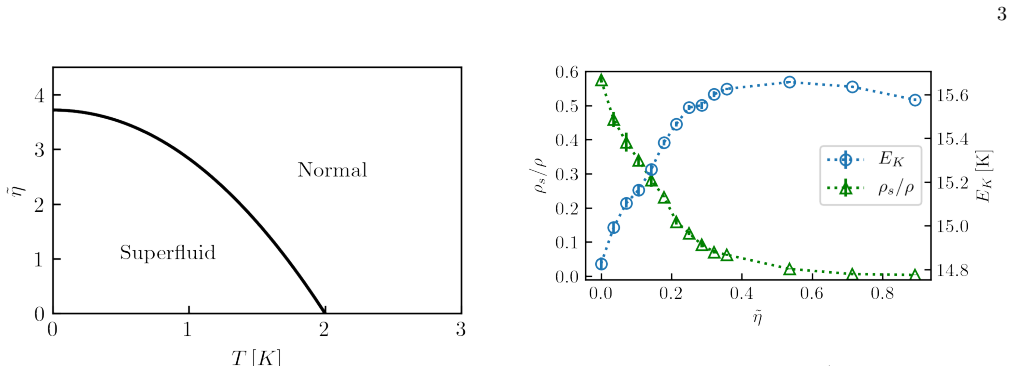
At zero temperature a translation-invariant boson fluid is normally a perfect superfluid, with superfluid density equal to the total density because Galilean invariance fixes the phase action. The paper's central claim is that a time-nonlocal dissipative term breaks that invariance in a way that suppresses superfluidity: in the Feynman picture the off-diagonal single-particle density matrix keeps a finite width (the momentum variance ⟨p²⟩ saturates) as T→0, so the action for macroscopic exchange processes no longer vanishes and bosons cannot condense into collective motion. The authors show numerically that the superfluid fraction ρs/ρ falls monotonically with dissipation strength, and analytically in a second model that ρs reaches zero at a finite critical dissipation while the condensate density ρ0 remains nonzero at that point.
Load-bearing premise
The extended Feynman argument assumes that in an interacting boson fluid the off-diagonal single-particle density matrix remains Gaussian and that interactions only renormalize the particle mass; if that fails, the zero-temperature transition is not rigorously established, and the numerical simulation alone only demonstrates suppression at finite temperature.
Editorial extensions
If this is right
- Dilute bosons coupled to an Ohmic bath remain metallic at zero temperature, providing a microscopic route to the bose metal.
- In two-dimensional superconductors in a magnetic field, dissipative vortex cores lose their superfluidity; since vortex density grows with field, this gives a giant positive magnetoresistance.
- Dissipation also modifies the zero-field vortex-loop proliferation transition, leading to a phase distinct from the ordinary superfluid.
- A retarded, time-nonlocal interaction that breaks Galilean invariance is sufficient to destroy superfluidity even without disorder or a lattice.
Reading between the lines
- The same mechanism should apply to other gapless baths or retarded interactions that freeze the off-diagonal density matrix; the criterion d²⟨p²⟩/ℏ² ~ 1 offers a quantitative test in any bosonic simulator.
- The one-loop result that condensate density remains finite when superfluid density vanishes is likely an artifact of the approximation; the Josephson relation suggests both should vanish together, which is testable with improved numerics.
- Engineered dissipation in cold-atom or superconducting-circuit platforms could continuously tune a superfluid into a metal, making the predicted zero-temperature metallic phase observable.
Signed reviews
Editorial analysis
A structured set of objections, weighed in public.
Referee Report
Summary. The manuscript argues that Ohmic dissipation, modeled by a nonlocal imaginary-time action, suppresses superfluidity in a dilute boson system and can drive it into a metallic state with vanishing superfluid density at zero temperature. The argument is developed in three parts: first, an extension of Feynman's polygon picture in which the off-diagonal single-particle density matrix of a dissipative quantum Brownian particle is inserted into the exchange-action estimate, yielding a criterion for a zero-temperature dissipative transition; second, path-integral Monte Carlo simulations of a first-quantized boson fluid with Aziz interactions at T = 2 K in three dimensions (N = 64) and T = 0.5 K in two dimensions (N = 25), showing a monotonic decrease of the superfluid fraction and condensate fraction with dissipation strength; and third, a zero-temperature one-loop Bogoliubov calculation in a second-quantized model with a frequency-dependent dissipative term, showing that the superfluid density vanishes at a critical dissipation strength. The results are connected to the 'failed superconductor' scenario in which vortices are subjected to dissipation from normal cores.
Significance. If the zero-temperature claim is correct, this would be an important contribution to the bose-metal problem, proposing a mechanism distinct from disorder and relevant to experiments on two-dimensional superconductors. The paper has real strengths: it presents an explicit first-quantized action, a direct quantum Monte Carlo simulation with a standard worm algorithm, a separate field-theoretic calculation with explicit formulas, and the authors are candid about the assumptions and limitations. The finite-temperature trend is robust and physically plausible. However, the central zero-temperature claim is currently supported only by combining a single-particle quantum Brownian motion result with an unproven Gaussian and mass-renormalization assumption, a heuristic order-one threshold, and finite-temperature numerics without zero-temperature extrapolation. The one-loop field theory is internally inconsistent at the point where the superfluid density vanishes because the condensate density remains finite, in conflict with the Josephson relation unless additional assumptions are made. The significance of the paper is therefore conditional on resolving these gaps.
major comments (4)
- [Extended Feynman's argument, Eq. (3)] The analytical zero-temperature criterion uses Eq. (3), which is the free-particle quantum Brownian motion result, and assumes that interactions only renormalize the mass and preserve the Gaussian form of the off-diagonal density matrix. The authors state this explicitly, writing that 'we assume that this form remains valid even in the presence of the interaction between particles' and that 'the effect of the interaction can be renormalized to the effective mass of the particle,' but no independent test is provided. This assumption is load-bearing because the exchange-action estimate for superfluidity requires the off-diagonal density matrix of the interacting dissipative system; if the distribution deviates from Gaussian or the mass renormalization is scale- or density-dependent, the predicted strong suppression could be quantitatively wrong or qualitatively inapplicable. A direct check would be to extract the off-diagonal density matrix or its second moment from the interacting QMC data and compare it with the single-particle expression Eq. (S2).
- [Extended Feynman's argument, critical criterion after Eq. (3)] The zero-temperature critical coupling is fixed by the heuristic condition d^2 <p^2>_{T=0}/hbar^2 ~ 1, where the constant is left unspecified as order one. Since the phase boundary in Fig. 1 is additionally calibrated by setting the dissipationless transition temperature to T = 2 K rather than by a microscopic criterion, the quantitative location of the predicted zero-temperature transition is schematic. This is acceptable for a conjecture, but it is not a derivation of the critical dissipation strength, and the statement that dissipation 'can lose the superfluidity' at zero temperature is not quantitatively established by this argument.
- [Result of the numerical calculation, Figs. 2 and S3] The Monte Carlo results show a monotonic decrease of the superfluid fraction with dissipation strength at one finite temperature in each dimensionality (T = 2 K in three dimensions and T = 0.5 K in two dimensions), each with a single system size and no error bars. No temperature sweep or finite-size scaling is presented, so the data demonstrate a finite-temperature suppression but do not establish a zero-temperature transition to a phase with rho_s = 0. The text later states that 'the transition to the phase with rho_s = 0 in this model remains intact,' but the numerical support for this statement is missing; an extrapolation in temperature and system size would be needed.
- [Second Model, Fig. 5 and the Josephson relation] The one-loop field-theoretic calculation shows that rho_s vanishes while rho_0 remains finite at the critical dissipation, and the authors concede that 'assuming the smooth behavior of the single particle Green function at the critical point, the Josephson relation requires that both rho_0 and rho_s becomes zero.' This is an acknowledged internal inconsistency in the only zero-temperature calculation of the second model. Consequently, the one-loop result cannot serve as an internally consistent proof of a zero-temperature normal phase; resolving whether rho_0 actually vanishes at the critical point, or whether the one-loop approximation breaks down, is required before the second model can be regarded as independent confirmation of the central claim.
minor comments (5)
- [Eq. (2) and following text] The replacement of the finite-temperature dissipative kernel by the zero-temperature kernel with periodic image lines is only sketched; a derivation or a more explicit reference to the polaron analogy in footnotes [33,57,58] would clarify the validity of this step at finite beta.
- [Fig. 3 and text near it] The fitting function for the off-diagonal density matrix omits the coupling term, and the authors note that this leads to an overestimation of n0; the magnitude of this overestimation is not quantified, which weakens the quantitative meaning of the condensate fraction shown in Fig. 3.
- [Result of the numerical calculation] The Monte Carlo section reports no statistical error bars in Figs. 2, 3, S1, and S3; adding error bars and reporting the binning analysis would make the monotonic trends more convincing.
- [Eqs. (5) and (6)] The quantities epsilon_k and omega_k used in the Green functions are not explicitly defined in the main text; the authors should state that epsilon_k = k^2/2m and give the explicit Bogoliubov dispersion used.
- [Eq. (4)] The word 'discritized' should be 'discretized'; there are also several typographical inconsistencies with mathematical symbols in the displayed action in the introduction.
Circularity Check
No significant circularity: dissipation strength enters as an input and superfluidity is evaluated by independent estimators (winding-number QMC and one-loop current response); the paper's approximations are stated assumptions, not fitted targets.
full rationale
The paper's central claim is that Ohmic dissipation can drive dilute bosons into a metallic state. The derivation chain is not circular. In the first model, the dissipative action (Eq. 1) contains η as an external parameter; the off-diagonal density matrix result (Eq. 3) is the standard quantum-Brownian-motion expression from Weiss and Caldeira-Leggett, and it is used in Feynman's polygon criterion to infer a phase boundary. The Gaussian form and mass renormalization are explicitly assumed, not derived from the target conclusion, and the QMC cross-check computes ρs from the independent winding-number estimator rather than from the assumed Gaussian form. In the second model, ρs is computed from the transverse current-current response (Eq. 5) with η as a control parameter, ρ0 determined from Eq. (6), and cutoffs stated; no parameter is fitted to enforce ρs = 0. The Josephson-relation caveat (Fig. 5 discussion) is an acknowledged consistency limitation of the one-loop calculation, not a circular use of the conclusion. The only self-citation ([27], a textbook used for the Ohmic-bath action) is not load-bearing, since the same input is standard and independently cited via Caldeira-Leggett and Weiss. The finite-temperature QMC limitation and the Gaussian-assumption uncertainty are correctness concerns, not circularity.
Assumptions & free parameters
free parameters (3)
- Threshold constant in T=0 transition criterion =
1 (dimensionless)
- Bath UV cutoff tau_c in Monte Carlo =
0.2 (3D), 0.05 (2D)
- Energy and frequency cutoffs in field theory =
epsilon_c = 900 rho g, omega_c = 1000 rho g
assumptions (4)
- domain assumption Feynman's exchange-picture characterization of superfluidity: superfluidity is associated with macroscopic exchange processes and winding-number fluctuations.
- domain assumption The Caldeira-Leggett model with Ohmic spectral density describes the coupling to the environment.
- ad hoc to paper The off-diagonal density matrix remains Gaussian in the presence of interactions, with interactions only renormalizing the mass.
- domain assumption Bogoliubov approximation in the field-theoretic model: only quadratic fluctuations around the condensate are retained.
Cite this review
Pith. "Pith review of Suppression of superfluidity by dissipation -- An application to failed superconductor." pith.science (2026). https://pith.science/paper/LRMXBQ3M
@misc{pith2026190806590,
  author       = {Pith},
  title        = {Pith review of: Suppression of superfluidity by dissipation -- An application to failed superconductor},
  year         = {2026},
  howpublished = {\url{https://pith.science/paper/LRMXBQ3M}},
  note         = {Machine review of arXiv:1908.06590}
}
read the original abstract
The ground states of bosons have been classified into superfluid, Mott insulator, and bose glass. Recent experiments in two-dimensional superconductors strongly suggest the existence of the fourth quantum state of Cooper pairs, i.e., bose metal or quantum metal, where the resistivity remains constant at lowest temperature. However, its theoretical understanding remains unsettled. In this paper, we show theoretically that the bosons in the dilute limit subject to dissipation can lose the superfluidity and remain metallic, utilizing the Feynman's picture of superfluidity in the first quantized formulation. This result is relevant to the quantum vortices under an external magnetic field in two-dimensional superconductors with the finite resistivity of the normal core as the source of dissipation.
Figures


Reference graph
Works this paper leans on
-
[1]
A. Kapitulnik, S. A. Kivelson, and B. Spivak, Reviews of Modern Physics 91, 011002 (2019)
work page 2019
-
[2]
D. Dalidovich and P. Phillips, Physical Review Letters84, 737 (2000)
work page 2000
-
[3]
L. Zhu, Y. Chen, and C. M. Varma, Physical Review B 91, 205129 (2015)
work page 2015
-
[4]
L. Zhu, C. Hou, and C. M. Varma, Physical Review B 94, 235156 (2016)
work page 2016
- [5]
-
[6]
S. Chakravarty, G.-L. Ingold, S. Kivelson, and A. Luther, Physical Review Letters 56, 2303 (1986)
work page 1986
-
[7]
S. Chakravarty, G.-L. Ingold, S. Kivelson, and G. Zi- manyi, Physical Review B 37, 3283 (1988)
work page 1988
-
[8]
M. P. A. Fisher and G. Grinstein, Physical Review Letters 60, 208 (1988)
work page 1988
Show all 58 references
-
[9]
M. P. A. Fisher, P. B. Weichman, G. Grinstein, and D. S. Fisher, Physical Review B 40, 546 (1989)
1989
-
[10]
Sachdev, Quantum Phase Transitions (Cambridge University Press, Cambridge, 2011)
S. Sachdev, Quantum Phase Transitions (Cambridge University Press, Cambridge, 2011)
2011
-
[11]
Z. Cai, U. Schollw¨ ock, and L. Pollet, Physical Review Letters 113, 260403 (2014)
2014
-
[12]
Greiter, F
M. Greiter, F. Wilczek, and E. Witten, Mod.Phys.Lett. B3, 903 (1989)
1989
-
[13]
Son and M
D. Son and M. Wingate, Annals of Physics 321, 197 (2006)
2006
-
[14]
I. J. R. Aitchison, P. Ao, D. J. Thouless, and X.-M. Zhu, Physical Review B 51, 6531 (1995)
1995
-
[15]
I. J. R. Aitchison, G. Metikas, and D. J. Lee, Physical Review B 62, 6638 (2000)
2000
-
[16]
V. N. Popov, Functional integrals and collective excita- tions, Cambridge monographs on mathematical physics (Cambridge Univ. Press, Cambridge, 1987)
1987
-
[17]
H. T. C. Stoof, D. B. M. Dickerscheid, and K. Gubbels, Ultracold quantum fields (Springer, Berlin, 2009)
2009
-
[18]
Imada, A
M. Imada, A. Fujimori, and Y. Tokura, Reviews of Mod- ern Physics 70, 1039 (1998)
1998
-
[19]
Huang and H.-F
K. Huang and H.-F. Meng, Physical Review Letters 69, 644 (1992)
1992
-
[20]
A. V. Lopatin and V. M. Vinokur, Physical Review Let- ters 88, 235503 (2002)
2002
-
[21]
M. V. Feigelman, V. B. Geshkenbein, L. B. Ioffe, and A. I. Larkin, Physical Review B 48, 16641 (1993)
1993
-
[22]
Weiss, Quantum Dissipative Systems , 4th ed
U. Weiss, Quantum Dissipative Systems , 4th ed. (WORLD SCIENTIFIC, 2012)
2012
-
[23]
R. P. Feynman, Physical Review 91, 1291 (1953)
1953
-
[24]
R. P. Feynman, Physical Review 94, 262 (1954)
1954
-
[25]
N. B. Kopnin, Theory of nonequilibrium superconductiv- ity, International series of monographs on physics No. 110 (Oxford Univ. Press, Oxford, 2009)
2009
-
[26]
A. O. Caldeira and A. J. Leggett, Annals of Physics 149, 374 (1983)
1983
-
[27]
Nagaosa, Quantum Field Theory in Condensed Matter Physics, Theoretical and Mathematical Physics (Springer- Verlag, Berlin Heidelberg, 1999)
N. Nagaosa, Quantum Field Theory in Condensed Matter Physics, Theoretical and Mathematical Physics (Springer- Verlag, Berlin Heidelberg, 1999)
1999
-
[28]
O. S. Duarte and A. O. Caldeira, Physical Review Letters 97, 250601 (2006)
2006
-
[29]
R. P. Feynman, Physical Review 90, 1116 (1953)
1953
-
[30]
E. L. Pollock and D. M. Ceperley, Physical Review B 36, 8343 (1987)
1987
-
[31]
D. M. Ceperley, Reviews of Modern Physics 67, 279 (1995)
1995
-
[32]
S. M. Apenko, Physical Review B 60, 3052 (1999)
1999
-
[33]
We note that there is a similar problem in the treatment of the effective mass of polaron [57, 58]
-
[34]
Boninsegni, N
M. Boninsegni, N. Prokof’ev, and B. Svistunov, Physical Review Letters 96, 070601 (2006)
2006
-
[35]
Boninsegni, N
M. Boninsegni, N. V. Prokof’ev, and B. V. Svistunov, Physical Review E 74, 036701 (2006)
2006
-
[36]
Mezzacapo and M
F. Mezzacapo and M. Boninsegni, Physical Review Let- ters 97, 045301 (2006)
2006
-
[37]
Mezzacapo and M
F. Mezzacapo and M. Boninsegni, Physical Review A 75, 033201 (2007)
2007
-
[38]
R. A. Aziz, V. P. S. Nain, J. S. Carley, W. L. Taylor, and G. T. McConville, The Journal of Chemical Physics 70, 4330 (1979)
1979
-
[39]
Ambegaokar and M
V. Ambegaokar and M. Troyer, American Journal of Physics 78, 150 (2010)
2010
-
[40]
S. A. Chin, Physics Letters A 226, 344 (1997)
1997
-
[41]
Werner, M
P. Werner, M. Troyer, and S. Sachdev, Journal of the Physical Society of Japan 74, 67 (2005)
2005
-
[42]
Werner, K
P. Werner, K. V¨ olker, M. Troyer, and S. Chakravarty, Physical Review Letters 94, 047201 (2005)
2005
-
[43]
See supplemental material for the details of the off diag- onal density matrix and the numerical calculation in two dimension
-
[44]
H. R. Glyde, Reports on Progress in Physics 81, 014501 (2017)
2017
-
[45]
Nozieres, Theory Of Quantum Liquids (CRC Press, 2018)
P. Nozieres, Theory Of Quantum Liquids (CRC Press, 2018). 6
2018
-
[46]
Griffin, Excitations in a Bose-condensed liquid (Cam- bridge University Press, Cambridge, 1993)
A. Griffin, Excitations in a Bose-condensed liquid (Cam- bridge University Press, Cambridge, 1993)
1993
-
[47]
Keeling, Physical Review Letters 107, 080402 (2011)
J. Keeling, Physical Review Letters 107, 080402 (2011)
2011
-
[48]
B. D. Josephson, Physics Letters 21, 608 (1966)
1966
-
[49]
C. A. Mller, Physical Review A 91, 023602 (2015)
2015
-
[50]
Caroli, P
C. Caroli, P. G. De Gennes, and J. Matricon, Physics Letters 9, 307 (1964)
1964
-
[51]
Stone, Physical Review B 53, 16573 (1996)
M. Stone, Physical Review B 53, 16573 (1996)
1996
-
[52]
Bardeen and M
J. Bardeen and M. J. Stephen, Physical Review 140, A1197 (1965)
1965
-
[53]
Saito, T
Y. Saito, T. Nojima, and Y. Iwasa, Nature Communica- tions 9, 778 (2018)
2018
-
[54]
L. L. Foldy, Physical Review 124, 649 (1961)
1961
-
[55]
S. R. Hore and N. E. Frankel, Physical Review B 12, 2619 (1975)
1975
-
[56]
J. C. Lee, Physical Review B 12, 2644 (1975)
1975
-
[57]
R. P. Feynman, Physical Review 97, 660 (1955)
1955
-
[58]
Suppression of superfluidity by dissipation — An application to failed superconductor
D. C. Khandekar, K. V. Bhagwat, and S. V. Lawande, Physical Review B 37, 3085 (1988). 7 Supplemental material for “Suppression of superfluidity by dissipation — An application to failed superconductor” Off diagonal density matrix in three dimension Here, we will discuss the resu...
1988
Reviewed August 14, 2026 · model on record in the stance chip above.
Discussion (0). Continue with ORCID to comment.