REVIEW 4 major objections 5 minor 2 cited by
The influence of a top-heavy integrated galactic IMF and dust on the chemical evolution of high-redshift starbursts
T0 review · 4 major / 5 minor · reviewed 2026-08-14 · deepseek-v4-flash
Pith's one-line read High-redshift starburst abundance patterns are equally consistent with top-heavy IMFs plus little dust or with Salpeter-like IMFs plus lots of dust.
desk verdict A useful model/data comparison that honestly exposes an IMF-vs-dust degeneracy in high-z starburst abundance patterns; the specific beta thresholds should not be over-read until the extrapolated cluster-mass relation is sensitivity-tested. read the letter →
The pith
A machine-rendered reading of the paper's core claim, the machinery that carries it, and where it could break.
The reading
What carries the argument
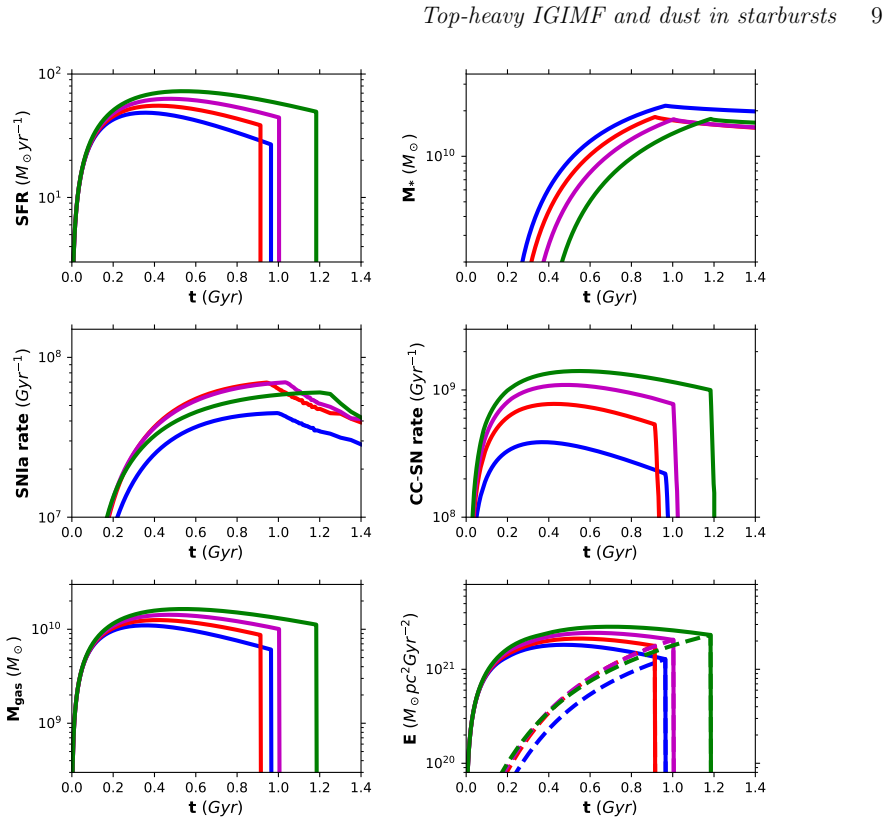
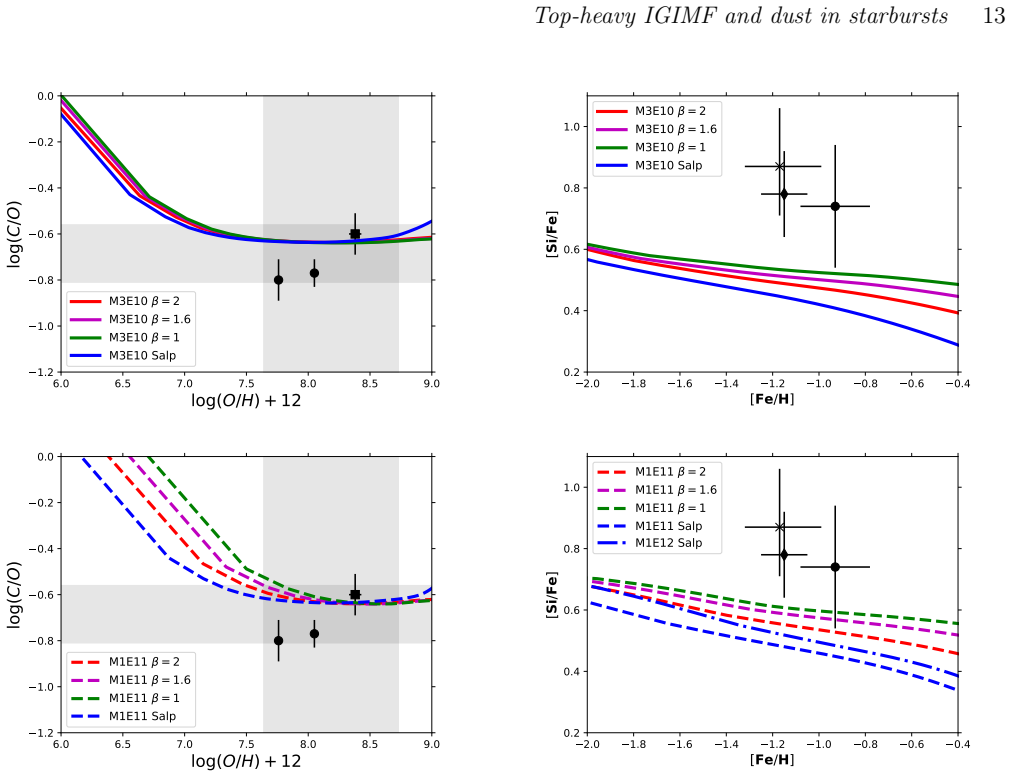
The load-bearing object is the IGIMF, built by integrating a universal cluster IMF over the embedded cluster mass function, $\xi_{\rm ecl}(M_{\rm ecl})\propto M_{\rm ecl}^{-\beta}$, whose upper limit rises with star formation rate as $M_{\rm ecl,max}=8.5\times10^4(\psi/M_\odot\,{\rm yr}^{-1})^{0.75}\,M_\odot$, capped at $10^7\,M_\odot$. Lower $\beta$ or higher SFR flattens the galaxy-wide IMF, increasing massive-star yields and dust production. This is coupled to a dust-evolution model that tracks dust production from supernovae and AGB stars, dust growth, destruction, and differential depletion of refractory elements; the dust treatment is what makes the $\beta$-degeneracy visible in the $[\mathrm{Si}/\mathrm{Fe}]$, $[\mathrm{Mg}/\mathrm{Fe}]$, and $[\mathrm{O}/\mathrm{Fe}]$ diagrams.
What would settle it
Measure the dust mass and dust-to-metal ratio of the same lensed starbursts analyzed here with far-infrared or submillimetre observations. If those galaxies are dust-poor yet still show the observed high $[\alpha/\mathrm{Fe}]$ and $[\mathrm{Si}/\mathrm{Fe}]$ ratios, the dust-depletion branch with $\beta\ge2$ is excluded and a very top-heavy IMF would be required. If instead independent stellar-population or lensing constraints fix a Salpeter IMF, the data demand dust depletion at the top of the modeled range.
Extended reading notes
Core claim
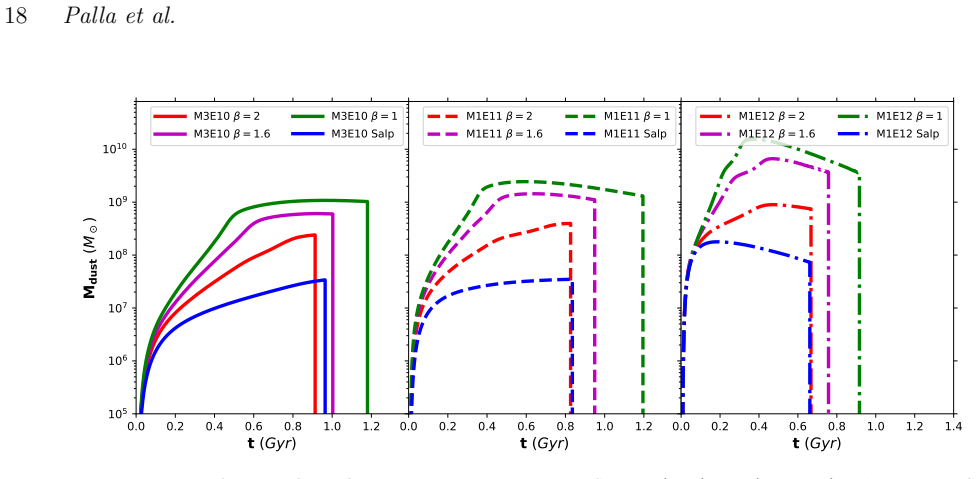
The paper's central claim is that the abundance patterns observed in lensed and stacked high-redshift starbursts are reproduced by chemical evolution models in two alternative regimes: either a strongly top-heavy integrated galactic IMF, with slope $\beta<2$ for the embedded cluster mass function and modest dust depletion, or a Salpeter-like IMF ($\beta\ge2$) if dust depletion is significant. The models follow C, N, $\alpha$-elements, and Fe in both gas and dust. Without dust, the IGIMF, and especially low $\beta$, gives higher $[\alpha/\mathrm{Fe}]$ and matches the observed patterns better than the Salpeter IMF, while with strong dust the Salpeter and $\beta=2$ cases fit the data. The paper further claims that $\beta=2$, a moderately top-heavy IGIMF, is the one case that reasonably satisfies both the abundance constraints and the dust mass constraints, and that dust builds faster and to larger masses in top-heavier IMF models.
Load-bearing premise
The conclusion depends on the assumption that a galaxy's largest newborn star cluster grows with its star formation rate in the same way it does in nearby galaxies, and stops at ten million solar masses; if that is different at high redshift, the same model parameters produce different IMFs and the inferred constraints would shift.
Editorial extensions
If this is right
- A direct consequence is that abundance ratios alone cannot distinguish a top-heavy IMF from dusty, Salpeter-like enrichment in high-redshift starbursts.
- If dust is as important as the large dust masses observed at these redshifts suggest, extreme top-heavy IMFs ($\beta\le1.6$) are disfavoured, and $\beta=2$ or a Salpeter IMF matches the data.
- A moderately top-heavy IGIMF can solve the dust-budget crisis: it produces dust masses above $10^8\,M_\odot$ within roughly 0.2 Gyr, matching high-redshift dust reservoirs.
- Chemical evolution models using a Salpeter IMF underestimate $[\alpha/\mathrm{Fe}]$ unless dust depletion is included, while IGIMF models raise both $[\alpha/\mathrm{Fe}]$ and the star formation rate.
- The extreme $\beta=1$ case fails to reproduce downsizing in star formation, so it is both unnecessary for the data and disfavoured by the model galaxy scaling relations.
Reading between the lines
- If the claimed degeneracy is real, abundance studies of high-redshift galaxies should quote IMF constraints as a two-parameter plane, IMF slope versus dust depletion, rather than a single IMF slope.
- The same dust-IMF degeneracy may affect other probes, such as stellar mass-to-light ratios, supernova-rate ratios, and dust-budget arguments, possibly reconciling them without invoking an exotic IMF once depletion is modeled.
- A testable extension is to measure dust-to-metal ratios and refractory depletion in the same lensed systems with far-infrared and submillimetre observations, which would break the degeneracy and select between $\beta<2$ and $\beta\ge2$.
- If the star-formation-rate-to-maximum-cluster-mass relation evolves with redshift, the $\beta$ constraints derived here would map to different physical IMFs, connecting IGIMF studies to cluster formation physics at high redshift.
Signed reviews
Editorial analysis
A structured set of objections, weighed in public.
Referee Report
Summary. This paper constructs one-zone chemical evolution models of high-redshift starbursts that incorporate the SFR-dependent integrated galactic initial mass function (IGIMF) of Weidner et al. (2011) and a detailed dust evolution model, and compares the predicted C, N, O, Mg, Si, and Fe abundances with a sample of lensed galaxies and composite spectra at z ~ 2-3. For three galaxy masses and three values of the embedded cluster mass function slope beta (1, 1.6, 2), together with a Salpeter IMF, the models are run under several dust prescriptions (reverse shock on/off, accretion, destruction). The main finding is a degeneracy: observed abundance patterns can be matched either by a strongly top-heavy IGIMF (beta < 2) with little dust or by a Salpeter-like/moderately top-heavy IMF (beta >= 2) with significant dust depletion. The paper also computes dust mass growth and argues that a moderate top-heavy IGIMF with beta = 2 solves the 'dust budget crisis' while satisfying the abundance constraints.
Significance. If the central degeneracy is real, it is important: it reframes claims of top-heavy IMFs in high-redshift starbursts by showing that dust depletion is a degenerate alternative, and it identifies beta = 2 as a compromise that can satisfy both abundance and dust mass constraints. The paper is valuable in combining IGIMF chemical evolution with a detailed treatment of dust production, growth, and destruction, in following multiple elements in both gas and dust phases, and in compiling a multi-indicator abundance dataset for lensed high-z galaxies. The clear visual demonstration of the degeneracy and the explicit model grid are strengths. However, the quantitative boundaries (beta < 2 versus beta >= 2) are not yet established: the key Mecl,max-SFR relation is extrapolated far beyond its calibration regime without sensitivity tests, the model-data comparison is qualitative with no fitting statistic, and the dust mass comparison is made against a generic galaxy sample rather than the specific systems in Table 2. The paper is therefore a promising and useful first step rather than a settled quantitative constraint.
major comments (4)
- [Section 2.1, Eqs. (3) and (5)] The mapping from the free parameter beta to an actual IGIMF is controlled by Mecl,max = 8.5e4 (psi/Msun/yr)^0.75 Msun with a hard cap at 1e7 Msun, and both the high-mass slope alpha3(Mecl) in Eq. (5) and the upper stellar mass limit mmax depend on Mecl,max. At the SFRs reached in the M1E11 and M1E12 models (several hundred to ~1e3 Msun/yr), this relation is extrapolated far beyond the local embedded-cluster data used to calibrate it, and the cap becomes active for psi >~ 500 Msun/yr, which is precisely the regime of the highest-SFR systems in the sample (RCSGA, the 8 o'clock arc). The paper presents no sensitivity analysis of the exponent, normalization, or cap, and alternative IGIMF formulations (Yan et al. 2017; Jerabkova et al. 2018) are deferred to future work. The qualitative degeneracy between top-heaviness and dust depletion would probably survive changes to Eq. (3), but the specific quantitative thresholds 'beta < 2' and 'beta >= 2' are not robust unless this relation is tested or varied.
- [Section 4.3, Figs. 6-13 and Table 3] The comparison between model tracks and observed abundances is strictly qualitative: no goodness-of-fit or likelihood is defined, and model agreement is judged by visual overlap of the tracks with 1-sigma error bars. The sample is small and heterogeneous, mixing direct, R23, and N2 oxygen abundance determinations that the authors themselves note can differ by up to 0.2 dex. Because the central claim is a threshold statement about beta, the analysis needs a quantitative criterion (e.g., a chi-square or likelihood over the abundance ratios, with the systematic indicator offsets either modeled or propagated). Without such a criterion, the statements that beta < 2 is needed in the low-dust case and beta >= 2 in the dusty case are not yet supported beyond visual inspection.
- [Section 4.3, M1E12 IGIMF omission] The M1E12 models with the IGIMF are excluded from the abundance comparison because their SFRs are 'much larger than the ones observed in the systems of our dataset.' The observed SFRs in Table 2 are, however, derived assuming a Salpeter IMF, so this exclusion uses the very assumption the paper is testing; if the true IMF were top-heavy, the SFR estimates would shift. The authors should either demonstrate that the exclusion is robust to the IMF dependence of SFR estimators or include the M1E12 IGIMF models with a suitable recalibration of the observed SFRs.
- [Section 4.4 and Fig. 14] The conclusion that a moderate top-heavy IGIMF with beta = 2 'reasonably satisfies both the abundance and dust mass constraints' is not quantitatively supported on the dust side. The model dust masses are compared with a general Herschel galaxy sample at comparable redshift, not with dust mass measurements for the specific starbursts in Table 2; no dust masses are listed for those systems, and no criterion is specified for what counts as satisfying the dust mass constraint. The dust-mass discussion should either present observed Mdust values for the same objects or treat the dust evolution as a prediction to be tested, and the 'both constraints' statement should be softened accordingly.
minor comments (5)
- [Table 3] In the RCSGA 032727-132609 row, the log(N/O) entry is printed as '1.7 ± 0.02'; the value should almost certainly be negative (about -1.7) to be consistent with the other systems and with physical expectations, so please correct this typo.
- [Section 2.2.1 and Fig. 2 caption] There is a duplicated article in 'with a a galactic wind occurring', and the phrase 'devoids the galaxy from the residual gas' in the Fig. 2 caption should be 'deprives the galaxy of the residual gas' or similar.
- [Sections 3.6 and 3.7] The phrases 'from the Hα-detection' and 'from the [OII]-detection' should be 'from the Hα detection' and 'from the [OII] detection' (also occurring in Section 3.7).
- [Section 2.2.1] The aside that the large adopted core radius 'can also be interpreted as the natural core radius of Milgromian potentials' is not used anywhere in the paper and may distract; consider removing it or expanding it into a substantive discussion.
- [Fig. 7 caption] The caption refers to a 'confidence region' from Shapley et al. (2003), but the text describes it as the 'dark grey confidence region'; please define in the caption what the shaded region represents (e.g., the quoted range from the composite spectrum).
Circularity Check
No significant circularity: beta and dust prescriptions are model inputs scanned against external abundance and dust data, not fitted or derived from the same observables.
full rationale
The paper's central claim is a model-grid comparison, not an inversion or fit. The slope beta and the dust prescriptions (reverse shock, growth, destruction) are free inputs, and the observed abundances (Table 3) and dust masses (Calura et al. 2017; Pozzi et al. 2020) are external benchmarks. The conclusion that either a very top-heavy IGIMF (beta<2) with little dust or a Salpeter-like IMF (beta>=2) with significant dust reproduces the observed [alpha/Fe] patterns is a readout of the computed grid, not a prediction whose output is equivalent to an input. The IGIMF relations (Eqs. 2-5) are adopted from the external Weidner/Kroupa framework, not from the present authors' own prior results, and no uniqueness theorem is invoked to force the choice. Self-citations (e.g., Calura et al. 2010; De Masi et al. 2018; Palla et al. 2020) supply model machinery and prior context but do not carry the inference. The only mildly self-referential element is that the observed SFRs in Table 2 are Salpeter-based and are used to omit the M1E12 IGIMF models from the abundance plots; however, the abundance-ratio conclusions rest on the M3E10 and M1E11 models and are not statistically forced by that selection. The extrapolation of Eq. (3) to z~2-3 is a legitimate robustness concern, but it is an external-input uncertainty, not circularity. The paper also explicitly flags the ad hoc primary-N yield as a limitation and does not base its refractory-element conclusions on it. Overall, the derivation chain is self-contained against external data and contains no circular step requiring a score above 0.
Assumptions & free parameters
free parameters (6)
- ECMF slope beta =
1, 1.6, 2 (discrete grid; no best-fit value)
- Star formation efficiency nu =
5, 10, 20 Gyr^-1
- Infall timescale tau_inf =
0.5, 0.4, 0.2 Gyr
- Effective radius Reff =
2, 3, 10 kpc
- SN feedback thermalization fractions =
few percent of CC-SN blast energy; 3% of massive-star wind energy
- Dust growth/destruction reference parameters =
nH=100 cm^-3, a=0.1 micron, T=50 K, epsilon=0.1
assumptions (7)
- domain assumption Galaxies form stars in embedded clusters distributed as a single power law with slope beta (Eq. 2), and the stellar IMF within clusters is canonical (Kroupa, Eq. 4).
- domain assumption The maximum embedded cluster mass grows with SFR as Mecl,max = 8.5e4 psi^0.75 M_sun (Eq. 3), capped at 10^7 M_sun.
- domain assumption High-z starbursts can be modeled as one-zone open boxes with exponential infall, Schmidt-Kennicutt SFR, and a thermal-energy galactic wind (Section 2.2.1).
- domain assumption Adopted stellar yields (van den Hoek & Groenewegen 1997; Francois et al. 2004; Iwamoto et al. 1999) are correct for LIMS, CC-SNe, and SNe Ia.
- ad hoc to paper Primary nitrogen is produced by all massive stars (Matteucci 1986 yields), described by the authors as 'an ad hoc hypothesis' needed to explain observed N/O (Section 4.3.1).
- domain assumption Type Ia SNe do not produce dust, and dust growth/destruction follow Asano et al. (2013) prescriptions.
- domain assumption Dark matter halo is ten times the luminous mass and has a core radius ten times Reff.
Cite this review
Pith. "Pith review of The influence of a top-heavy integrated galactic IMF and dust on the chemical evolution of high-redshift starbursts." pith.science (2026). https://pith.science/paper/SCMBXTJQ
@misc{pith2026190806832,
  author       = {Pith},
  title        = {Pith review of: The influence of a top-heavy integrated galactic IMF and dust on the chemical evolution of high-redshift starbursts},
  year         = {2026},
  howpublished = {\url{https://pith.science/paper/SCMBXTJQ}},
  note         = {Machine review of arXiv:1908.06832}
}
abstract
We study the effects of the integrated galactic initial mass function (IGIMF) and dust evolution on the abundance patterns of high redshift starburst galaxies. In our chemical models, the rapid collapse of gas clouds triggers an intense and rapid star formation episode, which lasts until the onset of a galactic wind, powered by the thermal energy injected by stellar winds and supernova explosions. Our models follow the evolution of several chemical elements (C, N, $\alpha$-elements and Fe) both in the gas and dust phases. %The most recent stellar yield and dust prescriptions are adopted. We test different values of $\beta$, the slope of the embedded cluster mass function for the IGIMF, where lower $\beta$ values imply a more top-heavy initial mass function (IMF). The computed abundances are compared to high-quality abundance measurements obtained in lensed galaxies and from composite spectra in large samples of star-forming galaxies in the redshift range $2 \lesssim z \lesssim 3$. The adoption of the IGIMF causes a sensible increase of the rate of star formation with respect to a standard Salpeter IMF, with a strong impact on chemical evolution. We find that in order to reproduce the observed abundance patterns in these galaxies, either we need a very top-heavy IGIMF ($\beta < 2$) or large amounts of dust. In particular, if dust is important, the IGIMF should have $\beta \ge 2$, which means an IMF slightly more top-heavy than the Salpeter one. The evolution of the dust mass with time for galaxies of different mass and IMF is also computed, highlighting that the dust amount increases with a top-heavier IGIMF.
Figures


Figures from the paper (9 more)




Forward citations
Cited by 2 Pith papers
-
Bright Galaxies at Cosmic Dawn: A Cloud-Scale Star Formation Model Unifying Variable SFE, IMFs, and Stochasticity
A cloud-based semi-analytic model shows that a top-heavy stellar initial mass function and a cloud-property-dependent star-formation efficiency, rather than cloud mass or density, most strongly shape the UV luminosity...
-
Interstellar dust production, destruction and effects of dust depletion in galaxies
The paper reviews dust production, destruction and growth processes in galaxies, compiles literature data on comoving dust mass density, presents evidence for and against interstellar dust growth, and identifies the h...
Reference graph
Works this paper leans on
-
[1]
S., Lin H., Tucker D., Buckley-Geer E., Kubik D., Diehl T., Annis J., Frieman J., 2007, in American Astronomical Society Meeting Abstracts
Allam S. S., Lin H., Tucker D., Buckley-Geer E., Kubik D., Diehl T., Annis J., Frieman J., 2007, in American Astronomical Society Meeting Abstracts. p. 99.02
2007
-
[2]
Asano R. S., Takeuchi T. T., Hirashita H., Inoue A. K., 2013, @doi [Earth, Planets, and Space] 10.5047/eps.2012.04.014 , https://ui.adsabs.harvard.edu/abs/2013EP&S...65..213A 65, 213
-
[3]
Asplund M., Grevesse N., Sauval A. J., Scott P., 2009, @doi [ ] 10.1146/annurev.astro.46.060407.145222 , https://ui.adsabs.harvard.edu/abs/2009ARA&A..47..481A 47, 481
arXiv 2009
-
[4]
Baker A. J., Tacconi L. J., Genzel R., Lehnert M. D., Lutz D., 2004, @doi [ ] 10.1086/381798 , https://ui.adsabs.harvard.edu/abs/2004ApJ...604..125B 604, 125
doi:10.1086/381798 2004
-
[7]
Bayliss M. B., Rigby J. R., Sharon K., Wuyts E., Florian M., Gladders M. D., Johnson T., Oguri M., 2014, @doi [ ] 10.1088/0004-637X/790/2/144 , http://adsabs.harvard.edu/abs/2014ApJ...790..144B 790, 144
-
[8]
Belokurov V., et al., 2007, @doi [ ] 10.1086/524948 , https://ui.adsabs.harvard.edu/abs/2007ApJ...671L...9B 671, L9
doi:10.1086/524948 2007
-
[9]
Bianchi S., Schneider R., 2007, @doi [ ] 10.1111/j.1365-2966.2007.11829.x , https://ui.adsabs.harvard.edu/abs/2007MNRAS.378..973B 378, 973
arXiv 2007
-
[10]
Bradamante F., Matteucci F., D'Ercole A., 1998, , https://ui.adsabs.harvard.edu/abs/1998A&A...337..338B 337, 338
1998
Show all 104 references
-
[11]
Calura F., Matteucci F., 2006, @doi [ ] 10.1086/508147 , http://adsabs.harvard.edu/abs/2006ApJ...652..889C 652, 889
2006 doi
-
[13]
Calura F., Pipino A., Matteucci F., 2008, @doi [ ] 10.1051/0004-6361:20078090 , https://ui.adsabs.harvard.edu/abs/2008A&A...479..669C 479, 669
2008 doi
-
[15]
Calura F., Gilli R., Vignali C., Pozzi F., Pipino A., Matteucci F., 2014, @doi [ ] 10.1093/mnras/stt2329 , https://ui.adsabs.harvard.edu/abs/2014MNRAS.438.2765C 438, 2765
2014 doi
-
[16]
Calura F., et al., 2017, @doi [ ] 10.1093/mnras/stw2749 , https://ui.adsabs.harvard.edu/abs/2017MNRAS.465...54C 465, 54
2017 doi
-
[18]
Chiappini C., Romano D., Matteucci F., 2003, @doi [ ] 10.1046/j.1365-8711.2003.06154.x , https://ui.adsabs.harvard.edu/abs/2003MNRAS.339...63C 339, 63
2003
-
[20]
Christensen L., et al., 2012b, @doi [ ] 10.1111/j.1365-2966.2012.22007.x , http://adsabs.harvard.edu/abs/2012MNRAS.427.1973C 427, 1973
2012
-
[21]
Conroy C., van Dokkum P., 2012a, @doi [ ] 10.1088/0004-637X/747/1/69 , https://ui.adsabs.harvard.edu/abs/2012ApJ...747...69C 747, 69
-
[22]
G., 2012b, @doi [ ] 10.1088/0004-637X/760/1/71 , http://adsabs.harvard.edu/abs/2012ApJ...760...71C 760, 71
Conroy C., van Dokkum P. G., 2012b, @doi [ ] 10.1088/0004-637X/760/1/71 , http://adsabs.harvard.edu/abs/2012ApJ...760...71C 760, 71
-
[24]
De Masi C., Matteucci F., Vincenzo F., 2018, @doi [ ] 10.1093/mnras/stx3044 , http://adsabs.harvard.edu/abs/2018MNRAS.474.5259D 474, 5259
2018 doi
-
[25]
Dell'Agli F., Garc \' a-Hern \'a ndez D. A., Schneider R., Ventura P., La Franca F., Valiante R., Marini E., Di Criscienzo M., 2017, @doi [ ] 10.1093/mnras/stx387 , https://ui.adsabs.harvard.edu/abs/2017MNRAS.467.4431D 467, 4431
2017 doi
-
[26]
Dessauges-Zavadsky M., D'Odorico S., Schaerer D., Modigliani A., Tapken C., Vernet J., 2010, @doi [ ] 10.1051/0004-6361/200913337 , http://adsabs.harvard.edu/abs/2010A
2010 doi
-
[27]
Dwek E., 1998, @doi [ ] 10.1086/305829 , https://ui.adsabs.harvard.edu/abs/1998ApJ...501..643D 501, 643
1998 doi
-
[28]
W., Belokurov V., Warren S
Dye S., Evans N. W., Belokurov V., Warren S. J., Hewett P., 2008, @doi [ ] 10.1111/j.1365-2966.2008.13401.x , https://ui.adsabs.harvard.edu/abs/2008MNRAS.388..384D 388, 384
2008
-
[29]
Ferrara A., Viti S., Ceccarelli C., 2016, @doi [ ] 10.1093/mnrasl/slw165 , https://ui.adsabs.harvard.edu/abs/2016MNRAS.463L.112F 463, L112
2016 doi
-
[30]
Ferreras I., Weidner C., Vazdekis A., La Barbera F., 2015, @doi [ ] 10.1093/mnrasl/slv003 , http://adsabs.harvard.edu/abs/2015MNRAS.448L..82F 448, L82
2015 doi
-
[31]
L., Papovich C., Rudnick G., Egami E., Le Floc'h E., Rieke M
Finkelstein S. L., Papovich C., Rudnick G., Egami E., Le Floc'h E., Rieke M. J., Rigby J. R., Willmer C. N. A., 2009, @doi [ ] 10.1088/0004-637X/700/1/376 , http://adsabs.harvard.edu/abs/2009ApJ...700..376F 700, 376
2009 doi
-
[32]
Fran c ois P., Matteucci F., Cayrel R., Spite M., Spite F., Chiappini C., 2004, @doi [ ] 10.1051/0004-6361:20034140 , http://adsabs.harvard.edu/abs/2004A
2004 doi
-
[33]
Gall C., Hjorth J., 2018, @doi [ ] 10.3847/1538-4357/aae520 , https://ui.adsabs.harvard.edu/abs/2018ApJ...868...62G 868, 62
2018 doi
-
[34]
C., 2011, @doi [ ] 10.1007/s00159-011-0043-7 , https://ui.adsabs.harvard.edu/abs/2011A&ARv..19...43G 19, 43
Gall C., Hjorth J., Andersen A. C., 2011, @doi [ ] 10.1007/s00159-011-0043-7 , https://ui.adsabs.harvard.edu/abs/2011A&ARv..19...43G 19, 43
2011 doi
-
[35]
R., Skillman E
Garnett D. R., Skillman E. D., Dufour R. J., Peimbert M., Torres-Peimbert S., Terlevich R., Terlevich E., Shields G. A., 1995, @doi [ ] 10.1086/175503 , https://ui.adsabs.harvard.edu/abs/1995ApJ...443...64G 443, 64
1995 doi
-
[36]
K., Matteucci F., 1997, @doi [ ] 10.1093/mnras/291.1.L8 , http://adsabs.harvard.edu/abs/1997MNRAS.291L...8G 291, L8
Gibson B. K., Matteucci F., 1997, @doi [ ] 10.1093/mnras/291.1.L8 , http://adsabs.harvard.edu/abs/1997MNRAS.291L...8G 291, L8
1997 doi
-
[37]
Gioannini L., Matteucci F., Vladilo G., Calura F., 2017, @doi [ ] 10.1093/mnras/stw2343 , http://adsabs.harvard.edu/abs/2017MNRAS.464..985G 464, 985
2017 doi
-
[38]
L., et al., 2012, @doi [ ] 10.1088/0004-637X/760/1/96 , https://ui.adsabs.harvard.edu/abs/2012ApJ...760...96G 760, 96
Gomez H. L., et al., 2012, @doi [ ] 10.1088/0004-637X/760/1/96 , https://ui.adsabs.harvard.edu/abs/2012ApJ...760...96G 760, 96
2012 doi
-
[39]
Grieco V., Matteucci F., Calura F., Boissier S., Longo F., D'Elia V., 2014, @doi [ ] 10.1093/mnras/stu1500 , https://ui.adsabs.harvard.edu/abs/2014MNRAS.444.1054G 444, 1054
2014 doi
-
[40]
N., Shapley A
Hainline K. N., Shapley A. E., Kornei K. A., Pettini M., Buckley-Geer E., Allam S. S., Tucker D. L., 2009, @doi [ ] 10.1088/0004-637X/701/1/52 , https://ui.adsabs.harvard.edu/abs/2009ApJ...701...52H 701, 52
2009 doi
-
[41]
Israelian G., Ecuvillon A., Rebolo R., Garc \' a-L \'o pez R., Bonifacio P., Molaro P., 2004, @doi [ ] 10.1051/0004-6361:20047132 , https://ui.adsabs.harvard.edu/abs/2004A&A...421..649I 421, 649
2004 doi
-
[42]
R., Thielemann F.-K., 1999, @doi [ ] 10.1086/313278 , https://ui.adsabs.harvard.edu/abs/1999ApJS..125..439I 125, 439
Iwamoto K., Brachwitz F., Nomoto K., Kishimoto N., Umeda H., Hix W. R., Thielemann F.-K., 1999, @doi [ ] 10.1086/313278 , https://ui.adsabs.harvard.edu/abs/1999ApJS..125..439I 125, 439
1999 doi
-
[43]
Je r \'a bkov \'a T., Kroupa P., Dabringhausen J., Hilker M., Bekki K., 2017, @doi [ ] 10.1051/0004-6361/201731240 , https://ui.adsabs.harvard.edu/abs/2017A&A...608A..53J 608, A53
2017 doi
-
[44]
Y., 2018, @doi [ ] 10.1051/0004-6361/201833055 , https://ui.adsabs.harvard.edu/abs/2018A&A...620A..39J 620, A39
Je r \'a bkov \'a T., Hasani Zonoozi A., Kroupa P., Beccari G., Yan Z., Vazdekis A., Zhang Z. Y., 2018, @doi [ ] 10.1051/0004-6361/201833055 , https://ui.adsabs.harvard.edu/abs/2018A&A...620A..39J 620, A39
2018 doi
-
[45]
Kennicutt Jr. R. C., 1998, @doi [ ] 10.1086/305588 , http://adsabs.harvard.edu/abs/1998ApJ...498..541K 498, 541
1998 doi
-
[47]
Kroupa P., 2002, @doi [Science] 10.1126/science.1067524 , http://adsabs.harvard.edu/abs/2002Sci...295...82K 295, 82
2002 doi
-
[48]
Kroupa P., Weidner C., 2003, @doi [ ] 10.1086/379105 , http://adsabs.harvard.edu/abs/2003ApJ...598.1076K 598, 1076
2003 doi
-
[49]
G., de Carvalho R
La Barbera F., Ferreras I., Vazdekis A., de la Rosa I. G., de Carvalho R. R., Trevisan M., Falc \'o n-Barroso J., Ricciardelli E., 2013, @doi [ ] 10.1093/mnras/stt943 , https://ui.adsabs.harvard.edu/abs/2013MNRAS.433.3017L 433, 3017
2013 doi
-
[50]
arXiv:1911.08450
Lacchin E., Matteucci F., Vincenzo F., Palla M., 2019, arXiv e-prints, https://ui.adsabs.harvard.edu/abs/2019arXiv191108450L p. arXiv:1911.08450
2019 arXiv
-
[51]
J., Lada E
Lada C. J., Lada E. A., 2003, @doi [ ] 10.1146/annurev.astro.41.011802.094844 , http://adsabs.harvard.edu/abs/2003ARA
2003 arXiv
-
[53]
L \"u ghausen F., Famaey B., Kroupa P., Angus G., Combes F., Gentile G., Tiret O., Zhao H., 2013, @doi [ ] 10.1093/mnras/stt639 , https://ui.adsabs.harvard.edu/abs/2013MNRAS.432.2846L 432, 2846
2013 doi
-
[54]
L \"u ghausen F., Famaey B., Kroupa P., 2015, @doi [Canadian Journal of Physics] 10.1139/cjp-2014-0168 , https://ui.adsabs.harvard.edu/abs/2015CaJPh..93..232L 93, 232
2015 doi
-
[55]
A., 1998, @doi [ ] 10.1086/305126 , http://adsabs.harvard.edu/abs/1998ApJ...493..180M 493, 180
Massey P., Hunter D. A., 1998, @doi [ ] 10.1086/305126 , http://adsabs.harvard.edu/abs/1998ApJ...493..180M 493, 180
1998 doi
-
[56]
Matteucci F., 1986, @doi [ ] 10.1093/mnras/221.4.911 , http://adsabs.harvard.edu/abs/1986MNRAS.221..911M 221, 911
1986 doi
-
[57]
Matteucci F., 1994, , http://adsabs.harvard.edu/abs/1994A
1994
-
[58]
Matteucci F., 2012, Chemical Evolution of Galaxies , @doi 10.1007/978-3-642-22491-1
2012 doi
-
[59]
Matteucci F., Greggio L., 1986, , http://adsabs.harvard.edu/abs/1986A
1986
-
[60]
Matteucci F., Pipino A., 2002, @doi [ ] 10.1086/340771 , https://ui.adsabs.harvard.edu/abs/2002ApJ...569L..69M 569, L69
2002 doi
-
[61]
Matteucci F., Recchi S., 2001, @doi [ ] 10.1086/322472 , http://adsabs.harvard.edu/abs/2001ApJ...558..351M 558, 351
2001 doi
-
[62]
Mattsson L., 2011, @doi [ ] 10.1111/j.1365-2966.2011.18447.x , https://ui.adsabs.harvard.edu/abs/2011MNRAS.414..781M 414, 781
2011
-
[63]
arXiv:1505.04758
Mattsson L., 2015, arXiv e-prints, https://ui.adsabs.harvard.edu/abs/2015arXiv150504758M p. arXiv:1505.04758
2015 arXiv
-
[64]
T., et al., 2016, @doi [ ] 10.3847/0004-6256/151/1/5 , https://ui.adsabs.harvard.edu/abs/2016AJ....151....5M 151, 5
Megeath S. T., et al., 2016, @doi [ ] 10.3847/0004-6256/151/1/5 , https://ui.adsabs.harvard.edu/abs/2016AJ....151....5M 151, 5
2016 doi
-
[65]
Meneghetti M., et al., 2017, @doi [ ] 10.1093/mnras/stx2064 , https://ui.adsabs.harvard.edu/abs/2017MNRAS.472.3177M 472, 3177
2017 doi
-
[66]
Meynet G., Maeder A., 2002, @doi [ ] 10.1051/0004-6361:20020755 , https://ui.adsabs.harvard.edu/abs/2002A&A...390..561M 390, 561
2002 doi
-
[67]
Nittler L. R., O'D. Alexander C. M., Liu N., Wang J., 2018, @doi [ ] 10.3847/2041-8213/aab61f , https://ui.adsabs.harvard.edu/abs/2018ApJ...856L..24N 856, L24
2018 doi
-
[68]
Nozawa T., Maeda K., Kozasa T., Tanaka M., Nomoto K., Umeda H., 2011, @doi [ ] 10.1088/0004-637X/736/1/45 , https://ui.adsabs.harvard.edu/abs/2011ApJ...736...45N 736, 45
2011 doi
-
[69]
Palla M., Matteucci F., Calura F., Longo F., 2020, @doi [ ] 10.3847/1538-4357/ab6080 , https://ui.adsabs.harvard.edu/abs/2020ApJ...889....4P 889, 4
2020 doi
-
[70]
C., Adelberger K
Pettini M., Steidel C. C., Adelberger K. L., Dickinson M., Giavalisco M., 2000, @doi [ ] 10.1086/308176 , http://adsabs.harvard.edu/abs/2000ApJ...528...96P 528, 96
2000 doi
-
[71]
E., Steidel C
Pettini M., Shapley A. E., Steidel C. C., Cuby J.-G., Dickinson M., Moorwood A. F. M., Adelberger K. L., Giavalisco M., 2001, @doi [ ] 10.1086/321403 , http://adsabs.harvard.edu/abs/2001ApJ...554..981P 554, 981
2001 doi
-
[72]
A., Steidel C
Pettini M., Rix S. A., Steidel C. C., Adelberger K. L., Hunt M. P., Shapley A. E., 2002, @doi [ ] 10.1086/339355 , http://adsabs.harvard.edu/abs/2002ApJ...569..742P 569, 742
2002 doi
-
[73]
Pflamm-Altenburg J., Weidner C., Kroupa P., 2007, @doi [ ] 10.1086/523033 , http://adsabs.harvard.edu/abs/2007ApJ...671.1550P 671, 1550
2007 doi
-
[75]
Pipino A., Matteucci F., 2011, @doi [ ] 10.1051/0004-6361/201016191 , https://ui.adsabs.harvard.edu/abs/2011A&A...530A..98P 530, A98
2011 doi
-
[76]
Pipino A., Matteucci F., Borgani S., Biviano A., 2002, @doi [ ] 10.1016/S1384-1076(02)00136-7 , https://ui.adsabs.harvard.edu/abs/2002NewA....7..227P 7, 227
2002 doi
-
[77]
L., Matteucci F., Calura F., Silva L., Granato G., Maiolino R., 2011, @doi [ ] 10.1051/0004-6361/201014843 , http://adsabs.harvard.edu/abs/2011A
Pipino A., Fan X. L., Matteucci F., Calura F., Silva L., Granato G., Maiolino R., 2011, @doi [ ] 10.1051/0004-6361/201014843 , http://adsabs.harvard.edu/abs/2011A
2011 doi
-
[78]
Pozzi F., Calura F., Zamorani G., Delvecchio I., Gruppioni C., Santini P., 2020, @doi [ ] 10.1093/mnras/stz2724 , https://ui.adsabs.harvard.edu/abs/2020MNRAS.491.5073P 491, 5073
2020 doi
-
[79]
M., Pettini M., Shapley A
Quider A. M., Pettini M., Shapley A. E., Steidel C. C., 2009, @doi [ ] 10.1111/j.1365-2966.2009.15234.x , https://ui.adsabs.harvard.edu/abs/2009MNRAS.398.1263Q 398, 1263
2009
-
[80]
Recchi S., Matteucci F., D'Ercole A., 2001, @doi [ ] 10.1046/j.1365-8711.2001.04189.x , http://adsabs.harvard.edu/abs/2001MNRAS.322..800R 322, 800
2001
-
[81]
Recchi S., Calura F., Kroupa P., 2009, @doi [ ] 10.1051/0004-6361/200811472 , http://adsabs.harvard.edu/abs/2009A
2009 doi
-
[82]
K., Kroupa P., 2014, @doi [ ] 10.1093/mnras/stt1971 , http://adsabs.harvard.edu/abs/2014MNRAS.437..994R 437, 994
Recchi S., Calura F., Gibson B. K., Kroupa P., 2014, @doi [ ] 10.1093/mnras/stt1971 , http://adsabs.harvard.edu/abs/2014MNRAS.437..994R 437, 994
2014 doi
-
[83]
R., Wuyts E., Gladders M
Rigby J. R., Wuyts E., Gladders M. D., Sharon K., Becker G. D., 2011, @doi [ ] 10.1088/0004-637X/732/1/59 , http://adsabs.harvard.edu/abs/2011ApJ...732...59R 732, 59
2011 doi
-
[84]
I., Tosi M., Matteucci F., 2010, @doi [ ] 10.1051/0004-6361/201014483 , https://ui.adsabs.harvard.edu/abs/2010A&A...522A..32R 522, A32
Romano D., Karakas A. I., Tosi M., Matteucci F., 2010, @doi [ ] 10.1051/0004-6361/201014483 , https://ui.adsabs.harvard.edu/abs/2010A&A...522A..32R 522, A32
2010 doi
-
[85]
Y., Papadopoulos P
Romano D., Matteucci F., Zhang Z. Y., Papadopoulos P. P., Ivison R. J., 2017, @doi [ ] 10.1093/mnras/stx1197 , https://ui.adsabs.harvard.edu/abs/2017MNRAS.470..401R 470, 401
2017 doi
-
[86]
Rowlands K., Gomez H. L., Dunne L., Arag \'o n-Salamanca A., Dye S., Maddox S., da Cunha E., van der Werf P., 2014, @doi [ ] 10.1093/mnras/stu605 , https://ui.adsabs.harvard.edu/abs/2014MNRAS.441.1040R 441, 1040
2014 doi
-
[87]
E., 1955, @doi [ ] 10.1086/145971 , http://adsabs.harvard.edu/abs/1955ApJ...121..161S 121, 161
Salpeter E. E., 1955, @doi [ ] 10.1086/145971 , http://adsabs.harvard.edu/abs/1955ApJ...121..161S 121, 161
1955 doi
-
[88]
A., Ferreras I., Negri A., Dalla Vecchia C., 2019, @doi [Nature Astronomy] 10.1038/s41550-019-0955-0 , https://ui.adsabs.harvard.edu/abs/2019NatAs.tmp....1S p
Salvador-Rusi \ n ol N., Vazdekis A., La Barbera F., Beasley M. A., Ferreras I., Negri A., Dalla Vecchia C., 2019, @doi [Nature Astronomy] 10.1038/s41550-019-0955-0 , https://ui.adsabs.harvard.edu/abs/2019NatAs.tmp....1S p. 1
2019 doi
-
[89]
Schmidt M., 1959, @doi [ ] 10.1086/146614 , http://adsabs.harvard.edu/abs/1959ApJ...129..243S 129, 243
1959 doi
-
[90]
P., Bender R., Hopp U., Belloni P., Ziegler B., 1998, @doi [ ] 10.1046/j.1365-8711.1998.01443.x , https://ui.adsabs.harvard.edu/abs/1998MNRAS.298..945S 298, 945
Seitz S., Saglia R. P., Bender R., Hopp U., Belloni P., Ziegler B., 1998, @doi [ ] 10.1046/j.1365-8711.1998.01443.x , https://ui.adsabs.harvard.edu/abs/1998MNRAS.298..945S 298, 945
1998
-
[91]
E., Steidel C
Shapley A. E., Steidel C. C., Pettini M., Adelberger K. L., 2003, @doi [ ] 10.1086/373922 , http://adsabs.harvard.edu/abs/2003ApJ...588...65S 588, 65
2003 doi
-
[92]
I., Chary R.-R., Colbert J., Frayer D
Siana B., Teplitz H. I., Chary R.-R., Colbert J., Frayer D. T., 2008, @doi [ ] 10.1086/592682 , http://adsabs.harvard.edu/abs/2008ApJ...689...59S 689, 59
2008 doi
-
[93]
Spite M., et al., 2005, @doi [ ] 10.1051/0004-6361:20041274 , https://ui.adsabs.harvard.edu/abs/2005A&A...430..655S 430, 655
2005 doi
-
[95]
C., et al., 2014, @doi [ ] 10.1088/0004-637X/795/2/165 , https://ui.adsabs.harvard.edu/abs/2014ApJ...795..165S 795, 165
Steidel C. C., et al., 2014, @doi [ ] 10.1088/0004-637X/795/2/165 , https://ui.adsabs.harvard.edu/abs/2014ApJ...795..165S 795, 165
2014 doi
-
[96]
C., Strom A
Steidel C. C., Strom A. L., Pettini M., Rudie G. C., Reddy N. A., Trainor R. F., 2016, @doi [ ] 10.3847/0004-637X/826/2/159 , http://adsabs.harvard.edu/abs/2016ApJ...826..159S 826, 159
2016 doi
-
[97]
I., et al., 2000, @doi [ ] 10.1086/312595 , http://adsabs.harvard.edu/abs/2000ApJ...533L..65T 533, L65
Teplitz H. I., et al., 2000, @doi [ ] 10.1086/312595 , http://adsabs.harvard.edu/abs/2000ApJ...533L..65T 533, L65
2000 doi
-
[98]
Thies I., Pflamm-Altenburg J., Kroupa P., Marks M., 2015, @doi [ ] 10.1088/0004-637X/800/1/72 , https://ui.adsabs.harvard.edu/abs/2015ApJ...800...72T 800, 72
2015 doi
-
[100]
Valiante R., Schneider R., Salvadori S., Gallerani S., 2014, @doi [ ] 10.1093/mnras/stu1613 , https://ui.adsabs.harvard.edu/abs/2014MNRAS.444.2442V 444, 2442
2014 doi
-
[101]
Vanzella E., et al., 2017, @doi [ ] 10.1093/mnras/stx351 , https://ui.adsabs.harvard.edu/abs/2017MNRAS.467.4304V 467, 4304
2017 doi
-
[102]
Vincenzo F., Kobayashi C., 2018, @doi [ ] 10.1051/0004-6361/201732395 , https://ui.adsabs.harvard.edu/abs/2018A&A...610L..16V 610, L16
2018 doi
-
[103]
A., 2015, @doi [ ] 10.1093/mnras/stv357 , http://adsabs.harvard.edu/abs/2015MNRAS.449.1327V 449, 1327
Vincenzo F., Matteucci F., Recchi S., Calura F., McWilliam A., Lanfranchi G. A., 2015, @doi [ ] 10.1093/mnras/stv357 , http://adsabs.harvard.edu/abs/2015MNRAS.449.1327V 449, 1327
2015 doi
-
[104]
Vincenzo F., Belfiore F., Maiolino R., Matteucci F., Ventura P., 2016, @doi [ ] 10.1093/mnras/stw532 , https://ui.adsabs.harvard.edu/abs/2016MNRAS.458.3466V 458, 3466
2016 doi
-
[105]
Vladilo G., Gioannini L., Matteucci F., Palla M., 2018, @doi [ ] 10.3847/1538-4357/aae8dc , http://adsabs.harvard.edu/abs/2018ApJ...868..127V 868, 127
2018 doi
-
[107]
Weidner C., Kroupa P., 2005, @doi [ ] 10.1086/429867 , http://adsabs.harvard.edu/abs/2005ApJ...625..754W 625, 754
2005 doi
-
[108]
S., 2004, @doi [ ] 10.1111/j.1365-2966.2004.07758.x , https://ui.adsabs.harvard.edu/abs/2004MNRAS.350.1503W 350, 1503
Weidner C., Kroupa P., Larsen S. S., 2004, @doi [ ] 10.1111/j.1365-2966.2004.07758.x , https://ui.adsabs.harvard.edu/abs/2004MNRAS.350.1503W 350, 1503
2004
-
[109]
Weidner C., Kroupa P., Pflamm-Altenburg J., 2011, @doi [ ] 10.1111/j.1365-2966.2010.17959.x , http://adsabs.harvard.edu/abs/2011MNRAS.412..979W 412, 979
2011
-
[110]
Weidner C., Ferreras I., Vazdekis A., La Barbera F., 2013, @doi [ ] 10.1093/mnras/stt1445 , http://adsabs.harvard.edu/abs/2013MNRAS.435.2274W 435, 2274
2013 doi
-
[111]
E., Weaver T
Woosley S. E., Weaver T. A., 1995, @doi [ ] 10.1086/192237 , http://adsabs.harvard.edu/abs/1995ApJS..101..181W 101, 181
1995 doi
-
[112]
Wuyts E., et al., 2010, @doi [ ] 10.1088/0004-637X/724/2/1182 , http://adsabs.harvard.edu/abs/2010ApJ...724.1182W 724, 1182
2010 doi
-
[113]
Yan Z., Jerabkova T., Kroupa P., 2017, @doi [ ] 10.1051/0004-6361/201730987 , https://ui.adsabs.harvard.edu/abs/2017A&A...607A.126Y 607, A126
2017 doi
-
[114]
Yan Z., Jerabkova T., Kroupa P., Vazdekis A., 2019, @doi [ ] 10.1051/0004-6361/201936029 , https://ui.adsabs.harvard.edu/abs/2019A&A...629A..93Y 629, A93
2019 doi
-
[115]
Yee H. K. C., Ellingson E., Bechtold J., Carlberg R. G., Cuillandre J. C., 1996, @doi [ ] 10.1086/117916 , https://ui.adsabs.harvard.edu/abs/1996AJ....111.1783Y 111, 1783
1996 doi
-
[116]
J., Papadopoulos P
Zhang Z.-Y., Romano D., Ivison R. J., Papadopoulos P. P., Matteucci F., 2018, @doi [ ] 10.1038/s41586-018-0196-x , https://ui.adsabs.harvard.edu/abs/2018Natur.558..260Z 558, 260
2018 doi
-
[117]
B., Groenewegen M
van den Hoek L. B., Groenewegen M. A. T., 1997, @doi [ ] 10.1051/aas:1997162 , http://adsabs.harvard.edu/abs/1997A
1997 doi
Reviewed August 14, 2026 · model on record in the stance chip above.
Discussion (0). Continue with ORCID to comment.