REVIEW 4 major objections 3 minor 1 cited by
A uniform locally constant field approximation for photon-seeded pair production
T0 review · 4 major / 3 minor · reviewed 2026-08-14 · deepseek-v4-flash
Pith's one-line read This paper claims that a uniform Airy extension of the locally constant field approximation predicts photon-seeded pair rates to about ten percent accuracy at $\xi \approx 1.25$, where the standard LCFA errs by 20–55 percent.
desk verdict A useful, well-benchmarked extension of the LCFA for pair creation at moderate intensity, but the derivation's asymptotic ordering does not justify the accuracy claim at the lowest intensities. read the letter →
The pith
A machine-rendered reading of the paper's core claim, the machinery that carries it, and where it could break.
The reading
What carries the argument
The load-bearing object is the uniform Airy correction to the LCFA's Airy argument. Starting from the QED exponent expanded to fifth order in the phase difference $\theta$, the paper pairs the stationary points of the exponent and casts the integral in the form $\int dy\, e^{i(X^2 y + y^3/3)}$, which gives the replacement $z_e \to z_e^+$ with the derivative combination $(E'^2 + 3 E\cdot E'')/(30 |E|^4)$ suppressed by a step-function intensity filter $\Theta[\xi(\phi)-\xi^*]$. This keeps all derivative corrections inside the Airy functions, preserving the simple LCFA integrand shape rather than adding an external expansion; the pre-exponent Jacobian $d\theta/dy$ is computed but dropped because its corrections enter at order $1/\xi^4$, while the argument corrections enter at order $1/\xi^2$. The same combination can be written with the electron's instantaneous acceleration and its derivatives as $(-\ddot u\cdot\ddot u + 3\dot u\cdot \dddot u)/(30 \dot u^4)$, so the scheme is expressible without explicit field derivatives.
What would settle it
Take a short linearly polarised pulse with a $\cos^2$ envelope and two laser cycles, compute the exact QED lightfront spectrum by numerical integration, and compare the phase-integrated ULCFA spectrum at $\xi = 1.25$ and $\eta_k = 0.6$; if the ULCFA deviates from the exact result by more than about ten percent, the paper's claim of accuracy down to $\xi \approx 1.25$ is refuted.
Extended reading notes
Core claim
On the paper's own terms, the central claim is that the pair-creation rate integrand $$ I_{\rm ULCFA} = \mathrm{Ai}_1(z_e^+) + \left(\frac{2}{z_e} - \frac{\xi \eta_k}{\sqrt{z_e}}\right)\mathrm{Ai}'(z_e^+), \qquad z_e^+ = z_e \left(1 + \Theta[\xi(\phi)-\xi^*]\, \frac{E'^2 + 3 E\cdot E''}{30 |E|^4}\right)^{2/3}, $$ with $z_e = (|E| \eta_k t(1-t))^{-2/3}$ and $\mathrm{Ai}_1(z)=\int_z^\infty \mathrm{Ai}(s)\,ds$, is consistently more accurate than the standard LCFA for $\xi \sim O(1)$. The paper demonstrates this by comparing integrated lightfront spectra for two backgrounds: a circularly polarised monochromatic field, where exact analytical harmonic sums serve as the reference, and a short linearly polarised $\cos^2$ pulse, where the reference is numerical integration of the full QED probability. In those comparisons the ULCFA error stays near or below ten percent for $\xi \gtrsim 1.25$, while the LCFA error ranges from roughly 20 to 55 percent, and the paper also shows that the ULCFA recovers known tunnelling and multiphoton limits in the appropriate asymptotic regimes.
Load-bearing premise
The load-bearing premise is the asymptotic ordering that justifies keeping only the Airy-argument corrections: the paper assumes $\xi \gg 1$ so pre-exponential corrections, entering at order $1/\xi^4$, are negligible next to argument corrections at order $1/\xi^2$, and then applies the resulting formula at $\xi \sim 1$, where that ordering is not guaranteed to hold.
Editorial extensions
If this is right
- The ULCFA integrand can be dropped into existing LCFA-based particle-in-cell Monte Carlo codes as a one-line replacement, giving moderate-intensity pair-creation rates without changing the simulation structure.
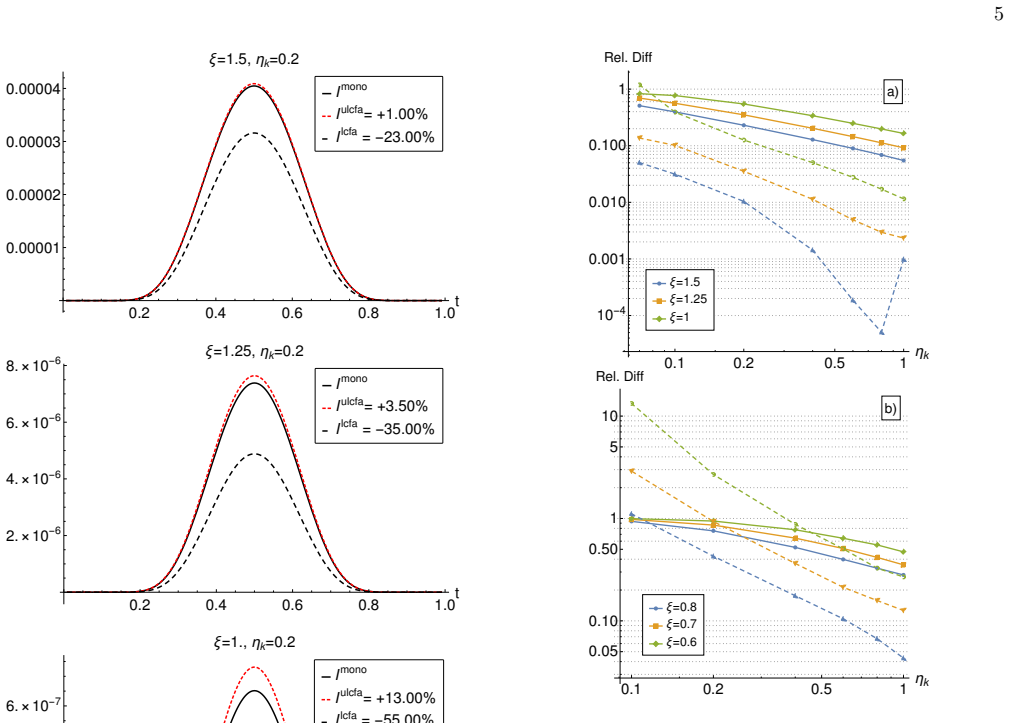
- For circularly polarised monochromatic backgrounds, the ULCFA matches the exact harmonic-sum result to about 1 percent at $\xi=1.5$, 3.5 percent at $\xi=1.25$, and 13 percent at $\xi=1$, while the LCFA errors are 23, 35, and 55 percent respectively.
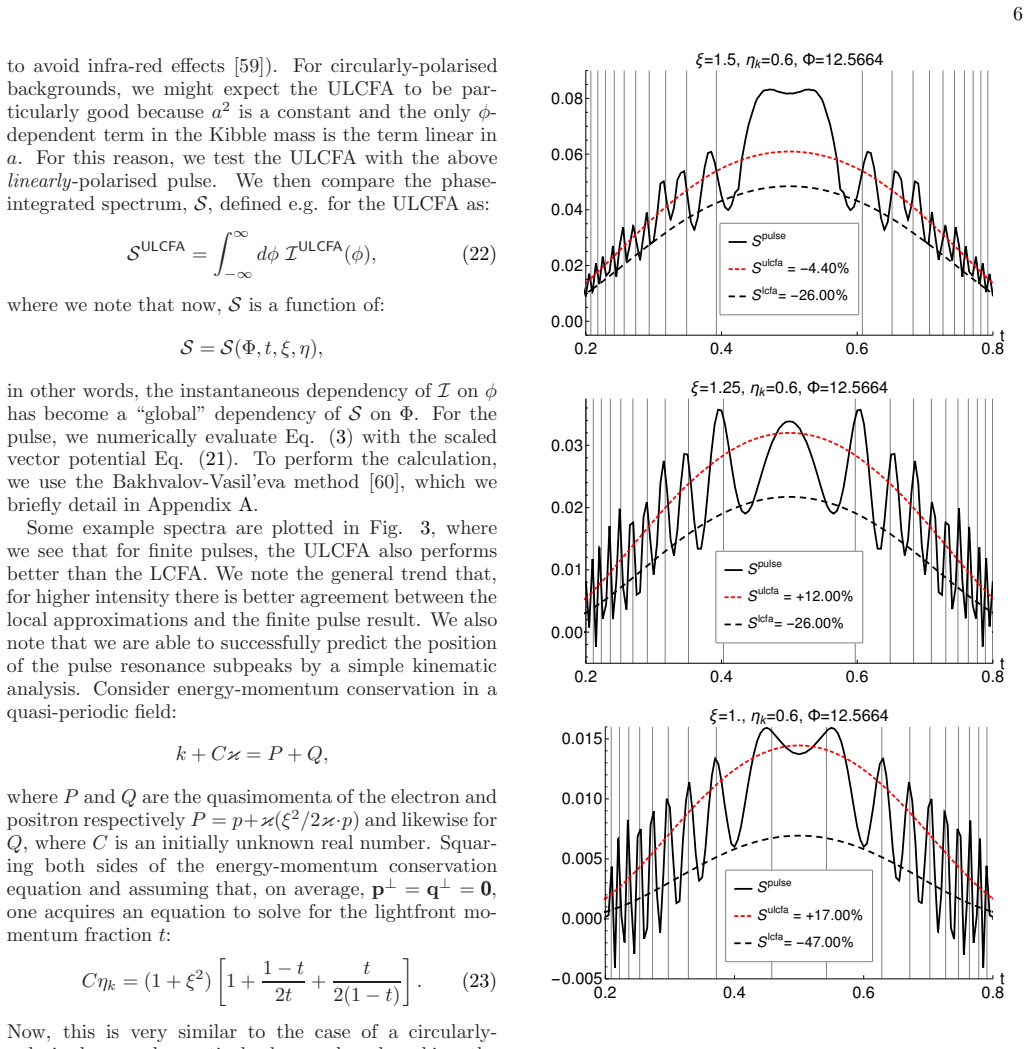
- For short linearly polarised pulses, the ULCFA phase-integrated spectra differ from the numerical QED result by roughly 4–17 percent for $\xi$ between 1 and 1.5, versus 26–47 percent for the LCFA.
- The ULCFA reproduces the known small-$\chi_k$ tunnelling exponent with corrections $1-1/(15\xi^2)$ for circular polarisation and $1-1/(10\xi^2)$ for linear polarisation at the saddle point, so the approximation connects to established asymptotic results.
- The pulse-resonance subpeak positions are predicted by solving the cycle-averaged conservation relation $C\eta_k=(1+\xi^2)[1+(1-t)/(2t)+t/(2(1-t))]$ with integer $C$, which the numerical spectra confirm.
Reading between the lines
- The same uniform-Airy argument-replacement could be applied to nonlinear Compton scattering and one-photon pair annihilation, since they share the same LCFA exponent structure, potentially giving moderate-intensity rates for those processes too.
- The acceleration-history form of the derivative correction, involving $\ddot u$ and $\dddot u$, suggests the ULCFA could be evaluated on the fly in a particle-tracking code using the electron's local acceleration history rather than explicit field derivatives, which would simplify implementation in plasma simulations.
- The optimal intensity filter $\xi^*$ likely depends on the seed-photon energy parameter $\eta_k$; a systematic scan over the ($\xi,\eta_k$) plane could turn the fixed $\xi^*=0.7$ used here into an adaptive threshold and extend the useful range of the approximation.
- If the ULCFA's accuracy holds across polarisations and pulse shapes, it would place the multiphoton-to-tunnelling transition region within reach of local-rate simulations, which is exactly the regime upcoming 10-GeV-class beam-laser experiments are designed to probe.
Editorial analysis
A structured set of objections, weighed in public.
Referee Report
Summary. This paper derives a 'uniform locally constant field approximation' (ULCFA) for nonlinear Breit-Wheeler pair creation in plane-wave backgrounds. Starting from the standard QED probability, the author applies a uniform Airy stationary-point analysis to the phase integral and encodes next-order field-derivative corrections in the Airy argument of the LCFA integrand, with an intensity filter that switches back to the LCFA below xi*=0.7. The ULCFA is benchmarked against the exact circularly-polarised monochromatic result and against numerical evaluation of the full finite-pulse probability for a short cos^2 pulse. The reported indicators show ULCFA rate errors of about +3.5% to +13% at xi=1-1.5 in the monochromatic case and -4% to +17% in the pulse case, compared with LCFA errors of 23-55% and 26-47%, respectively. The paper concludes that LCFA-type methods can be extended to xi approximately 1.25 with roughly 10% accuracy.
Significance. If the accuracy claim survives scrutiny, the ULCFA is a practically useful improvement: it is simple to implement in existing LCFA-based simulation codes and targets the xi of order 1 regime relevant to LUXE and E320 at FACET-II. The benchmarking is genuinely external to the derivation: the monochromatic benchmark is an exact analytic result and the pulse benchmark is a numerical evaluation of the full QED probability, and the intensity filter xi*=0.7 is explicitly not fitted to the benchmark rates. The kinematic prediction of finite-pulse subpeak positions from a cycle-averaged momentum relation is a useful consistency check, although the author correctly notes that it is not a universal rule.
major comments (4)
- [Sec. I, after Eq. (13)] The asymptotic ordering used to drop the pre-exponent corrections is not valid at the claimed validity boundary. For the circularly-polarised monochromatic background, Eq. (13) gives the correction factor 1 - 16/(3 xi^4); at xi=1.25 this is approximately -1.18, so the 'small' 1/xi^4 correction changes the sign of the prefactor and the 2/3 power requires an unspecified branch choice. Since Eq. (14) omits these corrections, the derivation in Sec. I does not control the ULCFA at xi approximately 1.25; the benchmark agreement is empirical. Please either include the pre-exponent corrections, provide a controlled error estimate for their omission, or substantially qualify the derivation claim.
- [Sec. I, Eqs. (7)-(12)] The passage from the general uniform-Airy expression, Eq. (10), to the argument shift in Eq. (12) is too compressed to verify. In particular, the discarded pair of stationary points is dismissed without quantifying its Airy argument, the branch of the (2/3)-power expression is not specified, and the relation of g(theta) in Eq. (11) to f1 = E'^2 + 3 E dot E'' is not shown. Because Eq. (12) is the central formula, this step should be written out in detail.
- [Sec. II.B and Appendix A] The numerical pulse benchmark does not report convergence tests or error estimates for the Bakhvalov-Vasil'eva integration; only the final spectra and integrated relative differences are shown. Since the claimed improvement at xi=1.25 is a comparison between a 12% error and a 26% error, an estimate of the numerical uncertainty of the reference result is needed to make the benchmark quantitative.
- [Conclusion, final paragraph] The claim that the ULCFA 'can be accurate to within 10% even down to intensities as low as xi approximately 1.25' is contradicted by the displayed pulse results in Fig. 3, where the integrated error is +12% at xi=1.25 and +17% at xi=1. Please either adjust the statement or define the restricted class of cases for which the 10% figure holds.
minor comments (3)
- [Sec. II.B] The word 'pair-creaton' appears and should be 'pair-creation'.
- [Eq. (23)] The quantity C is introduced as an unknown real number and is later set to an integer for the subpeak prediction; the notation should distinguish the general real C from the integer multiple used in the cycle-averaged comparison.
- [Figs. 1 and 3] The axis labels are minimal; adding explicit labels such as 't' and 'integrated spectrum' would improve readability.
Circularity Check
No significant circularity: the ULCFA is derived from the standard QED probability and benchmarked against external exact and numerical results; the only self-citation is to the authors' earlier LCFA+ paper and is not load-bearing.
full rationale
The derivation chain is self-contained: it starts from the full QED plane-wave probability Eq. (3) and applies the uniform Airy method of Refs. [41-43] to replace the Airy arguments ze -> ze+ in Eq. (12), with the pre-exponent left at the LCFA level. No parameter is fitted to the benchmark rates. The intensity filter xi* = 0.7 is explicitly chosen 'without recourse to optimisation' and is only active where the ULCFA is expected to fail; in the monochromatic benchmark it is neglected because xi is constant. The benchmarks themselves are external to the derivation: the exact analytical circularly-polarised monochromatic result Eq. (19) and the numerical evaluation of Eq. (3) for a finite cos^2 pulse. The paper's claim of ~10% accuracy at xi ~ 1.25 is therefore an empirical finding, not an output forced by the input. The skeptical objection that the pre-exponent corrections dropped after Eq. (13) are not small at xi = 1.25 (for the circular benchmark 1 - 16/(3 xi^4) ≈ -1.18) is a legitimate correctness/regime concern about the stated xi >> 1 ordering, but it is not circularity. The paper does cite the author's own Ref. [16] as motivation for the intensity filter and as 'in the spirit of' the extension, but the ULCFA formula and its benchmarking do not reduce to Ref. [16]; there is no fitted input renamed as a prediction, no uniqueness argument imported from the authors' prior work, and no known result merely renamed. The acknowledged limitations (dropped pre-exponent terms, the 'useful observation, not a universal rule' for pulse resonances) are stated openly and do not indicate circular reasoning.
Assumptions & free parameters
free parameters (1)
- Intensity filter threshold xi* =
0.7
assumptions (4)
- domain assumption The Volkov solutions and the probability formula Eq. (3) are the correct QED description of pair creation in a plane-wave background.
- standard math The uniform Airy approximation of Vallee and Soares is applicable to the phase integral in the QED probability.
- domain assumption The Taylor expansion of the exponent to fifth order, Eq. (11), captures the dominant stationary points, and the discarded stationary-point pair is suppressed.
- domain assumption Pre-exponent corrections scale as 1/xi^4 and can be neglected compared with Airy-argument corrections of order 1/xi^2.
Cite this review
Pith. "Pith review of A uniform locally constant field approximation for photon-seeded pair production." pith.science (2026). https://pith.science/paper/2FWCGFCB
@misc{pith2026190806985,
  author       = {Pith},
  title        = {Pith review of: A uniform locally constant field approximation for photon-seeded pair production},
  year         = {2026},
  howpublished = {\url{https://pith.science/paper/2FWCGFCB}},
  note         = {Machine review of arXiv:1908.06985}
}
read the original abstract
A challenge to upcoming experiments that plan to collide a particle beam with laser pulses of moderate intensity is how to correctly incorporate quantum effects into simulation frameworks. Using a uniform approach, we extend the widely-used locally constant field approximation (LCFA) to derive an improved rate of photon-seeded pair creation (the nonlinear Breit-Wheeler process). By benchmarking our "ULCFA" expressions with the lightfront spectrum of: i) exact analytical results and ii) numerical integration of the QED probability for short pulses, we show that our extended approach remains accurate at smaller values of the intensity parameter than the standard LCFA.
Figures

Forward citations
Cited by 1 Pith paper
-
One-photon pair-annihilation in pulsed plane-wave backgrounds
A locally constant field approximation for one-photon pair annihilation in plane-wave laser backgrounds is derived, benchmarked, and shown to give negligible event rates in realistic laser-plasma and QED-cascade scenarios.
Reference graph
Works this paper leans on
-
[1]
In general, the LCF A and ULCF A both increase in accuracy as ξ is increased from ξ = 1. However, it can be seen that the ULCF A is substantially more accurate than the LCF A in the region close to ξ ≈ 1, where the LCF A is not ex- pected to be accurate. In Fig. 2a, it is demonstrated how this accuracy also depends on the energy parameter ηk. If ξ is redu...
-
[2]
A. I. Nikishov and V. I. Ritus, Sov. Phys. JETP 19, 529 (1964)
1964
-
[3]
to a linearly-polarised monochromatic background, which has the form a⊥ = mξ[sinφ, 0], instead. By per- forming an asymptotic analysis for χ k → 0 in the spirit of [53, 54], then for the saddle at φ = 0, t = 1 / 2, θ = 2iξ cosh−1[ √ 1 +ξ2/ξ ], the exponent becomes: I ∼ exp { 2ξ χ k (√ 1 +ξ2 − (2 +ξ2) sech−1 ξ√ 1 +ξ2 )} . (17) If one also considers strong ...
- [4]
-
[5]
Heinzl, A
T. Heinzl, A. Ilderton, and M. Marklund, Phys. Lett. B 692, 250 (2010)
2010
-
[6]
× 10-7 ξ=1., ηk=0.2 FIG. 1. Comparison of the LCF A and ULCF A to the ex- act analytical result for a circularly-polarised monochro matic background. The percentages in boxes are the relative error s in the integral, calculated by integrating the curve over t. The relative error is further investigated in Fig. 2. B. Numerical evaluation of pulse integral ...
-
[7]
A. I. Titov, H. Takabe, B. Kampfer, and A. Hosaka, Phys. Rev. Lett. 108, 240406 (2012), 1205.3880
work page Pith review arXiv 2012
-
[8]
× 10-6 ξ=1.25, ηk=0.2 I mono I ulcfa= +13.00% I lcfa = -55.00% 0.2 0.4 0.6 0.8 1.0 t
Show all 76 references
-
[9]
(12) Here, we have manually added a filter to the Airy ar- gument (as opposed to outside the Airy function [16]), which ensures the local ξ is greater than some positive ξ∗
to the remaining pair of stationary points, equates to the prescription of replacing Airy-function ar- guments via ze →z+ e , where: z+ e =ze ( 1 +θ [ξ(φ) −ξ∗] EEE ′2(φ) + 3EEE(φ) · EEE ′′(φ) 30|EEE(φ)|4 )2/ 3 . (12) Here, we have manually added a filter to the Airy ar- gument ...
-
[10]
However, we note that this is simply a useful observation, not a universal rule - when longer or more intense pulses were used, the agreement was not as clear as implied here, but the agreement demonstrates that the numerical routine is behaving in a logical way. III. CONCLUSI...
-
[11]
local field
requires ξ ⁄≪1 [16]). Such a filter appears to be a standard consequence of including derivative corrections to the LCF A, whether at the level of the intensity [16], or in particle energy [20] (where higher derivatives can be used to define a new timescale to use in sampling th...
-
[12]
From the saddle-point analysis, we note we also have access to small ξ in the small χ k limit, in which case Eq
to this background, and re- placing the φ-dependent argument with the saddle point at φ = 0. From the saddle-point analysis, we note we also have access to small ξ in the small χ k limit, in which case Eq. ( 17) reduces to: I ∼ ξ2n∗ ; n∗ = 2(1 +ξ2) ηk , (18) which is exactly t...
-
[13]
instantaneous
in powers of 1 /ξ , the pre-exponent corrections scale as 1/ξ 4, whereas the Airy-argument corrections scale as 1/ξ 2 and hence are more significant. Then we define the ULCF A integrand for electron- seeded pair-creation as: I ULCFA = Ai 1(z+ e ) + ( 2 ze −ξηk √ze ) Ai′(z+ e ). ...
-
[14]
Breit and J
G. Breit and J. A. Wheeler, Phys. Rep. 46, 1087 (1934)
1934
-
[15]
N. B. Narozhny ˘ ı, Sov. Phys. JETP28, 371 (1969)
1969
-
[16]
Nousch, D
T. Nousch, D. Seipt, B. K¨ ampfer, and A. I. Titov, Phys. Lett. B 715, 246 (2012)
2012
-
[17]
can interpolate be- tween the tunneling and multiphoton regime, for small χ k. This is an analytic example of the interpolating function used in the analysis of the SLAC E144 experi- ment [48], and is similar to the seminal result by Brezin and Itzykson for pair-creation by an...
-
[18]
A. I. Titov, A. Otto, and B. Kampfer (2019), 1907.00643
2019 arXiv
-
[19]
Di Piazza, Phys
A. Di Piazza, Phys. Rev. Lett. 117, 213201 (2016)
2016
-
[20]
Di Piazza et al., Rev
A. Di Piazza et al., Rev. Mod. Phys. 84, 1177 (2012)
2012
-
[21]
King and T
B. King and T. Heinzl, High Power Laser Science and Engineering 4, e5 (2016), hep-ph/1510.08456
2016 arXiv
-
[22]
N. B. Narozhny and A. M. Fedotov, Contemporary Physics 56, 249 (2015)
2015
- [23]
-
[24]
C. N. Harvey, A. Ilderton, and B. King, Phys. Rev. A 91, 013822 (2015)
2015
-
[25]
Di Piazza, M
A. Di Piazza, M. Tamburini, S. Meuren, and C. H. Keitel, Phys. Rev. A 98, 012134 (2018), URL https://link.aps.org/doi/10.1103/PhysRevA.98.012134
2018 doi
-
[26]
Ilderton, B
A. Ilderton, B. King, and D. Seipt, Phys. Rev. A 99, 042121 (2019), URL https://link.aps.org/doi/10.1103/PhysRevA.99.042121
2019 doi
-
[27]
V. I. Ritus, J. Russ. Laser Res. 6, 497 (1985)
1985
-
[28]
V. M. Katkov and V. N. Baier, Electromagnetic Processes at High Energies in Oriented Single Crystals (World Sci- entific Publishing, 1994)
1994
-
[29]
T. G. Blackburn, D. Seipt, S. S. Bulanov, and M. Mark- lund (2019), 1904.07745
2019 arXiv
-
[30]
Di Piazza, M
A. Di Piazza, M. Tamburini, S. Meuren, and C. H. Keitel, Phys. Rev. A 99, 022125 (2019), URL https://link.aps.org/doi/10.1103/PhysRevA.99.022125
2019 doi
-
[31]
I. A. Aleksandrov, G. Plunien, and V. M. Shabaev, Phys. Rev. D 99, 016020 (2019), URL https://link.aps.org/doi/10.1103/PhysRevD.99.016020
2019 doi
- [32]
-
[33]
Ilderton, B
A. Ilderton, B. King and S. Tang, One-photon pair- annihilation in pulsed plane-wave backgrounds , (to ap- pear) (2019)
2019
-
[34]
E. N. Nerush et al., Phys. Rev. Lett. 106, 035001 (2011)
2011
-
[35]
N. V. Elkina et al., Phys. Rev. ST Accel. Beams 14, 054401 (2011)
2011
-
[36]
C. P. Ridgers, C. S. Brady, R. Duclous, J. G. Kirk, K. Bennett, T. D. Arber, A. P. L. Robinson, and A. R. Bell, Phys. Rev. Lett. 108, 165006 (2012), URL https://link.aps.org/doi/10.1103/PhysRevLett.108.165006
2012 doi
-
[37]
B. King, N. Elkina, and H. Ruhl, Phys. Rev. A 87, 042117 (2013)
2013
-
[38]
S. S. Bulanov, C. B. Schroeder, E. Esarey, and W. P. Leemans, Phys. Rev. A 87, 062110 (2013), URL https://link.aps.org/doi/10.1103/PhysRevA.87.062110
2013 doi
-
[39]
Ridgers, J
C. Ridgers, J. Kirk, R. Duclous, T. Blackburn, C. Brady, K. Bennett, T. Arber, and A. Bell, Journal of Computa- tional Physics 260, 273 (2014), ISSN 0021-9991, URL http://www.sciencedirect.com/science/article/pii/S0021999113008061
2014
-
[40]
T. G. Blackburn, Plasma Physics and Con- trolled Fusion 57, 075012 (2015), URL https://doi.org/10.1088%2F0741-3335%2F57%2F7%2F075012
2015
-
[41]
E. G. Gelfer, A. A. Mironov, A. M. Fedotov, V. F. Bashmakov, E. N. Nerush, I. Y. Kostyukov, and N. B. Narozhny, Phys. Rev. A 92, 022113 (2015), URL https://link.aps.org/doi/10.1103/PhysRevA.92.022113
2015 doi
-
[42]
Jirka, O
M. Jirka, O. Klimo, S. V. Bulanov, T. Z. Esirke- pov, E. Gelfer, S. S. Bulanov, S. Weber, and G. Korn, Phys. Rev. E 93, 023207 (2016), URL https://link.aps.org/doi/10.1103/PhysRevE.93.023207
2016 doi
-
[43]
Gonoskov, A
A. Gonoskov, A. Bashinov, S. Bastrakov, E. Efi- menko, A. Ilderton, A. Kim, M. Marklund, I. Meyerov, A. Muraviev, and A. Sergeev, Phys. Rev. X 7, 041003 (2017), URL https://link.aps.org/doi/10.1103/PhysRevX.7.041003
2017 doi
-
[44]
E. S. Efimenko, A. V. Bashinov, A. A. Gonoskov, S. I. Bastrakov, A. A. Muraviev, I. B. Meyerov, A. V. Kim, and A. M. Sergeev, Phys. Rev. E 99, 031201 (2019), URL https://link.aps.org/doi/10.1103/PhysRevE.99.031201
2019 doi
-
[45]
Sarri et al., Phys
G. Sarri et al., Phys. Rev. Lett. 113, 224801 (2014)
2014
-
[46]
Sarri et al., Nature communications 6, 6747 (2015)
G. Sarri et al., Nature communications 6, 6747 (2015)
2015
-
[47]
J. M. Cole, K. T. Behm, E. Gerstmayr, T. G. Blackburn, J. C. Wood, C. D. Baird, M. J. Duff, C. Harvey, A. Ilderton, A. S. Joglekar, et al., Phys. Rev. X 8, 011020 (2018), URL https://link.aps.org/doi/10.1103/PhysRevX.8.011020
2018 doi
-
[48]
Poder, M
K. Poder, M. Tamburini, G. Sarri, A. Di Piazza, S. Kuschel, C. D. Baird, K. Behm, S. Bohlen, J. M. Cole, D. J. Corvan, et al., Phys. Rev. X 8, 031004 (2018), URL https://link.aps.org/doi/10.1103/PhysRevX.8.031004
2018 doi
-
[49]
A. K. Harding and D. Lai, Rep. Prog. Phys. 69, 2631 (2006)
2006
-
[50]
Yokoya and P
K. Yokoya and P. Chen, in Frontiers of Particle Beams: Intensity Limitations , edited by M. Dienes, M. Month, and S. Turner (Springer Berlin Heidelberg, Berlin, Hei- delberg, 1992), pp. 415–445, ISBN 978-3-540-46797-7
1992
-
[51]
S. C. Miller and R. H. Good, Phys. Rev. 91, 174 (1953), URL https://link.aps.org/doi/10.1103/PhysRev.91.174
1953 doi
-
[52]
Valle´ e and M
O. Valle´ e and M. Soares, Airy Functions and Applica- tions to Physics (Imperial College Press, 57 Selton Street, Covent Garden, London WC2H 9HE, 2010)
2010
-
[53]
G. V. Dunne and M. Unsal, Phys. Rev. D89, 105009 (2014), 1401.5202
2014 arXiv
-
[54]
Altarelli, R
M. Altarelli, R. Assmann, F. Burkart, B. Heinemann, T. Heinzl, T. Koffas, A. R. Maier, D. Reis, A. Ringwald, and M. Wing (2019), 1905.00059
2019 arXiv
-
[55]
The F ACET-II SFQED Collaboration, Probing Strong- field QED at F ACET-II (SLAC E-320) , (to appear) (2019)
2019
-
[56]
D. L. Burke, R. C. Field, G. Horton-Smith, J. E. Spencer, D. Walz, S. C. Berridge, W. M. Bugg, K. Shmakov, A. W. Weidemann, C. Bula, et al., Phys. Rev. Lett. 79, 1626 (1997), URL https://link.aps.org/doi/10.1103/PhysRevLett.79.1626
1997 doi
-
[57]
D. L. Burke et al., Phys. Rev. Lett. 79, 1626 (1997)
1997
-
[58]
Bamber et al., Phys
C. Bamber et al., Phys. Rev. D 60, 092004 (1999)
1999
-
[59]
I. C. E. Turcu et al., Rom. Rep. Phys. 68, S145 (2016)
2016
-
[60]
B. Shen, Z. Bu, J. Xu, T. Xu, L. Ji, R. Li, and Z. Xu, Plasma Phys. Control. Fusion 60, 044002 (2018)
2018
-
[61]
Seipt and A
D. Seipt and A. G. R. Thomas, Plasma Phys. Control. 9 Fusion 61, 074005 (2019), 1903.11463
2019 arXiv
-
[62]
551 of the review [17], also reported in [65]
Note1, for example, on P. 551 of the review [17], also reported in [65]
- [63]
- [64]
-
[65]
Note2, recent work has shown that the order in which such limits are taken is crucial, and that they are not, in general, commutative [66]
-
[66]
F. W. J. Olver, Asymptotics and Special Functions (AKP Classics, A K Peters Ltd., 63 South Avenue, Natick, MA 01760, 1997)
1997
-
[67]
Seipt, T
D. Seipt, T. Heinzl, M. Marklund, and S. S. Bu- lanov, Phys. Rev. Lett. 118, 154803 (2017), URL https://link.aps.org/doi/10.1103/PhysRevLett.118.154803
2017 doi
-
[68]
NIST, Nist digital library of mathematical functions , http://dlmf.nist.gov/ (2017)
2017
-
[69]
V. Dinu, T. Heinzl, and A. Ilderton, Phys. Rev. D 86, 085037 (2012)
2012
-
[70]
Bakhvalov and L
N. Bakhvalov and L. Vasileva, USSR Comput. Math. Math. Phys. 8, 241 (1968)
1968
-
[71]
V. B. Berestetskii, E. M. Lifshitz, and L. P. Pitaevskii, Quantum Electrodynamics (second edition) (Butterworth-Heinemann, Oxford, 1982)
1982
-
[72]
Olver, Ph.D
S. Olver, Ph.D. thesis, University of Cambridge (2008)
2008
-
[73]
G. B. Arfken, H. J. Weber, and F. E. Harris, Mathemat- ical Methods for Physicists (Elsevier, 2012), seventh ed
2012
-
[74]
V. Dinu, T. Heinzl, A. Ilderton, M. Marklund, and G. Torgrimsson, Phys. Rev. D 89, 125003 (2014), URL http://link.aps.org/doi/10.1103/PhysRevD.89.125003
2014 doi
-
[75]
Hartin, A
A. Hartin, A. Ringwald, and N. Tapia, Phys. Rev. D 99, 036008 (2019), URL https://link.aps.org/doi/10.1103/PhysRevD.99.036008
2019 doi
-
[76]
Ilderton, Phys
A. Ilderton, Phys. Rev. D 99, 085002 (2019), URL https://link.aps.org/doi/10.1103/PhysRevD.99.085002
2019 doi
Reviewed August 14, 2026 · model on record in the stance chip above.
Discussion (0). Continue with ORCID to comment.