REVIEW 3 major objections 5 minor 34 references
Joint Embedding of 3D Scan and CAD Objects
T0 review · 3 major / 5 minor · reviewed 2026-08-14 · deepseek-v4-flash
Pith's one-line read The paper claims that a stacked-hourglass 3D CNN, trained with a triplet loss on aligned scan-CAD pairs, learns a joint embedding where semantically similar scans and CAD models sit close together, improving fine-grained CAD retrieval for…
desk verdict Solid architecture and a useful dataset, but the benchmark protocol makes the headline 12% retrieval gain a category-separation effect, not evidence of fine-grained instance similarity. read the letter →
The pith
A machine-rendered reading of the paper's core claim, the machinery that carries it, and where it could break.
The reading
What carries the argument
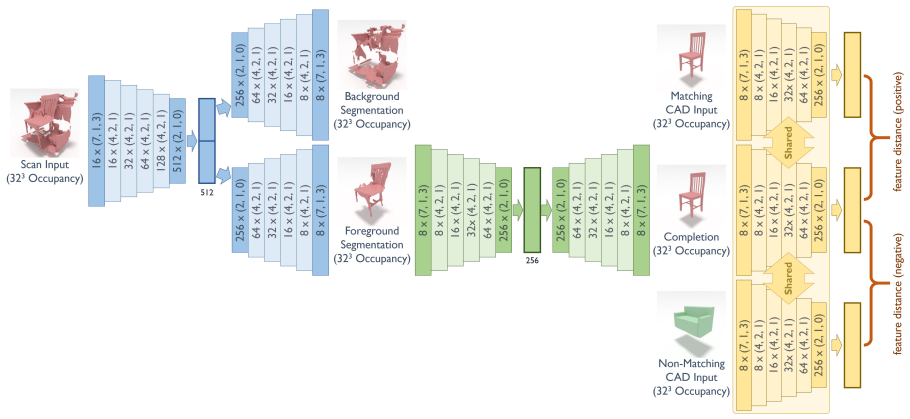
The load-bearing object is the stacked hourglass: a sequence of encoder-decoder 3D CNNs operating on $32^{3}$ binary occupancy grids. The first hourglass reconstructs foreground and background separately from a cluttered scan; the second reconstructs the complete occupancy of the segmented object; the final encoder outputs a 256-dimensional feature vector that is trained by a triplet loss against an identical encoder on CAD models, using Euclidean distance and a margin of 0.2. The design forces the scan through a CAD-like reconstruction before the embedding, so the embedding is learned on geometry that has already shed clutter and partialness.
What would settle it
Have a fresh set of annotators independently re-rank the same CAD proposal pools from the benchmark and measure agreement; low agreement, or a drop in top-1 retrieval accuracy when the annotated labels are swapped for class labels, would show the fine-grained similarity signal driving the 12-point gain is not stable.
Extended reading notes
Core claim
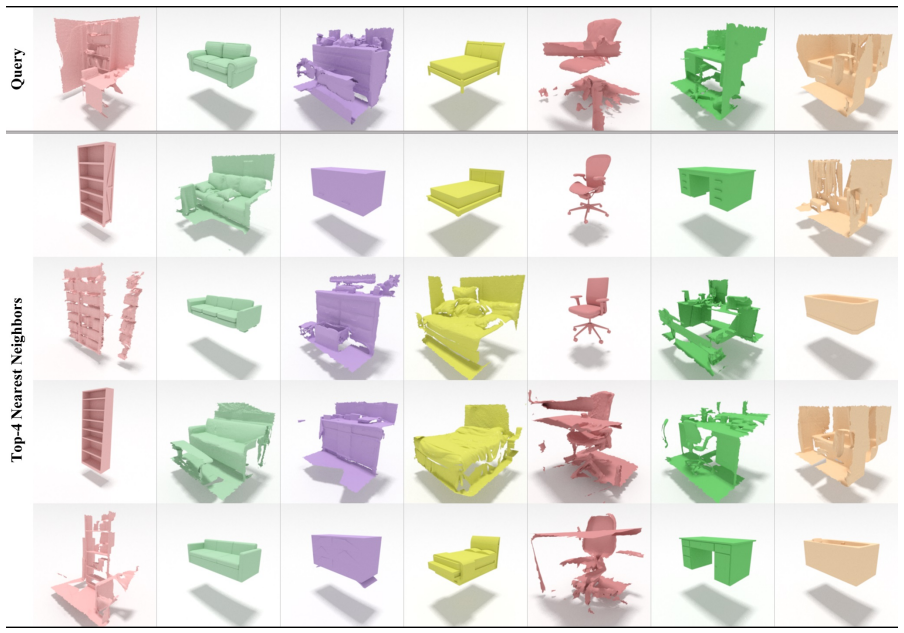
The central claim is that lower-level geometric gaps between scan and CAD geometry can be bridged by transforming the scan through two proxy tasks before embedding: foreground/background segmentation and object completion. Once the scan is rendered in a CAD-like form, the triplet loss pulls the matching CAD model close and pushes a different-class CAD model away, producing an embedding with a confusion score of 0.50 (the value for perfect mixing of scan and CAD neighbors). The same embedding gives 0.43 instance-average retrieval accuracy and 0.16 instance-average ranking quality on the new benchmark, and the paper shows through ablations that segmentation, completion, triplet negatives, and end-to-end training each contribute to the gain.
Load-bearing premise
The load-bearing premise is that the 5,102 human rankings of scan-CAD similarity are reliable ground truth; if those rankings are noisy or biased, the reported retrieval and ranking numbers do not substantiate the claimed improvement.
Editorial extensions
If this is right
- CAD model retrieval for scans can be evaluated at finer granularity than object class, using ranked similarity annotations instead of category matches.
- The ablation results imply that foreground segmentation and shape completion are not optional preprocessing: each step materially improves class-average retrieval accuracy.
- End-to-end training of the two hourglasses with the triplet loss outperforms the variant that inserts a separately trained completion network, so proxy tasks and embedding are best learned jointly.
- Rotation augmentation around the up axis makes retrieval robust to arbitrary rotations while keeping performance near the canonical-pose case, at 0.42 instance-average retrieval accuracy.
Reading between the lines
- The same embedding could support tasks beyond retrieval, such as transferring CAD semantics to scans or generating a clean CAD-like model from a partial scan, since the embedding is constructed from a segmented and completed representation.
- Because the model uses only geometry, adding color or texture could improve retrieval in categories where shape alone is ambiguous; this is a direct extension the paper leaves open.
- The benchmark's reliability would be strengthened by measuring inter-annotator agreement; a re-annotation study would test whether the ranked labels are stable enough to support the reported numerical gains.
- It is an open question whether the embedding generalizes to object categories beyond the 31 annotated classes; evaluating on held-out classes would show whether the space reflects true semantic similarity rather than memorized class structure.
Signed reviews
Editorial analysis
A structured set of objections, weighed in public.
Referee Report
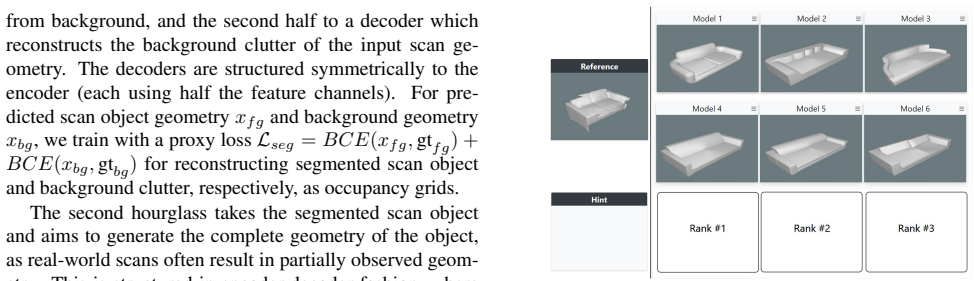
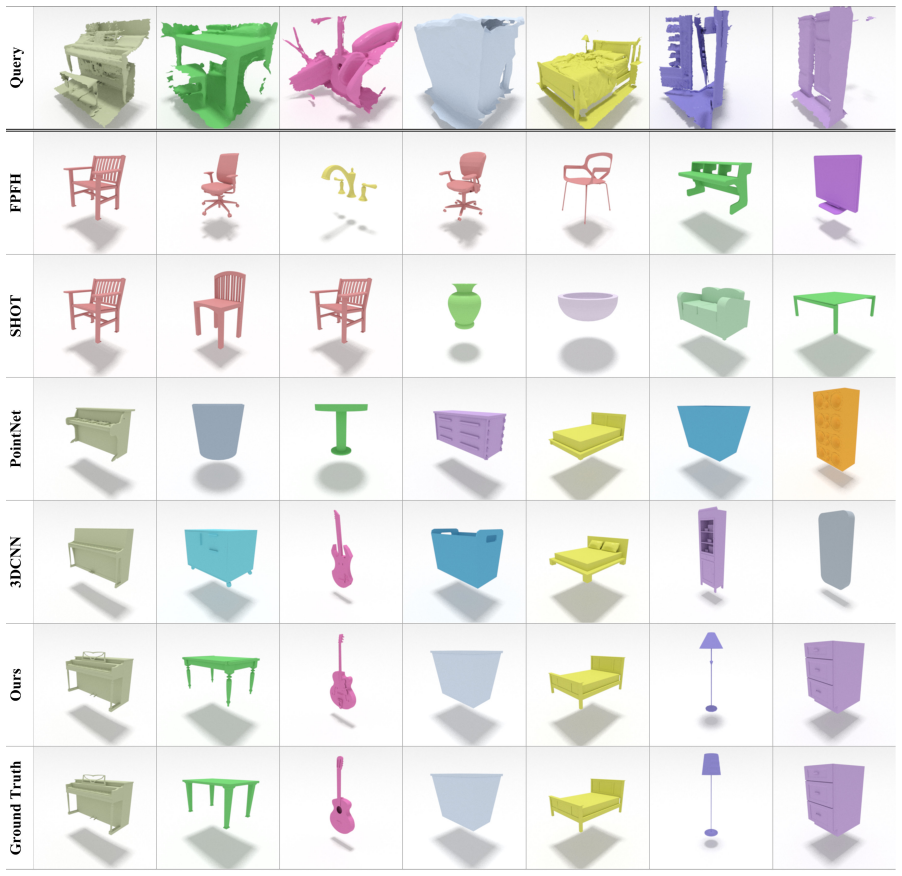
Summary. The paper proposes a stacked-hourglass 3D CNN that learns a joint embedding between real-world scan objects and CAD models. The network first segments a scan from background clutter, then completes the object geometry, and finally maps the completed occupancy grid and CAD occupancy grids into a shared space via a triplet loss. To evaluate the embedding, the authors introduce a Scan-CAD Object Similarity benchmark of 5102 human-ranked scan-to-CAD annotations, with retrieval-accuracy and ranking-quality metrics, and report improvements over FPFH, SHOT, PointNet, and a volumetric 3D CNN baseline, including a 12 percentage point gain in instance retrieval accuracy.
Significance. If the claims hold, the paper would make two useful contributions: a cross-domain embedding architecture with a principled segmentation/completion pipeline, and a benchmark that moves CAD retrieval evaluation beyond category labels. The paper has real strengths: end-to-end training with proxy losses is soundly motivated, the ablation study isolates the segmentation, completion, triplet, and end-to-end components, and the appendix provides rotation robustness experiments and a comparison against an alternative completion network. The main problem is that the evaluation protocol does not currently substantiate the instance-level and fine-grained claims, which are the paper's headline contributions.
major comments (3)
- [Section 4.2 and Section 5.1]
- [Section 5, Dataset Statistics and Tables 2 and 4]
- [Section 5.1 and Table 4]
minor comments (5)
- [Section 5.1]
- [Section 5.1 and Table 1]
- [Section 6]
- [Appendix A]
- [General]
Circularity Check
No circular reduction of the central claim: the human-ranked similarity labels are independent of the triplet-loss training signal, so the retrieval result is not equivalent to the training input by construction. Minor self-citation of Scan2CAD and a self-built benchmark are present but not load-bearing.
full rationale
The paper's claimed derivation is: train a stacked-hourglass 3D CNN with a triplet loss on Scan2CAD scan-to-CAD positive pairs and different-class negatives, then evaluate CAD retrieval on the newly collected Scan-CAD Object Similarity benchmark whose labels are human rankings of up to three of six proposed CAD models. The decisive point is that the benchmark labels are not the training signal: the triplet loss never sees the human rankings, and the retrieval/ranking metrics are not algebraically equal to the loss. The six proposals are sampled as latent nearest neighbors of the Scan2CAD-associated CAD model, so the candidate pool is anchored by the same alignment source used in training; this creates a real evaluation-validity concern, since the 100 distractors are from different classes and the within-class ranking quality in Table 4 is at chance (0.16), which suggests the reported 12% instance-retrieval gain may largely reflect class separation rather than fine-grained instance similarity. However, this is a confound in what the benchmark measures, not a case where a predicted quantity reduces by construction to a fitted parameter or to a self-citation. Scan2CAD is self-cited, but it is a published dataset with externally checkable alignments, and the human annotations provide an independent signal that the model does not optimize directly. No equation in the paper is equivalent to another by definition, and no fitted constant is renamed as a prediction. The central claim therefore does not collapse into its inputs; the paper merely overstates the granularity of what its benchmark can certify. Score 2 reflects the minor self-citation and self-built evaluation protocol, not a load-bearing circularity.
Assumptions & free parameters
free parameters (5)
- Triplet margin =
0.2 (0.1 for rotation-augmented variant)
- Number of CAD proposals per annotation =
6
- Number of nearest neighbors for proposal sampling =
30
- Voxel grid resolution =
32^3
- Final embedding dimension =
256
assumptions (5)
- domain assumption Scan2CAD alignments provide correct positive pairs between each scan object and its matching CAD model.
- domain assumption The 32^3 binary voxel occupancy grid preserves enough shape information to capture semantic similarity.
- domain assumption Randomly sampled different-class CAD models are a sufficient source of negatives for the triplet loss.
- domain assumption The human rankings in the new benchmark are a reliable ground truth for object similarity.
- domain assumption The completion ground truth is the aligned CAD model Cp.
Cite this review
Pith. "Pith review of Joint Embedding of 3D Scan and CAD Objects." pith.science (2026). https://pith.science/paper/KQCGQ6ZE
@misc{pith2026190806989,
  author       = {Pith},
  title        = {Pith review of: Joint Embedding of 3D Scan and CAD Objects},
  year         = {2026},
  howpublished = {\url{https://pith.science/paper/KQCGQ6ZE}},
  note         = {Machine review of arXiv:1908.06989}
}
read the original abstract
3D scan geometry and CAD models often contain complementary information towards understanding environments, which could be leveraged through establishing a mapping between the two domains. However, this is a challenging task due to strong, lower-level differences between scan and CAD geometry. We propose a novel approach to learn a joint embedding space between scan and CAD geometry, where semantically similar objects from both domains lie close together. To achieve this, we introduce a new 3D CNN-based approach to learn a joint embedding space representing object similarities across these domains. To learn a shared space where scan objects and CAD models can interlace, we propose a stacked hourglass approach to separate foreground and background from a scan object, and transform it to a complete, CAD-like representation to produce a shared embedding space. This embedding space can then be used for CAD model retrieval; to further enable this task, we introduce a new dataset of ranked scan-CAD similarity annotations, enabling new, fine-grained evaluation of CAD model retrieval to cluttered, noisy, partial scans. Our learned joint embedding outperforms current state of the art for CAD model retrieval by 12% in instance retrieval accuracy.
Figures

Figures from the paper (3 more)

Reference graph
Works this paper leans on
-
[1]
Armen Avetisyan, Manuel Dahnert, Angela Dai, Manolis Savva, Angel X. Chang, and Matthias Nießner. Scan2cad: Learning cad model alignment in rgb-d scans. InProc. Com- puter Vision and Pattern Recognition (CVPR), IEEE , 2019. 4
work page 2019
-
[2]
Learning visual similarity for product design with convolutional neural networks
Sean Bell and Kavita Bala. Learning visual similarity for product design with convolutional neural networks. ACM Transactions on Graphics (TOG), 34(4):98, 2015. 2
work page 2015
-
[3]
Angel X. Chang, Angela Dai, Thomas Funkhouser, Maciej Halber, Matthias Niessner, Manolis Savva, Shuran Song, Andy Zeng, and Yinda Zhang. Matterport3D: Learning from RGB-D data in indoor environments. International Confer- ence on 3D Vision (3DV), 2017. 1, 2
work page 2017
-
[4]
Angel X. Chang, Thomas Funkhouser, Leonidas Guibas, Pat Hanrahan, Qixing Huang, Zimo Li, Silvio Savarese, Mano- lis Savva, Shuran Song, Hao Su, Jianxiong Xiao, Li Yi, and Fisher Yu. ShapeNet: An Information-Rich 3D Model Repository. Technical Report arXiv:1512.03012 [cs.GR], Stanford University — Princeton University — Toyota Tech- nological Institute at ...
arXiv 2015
-
[5]
A 3d object retrieval system based on multi-resolution reeb graph
Ding-Yun Chen and Ming Ouhyoung. A 3d object retrieval system based on multi-resolution reeb graph. In Proc. of Computer Graphics Workshop, volume 16, 2002. 2
work page 2002
-
[6]
On visual similarity based 3d model retrieval
Ding-Yun Chen, Xiao-Pei Tian, Yu-Te Shen, and Ming Ouhyoung. On visual similarity based 3d model retrieval. In Computer graphics forum, volume 22, pages 223–232. Wi- ley Online Library, 2003. 2
work page 2003
-
[7]
Robust reconstruction of indoor scenes
Sungjoon Choi, Qian-Yi Zhou, and Vladlen Koltun. Robust reconstruction of indoor scenes. In 2015 IEEE Conference on Computer Vision and Pattern Recognition (CVPR), pages 5556–5565. IEEE, 2015. 1
work page 2015
-
[8]
Chang, Manolis Savva, Maciej Hal- ber, Thomas Funkhouser, and Matthias Nießner
Angela Dai, Angel X. Chang, Manolis Savva, Maciej Hal- ber, Thomas Funkhouser, and Matthias Nießner. ScanNet: Richly-annotated 3D reconstructions of indoor scenes. In Proc. Computer Vision and Pattern Recognition (CVPR), IEEE, 2017. 1, 2, 4
work page 2017
Show all 34 references
-
[9]
Bundlefusion: Real-time globally consistent 3d reconstruction using on-the-fly sur- face reintegration
Angela Dai, Matthias Nießner, Michael Zollh ¨ofer, Shahram Izadi, and Christian Theobalt. Bundlefusion: Real-time globally consistent 3d reconstruction using on-the-fly sur- face reintegration. ACM Transactions on Graphics (TOG) , 36(3):24, 2017. 1
2017
-
[10]
Shape completion using 3d-encoder-predictor cnns and shape synthesis
Angela Dai, Charles Ruizhongtai Qi, and Matthias Nießner. Shape completion using 3d-encoder-predictor cnns and shape synthesis. In Proc. Computer Vision and Pattern Recognition (CVPR), IEEE, 2017. 10, 11
2017
-
[11]
Pose-oblivious shape signature
Ran Gal, Ariel Shamir, and Daniel Cohen-Or. Pose-oblivious shape signature. IEEE transactions on visualization and computer graphics, 13(2):261–271, 2007. 2
2007
-
[12]
Lesss: Learned shared se- mantic spaces for relating multi-modal representations of 3d shapes
Robert Herzog, Daniel Mewes, Michael Wand, Leonidas Guibas, and Hans-Peter Seidel. Lesss: Learned shared se- mantic spaces for relating multi-modal representations of 3d shapes. In Computer Graphics Forum , volume 34, pages 141–151. Wiley Online Library, 2015. 2
2015
-
[13]
Topology matching for fully automatic similarity estimation of 3d shapes
Masaki Hilaga, Yoshihisa Shinagawa, Taku Kohmura, and Tosiyasu L Kunii. Topology matching for fully automatic similarity estimation of 3d shapes. In Proceedings of the 28th annual conference on Computer graphics and interac- tive techniques, pages 203–212. ACM, 2001. 2
2001
-
[14]
Shrec17: Rgb- d to cad retrieval with objectnn dataset
Binh-Son Hua, Quang-Trung Truong, Minh-Khoi Tran, Quang-Hieu Pham, Asako Kanezaki, Tang Lee, HungYueh Chiang, Winston Hsu, Bo Li, Yijuan Lu, et al. Shrec17: Rgb- d to cad retrieval with objectnn dataset. 2, 4, 5
-
[15]
Kinectfusion: real-time 3d reconstruction and inter- action using a moving depth camera
Shahram Izadi, David Kim, Otmar Hilliges, David Molyneaux, Richard Newcombe, Pushmeet Kohli, Jamie Shotton, Steve Hodges, Dustin Freeman, Andrew Davison, et al. Kinectfusion: real-time 3d reconstruction and inter- action using a moving depth camera. In Proceedings of the 24th ...
2011
-
[16]
Yangyan Li, Hao Su, Charles Ruizhongtai Qi, Noa Fish, Daniel Cohen-Or, and Leonidas J. Guibas. Joint embeddings of shapes and images via cnn image purification.ACM Trans. Graph., 2015. 2
2015
-
[17]
Style compatibility for 3D furniture models
Tianqiang Liu, Aaron Hertzmann, Wilmot Li, and Thomas Funkhouser. Style compatibility for 3D furniture models. ACM Transactions on Graphics (Proc. SIGGRAPH) , 34(4), Aug. 2015. 4
2015
-
[18]
Deep exemplar 2d-3d detection by adapting from real to rendered views
Francisco Massa, Bryan C Russell, and Mathieu Aubry. Deep exemplar 2d-3d detection by adapting from real to rendered views. In Proceedings of the IEEE Conference on Computer Vision and Pattern Recognition , pages 6024– 6033, 2016. 2
2016
-
[19]
Kinectfusion: Real-time dense surface mapping and track- ing
Richard A Newcombe, Shahram Izadi, Otmar Hilliges, David Molyneaux, David Kim, Andrew J Davison, Pushmeet Kohi, Jamie Shotton, Steve Hodges, and Andrew Fitzgibbon. Kinectfusion: Real-time dense surface mapping and track- ing. In Mixed and augmented reality (ISMAR), 2011 10th I...
2011
-
[20]
Stacked hour- glass networks for human pose estimation
Alejandro Newell, Kaiyu Yang, and Jia Deng. Stacked hour- glass networks for human pose estimation. In Computer Vi- sion – ECCV 2016 , pages 483–499. Springer International Publishing, 2016. 3
2016
-
[21]
Real-time 3d reconstruction at scale us- ing voxel hashing
Matthias Nießner, Michael Zollh ¨ofer, Shahram Izadi, and Marc Stamminger. Real-time 3d reconstruction at scale us- ing voxel hashing. ACM Transactions on Graphics (TOG) ,
-
[22]
Shape-similarity search of 3d models by using en- hanced shape functions
Ryutarou Ohbuchi, Takahiro Minamitani, and Tsuyoshi Takei. Shape-similarity search of 3d models by using en- hanced shape functions. In Proceedings of Theory and Prac- tice of Computer Graphics, 2003. , pages 97–104. IEEE,
2003
-
[23]
Shape distributions
Robert Osada, Thomas Funkhouser, Bernard Chazelle, and David Dobkin. Shape distributions. ACM Transactions on Graphics (TOG), 21(4):807–832, 2002. 2
2002
-
[24]
Learning deep object detectors from 3d models
Xingchao Peng, Baochen Sun, Karim Ali, and Kate Saenko. Learning deep object detectors from 3d models. In Proceed- ings of the IEEE International Conference on Computer Vi- sion, pages 1278–1286, 2015. 2
2015
-
[25]
Shrec18: Rgb-d object-to-cad retrieval
Quang-Hieu Pham, Minh-Khoi Tran, Wenhui Li, Shu Xiang, Heyu Zhou, Weizhi Nie, Anan Liu, Yuting Su, Minh-Triet Tran, Ngoc-Minh Bui, et al. Shrec18: Rgb-d object-to-cad retrieval. 2, 4, 5
-
[26]
Pointnet: Deep learning on point sets for 3d classifica- tion and segmentation
Charles R Qi, Hao Su, Kaichun Mo, and Leonidas J Guibas. Pointnet: Deep learning on point sets for 3d classifica- tion and segmentation. Proc. Computer Vision and Pattern Recognition (CVPR), IEEE, 1(2):4, 2017. 2, 5, 6, 7, 8
2017
-
[27]
V olumetric and multi-view cnns for object classification on 3d data
Charles Ruizhongtai Qi, Hao Su, Matthias Nießner, Angela Dai, Mengyuan Yan, and Leonidas Guibas. V olumetric and multi-view cnns for object classification on 3d data. In Proc. Computer Vision and Pattern Recognition (CVPR), IEEE ,
-
[28]
Fast point feature histograms (fpfh) for 3d registration
Radu Bogdan Rusu, Nico Blodow, and Michael Beetz. Fast point feature histograms (fpfh) for 3d registration. In Robotics and Automation, 2009. ICRA’09. IEEE Interna- tional Conference on, pages 3212–3217. Citeseer, 2009. 2, 5, 6, 7, 8
2009
-
[29]
Skeleton based shape matching and retrieval
Hari Sundar, Deborah Silver, Nikhil Gagvani, and Sven Dickinson. Skeleton based shape matching and retrieval. In 2003 Shape Modeling International., pages 130–139. IEEE,
2003
-
[30]
Unique signatures of histograms for local surface descrip- tion
Federico Tombari, Samuele Salti, and Luigi Di Stefano. Unique signatures of histograms for local surface descrip- tion. In Kostas Daniilidis, Petros Maragos, and Nikos Para- gios, editors, Computer Vision – ECCV 2010 , pages 356– 369, Berlin, Heidelberg, 2010. Springer Berlin ...
2010
-
[31]
Sgpn: Similarity group proposal network for 3d point cloud instance segmentation
Weiyue Wang, Ronald Yu, Qiangui Huang, and Ulrich Neu- mann. Sgpn: Similarity group proposal network for 3d point cloud instance segmentation. In Proceedings of the IEEE Conference on Computer Vision and Pattern Recognition , pages 2569–2578, 2018. 10
2018
-
[32]
Large scale image annotation: learning to rank with joint word- image embeddings
Jason Weston, Samy Bengio, and Nicolas Usunier. Large scale image annotation: learning to rank with joint word- image embeddings. Machine learning, 81(1):21–35, 2010. 2
2010
-
[33]
Wsabie: Scaling up to large vocabulary image annotation
Jason Weston, Samy Bengio, and Nicolas Usunier. Wsabie: Scaling up to large vocabulary image annotation. In Twenty- Second International Joint Conference on Artificial Intelli- gence, 2011. 2
2011
-
[34]
Elasticfusion: Dense slam without a pose graph
Thomas Whelan, Stefan Leutenegger, Renato F Salas- Moreno, Ben Glocker, and Andrew J Davison. Elasticfusion: Dense slam without a pose graph. Proc. Robotics: Science and Systems, Rome, Italy, 2015. 1 A. Additional Quantitative Studies We provide several additional quantitative...
2015
Reviewed August 14, 2026 · model on record in the stance chip above.
Discussion (0). Continue with ORCID to comment.