REVIEW 3 major objections 4 minor 96 references
Electrodynamics of tilted Dirac/Weyl materials: A unique platform for unusual surface plasmon polaritons
T0 review · 3 major / 4 minor · reviewed 2026-08-14 · deepseek-v4-flash
Pith's one-line read This paper claims that the electronic tilt of Dirac and Weyl cones changes Maxwell’s equations inside the material, giving surface plasmon polaritons a new, tilt-controlled spectrum.
desk verdict A promising catalog of tilt-dependent SPP spectra is undermined by a wrong sign and an invalid cancellation in the step from Eq. (14) to Eq. (15), so the central results are not established as written. read the letter →
The pith
A machine-rendered reading of the paper's core claim, the machinery that carries it, and where it could break.
The reading
What carries the argument
The central object is the deformed Minkowski metric $g_{\mu\nu}$ of Eq. (3), with off-diagonal time-space entries $-\zeta_i$, which encodes the tilt in the dispersion $g^{\mu\nu} k_\mu k_\nu = 0$. This metric is used to raise indices of the field-strength tensor $F_{\mu\nu}$, producing the tilt-mixed fields $\bar{E}$ and $\bar{B}$ of Eq. (6), and hence the modified inhomogeneous Maxwell equations (12)–(13). The derivation then runs through the wave equation (16), the surface-mode ansatz with evanescent decay $\gamma$, and the boundary conditions at the vacuum interface; the tilt-dependent SPP dispersions and formulas such as Eqs. (22) and (38) are the output of that machinery.
What would settle it
Compute the surface plasmon dispersion from the microscopic polarization tensor of the tilted cone without imposing the tilted metric on the photon field; if the saturation frequency in Eq. (22) shows no $\zeta$ dependence, or if a candidate material shows no orientation asymmetry between $q\parallel\zeta$ and $q\perp\zeta$ in measured SPP spectra, the central claim is refuted. A sharper test: for $q\perp\zeta$ in a tilted Dirac material the paper predicts the $\zeta=0$ spectrum, so observing a tilt-induced shift in that geometry would contradict the theory.
Extended reading notes
Core claim
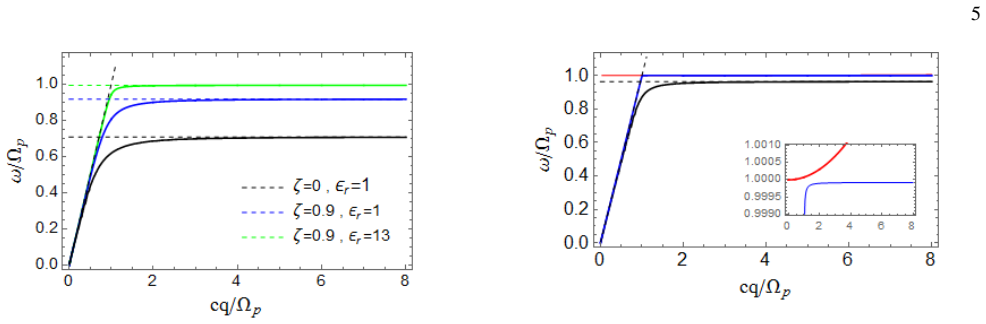
The paper’s central claim is that the tilt parameter $\zeta$ enters the inhomogeneous Maxwell equations through the same deformed metric $g_{\mu\nu}$ that governs the tilted cone, replacing the field-strength components by $\bar{E}=E+\zeta\times B$ and $\bar{B}=B(1-\zeta^2)+\zeta(\zeta\cdot B)+\zeta\times E$. Solving the modified wave equation for surface modes at a vacuum interface yields SPP dispersions whose large-momentum saturation frequency obeys $\Omega_s = \Omega_p/\sqrt{1+(1-\zeta^2)/\epsilon_r}$, so the familiar non-tilted value shifts upward with tilt and reaches $\Omega_p$ as $\zeta\to 1$; for $1<\zeta<\sqrt{1+\epsilon_r}$ the surface mode sits above the bulk plasmon, and beyond that it becomes unstable. Depending on the relative orientation of $q$, $b$, and $\zeta$, the same equations produce SPP-forbidden regions where bulk plasmons take over, soft SPP modes with vanishing frequency at large $q$ when $\zeta\to 1$, a kink that freezes the group velocity, negative group velocity at short wavelengths, and a tilt-only instability wavevector. The paper presents this as a new ‘spacetime-interface’ electrodynamics: the SPP lives on the boundary between Minkowski vacuum and the tilted cone’s effective geometry.
Load-bearing premise
The entire derivation assumes that the electromagnetic fields themselves obey Maxwell equations written in the same tilted metric that describes the electronic dispersion; if only the electrons feel the tilt and the photon remains in flat Minkowski spacetime, the modified wave equation and all predicted surface plasmon features do not follow.
Editorial extensions
If this is right
- In tilted Dirac matter, the surface plasmon saturation frequency is set by $\zeta$ and $\epsilon_r$ through $\Omega_s = \Omega_p/\sqrt{1+(1-\zeta^2)/\epsilon_r}$, so measuring $\Omega_s$ gives a direct map of the tilt parameter.
- For over-tilted cones ($\zeta>1$), surface modes with $\Omega_s>\Omega_p$ become possible, extending the SPP band beyond where ordinary conductors support surface modes; at the horizon value $\zeta=1$ the SPP becomes dispersionless and stops at a kink, filtering out large-wavevector modes.
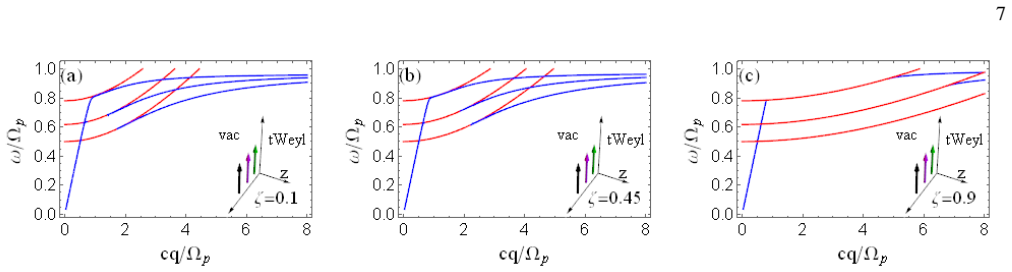
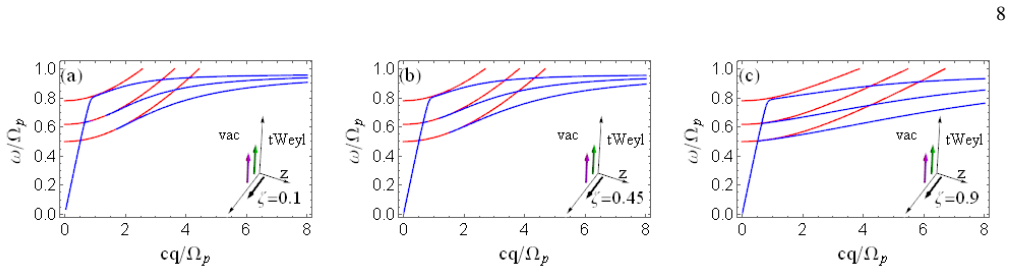
- In tilted Weyl matter with the axion vector in the surface (Fermi arcs), a tilt transverse to the Fermi arc closes the SPP-forbidden gap that the axion parameter alone would open, while a tilt parallel to the Fermi arc widens it.
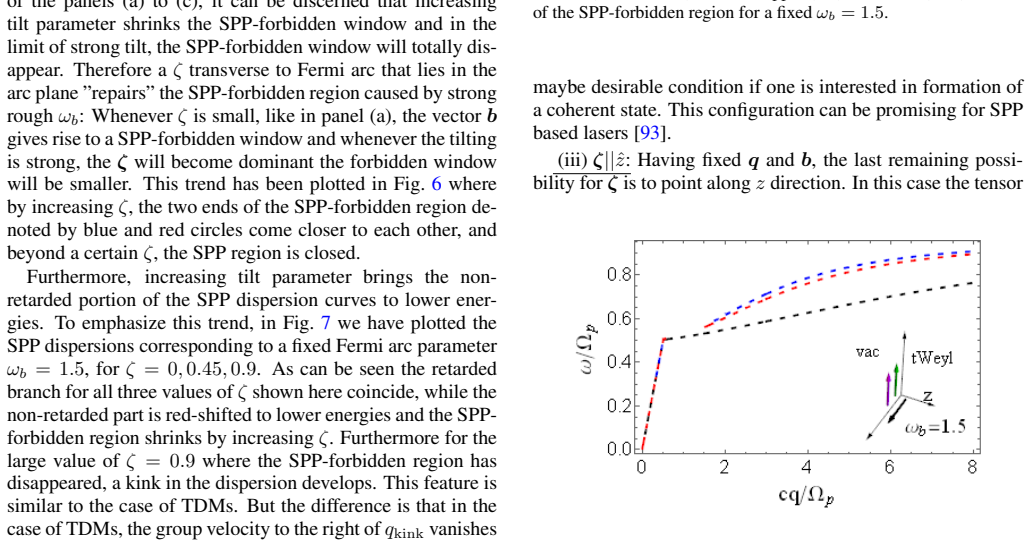
- For a facet with no Fermi arcs, strong tilt forbids long-wavelength propagation and introduces an instability wavevector $q_{\rm inst}$ that depends only on $\zeta$, so the tilt acts as a tunable SPP filter.
Reading between the lines
- If the metric-level coupling is right, the same $\zeta$-induced mixing of $E$ and $B$ should appear in other electromagnetic phenomena beyond SPPs—for example in the Casimir force, near-field heat transfer, or the optical response of tilted Dirac/Weyl films, where it would create anisotropies absent in upright cones.
- The predicted $q_{\rm inst}$ being independent of the axion parameter suggests a clean laboratory check: near-field optical microscopy on a tilted Weyl surface could measure the cutoff wavevector as a function of tilt, testing the $\zeta$-only scaling without needing to control the axion parameter.
- The orientation dependence of $\Omega_s$ in Eq. (22) could be inverted into a material-characterization tool: because the direction of $\zeta$ is fixed by the crystal while $q$ is chosen experimentally, measuring the SPP dispersion for $q\parallel\zeta$ versus $q\perp\zeta$ distinguishes tilt from mere anisotropic effective mass, which would not produce the same $(1-\zeta^2)$ scaling.
Signed reviews
Editorial analysis
A structured set of objections, weighed in public.
Referee Report
Summary. This paper proposes an extension of Maxwell electrodynamics for tilted Dirac and Weyl semimetals in which the tilt vector ζ is encoded in the spacetime metric g_{μν} of Eq. (3). The authors define the field strength in this metric (Eqs. (5)-(6)), derive modified inhomogeneous Maxwell equations (Eqs. (12)-(13)), and then study surface plasmon polaritons at a planar interface between the tilted material and vacuum or a simple dielectric. They treat tilted Dirac matter (b^μ = 0) and tilted Weyl matter with b^μ = (0,b) or (b0,0), covering different orientations of the propagation vector q, the axion vector b, and ζ. The central claims are a tilt-dependent SPP saturation frequency (Eq. (22)), SPP-forbidden regions controlled by axion and tilt parameters, soft modes at large q when ζ→1, SPP branches above the bulk plasmon frequency, negative group velocity, and a tilt-dependent instability wave vector.
Significance. The paper is systematic and addresses a question of current interest: whether SPP spectroscopy can map tilt and Fermi-arc parameters. The analytic benchmark against Hofmann and Das Sarma (Ref. [81]) in the ζ = 0 limit is a useful check, and Eq. (22) is a simple falsifiable prediction. If the proposed electrodynamics were correct, the orientation-resolved SPP catalog would be a valuable resource. However, two load-bearing steps in Section II are not valid as written: the sign of Faraday's law in Eq. (10) and the cancellation leading to Eq. (15). In addition, the promotion of the electronic tilt to a metric for the photon field is assumed rather than derived from the microscopic Hamiltonian. Consequently, the dispersion relations and figures of Sections III-V are not established.
major comments (3)
- [II, Eq. (10)] Equation (10) states ∇×E = c^{-1} ∂B/∂t, which is Faraday's law with the wrong sign; the standard form is ∇×E = -c^{-1} ∂B/∂t. This is not a typographical detail, because Eq. (10) is used immediately afterward to eliminate ∂B/∂t (equivalently B) from Eq. (14). With the harmonic convention e^{-iωt}, the sign determines the relation between B and ∇×E that enters the cancellation claimed in Eq. (15).
- [II, Eqs. (14)-(15)] The transition from Eq. (14) to Eq. (15) is not a consequence of Eq. (10). For constant ζ and e^{-iωt} fields, Eq. (14) gives D = ... + ζ×B - (ic/ω)∇×(ζ×E) + ... . Even accepting the printed sign of Eq. (10), B = (ic/ω)∇×E, so the two terms combine to (ic/ω)[ζ×(∇×E) - ∇×(ζ×E)], and the vector identity yields ζ×(∇×E) - ∇×(ζ×E) = ∇(ζ·E) - ζ(∇·E). This is not zero for the evanescent SPP profiles of Eq. (17); for the q∥ζ configuration of Section III, ∇·E = iqE_x - γE_z, which is generically nonzero. With the correct minus sign in Faraday's law the sum is generically nonzero as well. Therefore Eq. (15) does not follow from Eq. (14). Since Eq. (15) is inserted into the wave equation Eq. (16) and is used to build the matrices in Eqs. (18), (24), (27), (31), (34), (35) and all dispersion formulas and figures in Sections III-V, the central SPP predictions are unproven as written. The ζ = 0 limit removes the tilt-dependent terms and therefore cannot validate the new ζ-dependent predictions.
- [II, Eqs. (3)-(6) and (16)] The foundational assumption of the paper is that the tilt in the electronic dispersion can be promoted to the spacetime metric g_{μν} of Eq. (3) and that the electromagnetic field strength in the material is obtained by raising indices with this metric, as in Eqs. (5)-(6). This is not a consequence of the Hamiltonian in Eq. (1). The tilt modifies the electronic current-response (polarization) tensor, but the photon field in the medium does not automatically live in a deformed spacetime; in standard effective-field-theory treatments of Weyl and axion electrodynamics, the axion term arises from integrating out fermions while the photon remains in Minkowski spacetime. A concrete test would be to compute the current-current correlation function from Eq. (1) and derive the SPP dispersion from the resulting nonlocal conductivity without altering the kinematic Maxwell equations. Unless that calculation reproduces Eqs. (19)-(22), the spectra reported here are conditional on an unvalidated modeling assumption. Because this assumption is the input to every dispersion relation in the paper, it is load-bearing.
minor comments (4)
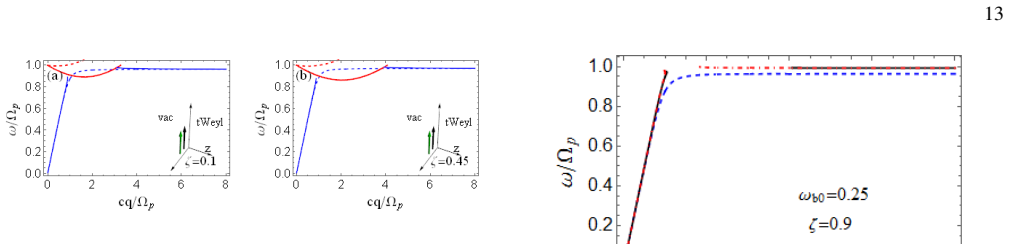
- [III, Fig. 2] The text around Fig. 2 says the black solid curve corresponds to εr = 1 while the blue and green curves correspond to εr = 1 and 13, respectively, which conflicts with the figure legend (black ζ = 0, blue and green ζ = 0.9 with εr = 1 and 13); please clarify the intended values.
- [I, Introduction] The Introduction contains the typographical error "Nernts effect" (should be Nernst effect).
- [IV A, footnote after Eq. (26)] The footnote after Eq. (26) says "Note that in there are some typos in the equations of the above reference" without specifying which equations or typos are meant; if the authors wish to caution readers about Ref. [81], the specific issues should be identified, or the footnote should be removed.
- [III, Eqs. (18)-(25)] The abbreviations λ² = 1-ζ² and λ′² = 2-ζ² are introduced in Eqs. (18) and (25) without a single defining statement; collecting these definitions in one place in Section II would improve readability.
Circularity Check
No circularity: SPP dispersions are derived analytically from the stated metric-based Maxwell model with ζ and b as inputs, and the ζ=0 limit is checked against external benchmarks.
full rationale
The paper starts from the tilted-Weyl Hamiltonian (Eq. 1), defines the tilt vector ζ through the dispersion (Eq. 2), and then introduces the metric gμν (Eq. 3) that reproduces that dispersion covariantly (Eq. 4). The modified Maxwell equations and the barred fields (Eqs. 5-6) are constructed mathematically from this metric, with the physical assumption stated explicitly ('Departing from the point that the tilt deformation ... can be encoded into the spacetime metric, it would be natural to explore how does the modified metric affect the Maxwell theory?'). The SPP spectra are then obtained by solving the wave equation (Eq. 16) with the displacement field (Eq. 15) under standard boundary conditions; no parameter is fitted to the computed SPP dispersions. The tilt and axion parameters ζ and b are inputs, not outputs. The ζ=0 limit reduces to the known results of Hofmann and Das Sarma (Ref. 81) and Ritchie's Ωs = Ωp/√(1+1/εr), providing an external benchmark. Self-citations [41,51] are used to motivate the metric language, but the essential metric-dispersion relation is re-derived in Eqs. (1)-(4), and the cited polarization-tensor result is stated with assumptions independent of the target SPP calculation; it is therefore background evidence rather than a load-bearing circular step. Any algebraic concern about the Eq. (14)-(15) cancellation is a correctness issue, not a circularity, and does not change this verdict.
Assumptions & free parameters
free parameters (2)
- tilt vector ζ=(ζx,ζy,ζz)
- axion parameter b (or b0)
assumptions (4)
- ad hoc to paper The tilt vector ζ in the electron dispersion can be promoted to a full spacetime metric gμν of Eq. (3), and the electromagnetic field strength Fμν in this medium is obtained by raising indices with this metric, Eqs. (5)-(6).
- domain assumption The bulk electromagnetic response is described by a local Drude dielectric function ε(ω)=εr(1-Ωp^2/ω^2) with a scalar background εr, and the two opposite-tilt Weyl nodes contribute additively with no inter-node scattering.
- standard math The axion term θF̃F with θ=-2b0t+2b·r is metric-independent and retains its Minkowski form in the tilted metric.
- domain assumption The interface boundary conditions are continuity of Ex, Ey, Dz, and B, with no surface current from the axion term.
Cite this review
Pith. "Pith review of Electrodynamics of tilted Dirac/Weyl materials: A unique platform for unusual surface plasmon polaritons." pith.science (2026). https://pith.science/paper/J73HXAIG
@misc{pith2026190807082,
  author       = {Pith},
  title        = {Pith review of: Electrodynamics of tilted Dirac/Weyl materials: A unique platform for unusual surface plasmon polaritons},
  year         = {2026},
  howpublished = {\url{https://pith.science/paper/J73HXAIG}},
  note         = {Machine review of arXiv:1908.07082}
}
abstract
The electrodynamics of Weyl semimetals (WSMs) is an extension of Maxwell's theory where in addition to field strength tensor $F_{\mu\nu}$, an axion field enters the theory which is parameterized by a four-vector $b^\mu=(b_0,\bf b)$. In the tilted Weyl matter (TWM) an additional set of parameters ${\bf\zeta}=(\zeta_x,\zeta_y,\zeta_z)$ enter the theory that can be encoded into the metric of the spacetime felt by electrons in TWM. This allows an extension of Maxwell's electrodynamics that describes electric and magnetic fields in TWMs and tilted Dirac material (TDM) when $b^\mu=0$. The tilt parameter $\bf\zeta$ appearing as off-diagonal metric entries mixing time and space components mingles $\bf E$ and $\bf B$ fields whereby modifies the inhomogeneous Maxwell's equations. Surface plasmon polariton (SPP) in these systems describes the propagation of electromagnetic waves at the {\it interface of two different spacetime geometries}. In the case of TDM, we find a characteristic dependence of SPP spectrum on the tilt parameter $\zeta$ which can be used map $\zeta$ from SPP measurements. In the case of TWM, depending on whether the interface with vacuum supports a Fermi arc or not, and whether the propagation direction is along the Fermi arc or transverse to it, we find many unusual spectral features for SPP modes. Our detailed study of the dependence of SPP spectra on the arrangements of three vectors $(\bf b, q,\zeta)$, the first two of which are at our control, can be utilized to map the tilt characteristics and Fermi arc characteristics from SPP measurements.
Figures

Figures from the paper (10 more)



Reference graph
Works this paper leans on
-
[81]
B. Feng, O. Sugino, R.-Y . Liu, J. Zhang, R. Yukawa, M. Kawa- mura, T. Iimori, H. Kim, Y . Hasegawa, H. Li, L. Chen, K. Wu, H. Kumigashira, F. Komori, T.-C. Chiang, S. Meng, and I. Mat- suda, Phys. Rev. Lett. 118, 096401 (2017)
work page 2017
-
[1]
(30) The resulting SPP and bulk plasmon dispersion is plotted in Fig
+q2ϵ1λ′2± √ ω4c−4ϵ4 2 +q4ϵ2 1ζ 4 + 2q2ω2c−2ϵ1ϵ2 2λ′2. (30) The resulting SPP and bulk plasmon dispersion is plotted in Fig. 8. The trend in terms of the energy scale of SPP curves, as well as the SPP-forbidden region is similar to Fig. 4. The difference is that in Fig. 4, the tilt parameter ζ gives rise to a much wider SPP-forbidden region than the presen...
-
[2]
(31) As it can be seen from the above tensor, the only matrix ele- ment which is dependent on the tilt parameter isT11
0 0 0 −γ2 1 −iqγ1 +iω2 c2ϵ2 0 −iqγ1−iω2 c2ϵ2 q2 − ω2 c2ϵ11. (31) As it can be seen from the above tensor, the only matrix ele- ment which is dependent on the tilt parameter isT11. But this block of the matrix is the trivial root for determinant. Hence in this case, the decay constant (coming from the lower 2× 2 block) will be independed of the tilting:...
-
[3]
J. D. Jackson, Classical electrodynamics, 3rd ed. (Wiley, New York, NY, 1999)
1999
-
[4]
M. Z. Hasan and J. E. Moore, Annual Review of Condensed Matter Physics 2, 55 (2011)
2011
-
[5]
Yan and C
B. Yan and C. Felser, Annual Review of Condensed Matter Physics 8, 337 (2017)
2017
-
[6]
Wilczek, Phys
F. Wilczek, Phys. Rev. Lett. 58, 1799 (1987)
1987
-
[7]
Qi and S.-C
X.-L. Qi and S.-C. Zhang, Physics Today 63, 33 (2010)
2010
Show all 96 references
-
[8]
Goswami and S
P. Goswami and S. Tewari, Phys. Rev. B 88, 245107 (2013)
2013
-
[9]
Y . Chen, S. Wu, and A. A. Burkov, Phys. Rev. B 88, 125105 (2013)
2013
-
[10]
X.-L. Qi, E. Witten, and S.-C. Zhang, Phys. Rev. B 87, 134519 (2013)
2013
-
[11]
M. M. Vazifeh and M. Franz, Phys. Rev. Lett. 111, 027201 (2013)
2013
-
[12]
Hosur and X
P. Hosur and X. Qi, Comptes Rendus Physique 14, 857 (2013), topological insulators / Isolants topologiques
2013
-
[13]
Ouellet and Z
J. Ouellet and Z. Bogorad, Phys. Rev. D 99, 055010 (2019). 15
2019
-
[14]
N. P. Armitage, E. J. Mele, and A. Vishwanath, Rev. Mod. Phys. 90, 015001 (2018)
2018
-
[15]
B. Q. Lv, H. M. Weng, B. B. Fu, X. P. Wang, H. Miao, J. Ma, P. Richard, X. C. Huang, L. X. Zhao, G. F. Chen, Z. Fang, X. Dai, T. Qian, and H. Ding, Phys. Rev. X 5, 031013 (2015)
2015
-
[16]
L. Lu, Z. Wang, D. Ye, L. Ran, L. Fu, J. D. Joannopoulos, and M. Soljaˇci´c, Science 349, 622 (2015)
2015
-
[17]
S.-Y . Xu, I. Belopolski, N. Alidoust, M. Neupane, G. Bian, C. Zhang, R. Sankar, G. Chang, Z. Yuan, C.-C. Lee, S.-M. Huang, H. Zheng, J. Ma, D. S. Sanchez, B. Wang, A. Bansil, F. Chou, P. P. Shibayev, H. Lin, S. Jia, and M. Z. Hasan, Sci- ence 349, 613 (2015)
2015
-
[18]
N. Xu, H. M. Weng, B. Q. Lv, C. E. Matt, J. Park, F. Bisti, V . N. Strocov, D. Gawryluk, E. Pomjakushina, K. Conder, N. C. Plumb, M. Radovic, G. Aut ´es, O. V . Yazyev, Z. Fang, X. Dai, T. Qian, J. Mesot, H. Ding, and M. Shi, Nature Communica- tions 7, 11006 EP (2016)
2016
-
[19]
Huang, T
L. Huang, T. M. McCormick, M. Ochi, Z. Zhao, M.-T. Suzuki, R. Arita, Y . Wu, D. Mou, H. Cao, J. Yan, N. Trivedi, and A. Kaminski, Nature Materials 15, 1155 EP (2016)
2016
-
[20]
M. Z. Hasan, S.-Y . Xu, I. Belopolski, and S.-M. Huang, Annual Review of Condensed Matter Physics 8, 289 (2017)
2017
-
[21]
H. B. Nielsen and M. Ninomiya, Phys. Lett. B 130, 389 (1983)
1983
-
[22]
A. A. Zyuzin and A. A. Burkov, Phys. Rev. B 86, 115133 (2012)
2012
-
[23]
D. E. Kharzeev, Progress in Particle and Nuclear Physics 75, 133 (2014)
2014
-
[24]
Ma and D
J. Ma and D. A. Pesin, Phys. Rev. B 92, 235205 (2015)
2015
-
[25]
Fujikawa, Phys
K. Fujikawa, Phys. Rev. Lett. 42, 1195 (1979)
1979
-
[26]
Zee, Quantum Field Theory in a Nutshell (Princeton Univer- sity Press, 2010)
A. Zee, Quantum Field Theory in a Nutshell (Princeton Univer- sity Press, 2010)
2010
-
[27]
M. E. Peskin and D. V . Schroeder,An Introduction To Quantum Field Theory (Avalon Publishing, 1995)
1995
-
[28]
Brazovskii and N
S. Brazovskii and N. Kirova, Ann. Phys. 403, 184 (2019)
2019
-
[29]
A. A. Soluyanov, D. Gresch, Z. Wang, Q. Wu, M. Troyer, X. Dai, and B. A. Bernevig, Nature 527, 495 (2015)
2015
-
[30]
K. Deng, G. Wan, P. Deng, K. Zhang, S. Ding, E. Wang, M. Yan, H. Huang, H. Zhang, Z. Xu, J. Denlinger, A. Fedorov, H. Yang, W. Duan, H. Yao, Y . Wu, S. Fan, H. Zhang, X. Chen, and S. Zhou, Nature Physics 12, 1105 EP (2016)
2016
-
[31]
Y . Wu, D. Mou, N. H. Jo, K. Sun, L. Huang, S. L. Bud’ko, P. C. Canfield, and A. Kaminski, Phys. Rev. B 94, 121113 (2016)
2016
-
[32]
A. A. Zyuzin and R. P. Tiwari, JETP Letters 103, 717 (2016)
2016
-
[33]
Tchoumakov, M
S. Tchoumakov, M. Civelli, and M. O. Goerbig, Phys. Rev. Lett. 117, 086402 (2016)
2016
-
[34]
Katayama, A
S. Katayama, A. Kobayashi, and Y . Suzumura, Journal of Physics: Conference Series 132, 012003 (2008)
2008
-
[35]
Sugawara, M
S. Sugawara, M. Tamura, N. Tajima, R. Kato, M. Sato, Y . Nishio, and K. Kajita, J. Phys. Soc. Jpn.79, 113704 (2010)
2010
-
[36]
M. O. Goerbig, J.-N. Fuchs, G. Montambaux, and F. Pi ´echon, Phys. Rev. B 78, 045415 (2008)
2008
-
[37]
M. O. Goerbig, J.-N. Fuchs, G. Montambaux, and F. Pi ´echon, EPL (Europhysics Letters) 85, 57005 (2009)
2009
-
[38]
Kajita, Y
K. Kajita, Y . Nishio, N. Tajima, Y . Suzumura, and A. Kobayashi, J. Phys. Soc. Jpn. 83, 07002 (2014)
2014
-
[39]
S ´ari, C
J. S ´ari, C. T ˝oke, and M. O. Goerbig, Phys. Rev. B 90, 155446 (2014)
2014
-
[40]
H.-J. Noh, J. Jeong, E.-J. Cho, K. Kim, B. I. Min, and B.-G. Park, Phys. Rev. Lett. 119, 016401 (2017)
2017
-
[41]
Morinari, T
T. Morinari, T. Himura, and T. Tohyama, J. Phys. Soc. Jpn. 78, 023704 (2009)
2009
-
[42]
Farajollahpour, Z
T. Farajollahpour, Z. Faraei, and S. A. Jafari, Phys. Rev. B 99, 235150 (2019)
2019
-
[43]
Jalali-Mola and S
Z. Jalali-Mola and S. A. Jafari, Phys. Rev. B 100, 075113 (2019)
2019
-
[44]
Xu, R.-L
Y . Xu, R.-L. Chu, and C. Zhang, Phys. Rev. Lett. 112, 136402 (2014)
2014
-
[45]
H. Weng, C. Fang, Z. Fang, B. A. Bernevig, and X. Dai, Phys. Rev. X 5, 011029 (2015)
2015
-
[46]
X. Wan, A. M. Turner, A. Vishwanath, and S. Y . Savrasov, Physical Review B 83, 205101 (2011)
2011
-
[47]
G. E. V olovik, Physics-Uspekhi61, 89 (2018)
2018
-
[48]
Trescher, B
M. Trescher, B. Sbierski, P. W. Brouwer, and E. J. Bergholtz, Phys. Rev. B 91, 115135 (2015)
2015
-
[49]
Ferreiros, A
Y . Ferreiros, A. A. Zyuzin, and J. H. Bardarson, Phys. Rev. B 96, 115202 (2017)
2017
-
[50]
Z.-M. Yu, Y . Yao, and S. A. Yang, Phys. Rev. Lett.117, 077202 (2016)
2016
-
[51]
Jalali-Mola and S
Z. Jalali-Mola and S. A. Jafari, Phys. Rev. B98, 195415 (2018)
2018
-
[52]
Jalali-Mola and S
Z. Jalali-Mola and S. A. Jafari, Phys. Rev. B98, 235430 (2018)
2018
-
[53]
S. A. Jafari, Phys. Rev. B 100, 045144 (2019)
2019
-
[54]
G. E. V olovik, JETP Letters104, 645 (2016)
2016
-
[55]
M. Yan, H. Huang, K. Zhang, E. Wang, W. Yao, K. Deng, G. Wan, H. Zhang, M. Arita, H. Yang, Z. Sun, H. Yao, Y . Wu, S. Fan, W. Duan, and S. Zhou, Nature Communications 1 (2017), 10.1038/s41467-017-00280-6
2017 doi
-
[56]
Ryder, Introduction to General Relativity (Cambridge Uni- versity Press, 2009)
L. Ryder, Introduction to General Relativity (Cambridge Uni- versity Press, 2009)
2009
-
[57]
Padmanabhan, Gravitation: F oundations and Frontiers (Cambridge University Press, 2010)
T. Padmanabhan, Gravitation: F oundations and Frontiers (Cambridge University Press, 2010)
2010
-
[58]
X.-F. Zhou, X. Dong, A. R. Oganov, Q. Zhu, Y . Tian, and H.-T. Wang, Phys. Rev. Lett.112, 085502 (2014)
2014
-
[59]
Lopez-Bezanilla and P
A. Lopez-Bezanilla and P. B. Littlewood, Phys. Rev. B 93, 241405 (2016)
2016
-
[60]
Verma, A
S. Verma, A. Mawrie, and T. K. Ghosh, Phys. Rev. B 96, 155418 (2017)
2017
-
[61]
R. H. Ritchie, Phys. Rev. 106, 874 (1957)
1957
-
[62]
A. D. Boardman, Electromagnetic surface modes (John Wiley & Sons, 1982)
1982
-
[63]
Raether, Surface Plasmonson Smooth and Rough Surfaces and on Gratings (Springer Tracts in Modern Physics, V olume
H. Raether, Surface Plasmonson Smooth and Rough Surfaces and on Gratings (Springer Tracts in Modern Physics, V olume
-
[64]
Zhang, L
J. Zhang, L. Zhang, and W. Xu, Journal of Physics D: Applied Physics 45, 113001 (2012)
2012
-
[65]
Homola, S
J. Homola, S. S. Yee, and G. Gauglitz, Sensors and Actuators B: Chemical 54, 3 (1999)
1999
-
[66]
Sarid and W
D. Sarid and W. A. Challener, Modern Introduction to Surface Plasmons: Theory, Mathematica Modeling, and Applications (Cambridge University Press, 2010)
2010
-
[67]
S. A. Maier, P. G. Kik, H. A. Atwater, S. Meltzer, E. Harel, B. E. Koel, and A. A. G. Requicha, Nature Materials 2, 229 (2003)
2003
-
[68]
A. V . Zayats and I. I. Smolyaninov, Journal of Optics A: Pure and Applied Optics 5, S16 (2003)
2003
-
[69]
W. L. Barnes, A. Dereux, and T. W. Ebbesen, nature 424, 824 (2003)
2003
-
[70]
Hermann, V
C. Hermann, V . A. Kosobukin, G. Lampel, J. Peretti, V . I. Sa- farov, and P. Bertrand, Phys. Rev. B 64, 235422 (2001)
2001
-
[71]
Nemova and R
G. Nemova and R. Kashyap, Opt. Lett. 31, 2118 (2006)
2006
-
[72]
J. N. Anker, W. P. Hall, O. Lyandres, N. C. Shah, J. Zhao, and R. P. Van Duyne, Nature Materials 7, 442 EP (2008), review Article
2008
-
[73]
Westphalen, U
M. Westphalen, U. Kreibig, J. Rostalski, H. Lth, and D. Meiss- ner, Solar Energy Materials and Solar Cells 61, 97 (2000)
2000
-
[74]
Zijlstra, J
P. Zijlstra, J. W. M. Chon, and M. Gu, Nature 459, 410 EP (2009)
2009
-
[75]
Stenzel, A
O. Stenzel, A. Stendal, K. V oigtsberger, and C. von Bor- czyskowski, Solar Energy Materials and Solar Cells 37, 337 (1995). 16
1995
-
[76]
D. M. KOLB, Surface Polaritons, edited by V . AGRANOVICH and D. MILLS, Modern Problems in Condensed Matter Sci- ences, V ol. 1 (Elsevier, 1982) pp. 299 – 329
1982
-
[77]
Y .-K. Kim, P. M. Lundquist, J. A. Helfrich, J. M. Mikrut, G. K. Wong, P. R. Auvil, and J. B. Ketterson, Applied Physics Letters 66, 3407 (1995)
1995
-
[78]
J. B. Pendry, Phys. Rev. Lett. 85, 3966 (2000)
2000
-
[79]
Yang and N
B.-J. Yang and N. Nagaosa, Nature Communications 5, 4898 EP (2014), article
2014
-
[80]
V . M. Agranovich,Surface polaritons, V ol. 1 (Elsevier, 2012)
2012
-
[82]
Carrol, Spacetime and Geometry: An Introduction to General Relativity (Pearson, 2013)
S. Carrol, Spacetime and Geometry: An Introduction to General Relativity (Pearson, 2013)
2013
-
[83]
T. O. Wehling, A. M. Black-Schaffer, and A. V . Balatsky, Adv. Phys. 63, 1 (2014)
2014
-
[84]
Hofmann and S
J. Hofmann and S. Das Sarma, Phys. Rev. B93, 241402 (2016)
2016
-
[85]
Tamaya, T
T. Tamaya, T. Kato, K. Tsuchikawa, S. Konabe, and S. Kawa- bata, Journal of Physics: Condensed Matter 31, 305001 (2019)
2019
-
[86]
Chang, S.-Y
G. Chang, S.-Y . Xu, S.-M. Huang, D. S. Sanchez, C.-H. Hsu, G. Bian, Z.-M. Yu, I. Belopolski, N. Alidoust, H. Zheng, T.-R. Chang, H.-T. Jeng, S. A. Yang, T. Neupert, H. Lin, and M. Z. Hasan, Scientific Reports 7, 1688 (2017)
2017
-
[87]
F. M. D. Pellegrino, M. I. Katsnelson, and M. Polini, Phys. Rev. B 92, 201407 (2015)
2015
-
[88]
Grosso and G
G. Grosso and G. P. Parravicini, Solid State Physics (Elsevier Science, 2000)
2000
-
[89]
M. P. Marder, Condensed matter physics (John Wiley & Sons, 2010)
2010
-
[90]
Kittel, Introduction to solid state physics, V ol
C. Kittel, Introduction to solid state physics, V ol. 8 (Wiley New York, 1976)
1976
-
[91]
Faraei and S
Z. Faraei and S. A. Jafari, Phys. Rev. B 100, 035447 (2019)
2019
-
[92]
A. B. Sushkov, J. B. Hofmann, G. S. Jenkins, J. Ishikawa, S. Nakatsuji, S. Das Sarma, and H. D. Drew, Phys. Rev. B 92, 241108 (2015)
2015
-
[93]
Faraei, T
Z. Faraei, T. Farajollahpour, and S. A. Jafari, Phys. Rev. B 98, 195402 (2018)
2018
-
[95]
Witten, La Rivista del Nuovo Cimento 39, 313 (2016)
E. Witten, La Rivista del Nuovo Cimento 39, 313 (2016)
2016
-
[96]
Berini and I
P. Berini and I. D. Leon, Nature Photonics 6, 16 (2011)
2011
-
[111]
Springer-Verlag, 1988, 1988)
ISBN 978-3-540-17363-2. Springer-Verlag, 1988, 1988)
1988
Reviewed August 14, 2026 · model on record in the stance chip above.
Discussion (0). Continue with ORCID to comment.