REVIEW 3 major objections 6 minor 23 references
Protecting Neural Networks with Hierarchical Random Switching: Towards Better Robustness-Accuracy Trade-off for Stochastic Defenses
T0 review · 3 major / 6 minor · reviewed 2026-08-14 · deepseek-v4-flash
Pith's one-line read Randomly switched channels buy five times more robustness per accuracy point.
desk verdict A genuinely new stochastic defense and a useful metric, but the headline robustness claims are overstated and the 'no gradient obfuscation' conclusion rests on a thin adaptive attack suite. read the letter →
The pith
A machine-rendered reading of the paper's core claim, the machinery that carries it, and where it could break.
The reading
What carries the argument
The central object is a HRS-protected model: a chain of M switching blocks, each containing N_i parallel channels with different weights and a random switcher that selects one active channel per block. The active channels across blocks form a path with the same architecture as the base model, and a bottom-up training algorithm trains each block's channels sequentially (freezing earlier blocks) so that every path is fully functional. This decentralized randomization means no single deterministic model serves as a privileged surrogate for the attacker, which the paper argues is why fixed-randomness attacks fail against HRS, and it keeps clean accuracy high because every active path is itself a competent classifier.
What would settle it
Run a BPDA-style attack that replaces each random switcher with a soft mixture (or average) of all channels' outputs, or train a surrogate ensemble over all active paths, and measure attack success rate on CIFAR-10 HRS under the same 8/255 budget; if the success rate jumps far above the reported 51-54%, the central robustness claim is weakened.
Extended reading notes
Core claim
HRS-protected models are built by dividing a base network into blocks, each replaced by several parallel channels with independent weights and a random switcher. At inference, exactly one channel per block is active, so every active path has the same structure as the base model and each path is trained to be fully functional via a bottom-up training procedure. Under white-box, expectation-over-transformation (EOT), and fixed-randomness adaptive attacks on MNIST and CIFAR-10, HRS keeps attack success rates far below those of dropout, Gaussian noise, stochastic activation pruning, and adversarial training at matched clean-accuracy levels. For example, on CIFAR-10 under an L-infinity bound of 8/255, PGD and CW-PGD attacks reach only 51.1% and 54.5% success against HRS with at most 0.48% test accuracy drop, while other stochastic defenses are completely broken and adversarial training with a comparable defense rate loses 7% more accuracy. HRS also appears to be the first defense shown to blunt adversarial reprogramming, reducing reprogramming test accuracy substantially compared with other defenses.
Load-bearing premise
The claim that HRS's robustness is not due to gradient obfuscation rests on the assumption that the tested adaptive attacks, EOT with ten gradient samples and fixed randomness, are strong enough to expose any weakness; a stronger attack through a differentiable surrogate of the random switching could still break it.
Editorial extensions
If this is right
- Defense strength can be tuned by increasing the number of channels or blocks without changing the base architecture, and more channels consistently lower attack success rates.
- HRS establishes a new, attack-independent way to defend neural networks that is compatible with ordinary training pipelines and adds little inference overhead, since only one active path is evaluated at a time.
- DES provides a standardized trade-off metric, so future defenses can be compared by robustness gained per unit of clean-accuracy lost rather than by defense rate alone.
- Adversarial reprogramming, previously only studied as an attack, appears to be defensible: HRS substantially reduces reprogramming accuracy across kernel sizes on the tested CIFAR-10-to-MNIST task.
- The robustness-accuracy trade-off of stochastic defenses is not fixed: choosing the right randomization structure (block switching rather than neuron dropping or noise) can push the Pareto frontier outward.
Reading between the lines
- Because each active path in HRS is fully functional, a natural stronger attack not reported in the paper is a backpropagation-through-expectation (BPDA-style) attack that replaces the random switcher with a differentiable soft mixture of all channel outputs; if that attack succeeds where EOT and fixed randomness fail, the 'no gradient obfuscation' claim would need qualification.
- HRS could plausibly be combined with adversarial training by training each active path on adversarial examples, potentially yielding even higher DES than either method alone.
- The DES advantage may depend on the chosen attack-strength range and accuracy budget; at very large perturbations or very tight accuracy tolerances the measured gap over adversarial training could shrink.
- The apparent success against adversarial reprogramming suggests HRS may generalize to other input-transformation attacks, because switching prevents the attacker from locking onto the stable input-output mapping needed to train a reprogramming layer.
Signed reviews
Editorial analysis
A structured set of objections, weighed in public.
Referee Report
Summary. The paper proposes Defense Efficiency Score (DES), a metric that measures the gain in defense rate per unit drop in clean test accuracy, and uses it to compare stochastic defenses. The main contribution is Hierarchical Random Switching (HRS), which replaces selected network blocks with randomly switched parallel channels trained by a bottom-up procedure. Experiments on MNIST and CIFAR-10 under white-box, EOT, and fixed-randomness attacks show that HRS achieves higher defense rates than SAP, defensive dropout, Gaussian noise, and adversarial training at comparable clean accuracy, and the paper reports substantially higher mean DES for HRS, especially on CIFAR-10. The paper also applies HRS to adversarial reprogramming and claims the first defense against that threat.
Significance. If the robustness results withstand stronger adaptive attacks, HRS is a meaningful contribution: it introduces a decentralized randomization mechanism that is architecturally simple, requires no attack-specific training, and preserves clean accuracy better than previously proposed stochastic defenses. The DES metric, though simple, addresses a real need for standardizing robustness-accuracy comparisons. The paper ships a public code repository, evaluates four attack families, and includes two adaptive attack settings, which is a strength. The central claim, however, rests on the adequacy of the adaptive attacks and on the fairness of the DES comparison; both need strengthening before the reported superiority can be taken as established.
major comments (3)
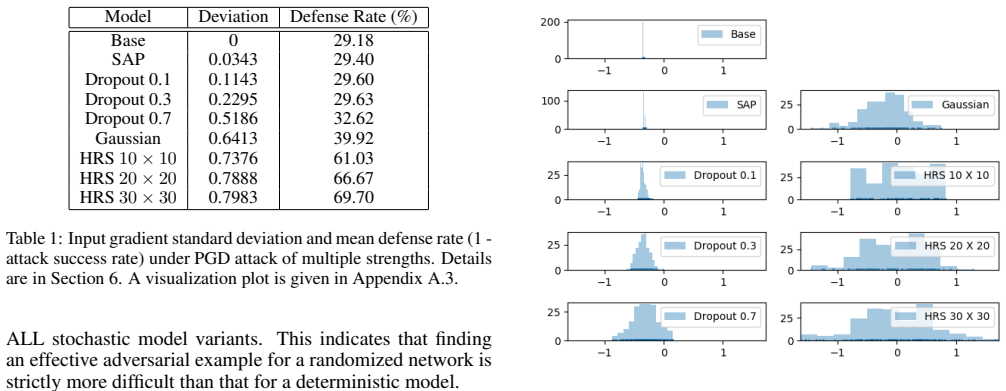
- [Section 6.1] The conclusion in Section 6.2 (finding 1) that HRS robustness is not due to gradient obfuscation is not supported by the adaptive attacks used. EOT with n=10 samples only a small fraction of the 100-900 possible active paths of HRS, and the pilot study in Appendix C.3 that justifies n=10 is conducted on a Gaussian-noise defense rather than on HRS. Fixed randomness freezes one active path, which removes the stochasticity instead of attacking the expected stochastic classifier. A BPDA-style attack with a differentiable surrogate that averages over channels, or EOT with n comparable to the number of paths, is needed before the 'not obfuscated' claim can be made; Table 1's high input-gradient standard deviation for HRS makes this concern concrete.
- [Section 6.3 / Table 2] The DES comparison is not parameter-matched and omits an ensemble baseline. The HRS models use 10x10 to 30x30 parallel channels, giving HRS a much larger parameter footprint than the base network and than the SAP/dropout/Gaussian baselines; no ensemble of base models or a larger deterministic network with comparable parameter count is evaluated. Under the same accuracy level (Table A2), the DES advantage could partly reflect additional capacity rather than the random-switching mechanism, so the central claim of a better robustness-accuracy trade-off should be tested against a parameter-matched single model or ensemble.
- [Section 4 / Eq. (3)] The DES comparison depends on the ad-hoc offset eta=0.002 and on the range of defense strengths selected for each method, but no sensitivity analysis is reported. Because 'mean DES' is the headline comparison in Table 2, the authors should show that rankings and ratios are stable with respect to eta and to the Δt/Δd range, or at least report the ranges explicitly for every method.
minor comments (6)
- [Abstract vs. main text] The abstract says 'at least 5X higher than current stochastic network defenses' but Section 4 says 'more than 3X' and Table 2 on MNIST shows mean DES of HRS only 1.11x over Gaussian (62.65 vs 56.48); please align the claims and define 'most settings' precisely.
- [Section 2.1] The phrase 'Projected Gradient Decent' should be 'Projected Gradient Descent'.
- [Sections 3.3 and 6.3] There are unresolved table references ('Table ??') in the manuscript; these should be replaced with Table 1 and Table 2, and Table 1's column header 'Model Deviation Defense Rate (%)' needs formatting.
- [Appendix C.2] The Gaussian noise baseline uses additional dropout during training to prevent over-fitting; this should be stated in the main text so readers do not attribute all effects to noise, since the comparison is then not a pure Gaussian-noise baseline.
- [Section 6.2] Finding 4 refers to a 'large DEI score'; this should be 'DES score'.
- [Section 7] The adversarial reprogramming experiments use only a non-adaptive reprogramming procedure; a randomization-aware reprogramming attack (for example EOT over HRS paths) would strengthen the claim of being an effective defense and of being the 'first defense' against this threat.
Circularity Check
No circularity: HRS's robustness-accuracy advantage is empirically measured against external attacks and baselines, not derived from its own definitions or self-citations.
full rationale
The central claims are supported by measurements, not by a derivation chain that reduces to the paper's own inputs. DES (Eq. 3) is explicitly defined as the ratio of measured defense-rate gain to measured accuracy drop, and the DES values in Table 2 are computed from attack-success-rate and test-accuracy measurements on MNIST and CIFAR-10, not from a fitted parameter that is then renamed as a prediction. The HRS architecture is trained by the bottom-up procedure in Algorithm 1, which does not optimize DES, and robustness is benchmarked against external attack algorithms (FGSM, CW, PGD, CW-PGD) and external baselines (SAP, defensive dropout, Gaussian noise, adversarial training). The paper's self-citations (defensive dropout, EAD, fault sneaking) appear as baselines or background; none is used as the load-bearing justification for HRS's effectiveness, and no uniqueness theorem or prior-work ansatz is imported to force the HRS design. No equation in the paper is equivalent to another by construction, and no fitted input is presented as a prediction. The only arguable limitation is whether the EOT attack with n=10 and the fixed-randomness attack are strong enough to fully rule out gradient obfuscation, but that is an empirical evaluation-strength concern, not a circularity. Accordingly, the paper is self-contained against external benchmarks and receives a score of 0.
Assumptions & free parameters
free parameters (3)
- DES offset eta =
0.002
- EOT sample count n =
10
- Gaussian noise deviations on CIFAR-10 =
0.02 and 0.01
assumptions (3)
- domain assumption Input gradient variance or deviation is a predictor of defense effectiveness
- domain assumption Each active path in HRS can be trained to near-base accuracy
- domain assumption The adversary is bounded by an l-infinity norm-ball perturbation
Cite this review
Pith. "Pith review of Protecting Neural Networks with Hierarchical Random Switching: Towards Better Robustness-Accuracy Trade-off for Stochastic Defenses." pith.science (2026). https://pith.science/paper/VEG56VUJ
@misc{pith2026190807116,
  author       = {Pith},
  title        = {Pith review of: Protecting Neural Networks with Hierarchical Random Switching: Towards Better Robustness-Accuracy Trade-off for Stochastic Defenses},
  year         = {2026},
  howpublished = {\url{https://pith.science/paper/VEG56VUJ}},
  note         = {Machine review of arXiv:1908.07116}
}
read the original abstract
Despite achieving remarkable success in various domains, recent studies have uncovered the vulnerability of deep neural networks to adversarial perturbations, creating concerns on model generalizability and new threats such as prediction-evasive misclassification or stealthy reprogramming. Among different defense proposals, stochastic network defenses such as random neuron activation pruning or random perturbation to layer inputs are shown to be promising for attack mitigation. However, one critical drawback of current defenses is that the robustness enhancement is at the cost of noticeable performance degradation on legitimate data, e.g., large drop in test accuracy. This paper is motivated by pursuing for a better trade-off between adversarial robustness and test accuracy for stochastic network defenses. We propose Defense Efficiency Score (DES), a comprehensive metric that measures the gain in unsuccessful attack attempts at the cost of drop in test accuracy of any defense. To achieve a better DES, we propose hierarchical random switching (HRS), which protects neural networks through a novel randomization scheme. A HRS-protected model contains several blocks of randomly switching channels to prevent adversaries from exploiting fixed model structures and parameters for their malicious purposes. Extensive experiments show that HRS is superior in defending against state-of-the-art white-box and adaptive adversarial misclassification attacks. We also demonstrate the effectiveness of HRS in defending adversarial reprogramming, which is the first defense against adversarial programs. Moreover, in most settings the average DES of HRS is at least 5X higher than current stochastic network defenses, validating its significantly improved robustness-accuracy trade-off.
Figures


Figures from the paper (3 more)


Reference graph
Works this paper leans on
-
[1]
Synthesizing robust adver- sarial examples
[Athalye et al., 2017] Anish Athalye, Logan Engstrom, An- drew Ilyas, and Kevin Kwok. Synthesizing robust adver- sarial examples. arXiv preprint arXiv:1707.07397,
arXiv 2017
-
[3]
Towards evaluating the robustness of neural net- works
[Carlini and Wagner, 2017b] Nicholas Carlini and David Wagner. Towards evaluating the robustness of neural net- works. In Security and Privacy (SP), 2017 IEEE Sympo- sium on, pages 39–57. IEEE,
work page 2017
-
[4]
EAD: Elastic-Net Attacks to Deep Neural Networks via Adversarial Examples
[Chen et al., 2017] Pin-Yu Chen, Yash Sharma, Huan Zhang, Jinfeng Yi, and Cho-Jui Hsieh. Ead: elastic-net attacks to deep neural networks via adversarial examples. arXiv preprint arXiv:1709.04114,
work page Pith review arXiv 2017
-
[5]
Dhillon, Kamyar Aziz- zadenesheli, Jeremy D
[Dhillon et al., 2018] Guneet S. Dhillon, Kamyar Aziz- zadenesheli, Jeremy D. Bernstein, Jean Kossaifi, Aran Khanna, Zachary C. Lipton, and Animashree Anandku- mar. Stochastic activation pruning for robust adversarial defense. In International Conference on Learning Repre- sentations,
work page 2018
-
[7]
Explaining and harnessing adversarial examples
[Goodfellow et al., 2015] Ian Goodfellow, Jonathon Shlens, and Christian Szegedy. Explaining and harnessing adversarial examples. 2015 ICLR , arXiv preprint arXiv:1412.6572,
arXiv 2015
-
[12]
Towards robust neural networks via random self-ensemble
[Liu et al., 2017] Xuanqing Liu, Minhao Cheng, Huan Zhang, and Cho-Jui Hsieh. Towards robust neural networks via random self-ensemble. arXiv preprint arXiv:1712.00673,
arXiv 2017
-
[13]
Towards deep learning models resistant to adversarial attacks
[Madry et al., 2017] Aleksander Madry, Aleksandar Makelov, Ludwig Schmidt, Dimitris Tsipras, and Adrian Vladu. Towards deep learning models resistant to adversarial attacks. arXiv preprint arXiv:1706.06083 ,
arXiv 2017
-
[14]
[Mazurowski et al., 2008] Maciej A Mazurowski, Piotr A Habas, Jacek M Zurada, Joseph Y Lo, Jay A Baker, and Georgia D Tourassi. Training neural network classifiers for medical decision making: The effects of imbalanced datasets on classification performance. Neural networks, 21(2-3):427–436,
work page 2008
Show all 23 references
-
[17]
Is robustness the cost of accuracy?–a comprehensive study on the robust- ness of 18 deep image classification models
[Su et al., 2018] Dong Su, Huan Zhang, Hongge Chen, Jin- feng Yi, Pin-Yu Chen, and Yupeng Gao. Is robustness the cost of accuracy?–a comprehensive study on the robust- ness of 18 deep image classification models. In ECCV, pages 631–648,
2018
-
[18]
Intriguing properties of neural networks
[Szegedy et al., 2013] Christian Szegedy, Wojciech Zaremba, Ilya Sutskever, Joan Bruna, Dumitru Erhan, Ian Goodfellow, and Rob Fergus. Intriguing properties of neural networks. arXiv preprint arXiv:1312.6199,
2013 arXiv
-
[20]
Using deep learning to extract scenery infor- mation in real time spatiotemporal compressed sensing
[Wang et al., 2018b] Xiao Wang, Jie Zhang, Tao Xiong, Trac Duy Tran, Sang Peter Chin, and Ralph Etienne- Cummings. Using deep learning to extract scenery infor- mation in real time spatiotemporal compressed sensing. In 2018 IEEE International Symposium on Circuits and Sys- tem...
2018
-
[21]
An admm-based universal framework for ad- versarial attacks on deep neural networks
[Zhao et al., 2018] Pu Zhao, Sijia Liu, Yanzhi Wang, and Xue Lin. An admm-based universal framework for ad- versarial attacks on deep neural networks. In 2018 ACM Multimedia Conference on Multimedia Conference, pages 1065–1073. ACM,
2018
-
[22]
Fault sneaking attack: A stealthy framework for misleading deep neural networks
[Zhao et al., 2019] Pu Zhao, Siyue Wang, Cheng Gongye, Yanzhi Wang, Yunsi Fei, and Xue Lin. Fault sneaking attack: A stealthy framework for misleading deep neural networks. In Proceedings of the 56th Annual Design Au- tomation Conference 2019, DAC ’19, pages 165:1–165:6, New Y...
2019
-
[30]
Spots of dropout are due to different training and testing dropout rate ranging from 0.1 to 0.9. Spots of Gaussian noise are due to different initial and inner Gaussian noise deviations ranging from (0.01, 0.005) to (0.11, 0.055) on CIFAR-10 and from (0.1, 0.05) to (0.325, 0.1...
2018
-
[1998]
The mnist database of hand- written digits
[LeCun, 1998] Yann LeCun. The mnist database of hand- written digits. http://yann. lecun. com/exdb/mnist/,
1998
-
[2008]
Distillation as a defense to adversarial perturbations against deep neu- ral networks
[Papernot et al., 2016] Nicolas Papernot, Patrick McDaniel, Xi Wu, Somesh Jha, and Ananthram Swami. Distillation as a defense to adversarial perturbations against deep neu- ral networks. In Security and Privacy (SP), 2016 IEEE Symposium on, pages 582–597. IEEE,
2016
-
[2009]
Lecun, L
[Lecun et al., 1998] Y . Lecun, L. Bottou, Y . Bengio, and P. Haffner. Gradient-based learning applied to document recognition. Proceedings of the IEEE, 86(11):2278–2324, Nov
1998
-
[2013]
Ensemble adversarial training: Attacks and de- fenses
[Tram`er et al., 2017] Florian Tram`er, Alexey Kurakin, Nico- las Papernot, Ian Goodfellow, Dan Boneh, and Patrick Mc- Daniel. Ensemble adversarial training: Attacks and de- fenses. arXiv preprint arXiv:1705.07204,
2017 arXiv
-
[2014]
Learning multiple layers of features from tiny images
[Krizhevsky and Hinton, 2009] Alex Krizhevsky and Geof- frey Hinton. Learning multiple layers of features from tiny images. Technical report, Citeseer,
2009
-
[2015]
Convolutional neural network architectures for matching natural language sentences
[Hu et al., 2014] Baotian Hu, Zhengdong Lu, Hang Li, and Qingcai Chen. Convolutional neural network architectures for matching natural language sentences. In Advances in neural information processing systems, pages 2042–2050,
2014
-
[2016]
Dropout: a simple way to prevent neural networks from overfitting
[Srivastava et al., 2014] Nitish Srivastava, Geoffrey Hinton, Alex Krizhevsky, Ilya Sutskever, and Ruslan Salakhutdi- nov. Dropout: a simple way to prevent neural networks from overfitting. The Journal of Machine Learning Re- search, 15(1):1929–1958,
2014
-
[2017]
Obfuscated gradients give a false sense of security: Circumventing defenses to adversarial examples
[Athalye et al., 2018] Anish Athalye, Nicholas Carlini, and David Wagner. Obfuscated gradients give a false sense of security: Circumventing defenses to adversarial examples. arXiv preprint arXiv:1802.00420,
2018 arXiv
-
[2018]
Adversarial re- programming of neural networks
[Elsayed et al., 2018] Gamaleldin F Elsayed, Ian Good- fellow, and Jascha Sohl-Dickstein. Adversarial re- programming of neural networks. arXiv preprint arXiv:1806.11146,
2018 arXiv
Reviewed August 14, 2026 · model on record in the stance chip above.
Discussion (0). Continue with ORCID to comment.