REVIEW 5 major objections 6 minor 33 references
LogicENN: A Neural Based Knowledge Graphs Embedding Model with Logical Rules
T0 review · 5 major / 6 minor · reviewed 2026-08-14 · deepseek-v4-flash
Pith's one-line read A neural knowledge-graph embedding that makes relations the output layer can inject logical rules, including implication and equivalence, without grounding.
desk verdict A genuinely novel architecture and promising raw-metric results, but the headline grounding-free implication claim rests on an invalid inference and the implemented regularizer is weaker than stated. read the letter →
The pith
A machine-rendered reading of the paper's core claim, the machinery that carries it, and where it could break.
The reading
What carries the argument
The load-bearing object is the shared hidden-layer feature map $\Phi_{h,t}\in\mathbb{R}^L$, computed by a universal feed-forward network from the concatenated entity embeddings, with relation embeddings $\beta^r$ as the output layer's coefficients. The score identity $f^r_{h,t}=\Phi_{h,t}^T\beta^r$ does the work: it separates the entity-pair space from the relation space, so a rule that must hold for all entity pairs can be written as a condition on the $\beta$ vectors alone (for implication and equivalence) or as a condition on $\Phi$ (for transitivity and composition). The density of such feature maps among continuous functions on compact entity-pair space is what carries the full-expressiveness theorem, and the positivity of the activation function is what lets the implication and equivalence conditions drop the entity-pair dependence.
What would settle it
After training LogicENN on a dataset with a known implication rule, compute the feature vectors $\Phi_{h,t}$ for all entity pairs and check whether they span the positive orthant; if some coordinate is never covered, inspect the per-coordinate differences $\beta^{r1}_i-\beta^{r2}_i$, since the implemented regularizer $\max(\sum_i(\beta^{r1}_i-\beta^{r2}_i)+\xi_{Im},0)$ can be satisfied while a single positive component flips the rule for an entity pair whose feature vector concentrates on that coordinate.
Extended reading notes
Core claim
On its own terms, the paper's discovery is the score identity $f^r_{h,t}=\Phi_{h,t}^T\beta^r$, where $\Phi_{h,t}$ is the output of a shared hidden layer applied to the concatenated entity embeddings $[h,t]$ and $\beta^r$ is the relation's output vector. Because the hidden map is shared by all relations, the model has only $O(N_e d + N_r L)$ parameters, and because the map is a universal approximator, the paper proves that any finite ground truth over binary predicates can be represented. This expressiveness result is then used as the license to derive rule constraints: each rule type in Table 6 becomes an equality or inequality on $\Phi$ and $\beta$, and the paper proves necessity and sufficiency of those constraints for the model to infer the rule. For implication and equivalence, the relation-side condition collapses to $\beta^{r1}\le \beta^{r2}$ (or $=$) for positive activations, which is independent of the entity pair and needs no grounding. Experiments add these constraints as regularizers and report strong link-prediction results.
Load-bearing premise
The grounding-free derivation for implication and equivalence assumes that the entity-pair feature vectors cover every possible combination of hidden-node directions, so a nonnegative inner product with $\beta^{r1}-\beta^{r2}$ forces every coordinate of $\beta^{r1}$ to be no larger than the corresponding coordinate of $\beta^{r2}$; the paper states that the activation is positive but never shows that the feature vectors have this coverage.
Editorial extensions
If this is right
- Rule injection becomes a regularization term rather than a data-expansion step, so adding background knowledge to a neural knowledge-graph embedding no longer requires materializing all grounded triples.
- For implication and equivalence, the constraint lives entirely in the relation vectors, which makes those rules cheap to impose and to check across an entire graph.
- The full-expressiveness guarantee means LogicENN is not restricted to a handful of pre-existing relation patterns; any finite ground truth over binary predicates has a representation in the model.
- On the reported benchmarks, the rule-injected model improves raw Hit@10 on FB15k from roughly 40% without rules to about 67% with rules, and it beats the comparison models on raw MR, Hit@10, and MRR on FB15k.
- Because relations are output vectors of a shared network, the space complexity stays linear in the number of entities and relations, so rule-enriched embeddings remain practical on large graphs.
Reading between the lines
- Editorial inference: the grounding-free implication step is only valid if the trained feature vectors span the nonnegative orthant of the hidden space; the paper does not check this, so a practical safeguard would be to add a small per-coordinate penalty or to verify the span after training.
- Editorial inference: because relations are output coefficients, new relations could be added after training by learning only their $\beta^r$ vectors against the fixed shared feature map, which would amount to a form of few-shot relation learning; the paper does not explore this.
- Editorial inference: the expressiveness theorem is an existence result for arbitrarily wide networks, so at the finite hidden widths used in the experiments the guarantee is not automatic; testing each rule type on held-out entity pairs would make the claim operational.
Signed reviews
Editorial analysis
A structured set of objections, weighed in public.
Referee Report
Summary. This paper proposes LogicENN, a knowledge graph embedding model in which the concatenated entity embedding [h;t] is fed into a shared hidden layer and each relation r is represented by an output weight vector β^r; the score of a triple is Φ_{h,t}^T β^r (Eq. 1). The authors claim (i) full expressiveness: for any ground truth over a KG there exists a LogicENN representing it; (ii) a rule-injection framework with algebraic formulations for equivalence, symmetry, inverse, implication, composition, transitivity, negation, reflexivity/irreflexivity; (iii) grounding-free injection of implication and equivalence; and (iv) state-of-the-art link prediction on FB15k, WN18, and FB15k-237. The manuscript includes proof sketches in a supplementary section and experiments with the proposed regularizers.
Significance. If the theoretical claims could be established, LogicENN would be a meaningful contribution: the architecture cleanly separates entity features from relation decoders, the rule regularizers cover a broad set of Horn-type rules, and the grounding-free implication/equivalence construction would be a practical advantage over RUGE and related approaches. The paper also provides a useful empirical comparison with rule-based and neural baselines. However, the current manuscript does not establish the main claims: the grounding-free step rests on an invalid componentwise inference, the implemented implication regularizer is weaker than the stated rule, the iff theorem is largely a restatement, and the expressiveness proof is only a sketch. These issues are central rather than cosmetic.
major comments (5)
- [Section 3.3 and Table 6 (implication row)] The claim that Φ^T_{h,t} ≥ 0 and Φ^T_{h,t}(β^{r1}-β^{r2}) ≤ 0 for all h,t imply β^{r1} ≤ β^{r2} componentwise is false. A positive vector Φ can have all its mass on coordinates where δ_i < 0, masking a positive δ_j; for example, with L=2, Φ=(1,0) and δ=(-1,2), we have Φ^Tδ ≤ 0 while δ_2 > 0. One would need the set of reachable feature vectors {Φ_{h,t}} to span the nonnegative orthant, which is neither stated nor proved and generally fails on a finite KG. Consequently the grounding-free formulation of implication is not established; the same problem affects equivalence, where equality of weighted sums does not imply β^{r1}=β^{r2}.
- [Table 6, Equivalent regularization form for implication] The implemented regularizer max(∑_i(β^{r1}_i-β^{r2}_i)+ξ_Im,0) enforces only a signed-sum constraint. This is strictly weaker than the score implication Φ^T_{h,t}(β^{r1}-β^{r2})≤0, since a vector with a large negative sum and one positive coordinate can satisfy the regularizer while violating the implication for feature vectors concentrated on that coordinate. The actual optimization therefore does not implement the grounding-free rule claimed in Section 3.3.
- [Theorem 2 and supplementary Theorem 4] Theorem 2 (and its supplementary Theorem 4) states necessary and sufficient conditions for LogicENN to 'infer' rules, but each condition is just the score-function definition of the rule rewritten through Eq. (1). For example, equivalence iff Φ^T_{h,t}(β^{r1}-β^{r2})=0 is exactly f_{r1}=f_{r2}; no argument connects this algebraic identity to the ability to learn the rule from data. As stated the theorem is a restatement rather than a capability proof.
- [Section 3.2 and Supplementary Section 6.2 (Theorem 3)] The proof of full expressiveness cites universal approximation of a single continuous function f, but LogicENN must simultaneously realize one score function per relation through a shared hidden layer Φ and relation-specific output weights β^r. The proof does not show how the vector-valued target (f_r for all r) is approximated by the shared architecture, nor how approximation error is reconciled with exact truth values M/0. The theorem may be salvageable using vector-valued universal approximation, but as written the central expressiveness claim is not proved.
- [Section 4, Table 3 and discussion] The claim 'inclusion of each rule improves the performance' is contradicted by the reported numbers. On FB15k with ReLU, implication raises MR from 320 to 321 and lowers Hit@10 from 42.2 to 40.5; equivalence lowers Hit@10 from 42.2 to 41.7; composition lowers Hit@10 from 42.2 to 41.0. The paper needs to distinguish rules that help from rules that hurt and temper the claim that rule injection is uniformly beneficial.
minor comments (6)
- [Throughout] Theorem numbering is inconsistent: the main text labels the expressiveness and rule theorems Theorem 1 and Theorem 2, while the supplementary labels them Theorem 3 and Theorem 4; please align the numbering.
- [Supplementary proof of symmetric rule] In the proof for the symmetric relation, the line 'Φ^T_{h,t}β^{r1} − Φ^T_{h,t}β^{r2} = 0' should refer to Φ^T_{h,t}β^r − Φ^T_{t,h}β^r; as written it repeats the equivalence case.
- [Table 6, transitivity and composition rows] The function σ is used in the transitivity and composition rows but never defined; the text should specify the sigmoid (or other) function and its range.
- [References] The reference [Sun et al., 2019] is titled 'Factorizing YAGO' but the cited paper is the RotatE paper; this citation should be corrected.
- [Abstract and Table 4] The abstract's unqualified 'outperforms the state-of-the-art models in link prediction' is too strong: on FB15k-237, LogicENN*_R is best only in raw Hit@10, with worse MR than RotatE and QuatE and worse filtered Hit@10 than QuatE; the claim should be restricted to the specific metrics and settings.
- [Section 3.3] Section 3.3 defines P(a⇒b) as P(a)≤P(b), which is a nonstandard choice for fuzzy-logic style truth values; please state explicitly that this is a modeling convention and note its limitations for graded truth.
Circularity Check
Rule-inference theorem is a restatement of the paper's own truth definitions, and the Figure 2 verification plots the regularized quantities; the universal-approximation expressiveness proof is independent.
-
self definitional
[Section 3.3, Theorem 4 / Table 6 (main-text Theorem 2)]
"Theorem 4. For all h,t,s ∈E, set ξh,t = 0 in column 'Formulation based on NN' of Table 6. For each relation type given in Table 6, LogicENN can infer it if and only if the corresponding equation in column 'Formulation based on NN' holds (ξh,t is set to 0)."
The 'Formulation based on NN' column is obtained by substituting the model identity f_{h,t}^r = Φ_{h,t}^T β^r (Eq. 1) into the 'Formulation based on score function' column, and that score column is the truth definition chosen for each rule: Section 3.3 fixes P(a⇒b) := P(a)≤P(b), so the implication condition f_{r1}≤f_{r2} (hence Φ_{h,t}^T(β^{r1}−β^{r2})≤0) is the rule by definition. Equivalence is likewise represented as score equality. Stating that LogicENN 'can infer' a rule iff the defining score inequality holds is therefore a restatement of the definitions rather than an independently derived capability. The genuinely non-circular expressiveness content is Theorem 3, whose proof imports the external universal approximation theorem rather than relying on the paper's own equations alone.
-
fitted input called prediction
[Section 4, Figure 2; regularizers in Table 6]
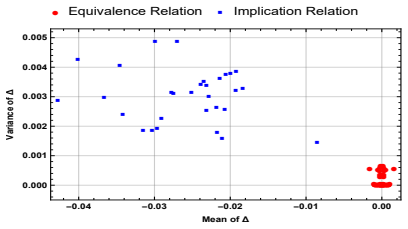
"Therefore, if the model has properly learned implication (equivalence) the differences of the embedding vectors of these two relations should contain negative (zero) elements. In Figure 2, the x-axis represents the means of the elements of the two ∆s and the y-axis represents their variances. ... This shows that LogicENN has properly encoded these rules without using grounding for 30 implication and 68 equivalence relations in FB15k."
The equivalence regularizer actually used in training is max(‖β^{r1}−β^{r2}‖_1−ξEq,0), and the implication regularizer is max(Σ_i(β^{r1}_i−β^{r2}_i)+ξIm,0). The quantities plotted in Figure 2 are the means of ΔEquivalence = β^{r1}−β^{r2} and ΔImplication = β^{r1}−β^{r2}; these are the same quantities the regularizers were designed to shrink. Observing that the equivalence points cluster near zero and implication points are negative is therefore a direct reflection of the optimization objective, not an independent confirmation that the rules were learned. The empirical link prediction comparisons in Tables 2 and 4 remain external and are not affected by this circularity.
full rationale
The paper's strongest theoretical claim, full expressiveness (Theorem 3), is not circular: it invokes the external universal approximation theorem of Huang et al. (2000) to show that the shared hidden-layer network can represent arbitrary finite ground truth. That is independent support and gives the central claim real content. The circularity is concentrated in the rule-inference theorem: Theorem 4's 'if and only if' conditions are obtained by substituting Eq. (1) into the score-function formulations, and those score-function formulations are exactly the truth definitions the paper adopted (e.g., P(a⇒b) := P(a)≤P(b)). Thus the theorem restates the rules in model coordinates rather than proving an independent capability. A separate weakness is the grounding-free componentwise step for implication and equivalence: concluding β^{r1}≤β^{r2} componentwise from Φ_{h,t}^T(β^{r1}−β^{r2})≤0 with nonnegative Φ is mathematically unsupported because the finite set of reachable Φ_{h,t} vectors need not span the nonnegative orthant. I treat that as a correctness gap rather than circularity, since it does not reduce a derived output to an input by construction. The Figure 2 evidence is partly circular because it visualizes the same L1/sum differences that the regularizers directly penalize. No load-bearing self-citation chain was found, and the benchmark link prediction results are external and non-circular.
Assumptions & free parameters
free parameters (8)
- Slack variable xi_Eq for equivalence rule =
1 (FB15k LogicENN_R)
- Slack variable xi_Sy for symmetry rule =
0.5 (FB15k LogicENN_R)
- Slack variable xi_Im for implication rule =
5 (FB15k LogicENN_R)
- Slack variable xi_Co for composition rule =
0.1 (FB15k)
- Slack variable xi_In for inverse rule =
3 (FB15k); 0.1 (WN18)
- Regularization coefficient lambda =
0.05 (FB15k); 0.01 (WN18)
- Negative sample ratio alpha =
8 (FB15k); 5 (WN18)
- Embedding dimension d and learning rate gamma =
d=200, gamma=0.001
assumptions (6)
- standard math Single-hidden-layer feedforward networks with a continuous, bounded, non-constant activation function are dense in C(Omega) for compact Omega (universal approximation).
- standard math Lemma 2.1 of Huang et al. (2000): for N disjoint compact regions there is a continuous function taking prescribed distinct values on each region.
- domain assumption The entity embedding space Omega_E is a compact subset of R^d.
- domain assumption Truth values P(a), P(b) are modeled by scores, with P(a => b) defined as P(a) <= P(b) and conjunction as product of probabilities via an unstated function sigma.
- ad hoc to paper The activation is positive (Phi_{h,t} >= 0) so that Phi^T(beta1 - beta2) <= 0 implies beta1 <= beta2 componentwise.
- ad hoc to paper An undefined function sigma maps scores to truth values for transitivity and composition regularizers.
Cite this review
Pith. "Pith review of LogicENN: A Neural Based Knowledge Graphs Embedding Model with Logical Rules." pith.science (2026). https://pith.science/paper/UWIY5SIJ
@misc{pith2026190807141,
  author       = {Pith},
  title        = {Pith review of: LogicENN: A Neural Based Knowledge Graphs Embedding Model with Logical Rules},
  year         = {2026},
  howpublished = {\url{https://pith.science/paper/UWIY5SIJ}},
  note         = {Machine review of arXiv:1908.07141}
}
read the original abstract
Knowledge graph embedding models have gained significant attention in AI research. Recent works have shown that the inclusion of background knowledge, such as logical rules, can improve the performance of embeddings in downstream machine learning tasks. However, so far, most existing models do not allow the inclusion of rules. We address the challenge of including rules and present a new neural based embedding model (LogicENN). We prove that LogicENN can learn every ground truth of encoded rules in a knowledge graph. To the best of our knowledge, this has not been proved so far for the neural based family of embedding models. Moreover, we derive formulae for the inclusion of various rules, including (anti-)symmetric, inverse, irreflexive and transitive, implication, composition, equivalence and negation. Our formulation allows to avoid grounding for implication and equivalence relations. Our experiments show that LogicENN outperforms the state-of-the-art models in link prediction.
Figures

Reference graph
Works this paper leans on
- [1]
-
[5]
[Ding et al., 2018] B. Ding, Q. Wang, B. Wang, and L. Guo. Improving knowledge graph embedding using simple con- straints. In ACL,
work page 2018
-
[6]
[Dong et al., 2014] X. Dong, E. Gabrilovich, G. Heitz, W. Horn, Ni Lao, K. Murphy, T. Strohmann, S. Sun, and W. Zhang. Knowledge vault: A web-scale approach to probabilistic knowledge fusion. In ACM-SIGKDD,
work page 2014
-
[8]
[Guo et al., 2016] S. Guo, Q. Wang, L. Wang, B. Wang, and Li Guo. Jointly embedding knowledge graphs and logical rules. In EMNLP,
work page 2016
-
[9]
[Guo et al., 2018] S. Guo, Q. Wang, L. Wang, B. Wang, and Li Guo. Knowledge graph embedding with iterative guid- ance from soft rules. In AAAI,
work page 2018
-
[10]
[Guu et al., 2015] K. Guu, J. Miller, and P. Liang. Traversing knowledge graphs in vector space. In EMNLP,
work page 2015
-
[12]
Classification ability of single hidden layer feedforward neural networks
[Huang et al., 2000] G.B Huang, Y .Q Chen, and H.A Babri. Classification ability of single hidden layer feedforward neural networks. IEEE TNN, 11(3),
work page 2000
-
[14]
Multivariable calculus, ap- plications and theory
[Kuttler, 2011] Kenneth Kuttler. Multivariable calculus, ap- plications and theory
work page 2011
Show all 33 references
-
[16]
[Liu et al., 2017] H. Liu, Y . Wu, and Y . Yang. Analogical inference for multi-relational embeddings. InICML,
2017
-
[18]
Neelakantan, B
[Neelakantan et al., 2015] A. Neelakantan, B. Roth, and A. McCallum. Compositional vector space models for knowledge base completion. arXiv:1504.06662,
2015 arXiv
-
[19]
[Nguyen et al., 2018] D.Q Nguyen, T.D Nguyen, D.Q Nguyen, and D. Phung. A novel embedding model for knowledge base completion based on convolutional neural network. In NAACL-HLT,
2018
-
[20]
Nickel, V
[Nickel et al., 2012] M. Nickel, V . Tresp, and H.P. Kriegel. Factorizing Y AGO: scalable machine learning for linked data. In 21st conf. on World Wide Web. ACM,
2012
-
[22]
Rockt ¨aschel, S
[Rockt¨aschel et al., 2015] T. Rockt ¨aschel, S. Singh, and S. Riedel. Injecting logical background knowledge into embeddings for relation extraction. In NAACL-HLT,
2015
-
[23]
Shi and T
[Shi and Weninger, 2017] B. Shi and T. Weninger. Proje: Embedding projection for knowledge graph completion. In AAAI, volume 17,
2017
-
[24]
Socher, D
[Socher et al., 2013] R. Socher, D. Chen, C.D Manning, and Andrew Ng. Reasoning with neural tensor networks for knowledge base completion. In NIPS,
2013
-
[25]
[Sun et al., 2019] Z. Sun, Z. Deng, J. Nie, and J. Tang. Fac- torizing yago: scalable machine learning for linked data. In ICLR,
2019
-
[27]
Trouillon, C
[Trouillon et al., 2017] T. Trouillon, C. Dance, ´E. Gaussier, J. Welbl, S. Riedel, and et al. Knowledge graph completion via complex tensor factorization. JMLR, 18(1),
2017
-
[28]
[Wang et al., 2014] Z. Wang, J. Zhang, J. Feng, and Z. Chen. Knowledge graph embedding by translating on hyper- planes. In AAAI, volume 14,
2014
-
[29]
[Wang et al., 2017] Q. Wang, Z. Mao, B. Wang, and Li Guo. Knowledge graph embedding: A survey of approaches and applications. IEEE-TKDE, 29(12),
2017
-
[30]
[Wang et al., 2018] Y . Wang, R. Gemulla, and H. Li. On multi-relational link prediction with bilinear models. In AAAI,
2018
-
[31]
Yang, W.t Yih, X
[Yang et al., 2015] B. Yang, W.t Yih, X. He, J. Gao, and Li Deng. Embedding entities and relations for learning and inference in knowledge bases. In ICLR,
2015
-
[32]
A translation-based knowledge graph embedding preserving logical property of relations
[Yoon et al., 2016] H.G Yoon, H.J Song, S.B Park, and S.Y Park. A translation-based knowledge graph embedding preserving logical property of relations. In NAACL-HLT,
2016
-
[33]
Quaternion knowledge graph embedding
[Zhang et al., 2019] Shuai Zhang, Yi Tay, Lina Yao, and Qi Liu. Quaternion knowledge graph embedding. arXiv preprint arXiv:1904.10281, 2019
2019 arXiv
-
[2000]
[Kazemi and Poole, 2018] S.M Kazemi and D. Poole. Sim- ple embedding for link prediction in knowledge graphs. arXiv:1802.04868,
2018 arXiv
-
[2011]
Lacroix, N
[Lacroix et al., 2018] T. Lacroix, N. Usunier, and G. Obozin- ski. Canonical tensor decomposition for knowledge base completion. arXiv:1806.07297,
2018 arXiv
-
[2012]
Nickel, K
[Nickel et al., 2016] M. Nickel, K. Murphy, V . Tresp, and E. Gabrilovich. A review of relational machine learning for knowledge graphs. Proc. of IEEE, 104(1),
2016
-
[2013]
Demeester, T
[Demeester et al., 2016] T. Demeester, T. Rockt ¨aschel, and S. Riedel. Lifted rule injection for relation embeddings. arXiv:1606.08359,
2016 arXiv
-
[2014]
[Guan et al., 2018] S. Guan, X. Jin, Y . Wang, and X. Cheng. Shared embedding based neural networks for knowledge graph completion. In 27th ACM-CIKM,
2018
-
[2015]
[Han et al., 2018] X. Han, C. Zhang, T. Sun, Y . Ji, and Z. Hu. A triple-branch neural network for knowledge graph em- bedding. IEEE Access, 6,
2018
-
[2016]
Dettmers, P
[Dettmers et al., 2018] T. Dettmers, P. Minervini, P. Stene- torp, and S. Riedel. Convolutional 2d knowledge graph embeddings. In AAAI,
2018
-
[2017]
Minervini, T
[Minervini et al., ] P. Minervini, T. Demeester, T. Rockt ¨aschel, and S. Riedel. Adversarial sets for regularising neural link predictors. arXiv:1707.07596. [Minervini et al., 2017] P. Minervini, L. Costabello, E. Mu˜noz, V . Nov´aˇcek, and P.Y Vandenbussche. Regular- izing k...
2017 arXiv
-
[2018]
Bordes, N
[Bordes et al., 2013] A. Bordes, N. Usunier, A. Garcia- Duran, J. Weston, and O. Yakhnenko. Translating embed- dings for modeling multi-relational data. In NIPS,
2013
-
[2019]
Trouillon, J
[Trouillon et al., 2016] T. Trouillon, J. Welbl, S. Riedel, ´E. Gaussier, and G. Bouchard. Complex embeddings for simple link prediction. In ICML,
2016
Reviewed August 14, 2026 · model on record in the stance chip above.
Discussion (0). Continue with ORCID to comment.