REVIEW 3 major objections 5 minor 64 references
Three-dimensional graphene networks modified with acetylenic linkages for high-performance optoelectronics and Li-ion battery anode material
T0 review · 3 major / 5 minor · reviewed 2026-08-14 · deepseek-v4-flash
Pith's one-line read By inserting acetylenic linkages into two known 3D carbon networks, this paper proposes a direct-gap semiconductor with possibly the strongest optical absorption among semiconducting carbon allotropes and a nodal-line semimetal with a…
desk verdict Two plausible new 3D carbon allotropes with solid DFT work, but the superlative optical absorption claim is overreach and the Li capacity rests on limited site sampling. read the letter →
The pith
A machine-rendered reading of the paper's core claim, the machinery that carries it, and where it could break.
The reading
What carries the argument
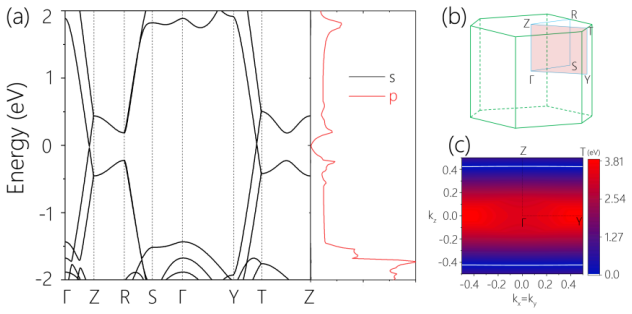
The central machinery is acetylenic-linkage substitution: replacing selected carbon–carbon bonds in the carbon kagome lattice (CKL) and interpenetrated graphene network (IGN) with –C≡C– units creates the new frameworks CYKL and IGYN. The insertion is not cosmetic—it changes hybridization (from sp2/sp3 to sp+sp2/sp3), greatly lowers mass density, and adds unpaired p orbitals that the paper argues strengthen the p-orbital-frustration optical transitions inherited from CKL. For lithium storage, the same inserted linkages enlarge the pores and add interaction sites, allowing more Li atoms per formula unit than the parent IGN. Two minimal tight-binding models, in which the acetylenic units are represented only as hopping parameters, reproduce the first-principles band structures near the Fermi level and show that the parent symmetries and topological features survive the modification.
What would settle it
A systematic calculation including excitonic and self-energy corrections over the full space of known semiconducting carbon allotropes, or a measured optical absorption spectrum of synthesized CYKL, would settle the superlative optical claim: if any competing phase shows a larger peak absorption coefficient in the same energy range, or the measured spectrum falls short of the predicted one, the claim fails. The battery claim could be tested by measuring the capacity and voltage profile of an IGYN electrode synthesized from carbon-rich soot or other carbon sources.
Extended reading notes
Core claim
The paper's discovery is that two existing 3D carbon networks, when selected carbon–carbon bonds are replaced by acetylenic (triple-bond) units, yield two new dynamically stable phases with sharply improved target properties. For CYKL, the direct-gap semiconducting character of the carbon kagome lattice survives, but the bandgap shrinks (PBE/HSE06: 1.81/2.71 eV) and the calculated optical absorption coefficient exceeds that of ZnO, GaN, CKL, T-carbon, R16, h-carbon, and diamond in the same energy window; the paper attributes this to p-orbital frustration in the triangles reinforced by the unpaired p orbitals of the acetylenic bonds. For IGYN, the nodal-line semimetal band structure of its parent is preserved, while the extra space opened by the linkages allows one unit cell to host four Li atoms (LiC4.5), yielding 496 mAh/g capacity, about 33% more than graphite and IGN, with diffusion barriers of 0.3–0.45 eV, about 2.1% volume expansion, and an open-circuit voltage of 0.67 V. The paper also presents tight-binding models showing that the linkages act as hopping bridges and do not change the underlying symmetry of the parent lattices.
Load-bearing premise
The load-bearing premise is that the optical absorption coefficients computed at the independent-particle level used here are accurate enough to rank CYKL above every other semiconducting carbon allotrope, even though electron–hole and self-energy corrections were not included and the comparison set was not an exhaustive scan of all known carbon phases.
Editorial extensions
If this is right
- If CYKL's optical absorption is as strong as calculated, it becomes a leading all-carbon candidate for optoelectronic devices and, with its small electron effective masses, a possible electron transport material in perovskite solar cells.
- If IGYN's calculated capacity of 496 mAh/g holds, it provides a carbon-only anode that stores about a third more lithium than graphite while expanding only about 2% by volume, which would improve cycle life and rate performance.
- The acetylenic-linkage modification strategy could be used to generate other new carbon allotropes whose properties are tuned by the density and placement of triple bonds.
- The simulated XRD patterns of CYKL and IGYN match features in detonation soot and chimney soot, so these phases—or close relatives—may already exist in such samples and could be identified by closer diffraction analysis.
Reading between the lines
- Beyond the paper: the superlative optical claim is made at a level of theory that omits excitonic effects; a many-body calculation across the known carbon-allotrope space would be the natural test and could change the ranking.
- Beyond the paper: the same insertion strategy applied to other 3D nodal-line semimetals or porous carbon hosts may raise lithium capacity further; computing the capacity of analogue-modified structures would show whether the 33% improvement is a general trend or specific to IGYN.
- Beyond the paper: the close XRD match with soot samples suggests an experimental route—synthesizing CYKL or IGYN from carbon-rich detonation products and directly measuring the predicted absorption and capacity, rather than waiting for bottom-up growth.
- Beyond the paper: IGYN's open-circuit voltage of 0.67 V sits between graphite's 0.3 V and typical oxide anodes, so a full-cell calculation pairing IGYN with common cathodes could indicate whether the higher voltage mainly improves safety against lithium plating or reduces total cell voltage.
Signed reviews
Editorial analysis
A structured set of objections, weighed in public.
Referee Report
Summary. The paper proposes two new three-dimensional carbon allotropes, CYKL and IGYN, obtained by inserting acetylenic linkages into the known carbon kagome lattice (CKL) and interpenetrated graphene network (IGN). Using first-principles DFT (PBE and HSE06), phonon calculations, tight-binding models, and CI-NEB, the authors report that CYKL is a direct-gap semiconductor with strong optical absorption, small carrier effective masses, and potential as an electron transport material for perovskite solar cells; IGYN preserves the nodal-line semimetal character of IGN and shows improved Li-ion capacity of 496 mAh/g with low diffusion barriers, small volume change, and an open-circuit voltage of 0.67 V. Stability is argued from equation-of-state energetics and the absence of imaginary phonon modes. The paper also provides simulated XRD patterns to guide experimental identification.
Significance. If the headline claims hold, the paper offers a promising design strategy for 3D carbon allotropes and adds two new structures with potentially useful optoelectronic and battery-storage properties. The first-principles methodology is standard and the results are reproducible in principle: the direct gap of CYKL, the nodal-line semimetal character of IGYN, the phonon stability, and the Li-intercalation energetics are all computed with established methods (PBE/HSE06, Phonopy, CI-NEB). The paper honestly presents the tight-binding models as fitted interpretations rather than as predictive tools. However, the most eye-catching claim, that CYKL 'possibly possesses the strongest optical transition coefficient amongst of all semiconducting carbon allotropes,' is not established by the evidence presented, and the maximum Li-capacity claim would benefit from a clearer demonstration that the identified 4 Li per cell is a true thermodynamic maximum. These two points are load-bearing for the paper's novelty and require attention.
major comments (3)
- [Abstract and Section 3, Fig. 3b] The claim that CYKL possesses the strongest optical transition coefficient among all semiconducting carbon allotropes is not supported by the calculations shown. The comparison in Fig. 3b includes only eight materials (ZnO, GaN, CKL, CYKL, R16, T-Carbon, h-Carbon, and diamond), not a survey of the carbon-allotrope space invoked by the Samara Carbon Allotrope Database. Moreover, the absorption coefficients are computed at the independent-particle PBE level, without GW quasiparticle corrections or excitonic BSE effects; for carbon allotropes the near-edge optical response is known to be strongly affected by excitonic effects and by the PBE band-gap error, so a quantitative cross-material ranking of absorption coefficients is not established at this level. The authors should either add many-body calculations and a systematic comparison over a representative set of semiconducting carbon allotropes, or explicitly restrict the claim to 'stronger absorption than the compared materials' and modify the abstract and concluding paragraph accordingly.
- [Section 3, Li-ion capacity (Fig. S4b, Fig. S5a)] The maximum Li capacity of IGYN is determined by 'increasing the Li atoms until the full Li-intercalated configuration is reached,' and the text reports that one unit cell hosts four Li atoms (LiC4.5, 496 mAh/g). The manuscript does not show the sequence of Li concentrations tested, the adsorption energies at each concentration, or whether any configuration with more than four Li atoms per cell was attempted and found thermodynamically unfavorable. Without this information, the claim that four Li atoms is the maximum capacity is not fully supported. The authors should provide the computed adsorption energies as a function of Li concentration, including at least one configuration beyond the proposed maximum, and state the stopping criterion used in the incremental filling.
- [Section 3, Eq. (3) and OCV] The open-circuit voltage is computed from the same total-energy differences as the adsorption energy in Eq. (2), but the quoted value of 0.67 V for LiC4.5 is presented without a clear statement of the sign convention or the reference used for the metallic Li energy. The formula as written, E_OCV = -(E_LixC - E_C - xE_Li)/xe, will produce a positive value when the adsorption energy is negative, but the authors should explicitly confirm that the bulk Li reference is the same in both formulas and that the elementary charge e is used with the proper unit conversion to volts. This is important because the OCV is a quantitative claim in Table 4.
minor comments (5)
- [Section 2, Computational Methods] The method used to compute the optical absorption coefficient is not described. The authors should specify the dielectric function calculation (e.g., independent-particle random-phase approximation), the number of bands included, and the formula used to convert the dielectric function to the absorption coefficient plotted in Fig. 3b.
- [General terminology] The phrase 'optical transition coefficient' is nonstandard; the manuscript likely means 'optical absorption coefficient.' Please use consistent terminology throughout the abstract, main text, and figure captions.
- [Table 2] The effective-mass notation (parallel/perpendicular) is adopted from Ref. [37], but the directions are not defined for CKL, CYKL, or T-Carbon in the present manuscript. Please specify the crystal directions corresponding to the parallel and perpendicular components.
- [Section 3, Li diffusion] The CI-NEB paths shown in Fig. S4a are described only as 'paths going through P-I and P-II and paralleling to the c-axis.' Please specify the initial and final Li positions for each path and the number of intermediate images used.
- [Abstract, Introduction, Table 1, Acknowledgments] The manuscript contains numerous language errors and typographical artifacts, including 'amongst of all' in the abstract, 'doesn’t suggests' in the Introduction, the space-group label 'F63/MMC' (likely a typographical rendering of F6_3/mmc) in Table 1, and the fragment '9966?' in the Acknowledgments. A careful language and copy-edit is needed before publication.
Circularity Check
No significant circularity: the central predictions are first-principles outputs, not fitted or self-referential quantities.
full rationale
The paper's load-bearing results (CYKL direct gap and optical absorption; IGYN nodal-line semimetal and Li capacity 496 mAh/g) are computed directly from DFT total-energy, band-structure, phonon, CI-NEB, and intercalation calculations, not from parameters fitted to the predicted quantities. The TB models in Section 3 and Table 3 are explicitly fitted to the DFT bands, but they are used only to interpret orbital interactions (the text says 'we use t0 and t1 to describe the nearest-neighbor hopping energies' and 'the band structure of TB theory fits to that of first-principles calculations around Fermi level very well'), and no headline prediction is taken from the TB fit. The prior CKL and IGN results are cited as parent structures and are independently recomputed in Table 1, so the self-citations are contextual, not load-bearing. The 'strongest optical absorption' claim rests on a limited comparison set (Fig. 3b) and on PBE-level spectra without excitonic corrections, but that is an evidence-strength limitation, not a circular reduction: the claim is not defined in terms of the comparison set, and no fitted input is renamed as a prediction. Accordingly, the derivation chain is self-contained and no circular step meeting the quoting standard is present.
Assumptions & free parameters
free parameters (6)
- CKL-TB t0 =
2.49 eV
- CKL-TB t1 =
1.82 eV
- CKL-TB t2 =
-0.20 eV
- CKL-TB t3 =
-0.17 eV
- IGN-TB t0 =
0.55 eV
- IGN-TB t1 =
1.21 eV
assumptions (5)
- domain assumption DFT-PBE and HSE06 approximations accurately describe electronic structure, bandgaps, and optical matrix elements of carbon allotropes.
- domain assumption Phonon spectra computed with finite-difference force constants in a 2x2x2 supercell are sufficient to establish dynamic stability.
- domain assumption The atomic energy of a single Li atom in bulk is a valid reference for computing adsorption energies and OCVs in Eqs. (2) and (3).
- ad hoc to paper The set of initial Li sites (Li-I, Li-II, Li-III) plus subsequent relaxation and incremental filling captures the maximum Li capacity.
- domain assumption Independent-particle PBE absorption coefficients, without GW-BSE or excitonic corrections, are sufficient to rank optical absorption across different carbon allotropes.
Cite this review
Pith. "Pith review of Three-dimensional graphene networks modified with acetylenic linkages for high-performance optoelectronics and Li-ion battery anode material." pith.science (2026). https://pith.science/paper/MZA2UZHW
@misc{pith2026190807142,
  author       = {Pith},
  title        = {Pith review of: Three-dimensional graphene networks modified with acetylenic linkages for high-performance optoelectronics and Li-ion battery anode material},
  year         = {2026},
  howpublished = {\url{https://pith.science/paper/MZA2UZHW}},
  note         = {Machine review of arXiv:1908.07142}
}
read the original abstract
Searching for three-dimensional(3D) semiconducting carbon allotropes with proper bandgaps and excellent optoelectronic properties is always the chasing goal for the new emerging all-carbon optoelectronics. On the other side, 3D carbon materials have also been recognized as promising anode materials superior to commercialized graphite in Li-ion batteries (LIBs). Here, using first-principles calculations, we propose two novel 3D carbon allotropes through acetylenic linkages modification of two structurally intimately correlated 3D carbon structures - carbon kagome lattice(CKL)and interpenetrated graphene network(IGN). The modified CKL is a truly direct-gap semiconductor and possibly possesses the strongest optical transition coefficient amongst of all semiconducting carbon allotropes. The suitable bandgap and small effective masses also imply it can be a good electron transport material(ETM) for perovskite solar cells. As for the modified IGN, it is a topological nodal-line semimetal and shows greatly enhanced specific capacity as anode materials in LIBs comparing to that of IGN. Our work not only finds two new 3D carbon phases with fabulous physical and chemical properties for high-performance optoelectronics and Li-ion anode material, we also offer a fresh view to create various carbon structures with versatile properties.
Figures
Reference graph
Works this paper leans on
-
[42]
J.Y . Jo, B.G. Kim. Carbon allotropes with triple bond predicted by first-principle calculation: Triple bond modified diamond and T-carbon. Phys. Rev. B. 86 (2012) 075151
work page 2012
-
[1]
A. Hirsch. The era of carbon allotropes. Nat. Mater. 9 (2010) 868-871
work page 2010
-
[2]
N.V . Krainyukova, E.N. Zubarev. Carbon Honeycomb High Capacity Storage for Gaseous and Liquid Species. Phys. Rev. Lett. 116 (2016) 055501
work page 2016
-
[3]
N.V . Krainyukova, E.N. Zubarev. Erratum: Carbon Honeycomb High Ca pacity Storage for Gaseous and Liquid Species [Phys. Rev. Lett. 116, 055501 (2016)]. Phys. Rev. Lett. 118 (2017) 029901
work page 2016
- [4]
-
[5]
X.L. Sheng, Q.B. Yan, F. Ye, Q.R. Zheng, G. Su. T-carbon: a novel carbon allotrope. Phys. Rev. Lett. 106 (2011) 155703
work page 2011
- [6]
-
[7]
V . Meunier, A.G. Souza Filho, E.B. Barros, M.S. Dresselhaus. Physical properties of low - dimensional sp2-based carbon nanostructures. Rev. Mod. Phys. 88 (2016) 025005
work page 2016
Show all 64 references
-
[8]
Segawa, H
Y . Segawa, H. Ito, K. Itami. Structurally uniform and atomically precise carbon nanostructures. Nat. Rev. Mater. 1 (2016) 15002
2016
-
[9]
Zhang, M
J. Zhang, M. Terrones, C.R. Park, R. Mukherjee, M. Monthioux, N. Koratkar, et al. Carbon science in 2016: Status, challenges and perspectives. Carbon. 98 (2016) 708-732
2016
-
[10]
W. Chen, P. Xiao, H. Chen, H. Zhang, Q. Zhang, Y . Chen. Polymeric Graphene Bulk Materials with a 3D Cross-Linked Monolithic Graphene Network. Adv. Mater. 31 (2019) 1802403
2019
-
[11]
Hoffmann, A.A
R. Hoffmann, A.A. Kabanov, A.A. Golov, D.M. Proserpio. Homo Citans and Carbon Allotropes: 18 For an Ethics of Citation. Angew. Chem. Int. Ed. 55 (2016) 10962-10976
2016
-
[12]
Novoselov, A.K
K.S. Novoselov, A.K. Geim, S.V . Morozov, D. Jiang, Y . Zhang, S.V . Dubonos, et al. Electric Field Effect in Atomically Thin Carbon Films. Science. 306 (2004) 666-669
2004
-
[13]
Novoselov, A.K
K.S. Novoselov, A.K. Geim, S.V . Morozov, D. Jiang, M.I. Katsnelson, I.V . Grigorieva, et al. Two- dimensional gas of massless Dirac fermions in graphene. Nature. 438 (2005) 197-200
2005
-
[14]
Castro Neto, N.M.R
A.H. Castro Neto, N.M.R. Peres, K.S. Novoselov, A.K. Geim. The electronic properties of graphene. Rev. Mod. Phys. 81 (2009) 109-162
2009
-
[15]
Y . Chen, Y . Xie, S.A. Yang, H. Pan, F. Zhang, M.L. Cohen, et al. Nanostructured Carbon Allotropes with Weyl-like Loops and Points. Nano Lett. 15 (2015) 6974-6978
2015
-
[16]
H. Weng, Y . Liang, Q. Xu, R. Yu, Z. Fang, X. Dai, et al. Topological node-line semimetal in three- dimensional graphene networks. Phys. Rev. B. 92 (2015) 045108
2015
-
[17]
Zhong, Y
C. Zhong, Y . Xie, Y . Chen, S. Zhang. Coexistence of flat bands and Dirac bands in a carbon - Kagome-lattice family. Carbon. 99 (2016) 65-70
2016
-
[18]
Zhong, Y
C. Zhong, Y . Chen, Y . Xie, S.A. Yang, M.L. Cohen, S.B. Zhang. Towards three-dimensional Weyl-surface semimetals in graphene networks. Nanoscale. 8 (2016) 7232-7239
2016
-
[19]
Zhong, Y
C. Zhong, Y . Chen, Z.M. Yu, Y . Xie, H. Wang, S.A. Yang, et al. Three-dimensional Pentagon Carbon with a genesis of emergent fermions. Nat. Commun. 8 (2017) 15641
2017
-
[20]
Nomura, T
T. Nomura, T. Habe, R. Sakamoto, M. Koshino. Three-dimensional graphdiyne as a topological nodal-line semimetal. Phys. Rev. Mater. 2 (2018) 054204
2018
-
[21]
J. Hu, W. Wu, C. Zhong, N. Liu, C. Ouyang, H.Y . Yang, et al. Three-dimensional honeycomb carbon: Junction line distortion and novel emergent fermions. Carbon. 141 (2019) 417-426
2019
-
[22]
J.E. Moore. The birth of topological insulators. Nature. 464 (2010) 194-198
2010
-
[23]
Bansil, H
A. Bansil, H. Lin, T. Das. Colloquium: Topological band theory. Rev. Mod. Phys. 88 (2016) 021004
2016
-
[24]
Armitage, E.J
N.P. Armitage, E.J. Mele, A. Vishwanath. Weyl and Dirac semimetals in three-dimensional solids. Rev. Mod. Phys. 90 (2018) 015001
2018
-
[25]
P.L. McEuen. Carbon-based electronics. Nature. 393 (1998) 15-17
1998
-
[26]
Avouris, Z
P. Avouris, Z. Chen, V . Perebeinos. Carbon-based electronics. Nat. Nanotechnol. 2 (2007 ) 605- 615
2007
-
[27]
P.-P. Sun, L. Bai, D.R. Kripalani, K. Zhou. A new carbon phase with direct bandgap and high carrier mobility as electron transport material for perovskite solar cells. npj Comput. Mater. 5 (2019)
2019
-
[28]
L. Ji, Z. Lin, M. Alcoutlabi, X. Zhang. Recent developments in nanostructured anode materials 19 for rechargeable lithium-ion batteries. Energy Environ. Sci. 4 (2011) 2682-2699
2011
-
[29]
H. Li, H. Zhou. Enhancing the performances of Li -ion batteries by carbon-coating: present and future. Chem. Commun. 48 (2012) 1201-1217
2012
-
[30]
Goriparti, E
S. Goriparti, E. Miele, F. De Angelis, E. Di Fabrizio, R. Proietti Zaccaria, C. Capiglia. Review on recent progress of nanostructured anode materials for Li-ion batteries. J. Power Sources. 257 (2014) 421-443
2014
-
[31]
J. Liu, T. Zhao, S. Zhang, Q. Wang. A new metallic carbon allotrope with high stability and potential for lithium ion battery anode material. Nano Energy. 38 (2017) 263-270
2017
-
[32]
J. Liu, S. Wang, Q. Sun. All-carbon-based porous topological semimetal for Li-ion battery anode material. Proc. Natl. Acad. Sci. U. S. A. 114 (2017) 651-656
2017
-
[33]
J. Liu, S. Wang, Y . Qie, C. Zhang, Q. Sun. High-pressure-assisted design of porous topological semimetal carbon for Li -ion battery ano de with high -rate performance. Phys. Rev. Mater. 2 (2018) 025403
2018
-
[34]
J. Liu, X. Li, Q. Wang, Y . Kawazoe, P. Jena. A new 3D Dirac nodal-line semi-metallic graphene monolith for lithium ion battery anode materials. J. Mater. Chem. A. 6 (2018) 13816-13824
2018
-
[35]
Y . Qie, J. Liu, S. Wang, Q. Sun, P. Jena. Tetragonal C24: a topological nodal-surface semimetal with potential as an anode material for sodium ion batteries. J. Mater. Chem. A. 7 (2019) 5733-5739
2019
-
[36]
H. Xie, Y . Qie, M. Imran, Q. Sun. Topological semimetal porous carbon as a high -performance anode for Li-ion batteries. J. Mater. Chem. A. 7 (2019) 14253-14259
2019
-
[37]
Chen, Y .Y
Y . Chen, Y .Y . Sun, H. Wang, D. West, Y . Xie, J. Zhong, et al. Carbon kagome lattice and orbital- frustration-induced metal-insulator transition for optoelectronics. Phys. Rev. Lett. 113 (2014) 085501
2014
-
[38]
Kresse, J
G. Kresse, J. Furthmüller. Efficiency of ab -initio total energy calculations for metals and semiconductors using a plane-wave basis set. Comp. Mater. Sci. 6 (1996) 15-50
1996
-
[39]
Kresse, J
G. Kresse, J. Furthmüller. Efficient iterative schemes for ab initio total-energy calculations using a plane-wave basis set. Phys. Rev. B. 54 (1996) 11169-11186
1996
-
[40]
Perdew, J.A
J.P. Perdew, J.A. Chevary, S.H. V osko, K.A. Jackson, M.R. Pederson, D.J. Singh, et al. Atoms, molecules, solids, and surfaces: Applications of the generalized gradient approximation for exchange and correlation. Phys. Rev. B. 46 (1992) 6671-6687
1992
-
[41]
A. Togo, F. Oba, I. Tanaka. First -principles calculations of the ferroelastic transition between rutile-type and CaCl2-type SiO2 at high pressures. Phys. Rev. B. 78 (2008) 134106
2008
-
[43]
Z. -Z. Li, J. -T. Wang, H. Mizuseki, C. Chen. Computational discovery of a new rhombohedral 20 diamond phase. Phys. Rev. B. 98 (2018) 094107
2018
-
[44]
Occelli, P
F. Occelli, P. Loubeyre, R. LeToullec. Properties of diamond under hydrostatic pressures up to 140 GPa. Nat. Mater. 2 (2003) 151-154
2003
-
[45]
J.-T. Wang, C. Chen, Y . Kawazoe. Topological nodal line semimetal in an orthorhombic graphene network structure. Phys. Rev. B. 97 (2018) 245147
2018
-
[46]
H. Bu, M. Zhao, A. Wang, X. Wang. First-principles prediction of the transition from graphdiyne to a superlattice of carbon nanotubes and graphene nanoribbons. Carbon. 65 (2013) 341-348
2013
-
[47]
Paier, M
J. Paier, M. Marsman, K. Hummer, G. Kresse, I.C. Gerber, J.G. Angyan. Screened hybrid density functionals applied to solids. J. Chem. Phys. 124 (2006) 154709
2006
-
[48]
Burschka, N
J. Burschka, N. Pellet, S. -J. Moon, R. Humphry -Baker, P. Gao, M.K. Nazeeruddin, et al. Sequential deposition as a route to high -performance perovskite-sensitized solar cells. Nature. 499 (2013) 316-319
2013
-
[49]
Henkelman, B .P
G. Henkelman, B .P. Uberuaga, H. Jónsson. A climbing image nudged elastic band method for finding saddle points and minimum energy paths. J. Chem. Phys. 113 (2000) 9901-9904
2000
-
[50]
Persson, V .A
K. Persson, V .A. Sethuraman, L.J. Hardwick, Y . Hinuma, Y .S. Meng, A. van der Ven, et al. Lithium Diffusion in Graphitic Carbon. J. Phys. Chem. Lett. 1 (2010) 1176-1180
2010
-
[51]
Goodenough, Y
J.B. Goodenough, Y . Kim. Challenges for Rechargeable Li Batteries. Chem. Mater. 22 (2010) 587-603
2010
-
[52]
Eftekhari
A. Eftekhari. Low voltage anode materials for lithium-ion batteries. Energy Storage Materials. 7 (2017) 157-180
2017
-
[53]
J. Hu, C. Ouyang, S.A. Yang, H.Y . Yang. Germagraphene as a promising anode material for lithium-ion batteries predicted from first -principles calculations. Nanoscale Horizons. 4 (2019) 457 - 463
2019
-
[54]
Joshi, B
R.P. Joshi, B. Ozdemir, V . Barone, J.E. Peralta. Hexagonal BC3: A Robust Electrode Material for Li, Na, and K Ion Batteries. J. Phys. Chem. Lett. 6 (2015) 2728-2732
2015
-
[55]
Aydinol, A.F
M.K. Aydinol, A.F. Kohan, G. Ceder, K. Cho, J. Joannopoulos. Ab initio study of lithium intercalation in metal oxides and metal dichalcogenides. Phys. Rev. B. 56 (1997) 1354-1365
1997
-
[56]
Z. Yang, D. Choi, S. Kerisit, K.M. Rosso, D. Wang, J. Zhang, et al. Nanostructures and lithium electrochemical reactivity of lithium titanites and tit anium oxides: A review. J. Power Sources. 192 (2009) 588-598
2009
-
[57]
S. Zhao, W. Kang, J. Xue. The potential application of phosphorene as an anode material in Li - ion batteries. J. Mater. Chem. A. 2 (2014) 19046-19052
2014
-
[58]
X. Gao, H. Liu, D. Wang, J. Zhan g. Graphdiyne: synthesis, properties, and applications. Chem. 21 Soc. Rev. 48 (2019) 908-936
2019
-
[59]
M. Long, L. Tang, D. Wang, Y . Li, Z. Shuai. Electronic Structure and Carrier Mobility in Graphdiyne Sheet and Nanoribbons: Theoretical Predictions. ACS Nano. 5 (2011) 2593-2600
2011
-
[60]
Zhang, J.-W
R.-S. Zhang, J.-W. Jiang. The art of designing carbon allotropes. Frontiers of Physics. 14 (2018) 13401
2018
-
[61]
You, X.-Y
J.-Y . You, X.-Y . Ma, Z. Zhang, K.-R. Hao, Q.-B. Yan, X.-L. Sheng, et al. Carboneyane: A nodal line topological carbon with sp−sp2 −sp3 chemical bonds. Carbon. 152 (2019) 909-914
2019
-
[62]
H. Yu, Y . Xue, Y . Li. Graphdiyne and its Assembly Architectures: Synthesis, Functionalization, and Applications. Adv. Mater. (2019) 1803101
2019
-
[63]
P. Chen, F. Huang, S. Yun. Characterization of the condensed carbon in detonation soot. Carbon. 41 (2003) 2093-2099
2003
-
[64]
Pantea, S
D. Pantea, S. Brochu, S. Thiboutot, G. Ampleman, G. Scholz. A morphological investigation of soot produced by the detonation of munitions. Chemosphere. 65 (2006) 821-831
2006
Reviewed August 14, 2026 · model on record in the stance chip above.
Discussion (0). Continue with ORCID to comment.