REVIEW 4 major objections 5 minor 41 references
ARAML: A Stable Adversarial Training Framework for Text Generation
T0 review · 4 major / 5 minor · reviewed 2026-08-14 · deepseek-v4-flash
Pith's one-line read Adversarial training for text generation can be made stable by replacing policy gradient with reward-weighted maximum likelihood on samples near the real data.
desk verdict ARAML offers a genuinely different, empirically competitive way to train text generators, but the importance-sampling derivation fails at the one step that justifies it. read the letter →
The pith
A machine-rendered reading of the paper's core claim, the machinery that carries it, and where it could break.
The reading
What carries the argument
The central machinery is the stationary sampling distribution $P_s(X) = \mathbb{E}_{X \sim P_{\text{data}}}[P_s(X_s|X)]$, built from edit-distance sampling: choose an edit distance $d$ with probability proportional to $\exp\{-d/\tau\} c(d,m)$, choose substitution positions, then fill the positions with words chosen by a pretrained language model in constrained sampling. The reward is defined as $r_\varphi(X) = \tau[\log P_s(X) + D_\varphi(X)]$, which makes the importance weight $W_\varphi(X) \propto \exp\{D_\varphi(X)\}$ independent of $P_s$. A least-squares discriminator loss assigns higher rewards to real data, and the generator is updated by weighted maximum likelihood, so no policy gradient is taken.
What would settle it
Estimate the true proposal distribution of the constrained sampler on held-out data and compare it with the $P_s$ used in Equation (6). If the KL divergence between the two is large at the operating temperature, or if replacing $P_s$ in the reward with the empirically estimated proposal changes the resulting generator, then the training objective is not the one the paper claims to optimize.
Extended reading notes
Core claim
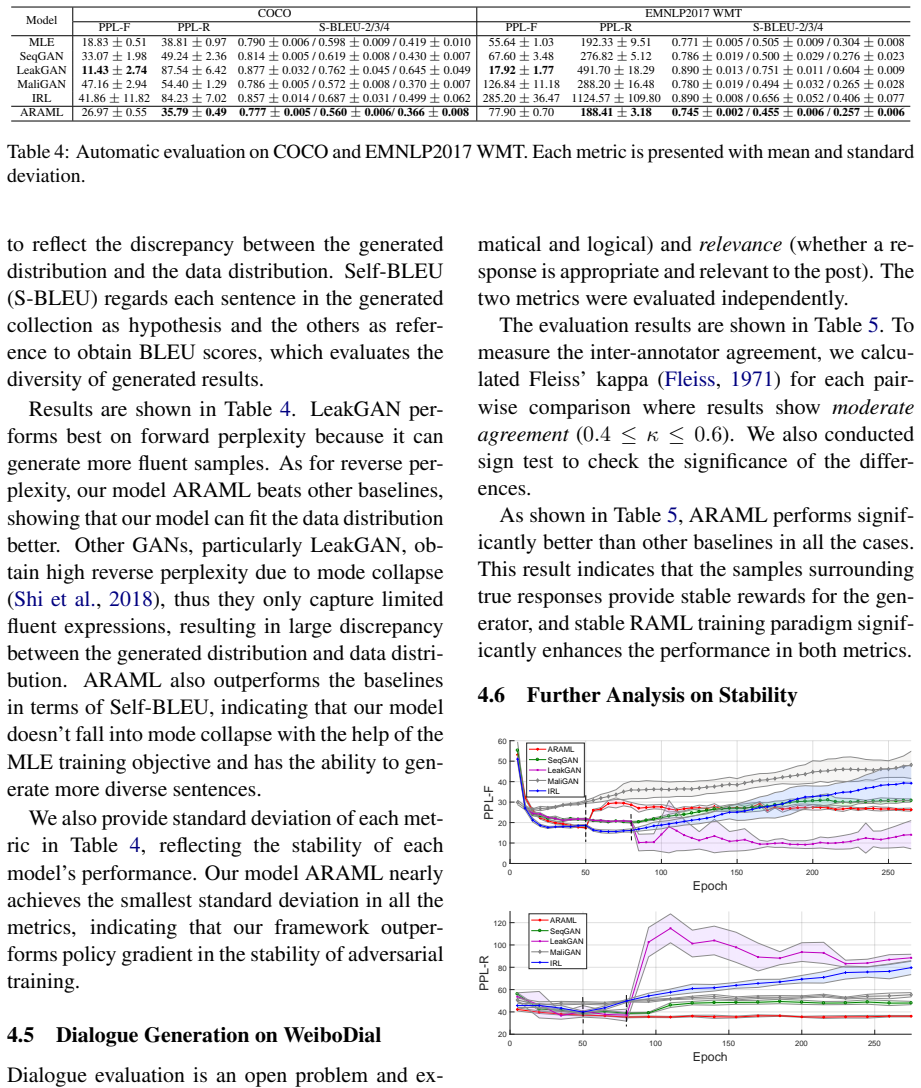
The core discovery is that one can keep the adversarial reward signal while avoiding RL variance by fixing the sampling distribution. Concretely, the generator loss is $L_{G_\theta} = -\mathbb{E}_{X \sim P_s}[W_\varphi(X) \log P_{G_\theta}(X)]$ with importance weight $W_\varphi(X) \propto \exp\{D_\varphi(X)\}$, where $P_s$ is a stationary distribution of small word substitutions around real data and $D_\varphi$ is the discriminator. Because $P_s$ is fixed, the exploration space is pinned near the data, and the generator is trained by a weighted likelihood objective that, by the RAML argument, has the same global optimum as the original RL objective up to first order. The paper claims this yields training curves with smaller variance and better reverse perplexity and diversity than strong GAN and RL baselines on all three datasets.
Load-bearing premise
The method assumes that the words substituted by the constrained sampling procedure are drawn exactly from the distribution $P_s(X)$ used in the reward function and importance weight; if the realized proposal distribution differs from this $P_s$, the generator is optimizing a misspecified objective rather than the intended reward-augmented likelihood.
Editorial extensions
If this is right
- Text GANs can be trained without high-variance policy gradient, so training curves should be more reproducible across random seeds.
- Because samples are always drawn near real data, the generator is constantly exposed to fluent, diverse data-like sentences, which should reduce mode collapse.
- The same objective extends directly to conditional generation, making reward-weighted likelihood on nearby responses applicable to dialogue and other structured prediction tasks.
- Since no explicit task metric is required, the discriminator can supply rewards for tasks where automatic metrics such as BLEU are weak or unavailable.
- If the stability claim holds, ARAML-style training could serve as a drop-in replacement for policy-gradient updates in other discrete generative settings beyond text.
Reading between the lines
- Not in the paper: the importance-weight construction suggests the discriminator only needs to rank nearby samples, so one could test whether a weaker critic, such as a sentence-level coherence or entailment score, provides the same stabilizing signal.
- Not in the paper: ARAML is close to a denoising objective on real sentences, so a testable extension is to combine it with explicit denoising autoencoding or data augmentation to further improve fluency.
- Not in the paper: the sampler is limited to one-pass word substitutions; extending it to insertions, deletions, or span-level edits could increase diversity while retaining stability, but this is not demonstrated here.
- Not in the paper: because the generator is trained on a fixed exploration distribution, one could in principle decouple the critic update schedule from the generator update schedule entirely and measure how much of the stability comes from that decoupling.
Signed reviews
Editorial analysis
A structured set of objections, weighed in public.
Referee Report
Summary. The paper proposes ARAML, an adversarial training framework for text generation. Instead of optimizing the generator with policy gradient, the generator is trained with maximum likelihood estimation on samples drawn from a stationary distribution near the real data, where the sample weights come from a discriminator via an importance-sampling argument. The framework is evaluated on three tasks (COCO image captions, EMNLP2017 WMT, and WeiboDial dialogue), comparing against several GAN and RL baselines, and the paper claims improved generation quality and greater training stability. The central theoretical contribution is the derivation of a reward-augmented MLE objective in Section 3.3, connecting an RL-style loss to a RAML-style loss through importance sampling.
Significance. The motivation for the paper is well placed: replacing high-variance policy gradient with reward-augmented maximum likelihood on a fixed proposal distribution could indeed alleviate a known instability problem in discrete-text GANs. The empirical evaluation is broad, including automatic metrics and human evaluation, and the authors state that code is available. If the theoretical derivation were sound, the framework would be a useful contribution to stable text generation. However, as written, the importance-sampling derivation has a load-bearing gap concerning the computation of the marginal proposal density and the definition of the constrained sampling distribution. The stability comparison also rests on a selective choice of trials. These issues need to be resolved before the central claims can be accepted.
major comments (4)
- [Section 3.3, Eqs. (6)-(14)] The derivation of the generator objective relies on importance sampling with proposal Ps and weights W ∝ Q/Ps, which leads to the clean cancellation W ∝ exp(D). However, the actual sampling procedure described in Section 3.3.1 is hierarchical: first draw X from Pdata, then draw Xs from Ps(Xs|X). The density of the resulting proposal for the generated sample Xs is the marginal Ps(Xs) = Σ_X Pdata(X)Ps(Xs|X), not the conditional density used in the recursion of Eq. (12). The reward in Eq. (13) requires log Ps(Xs) for the sampled sentence, but the paper never explains how this intractable marginal is computed during training. If the implementation uses the conditional density or omits the log-marginal term, then the cancellation in Eq. (14) is invalid and the generator is not optimizing the advertised reward-augmented MLE objective. This directly undermines the central claim that the framework provides a stable and well-founded RAML objective.
- [Section 3.3.1, Eq. (12)] The constrained sampling strategy is described as sampling words 'to maximize the language model score of the target sentence,' which is a deterministic operation. As a result, the product in Eq. (12) does not define a normalized probability distribution over the edited sentence Xs. Consequently, the existence and normalization of the proposal Ps used in Eqs. (6) and (7) are not established. If a probabilistic interpretation is intended, the paper must specify the actual distribution over word choices (for example, a softmax with temperature or a top-k sampling scheme); otherwise, the importance-sampling identity is not defined for the constrained sampling variant that the paper adopts.
- [Section 4.6, Figure 2] The stability comparison reports that the authors 'conducted experiments on COCO many times and chose the best 5 trials' for each model before plotting the forward/reverse perplexity curves and standard deviations. Selecting the best trials truncates the observed variance and is not a neutral way to compare training stability: for models with high run-to-run variance, the selection can substantially understate the true variability and thereby favor the stability claim of ARAML. The paper should state the total number of runs, the exact selection criterion, and ideally show statistics over all runs or report the variance without selection.
- [Table 4 and Abstract] The abstract and conclusion claim that the proposed model can outperform state-of-the-art text GANs. However, on forward perplexity (PPL-F), LeakGAN is markedly better on both COCO (11.43 vs. 26.97) and EMNLP2017 (17.92 vs. 77.90), and ARAML wins only on reverse perplexity and Self-BLEU. The authors explain this as mode collapse, which is plausible, but the broad outperform claim is not supported by the full set of metrics. The claims should be qualified to specify which metrics are improved and under which assumptions.
minor comments (5)
- [Section 3.3.1, Eq. (7)] The notation in Eq. (7) is confusing: the left-hand side is written as Ps(X) while the right-hand side is an expectation over source sentences producing Xs. The equation should be written as Ps(Xs) = E_{X~Pdata(X)}[Ps(Xs|X)] to avoid the impression that the conditional and marginal are the same object.
- [Table 3] The entry '0.950.9' in the Temperature row appears to be a typographical error; it likely should be two separate values (for example, 0.95 and 0.9). Please clarify.
- [Related Work] The name 'Semeniuta1' contains an extraneous '1' and should be corrected to 'Semeniuta'.
- [Section 3.3.1, Eq. (9)] The approximate count c(e,m) for the number of sentences at edit distance e ignores the possibility of duplicate positions or identical replacement words, which makes the formula approximate. The paper should state that this is an approximation and that the normalizing constant in Eq. (10) is therefore also approximate.
- [Section 4.6] The phrase 'best 5 trials' should be precisely defined (e.g., lowest final perplexity, or lowest area under the curve), and the total number of trials should be reported for reproducibility.
Circularity Check
No circularity: the ARAML objective follows transparently from RAML and an algebraic importance-sampling identity; evaluation metrics are external.
full rationale
The paper's derivation chain is self-contained and non-circular. Equations (3)-(6) restate the external RAML result (Norouzi et al., 2016), and the importance-sampling step is a standard algebraic identity. The reward function in Eq. (13) deliberately includes log Ps so that the importance weight cancels to exp(D) in Eq. (14); this is a transparent construction, not a hidden reuse of the target result. The generator is trained on samples from a constructed stationary distribution Ps, and all reported metrics (forward/reverse perplexity, Self-BLEU, and human ratings) are computed by held-out external evaluators; no evaluation metric is used to define the reward or to fit a parameter that is later reported as a prediction. The cited self-works (Ke et al. 2018; Zhou et al. 2018a; Qian et al. 2018) appear only as related work or dataset sources and are not load-bearing. The main weakness is a correctness gap, not circularity: Eq. (7) defines Ps as a marginal over all source sentences, and Eq. (12) gives an unnormalized product of conditional choices, so it is not established that log Ps(X) in Eq. (13) is computable or that the constrained-sampling proposal equals Ps; if it does not, Eq. (6) is misspecified. That is an implementation/theory gap, because the equations are not equivalent to their inputs by construction and no prediction is renamed from a fit.
Assumptions & free parameters
free parameters (2)
- temperature tau =
0.85 (COCO), 0.9/0.95 (EMNLP2017), 0.9 (WeiboDial)
- sampling size =
5
assumptions (3)
- standard math The equivalence between L_RL and L_RAML up to first-order Taylor approximations, both having the same global optimum (Norouzi et al. 2016).
- domain assumption The edit-distance sampling procedure, including constrained word replacement, exactly implements the distribution P_s used in the reward function r_phi(X) = tau[log P_s(X) + D_phi(X)] and in the importance weight W.
- domain assumption The discriminator output D_phi provides a useful reward signal for generation quality, such that weighting edited samples by exp(D_phi(X)) steers the generator toward the real data distribution.
Cite this review
Pith. "Pith review of ARAML: A Stable Adversarial Training Framework for Text Generation." pith.science (2026). https://pith.science/paper/7OR6AM7P
@misc{pith2026190807195,
  author       = {Pith},
  title        = {Pith review of: ARAML: A Stable Adversarial Training Framework for Text Generation},
  year         = {2026},
  howpublished = {\url{https://pith.science/paper/7OR6AM7P}},
  note         = {Machine review of arXiv:1908.07195}
}
read the original abstract
Most of the existing generative adversarial networks (GAN) for text generation suffer from the instability of reinforcement learning training algorithms such as policy gradient, leading to unstable performance. To tackle this problem, we propose a novel framework called Adversarial Reward Augmented Maximum Likelihood (ARAML). During adversarial training, the discriminator assigns rewards to samples which are acquired from a stationary distribution near the data rather than the generator's distribution. The generator is optimized with maximum likelihood estimation augmented by the discriminator's rewards instead of policy gradient. Experiments show that our model can outperform state-of-the-art text GANs with a more stable training process.
Figures


Reference graph
Works this paper leans on
-
[1]
URL: " 'urlintro :=
ENTRY address author booktitle chapter edition editor howpublished institution journal key month note number organization pages publisher school series title type volume year eprint doi pubmed url lastchecked label extra.label sort.label short.list INTEGERS output.state before.all mid.sentence after.sentence after.block STRINGS urlintro eprinturl eprintpr...
-
[2]
write newline
" write newline "" before.all 'output.state := FUNCTION n.dashify 't := "" t empty not t #1 #1 substring "-" = t #1 #2 substring "--" = not "--" * t #2 global.max substring 't := t #1 #1 substring "-" = "-" * t #2 global.max substring 't := while if t #1 #1 substring * t #2 global.max substring 't := if while FUNCTION word.in bbl.in capitalize " " * FUNCT...
-
[3]
Dzmitry Bahdanau, Philemon Brakel, Kelvin Xu, Anirudh Goyal, Ryan Lowe, Joelle Pineau, Aaron Courville, and Yoshua Bengio. 2017. An actor-critic algorithm for sequence prediction. In Proceedings of International Conference on Learning Representations
work page 2017
-
[4]
Samy Bengio, Oriol Vinyals, Navdeep Jaitly, and Noam Shazeer. 2015. Scheduled sampling for sequence prediction with recurrent neural networks. In Advances in Neural Information Processing Systems, pages 1171--1179
2015
-
[5]
Yoshua Bengio, Réjean Ducharme, Pascal Vincent, and Christian Jauvin. 2003. A neural probabilistic language model. Journal of Machine Learning Research, 3:1137--1155
work page 2003
-
[6]
Massimo Caccia, Lucas Caccia, William Fedus, Hugo Larochelle, Joelle Pineau, and Laurent Charlin. 2018. Language gans falling short. arXiv preprint arXiv: 1811.02549
arXiv 2018
-
[7]
Arun Tejasvi Chaganty, Stephen Mussmann, and Percy Liang. 2018. The price of debiasing automatic metrics in natural language evaluation. In Proceedings of the 56th Annual Meeting of the Association for Computational Linguistics, pages 643--653
work page 2018
-
[8]
Tong Che, Yanran Li, Ruixiang Zhang, R Devon Hjelm, Wenjie Li, Yangqiu Song, and Yoshua Bengio. 2017. Maximum-likelihood augmented discrete generative adversarial networks. arXiv preprint arXiv: 1702.07983
arXiv 2017
Show all 41 references
-
[9]
Lawrence Zitnick
Xinlei Chen, Hao Fang, Tsung-Yi Lin, Ramakrishna Vedantam, Saurabh Gupta, Piotr Dollar, and C. Lawrence Zitnick. 2015. Microsoft coco captions: Data collection and evaluation server. arXiv preprint arXiv: 1504.00325
2015 arXiv
-
[10]
Kyunghyun Cho, Bart Van Merrienboer, Dzmitry Bahdanau, and Yoshua Bengio. 2014. On the properties of neural machine translation: Encoder-decoder approaches. In Proceedings of Eighth Workshop on Syntax, Semantics and Structure in Statistical Translation, pages 103--111
2014
-
[11]
Goodfellow, and Andrew M
William Fedus, Ian J. Goodfellow, and Andrew M. Dai. 2018. Maskgan: Better text generation via filling in the \_ \_ \_ \_ \_ \_ \_ . In Proceedings of International Conference on Learning Representations
2018
-
[12]
Joseph L Fleiss. 1971. Measuring nominal scale agreement among many raters. Psychological Bulletin, 76(5):378--382
1971
-
[13]
Alex Graves. 2013. Generating sequences with recurrent neural networks. arXiv preprint arXiv: 1308.0850
2013 arXiv
-
[14]
Jiaxian Guo, Sidi Lu, Han Cai, Weinan Zhang, Yong Yu, and Jun Wang. 2018. Long text generation via adversarial training with leaked information. In Proceedings of AAAI conference on Artificial Intelligence, pages 5141--5148
2018
-
[15]
Sepp Hochreiter and Jürgen Schmidhuber. 1997. Long short-term memory. Neural Computation, 9(8):1735--1780
1997
-
[16]
Pei Ke, Jian Guan, Minlie Huang, and Xiaoyan Zhu. 2018. Generating informative responses with controlled sentence function. In Proceedings of the 56th Annual Meeting of the Association for Computational Linguistics, pages 1499--1508
2018
-
[17]
Jiwei Li, Michel Galley, Chris Brockett, Jianfeng Gao, and Bill Dolan. 2016. A diversity-promoting objective function for neural conversation models. In Conference of the North American Chapter of the Association for Computational Linguistics: Human Language Technologies, page...
2016
-
[18]
Jiwei Li, Will Monroe, Tianlin Shi, Sebastien Jean, Alan Ritter, and Dan Jurafsky. 2017. Adversarial learning for neural dialogue generation. In Proceedings of the Conference on Empirical Methods in Natural Language Processing, pages 2157--2169
2017
-
[19]
Kevin Lin, Dianqi Li, Xiaodong He, Zhengyou Zhang, and Ming-Ting Sun. 2017. Adversarial ranking for language generation. In Advances in Neural Information Processing Systems, pages 3155--3165
2017
-
[20]
Serban, Michael Noseworthy, Laurent Charlin, and Joelle Pineau
Chia Wei Liu, Ryan Lowe, Iulian V. Serban, Michael Noseworthy, Laurent Charlin, and Joelle Pineau. 2016. How not to evaluate your dialogue system: An empirical study of unsupervised evaluation metrics for dialogue response generation. In Proceedings of the Conference on Empiri...
2016
-
[21]
Xudong Mao, Qing Li, Haoran Xie, Raymond Y. K. Lau, Zhen Wang, and Stephen Paul Smolley. 2017. Least squares generative adversarial networks. In International Conference on Computer Vision, pages 2813--2821
2017
-
[22]
Ning Miao, Hao Zhou, Lili Mou, Rui Yan, and Lei Li. 2019. Cgmh: Constrained sentence generation by metropolis-hastings sampling. In Proceedings of AAAI conference on Artificial Intelligence
2019
-
[23]
Tomas Mikolov, Martin Karafiat, Lukas Burget, Jan Honza Cernock, and Sanjeev Khudanpur. 2010. Recurrent neural network based language model. In Proceedings of the 11st Annual Conference of the International Speech Communication Association, pages 1045--1048
2010
-
[24]
Lili Mou, Yiping Song, Rui Yan, Ge Li, Lu Zhang, and Zhi Jin. 2016. Sequence to backward and forward sequences: A content-introducing approach to generative short-text conversation. In Proceedings of 26th International Conference on Computational Linguistics, pages 3349--3358
2016
-
[25]
Mohammad Norouzi, Samy Bengio, Zhifeng Chen, Navdeep Jaitly, Mike Schuster, Yonghui Wu, and Dale Schuurmans. 2016. Reward augmented maximum likelihood for neural structured prediction. In Advances in Neural Information Processing Systems, pages 1723--1731
2016
-
[26]
Jekaterina Novikova, Ondrej Dusek, Amanda Cercas Curry, and Verena Rieser. 2017. Why we need new evaluation metrics for NLG . In Proceedings of the 2017 Conference on Empirical Methods in Natural Language Processing, pages 2241--2252
2017
-
[27]
Qiao Qian, Minlie Huang, Haizhou Zhao, Jingfang Xu, and Xiaoyan Zhu. 2018. Assigning personality/profile to a chatting machine for coherent conversation generation. In Proceedings of the Twenty-Seventh International Joint Conference on Artificial Intelligence, pages 4279--4285
2018
-
[28]
Marc’Aurelio Ranzato, Sumit Chopra, Michael Auli, and Wojciech Zaremba. 2016. Sequence level training with recurrent neural networks. In Proceedings of International Conference on Learning Representations
2016
-
[29]
Stanislau Semeniuta1, Aliaksei Severyn, and Sylvain Gelly. 2018. On accurate evaluation of gans for language generation. arXiv preprint arXiv: 1806.04936
2018 arXiv
-
[30]
Zhan Shi, Xinchi Chen, Xipeng Qiu, and Xuanjing Huang. 2018. Toward diverse text generation with inverse reinforcement learning. In Proceedings of the Twenty-Seventh International Joint Conference on Artificial Intelligence, pages 4361--4367
2018
-
[31]
Jinyue Su, Jiacheng Xu, Xipeng Qiu, and Xuanjing Huang. 2018. Incorporating discriminator in sentence generation: A gibbs sampling method. In Proceedings of AAAI conference on Artificial Intelligence, pages 5496--5503
2018
-
[32]
Ilya Sutskever, Oriol Vinyals, and Quoc V Le. 2014. Sequence to sequence learning with neural networks. In Advances in Neural Information Processing Systems, pages 3104--3112
2014
-
[33]
Chongyang Tao, Lili Mou, Dongyan Zhao, and Rui Yan. 2018. Ruber: An unsupervised method for automatic evaluation of open-domain dialog systems. In Proceedings of the Thirty-Second AAAI Conference on Artificial Intelligence, pages 722--729
2018
-
[34]
Oriol Vinyals and Quoc Le. 2015. A neural conversational model. In International Conference on Machine Learning Deep Learning Workshop
2015
-
[35]
Chen Xing, Wei Wu, Yu Wu, Jie Liu, Yalou Huang, Ming Zhou, and Wei - Ying Ma. 2017. Topic aware neural response generation. In Proceedings of the Thirty-First AAAI Conference on Artificial Intelligence, pages 3351--3357
2017
-
[36]
Jingjing Xu, Xuancheng Ren, Junyang Lin, and Xu Sun. 2018. Diversity-promoting gan: A cross-entropy based generative adversarial network for diversified text generation. In Conference on Empirical Methods in Natural Language Processing, page 3940–3949
2018
-
[37]
Lantao Yu, Weinan Zhang, Jun Wang, and Yong Yu. 2017. Seqgan: Sequence generative adversarial nets with policy gradient. In Proceedings of AAAI conference on Artificial Intelligence, pages 2852--2858
2017
-
[38]
Rush, and Yann LeCun
Junbo Jake Zhao, Yoon Kim, Kelly Zhang, Alexander M. Rush, and Yann LeCun. 2018. Adversarially regularized autoencoders. In Proceedings of the 35th International Conference on Machine Learning, pages 5897--5906
2018
-
[39]
Hao Zhou, Minlie Huang, Tianyang Zhang, Xiaoyan Zhu, and Bing Liu. 2018 a . Emotional chatting machine: Emotional conversation generation with internal and external memory. In Proceedings of AAAI conference on Artificial Intelligence
2018
-
[40]
Hao Zhou, Tom Young, Minlie Huang, Haizhou Zhao, Jingfang Xu, and Xiaoyan Zhu. 2018 b . Commonsense knowledge aware conversation generation with graph attention. In Proceedings of the Twenty-Seventh International Joint Conference on Artificial Intelligence, pages 4623--4629
2018
-
[41]
Yaoming Zhu, Sidi Lu, Lei Zheng, Jiaxian Guo, Weinan Zhang, Jun Wang, and Yong Yu. 2018. Texygen: A benchmarking platform for text generation models. In Proceedings of the 41st International ACM SIGIR Conference on Research Development in Information Retrieval, pages 1097--1100
2018
Reviewed August 14, 2026 · model on record in the stance chip above.
Discussion (0). Continue with ORCID to comment.