REVIEW 3 major objections 5 minor 1 cited by
Search for dark matter annihilation in the center of the Earth with 8 years of IceCube data
T0 review · 3 major / 5 minor · reviewed 2026-08-14 · deepseek-v4-flash
Pith's one-line read After eight years of IceCube data, the projected sensitivity for dark-matter neutrinos from Earth's center improves by roughly 3.8.
desk verdict Honest proceedings status report: the 3.8x sensitivity gain is a projected ceiling from MC with an optimized BDT cut, not a measured result, but the paper is transparent about that. read the letter →
The pith
A machine-rendered reading of the paper's core claim, the machinery that carries it, and where it could break.
The reading
What carries the argument
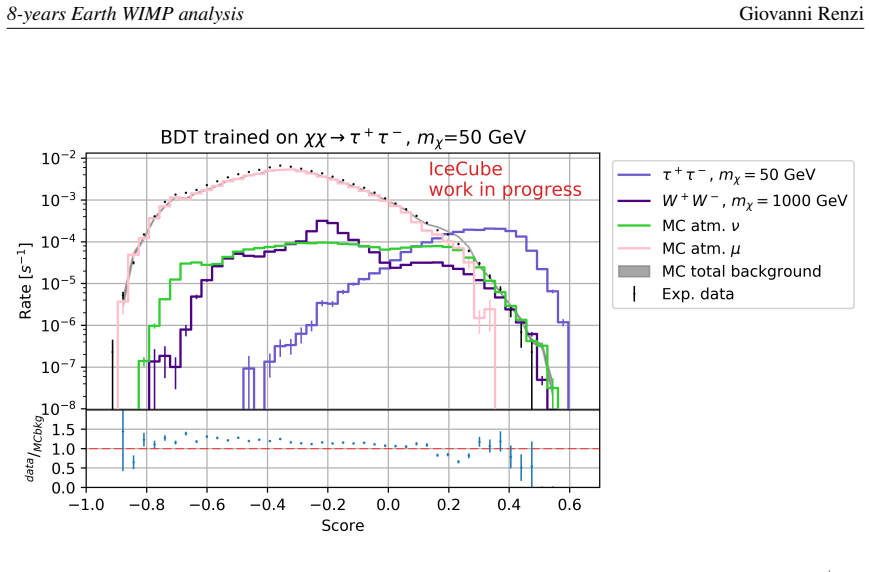
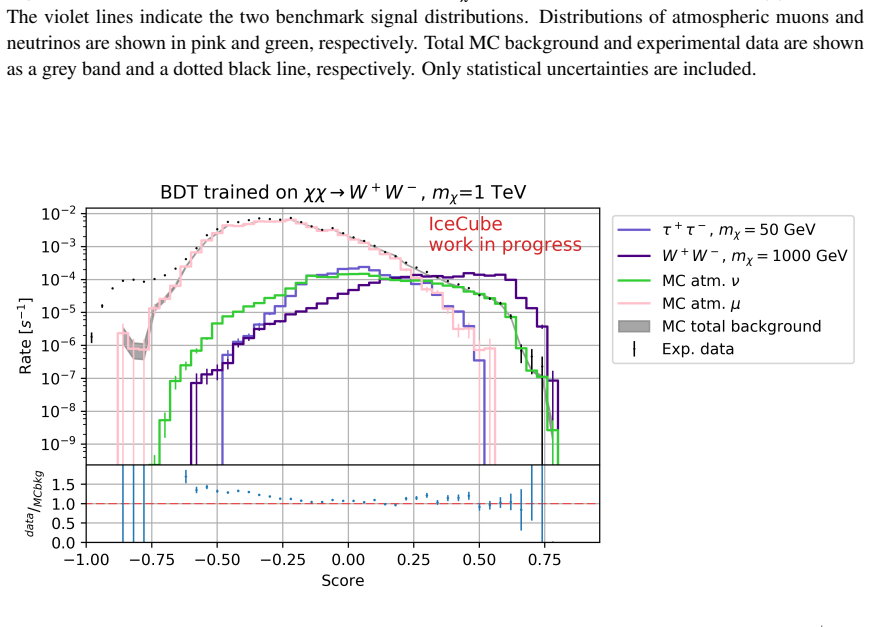
The carrying object is the BDT classifier, which assigns every event a single signal-likeness score; one BDT is trained on a $m_\chi=50$ GeV $\tau^+\tau^-$ benchmark and another on $m_\chi=1$ TeV $W^+W^-$, with the high-mass model used for the reported sensitivities. After a cut on the score, a binned Poisson likelihood over reconstructed zenith angle compares data with a signal-plus-background model built from CORSIKA air-shower muons, NuGen/GENIE atmospheric neutrinos, and oscillation treatment below 100 GeV, while the signal is generated with WimpSim. The detector-level quantity that carries the result is the volumetric neutrino flux $\Gamma_{\nu\to\mu} = N_{\rm sig}^{0.9}/(t_{\rm live}V_{\rm eff})$, which is converted through simulation to the annihilation rate $\Gamma_A$, the physical variable compared with other experiments.
What would settle it
Unblind the full eight-year signal region and compare the observed post-cut event rate and zenith-angle distribution with the simulated 0.19 mHz background: any deviation beyond the quoted uncertainties would invalidate the projected median limit. Alternatively, compute the 90% upper limit directly from the observed data; if it is statistically consistent with the previous one-year IceCube limit rather than about 3.8 times more sensitive, the central claim is falsified.
Extended reading notes
Core claim
On its own terms, the paper claims that a BDT-based event selection over eight years makes the Earth-center dark-matter channel a substantially more powerful neutrino search than the previous one-year IceCube analysis. For the benchmark channel $\chi\chi\to W^+W^-$ with $m_\chi = 1$ TeV, the median 90% sensitivity on the volumetric neutrino flux exceeds the earlier result by roughly a factor of 3.8, and the corresponding sensitivity on the annihilation rate is markedly better than both IceCube's previous upper limit and the ANTARES limit in the same channel. These numbers come from a binned likelihood in reconstructed zenith angle, a frequentist upper-limit prescription, and $10^4$ background-only pseudo-experiments, after a BDT score cut near 0.30 leaves a total background rate of 0.19 mHz. The paper presents this as the first sensitivity study of an ongoing analysis and expects further gains from moving to an event-wise unbinned likelihood that also uses reconstructed energy.
Load-bearing premise
The projection assumes that the simulated atmospheric background reproduces the real detector data after the BDT cut well enough that the median expected limit from background-only pseudo-experiments is meaningful; the paper checks that agreement on only 10% of the data and shows only statistical uncertainties in the comparison plots.
Editorial extensions
If this is right
- If the projected sensitivity becomes the observed result, IceCube's eight-year $W^+W^-$ search would surpass both its own one-year limit and ANTARES in that channel.
- A null signal would convert the improved sensitivity into tighter upper limits on the spin-independent dark-matter-nucleon scattering cross-section, approaching the strongest constraints available from Earth-capture searches.
- The same BDT and likelihood chain applies to other annihilation channels; the paper reports comparable selection performance for channels such as $b\bar b$, so the method can be reused across final states.
- Replacing the binned zenith-angle likelihood by the event-wise unbinned version with reconstructed energy is expected, as the paper states, to improve sensitivity further.
Reading between the lines
- The quoted 3.8-fold gain is benchmarked at $m_\chi=1$ TeV; a plausible extension, not stated in the paper, is that the gain varies with mass and may be smaller at low masses where the softer neutrino spectrum makes DeepCore veto performance the limiting factor.
- Because the background estimate is validated on only 10% of the data, a natural robustness check is to compare the post-cut rate (0.19 mHz) and zenith distribution year by year; if the rate drifts, the median-limit projection degrades in a mass-dependent way.
- The likelihood structure transfers directly to any fixed-direction source, so applying the same eight-year data set and BDT chain to the Sun would likely produce a comparable sensitivity gain for solar WIMP capture.
- Adding reconstructed energy to the likelihood is a natural test of the method: the energy spectrum of secondary neutrinos differs sharply between $W^+W^-$ and $b\bar b$ final states, so an energy-aware version of this analysis should separate channels more cleanly than the zenith-only version.
Signed reviews
Editorial analysis
A structured set of objections, weighed in public.
Referee Report
Summary. The paper reports an updated sensitivity study for a search for dark matter annihilation in the center of the Earth using 8 years of IceCube data (2011-2018). The analysis employs a BDT-based event selection trained on two benchmark signals (mχ=50 GeV, τ+τ−; mχ=1 TeV, W+W−), a binned likelihood in the reconstructed zenith angle, and the Feldman-Cousins method to derive a 90% sensitivity defined as the median upper limit from 10^4 background-only pseudo-experiments. The central result is a projected volumetric neutrino-flux sensitivity that exceeds the previous IceCube result by a factor of ~3.8 at mχ=1 TeV in the W+W− channel, together with improved sensitivity on the annihilation rate compared to previous IceCube and ANTARES limits. The paper also outlines a future extension to an event-wise unbinned likelihood including reconstructed energy.
Significance. If the projected improvement is robust, this analysis would place IceCube in a competitive position for spin-independent dark matter-nucleon scattering constraints from Earth-capture signals, a complementary probe to direct-detection and solar-capture searches. The work uses standard, publicly documented simulation tools (CORSIKA, NuGen/GENIE, WimpSim), a well-established statistical framework (binned likelihood, Feldman-Cousins), and a large background-only pseudo-experiment ensemble, which provides a reproducible basis for the sensitivity estimate. These strengths are, however, partly offset by the issues identified in the major comments, so the quantitative significance of the claimed gain is currently not fully established.
major comments (3)
- [Section 5, central paragraph (after Fig. 4)] The BDT score cut is set to 0.30 by a preliminary scan that optimizes the sensitivity on the same Monte Carlo used to compute the reported median limit. This in-sample optimization procedure introduces a selection bias that makes the quoted 3.8x improvement over the previous IceCube result a best-case ceiling rather than an unbiased expectation. The authors should either demonstrate that the sensitivity is stable under reasonable variations of the cut, use a validation sample that was not used for cut selection, or quantify the trial factor associated with the scan. Without this, the central claim is not fully robust.
- [Section 4 and Figs. 2 and 3 captions] The background estimate after the final BDT cut (0.19 mHz, Ntot=43032 events) and the zenith-angle background PDF B(bini) entering Eq. (5.1) are derived entirely from Monte Carlo (CORSIKA atmospheric muons, NuGen/GENIE neutrinos, and oscillation treatment), with the captions of Figs. 2 and 3 explicitly stating that only statistical uncertainties are included. Data/MC agreement in the signal region is validated with only a 10% data subset, which is then disregarded. Unmodeled systematics in the background rate or in the PDF shape, especially near the Earth-center direction (cos θ≈−1) where the signal peaks, directly propagate into the likelihood and would degrade the realized limits. The paper should propagate at least conservative systematic uncertainties on the normalization and shape of B(bini), or clearly label the reported sensitivity as a statistical-only upper bound.
- [Section 5, Fig. 5 and Sec. 1] The claimed improvement factor of ~3.8 compares a median expected sensitivity (from pseudo-experiments) with 'the previous IceCube sensitivity [2]'. If reference [2] actually reports an observed upper limit, as suggested by the phrase 'published upper limits on the spin-independent DM-nucleon scattering cross-section' in Sec. 1, then the comparison is not on equal footing: a median sensitivity should be compared with the previous analysis's median expected sensitivity, not with its observed limit. Please clarify the quantity taken from [2] and, if needed, recompute the improvement factor so that the comparison is apples-to-apples.
minor comments (5)
- [Section 2, DeepCore description] The text states that DeepCore is installed at 'a depth of 1750 cm'; the intended unit is presumably meters (1750 m), consistent with the surrounding depths quoted in meters. Please correct this typo.
- [Section 4, event selection paragraph] The sentence 'During the development of the event selection is was verified...' contains a typo ('is was' should be 'it was'), and the later sentence 'An initial series of cuts is applied on to reduce...' is grammatically awkward ('on to' should likely be 'to'). Please proofread these passages.
- [Section 5, Eq. (5.1)] The notation of the product index 'binmax ∏ bini=binmin' is nonstandard and slightly confusing; typically one writes ∏_{bini=binmin}^{binmax}. The authors may want to clarify that 'bini' is a bin label, not a running index.
- [Section 6, Conclusion] The conclusion says the new analysis 'could lead to world competitive limits' on the spin-independent cross-section, but the paper presents sensitivities, not observed limits. The wording should be adjusted to say that the analysis could produce world-competitive sensitivities or limits once applied to the full data.
- [General] The paper would benefit from an explicit statement that all quoted results are median expected sensitivities and not observed limits, and from specifying how the 10% data validation subset is handled (the statement that it is 'disregarded for further analysis' is helpful but could be made more precise, e.g., that it is excluded from both the sensitivity estimate and any future limit calculation).
Circularity Check
No significant circularity: the sensitivity projection is MC-based but is not definitionally tied to its inputs; the BDT optimization is a statistical caveat, not a circular step.
full rationale
The paper reports an expected sensitivity, defined as the median 90% upper limit from 10^4 background-only pseudo-experiments. The signal and background zenith-angle PDFs entering Eq. 5.2 are produced by independent external simulations (WimpSim for signal; CORSIKA, NuGen/GENIE for background), not by fitting the reported limit itself. The ~3.8x improvement over the previous IceCube sensitivity [2] is a comparison between two separately computed sensitivity curves, and the comparison with ANTARES [12] is an external benchmark; neither reduces to a fitted parameter being renamed as a prediction. The only in-sample optimization is the BDT score cut, chosen by scanning the sensitivity on the same MC; this can make the quoted sensitivity optimistic if the MC background is inaccurate, and the paper itself notes that only statistical uncertainties are shown in Figs. 2-3 and that only ~10% of data is used for data/MC validation in the signal region. These are legitimate statistical/systematic caveats, not circularity, because no equation in the paper equates the output to an input by construction. Self-citation to [2] is limited to methodological similarity and baseline comparison and is not load-bearing.
Assumptions & free parameters
free parameters (1)
- BDT score cut value =
0.30
assumptions (5)
- domain assumption Standard Halo Model: truncated Maxwellian velocity distribution with dispersion 270 km/s, escape velocity 544 km/s, and local dark matter density 0.3 GeV/cm3
- domain assumption Capture-annihilation equilibrium relation Gamma_A = (C/2) tanh^2(t_Earth/tau), Eq. (3.1)
- domain assumption MC background simulations (CORSIKA, NuGen, GENIE) with a 10% data validation subset correctly model the data after the BDT cut
- domain assumption WimpSim neutrino spectra correctly describe the annihilation channels
- standard math Feldman-Cousins 90% upper limit construction with a binned Poisson likelihood
Cite this review
Pith. "Pith review of Search for dark matter annihilation in the center of the Earth with 8 years of IceCube data." pith.science (2026). https://pith.science/paper/NMMF7PIX
@misc{pith2026190807255,
  author       = {Pith},
  title        = {Pith review of: Search for dark matter annihilation in the center of the Earth with 8 years of IceCube data},
  year         = {2026},
  howpublished = {\url{https://pith.science/paper/NMMF7PIX}},
  note         = {Machine review of arXiv:1908.07255}
}
read the original abstract
Dark matter particles in the galactic halo can scatter off particles in celestial bodies such as stars or planets, lose energy and become gravitationally trapped. In this process, an accumulation of dark matter in the center of celestial bodies is expected, for example, at the center of the Earth. If dark matter self-annihilates into Standard Model particles, the end products of these annihilations include neutrinos. The IceCube Neutrino Observatory at the geographic South Pole can detect the resulting flux of neutrinos originating from dark matter annihilation in the center of the Earth. A search for this signal is on-going using 8 years of IceCube data and probing different annihilation channels. Here the sensitivities are presented for this new analysis, showing significant improvements with respect to the previous analyses from IceCube and other experiments.
Figures

Figures from the paper (3 more)


Forward citations
Cited by 1 Pith paper
-
Complementary Planetary Spectroscopy Probes of Dark Matter
Dark matter annihilation energy deposited in planetary atmospheres and interiors, compared against existing UV airglow and heat flow measurements, yields new sub-GeV scattering constraints and long-lived mediator reach.
Reference graph
Works this paper leans on
-
[2]
IceCube Collaboration, M. G. Aartsen et al., EPJ C 77 (2017) 82
work page 2017
- [1]
-
[3]
IceCube Collaboration, M. G. Aartsen et al., JINST 12 (2017) P03012
2017
- [4]
-
[5]
G. Jungman, M. Kamionkowski, and K. Griest, Phys. Rept. 267 (1996) 195–373
work page 1996
-
[6]
J. I. Read, J. Phys. G 41 (2014)
work page 2014
- [7]
-
[8]
D. Heck, J. Knapp, J. Capdevielle, G. Schatz, and T. Thouw, FZKA 6019 (1998)
work page 1998
Show all 12 references
-
[9]
IceCube Collaboration, M. G. Aartsen et al., Phys. Rev. Lett. 120 (2018) 071801
2018
-
[10]
Blennow, J
M. Blennow, J. Edsjö, and T. Ohlsson, JCAP WimpSim Neutrino Monte Carlo, http://wimpsim.astroparticle.se/ (2008) 021
2008
-
[11]
G. J. Feldman and R. D. Cousins, Phys. Rev. D 57 (Apr, 1998) 3873–3889
1998
-
[12]
Dark Univ
ANTARES Collaboration, Phys. Dark Univ. 16 (2017) 41–48. 8
2017
Reviewed August 14, 2026 · model on record in the stance chip above.
Discussion (0). Continue with ORCID to comment.