REVIEW 4 major objections 5 minor 1 cited by
Complementary Planetary Spectroscopy Probes of Dark Matter
T0 review · 4 major / 5 minor · reviewed 2026-08-06 · deepseek-v4-flash
Pith's one-line read Existing UV airglow measurements of Jupiter and Saturn could place the strongest current limits on sub-GeV dark matter scattering, even when annihilation goes through a heavy mediator.
desk verdict A genuinely useful framework for planetary DM energy deposition with a serious unaddressed problem in the UV airglow constraints: they count annihilation below the homopause that cannot contribute to the observed emission. read the letter →
The pith
A machine-rendered reading of the paper's core claim, the machinery that carries it, and where it could break.
The reading
What carries the argument
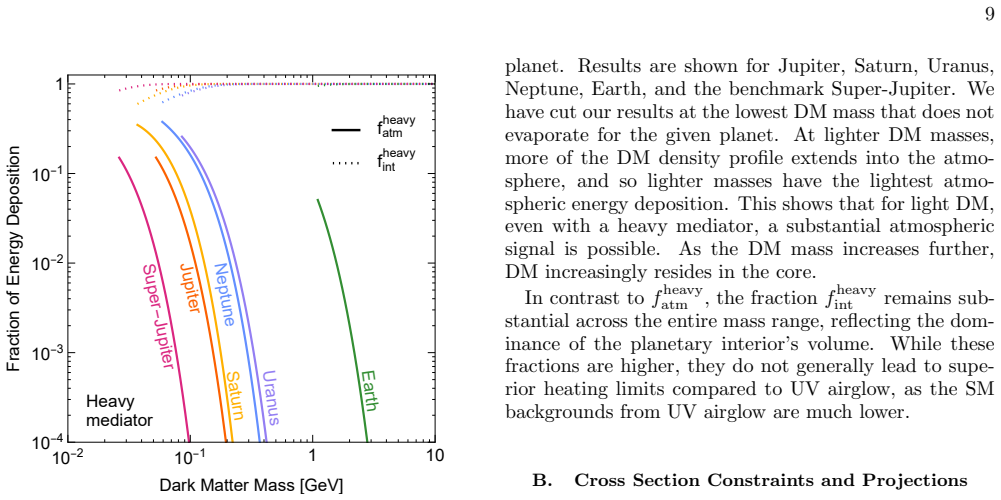
The load-bearing quantity is the atmospheric annihilation fraction $f_{\rm atm}$, the share of dark matter annihilation events that deposit energy in the atmosphere, defined through an integral over the squared normalized dark matter density profile $G_\chi(r)$. The profile itself combines a local-thermal-equilibrium interior distribution with an isothermal atmospheric extension at the planet's surface temperature (Eq. 9), truncated at a mass-dependent radius $R_{\rm max}$ (Eq. 10), with the two limiting regimes blended according to the Knudsen number, the ratio of the dark matter mean free path to its scale radius. This machinery makes the paper's central effect possible: light dark matter extends into the rarefied atmosphere, so a substantial fraction of captured particles annihilate there and produce UV airglow even when the mediator is heavy.
What would settle it
Run a full atmospheric simulation of the exobase region for Jupiter or Saturn, including vertical mixing, winds, and momentum transfer from dark matter scattering, and compare the steady-state captured dark matter density above the 1-bar surface with the isothermal extension of Eq. 9. If the atmosphere depletes the dark matter population by a factor of two or more, the headline sub-GeV airglow constraints weaken by the same factor; if the population survives, the constraints stand.
Extended reading notes
Core claim
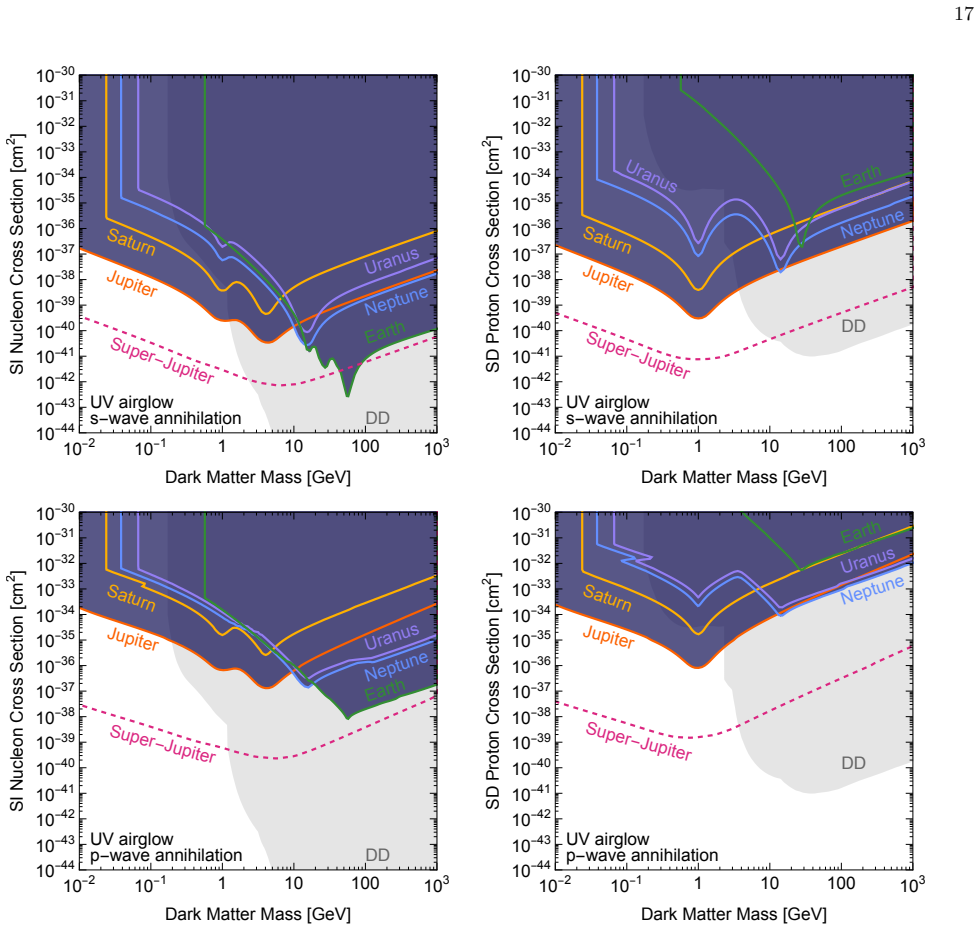
The paper's central claim is that the energy injected by dark matter annihilation inside a planet can be separated into an atmospheric fraction and an interior fraction, computable from the dark matter radial profile, the planet's temperature and density structure, and the mediator's decay length, and that comparing these fractions with observed UV airglow and internal heat flow produces dark matter constraints. Even when annihilation goes through a heavy mediator, more than ten percent of captured sub-GeV dark matter annihilates in the atmosphere because a thermalized population resides in the upper atmosphere, which is treated as an isothermal layer at the planet's surface temperature. The resulting hydrogen Lyman and Werner band emission is bounded by Voyager and New Horizons nightglow data for the giant planets, giving Jupiter and Saturn the best current limits on spin-independent (scattering independent of nuclear spin) and spin-dependent proton (scattering on unpaired proton spin) interactions below about a GeV. For light, long-lived mediators, planets of different radii probe different decay lengths, so the ensemble of Earth, ice giants, and gas giants maps out mediator parameter space in a way that complements collider long-lived particle searches.
Load-bearing premise
The results assume captured dark matter in the atmosphere follows an isothermal distribution at the planet's surface temperature, truncated at a mass-dependent radius; if that atmospheric population is depleted by winds, incomplete thermalization, or a different boundary treatment, the airglow limits weaken in proportion to the lost annihilation fraction.
Editorial extensions
If this is right
- Existing Jupiter and Saturn UV nightglow data constrain sub-GeV dark matter-nucleon scattering more strongly than current direct detection experiments, so a first test of this mass range requires no new instrumentation.
- The airglow channel opens parameter space for strongly interacting dark matter subcomponents that never reach underground detectors, and for spin-dependent neutron-only scattering that cosmology cannot constrain.
- Planets of different radii are sensitive to different mediator decay lengths, so the Solar System ensemble and future Super-Jupiters map out light-mediator parameter space in a way that complements long-lived particle collider searches.
- A free-floating Super-Jupiter could extend the same techniques: UV airglow observations project new sub-GeV sensitivity, and internal heat observations near the Galactic Center project sensitivity to large, previously untested cross sections.
- Because the constraints depend only on total energy deposited, they are insensitive to branching ratios and spectral details of the annihilation products, which makes them applicable across many dark sector models.
Reading between the lines
- Beyond the paper: if the atmospheric dark matter population is partially depleted by winds, vertical mixing, or incomplete thermalization, the sub-GeV airglow limits would weaken approximately in proportion; atmospheric modelling of the exobase, the transition to the collisionless upper atmosphere, could quantify this.
- Beyond the paper: the same capture-and-deposition machinery could be applied to hydrogen-rich brown dwarfs and mini-Neptunes with measured or modelable exobase temperatures, extending the mass and decay-length reach beyond the Solar System.
- Beyond the paper: the conversion from brightness to precipitating power, about 10 Rayleigh per microwatt per square meter, is the single largest observational multiplier, so an improved empirical calibration of H2 Lyman and Werner band brightness versus electron power would shift all airglow limits by a common factor.
- Beyond the paper: a latitudinally or time-resolved UV dataset could separate a dark matter airglow component from auroral and dayglow backgrounds, potentially turning the constraints reported here into a positive detection channel.
Editorial analysis
A structured set of objections, weighed in public.
Referee Report
Summary. The paper develops a general framework for interpreting dark matter energy injection in planets through two observables: UV airglow from the atmosphere and internal heat flow from the interior. It models DM capture, thermalization, annihilation, and evaporation, and computes the fraction of annihilation energy deposited in the atmosphere versus the interior for both a heavy (prompt) mediator and a light/long-lived mediator. These fractions are combined with published UV brightness and heat-flow measurements for Earth, Jupiter, Saturn, Uranus, and Neptune, as well as projections for a benchmark Super-Jupiter, to derive constraints on spin-independent and spin-dependent DM-nucleon scattering cross sections. The headline claim is that planetary UV airglow observations surpass direct detection limits for sub-GeV DM even with a heavy mediator, because a portion of the captured DM population annihilates in the atmosphere, and that planetary spectroscopy is therefore a powerful and complementary dark-sector probe.
Significance. If the central claims hold, the paper would establish a qualitatively new and competitive channel for sub-GeV DM-nucleon scattering, particularly for spin-dependent proton scattering where direct detection is weak. The framework is genuinely general: it treats radial DM profiles, mediator decay lengths, and planetary structure in a unified way, and the heavy- versus light-mediator comparison is a useful organizational principle. The authors make good use of existing public tools (Asteria) and public datasets, and they are careful to separate constraints from projections. However, the headline UV-airglow limits rest on an atmospheric emission model that is not developed in the paper, and several model-dependent ingredients (the atmospheric DM profile, the solar-calibrated transition parameters, and the evaporation cutoff) are adopted with only partial sensitivity testing. The paper is therefore valuable and likely correct in its broad architecture, but the quantitative sub-GeV limits require further support.
major comments (4)
- [II.B, Eqs. (30)-(31), (34), and Fig. 4] The UV airglow constraints count all annihilation events between the 1-bar radius R and the exobase Ratm through the fraction f_atm in Eq. (34), and impose Eq. (31) using a 10 R per uW/m2 conversion factor calibrated for precipitating electrons. However, H2 Lyman and Werner band photons are collisionally quenched and absorbed below the homopause, and the observed nightside UV airglow originates mainly above the homopause. The DM atmospheric density falls with scale height H = kT(R)/(m_chi g); for Jupiter at m_chi = 0.3 GeV this is roughly 170 km, while the homopause is typically a few hundred km above the 1-bar level. Thus only a small fraction of the events counted in f_atm occur in the UV-transparent region. The manuscript contains no radiative-transfer or quenching treatment and does not distinguish the energy deposition altitude from the emission altitude. This is a load-bearing issue for the central sub-GeV UV-airglow limits in Fig. 4, which may be overestimated by orders of magnitude. I ask the authors to either perform a vertical radiative-transfer estimate, conservatively restrict f_atm to the region above the homopause, or quantify the resulting reduction of the claimed limits.
- [I.B.3, Eqs. (9)-(10)] The atmospheric DM profile is assumed to be isothermal at the planetary surface temperature T(R), joined to the interior LTE profile at R and truncated at a mass-dependent radius Rmax given by Eq. (10). This assumption directly controls the atmospheric annihilation fraction and hence the 'more than 10% of captured DM annihilates in the atmosphere' claim in Sec. V. The paper notes that an alternative truncation changes results by only about 10%, but it does not quantify the sensitivity to the assumed profile shape, e.g., a depleted profile due to atmospheric winds or incomplete thermalization, or a different treatment of the exobase boundary. Because this is the key physical input that enables the sub-GeV airglow constraints, the authors should provide a sensitivity study over plausible atmospheric DM distributions and demonstrate that the headline limits are robust, or state the extent to which they weaken.
- [I.B.5, Eqs. (12)-(13)] The transition between the LTE and isothermal radial profiles is interpolated using f(K) with K0 = 0.4 and sigma = 0.5, parameters fitted to solar simulations [105]. The same functional form is applied to all planets, whose atmospheric compositions, temperatures, and Knudsen-number regimes differ substantially from the Sun. Since the cross-section limits in Fig. 4 span the intermediate regime where this blending matters, the authors should show the sensitivity of the constraints to the choice of K0 and sigma, for example by comparing the pure-LTE and pure-isothermal limits with the blended result. Without this, the robustness of the limits across the full cross-section range is not established.
- [I.D, Eqs. (22)-(29)] The low-mass reach of all the constraints is set by the evaporation cutoff, and the paper states that the evaporation smoothing changes results by 'a few tens of percent' and that varying the core temperature shifts the cutoff approximately linearly in DM mass. Since the headline sub-GeV sensitivity in Fig. 4 extends to masses near 0.1 GeV and below, the evaporation uncertainty directly affects the claimed region of new parameter space. I recommend displaying the evaporation mass cutoff as an uncertainty band, or explicitly quoting the range of cutoff masses for each planet under reasonable core-temperature variations, so that the reader can judge how much of the sub-GeV reach is robust.
minor comments (5)
- [II.A.1, Table I] The conversion factor of 10 R per uW/m2 is stated to be model-dependent, with values ranging from 7.8 to 14.6 R depending on electron energy. Since this factor enters all airglow limits linearly, its uncertainty should be propagated into the final constraints or quoted as a systematic band.
- [II.A.3 and II.C.3] The Super-Jupiter is described as 'local free-floating' for the UV airglow projection but as located at 0.1 kpc from the Galactic Center for the internal-heating projection. These are different benchmarks with different DM densities and backgrounds; the text should state this explicitly to avoid confusion.
- [Fig. 2] The caption does not mention that Earth is omitted from the 0.5 GeV isothermal panel; the text explains this, but a short caption note would improve readability.
- [I.B.3, Eq. (10)] The expression Rmax ~ GM m_chi / T_chi is dimensionally correct only in units where Boltzmann's constant is unity; this should be stated or written with k_B explicitly for clarity.
- [I.C, Eq. (17)] The notation Cann is used both as an annihilation rate coefficient in Eq. (1) and as the coefficient in Eq. (18); the two are related but distinct, and a brief clarifying sentence would help the reader track the dimensions.
Circularity Check
No significant circularity: the constraints are obtained by comparing a forward DM energy-deposition calculation to externally measured UV airglow and internal heat fluxes.
full rationale
I walked the derivation chain: capture (Eq. 2, with Asteria), radial DM profiles (Eqs. 5-12), annihilation rate (Eqs. 17-18), atmospheric/interior deposition fractions (Eqs. 34-40), and the final constraints (Eqs. 31 and 33). The observed powers P_observed_atm and P_observed_int are external datasets from Voyager, New Horizons, Cassini, AMS-02, ELFIN, and boreholes, not quantities fitted from the DM model. The isothermal atmospheric extension (Eq. 9) and the solar-calibrated blending parameters K0 = 0.4 and ς = 0.5 (Eq. 13) are explicit physical inputs, not inversions of the target airglow or heat-flow signals. The self-citations to the companion paper [120] and to the Asteria package [124,125] are not load-bearing in the circular sense: [120] is a separate study comparing the same UV airglow mechanism to real observations, and Asteria is a public, code-released capture package; neither is fitted to the planetary observables used here. The statement that more than 10% of captured DM can annihilate in the atmosphere is the geometric fraction f_atm of Eq. (34) under the adopted atmospheric profile; it is model-dependent, and the homopause/radiative-transfer concern raised by the skeptic is a genuine physical uncertainty rather than a circularity, because the model is not fit to the UV data. No step reduces an output to an input by construction.
Assumptions & free parameters
free parameters (4)
- Transition blending parameters K0, ς =
K0 = 0.4, ς = 0.5
- UV brightness to power conversion factor =
10 R per µW/m^2
- Advection timescales =
100 yr giant planets, 1 Myr Earth
- Super-Jupiter benchmark parameters =
density x10, temperature x5 vs Jupiter; heat 459 W/m^2; DM density enhancement ~1500
assumptions (6)
- domain assumption Capture-annihilation equilibrium is assumed for the main constraints (Eq. 21).
- domain assumption DM-SM interactions are contact interactions; long-range interactions are neglected.
- domain assumption DM annihilates entirely into visible SM particles, neglecting neutrino branching.
- ad hoc to paper Atmospheric DM follows an isothermal distribution at the surface temperature T(R), with outer boundary Rmax (Eq. 9).
- ad hoc to paper The transition between LTE and isothermal regimes is interpolated with f(K) using K0=0.4 and ς=0.5, fitted to solar simulations.
- domain assumption Evaporation is modeled with the Gould and Jeans frameworks of Refs. [129,143-147].
Cite this review
Pith. "Pith review of Complementary Planetary Spectroscopy Probes of Dark Matter." pith.science (2026). https://pith.science/paper/VEN2K7DQ
@misc{pith2026250800980,
  author       = {Pith},
  title        = {Pith review of: Complementary Planetary Spectroscopy Probes of Dark Matter},
  year         = {2026},
  howpublished = {\url{https://pith.science/paper/VEN2K7DQ}},
  note         = {Machine review of arXiv:2508.00980}
}
read the original abstract
We investigate dark matter (DM) interactions via spectroscopic signatures of energy injection in planetary environments. We develop a general framework to account for how DM energy injection signals depend on the DM spatial distribution, planetary structure, and DM energy deposition profile. We combine UV airglow data on the Solar System's gas giants from the Voyager and New Horizons flybys, and ionospheric measurements from AMS-02 and ELFIN CubeSat on Earth, with internal heat flow data from Cassini, Voyager, and terrestrial boreholes, to constrain DM-nucleon scattering across both heavy and light mediator scenarios. We show that Earth, gas giants, and ice giants probe complementary DM masses and mediator properties, and forecast the reach of a free-floating Super-Jupiter. These results establish planetary spectroscopy as a powerful and versatile probe of the dark sector, complementary to direct detection, cosmology, and collider searches.
Figures


Figures from the paper (10 more)




Forward citations
Cited by 1 Pith paper
-
Search for Dark Matter Annihilation and Decay with H$\alpha$ Line Emission
H-alpha line emission from recombining gas in quiet dwarf galaxies is a new probe of dark matter annihilation/decay, giving leading limits for some dark matter masses.
Reference graph
Works this paper leans on
-
[105]
J. Bramante, J. Kumar, G. Mohlabeng, N. Raj, and N. Song, Phys. Rev. D 108, 063022 (2023), arXiv:2210.01812 [hep-ph]
arXiv 2023
-
[1]
Gas and Ice Giants Space probes such as Voyager 1, Voyager 2, and New Horizons have obtained UV nightglow spectra of the gas and ice giant planets away from their polar auroral re- gions. Our analysis of the Solar System giant plan- ets focuses on the excitation of the Lyman and Werner bands of molecular hydrogen (H 2), which dominate far UV emissions and...
-
[2]
Nonetheless, a UV nightglow has been observed, e.g
Earth Earth’s atmosphere differs markedly from those of the giant planets due to its much lower hydrogen content. Nonetheless, a UV nightglow has been observed, e.g. by the Universitetskii-Tatiana satellite [166]. Thanks to the wealth of experiments in the Earth’s upper at- mosphere, the precipitating electron energy flux can be directly measured, for exa...
-
[3]
The main origin of UV airglow in this case is not stellar, but rather from cosmic-ray electrons precipitating in the at- mosphere
Local Free-Floating Super-Jupiter To investigate an exoplanetary scenario, we use a benchmark free-floating Super-Jupiter; free-floating tar- gets will be optimal due to their lower backgrounds. The main origin of UV airglow in this case is not stellar, but rather from cosmic-ray electrons precipitating in the at- mosphere. We calculate the expected elect...
-
[4]
This is done by considering the photon power incident on the planet, and measuring the planet’s Bond albedo (the fraction of scattered light), using optical instruments
Gas and Ice Giants In the giant planets, the internal heating is estimated by evaluating the photon power absorbed by the planet. This is done by considering the photon power incident on the planet, and measuring the planet’s Bond albedo (the fraction of scattered light), using optical instruments. The effective temperature of the planet is obtained via i...
-
[5]
Oceanic and continental boreholes are used to directly measure the temperature without the influ- ence of variation in the Earth’s surface temperature, from e.g
Earth On Earth, several techniques are used to measure the internal heat. Oceanic and continental boreholes are used to directly measure the temperature without the influ- ence of variation in the Earth’s surface temperature, from e.g. day-night variance [177]. We use recent results which take into account effects from the local environment, i.e., matchin...
-
[6]
heavy mediator
Super-Jupiter in the Galactic Center We adopt the internal heat flux of a 10 Gyr Super- Jupiter from the ATMO model [161]. We take this bench- mark to be free-floating at 0.1 kpc from the Galactic Center, such that it is not irradiated by a star and its internal heat is a remnant from its formation. D. DM Induced Internal Heat Flow DM annihilation can inj...
-
[7]
Details of the Monte Carlo method are provided in Appendix D
Deposition in the Atmosphere The atmospheric energy deposition fraction from DM annihilation into light mediators is computed as f light atm = X i Patm i /N , (37) where Patm i is the probability that a mediator decays in the atmosphere, given an annihilation at point i, and N is the total number of sampled points. Details of the Monte Carlo method are pr...
Show all 247 references
-
[8]
An analytic approximation, similar to Eq
Deposition in the Interior The total fraction of energy deposited in the planetary interior is given by f light int = X i Pint i /N , (39) where Pint i is the probability that a mediator decays in the interior following an annihilation at point i. An analytic approximation, si...
-
[9]
Heavy Mediator a. Spin-Dependent Neutron Interactions Figure 11 presents heavy-mediator constraints on spin-dependent DM-neutron interactions, using the Solar System giant planets, Earth, and a Super-Jupiter, for both UV airglow and internal heating. Direct detection experimen...
-
[10]
Light Mediator In addition to the results of the main text, we present here light mediator constraints and sensitivities for additional parameters. Figure 13 explores the mediator and DM mass parameter space for a spin-dependent proton and spin-independent interaction of σ = 1...
-
[11]
Each position is sampled with probability proportional to n2 χ, corresponding to the DM annihilation rate density
Monte-Carlo Sampling For each of sixty logarithmically spaced DM masses between 10 −3 and 103 GeV, we generate N = 105 annihilation points ⃗ xi within the planet, drawn according to either the LTE or isothermal DM density profiles. Each position is sampled with probability pro...
-
[12]
We define the path from ⃗ xi to the atmospheric surface as ⃗ si = ⃗Ratm − ⃗ xi, with magnitude si = |⃗ si|
Angular Definitions To compute energy deposition probabilities, we define two angles, θi and φi, based on the triangle formed by the annihilation point ⃗ xi, the surface point ⃗Ratm, and the planetary center. We define the path from ⃗ xi to the atmospheric surface as ⃗ si = ⃗R...
-
[13]
• Region A: The annihilation occurs in the atmosphere, and the path to ⃗Ratm does not intersect the planetary interior
Geometric Regions We partition the space into three mutually exclusive regions, A, B, and C, corresponding to different numbers of crossings of the atmosphere-interior boundary along the line from ⃗ xi to ⃗Ratm. • Region A: The annihilation occurs in the atmosphere, and the pa...
-
[14]
Deposition Probabilities For each point, we compute the probability that the mediator decays in the atmosphere along its path to ⃗Ratm. This probability depends on the region in which the point falls: Patm i = 1 − e−si/L if ⃗ xi ∈ A, e−(si−h− i )/L − e−si/L if ⃗ xi ∈ B...
-
[15]
Batell, M
B. Batell, M. Pospelov, A. Ritz, and Y. Shang, Phys. Rev. D 81, 075004 (2010), arXiv:0910.1567 [hep-ph]. 4 Deposition Probabilities 22
2010 arXiv
-
[16]
Schuster, N
P. Schuster, N. Toro, and I. Yavin, Phys. Rev. D 81, 016002 (2010), arXiv:0910.1602 [hep-ph]
2010 arXiv
-
[17]
Schuster, N
P. Schuster, N. Toro, N. Weiner, and I. Yavin, Phys. Rev. D 82, 115012 (2010), arXiv:0910.1839 [hep-ph]
2010 arXiv
-
[18]
Meade, S
P. Meade, S. Nussinov, M. Papucci, and T. Volansky, JHEP 06, 029, arXiv:0910.4160 [hep-ph]
-
[19]
R. K. Leane, T. Linden, P. Mukhopadhyay, and N. Toro, Phys. Rev. D 103, 075030 (2021), arXiv:2101.12213 [astro- ph.HE]
2021 arXiv
-
[20]
J. F. Acevedo, R. K. Leane, and L. Santos-Olmsted, J. Cosmology Astropart. Phys. 2024, 042 (2024), arXiv:2309.10843 [hep-ph]
2024 arXiv
-
[21]
J. L. Feng, J. Smolinsky, and P. Tanedo, Phys. Rev. D 93, 015014 (2016), [Erratum: Phys.Rev.D 96, 099901 (2017)], arXiv:1509.07525 [hep-ph]
2016 arXiv
-
[22]
J. L. Feng, J. Smolinsky, and P. Tanedo, Phys. Rev. D 93, 115036 (2016), [Erratum: Phys.Rev.D 96, 099903 (2017)], arXiv:1602.01465 [hep-ph]
2016 arXiv
-
[23]
R. K. Leane, K. C. Y. Ng, and J. F. Beacom, Phys. Rev. D 95, 123016 (2017), arXiv:1703.04629 [astro-ph.HE]
2017 arXiv
-
[24]
Niblaeus, A
C. Niblaeus, A. Beniwal, and J. Edsjo, JCAP 11, 011, arXiv:1903.11363 [astro-ph.HE]
1903 arXiv
-
[25]
D. Bose, T. N. Maity, and T. S. Ray, Phys. Rev. D 105, 123013 (2022), arXiv:2112.08286 [hep-ph]
2022 arXiv
-
[27]
R. K. Leane and T. Linden, Phys. Rev. Lett. 131, 071001 (2023), arXiv:2104.02068 [astro-ph.HE]
2023 arXiv
-
[28]
Y.-X. Chen, L. Zu, Z.-Q. Xia, Y.-L. S. Tsai, and Y.-Z. Fan, JCAP 08, 036, arXiv:2302.09951 [astro-ph.HE]
- [29]
-
[30]
Linden, T
T. Linden, T. T. Q. Nguyen, and T. M. P. Tait, arXiv e-prints , arXiv:2402.01839 (2024), arXiv:2402.01839 [hep-ph]
2024 arXiv
-
[31]
R. K. Leane and J. Tong, JCAP 12, 031, arXiv:2405.05312 [hep-ph]
-
[32]
Arina, M
C. Arina, M. Backovi´ c, J. Heisig, and M. Lucente, Phys. Rev. D 96, 063010 (2017), arXiv:1703.08087 [astro-ph.HE]
2017 arXiv
-
[33]
Albert et al
A. Albert et al. (HA WC), Phys. Rev.D98, 123012 (2018), arXiv:1808.05624 [hep-ph]
2018 arXiv
-
[34]
Albert et al
A. Albert et al. (HA WC), Phys. Rev. D98, 123011 (2018), arXiv:1808.05620 [astro-ph.HE]
2018 arXiv
-
[35]
M. U. Nisa, J. F. Beacom, S. Y. BenZvi, R. K. Leane, T. Linden, K. C. Y. Ng, A. H. G. Peter, and B. Zhou, Astronomy & Astrophysics (2019), arXiv:1903.06349 [astro-ph.HE]
2019 arXiv
-
[36]
Cuoco, P
A. Cuoco, P. De La Torre Luque, F. Gargano, M. Gustafsson, F. Loparco, M. N. Mazziotta, and D. Serini, Phys. Rev. D 101, 022002 (2020), arXiv:1912.09373 [astro-ph.HE]
2020 arXiv
-
[37]
Serini, F
D. Serini, F. Loparco, and M. N. Mazziotta (Fermi-LAT), PoS ICRC2019, 544 (2020)
2020
-
[38]
M. N. Mazziotta, F. Loparco, D. Serini, A. Cuoco, P. De La Torre Luque, F. Gargano, and M. Gustafsson, Phys. Rev. D 102, 022003 (2020), arXiv:2006.04114 [astro-ph.HE]
2020 arXiv
-
[39]
N. F. Bell, J. B. Dent, and I. W. Sanderson, Phys. Rev. D 104, 023024 (2021), arXiv:2103.16794 [hep-ph]
2021 arXiv
-
[40]
Cerme˜ no and M
M. Cerme˜ no and M. A. P´ erez-Garc ´ ıa, Phys. Rev. D98, 063002 (2018), arXiv:1807.03318 [hep-ph]
2018 arXiv
-
[41]
Krall and M
R. Krall and M. Reece, Chin. Phys. C 42, 043105 (2018), arXiv:1705.04843 [hep-ph]
2018 arXiv
-
[42]
Moore and T
M. Moore and T. R. Slatyer, Phys. Rev. D 110, 023515 (2024), arXiv:2403.03972 [hep-ph]
2024 arXiv
-
[43]
J. F. Acevedo, J. Bramante, Q. Liu, and N. Tyagi, JCAP 03, 028, arXiv:2404.10039 [hep-ph]
-
[44]
Bhattacharjee, S
P. Bhattacharjee, S. Robles, S. A. Meighen-Berger, and F. Calore, arXiv e-prints (2025), arXiv:2505.13629 [hep-ph]
2025
-
[45]
Gupta, P
A. Gupta, P. Bhattacharjee, and P. Majumdar, Phys. Rev. D 111, 123002 (2025), arXiv:2501.04663 [astro-ph.HE]
2025 arXiv
-
[46]
Freese, Phys
K. Freese, Phys. Lett. B 167, 295 (1986)
1986
-
[47]
Hooper, F
D. Hooper, F. Petriello, K. M. Zurek, and M. Kamionkowski, Phys. Rev. D 79, 015010 (2009), arXiv:0808.2464 [hep-ph]
2009 arXiv
-
[48]
N. F. Bell and K. Petraki, JCAP 2011 (4), 003, arXiv:1102.2958 [hep-ph]
2011 arXiv
-
[49]
T. T. Q. Nguyen and T. M. P. Tait, Phys. Rev. D 107, 115016 (2023), arXiv:2212.12547 [hep-ph]
2023 arXiv
-
[50]
Lin, W.-H
Y.-H. Lin, W.-H. Wu, M.-R. Wu, and H. T.-K. Wong, Phys. Rev. Lett. 130, 111002 (2023), arXiv:2206.06864 [hep-ph]
2023 arXiv
-
[51]
D. Bose, T. N. Maity, and T. S. Ray, JCAP 05 (05), 001, arXiv:2108.12420 [hep-ph]
-
[52]
D. Bose, D. Chowdhury, P. Mondal, and T. S. Ray, JHEP 06, 014, arXiv:2312.05131 [hep-ph]
-
[53]
Chauhan, M
B. Chauhan, M. H. Reno, C. Rott, and I. Sarcevic, JCAP 01, 030, arXiv:2308.16134 [hep-ph]
-
[54]
T. N. Maity, A. K. Saha, S. Mondal, and R. Laha, arXiv e-prints (2023), arXiv:2308.12336 [hep-ph]
2023 arXiv
-
[55]
Ansarifard and Y
S. Ansarifard and Y. Farzan, Phys. Rev. D 110, 063002 (2024), arXiv:2401.13043 [hep-ph]
2024 arXiv
-
[56]
G. M. French and M. Sher, Phys. Rev. D 106, 115037 (2022), arXiv:2210.04761 [hep-ph]
2022 arXiv
-
[57]
Choi et al
K. Choi et al. (Super-Kamiokande), Phys. Rev. Lett. 114, 141301 (2015), arXiv:1503.04858 [hep-ex]
2015 arXiv
- [58]
-
[59]
Adrian-Martinez et al
S. Adrian-Martinez et al. (ANTARES), Phys. Lett. B 759, 69 (2016), arXiv:1603.02228 [astro-ph.HE]
2016 arXiv
-
[60]
Albert et al
A. Albert et al. (ANTARES), Phys. Dark Univ. 16, 41 (2017), arXiv:1612.06792 [hep-ex]
2017 arXiv
-
[61]
M. G. Aartsen et al. (IceCube), JCAP 04, 022, arXiv:1601.00653 [hep-ph]
-
[62]
Abbasi et al
R. Abbasi et al. (IceCube), PoS ICRC2019, 541 (2020), arXiv:1908.07255 [astro-ph.HE]
2020 arXiv
- [63]
-
[64]
McKeen, D
D. McKeen, D. E. Morrissey, M. Pospelov, H. Ramani, and A. Ray, Phys. Rev. Lett.131, 011005 (2023), arXiv:2303.03416 [hep-ph]
2023 arXiv
-
[65]
Allahverdi, Y
R. Allahverdi, Y. Gao, B. Knockel, and S. Shalgar, Phys. Rev. D 95, 075001 (2017), arXiv:1612.03110 [hep-ph]
2017 arXiv
- [66]
-
[67]
Bhattacharjee and F
P. Bhattacharjee and F. Calore, Particles 7, 489 (2024), arXiv:2311.18455 [astro-ph.HE]
2024 arXiv
-
[68]
Krishna, R
D. Krishna, R. Sherpa, A. K. Saha, T. N. Maity, R. Laha, and N. Raj, arXiv e-prints (2025), arXiv:2503.07713 [hep-ph]
2025 arXiv
-
[69]
T. T. Q. Nguyen, T. Linden, P. Carenza, and A. Widmark, arXiv e-prints (2025), arXiv:2501.14864 [astro-ph.HE]
2025 arXiv
-
[70]
D. Bose, R. Pramanick, and T. S. Ray, Phys. Lett. B 866, 139542 (2025), arXiv:2405.07894 [hep-ph]
2025 arXiv
-
[71]
Robles and S
S. Robles and S. A. Meighen-Berger, arXiv e-prints (2024), arXiv:2411.04435 [hep-ph]. 4 Deposition Probabilities 23
2024
-
[72]
Berlin and D
A. Berlin and D. Hooper, Phys. Rev. D 110, 075018 (2024), arXiv:2407.04768 [hep-ph]
2024 arXiv
- [73]
-
[74]
de Lavallaz and M
A. de Lavallaz and M. Fairbairn, Phys. Rev. D 81, 123521 (2010), arXiv:1004.0629 [astro-ph.GA]
2010 arXiv
-
[75]
Kouvaris and P
C. Kouvaris and P. Tinyakov, Phys. Rev. D 82, 063531 (2010), arXiv:1004.0586 [astro-ph.GA]
2010 arXiv
-
[76]
Baryakhtar, J
M. Baryakhtar, J. Bramante, S. W. Li, T. Linden, and N. Raj, Phys. Rev. Lett. 119, 131801 (2017), arXiv:1704.01577 [hep-ph]
2017 arXiv
-
[77]
N. F. Bell, G. Busoni, and S. Robles, JCAP 1809 (09), 018, arXiv:1807.02840 [hep-ph]
- [78]
-
[79]
N. F. Bell, G. Busoni, S. Robles, and M. Virgato, JCAP 04, 006, arXiv:2312.11892 [hep-ph]
-
[80]
Hamaguchi, N
K. Hamaguchi, N. Nagata, and K. Yanagi, Phys. Lett. B795, 484 (2019), arXiv:1905.02991 [hep-ph]
2019 arXiv
-
[81]
D. A. Camargo, F. S. Queiroz, and R. Sturani, JCAP 1909 (09), 051, arXiv:1901.05474 [hep-ph]
1909 arXiv
-
[82]
N. F. Bell, G. Busoni, and S. Robles, JCAP 1906 (06), 054, arXiv:1904.09803 [hep-ph]
1906 arXiv
-
[83]
Garani and J
R. Garani and J. Heeck, Phys. Rev. D100, 035039 (2019), arXiv:1906.10145 [hep-ph]
2019 arXiv
-
[84]
J. F. Acevedo, J. Bramante, R. K. Leane, and N. Raj, JCAP 03, 038, arXiv:1911.06334 [hep-ph]
1911 arXiv
-
[85]
Joglekar, N
A. Joglekar, N. Raj, P. Tanedo, and H.-B. Yu, Phys. Lett. B 809, 135767 (2020), arXiv:1911.13293 [hep-ph]
2020 arXiv
-
[86]
Joglekar, N
A. Joglekar, N. Raj, P. Tanedo, and H.-B. Yu, Phys. Rev. D 102, 123002 (2020), arXiv:2004.09539 [hep-ph]
2020 arXiv
-
[87]
Garani, A
R. Garani, A. Gupta, and N. Raj, Phys. Rev. D 103, 043019 (2021), arXiv:2009.10728 [hep-ph]
2021 arXiv
-
[88]
J. T. Acu˜ na, P. Stengel, and P. Ullio, arXiv e-prints (2022), arXiv:2209.12552 [hep-ph]
2022 arXiv
-
[89]
Alvarez, A
G. Alvarez, A. Joglekar, M. Phoroutan-Mehr, and H.-B. Yu, Phys. Rev. D 107, 103024 (2023), arXiv:2301.08767 [hep-ph]
2023 arXiv
-
[90]
Fujiwara, K
M. Fujiwara, K. Hamaguchi, N. Nagata, and M. E. Ramirez-Quezada, Phys. Lett. B848, 138341 (2024), arXiv:2309.02633 [hep-ph]
2024 arXiv
-
[91]
R. K. Leane and J. Smirnov, Phys. Rev. Lett. 126, 161101 (2021), arXiv:2010.00015 [hep-ph]
2021 arXiv
-
[92]
C. Ilie, C. Levy, and J. Diks, JCAP 04, 082, arXiv:2312.13979 [astro-ph.CO]
-
[93]
I. John, R. K. Leane, and T. Linden, Phys. Rev. D 109, 123041 (2024), arXiv:2311.16228 [astro-ph.HE]
2024 arXiv
- [94]
-
[95]
Croon and J
D. Croon and J. Smirnov, arXiv e-prints , arXiv:2309.02495 (2023), arXiv:2309.02495 [hep-ph]
2023 arXiv
-
[96]
Kawasaki, H
M. Kawasaki, H. Murayama, and T. Yanagida, Prog. Theor. Phys. 87, 685 (1992)
1992
-
[97]
Abbas and A
S. Abbas and A. Abbas, Astropart. Phys. 8, 317 (1998), arXiv:astro-ph/9612214
1998 arXiv
- [98]
-
[99]
G. R. Farrar and G. Zaharijas, Phys. Rev. Lett. 96, 041302 (2006), arXiv:hep-ph/0510079
2006 arXiv
-
[100]
G. D. Mack, J. F. Beacom, and G. Bertone, Phys. Rev. D 76, 043523 (2007), arXiv:0705.4298 [astro-ph]
2007 arXiv
-
[101]
S. L. Adler, Phys. Lett. B 671, 203 (2009), arXiv:0808.2823 [astro-ph]
2009 arXiv
-
[102]
G. D. Mack and A. Manohar, Journal of Physics G Nuclear Physics 40, 115202 (2013), arXiv:1211.1951 [astro-ph.CO]
2013 arXiv
-
[103]
Chauhan and S
B. Chauhan and S. Mohanty, Phys. Rev. D 94, 035024 (2016), arXiv:1603.06350 [hep-ph]
2016 arXiv
-
[104]
Bramante, A
J. Bramante, A. Buchanan, A. Goodman, and E. Lodhi, Phys. Rev. D 101, 043001 (2020), arXiv:1909.11683 [hep-ph]
2020 arXiv
-
[106]
N. F. Bell, G. Busoni, M. E. Ramirez-Quezada, S. Robles, and M. Virgato, JCAP 10, 083, arXiv:2104.14367 [hep-ph]
-
[107]
Cappiello and T
C. Cappiello and T. Daylan, arXiv e-prints (2025), arXiv:2505.24070 [hep-ph]
2025 arXiv
-
[108]
Benito, K
M. Benito, K. Karchev, R. K. Leane, S. P˜ oder, J. Smirnov, and R. Trotta, JCAP07, 038, arXiv:2405.09578 [astro-ph.IM]
-
[109]
I. V. Moskalenko and L. Wai, arXiv e-prints (2006), arXiv:astro-ph/0608535
2006 arXiv
-
[110]
Bertone and M
G. Bertone and M. Fairbairn, Phys. Rev. D 77, 043515 (2008), arXiv:0709.1485 [astro-ph]
2008 arXiv
-
[111]
McCullough and M
M. McCullough and M. Fairbairn, Phys. Rev. D 81, 083520 (2010), arXiv:1001.2737 [hep-ph]
2010 arXiv
-
[112]
Hooper, D
D. Hooper, D. Spolyar, A. Vallinotto, and N. Y. Gnedin, Phys. Rev. D 81, 103531 (2010), arXiv:1002.0005 [hep-ph]
2010 arXiv
-
[113]
Amaro-Seoane, J
P. Amaro-Seoane, J. Casanellas, R. Sch¨ odel, E. Davidson, and J. Cuadra, Mon. Not. Roy. Astron. Soc. 459, 695 (2016), arXiv:1512.00456 [astro-ph.CO]
2016 arXiv
-
[114]
P. W. Graham, R. Janish, V. Narayan, S. Rajendran, and P. Riggins, Phys. Rev. D 98, 115027 (2018), arXiv:1805.07381 [hep-ph]
2018 arXiv
-
[115]
Panotopoulos and I
G. Panotopoulos and I. Lopes, Int. J. Mod. Phys. D 29, 2050058 (2020), arXiv:2005.11563 [hep-ph]
2020 arXiv
-
[116]
M. E. Ramirez-Quezada, Phys. Rev. D 107, 083022 (2023), arXiv:2212.09785 [hep-ph]
2023 arXiv
-
[117]
Garani, N
R. Garani, N. Raj, and J. Reynoso-Cordova, JCAP 07, 038, arXiv:2303.18009 [astro-ph.HE]
-
[118]
Fairbairn, P
M. Fairbairn, P. Scott, and J. Edsjo, Phys. Rev. D 77, 047301 (2008), arXiv:0710.3396 [astro-ph]
2008 arXiv
-
[119]
Scott, M
P. Scott, M. Fairbairn, and J. Edsjo, Mon. Not. Roy. Astron. Soc. 394, 82 (2009), arXiv:0809.1871 [astro-ph]
2009 arXiv
-
[120]
Iocco, Astrophys
F. Iocco, Astrophys. J. Lett. 677, L1 (2008), arXiv:0802.0941 [astro-ph]
2008 arXiv
-
[121]
Freese, P
K. Freese, P. Gondolo, J. A. Sellwood, and D. Spolyar, Astrophys. J. 693, 1563 (2009), arXiv:0805.3540 [astro-ph]
2009 arXiv
-
[122]
Taoso, G
M. Taoso, G. Bertone, G. Meynet, and S. Ekstrom, Phys. Rev. D 78, 123510 (2008), arXiv:0806.2681 [astro-ph]
2008 arXiv
-
[123]
Sivertsson and P
S. Sivertsson and P. Gondolo, Astrophys. J. 729, 51 (2011), arXiv:1006.0025 [astro-ph.CO]
2011 arXiv
-
[124]
Freese, T
K. Freese, T. Rindler-Daller, D. Spolyar, and M. Valluri, Rept. Prog. Phys. 79, 066902 (2016), arXiv:1501.02394 [astro- ph.CO]
2016 arXiv
-
[125]
C. Ilie, C. Levy, J. Pilawa, and S. Zhang, arXiv e-prints (2020), arXiv:2009.11478 [astro-ph.CO]
2020 arXiv
-
[126]
C. Ilie, C. Levy, J. Pilawa, and S. Zhang, Phys. Rev. D 104, 123031 (2021), arXiv:2009.11474 [astro-ph.CO]
2021 arXiv
-
[127]
Lopes and I
J. Lopes and I. Lopes, Astron. Astrophys. 651, A101 (2021), arXiv:2107.13885 [astro-ph.SR]
2021 arXiv
-
[128]
Croon and J
D. Croon and J. Sakstein, Phys. Rev. D 109, 103021 (2024), arXiv:2310.20044 [astro-ph.HE]
2024 arXiv
-
[129]
C. Ilie, J. Paulin, and K. Freese, Proc. Nat. Acad. Sci. 120, e2305762120 (2023), arXiv:2304.01173 [astro-ph.CO]
2023 arXiv
-
[130]
Freese, C
K. Freese, C. Ilie, D. Spolyar, M. Valluri, and P. Bodenheimer, Astrophys. J. 716, 1397 (2010), arXiv:1002.2233 [astro- 4 Deposition Probabilities 24 ph.CO]
2010 arXiv
-
[131]
I. John, R. K. Leane, and T. Linden, Phys. Rev. D 112, 023028 (2025), arXiv:2405.12267 [astro-ph.HE]
2025 arXiv
-
[132]
Salati and J
P. Salati and J. Silk, Astrophys. J. 338, 24 (1989)
1989
-
[133]
Bramante and N
J. Bramante and N. Raj, Phys. Rept. 1052, 1 (2024), arXiv:2307.14435 [hep-ph]
2024 arXiv
-
[134]
Blanco, R
C. Blanco, R. K. Leane, M. Moore, and J. Tong, arXiv e-prints (2024), arXiv:2408.15318 [hep-ph]
2024 arXiv
-
[135]
Blanco and R
C. Blanco and R. K. Leane, Phys. Rev. Lett. 132, 261002 (2024), arXiv:2312.06758 [hep-ph]
2024 arXiv
-
[136]
G. Elor, N. L. Rodd, T. R. Slatyer, and W. Xue, J. Cosmology Astropart. Phys. 2016, 024 (2016), arXiv:1511.08787 [hep-ph]
2016 arXiv
-
[137]
P. J. McMillan and J. J. Binney, Mon. Not. Roy. Astron. Soc. 402, 934 (2010), arXiv:0907.4685 [astro-ph.GA]
2010 arXiv
-
[138]
R. K. Leane and J. Smirnov, JCAP 2023 (12), 040, arXiv:2309.00669 [hep-ph]
2023 arXiv
-
[139]
R. K. Leane and J. Smirnov, Asteria: A Package for Dark Matter Capture in Celestial Objects, https://doi.org/10. 5281/zenodo.8150110 (2023)
2023
-
[140]
V. A. Bednyakov and F. Simkovic, Phys. Part. Nucl. 36, 131 (2005), arXiv:hep-ph/0406218
2005 arXiv
-
[141]
D. N. Spergel and W. H. Press, Astrophys. J. 294, 663 (1985)
1985
-
[142]
A. C. Vincent, A. Serenelli, and P. Scott, JCAP 2015 (08), 040, arXiv:1504.04378 [hep-ph]
2015 arXiv
-
[143]
J. F. Acevedo, R. K. Leane, and J. Smirnov, J. Cosmology Astropart. Phys. 2024, 038 (2024), arXiv:2303.01516 [hep-ph]
2024 arXiv
-
[144]
Gould and G
A. Gould and G. Raffelt, Astrophys. J. 352, 654 (1990)
1990
-
[145]
A. C. Vincent and P. Scott, JCAP 04, 019, arXiv:1311.2074 [astro-ph.CO]
-
[146]
Banks, S
H. Banks, S. Ansari, A. C. Vincent, and P. Scott, JCAP 04 (04), 002, arXiv:2111.06895 [hep-ph]
-
[147]
R. K. Leane and J. Smirnov, JCAP 2023 (10), 057, arXiv:2209.09834 [hep-ph]
2023 arXiv
-
[148]
Banks, S
H. Banks, S. Beram, R. Reid, and A. C. Vincent, arXiv e-prints (2024), arXiv:2412.14342 [hep-ph]
2024 arXiv
-
[149]
De Luca, A
V. De Luca, A. Mitridate, M. Redi, J. Smirnov, and A. Strumia, Phys. Rev. D 97, 115024 (2018), arXiv:1801.01135 [hep-ph]
2018 arXiv
-
[150]
Pospelov, S
M. Pospelov, S. Rajendran, and H. Ramani, Phys. Rev. D 101, 055001 (2020), arXiv:1907.00011 [hep-ph]
2020 arXiv
-
[151]
Pospelov and H
M. Pospelov and H. Ramani, Phys. Rev. D 103, 115031 (2021), arXiv:2012.03957 [hep-ph]
2021 arXiv
-
[152]
Rajendran and H
S. Rajendran and H. Ramani, Phys. Rev. D 103, 035014 (2021), arXiv:2008.06061 [hep-ph]
2021 arXiv
-
[153]
Budker, P
D. Budker, P. W. Graham, H. Ramani, F. Schmidt-Kaler, C. Smorra, and S. Ulmer, PRX Quantum 3, 010330 (2022), arXiv:2108.05283 [hep-ph]
2022 arXiv
-
[154]
McKeen, M
D. McKeen, M. Moore, D. E. Morrissey, M. Pospelov, and H. Ramani, Phys. Rev. D 106, 035011 (2022), arXiv:2202.08840 [hep-ph]
2022 arXiv
-
[155]
Billard, M
J. Billard, M. Pyle, S. Rajendran, and H. Ramani, arXiv e-prints (2022), arXiv:2208.05485 [hep-ph]
2022 arXiv
-
[156]
Gold, Proc
E. Gold, Proc. Roy. Soc. of London Series A82, 43 (1909), https://royalsocietypublishing.org/doi/pdf/10.1098/rspa.1909.0006
1909
-
[157]
J. H. Jeans, The Dynamical Theory of Gases , 4th ed. (Cambridge University Press, 1925)
1925
-
[158]
Gould, ApJ 356, 302 (1990)
A. Gould, ApJ 356, 302 (1990)
1990
- [159]
-
[160]
D. A. Neufeld, G. R. Farrar, and C. F. McKee, Astrophys. J. 866, 111 (2018), arXiv:1805.08794 [astro-ph.CO]
2018 arXiv
-
[161]
Moore, Accelerating thermalized dark matter with beams and light , Master’s thesis, University of British Columbia (2021)
M. Moore, Accelerating thermalized dark matter with beams and light , Master’s thesis, University of British Columbia (2021)
2021
-
[162]
M. Qin, W. Li, X.-C. Shen, V. Angelopoulos, R. Selesnick, L. Capannolo, Q. Ma, A. Artemyev, and X.-J. Zhang, Geophys. Res. Lett. 51, e2023GL105134 (2024)
2024
-
[163]
Alcaraz et al
J. Alcaraz et al. (AMS), Phys. Lett. B 484, 10 (2000), [Erratum: Phys.Lett.B 495, 440–440 (2000)]
2000
-
[164]
Aguilar, D
M. Aguilar, D. Aisa, B. Alpat, A. Alvino, G. Ambrosi, K. Andeen, L. Arruda, N. Attig, P. Azzarello, A. Bachlechner, et al. , Phys. Rev. Lett. 113, 221102 (2014)
2014
-
[165]
Graziani, Time dependence of electron and positron fluxes measured with the AMS-02 spectrometer , Ph.D
M. Graziani, Time dependence of electron and positron fluxes measured with the AMS-02 spectrometer , Ph.D. thesis, U. Perugia (main) (2015)
2015
-
[166]
J. H. Davies and D. R. Davies, Solid Earth 1, 5 (2010)
2010
-
[167]
A. J. Bayless, G. R. Gladstone, J. Y. Chaufray, K. D. Retherford, A. J. Steffl, S. A. Stern, and D. C. Slater, in EPSC-DPS Joint Meeting 2011 , Vol. 2011 (2011) p. 1474
2011
-
[168]
L. Li, X. Jiang, R. A. West, P. J. Gierasch, S. Perez-Hoyos, A. Sanchez-Lavega, L. N. Fletcher, J. J. Fortney, B. Knowles, C. C. Porco, K. H. Baines, P. M. Fry, A. Mallama, R. K. Achterberg, A. A. Simon, C. A. Nixon, G. S. Orton, U. A. Dyudina, S. P. Ewald, and R. W. Schmude, ...
2018
-
[169]
A. L. Broadfoot, B. R. Sandel, D. E. Shemansky, J. B. Holberg, G. R. Smith, D. F. Strobel, J. C. McConnell, S. Kumar, D. M. Hunten, S. K. Atreya, T. M. Donahue, H. W. Moos, J. L. Bertaux, J. E. Blamont, R. B. Pomphrey, and S. Linick, Science 212, 206 (1981)
1981
-
[170]
X. Wang, L. Li, X. Jiang, P. M. Fry, R. A. West, C. A. Nixon, L. Guan, T. D. Karandana G, R. Albright, J. E. Colwell, T. Guillot, M. D. Hofstadter, M. E. Kenyon, A. Mallama, S. Perez-Hoyos, A. Sanchez-Lavega, A. A. Simon, D. Wenkert, and X. Zhang, Nature Communications 15, 5045 (2024)
2024
-
[171]
A. L. Broadfoot, S. K. Atreya, J. L. Bertaux, J. E. Blamont, A. J. Dessler, T. M. Donahue, W. T. Forrester, D. T. Hall, F. Herbert, J. B. Holberg, D. M. Hunten, V. A. Krasnopolsky, S. Linick, J. I. Lunine, J. C. Mcconnell, H. W. Moos, B. R. Sandel, N. M. Schneider, D. E. Shema...
1989
-
[172]
J. C. Pearl, B. J. Conrath, R. A. Hanel, J. A. Pirraglia, and A. Coustenis, Icarus 84, 12 (1990)
1990
-
[173]
J. C. Pearl and B. J. Conrath, J. Geophys. Res. 96, 18921 (1991)
1991
-
[175]
M. W. Phillips, P. Tremblin, I. Baraffe, G. Chabrier, N. F. Allard, F. Spiegelman, J. M. Goyal, B. Drummond, and 4 Deposition Probabilities 25 E. H´ ebrard, A&A637, A38 (2020), arXiv:2003.13717 [astro-ph.SR]
2020 arXiv
-
[176]
Gustin, D
J. Gustin, D. Grodent, L. C. Ray, B. Bonfond, E. J. Bunce, J. D. Nichols, and N. Ozak, Icarus 268, 215 (2016)
2016
-
[177]
J. C. Gerard and V. Singh, J. Geophys. Res. 87, 4525 (1982)
1982
-
[178]
J. H. Waite, T. E. Cravens, J. Kozyra, A. F. Nagy, S. K. Atreya, and R. H. Chen, J. Geophys. Res. 88, 6143 (1983)
1983
-
[179]
Gustin, B
J. Gustin, B. Bonfond, D. Grodent, and J. C. G´ erard, J. Geophys. Res. 117, A07316 (2012)
2012
-
[180]
A. V. Dmitriev, H. C. Yeh, M. I. Panasyuk, V. I. Galkin, G. K. Garipov, B. A. Khrenov, P. A. Klimov, L. L. Lazutin, I. N. Myagkova, and S. I. Svertilov, Planet. Space Sci. 59, 733 (2011)
2011
-
[181]
Alcaraz et al
J. Alcaraz et al. (AMS), Phys. Lett. B 472, 215 (2000), arXiv:hep-ex/0002049
2000 arXiv
-
[182]
Aguilar et al
M. Aguilar et al. (AMS), Phys. Rev. Lett. 110, 141102 (2013)
2013
-
[183]
Accardo et al
L. Accardo et al. (AMS), Phys. Rev. Lett. 113, 121101 (2014)
2014
-
[184]
Aguilar et al
M. Aguilar et al. (AMS), Phys. Rev. Lett. 113, 121102 (2014)
2014
-
[185]
Consolandi (AMS 02), in 10th International Symposium on Cosmology and Particle Astrophysics (2014) p
C. Consolandi (AMS 02), in 10th International Symposium on Cosmology and Particle Astrophysics (2014) p. 1265, arXiv:1402.0467 [astro-ph.HE]
2014 arXiv
-
[186]
Aguilar, D
M. Aguilar, D. Aisa, B. Alpat, A. Alvino, G. Ambrosi, K. Andeen, L. Arruda, N. Attig, P. Azzarello, A. Bachlechner, et al. , Phys. Rev. Lett. 114, 171103 (2015)
2015
-
[187]
Padovani, A
M. Padovani, A. V. Ivlev, D. Galli, and P. Caselli, Astron. Astrophys. 614, A111 (2018), arXiv:1803.09348 [astro-ph.HE]
2018 arXiv
-
[188]
W. B. Hubbard, Reviews of Geophysics and Space Physics 18, 1 (1980)
1980
-
[189]
Hanel, B
R. Hanel, B. Conrath, L. Herath, V. Kunde, and J. Pirraglia, J. Geophys. Res. 86, 8705 (1981)
1981
-
[190]
R. A. Hanel, B. J. Conrath, V. G. Kunde, J. C. Pearl, and J. A. Pirraglia, Icarus 53, 262 (1983)
1983
-
[191]
Hagermann, Philosophical Transactions of the Royal Society of London Series A 363, 2777 (2005)
A. Hagermann, Philosophical Transactions of the Royal Society of London Series A 363, 2777 (2005)
2005
- [192]
-
[193]
J. F. Acevedo, R. K. Leane, and A. J. Reilly, JHEP 07, 079, arXiv:2405.02393 [hep-ph]
-
[194]
Amole et al
C. Amole et al. (PICO), Phys. Rev. D 100, 022001 (2019), arXiv:1902.04031 [astro-ph.CO]
2019 arXiv
-
[195]
A. H. Abdelhameed et al. (CRESST), Phys. Rev. D 100, 102002 (2019), arXiv:1904.00498 [astro-ph.CO]
2019 arXiv
-
[196]
Angloher et al
G. Angloher et al. (CRESST), Phys. Rev. D 106, 092008 (2022), arXiv:2207.07640 [astro-ph.CO]
2022 arXiv
-
[197]
Agnes et al
P. Agnes et al. (DarkSide), Phys. Rev. Lett. 130, 101001 (2023), arXiv:2207.11967 [hep-ex]
2023
-
[198]
Aalbers et al
J. Aalbers et al. (LZ), Phys. Rev. Lett. 135, 011802 (2025), arXiv:2410.17036 [hep-ex]
2025 arXiv
-
[199]
Bo et al
Z. Bo et al. (PandaX), Phys. Rev. Lett. 134, 011805 (2025), arXiv:2408.00664 [hep-ex]
2025 arXiv
-
[200]
M. M. Arora et al. (NEWS-G), Phys. Rev. Lett. 134, 141002 (2025), arXiv:2407.12769 [hep-ex]
2025 arXiv
-
[201]
McCammon et al
D. McCammon et al. , Astrophys. J. 576, 188 (2002), arXiv:astro-ph/0205012
2002 arXiv
-
[202]
M. S. Mahdawi and G. R. Farrar, J. Cosmology Astropart. Phys. 2018, 007 (2018), arXiv:1804.03073 [hep-ph]
2018 arXiv
-
[203]
E. O. Nadler et al. (DES), Phys. Rev. Lett. 126, 091101 (2021), arXiv:2008.00022 [astro-ph.CO]
2021 arXiv
-
[204]
E. O. Nadler, V. Gluscevic, K. K. Boddy, and R. H. Wechsler, Astrophys. J. Lett. 878, 32 (2019), [Erratum: Astro- phys.J.Lett. 897, L46 (2020), Erratum: Astrophys.J. 897, L46 (2020)], arXiv:1904.10000 [astro-ph.CO]
2019 arXiv
-
[205]
M. A. Buen-Abad, R. Essig, D. McKeen, and Y.-M. Zhong, Phys. Rept. 961, 1 (2022), arXiv:2107.12377 [astro-ph.CO]
2022 arXiv
-
[206]
O’Hare, Directdetectionplots, https://github.com/cajohare/DirectDetectionPlots (2025), commit 7d669ed5b9321e67c64dbbb361a9fc72af6f5f2c
C. O’Hare, Directdetectionplots, https://github.com/cajohare/DirectDetectionPlots (2025), commit 7d669ed5b9321e67c64dbbb361a9fc72af6f5f2c
2025
-
[207]
P. Cox, M. J. Dolan, and J. Wood, arXiv e-prints (2024), arXiv:2408.12144 [hep-ph]
2024
- [208]
-
[209]
K. K. Rogers, C. Dvorkin, and H. V. Peiris, Phys. Rev. Lett. 128, 171301 (2022), arXiv:2111.10386 [astro-ph.CO]
2022 arXiv
-
[210]
Ariga et al
A. Ariga et al. (F ASER), Phys. Rev. D99, 095011 (2019), arXiv:1811.12522 [hep-ph]
2019 arXiv
-
[211]
Curtin et al
D. Curtin et al. , Rept. Prog. Phys. 82, 116201 (2019), arXiv:1806.07396 [hep-ph]
2019 arXiv
-
[212]
F. Chen, J. M. Cline, and A. R. Frey, Phys. Rev. D 80, 083516 (2009), arXiv:0907.4746 [hep-ph]
2009 arXiv
-
[213]
Hooper and S
D. Hooper and S. D. McDermott, Phys. Rev. D 97, 115006 (2018), arXiv:1802.03025 [hep-ph]
2018 arXiv
-
[214]
French, A
M. French, A. Becker, W. Lorenzen, N. Nettelmann, M. Bethkenhagen, J. Wicht, and R. Redmer, Apjs 202, 5 (2012)
2012
-
[215]
C. R. Mankovich and J. Fuller, Nature Astronomy 5, 1103 (2021), arXiv:2104.13385 [astro-ph.EP]
2021 arXiv
-
[216]
Nettelmann, R
N. Nettelmann, R. Helled, J. J. Fortney, and R. Redmer, Planet. Space Sci.77, 143 (2013), arXiv:1207.2309 [astro-ph.EP]
2013 arXiv
-
[217]
A. M. Dziewonski and D. L. Anderson, Phys. Earth Planet. Interiors 25, 297 (1981)
1981
-
[218]
J. M. Ajello, D. E. Shemansky, W. R. Pryor, A. I. Stewart, K. E. Simmons, T. Majeed, J. H. Waite, G. R. Gladstone, and D. Grodent, Icarus 152, 151 (2001)
2001
-
[219]
Koskinen, B
T. Koskinen, B. Sandel, R. Yelle, F. Capalbo, G. Holsclaw, W. McClintock, and S. Edgington, Icarus 226, 1318 (2013)
2013
-
[220]
Melin, Philosophical Transactions of the Royal Society A 378, 20190478 (2020)
H. Melin, Philosophical Transactions of the Royal Society A 378, 20190478 (2020)
2020
-
[221]
Singer, Journal of Geophysical Research 65, 2577 (1960)
S. Singer, Journal of Geophysical Research 65, 2577 (1960)
1960
-
[222]
Vidal-Madjar, J
A. Vidal-Madjar, J. McConnell, and G. H´ ebrard, Astronomy & Astrophysics 418, L1 (2004), arXiv:astro-ph/0403369 [astro-ph]
2004 arXiv
-
[223]
Gautier, B
D. Gautier, B. Conrath, M. Flasar, R. Hanel, V. Kunde, A. Chedin, and N. Scott, J. Geophys. Res. 86, 8713 (1981)
1981
-
[224]
B. J. Conrath, D. Gautier, R. A. Hanel, and J. S. Hornstein, ApJ 282, 807 (1984)
1984
-
[225]
Helled, D
R. Helled, D. J. Stevenson, J. I. Lunine, S. J. Bolton, N. Nettelmann, S. Atreya, T. Guillot, B. Militzer, Y. Miguel, and W. B. Hubbard, Icarus 378, 114937 (2022), arXiv:2202.10041 [astro-ph.EP]
2022 arXiv
-
[226]
B. J. Conrath and D. Gautier, Icarus 144, 124 (2000)
2000
-
[227]
R. K. Achterberg and F. M. Flasar, Planet. Sci. J. 1, 30 (2020)
2020
-
[228]
Conrath, D
B. Conrath, D. Gautier, R. Hanel, G. Lindal, and A. Marten, J. Geophys. Res. 92, 15003 (1987)
1987
-
[229]
J. T. Bergstralh, Rev. Geophys. 25, 251 (1987)
1987
-
[230]
Mousis, D
O. Mousis, D. H. Atkinson, T. Cavali´ e, L. N. Fletcher, M. J. Amato, S. Aslam, F. Ferri, J. B. Renard, T. Spilker, 4 Deposition Probabilities 26 E. Venkatapathy, P. Wurz, K. Aplin, A. Coustenis, M. Deleuil, M. Dobrijevic, T. Fouchet, T. Guillot, P. Hartogh, T. Hewagama, M. D....
2018 arXiv
-
[231]
Sanematsu and M
Y. Sanematsu and M. Tachibana, arXiv e-prints (2015), arXiv:1511.00249 [hep-ph]
2015 arXiv
-
[232]
J. F. Acevedo, J. Bramante, A. Goodman, J. Kopp, and T. Opferkuch, JCAP 2021 (04), 026, arXiv:2012.09176 [hep-ph]
2021 arXiv
-
[233]
X. Chu, R. Garani, C. Garc ´ ıa-Cely, and T. Hambye, JHEP05, 045, arXiv:2402.18535 [hep-ph]
-
[234]
J. Luo, D. Liang, and L. Shao, arXiv e-prints (2025), arXiv:2505.10026 [astro-ph.HE]
2025
-
[235]
T. R. Slatyer, Phys. Rev. D 93, 023527 (2016), arXiv:1506.03811 [hep-ph]
2016 arXiv
-
[236]
R. K. Leane, T. R. Slatyer, J. F. Beacom, and K. C. Ng, Phys. Rev. D 98, 023016 (2018), arXiv:1805.10305 [hep-ph]
2018 arXiv
-
[237]
Aghanim et al
N. Aghanim et al. (Planck), Astron. Astrophys. 641, A6 (2020), [Erratum: Astron.Astrophys. 652, C4 (2021)], arXiv:1807.06209 [astro-ph.CO]
2020 arXiv
-
[238]
Abdullah, A
M. Abdullah, A. DiFranzo, A. Rajaraman, T. M. P. Tait, P. Tanedo, and A. M. Wijangco, Phys. Rev. D 90, 035004 (2014), arXiv:1404.6528 [hep-ph]
2014 arXiv
-
[239]
N. F. Bell, Y. Cai, and R. K. Leane, JCAP 08, 001, arXiv:1605.09382 [hep-ph]
-
[240]
N. F. Bell, Y. Cai, and R. K. Leane, JCAP 01, 039, arXiv:1610.03063 [hep-ph]
-
[241]
N. F. Bell, Y. Cai, J. B. Dent, R. K. Leane, and T. J. Weiler, Phys. Rev. D96, 023011 (2017), arXiv:1705.01105 [hep-ph]
2017 arXiv
-
[242]
Agnese et al
R. Agnese et al. (SuperCDMS), Phys. Rev. D 99, 062001 (2019), arXiv:1808.09098 [astro-ph.CO]
2019 arXiv
-
[243]
Aprile et al
E. Aprile et al. (XENON), arXiv e-prints (2025), arXiv:2502.18005 [hep-ex]
2025
-
[244]
I. J. Arnquist et al. (Majorana), Phys. Rev. Lett. 131, 152501 (2023), arXiv:2306.01965 [nucl-ex]
2023 arXiv
-
[245]
Pospelov, A
M. Pospelov, A. Ritz, and M. B. Voloshin, Phys. Lett. B 662, 53 (2008), arXiv:0711.4866 [hep-ph]
2008 arXiv
-
[246]
Cyr-Racine and K
F.-Y. Cyr-Racine and K. Sigurdson, Phys. Rev. D 87, 103515 (2013), arXiv:1209.5752 [astro-ph.CO]
2013 arXiv
-
[247]
K. K. Boddy, V. Gluscevic, V. Poulin, E. D. Kovetz, M. Kamionkowski, and R. Barkana, Phys. Rev. D 98, 123506 (2018), arXiv:1808.00001 [astro-ph.CO]
2018 arXiv
-
[248]
A. Das, N. Kurinsky, and R. K. Leane, Phys. Rev. Lett. 132, 121801 (2024), arXiv:2210.09313 [hep-ph]
2024 arXiv
-
[249]
A. Das, N. Kurinsky, and R. K. Leane, JHEP 07, 233, arXiv:2405.00112 [hep-ph]
Reviewed August 6, 2026 · model on record in the stance chip above.
Discussion (0). Sign in to comment.