REVIEW 4 major objections 6 minor 24 references
Unsupervised Hierarchical Grouping of Knowledge Graph Entities
T0 review · 4 major / 6 minor · reviewed 2026-08-14 · deepseek-v4-flash
Pith's one-line read This paper claims that knowledge-graph entities can be grouped into named hierarchies with no labeled data, by turning each fact into a group and stacking groups by overlap.
desk verdict A simple, label-free way to build entity group hierarchies from KG triples, but the paper needs real evaluation and a spelled-out hierarchy algorithm before its 'effectively learn' claim can be believed. read the letter →
The pith
A machine-rendered reading of the paper's core claim, the machinery that carries it, and where it could break.
The reading
What carries the argument
The load-bearing mechanism is the predicate-object (PO) group together with the hub-promoted-index (HPI) similarity. A PO group is the set of subjects that appear in a triple with a given predicate and object; HPI between two groups is $|\Gamma(g_1)\cap\Gamma(g_2)|/\min(|g_1|,|g_2|)$, equal to 1 exactly when one group is a subset of the other. The construction's threshold $\theta=0.9$ converts near-containment into parent links, producing the hierarchy, while the Jaccard score provides a secondary overall-similarity view.
What would settle it
Take a knowledge graph in which most predicate-object pairs are uninformative, such as a 'birthDate' attribute with many entities sharing the same date or identifiers with shared prefixes, run the method, and compare the top-level groups against a manually curated type taxonomy. If precision or coverage is near chance, or if obvious groups like all entities with the same birth year dominate the hierarchy, the premise fails; equally, a random graph with planted subset structure should not yield spurious containment edges beyond the threshold.
Extended reading notes
Core claim
On the paper's own terms, the central claim is that a purely unsupervised, deterministic procedure over triples reconstructs a type hierarchy: create the set of all entities connected to an object by a predicate, call that set 'predicate_object', delete groups smaller than a minimum size, then compare groups with Jaccard and hub-promoted-index (HPI) similarity. HPI between two groups is $|\Gamma(g_1)\cap\Gamma(g_2)|/\min(|g_1|,|g_2|)$, so a value near 1 means one group is nearly a subset of the other; the paper treats HPI at or above 0.9 as a containment edge and builds a hierarchy of groups. Experiments on subsets of WordNet, Freebase, YAGO3, and NELL yield hierarchies whose named groups, such as 'LiveIn_Dublin' under 'LiveIn_Ireland' under 'LiveIn_Europe', match intuitive semantics.
Load-bearing premise
That every sizable set of entities sharing a predicate-object pair is a semantically meaningful type, for example that all entities linked to 'Dublin' by 'LiveIn' should form a class; if accidental co-occurrences dominate, the hierarchy is structurally valid but semantically empty.
Editorial extensions
If this is right
- Knowledge graphs without any schema or labeled types can receive a named, hierarchical type layer directly from their own triples.
- Because group construction is a parallelizable dictionary aggregation and similarity computation is pairwise over groups, the procedure can scale to large graphs by splitting triples across jobs.
- The 0.9 containment threshold explicitly tolerates missing members, so incomplete or noisy type information does not prevent hierarchy construction.
- New groups are named by the predicate-object pair that created them, so every node in the hierarchy carries a human-readable label rather than a latent cluster.
- The produced hierarchies could be examined as features for downstream tasks such as link prediction or fact checking.
Reading between the lines
- If the hierarchies are semantically reliable, they could be written back into the graph as type assertions, effectively extending the type layer of any knowledge graph at low cost; the author names this as future work rather than a demonstrated result.
- A testable extension would be to measure hierarchy quality against held-out human-curated types; the paper currently evaluates with illustrative examples rather than quantitative agreement.
- The same PO-group construction could be applied per relation to suppress one-to-one predicates before the minimum-size filter, potentially reducing noise in datasets dominated by unique relation-object pairs.
- Where two distinct predicate-object groups have identical members, the method will treat them as parallel nodes; merging groups by exact member equality would give a cleaner hierarchy and is a natural extension.
Signed reviews
Editorial analysis
A structured set of objections, weighed in public.
Referee Report
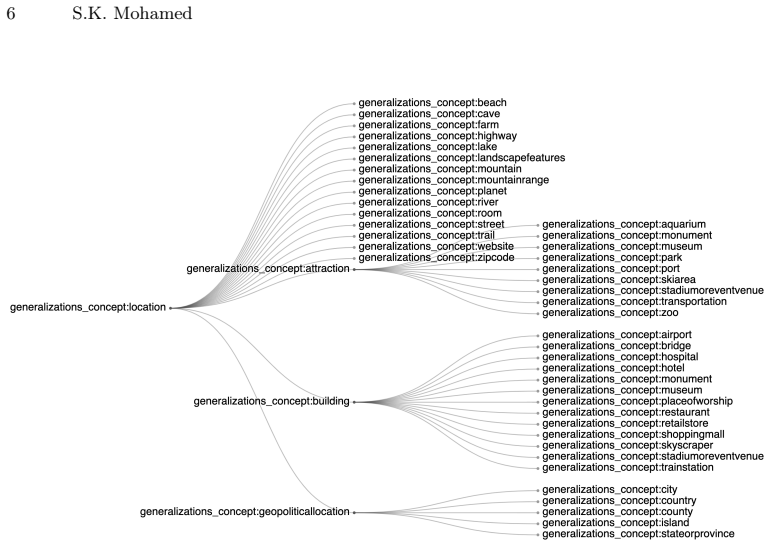
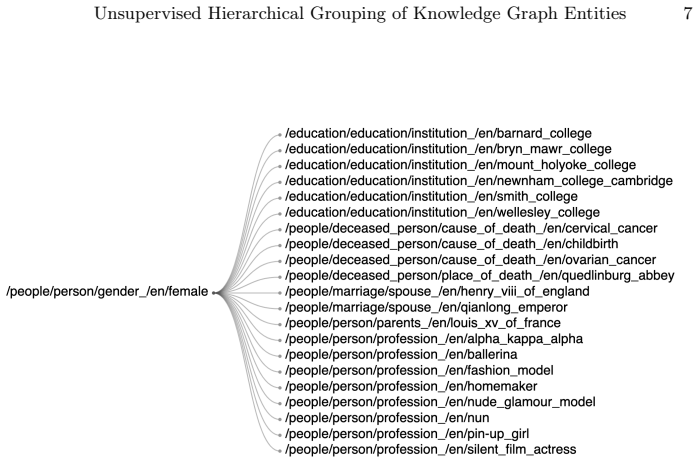
Summary. The paper proposes an unsupervised method for grouping knowledge graph entities into a hierarchy of named groups. For every predicate-object pair, the set of subjects sharing that pair is defined as a group; groups smaller than a threshold α are discarded. Group similarity is measured with Jaccard and hub-promoted-index (HPI) similarities, and a threshold θ on HPI is used to build a hierarchy. The method is applied to six KG benchmark datasets, and sample hierarchies are shown in Figures 2–3 and on a public gallery website. The paper claims that the approach effectively learns entity groups in a scalable way on noisy and sparse data, but the evidence is qualitative.
Significance. If the central claim is established, the method would offer a simple, unsupervised, and scalable alternative to supervised entity-type inference, with the additional benefit of proposing new named types not present in the ontology. The paper's strengths include a clear and elementary formalization, a parallel implementation described in Algorithm 1, and the public release of output hierarchies. The free parameters α and θ are explicitly user-set and not tuned to a benchmark, which is a point in favor of the method's transparency. However, the significance is currently limited by the absence of any quantitative evaluation of the hierarchical groups and by an underspecified hierarchy-construction step.
major comments (4)
- [Section 2.4] The hierarchy construction is underspecified. Equation (1) defines the symmetric HPI similarity, but the paper does not state how a parent–child relation is derived from it, nor does it present the algorithm that turns the similarity matrix into a hierarchy. In particular, HPI=1 holds for any pair of groups in which one is a subset of the other, regardless of which group is the subset, so HPI alone cannot determine the direction of subsumption. The authors must specify the direction rule (e.g., by size or by a separate containment measure) and provide the full construction procedure to make the method reproducible.
- [Section 3.2] The central claim that the approach 'effectively learn[s] entity groups' is not supported by quantitative evidence. The evaluation consists of two hand-picked example hierarchies (Figures 2 and 3) and a gallery website, with no comparison against known type hierarchies, no precision/recall or clustering quality measures, no baselines, and no statistical significance tests. Without such evaluation, the claim remains anecdotal.
- [Section 2.1] The assumption that every predicate-object group is a semantically meaningful type is questionable. As Figure 1 itself shows, the group 'PlayRugby' is a subset of 'LiveInEurope' for the sampled entities, so HPI=1 would place it under 'LiveInEurope,' yet playing rugby does not entail living in Europe. The hierarchy therefore reflects dataset co-occurrence, not type implication. The authors need to address this limitation explicitly or provide evidence that such misleading subsumptions are rare in the output hierarchies.
- [Sections 3.2 and 3.3] The scalability claim is not demonstrated. Although Algorithm 1 is parallelized and the paper states that experiments were run, no runtime, memory usage, or scaling measurements are reported. The reader cannot assess whether the method is scalable to large knowledge graphs as claimed.
minor comments (6)
- [Keywords] The keyword 'Heirarical' should be 'Hierarchical'.
- [Section 3.3] 'Python3.5' should be 'Python 3.5' and 'i70.4790K' should be 'i7-4790K'.
- [Section 5] 'operates on noisy data data' contains a duplicated word; it should be 'noisy data'.
- [Section 3.1] 'subset of of YAGO3' contains a duplicated 'of'; it should be 'subset of YAGO3'.
- [References] Reference [19] appears to be a duplicate of reference [11]; please merge or cite a distinct source.
- [Figures 2 and 3] The figures lack detailed captions that explain node types, hierarchy direction, and the datasets; consider adding this information for readability.
Circularity Check
No significant circularity: the method's groups and hierarchy are computed directly from graph triples via explicit set-overlap definitions, with no fitted parameter renamed as a prediction and no load-bearing self-citation.
full rationale
The paper's derivation chain is self-contained: entity groups are defined in Section 2.1 as sets of subjects sharing a predicate-object pair, Algorithm 1 constructs these groups directly from the input triples, Section 2.3 defines Jaccard and HPI similarities as explicit set-overlap formulas, and Section 2.4 builds the hierarchy by applying a user-set containment threshold theta to those computed similarity values. The thresholds alpha and theta are stated constants with stated motivations (minimum group size to avoid one-to-one predicates; theta=0.9 to tolerate 10% information loss), not parameters fitted to a benchmark or to any target outcome. No quantity is fitted to a subset of data and then predicted on a closely related quantity, and no claim is derived from a self-citation: the two references to the author's prior work (refs 21 and 24) concern other knowledge-graph tasks and are not used to justify the grouping method or its hierarchy construction. The paper makes no quantitative evaluation against external benchmarks, so there is no benchmark-fitting loop to inspect; the lack of semantic evaluation is a validity or correctness risk rather than circularity. The hierarchy is indeed only an overlap-based containment structure, not a proven semantic type hierarchy, but that is a limitation of the method's semantics, not a circular reduction of the output to the input. Accordingly, no circular step can be exhibited with the required quote-and-reduction evidence, and the honest finding is a score of 0.
Assumptions & free parameters
free parameters (2)
- minimum group size alpha =
10
- HPI containment threshold theta =
0.9
assumptions (3)
- domain assumption Entities that share the same predicate and object value form a cohesive, semantically meaningful group.
- domain assumption The HPI similarity with threshold theta (default 0.9) reliably indicates that one group is a sub-group of another when close to 1.
- domain assumption Group size filtering with threshold alpha removes spurious one-to-one relation groups without removing meaningful small groups.
invented entities (1)
-
Named group entities (e.g., 'LiveIn_Europe')
independent evidence
Cite this review
Pith. "Pith review of Unsupervised Hierarchical Grouping of Knowledge Graph Entities." pith.science (2026). https://pith.science/paper/NYCJBNSG
@misc{pith2026190807281,
  author       = {Pith},
  title        = {Pith review of: Unsupervised Hierarchical Grouping of Knowledge Graph Entities},
  year         = {2026},
  howpublished = {\url{https://pith.science/paper/NYCJBNSG}},
  note         = {Machine review of arXiv:1908.07281}
}
read the original abstract
Knowledge graphs have attracted lots of attention in academic and industrial environments. Despite their usefulness, popular knowledge graphs suffer from incompleteness of information, especially in their type assertions. This has encouraged research in the automatic discovery of entity types. In this context, multiple works were developed to utilize logical inference on ontologies and statistical machine learning methods to learn type assertion in knowledge graphs. However, these approaches suffer from limited performance on noisy data, limited scalability and the dependence on labeled training samples. In this work, we propose a new unsupervised approach that learns to categorize entities into a hierarchy of named groups. We show that our approach is able to effectively learn entity groups using a scalable procedure in noisy and sparse datasets. We experiment our approach on a set of popular knowledge graph benchmarking datasets, and we publish a collection of the outcome group hierarchies.
Figures

Reference graph
Works this paper leans on
-
[1]
Discovering meta-paths in large heterogeneous information networks
Changping Meng, Reynold Cheng, Silviu Maniu, Pierre Senellart, and Wangda Zhang. Discovering meta-paths in large heterogeneous information networks. In WWW, pages 754–764. ACM, 2015
work page 2015
-
[2]
Type-constrained representation learning in knowledge graphs
Denis Krompaß, Stephan Baier, and Volker Tresp. Type-constrained representation learning in knowledge graphs. In International Semantic Web Conference (1) , volume 9366 ofLecture Notes in Computer Science , pages 640–655. Springer, 2015
work page 2015
-
[3]
Baoxu Shi and Tim Weninger. Discriminative predicate path mining for fact checking in knowledge graphs.Knowl.-Based Syst., 104:123–133, 2016
work page 2016
-
[4]
Representation learning of knowledge graphs with hierarchical types
Ruobing Xie, Zhiyuan Liu, and Maosong Sun. Representation learning of knowledge graphs with hierarchical types. InIJCAI, pages 2965–2971. IJCAI/AAAI Press, 2016
work page 2016
-
[5]
Type prediction in RDF knowledge bases using hierarchical multilabel classification
André Melo, Heiko Paulheim, and Johanna Völker. Type prediction in RDF knowledge bases using hierarchical multilabel classification. InWIMS, pages 14:1– 14:10. ACM, 2016
work page 2016
-
[6]
Improving the quality of linked data using statistical distributions
Heiko Paulheim and Christian Bizer. Improving the quality of linked data using statistical distributions. Int. J. Semantic Web Inf. Syst. , 10(2):63–86, 2014
work page 2014
-
[7]
RDFS and OWL reasoning for linked data
Axel Polleres, Aidan Hogan, Renaud Delbru, and Jürgen Umbrich. RDFS and OWL reasoning for linked data. InReasoning Web, volume 8067 ofLecture Notes in Computer Science , pages 91–149. Springer, 2013
work page 2013
-
[8]
Type inference on noisy RDF data
Heiko Paulheim and Christian Bizer. Type inference on noisy RDF data. In International Semantic Web Conference (1) , volume 8218 of Lecture Notes in Computer Science, pages 510–525. Springer, 2013
work page 2013
Show all 24 references
-
[9]
Link prediction in complex networks: A survey.CoRR, abs/1010.0725, 2010
Linyuan Lu and Tao Zhou. Link prediction in complex networks: A survey.CoRR, abs/1010.0725, 2010
2010 arXiv
-
[10]
George A. Miller. WordNet: A lexical database for english. Commun. ACM , 38(11):39–41, 1995
1995
-
[11]
Translating embeddings for modeling multi-relational data
Antoine Bordes, Nicolas Usunier, Alberto García-Durán, Jason Weston, and Oksana Yakhnenko. Translating embeddings for modeling multi-relational data. InNIPS, pages 2787–2795, 2013
2013
-
[12]
Con- volutional 2d knowledge graph embeddings
Tim Dettmers, Pasquale Minervini, Pontus Stenetorp, and Sebastian Riedel. Con- volutional 2d knowledge graph embeddings. InAAAI. AAAI Press, 2018
2018
-
[13]
Bollacker, Colin Evans, Praveen Paritosh, Tim Sturge, and Jamie Taylor
Kurt D. Bollacker, Colin Evans, Praveen Paritosh, Tim Sturge, and Jamie Taylor. Freebase: a collaboratively created graph database for structuring human knowledge. In SIGMOD Conference, pages 1247–1250. ACM, 2008
2008
-
[14]
Representing text for joint embedding of text and knowledge bases
Kristina Toutanova, Danqi Chen, Patrick Pantel, Hoifung Poon, Pallavi Choudhury, and Michael Gamon. Representing text for joint embedding of text and knowledge bases. In EMNLP, pages 1499–1509. The Association for Computational Linguistics, 2015
2015
-
[15]
Suchanek
Farzaneh Mahdisoltani, Joanna Biega, and Fabian M. Suchanek. YAGO3: A knowledge base from multilingual wikipedias. InCIDR. www.cidrdb.org, 2015. 10 S.K. Mohamed
2015
-
[16]
On approximate reasoning capabilities of low-rank vector spaces
Guillaume Bouchard, Sameer Singh, and Théo Trouillon. On approximate reasoning capabilities of low-rank vector spaces. InAAAI Spring Syposium on Knowledge Representation and Reasoning (KRR): Integrating Symbolic and Neural Approaches . AAAI Press, 2015
2015
-
[17]
Mitchell, William W
Tom M. Mitchell, William W. Cohen, Estevam R. Hruschka Jr., Partha P. Talukdar, Bo Yang, Justin Betteridge, Andrew Carlson, Bhavana Dalvi Mishra, Matt Gardner, Bryan Kisiel, Jayant Krishnamurthy, Ni Lao, Kathryn Mazaitis, Thahir Mohamed, Ndapandula Nakashole, Emmanouil A. Plat...
2018
-
[18]
Mitchell
Matt Gardner and Tom M. Mitchell. Efficient and expressive knowledge base completion using subgraph feature extraction. InProceedings of the 2015 Conference on Empirical Methods in Natural Language Processing, EMNLP 2015, Lisbon, Portugal, September 17-21, 2015 , pages 1488–1498, 2015
2015
-
[19]
Translating embeddings for modeling multi-relational data
Antoine Bordes, Nicolas Usunier, Alberto García-Durán, Jason Weston, and Oksana Yakhnenko. Translating embeddings for modeling multi-relational data. InAdvances in Neural Information Processing Systems 26: 27th Annual Conference on Neural Information Processing Systems 2013. P...
2013
-
[20]
A review of relational machine learning for knowledge graphs.Proceedings of the IEEE, 104(1):11–33, 2016
Maximilian Nickel, Kevin Murphy, Volker Tresp, and Evgeniy Gabrilovich. A review of relational machine learning for knowledge graphs.Proceedings of the IEEE, 104(1):11–33, 2016
2016
-
[21]
Mohamed, Vít Novácek, and Pierre-Yves Vandenbussche
Sameh K. Mohamed, Vít Novácek, and Pierre-Yves Vandenbussche. Knowledge base completion using distinct subgraph paths. InSAC, 2018
2018
-
[22]
Knowledgegraph embedding: A survey of approaches and applications.IEEE Trans
Quan Wang, Zhendong Mao, Bin Wang, and Li Guo. Knowledgegraph embedding: A survey of approaches and applications.IEEE Trans. Knowl. Data Eng. , 29(12):2724– 2743, 2017
2017
-
[23]
Suchanek
Luis Galárraga, Christina Teflioudi, Katja Hose, and Fabian M. Suchanek. Amie: association rule mining under incomplete evidence in ontological knowledge bases. In WWW, 2013
2013
-
[24]
Mohamed, Emir Muñoz, Vít Novácek, and Pierre-Yves Vandenbussche
Sameh K. Mohamed, Emir Muñoz, Vít Novácek, and Pierre-Yves Vandenbussche. Identifying equivalent relation paths in knowledge graphs. InLDK, 2017
2017
Reviewed August 14, 2026 · model on record in the stance chip above.
Discussion (0). Continue with ORCID to comment.