REVIEW 3 major objections 5 minor 42 references
Energy-level alignment at organic/inorganic interfaces from first principles: Example of poly(\emph{para}-phenylene) / rock-salt ZnO(100)
T0 review · 3 major / 5 minor · reviewed 2026-08-14 · deepseek-v4-flash
Pith's one-line read A full many-body calculation of the PPP/ZnO(100) interface finds a type-I electron-level alignment where simpler constituent-based models predict type-II.
desk verdict A careful G0W0 benchmark showing simple alignment models fail badly for PPP/ZnO, but the headline type-I conclusion rests on a 0.09 eV offset that sits inside the paper's own acknowledged starting-point error. read the letter →
The pith
A machine-rendered reading of the paper's core claim, the machinery that carries it, and where it could break.
The reading
What carries the argument
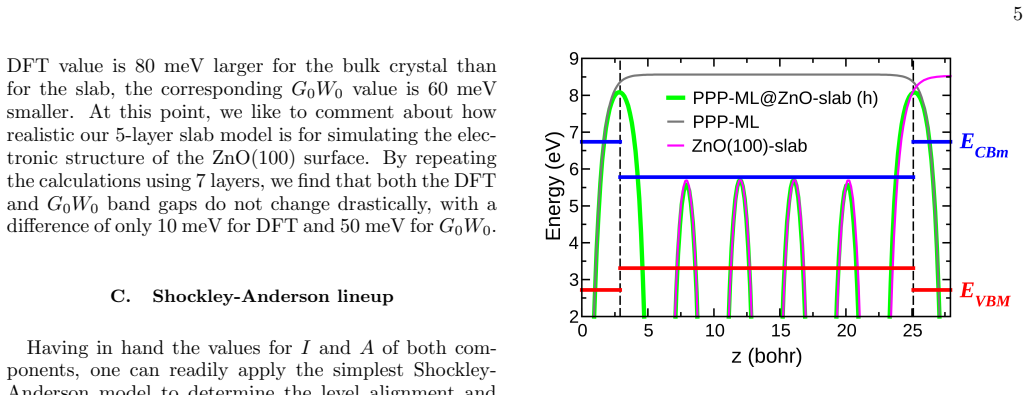
The load-bearing machinery is the G0W0 quasiparticle treatment of the full interface as a single periodic system, performed with an all-electron full-potential LAPW implementation using PBE as the starting point. Coulomb truncation is applied to isolate one-dimensional and two-dimensional subsystems. The argument proceeds by comparing three levels of description: the Shockley-Anderson model, the electrostatic-potential alignment model, and the full interface band structure, with the band character of states identified by wavefunction analysis. The key mechanism identified is hybridization between the polymer's LUMO and ZnO conduction states, which renormalizes the molecular band gap and, combined with polarization screening, shifts the conduction-band offset by more than 1.5 eV relative to the model predictions.
What would settle it
If a G0W0 calculation starting from hybrid-functional orbitals or a self-consistent GW scheme placed the ZnO conduction band above the PPP LUMO by enough to restore a type-II alignment, the paper's central conclusion would be overturned. A direct experimental test would be to measure the valence-band and conduction-band offsets at a well-characterized PPP/rs-ZnO(100) interface with photoemission and inverse photoemission and compare with the predicted type-I values.
Extended reading notes
Core claim
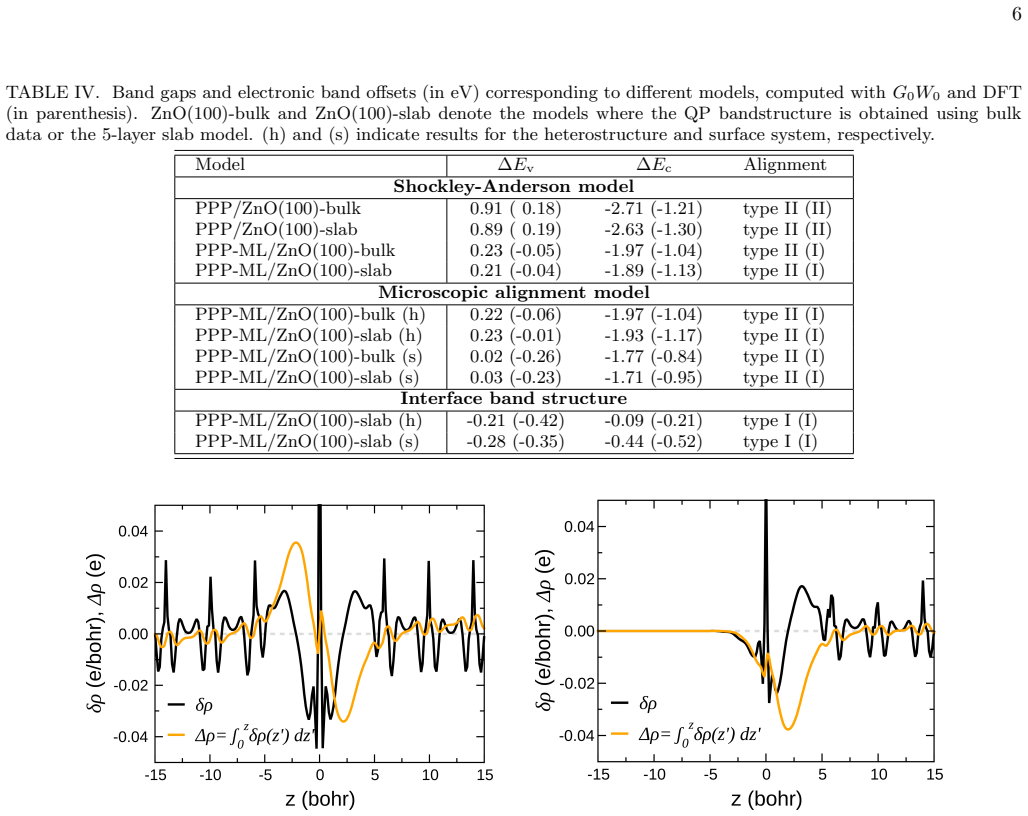
On the paper's own terms, the central discovery is that every simple model built from the separate constituents—Shockley-Anderson vacuum-level alignment and the electrostatic-potential microscopic alignment—gives a type-II alignment for PPP/rs-ZnO(100), with conduction-band offsets ΔEc between −1.7 and −2.7 eV at the G0W0 level. The full interface band structure, computed for the entire interacting system, instead gives ΔEc = −0.09 eV (heterostructure) or −0.44 eV (surface), which is a type-I alignment. The paper attributes the reversal to orbital hybridization between the PPP LUMO and ZnO conduction states and to the polarization-induced renormalization of molecular energy levels, contributions that are absent by construction from the constituent-based models. Quasiparticle corrections from G0W0 are quantitatively important for ionization energies and affinities, but the alignment type is already reversed at the DFT level.
Load-bearing premise
The load-bearing premise is that G0W0 with a PBE starting point gives an adequate description of the ZnO conduction band; the paper itself acknowledges a pronounced starting-point dependence in oxides and underestimates the ZnO band gap.
Editorial extensions
If this is right
- If the central claim holds, simple constituent-based models cannot be trusted to predict energy-level alignment at organic/inorganic interfaces; their predicted alignment type may be wrong.
- A many-body treatment of the entire interface, not just of the isolated constituents, is needed to capture hybridization and polarization-induced level renormalization.
- The interface geometry matters: the heterostructure and surface configurations give different ΔEc values, differing by a factor of about four, so structural details affect the offsets as much as the electronic-structure method.
- G0W0 corrections improve ionization energies and affinities of the isolated systems, and they are needed to quantify polarization renormalization, even though DFT already reverses the alignment type relative to the models.
- The polarization-induced molecular gap renormalization of 0.9–1.2 eV implies that any predictive model for such interfaces must include substrate screening of the molecular levels, not only electrostatics.
Reading between the lines
- The same failure of constituent-based models likely extends to other organic/inorganic interfaces where hybridization with inorganic conduction states is appreciable, not just PPP/ZnO.
- Using a hybrid-functional starting point for the G0W0 calculation would shift the ZnO conduction band upward relative to the PPP LUMO, which could alter the quantitative offsets and possibly the alignment type; this is a testable extension of the present results.
- Experimental validation could come from ultraviolet photoemission and inverse photoemission on a PPP film on rs-ZnO(100), comparing measured ionization energies and conduction-band onsets with the computed type-I offsets.
- The large spread of model predictions (up to 1 eV in ΔEc) suggests that screening-based corrections should be added to alignment models before any constituent-only prediction is used in device design.
Signed reviews
Editorial analysis
A structured set of objections, weighed in public.
Referee Report
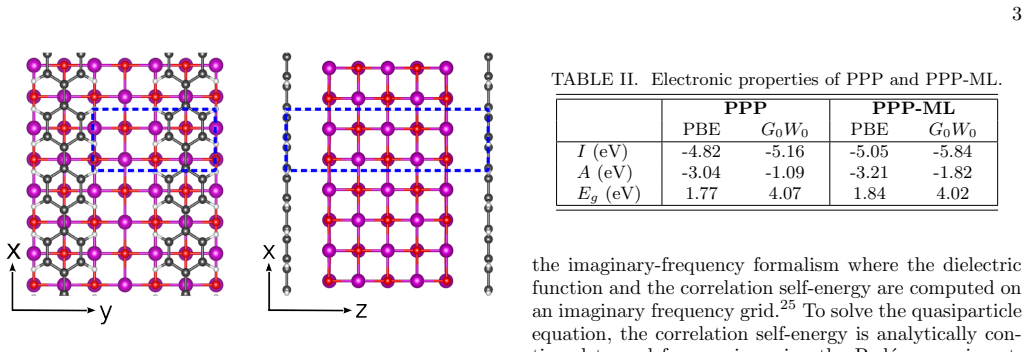
Summary. The manuscript presents first-principles calculations of the energy-level alignment at a model poly(para-phenylene)/rock-salt ZnO(100) interface. It computes ionization potentials and electron affinities of the isolated constituents at PBE and G0W0 levels, uses them in Shockley-Anderson and electrostatic-potential-alignment models, and compares the resulting band offsets with those extracted from full interface band-structure calculations in two geometries (heterostructure and surface). The authors find that all simple models predict a type-II alignment with Delta_Ec between -1.7 and -2.7 eV, whereas the full interface G0W0 calculation yields a type-I alignment with Delta_Ec = -0.09 eV (heterostructure) or -0.44 eV (surface); they attribute the difference to orbital hybridization and polarization-induced renormalization of the molecular levels.
Significance. If the result holds, it is an important demonstration that constituent-based alignment models can fail not just quantitatively but qualitatively for organic/inorganic interfaces, and that many-body treatments are needed. The paper's strengths include systematic model variants, explicit convergence checks (0.05 eV for constituents, 0.1 eV for the interface), and a public data repository in NOMAD. The central numerical margin, however, is small relative to the acknowledged G0W0 starting-point error, so the type-I conclusion needs a sensitivity analysis before it can be considered established.
major comments (3)
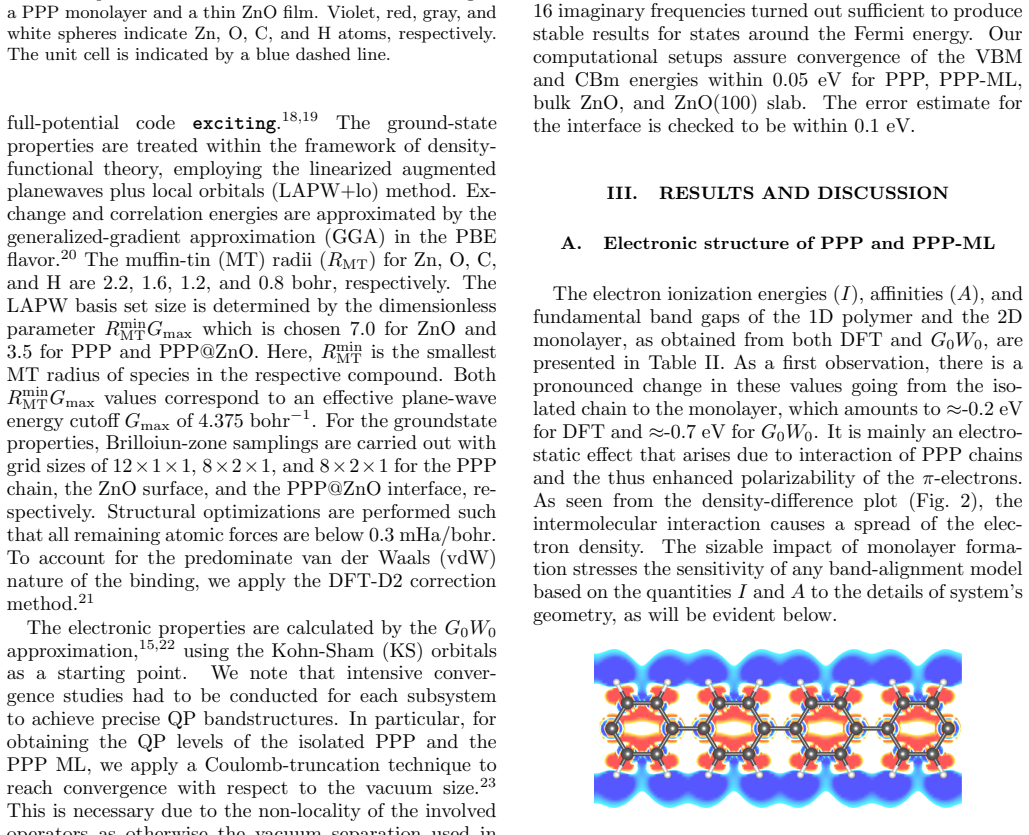
- [III B / Table IV] The central claim that the full interface treatment changes the alignment from type II to type I rests on the G0W0 value Delta_Ec = -0.09 eV for the heterostructure in Table IV. The paper itself reports in Sec. III B that G0W0@PBE underestimates the rs-ZnO band gap (indirect 2.27 eV vs experimental 2.7 eV; direct 3.32 eV vs 4.6 eV) and attributes this to a pronounced starting-point dependence in oxides. Since Delta_Ec is the difference between the PPP LUMO and the ZnO CBM, a differential quasiparticle correction of a few tenths of an eV, well within the documented starting-point sensitivity, could change the sign of Delta_Ec and therefore the alignment type. Note that under the manuscript's sign convention (Eq. 2), a simple rigid upward shift of the ZnO CBM makes Delta_Ec more negative, so the naive version of this concern does not apply; the valid residual concern is the unquantified differential error between the PPP and ZnO quasiparticle corrections. Please add a sensitivity analysis, e.g., rigid scissor shifts of the ZnO and/or PPP states derived from hybrid-functional or experimental gap corrections, and report the resulting Delta_Ec and type classification for both interface geometries.
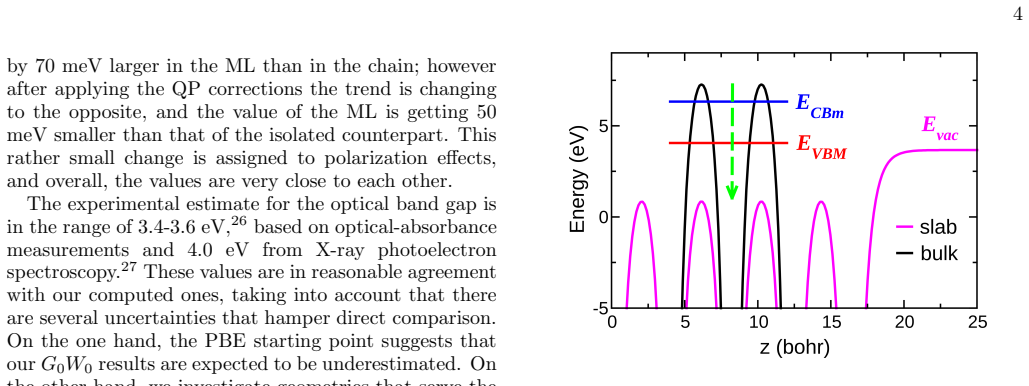
- [II B / III A] The interface model is idealized: coplanar PPP, fixed adsorption distance, and symmetric slabs. The paper notes in Sec. III A that the equilibrium torsion between benzene rings increases the band gap by roughly 0.4 eV at the DFT level. Because the PPP LUMO position is a key input to Delta_Ec, and because the heterostructure Delta_Ec is only -0.09 eV, a 0.4 eV-scale geometry sensitivity is comparable to the entire offset. Please test the sensitivity of the full-interface band offsets to the molecular torsion and to the adsorption distance, or provide a quantitative argument why the type-I conclusion is independent of these choices.
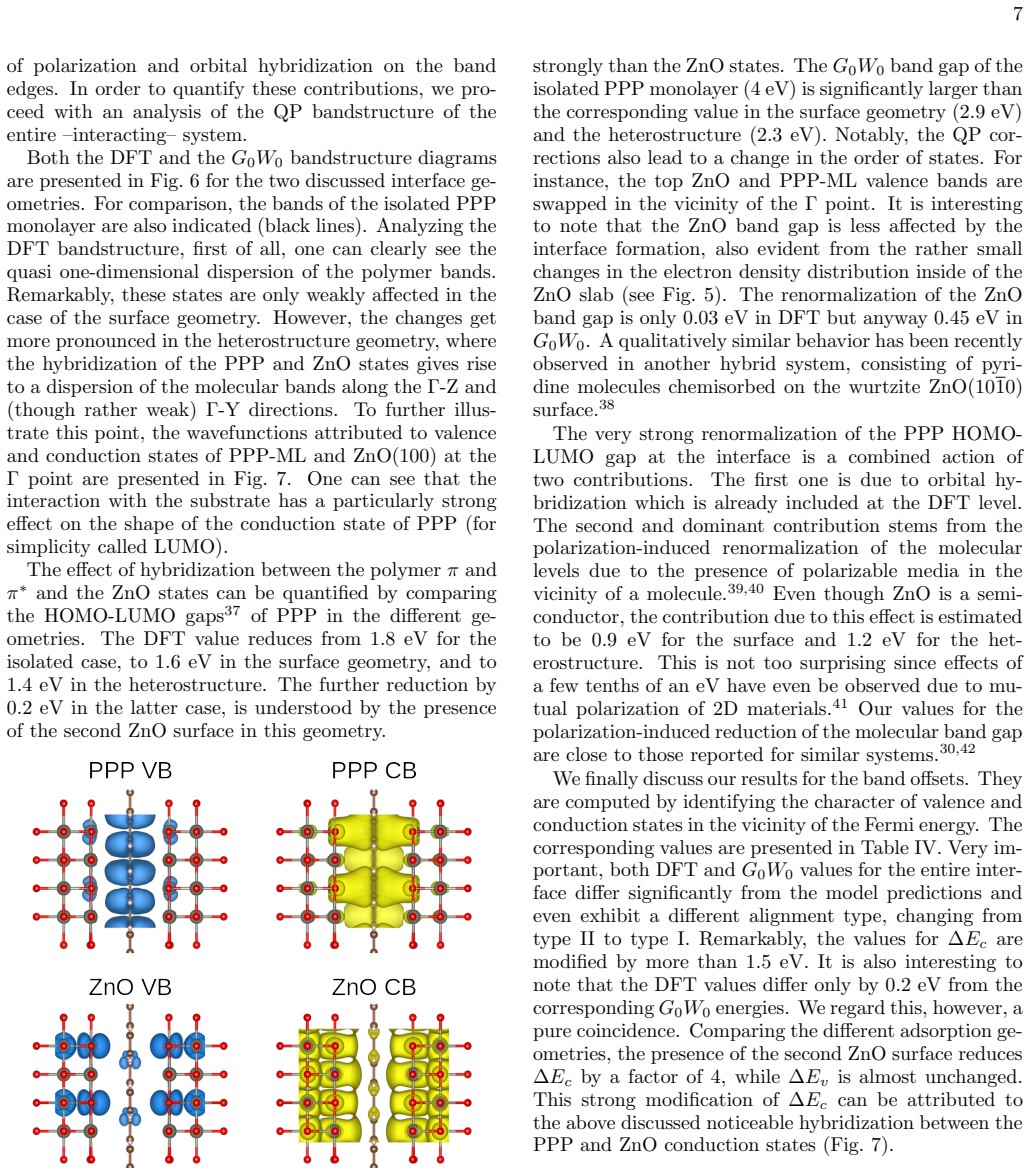
- [III E / Fig. 6] The interface band offsets are obtained by identifying states with predominant molecular character among the hybridized bands. Given the strong hybridization of the PPP LUMO with ZnO conduction states (Fig. 7), this assignment needs a quantitative measure (e.g., wavefunction projection onto molecular orbitals) and an uncertainty estimate. The difference between Delta_Ec = -0.09 eV and the type-I/type-II boundary is smaller than typical projection ambiguities, so the classification should be demonstrated to be stable under alternative assignment criteria.
minor comments (5)
- [Abstract] There are typos in the abstract: "anab-initio" should be "an ab-initio" and "stucture" should be "structure"; the same typo for "structure" appears later in the abstract.
- [II C] In the computational-details section, "Brilloiun-zone" should be "Brillouin-zone".
- [III D] The spelling "Shockley-Andersen" is used in Sec. III D, while "Shockley-Anderson" is used elsewhere; please make the naming consistent.
- [Table IV] The caption says "in parenthesis" but should be "in parentheses"; the caption would also benefit from an explicit statement of the material ordering used for the sign convention of Delta_Ev and Delta_Ec.
- [III E] The phrase "Very important" is informal for a research article; consider replacing it with a more measured expression, such as "Importantly".
Circularity Check
No circularity found: the Shockley–Anderson, electrostatic-alignment, and full-interface G0W0 band offsets are computed independently, and same-group citations enter only as code/method references.
full rationale
The central claim is a comparison between constituent-based model predictions and a full many-body treatment of the entire interface. In Sec. II A and Table IV, the model offsets are obtained from separately computed ionization energies, electron affinities, and electrostatic potentials of isolated PPP/PPP-ML and bulk/slab ZnO systems; the full-interface offsets are obtained from the G0W0 eigenvalues of the combined PPP@ZnO systems, with state character assigned by inspecting wavefunctions and band structures. No quantity entering the final offsets is fitted to those offsets, and the G0W0 inputs (PBE starting point, LAPW convergence parameters, k-grids, Coulomb truncation) do not include the target band alignment or alignment type. The paper explicitly acknowledges the G0W0@PBE starting-point dependence for rs-ZnO and its underestimated band gaps, but that is a correctness and robustness concern, not a circularity, since the calculation is not constrained to reproduce the claimed type-I result. Same-group citations (Refs. 18, 19, 30, 38) provide the code, the GW implementation, comparison values, and a related hybrid-interface study; they are not invoked as the evidence for the type-I/type-II conclusion. The derivation chain is therefore self-contained and non-circular.
Assumptions & free parameters
assumptions (4)
- domain assumption PBE + DFT-D2 ground-state geometry is accurate enough for the quasiparticle band alignment.
- domain assumption G0W0 with PBE Kohn-Sham orbitals is a valid approximation for the oxide and the interface.
- ad hoc to paper The lattice-coincidence interface, with coplanar PPP, fixed adsorption distance, and symmetric slabs, is representative of the physical interface.
- domain assumption Assignment of band offsets by orbital character of states near the Fermi energy is unambiguous.
Cite this review
Pith. "Pith review of Energy-level alignment at organic/inorganic interfaces from first principles: Example of poly(\emph{para}-phenylene) / rock-salt ZnO(100)." pith.science (2026). https://pith.science/paper/RXYI4LSM
@misc{pith2026190807293,
  author       = {Pith},
  title        = {Pith review of: Energy-level alignment at organic/inorganic interfaces from first principles: Example of poly(\emphpara-phenylene) / rock-salt ZnO(100)},
  year         = {2026},
  howpublished = {\url{https://pith.science/paper/RXYI4LSM}},
  note         = {Machine review of arXiv:1908.07293}
}
abstract
By means of full-potential all-electron density-functional theory and many-body perturbation theory, we compute the band alignment at a prototypical hybrid inorganic/organic interface. The electronic properties of a model system built of poly(\emph{para}-phenylene) and \emph{rs}-ZnO are studied in two different geometries, employing several approaches of increasing sophistication. To this extent, we explore models for predicting the level alignment, which are based on the knowledge of the electronic structure of the individual constituents and are commonly used for semiconductor interfaces. For their evaluation in the context of hybrid materials, we perform an \textit{ab-initio} study of the entire system, including a quasiparticle description of the electronic structure within the $G_0W_0$ approximation. Based on this, we quantify the impact of structure, charge redistribution, orbital hybridization, and molecular polarization on the band offsets and the alignment type. We highlight not only known limitations of predicting the level alignment at a hybrid inorganic/organic interface by simple models, but also demonstrate how structural details of the interface components impact the results.
Figures

Figures from the paper (5 more)

Reference graph
Works this paper leans on
-
[1]
author author C. Draxl , author D. Nabok , \ and\ author K. Hannewald ,\ 10.1021/ar500096q journal journal Acc. Chem. Res. \ volume 47 ,\ pages 3225 ( year 2014 ) NoStop
-
[2]
author author H. Ishii , author K. Sugiyama , author E. Ito , \ and\ author K. Seki ,\ @noop journal journal Advanced Materials \ volume 11 ,\ pages 605 ( year 1999 ) NoStop
work page 1999
-
[3]
author author S. Braun , author W. R. \ Salaneck , \ and\ author M. Fahlman ,\ 10.1002/adma.200802893 journal journal Advanced Materials \ volume 21 ,\ pages 1450 ( year 2009 ) NoStop
-
[4]
author author R. Otero , author A. L. \ V\'azquez de Parga , \ and\ author J. M. \ Gallego ,\ 10.1016/j.surfrep.2017.03.001 journal journal Surface Science Reports \ volume 72 ,\ pages 105 ( year 2017 ) NoStop
-
[5]
author author O. T. \ Hofmann \ and\ author E. Zojer ,\ in\ 10.1142/9789813270541_0001 booktitle World Scientific Reference of Hybrid Materials ,\ series and number World Scientific Series in Nanoscience and Nanotechnology \ ( publisher World Scientific ,\ year 2019 )\ pp.\ pages 3--40 NoStop
-
[6]
author author L. Kronik \ and\ author S. K\"ummel ,\ 10.1002/adma.201706560 journal journal Advanced Materials \ volume 30 ,\ pages 1706560 ( year 2018 ) NoStop
-
[7]
author author R. L. \ Anderson ,\ 10.1016/0038-1101(62)90115-6 journal journal Solid-State Electronics \ volume 5 ,\ pages 341 ( year 1962 ) NoStop
-
[8]
author author F. Bechsted \ and\ author R. Enderlein ,\ @noop title Semiconductor Surfaces and Interfaces \ ( publisher Akademie-Verlag, Berlin ,\ year 1988 ) NoStop
work page 1988
Show all 42 references
-
[9]
M\" o nch ,\ @noop title Electronic Properities of Semiconductor Interfaces \ ( publisher Springer, Berlin ,\ year 2004 ) NoStop
author author W. M\" o nch ,\ @noop title Electronic Properities of Semiconductor Interfaces \ ( publisher Springer, Berlin ,\ year 2004 ) NoStop
2004
-
[10]
Tersoff ,\ 10.1103/PhysRevB.30.4874 journal journal Physical Review B \ volume 30 ,\ pages 4874 ( year 1984 ) NoStop
author author J. Tersoff ,\ 10.1103/PhysRevB.30.4874 journal journal Physical Review B \ volume 30 ,\ pages 4874 ( year 1984 ) NoStop
1984 doi
-
[11]
Flores \ and\ author C
author author F. Flores \ and\ author C. Tejedor ,\ 10.1088/0022-3719/12/4/018 journal journal Journal of Physics C: Solid State Physics \ volume 12 ,\ pages 731 ( year 1979 ) NoStop
1979 doi
-
[12]
author author C. G. V. d. \ Walle \ and\ author R. M. \ Martin ,\ 10.1103/PhysRevB.35.8154 journal journal Physical Review B \ volume 35 ,\ pages 8154 ( year 1987 ) NoStop
1987 doi
-
[13]
author author W. R. L. \ Lambrecht \ and\ author B. Segall ,\ 10.1103/PhysRevLett.61.1764 journal journal Physical Review Letters \ volume 61 ,\ pages 1764 ( year 1988 ) NoStop
1988 doi
-
[14]
author author W. R. L. \ Lambrecht , author B. Segall , \ and\ author O. K. \ Andersen ,\ 10.1103/PhysRevB.41.2813 journal journal Physical Review B \ volume 41 ,\ pages 2813 ( year 1990 ) NoStop
1990 doi
-
[15]
Hedin ,\ 10.1103/PhysRev.139.A796 journal journal Phys
author author L. Hedin ,\ 10.1103/PhysRev.139.A796 journal journal Phys. Rev. \ volume 139 ,\ pages A796 ( year 1965 ) NoStop
1965 doi
-
[16]
author author D. S. \ Koda , author F. Bechstedt , author M. Marques , \ and\ author L. K. \ Teles ,\ 10.1021/acs.jpcc.6b01496 journal journal The Journal of Physical Chemistry C \ volume 120 ,\ pages 10895 ( year 2016 ) NoStop
2016 doi
-
[17]
Vasseur , author Y
author author G. Vasseur , author Y. Fagot-Revurat , author M. Sicot , author B. Kierren , author L. Moreau , author D. Malterre , author L. Cardenas , author G. Galeotti , author J. Lipton-Duffin , author F. Rosei , author M. Di Giovannantonio , author G. Contini , author P. ...
-
[18]
Gulans , author S
author author A. Gulans , author S. Kontur , author C. Meisenbichler , author D. Nabok , author P. Pavone , author S. Rigamonti , author S. Sagmeister , author U. Werner , \ and\ author C. Draxl ,\ 10.1088/0953-8984/26/36/363202 journal journal Journal of Physics: Condensed Ma...
-
[19]
Nabok , author A
author author D. Nabok , author A. Gulans , \ and\ author C. Draxl ,\ 10.1103/PhysRevB.94.035118 journal journal Physical Review B \ volume 94 ,\ pages 035118 ( year 2016 ) NoStop
2016 doi
-
[20]
author author J. P. \ Perdew , author K. Burke , \ and\ author M. Ernzerhof ,\ 10.1103/PhysRevLett.77.3865 journal journal Physical Review Letters \ volume 77 ,\ pages 3865 ( year 1996 ) NoStop
1996 doi
-
[21]
Grimme ,\ 10.1002/jcc.20495 journal journal Journal of Computational Chemistry \ volume 27 ,\ pages 1787 ( year 2006 ) NoStop
author author S. Grimme ,\ 10.1002/jcc.20495 journal journal Journal of Computational Chemistry \ volume 27 ,\ pages 1787 ( year 2006 ) NoStop
2006 doi
-
[22]
author author M. S. \ Hybertsen \ and\ author S. G. \ Louie ,\ 10.1103/PhysRevB.34.5390 journal journal Physical Review B \ volume 34 ,\ pages 5390 ( year 1986 ) NoStop
1986 doi
-
[23]
Ismail-Beigi ,\ 10.1103/PhysRevB.73.233103 journal journal Physical Review B \ volume 73 ,\ pages 233103 ( year 2006 ) NoStop
author author S. Ismail-Beigi ,\ 10.1103/PhysRevB.73.233103 journal journal Physical Review B \ volume 73 ,\ pages 233103 ( year 2006 ) NoStop
2006 doi
-
[24]
author author C. A. \ Rozzi , author D. Varsano , author A. Marini , author E. K. U. \ Gross , \ and\ author A. Rubio ,\ 10.1103/PhysRevB.73.205119 journal journal Physical Review B \ volume 73 ,\ pages 205119 ( year 2006 ) NoStop
2006 doi
-
[25]
Jiang , author R
author author H. Jiang , author R. I. \ Gómez-Abal , author X.-Z. \ Li , author C. Meisenbichler , author C. Ambrosch-Draxl , \ and\ author M. Scheffler ,\ 10.1016/j.cpc.2012.09.018 journal journal Computer Physics Communications \ volume 184 ,\ pages 348 ( year 2013 ) NoStop
2012 doi
-
[26]
Niko , author F
author author A. Niko , author F. Meghdadi , author C. Ambrosch-Draxl , author P. Vogl , \ and\ author G. Leising ,\ 10.1016/0379-6779(95)03447-R journal journal Synthetic Metals \ volume 76 ,\ pages 177 ( year 1996 ) NoStop
1996 doi
-
[27]
Riga , author J
author author J. Riga , author J. J. \ Pireaux , author J. P. \ Boutique , author R. Caudano , author J. J. \ Verbist , \ and\ author Y. Gobillon ,\ 10.1016/0379-6779(81)90025-4 journal journal Synthetic Metals \ volume 4 ,\ pages 99 ( year 1981 ) NoStop
-
[28]
Ambrosch-Draxl , author J
author author C. Ambrosch-Draxl , author J. A. \ Majewski , author P. Vogl , \ and\ author G. Leising ,\ 10.1103/PhysRevB.51.9668 journal journal Physical Review B \ volume 51 ,\ pages 9668 ( year 1995 ) NoStop
1995 doi
-
[29]
Artacho , author M
author author E. Artacho , author M. Rohlfing , author M. C \^o t \'e , author P. D. \ Haynes , author R. J. \ Needs , \ and\ author C. Molteni ,\ 10.1103/PhysRevLett.93.116401 journal journal Physical Review Letters \ volume 93 ,\ pages 116401 ( year 2004 ) NoStop
-
[30]
Puschnig , author P
author author P. Puschnig , author P. Amiri , \ and\ author C. Draxl ,\ 10.1103/PhysRevB.86.085107 journal journal Physical Review B \ volume 86 ,\ pages 085107 ( year 2012 ) NoStop
2012 doi
-
[31]
Segura , author J
author author A. Segura , author J. A. \ Sans , author F. J. \ Manj\'on , author A. Mu\ noz , \ and\ author M. J. \ Herrera-Cabrera ,\ 10.1063/1.1591995 journal journal Applied Physics Letters \ volume 83 ,\ pages 278 ( year 2003 ) NoStop
-
[32]
author author J. A. \ Sans , author A. Segura , author F. J. \ Manj\'on , author B. Mar\'i , author A. Mu\ noz , \ and\ author M. J. \ Herrera-Cabrera ,\ 10.1016/j.mejo.2005.05.010 journal journal Microelectronics Journal \ series SLAFES ,\ volume 36 ,\ pages 928 ( year 2005 ) NoStop
2005 doi
-
[33]
Schleife , author F
author author A. Schleife , author F. Fuchs , author J. Furthm\"uller , \ and\ author F. Bechstedt ,\ 10.1103/PhysRevB.73.245212 journal journal Physical Review B \ volume 73 ,\ pages 245212 ( year 2006 ) NoStop
2006 doi
-
[34]
Dixit , author R
author author H. Dixit , author R. Saniz , author D. Lamoen , \ and\ author B. Partoens ,\ 10.1088/0953-8984/22/12/125505 journal journal Journal of Physics: Condensed Matter \ volume 22 ,\ pages 125505 ( year 2010 ) NoStop
2010 doi
-
[35]
Bechstedt \ and\ author R
author author F. Bechstedt \ and\ author R. Del Sole ,\ 10.1103/PhysRevB.38.7710 journal journal Physical Review B \ volume 38 ,\ pages 7710 ( year 1988 ) NoStop
1988 doi
-
[36]
Schleife \ and\ author F
author author A. Schleife \ and\ author F. Bechstedt ,\ 10.1557/jmr.2012.147 journal journal Journal of Materials Research \ volume 27 ,\ pages 2180 ( year 2012 ) NoStop
2012 doi
-
[37]
note In the case of a combined system, the PPP HOMO and LUMO energies are determined by the analysis of VB and CB states with predominate molecular character. Stop
-
[38]
Turkina , author D
author author O. Turkina , author D. Nabok , author A. Gulans , author C. Cocchi , \ and\ author C. Draxl ,\ 10.1002/adts.201800108 journal journal Advanced Theory and Simulations \ volume 2 ,\ pages 1800108 ( year 2019 ) NoStop
2019 doi
-
[39]
author author P. D. \ Johnson \ and\ author S. L. \ Hulbert ,\ 10.1103/PhysRevB.35.9427 journal journal Physical Review B \ volume 35 ,\ pages 9427 ( year 1987 ) NoStop
1987 doi
-
[40]
author author J. B. \ Neaton , author M. S. \ Hybertsen , \ and\ author S. G. \ Louie ,\ 10.1103/PhysRevLett.97.216405 journal journal Physical Review Letters \ volume 97 ,\ pages 216405 ( year 2006 ) NoStop
2006 doi
-
[41]
Fu , author D
author author Q. Fu , author D. Nabok , \ and\ author C. Draxl ,\ 10.1021/acs.jpcc.6b01741 journal journal The Journal of Physical Chemistry C \ volume 120 ,\ pages 11671 ( year 2016 ) NoStop
2016 doi
-
[42]
author author J. M. \ Garcia-Lastra , author C. Rostgaard , author A. Rubio , \ and\ author K. S. \ Thygesen ,\ 10.1103/PhysRevB.80.245427 journal journal Physical Review B \ volume 80 ,\ pages 245427 ( year 2009 ) NoStop
2009 doi
Reviewed August 14, 2026 · model on record in the stance chip above.
Discussion (0). Continue with ORCID to comment.