REVIEW 2 major objections 6 minor 48 references
Quantum synchronization and correlation in bidirectionally and unidirectionally coupled optomechanical oscillators
T0 review · 2 major / 6 minor · reviewed 2026-08-14 · deepseek-v4-flash
Pith's one-line read At zero propagation delay, unidirectionally coupled optomechanical oscillators synchronize best when they are detuned, not identical, while Gaussian quantum discord fails to flag this quantum synchronization blockade.
desk verdict The unidirectional input-output model drops the vacuum noise of the loss port, so the synchronization blockade in Fig. 4(a) may be an artifact; the rest is a reasonable but incremental numerical study. read the letter →
The pith
A machine-rendered reading of the paper's core claim, the machinery that carries it, and where it could break.
The reading
What carries the argument
The load-bearing machinery is the zero-delay cascaded input–output boundary condition $a_{\rm in}^R(t)=\sqrt{\eta}\,a_{\rm out}^L(t)$, which turns the right cavity into a driven replica of the left cavity's output and breaks the exchange symmetry that makes identical oscillators resonant partners. On top of this, the paper uses the phase-synchronization measure $S_p$, defined from the variance of the relative phase quadrature $\delta p_-$, and the Gaussian quantum discord $D_G$ computed from the linearized fluctuation covariance matrix. These two observables, mapped over frequency detuning $\delta/\omega_{mL}$, coupling strength $\lambda/\kappa$, and transmission loss $\eta$, produce the tongue and blockade diagrams.
What would settle it
Recompute or measure the time-averaged synchronization $\langle S_p\rangle$ for the unidirectional cascade with a finite propagation delay $\tau$ of order one mechanical period ($1/\omega_{mL}$). If the minimum at $\delta=0$ and the maximum at finite detuning disappear or invert, the claimed quantum synchronization blockade does not hold.
Extended reading notes
Core claim
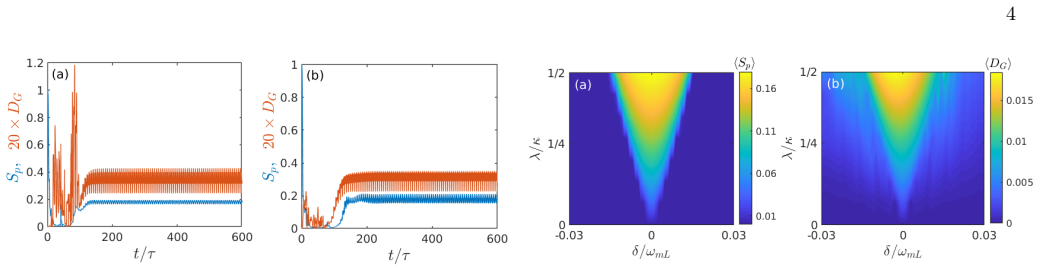
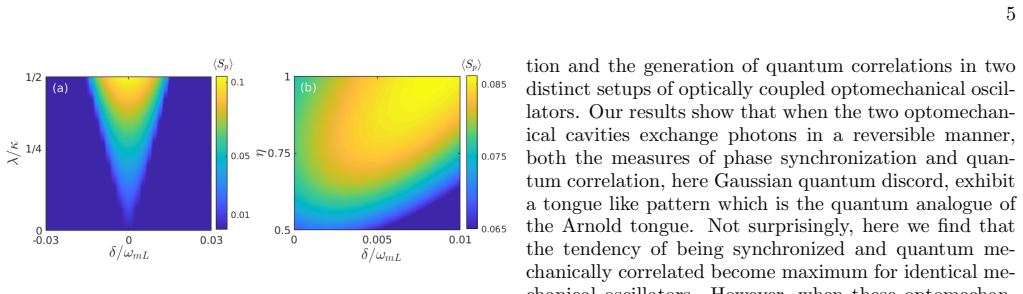
The central claim is that unidirectional optical coupling in a cascade of two optomechanical oscillators, described by the instantaneous input relation $a_{\rm in}^R(t)=\sqrt{\eta}\,a_{\rm out}^L(t)$ with $\tau=0$, produces a quantum synchronization blockade: identical mechanical oscillators ($\delta=0$) synchronize less than moderately detuned ones, and the optimum $\delta$ scales with transmission loss $\eta$. In the same cascade, Gaussian quantum discord $\langle D_G\rangle$ does not exhibit the blockade and instead traces out a tongue-shaped region reminiscent of the bidirectional case. The paper also finds that in the bidirectional topology both $\langle S_p\rangle$ and $\langle D_G\rangle$ form quantum Arnold tongues centered at resonance, that the blockade survives at thermal occupation $n_{\rm th}=10$, and that no logarithmic negativity (entanglement) is generated in either configuration.
Load-bearing premise
The unidirectional blockade rests on the assumption that light travels from the left to the right cavity instantly ($\tau=0$); if a realistic propagation delay breaks this exact phase relation, the suppression at resonance and the off-resonance peak may not survive.
Editorial extensions
If this is right
- In bidirectionally coupled optomechanical arrays, synchronization and Gaussian discord can be used interchangeably as indicators: both give a resonance-centered tongue in detuning–coupling space.
- In unidirectionally coupled chains, the maximum phase synchronization occurs between non-identical oscillators; the optimal detuning is set by the transmission loss $\eta$.
- Gaussian quantum discord is not a universal witness of quantum synchronization: it can fail to reveal a synchronization blockade, so experiments measuring only correlations may misread the synchronization phase diagram.
- The synchronization blockade persists at mechanical occupations up to $n_{\rm th}=10$, indicating the effect is not limited to ground-state mechanics, though thermal noise degrades the degree of synchronization.
- No entanglement (negative logarithmic negativity) appears in either topology, so the correlations generated are of the discord-only, non-entangled type.
Reading between the lines
- A practical design consequence the authors do not spell out: in a unidirectional optomechanical link, one should intentionally detune the receivers to maximize phase synchronization, with the optimal detuning set by the transmission loss $\eta$.
- The failure of Gaussian discord to reproduce the blockade suggests that phase synchronization carries directional phase-space information that second-moment correlation measures discard; higher-order or non-Gaussian witnesses might recover the blockade.
- A finite-delay ($\tau>0$) version of the cascade is the natural next check: if the blockade survives delay, it becomes a reliable design tool; if not, it is an artifact of the instantaneous-input approximation.
- Because no entanglement is produced, the synchronized states here are non-entangled but discordant; that makes them candidates for one-way quantum information tasks that need directional correlations without entanglement.
Signed reviews
Editorial analysis
A structured set of objections, weighed in public.
Referee Report
Summary. The paper investigates quantum phase synchronization and Gaussian quantum discord in two optically coupled optomechanical oscillators, comparing bidirectional and unidirectional coupling topologies. For the bidirectional configuration, the time-averaged synchronization measure and quantum discord both exhibit Arnold-tongue-like patterns centered at resonance. For the unidirectional configuration, the synchronization measure is reported to show a blockade-like behavior (suppressed at resonance, peaking at finite detuning), while quantum discord does not reproduce this anomaly. The analysis uses standard linearized quantum Langevin equations, a covariance-matrix approach, and the Mari et al. phase-synchronization measure, with time-averaged quantities computed after solving the classical limit-cycle dynamics.
Significance. If the reported synchronization blockade in the unidirectional configuration is physically correct, the paper offers a clear example where a phase-sensitive synchronization measure and a generic correlation measure behave differently across coupling topologies, which is of interest to the quantum synchronization and quantum information communities. The methods are standard: linearized Langevin dynamics, Gaussian covariance matrices, and a well-established synchronization metric. The paper also checks robustness at a thermal phonon occupation of n_th = 10. The central novelty, however, depends on the correct treatment of the unidirectional input-output model, which is presently incomplete.
major comments (2)
- [Section III, Eq. (5)] The printed definition S_p(t) = 1/2⟨δp_-(t)⟩ - 1 is undefined because the phase-difference fluctuation operator δp_- has zero mean. The standard Mari et al. definition uses the variance, S_p = 1/(2⟨δp_-^2⟩) - 1 (or an equivalent form). This is the central figure of merit of the paper; please correct the equation.
- [Section II, Eq. (2c), and Section IV, Fig. 4(a)] The unidirectional input relation a_R^in(t) = √η a_out^L(t) with τ=0 omits the vacuum noise from the unused loss port. The physical input is a_R^in(t) = √η a_out^L(t) + √(1-η) v(t), where v is vacuum. Without this term, the effective input field has commutator η δ(t-t') instead of the canonical δ(t-t'), so for η<1 the right-cavity noise budget is incomplete. Since η is the control parameter in Fig. 4(a), the reported synchronization blockade and its η-dependence may be artifacts of the missing vacuum noise. Please redo the calculation with the full input-output relation and confirm that the blockade persists, including at η=1. Also clarify the inconsistency between the stated τ=0 assumption and the Fig. 2 caption listing τ=1/ω_mL, and assess the robustness of the results to finite τ.
minor comments (6)
- [Section III, correlation matrix definition] The expression C_{i,l}(t) = ⟨R_i(t)R_l(t)† + R_l(t)†⟩ is missing the second R_i; it should be the symmetrized form ⟨R_i R_l† + R_l† R_i⟩.
- [Section II, text after Eq. (2) and Fig. 2 caption] The text states that τ is set to 0 for the rest of the paper, but the Fig. 2 caption lists τ = 1/ω_mL. This internal inconsistency should be resolved.
- [Section IV, Fig. 3 and Fig. 4 captions] The captions for Figs. 3 and 4 do not list the parameter ranges used (e.g., ranges of λ/κ, δ/ω_mL, and η). For reproducibility, please provide these values or state them in the text.
- [Section V, concluding paragraph] The phrase 'The blockade becomes maximum for detuned oscillators' is confusing: if 'blockade' denotes suppression of synchronization, the maximum blockade occurs at resonance. Please rephrase to state that synchronization is maximized at finite detuning.
- [Introduction, first sentence] The sentence 'Optically coupled optomechanical oscillators has turned out' uses a singular verb with a plural subject; it should be 'have turned out'.
- [Section II, Eq. (2c)] For clarity, explicitly define a_out^L(t) in the input-output relation, since it appears implicitly in the unidirectional coupling term.
Circularity Check
No significant circularity: the synchronization and discord results are computed from an independently specified linearized Langevin model with no parameters fitted to the target outcomes.
full rationale
All reported quantities are obtained by solving the linearized quantum Langevin equations, Eqs. (3) and (4), for the correlation matrix C_{i,l}(t), and then evaluating two distinct functionals: the synchronization measure S_p from Eq. (5) and the Gaussian quantum discord D_G via the prescription of Ref. [44]. Neither functional is fitted to the other, and neither is defined in terms of the target claim of an Arnold tongue or a synchronization blockade. The control parameters lambda/kappa, eta, and delta/omega_mL enter the model Hamiltonian and input-output relations before any measure is evaluated; no parameter is adjusted to reproduce the plots in Figs. 3 or 4. The cited works, Refs. [32] and [38], supply the synchronization measure and the existing blockade terminology, but the central numerical observation is generated by the paper's own simulation. The skeptical concern about the absent vacuum noise in Eq. (2c) and the zero-delay approximation is a physical-modelling validity question, not a circular-reasoning defect. Therefore no circular step can be quoted, and the derivation chain is self-contained with respect to the reported predictions.
Assumptions & free parameters
free parameters (4)
- Laser amplitude E_l =
52 (normalized to omega_mL)
- Optomechanical coupling g_L = g_R =
0.005
- Optical and mechanical damping kappa_L=kappa_R, gamma_mL=gamma_mR =
0.15, 0.005
- Mechanical frequency mismatch omega_mR/omega_mL and coupling lambda/kappa or eta =
1.005, lambda=kappa/2, eta scanned
assumptions (6)
- standard math Input baths are zero-mean Gaussian white noises with Markovian correlation functions.
- domain assumption Fluctuations around the classical limit-cycle trajectory remain small enough for a linearized treatment.
- domain assumption Each cavity is driven on resonance with the mechanical frequency, Delta0_j=omega_mj, and the drive is strong enough to create a limit cycle.
- domain assumption The unidirectional optical link is perfectly cascaded with zero transmission delay, a_in_R(t)=sqrt(eta) a_out_L(t), tau=0.
- standard math The synchronization measure of Mari et al. is valid for these Gaussian states and is evaluated by rotating to the classical phase frame.
- domain assumption The thermal occupation is the same for both mechanical oscillators because omega_mL is approximately omega_mR.
Cite this review
Pith. "Pith review of Quantum synchronization and correlation in bidirectionally and unidirectionally coupled optomechanical oscillators." pith.science (2026). https://pith.science/paper/UVEQAJAF
@misc{pith2026190807296,
  author       = {Pith},
  title        = {Pith review of: Quantum synchronization and correlation in bidirectionally and unidirectionally coupled optomechanical oscillators},
  year         = {2026},
  howpublished = {\url{https://pith.science/paper/UVEQAJAF}},
  note         = {Machine review of arXiv:1908.07296}
}
read the original abstract
Optically coupled optomechanical oscillators has turned out to be a versatile experimental resource for exploring optomechanical synchronizations and correlations. In this work, we investigate the phenomena of quantum synchronization and quantum correlations in two optically coupled optomechanical oscillators with two different topologies. In one case the oscillators are coupled with optical photons in a reversible manner, termed as bidirectional coupling, while in the other photons are allowed to enter to the other oscillator but not allowed to exchanged back in the opposite direction, termed as unidirectional coupling. Our results shows that irrespective of these configurations, when synchronization builds up, the two oscillators also become quantum mechanically correlated with a finite degree of Gaussian quantum discord. However, we find that depending on these topologies, both synchronization and quantum discord behave in a very distinctive manner. For instance, in bidirectionally coupled optomechanical oscillators, we find both quantum synchronization and discord exhibit a tongue like pattern which is the quantum analogue of an Arnold tongue. Whereas, in the unidirectionally coupled oscillators, we observe a novel blockade like behavior for quantum phase synchronization, also known as the quantum synchronization blockade, while quantum discord being failed to map such an anomalous behavior.
Figures


Figures from the paper (1 more)
Reference graph
Works this paper leans on
-
[40]
D. Witthaut, S. Wimberger, R. Burioni and M. Timme, Nat. Commun. 8, 14829 (2017)
work page 2017
-
[1]
A. Pikovsky, M. Rosenblum, and J. Kurths, Synchroniza- tion: A Universal Concept in Nonlinear Sciences (Cam- bridge University Press, Cambridge, UK 2003)
work page 2003
-
[2]
Hence, a figure of merit for the quantum phase synchronization could be given by: Sp(t) = 1 2⟨δp−(t)⟩−1. (5) A feasible way to gauze the degree of phase syn- chronization is to solve for the correlation matrix Ci,l(t), given in terms of the bosonic fluctuation op- erators Ci,l(t) = ⟨Ri(t)Rl(t)† +Rl(t)†⟩, where R(t) =( δa1(t),δa† 1(t),δb 1(t),δb† 1(t),δa 2(t...
-
[3]
For both configurations, i.e. with the bidirectional and the unidirectional coupling, it is observed that af- ter an initial transient, the system settles into a periodic steady-state with a significant degree of synchronization Sp(t), implying a quantum phase locked state between these two mechanical oscillators. Notably, we find that this quantum phase syn...
-
[4]
Bregni, Synchronization of Digital Telecommunica- tions Networks (Wiley, Chichester, England, 2002)
S. Bregni, Synchronization of Digital Telecommunica- tions Networks (Wiley, Chichester, England, 2002)
work page 2002
-
[5]
Huygens, Œuvres Compl´ etes de Christiaan Huygens (Martinus Nijhoff, The Hague, 1893), Vol
C. Huygens, Œuvres Compl´ etes de Christiaan Huygens (Martinus Nijhoff, The Hague, 1893), Vol. 15, p. 243; Œuvres Compl´ etes de Christiaan Huygens(Martinus Ni- jhoff, The Hague, 1932), Vol. 17, p. 183
work page 1932
-
[6]
S. H. Strogatz, Sync: The Emerging Science of Sponta- neous Order (Hyperion, New York, 2003)
work page 2003
- [7]
Show all 48 references
-
[8]
Ranta, V
E. Ranta, V. Kaitala, and P. Lundberg, Science 285, 1022 (1999)
1999
-
[9]
Womelsdrof, J.-M
T. Womelsdrof, J.-M. Schoffelen, R. Oostenveld, W. Singer, R. Desimone, A. K. Engel, and P. Fries, Science 316, 1609 (2007)
2007
-
[10]
Bargatin, E
I. Bargatin, E. Myers, J. Aldridge, C. Marcoux, P. Bri- anceau, L. Duraffourg, E. Colinet, S. Hentz, P. Andreucci and M. M. Roukes, Nano Lett. 12 1269 (2012)
2012
-
[11]
Toiya, H
M. Toiya, H. O. Gonzalez-Ochoa, V. K. Vanag, S. Fraden, and I. R. Epstein, J. Phys. Chem. Lett. 1, 1241 (2010)
2010
-
[12]
Antonio, D
D. Antonio, D. H. Zanette, and D. Lopez, Nat. Commun. 3, 806 (2012)
2012
-
[13]
Wiesenfeld, P
K. Wiesenfeld, P. Colet, and S. H. Strogatz, Phys. Rev. Lett. 76, 404 (1996)
1996
-
[14]
Makino, Y
K. Makino, Y. Hashimoto, J. Yoshikawa, H. Ohdan, T. Toyama, P. van Loock, and A. Furusawa, Science Adv. 2, e1501772 (2016)
2016
-
[15]
Morelli, C
M. Morelli, C. C. C. J. Kuo, and M. O. Pun, Proc. IEEE 95, 1394 (2007). 6
2007
-
[16]
Walter, A
S. Walter, A. Nunnenkamp and C. Bruder, Ann. Phys. (Berlin) 527, 131 (2014)
2014
-
[17]
V. M. Vinokur, T. I. Baturina, M. V. Fistul, A. Y. Mironov, M. R. Baklanov, and C. Strunk, Nature (Lon- don) 452, 613 (2008)
2008
-
[18]
T. E. Lee and H. R. Sadeghpour, Phys. Rev. Lett. 111, 234101 (2013)
2013
-
[19]
M. Xu, D. A. Tieri, E. C. Fine, J. K. Thompson, and M. J. Holland, Phys. Rev. Lett. 113, 154101 (2014)
2014
-
[20]
T. E. Lee, C.-K. Chan, and S Wang, Phys. Rev. E 89, 022913 (2014)
2014
-
[21]
L¨ orch, E
N. L¨ orch, E. Amitai, A. Nunnenkamp, and C. Bruder, Phys. Rev. Lett. 117, 073601 (2016)
2016
-
[22]
In this paper, we systematically investigate the phe- nomenon of quantum phase synchronization in optically coupled optomechanical oscillators
systems and recent optomechanical systems [40]. In this paper, we systematically investigate the phe- nomenon of quantum phase synchronization in optically coupled optomechanical oscillators. This specific choice of exploiting the optical coupling as opposed to the me- chanical...
-
[23]
M. R. Hush, W. Li, S. Genway, I. Lesanovsky, and A. D. Armour, Phys. Rev. A 91, 061401 (2015)
2015
-
[24]
Roulet and C
A. Roulet and C. Bruder, Phys. Rev. Lett. 121, 063601 (2018)
2018
-
[25]
Koppenh¨ ofer and A
M. Koppenh¨ ofer and A. Roulet, Phys. Rev. A99, 043804 (2019)
2019
-
[26]
Aspelmeyer, T
M. Aspelmeyer, T. J. Kippenberg, and F Marquardt, Rev. Mod. Phys. 86, 1391 (2014)
2014
-
[27]
Heinrich, M
G. Heinrich, M. Ludwig, J. Qian, B. Kubala, and F. Mar- quardt, Phys. Rev. Lett. 107, 043603 (2011)
2011
-
[28]
C. A. Holmes, C. P. Meaney, and G. J. Milburn, Phys. Rev. E 85, 066203 (2012)
2012
-
[29]
Zhang, G
M. Zhang, G. S. Wiederhecker, S. Manipatruni, A. Barnard, P. McEuen, and M. Lipson, Phys. Rev. Lett. 109, 233906 (2012)
2012
-
[30]
Bagheri, M
M. Bagheri, M. Poot, L. Fan, F. Marquardt, and H. X. Tang, Phys. Rev. Lett. 111, 213902 (2013)
2013
-
[31]
Zhang, S
M. Zhang, S. Shah, J. Cardenas, and M. Lipson, Phys. Rev. Lett. 115, 163902 (2015)
2015
-
[32]
Ludwig and F
M. Ludwig and F. Marquardt, Phys. Rev. Lett. 111, 073603 (2013)
2013
-
[33]
Weiss, A
T. Weiss, A. Kronwald and F. Marquard, New J. Phys. 18, 013043 (2016)
2016
-
[34]
Sonar, M
S. Sonar, M. Hajduˇ sek, M. Mukherje, R. Fazio, V. Ve- dral, S. Vinjanampathy, and L.-C. Kwek, Phys. Rev. Lett. 120, 163601 (2018)
2018
-
[35]
A. Mari, A. Farace, N. Didier, V. Giovannetti, and R. Fazio, Phys. Rev. Lett. 111, 103605 (2013)
2013
-
[36]
G. L. Giorgi, F. Galve, G. Manzano, P. Colet, and R. Zambrini, Phys. Rev. A 85, 052101 (2012)
2012
-
[37]
Manzano, F
G. Manzano, F. Galve, G. L. Giorgi, E. Hern´ andez- Garc´ ıa and R. Zambrini, Sci. Rep.3, 1439 (2013)
2013
-
[38]
Bemani, A
F. Bemani, A. Motazedifard, R. Roknizadeh, M. H. Naderi, and D. Vitali, Phys. Rev. A 96, 023805 (2017)
2017
-
[39]
Ameri, M
V. Ameri, M. Eghbali-Arani, A. Mari, A. Farace, F. Kheirandish, V. Giovannetti, and R. Fazio, Phys. Rev. A 91, 012301 (2015)
2015
-
[41]
L¨ orch, S
N. L¨ orch, S. E. Nigg. A. Nunnenkamp, R. P. Tiwari, and C. Bruder, Phys. Rev, Lett. 118, 243602 (2017)
2017
-
[42]
S. E. Nigg, Phys. Rev. A 97, 013811 (2018)
2018
-
[43]
Liao, R.-X
C.-G. Liao, R.-X. Chen, H. Xie, M.-Y. He, and X.-M. Lin, Phys. Rev. A 99, 033818 (2019)
2019
-
[44]
Ying, Y.-C
L. Ying, Y.-C. Lai, and C. Grebogi, Phys. Rev. A 90, 053810 (2014)
2014
-
[45]
T. Li, T. Y. Bao, Y. L. Zhang, C. L. Zou, X. B. Zou, and G.C. Guo, Opt. Express 24, 12336 (2016)
2016
-
[46]
Gil-Santos, M
E. Gil-Santos, M. Labousse, C. Baker, A. Goetschy, W. Hease, C. Gomez, A. Lemaˆ ıtre, G. Leo, C. Ciuti, and I. Favero, Phys. Rev. Lett. 118, 063605 (2017)
2017
-
[47]
Olivares, Eur
S. Olivares, Eur. Phys. J. Spec. Top. 203, 3 (2012)
2012
-
[48]
S. L. Braunstein and P. van Loock, Rev. Mod. Phys. 77, 513 (2005)
2005
Reviewed August 14, 2026 · model on record in the stance chip above.
Discussion (0). Continue with ORCID to comment.