REVIEW 2 major objections 5 minor 49 references
Global fits of the SM parameters
T0 review · 2 major / 5 minor · reviewed 2026-08-14 · deepseek-v4-flash
Pith's one-line read Measured W boson mass exceeds the Standard Model fit by 1.5–1.6 sigma
desk verdict A competent, openly self-referential conference summary: the only new widget is a conservative LHC sin^2θw average, and the headline W-mass tension is inherited from the author's own fits, hanging on hand-estimated theory errors. read the letter →
The pith
A machine-rendered reading of the paper's core claim, the machinery that carries it, and where it could break.
The reading
What carries the argument
The central object is the global electroweak fit, a combined χ² analysis of all precision observables, and within it the oblique parameters S, T, and U—conventional variables that capture new-physics or missing higher-order contributions to the W and Z boson vacuum-polarization (self-energy) diagrams. The paper assigns estimates ΔS = ±0.0034, ΔT = ±0.0073, and ΔU = ±0.0051 to unknown higher-order corrections, derived from loop-expansion counting factors, and treats them as uncorrelated. This step installs theory correlations among otherwise independent measurements and is what converts the raw W-mass excess into a quantified 1.5–1.6σ statement. A second working part is hadronic vacuum polarization: it enters the prediction for the electromagnetic coupling at the Z scale, the low-energy value of sin²θ_W, the muon anomalous magnetic moment, and the charm and bottom quark mass determinations, so data-driven errors in that sector propagate into several fit observables at once.
What would settle it
A future W boson mass measurement with total uncertainty at or below 5 MeV would settle the gap: if the new central value moves to the indirect 80.357 GeV or the fit 80.361 GeV, the tension disappears; if it stays near 80.379 GeV, the excess becomes significant. Independently, a complete next-to-next-to-leading-order calculation of the electroweak self-energies that shifts the predicted M_W by more than about 10 MeV would show the current discrepancy is a theory-uncertainty artifact.
Extended reading notes
Core claim
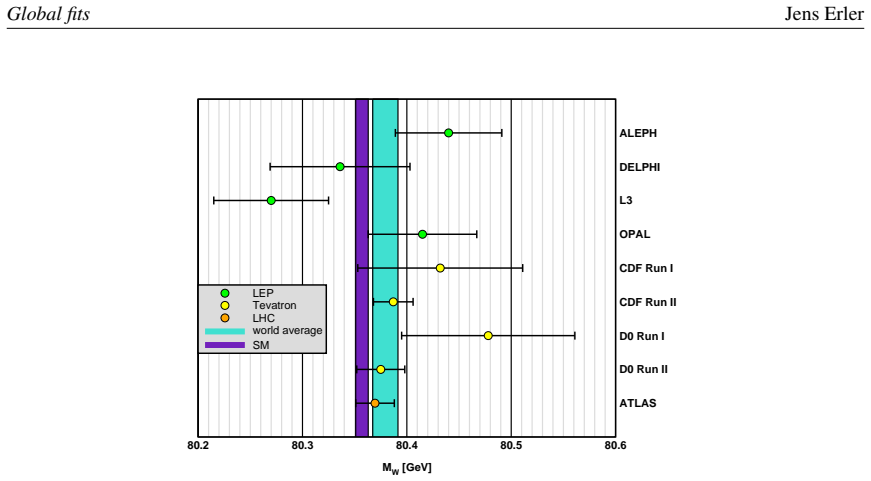
On the paper's own terms, the discovery is a status report with a single headline: the electroweak sector of the Standard Model still fits, but the direct measurement of the W boson mass runs slightly high. Combining LEP, SLC, Tevatron, LHC, and low-energy determinations, the paper obtains a world average sin²θ_W = 0.23149 ± 0.00013 in excellent agreement with the global-fit value 0.23153 ± 0.00004, whereas the W mass average 80.379 ± 0.012 GeV exceeds both the indirect determination 80.357 ± 0.006 GeV and the Standard Model prediction 80.361 ± 0.005 GeV by about 1.5–1.6σ. The same tension shows up as a 2σ deviation of the ρ0 parameter from 1 and as a drop in χ² when the oblique parameters S and T are allowed to float. The paper's methodological claim is that theory uncertainties from unknown higher orders, and especially their correlations across observables, must be included before such statements can be trusted.
Load-bearing premise
The quantitative bottom line—the 1.5–1.6σ W-mass excess and the otherwise excellent fit—rests on the author's estimates of unknown higher-order electroweak theory uncertainties, ΔS = ±0.0034, ΔT = ±0.0073, ΔU = ±0.0051, and on treating those three as uncorrelated; if the errors are larger or correlated, the tension could weaken, strengthen, or change its interpretation.
Editorial extensions
If this is right
- If the central claim is right, the most direct consequence is that the measured W boson mass, not the weak mixing angle, is the current place to look for physics beyond the Standard Model; sin²θ_W is already consistent with the fit at the level of a few times 10⁻⁵.
- The 2σ deviation of ρ0 from 1 and the improved χ² when S and T float mean that a future precision shift in M_W would also change indirect determinations of the top quark and Higgs boson masses.
- Future low-energy parity-violating electron scattering and neutrino experiments, at LEP/SLC-level precision, would test the predicted running of sin²θ_W and provide an independent check on the hadronic-vacuum-polarization input.
- New, more precise W mass measurements should be compared not to the old world average but to the fit prediction 80.361 ± 0.005 GeV, making the 1.5σ gap shrink or grow in a decisive way.
- The paper's treatment implies that theoretical uncertainty correlations must be included in any global electroweak fit; ignoring them would make the same data look either more or less consistent than it is.
Reading between the lines
- A natural extension the paper leaves implicit: the W-mass excess is compatible with a small positive contribution to the T or S parameters, and the quoted S = 0.02 ± 0.07, T = 0.06 ± 0.06 with 81% correlation already points in that direction; a future fit could test whether a single oblique-parameter pattern accommodates all data.
- If the ΔS, ΔT, ΔU estimates are later found to be correlated (for instance through common top-quark or Higgs corrections), the significance of the W-mass tension would change; one concrete check is to recompute the global fit with a fully correlated theory-error covariance matrix.
- The paper's observation that a new lattice result for hadronic vacuum polarization would remove the muon g−2 discrepancy while creating a new dispersive-versus-lattice discrepancy suggests that the hadronic part of global fits is where the next surprise could appear.
Editorial analysis
A structured set of objections, weighed in public.
Referee Report
Summary. This proceedings paper from LHCP2019 surveys determinations of the weak mixing angle and the W boson mass, and discusses the treatment of theoretical uncertainties (especially correlations) in global electroweak fits. It presents a world average for sin^2(theta_W), quotes an indirect and global-fit determination of M_W, and reports a mild tension: M_W(world) = 80.379 +/- 0.012 GeV is 1.6 sigma above the indirect value 80.357 +/- 0.006 GeV and 1.5 sigma above the SM global-fit value 80.361 +/- 0.005 GeV (Eqs. 3.1-3.3). The paper also contains results on the top quark and Higgs boson masses from fits with and without correlated theory uncertainties, a discussion of hadronic vacuum polarization effects and alpha(M_Z), and constraints on oblique parameters S, T, and rho_0. Most numerical results are attributed to the author's earlier publications [26], [32], [38], and [40].
Significance. If the quoted results are correct, the paper provides a concise and useful status update on electroweak precision measurements, with the explicit inclusion of correlated theory uncertainties being a notable feature. The claimed mild M_W tension and the associated rho_0 deviation are of interest to model builders, and the survey of sin^2(theta_W) measurements and the discussion of future PVES experiments (P2, MOLLER, SoLID) are informative. The paper is transparent about its assumptions and provides clear figures (Figures 1-3) summarizing the world data. However, the numerical payload is largely imported from the author's previous publications, and the proceedings text does not allow an independent check of the key fit results or of the sensitivity to the assumed correlation structure.
major comments (2)
- [Section 4 (Eqs. 3.1-3.3)] The central claim of a 1.6 sigma deviation of M_W (and the related rho_0 result) depends on the estimated oblique parameter uncertainties Delta S = +/-0.0034, Delta T = +/-0.0073, and Delta U = +/-0.0051. These are power-counting estimates, not results of a complete higher-order calculation, and the paper explicitly states that they are 'assumed' to be uncorrelated. No sensitivity analysis is provided; a moderate increase in these uncertainties (e.g., by a factor of two) or a non-trivial correlation between them could reduce the significance below the 1-sigma level, weakening the paper's central narrative. Please add a brief exploration of how the significance of the M_W tension changes under reasonable variations of these assumptions, or refer readers to a specific calculation in [26] where such a study is presented.
- [Section 2 (Eqs. 2.3-2.4)] The LHC average sin^2(theta_W) = 0.23131 +/- 0.00033 is obtained by assuming that the smallest published theory uncertainty (ATLAS, +/-0.00025) is fully common to the three LHC experiments, and that the PDF uncertainties of Tevatron and LHC determinations are approximately uncorrelated. The resulting world average of 0.23149 +/- 0.00013 and the claimed 'excellent agreement' with the global fit (Eq. 2.5) depend on these choices. Since the combination is not a simple weighted average with independent errors, the paper should demonstrate the stability of the result by repeating the procedure with, for example, a larger common theory error or fully correlated PDF uncertainties. Without such a check, the precision of Eq. (2.4) is a model-dependent statement rather than a direct experimental average.
minor comments (5)
- [Section 2] Typographical error: 'the ALTAS [23]' should read 'the ATLAS [23]'.
- [Table 1] The table caption contains a grammatically incomplete phrase: 'where the correlation with MH is Equation (4.7) is negligible'; this should be rewritten, e.g., 'the correlation with MH from Eq. (4.7) is negligible.'
- [Section 5 (Eq. 5.12)] The notation '1272 +/- 8 + 2616[alpha_s(MZ) - 0.1182] MeV' is ambiguous. Please clarify that the second term is the parametric dependence on alpha_s and state whether the quoted uncertainty is just the +/-8 MeV or the combined uncertainty after propagating the alpha_s error.
- [Section 6] The phrase 'these two extra degrees of freedom' is unclear; it would be more precise to write 'the two extra parameters S and T'.
- [General] For several quoted quantities (e.g., Eqs. 3.1-3.3, 4.3-4.7), it would be helpful to state explicitly in the text or caption that these are taken from Ref. [26] and [32], so that a reader can locate the original derivations without searching the reference list.
Circularity Check
No significant circularity: the W-mass tension is based on an indirect fit that excludes direct MW data, and the self-cited inputs are cross-checked by independent groups.
full rationale
The paper is a proceedings summary of the author's own global electroweak fits, so many central numbers are cited from Refs. [26] and [32] rather than re-derived. That is self-citation, but not circularity: the indirect determinations are explicitly out-of-sample with respect to the quantities they are compared with. Eq. (3.2) quotes MW(indirect)=80.357±0.006 GeV as the fit to all data 'excluding the direct measurement results of the mass and total width of the W boson', so the 1.6σ comparison with Eq. (3.1) is an honest cross-check rather than a fitted input renamed as a prediction. The same holds for mt(indirect) in Eq. (4.3) and MH(excluding direct MH) in Eqs. (4.5)-(4.6). The theory-correlation estimates ΔSZ, ΔT, ΔU in Sec. 4 are explicitly presented as estimates obtained from expansion parameters and citations to [26]; they are modeling assumptions that affect the error bars, but they are not derived from the quantities the paper claims to predict, so their fragility is a robustness concern, not a circularity. The self-cited results are also externally benchmarked in the text: the α(MZ) value from [38] agrees with the three independent evaluations in Eqs. (5.1)-(5.3), the PQCD charm vacuum-polarization contribution agrees with the lattice result in Eq. (5.7), and the charm mass in Eq. (5.12) is stated to agree with recent lattice results [45]. No uniqueness theorem from the authors is invoked to force a choice, and no ansatz is smuggled in as a first-principles derivation. The only mild wording issue is calling the global-fit MW in Eq. (3.3) a 'SM prediction' when a global fit may include the direct MW measurement, but the paper's separate indirect value provides the actual prediction, so this does not rise to circularity.
Assumptions & free parameters
free parameters (8)
- M_Z =
91.1884 ± 0.0020 GeV
- MS-bar top quark mass m_t(m_t) =
163.28 ± 0.44 GeV
- MS-bar bottom quark mass m_b(m_b) =
4.180 ± 0.021 GeV
- MS-bar charm quark mass m_c(m_c) =
1.275 ± 0.009 GeV (Table 1); 1.272 ± 0.008 GeV in Eq. (5.12)
- Strong coupling alpha_s(MZ) =
0.1187 ± 0.0016
- Hadronic vacuum polarization input Delta alpha_had^(3)(2 GeV) =
0.00590 ± 0.00005
- Theory uncertainty parameters Delta S, Delta T, Delta U =
Delta S = ±0.0034, Delta T = ±0.0073, Delta U = ±0.0051
- Rho_0 new-physics parameter =
1.00039 ± 0.00019
assumptions (5)
- domain assumption The Standard Model is the correct framework for the global fit and radiative corrections.
- ad hoc to paper Unknown higher-order contributions can be estimated by power-counting loop factors and treated as uncorrelated oblique parameters.
- domain assumption Dispersive hadronic vacuum polarization evaluations rely on e+e- data and approximate isospin symmetry.
- ad hoc to paper The LHC average uses a common theory uncertainty equal to the smallest published ATLAS uncertainty for all three detectors.
- ad hoc to paper PDF uncertainties for Tevatron and LHC sin^2(theta_W) extractions are approximately uncorrelated.
Cite this review
Pith. "Pith review of Global fits of the SM parameters." pith.science (2026). https://pith.science/paper/3L5XFK53
@misc{pith2026190807327,
  author       = {Pith},
  title        = {Pith review of: Global fits of the SM parameters},
  year         = {2026},
  howpublished = {\url{https://pith.science/paper/3L5XFK53}},
  note         = {Machine review of arXiv:1908.07327}
}
read the original abstract
I present a global survey of weak mixing angle measurements and other precision experiments and discuss the issue of correlations of the theoretical uncertainties in precision observables. Hadronic vacuum polarization effects complicate global fits in various ways and are also covered alongside some representative fit results.
Figures


Figures from the paper (3 more)


Reference graph
Works this paper leans on
-
[26]
J. Erler and M. Schott, Electroweak Precision Tests of the Standard Model after the Discovery of the Higgs Boson, Prog. Part. Nucl. Phys. 106, 68 (2019) [arXiv:1902.05142 [hep-ph]]
arXiv 2019
-
[32]
J. Erler and A. Freitas, Electroweak Model and Constraints on New Physics, pp. 161–179 in Ref. [33]
-
[38]
J. Erler and R. Ferro-Hernández, Weak Mixing Angle in the Thomson Limit, JHEP 1803, 196 (2018) [arXiv:1712.09146 [hep-ph]]
arXiv 2018
- [40]
-
[1]
K. S. Kumar, S. Mantry, W. J. Marciano and P. A. Souder, Low Energy Measurements of the Weak Mixing Angle, Ann. Rev. Nucl. Part. Sci. 63, 237 (2013) [arXiv:1302.6263 [hep-ex]]
arXiv 2013
-
[2]
P. Vilain et al. [CHARM-II Collaboration], Precision Measurement of Electroweak Parameters from the Scattering of Muon-Neutrinos on Electrons, Phys. Lett. B 335, 246 (1994)
work page 1994
-
[3]
G. P. Zeller et al. [NuTeV Collaboration], A Precise Determination of Electroweak Parameters in Neutrino Nucleon Scattering, Phys. Rev. Lett. 88, 091802 (2002)
work page 2002
-
[4]
D. Akimov et al. [COHERENT Collaboration], Observation of Coherent Elastic Neutrino-Nucleus Scattering, Science 357, no. 6356, 1123 (2017) [arXiv:1708.01294 [nucl-ex]]
arXiv 2017
Show all 49 references
-
[5]
Erler, C
J. Erler, C. J. Horowitz, S. Mantry and P. A. Souder, Weak Polarized Electron Scattering, Ann. Rev. Nucl. Part. Sci. 64, 269 (2014) [arXiv:1401.6199 [hep-ph]]
2014 arXiv
-
[6]
P. L. Anthony et al. [SLAC E158 Collaboration], Precision Measurement of the Weak Mixing Angle in Møller Scattering, Phys. Rev. Lett. 95, 081601 (2005) [hep-ex/0504049]
2005 arXiv
-
[7]
Benesch et al
J. Benesch et al. [MOLLER Collaboration], The MOLLER Experiment: An Ultra-Precise Measurement of the Weak Mixing Angle Using Møller Scattering, arXiv:1411.4088 [nucl-ex]
-
[8]
Bentz, I
W. Bentz, I. C. Cloet, J. T. Londergan and A. W. Thomas, Reassessment of the NuTeV determination of the weak mixing angle, Phys. Lett. B 693, 462 (2010) [arXiv:0908.3198 [nucl-th]]
2010 arXiv
-
[9]
Wang et al
D. Wang et al. [PVDIS Collaboration], Measurement of Parity Violation in Electron-Quark Scattering, Nature 506, no. 7486, 67 (2014)
2014
-
[10]
C. Y . Prescott et al. [SLAC E122 Collaboration], Further Measurements of Parity Nonconservation in Inelastic Electron Scattering, Phys. Lett. 84B, 524 (1979)
1979
-
[11]
P. A. Souder, Parity Violation in Deep Inelastic Scattering with the SoLID Spectrometer at JLab, Int. J. Mod. Phys. Conf. Ser. 40, 1660077 (2016). 11 Global fits Jens Erler
2016
-
[12]
Androi ´c et al
D. Androi ´c et al. [Qweak Collaboration], Precision Measurement of the Weak Charge of the Proton, Nature 557, no. 7704, 207 (2018) [arXiv:1905.08283 [nucl-ex]]
2018 arXiv
-
[13]
Erler, A
J. Erler, A. Kurylov and M. J. Ramsey-Musolf, The Weak Charge of the Proton and New Physics, Phys. Rev. D 68, 016006 (2003) [hep-ph/0302149]
2003 arXiv
-
[14]
Becker et al., The P2 Experiment, Eur
D. Becker et al., The P2 Experiment, Eur. Phys. J. A 54, 208 (2018) [arXiv:1802.04759 [nucl-ex]]
2018 arXiv
-
[15]
C. S. Wood et al., Measurement of Parity Nonconservation and an Anapole Moment in Cesium, Science 275, 1759 (1997)
1997
-
[16]
S. G. Porsev, K. Beloy and A. Derevianko, Precision Determination of Weak Charge of133Cs from Atomic Parity Violation, Phys. Rev. D 82, 036008 (2010) [arXiv:1006.4193 [hep-ph]]
2010 arXiv
-
[17]
B. M. Roberts, V . A. Dzuba and V . V . Flambaum,Parity and Time-Reversal Violation in Atomic Systems, Ann. Rev. Nucl. Part. Sci. 65, 63 (2015) [arXiv:1412.6644 [physics.atom-ph]]
2015 arXiv
-
[18]
Antypas et al., Isotopic Variation of Parity Violation in Atomic Ytterbium: Description of the Measurement Method and Analysis of Systematic Effects, Phys
D. Antypas et al., Isotopic Variation of Parity Violation in Atomic Ytterbium: Description of the Measurement Method and Analysis of Systematic Effects, Phys. Rev. A 100, no. 1, 012503 (2019)
2019
-
[19]
Schael et al
S. Schael et al. [ALEPH, DELPHI, L3, OPAL and SLD Collaborations, LEP Electroweak Working Group, and SLD Electroweak and Heavy Flavour Groups], Precision Electroweak Measurements on the Z Resonance, Phys. Rept. 427, 257 (2006) [hep-ex/0509008]
2006 arXiv
-
[20]
Bernreuther et al., The Forward-Backward Asymmetry for Massive Bottom Quarks at the Z Peak at Next-to-Next-to-Leading Order QCD, JHEP 1701, 053 (2017) [arXiv:1611.07942 [hep-ph]]
W. Bernreuther et al., The Forward-Backward Asymmetry for Massive Bottom Quarks at the Z Peak at Next-to-Next-to-Leading Order QCD, JHEP 1701, 053 (2017) [arXiv:1611.07942 [hep-ph]]
2017 arXiv
-
[21]
G. Toh et al., Determination of the Scalar and Vector Polarizabilities of the Cesium6s2S1/2→ 7s2S1/2 Transition and Implications for Atomic Parity Nonconservation, arXiv:1905.02768 [physics.atom-ph]
1905 arXiv
-
[22]
T. A. Aaltonen et al. [CDF and DØ Collaborations], Tevatron Run II Combination of the Effective Leptonic Electroweak Mixing Angle, Phys. Rev. D 97, no. 11, 112007 (2018) [arXiv:1801.06283 [hep-ex]]
2018 arXiv
-
[23]
ATLAS Collaboration, Measurement of the Effective Leptonic Weak Mixing Angle Using Electron and Muon Pairs from Z-Boson Decay in the ATLAS Experiment at√s = 8 TeV, ATLAS-CONF-2018-037
2018
-
[24]
A. M. Sirunyan et al. [CMS Collaboration], Measurement of the Weak Mixing Angle Using the Forward-Backward Asymmetry of Drell-Yan Events in pp Collisions at 8 TeV, Eur. Phys. J. C 78, no. 9, 701 (2018) [arXiv:1806.00863 [hep-ex]]
2018 arXiv
-
[25]
Aaij et al
R. Aaij et al. [LHCb Collaboration], Measurement of the Forward-Backward Asymmetry in Z/γ∗→ µ +µ− Decays and Determination of the Effective Weak Mixing Angle, JHEP 1511, 190 (2015) [arXiv:1509.07645 [hep-ex]]
2015 arXiv
-
[27]
Schael et al
S. Schael et al. [ALEPH, DELPHI, L3 and OPAL Collaborations and LEP Electroweak Working Group], Electroweak Measurements in Electron-Positron Collisions at W-Boson-Pair Energies at LEP, Phys. Rept. 532, 119 (2013) [arXiv:1302.3415 [hep-ex]]
2013 arXiv
-
[28]
T. A. Aaltonen et al. [CDF and DØ Collaborations], Combination of CDF and DØ W-Boson Mass Measurements, Phys. Rev. D 88, no. 5, 052018 (2013) [arXiv:1307.7627 [hep-ex]]
2013 arXiv
-
[29]
Aaboud et al
M. Aaboud et al. [ATLAS Collaboration], Measurement of the W-Boson Mass in pp Collisions at√s = 7 TeV with the ATLAS Detector, Eur. Phys. J. C 78, no. 2, 110 (2018) [arXiv:1701.07240 [hep-ex]]. 12 Global fits Jens Erler
2018 arXiv
-
[30]
Freitas, Higher-Order Electroweak Corrections to the Partial Widths and Branching Ratios of the Z Boson, JHEP 1404, 070 (2014) [arXiv:1401.2447 [hep-ph]]
A. Freitas, Higher-Order Electroweak Corrections to the Partial Widths and Branching Ratios of the Z Boson, JHEP 1404, 070 (2014) [arXiv:1401.2447 [hep-ph]]
2014 arXiv
-
[31]
M. E. Peskin and T. Takeuchi, Estimation of Oblique Electroweak Corrections, Phys. Rev. D 46, 381 (1992)
1992
-
[33]
Tanabashi et al
M. Tanabashi et al. [Particle Data Group], Review of Particle Physics, Phys. Rev. D 98, no. 3, 030001 (2018)
2018
-
[34]
Davier, A
M. Davier, A. Hoecker, B. Malaescu and Z. Zhang, Reevaluation of the Hadronic Vacuum Polarisation Contributions to the Standard Model Predictions of the Muon g− 2 and α(M2 Z) Using Newest Hadronic Cross-Section Data, Eur. Phys. J. C 77, no. 12, 827 (2017) [arXiv:1706.09436 [hep-ph]]
2017 arXiv
-
[35]
Jegerlehner, Variations on Photon Vacuum Polarization, arXiv:1711.06089 [hep-ph]
F. Jegerlehner, Variations on Photon Vacuum Polarization, arXiv:1711.06089 [hep-ph]
-
[36]
Keshavarzi, D
A. Keshavarzi, D. Nomura and T. Teubner, Muon g− 2 and α(M2 Z): a New Data-Based Analysis, Phys. Rev. D 97, no. 11, 114025 (2018) [arXiv:1802.02995 [hep-ph]]
2018 arXiv
-
[37]
Erler, Calculation of the QED Coupling α(MZ) in the Modified Minimal Subtraction Scheme, Phys
J. Erler, Calculation of the QED Coupling α(MZ) in the Modified Minimal Subtraction Scheme, Phys. Rev. D 59, 054008 (1999) [hep-ph/9803453]
1999 arXiv
-
[39]
Erler and M
J. Erler and M. Luo, Hadronic Loop Corrections to the Muon Anomalous Magnetic Moment, Phys. Rev. Lett. 87, 071804 (2001) [hep-ph/0101010]
2001 arXiv
-
[41]
Gérardin et al., The Leading Hadronic Contribution to (g− 2)µ from Lattice QCD with Nf = 2 + 1 Flavours of O(a) Improved Wilson Quarks, Phys
A. Gérardin et al., The Leading Hadronic Contribution to (g− 2)µ from Lattice QCD with Nf = 2 + 1 Flavours of O(a) Improved Wilson Quarks, Phys. Rev. D 100, no. 1, 014510 (2019) [arXiv:1904.03120 [hep-lat]]
2019 arXiv
-
[42]
G. W. Bennett et al. [Muon g-2 Collaboration], Final Report of the Muon E821 Anomalous Magnetic Moment Measurement at BNL, Phys. Rev. D 73, 072003 (2006) [hep-ex/0602035]
2006 arXiv
-
[43]
Erler and M
J. Erler and M. J. Ramsey-Musolf, The Weak Mixing Angle at Low Energies, Phys. Rev. D 72, 073003 (2005) [hep-ph/0409169]
2005 arXiv
-
[44]
Erler and M
J. Erler and M. Luo, Precision Determination of Heavy Quark Masses and the Strong Coupling Constant, Phys. Lett. B 558, 125 (2003) [hep-ph/0207114]
2003 arXiv
-
[45]
Aoki et al
S. Aoki et al. [Flavour Lattice Averaging Group],FLAG Review 2019, arXiv:1902.08191 [hep-lat]
2019 arXiv
-
[46]
Grinstein and M
B. Grinstein and M. B. Wise, Operator analysis for precision electroweak physics, Phys. Lett. B 265, 326 (1991)
1991
-
[47]
Carena, E
M. Carena, E. Ponton, J. Santiago and C. E. M. Wagner, Light Kaluza Klein States in Randall-Sundrum Models with Custodial SU(2), Nucl. Phys. B 759, 202 (2006) [hep-ph/0607106]
2006 arXiv
-
[48]
Randall and R
L. Randall and R. Sundrum, A Large Mass Hierarchy from a Small Extra Dimension, Phys. Rev. Lett. 83, 3370 (1999) [hep-ph/9905221]
1999 arXiv
-
[49]
A. Pich, I. Rosell and J. J. Sanz-Cillero, Oblique S and T Constraints on Electroweak Strongly-Coupled Models with a Light Higgs, JHEP 1401, 157 (2014) [arXiv:1310.3121 [hep-ph]]. 13
2014 arXiv
Reviewed August 14, 2026 · model on record in the stance chip above.
Discussion (0). Continue with ORCID to comment.