REVIEW 2 major objections 5 minor 30 references
Electroweak Precision Tests of the SM
T0 review · 2 major / 5 minor · reviewed 2026-08-14 · deepseek-v4-flash
Pith's one-line read The electroweak data are globally consistent with the Standard Model, except for a 1.5σ upward shift in the W boson mass.
desk verdict Competent, self-cited conference review that summarizes the EW fit status; the headline M_W tension is softer than it appears because it hinges on an asserted uncorrelated treatment of theory uncertainties. read the letter →
The pith
A machine-rendered reading of the paper's core claim, the machinery that carries it, and where it could break.
The reading
What carries the argument
The central machinery is the set of oblique parameters $S$, $T$, and $U$—standard objects that parametrize new physics contributions to electroweak gauge-boson self-energies. The paper re-tasks them as carriers of theory uncertainty: unknown higher-order electroweak corrections are translated into uncorrelated errors $\Delta S_Z = \pm 0.0034$, $\Delta T = \pm 0.0073$, and $\Delta U = \pm 0.0051$. Around this, the renormalization-group evolution of $\sin^2\theta_W$ and the data-driven hadronic vacuum polarization are the other load-bearing pieces, because they map low-energy measurements and $e^+e^-$ data into predictions for $\alpha(M_Z)$, $g-2$, and quark masses.
What would settle it
Measure the world-average $M_W$ with a combined uncertainty around 5 MeV, or reduce the uncertainty on $\alpha(M_Z)$ by a factor of two; if the central value of $M_W$ moves more than about 15 MeV toward or away from the Standard Model prediction, the $1.5\sigma$ excess will sharpen or disappear, deciding whether the tension is real or an artifact of the theory-error assignment.
Extended reading notes
Core claim
On its own terms, the paper establishes a status claim: the electroweak sector of the Standard Model is over-constrained by three independent routes to $\sin^2\theta_W$ and $M_W$, and the current world data are globally consistent with the model except for a $1.5\sigma$ upward shift in $M_W$. The author combines LEP, SLC, Tevatron, LHC, and low-energy parity-violating measurements to obtain $\sin^2\theta_W = 0.23149 \pm 0.00013$, in close agreement with the global-fit result $\sin^2\theta_W = 0.23153 \pm 0.00004$; the averaged $M_W = 80.379 \pm 0.012$ GeV is $1.5\sigma$ above the Standard Model prediction of $80.361 \pm 0.005$ GeV. A second claim is that realistic theory uncertainties, especially correlated higher-order electroweak corrections, change the fit-derived values of $m_t$ and $M_H$ only mildly but are needed to keep the reported tensions honest. The same hadronic vacuum polarization data connect $\alpha(M_Z)$, the muon anomalous magnetic moment, and heavy-quark masses, so a future lattice resolution of the $g-2$ discrepancy would imply a new discrepancy between dispersive and lattice evaluations of vacuum polarization.
Load-bearing premise
The results stand or fall on the assumption that the unknown higher-order electroweak corrections can be represented by uncorrelated oblique parameter errors of the stated sizes ($\Delta S_Z = \pm 0.0034$, $\Delta T = \pm 0.0073$, $\Delta U = \pm 0.0051$); if those errors are correlated or underestimated, the reported agreement and the $1.5\sigma$ tension would change.
Editorial extensions
If this is right
- The weak mixing angle is now pinned to an uncertainty of $0.00013$, so future low-energy parity-violating electron scattering experiments will serve as independent cross-checks of the high-energy determinations rather than as discovery tools.
- The $1.5\sigma$ upward shift in $M_W$, together with $\rho_0 = 1.00039 \pm 0.00019$, is the main electroweak hint of new physics; models that raise $M_W$ without distorting other observables are favored.
- Theory uncertainties in different observables are correlated through $\Delta S_Z$, $\Delta T$, and $\Delta U$; future global fits that ignore these correlations will misjudge the significance of any anomaly.
- If the recent lattice result for the hadronic vacuum polarization is confirmed, the muon $g-2$ anomaly would disappear, but a new discrepancy between dispersive and lattice determinations of vacuum polarization would take its place.
Reading between the lines
- The paper stops short of converting the $1.5\sigma$ $M_W$ excess into an updated quantitative exclusion bound on new physics; a natural next step is to re-run the $S,T,U$ fit with the new world averages and read off revised lower limits on extra gauge-boson and extra-dimensional masses.
- If the uncorrelated oblique-error assignment is too optimistic, the reported closeness of the $\sin^2\theta_W$ world average to the global fit would weaken; refitting with fully correlated $\Delta S_Z$, $\Delta T$, $\Delta U$ would provide a stress test of that agreement.
- The same hadronic vacuum polarization data drive $\alpha(M_Z)$, the muon $g-2$ prediction, and the charm quark mass simultaneously, so a high-precision measurement of any one of these observables can be used to sharpen predictions for the others.
Signed reviews
Editorial analysis
A structured set of objections, weighed in public.
Referee Report
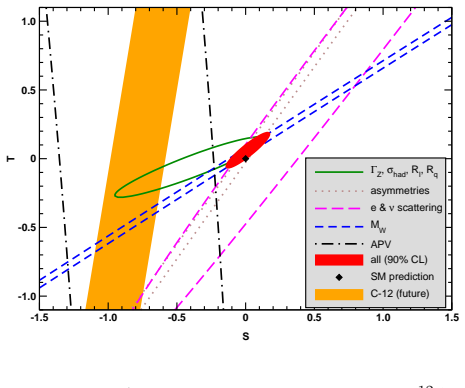
Summary. This paper is a short proceedings contribution that surveys current measurements of the electroweak mixing angle and the W-boson mass, discusses theory uncertainties and their correlations in global electroweak fits, and reviews the role of vacuum polarization. Numerically, it reports a world average sin^2θ_W = 0.23149 ± 0.00013 in agreement with the global fit value 0.23153 ± 0.00004, and an averaged M_W = 80.379 ± 0.012 GeV that is 1.5σ above the SM prediction 80.361 ± 0.005 GeV. These central numbers are inherited from the global fit in Ref. [16], where unknown higher-order self-energy corrections are converted into oblique-parameter uncertainties ΔS_Z = ±0.0034, ΔT = ±0.0073, and ΔU = ±0.0051 and treated as uncorrelated. The paper also quotes fit results for m_t and M_H, discusses α(MZ) and hadronic vacuum polarization, and presents ρ0 and S,T constraints. As a survey, most of its content is a summarization of published external results rather than a new derivation.
Significance. The paper provides a convenient, up-to-date snapshot of electroweak precision constraints and highlights two aspects that are often underemphasized: the correlations among theory uncertainties and the role of vacuum-polarization contributions in low- and high-energy observables. The figures are useful, and the reference list points to the relevant experimental and fitting literature. The headline claims are traceable to published measurements and to the author's global fit in Ref. [16], and no obvious arithmetic inconsistencies appear. The main limitation is that the quantitative conclusions concerning agreement or tension depend on an uncertainty-correlation model whose derivation and robustness are not documented in this manuscript; consequently the reader cannot independently assess the significance of the quoted 1.5σ M_W tension or the m_t/M_H comparisons.
major comments (2)
- [Section 1] The paper's central status claims depend on the assignment ΔS_Z = ±0.0034, ΔT = ±0.0073, ΔU = ±0.0051 and on the assumption that these are 'sufficiently different (uncorrelated)'. This assumption is load-bearing: it generates the theory correlations that affect the fitted SM predictions for M_W and sin^2θ_W, as well as the derived m_t and M_H values reported later in the same section. The manuscript does not derive the loop-factor translation, justify the zero off-diagonal covariance, or test how the quoted 1.5σ M_W tension changes with alternative correlation structures. The authors should either add this derivation and a sensitivity analysis, or explicitly and precisely point to the corresponding analysis in Ref. [16] and summarize its main findings here.
- [Section 1] The world average sin^2θ_W = 0.23149 ± 0.00013 is formed by combining LEP/SLC, Tevatron, and LHC results. For the LHC average, the smallest theory uncertainty is stated to be common to the three experiments, and the paper then states that PDF uncertainties can be assumed uncorrelated between p¯p and pp collisions. The covariance between the LHC average and the other entries is not given, and no sensitivity test is presented for the uncorrelated-PDF assumption. Because the quoted agreement with the global fit depends on the size of the world-average uncertainty, the correlation treatment should either be specified quantitatively or referred to a specific published combination that provides it.
minor comments (5)
- [Section 1] 'ALTAS' should be 'ATLAS' in the sentence 'The average 16) of those at the LHC, sin2θ_W = 0.23131±0.00033, by ALTAS, CMS, and LHCb'.
- [Section 1] 'which is a interesting' should read 'which is an interesting'.
- [Section 1] The phrase 'assuming them to be sufficiently different (uncorrelated)' is vague; 'sufficiently different' is not a defined criterion, and the parenthetical 'uncorrelated' should be stated directly if that is the intended assumption.
- [Section 2] The notation in the expression for a_c_μ, with error subscripts (PQCD, mhat_c, αs) appended to the central value, is difficult to parse; a table or explicit list of the three error terms would be clearer.
- [Throughout] The paper alternates between sin^2θ_W and sin2θ_W, and between M_W and MW; for a proceedings text this is cosmetic, but consistent notation would help.
Circularity Check
No significant circularity: this is a review that delegates fit numbers to published global fits, including some by the author, but no derivation reduces to its own inputs by construction.
full rationale
This is a proceedings-style review rather than an original derivation. The central quantitative statements—the world average sin2θ_W = 0.23149 ± 0.00013, the global fit value 0.23153 ± 0.00004, the W-mass average 80.379 ± 0.012 GeV, and the SM prediction 80.361 ± 0.005 GeV—are presented as results of external experiments and published global fits. Several key references are by the author (Refs. 16, 21, 24, 26), but the present paper does not claim to re-derive them; it cites prior published work for the fit procedure and the numerical outputs. Where a prediction is compared with a measurement, the text explicitly states that the direct measurement is excluded from the fit, e.g., 'global fits to all data except mt from the Tevatron and LHC' and 'global fits to all data except for the direct MH = 125.10 ± 0.14 GeV constraint.' The theory-uncertainty treatment via ΔS_Z, ΔT, ΔU is an assumed correlation structure rather than a fitted parameter or a renamed prediction; its robustness is a legitimate technical concern but not a circular reduction. No equation in the paper is equivalent to its own input by construction, and no uniqueness theorem or ansatz is smuggled in through self-citation. The self-citation pattern is therefore not load-bearing in the circularity sense, and the appropriate finding is no significant circularity.
Assumptions & free parameters
free parameters (3)
- ΔS_Z =
±0.0034
- ΔT =
±0.0073
- ΔU =
±0.0051
assumptions (4)
- domain assumption The Standard Model is the correct framework for computing electroweak radiative corrections.
- ad hoc to paper Unknown higher-order contributions to gauge boson self-energies can be captured by shifts in oblique parameters S, T, U that are uncorrelated.
- domain assumption Theory uncertainties for the LHC and Tevatron sin^2θ_W measurements can be treated as uncorrelated because different aspects of PDFs are relevant at pp and pbar-p colliders.
- domain assumption Hadronic vacuum polarization contributions from e+e- annihilation data, with optional lattice QCD input, provide valid inputs for α(M_Z).
Cite this review
Pith. "Pith review of Electroweak Precision Tests of the SM." pith.science (2026). https://pith.science/paper/3PG3QCIO
@misc{pith2026190807346,
  author       = {Pith},
  title        = {Pith review of: Electroweak Precision Tests of the SM},
  year         = {2026},
  howpublished = {\url{https://pith.science/paper/3PG3QCIO}},
  note         = {Machine review of arXiv:1908.07346}
}
read the original abstract
A global survey of weak mixing angle measurements at low and high energies is presented. Then I will discuss theoretical uncertainties in precision observables with special emphasis on their correlations. The important role of vacuum polarization in global fits will also be addressed before fit results are presented.
Figures


Reference graph
Works this paper leans on
- [16]
-
[1]
Akimov et al., Science 357, no
COHERENT: D. Akimov et al., Science 357, no. 6356, 1123 (2017)
work page 2017
- [2]
-
[3]
SLAC–E158: P. L. Anthony et al., Phys. Rev. Lett. 95, 081601 (2005)
work page 2005
-
[4]
JLab–PVDIS: D. Wang et al., Nature 506, no. 7486, 67 (2014)
work page 2014
-
[5]
SLAC–E122: C. Y. Prescott et al., Phys. Lett. 84B, 524 (1979)
work page 1979
-
[6]
Androi´ cet al., Nature 557, no
JLab–Qweak: D. Androi´ cet al., Nature 557, no. 7704, 207 (2018)
work page 2018
-
[7]
Erler, A
J. Erler, A. Kurylov and M. J. Ramsey-Musolf, Phys. Rev. D 68, 016006 (2003)
2003
Show all 30 references
-
[8]
Becker et al., Eur
JGU–P2: D. Becker et al., Eur. Phys. J. A 54, 208 (2018)
2018
-
[9]
C. S. Wood et al., Science 275, 1759 (1997)
1997
-
[10]
B. M. Roberts, V. A. Dzuba and V. V. Flambaum, Ann. Rev. Nucl. Part. Sci. 65, 63 (2015)
2015
-
[11]
Antypas et al., Phys
D. Antypas et al., Phys. Rev. A 100, no. 1, 012503 (2019)
2019
-
[12]
Schael et al., Phys
ALEPH, DELPHI, L3, OPAL, SLD and LEP EWWG: S. Schael et al., Phys. Rept. 427, 257 (2006)
2006
-
[13]
Bernreuther, L
W. Bernreuther, L. Chen, O. Dekkers, T. Gehrmann and D. Heisler, JHEP 1701, 053 (2017)
2017
-
[14]
Toh et al., arXiv:1905.02768 [physics.atom-ph]
G. Toh et al., arXiv:1905.02768 [physics.atom-ph]
1905 arXiv
-
[15]
CDF and DØ: T. A. Aaltonen et al., Phys. Rev. D 97, no. 11, 112007 (2018)
2018
-
[17]
Schael et al., Phys
ALEPH, DELPHI, L3, OPAL and LEP EWWG: S. Schael et al., Phys. Rept. 532, 119 (2013)
2013
-
[18]
CDF and DØ: T. A. Aaltonen et al., Phys. Rev. D 88, no. 5, 052018 (2013)
2013
-
[19]
Aaboud et al., Eur
ATLAS: M. Aaboud et al., Eur. Phys. J. C 78, no. 2, 110 (2018)
2018
-
[20]
M. E. Peskin and T. Takeuchi, Phys. Rev. D 46, 381 (1992)
1992
-
[21]
Erler and R
J. Erler and R. Ferro-Hern´ andez, JHEP1803, 196 (2018)
2018
-
[22]
Erler and M
J. Erler and M. Luo, Phys. Rev. Lett. 87, 071804 (2001)
2001
-
[23]
G´ erardinet al., Phys
A. G´ erardinet al., Phys. Rev. D 100, no. 1, 014510 (2019)
2019
-
[24]
Erler, P
J. Erler, P. Masjuan and H. Spiesberger, Eur. Phys. J. C 77, no. 2, 99 (2017)
2017
- [25]
-
[26]
Erler and A
PDG: J. Erler and A. Freitas, in M. Tanabashi et al., Phys. Rev. D 98, 030001 (2018)
2018
-
[27]
Grinstein and M
B. Grinstein and M. B. Wise, Phys. Lett. B 265, 326 (1991)
1991
-
[28]
Carena, E
M. Carena, E. Ponton, J. Santiago and C. E. M. Wagner, Nucl. Phys. B 759, 202 (2006)
2006
-
[29]
Randall and R
L. Randall and R. Sundrum, Phys. Rev. Lett. 83, 3370 (1999)
1999
-
[30]
A. Pich, I. Rosell and J. J. Sanz-Cillero, JHEP 1401, 157 (2014)
2014
Reviewed August 14, 2026 · model on record in the stance chip above.
Discussion (0). Continue with ORCID to comment.