REVIEW 4 major objections 5 minor 13 references
Effects of the atmospheric electric field on the HAWC scaler rate
T0 review · 4 major / 5 minor · reviewed 2026-08-14 · deepseek-v4-flash
Pith's one-line read Thunderstorm electric fields boost HAWC's scaler count rate.
desk verdict A genuinely useful but methodologically incomplete HAWC scaler thunderstorm catalog; the pressure correction and absent significance tests keep the quantitative claim preliminary. read the letter →
The pith
A machine-rendered reading of the paper's core claim, the machinery that carries it, and where it could break.
The reading
What carries the argument
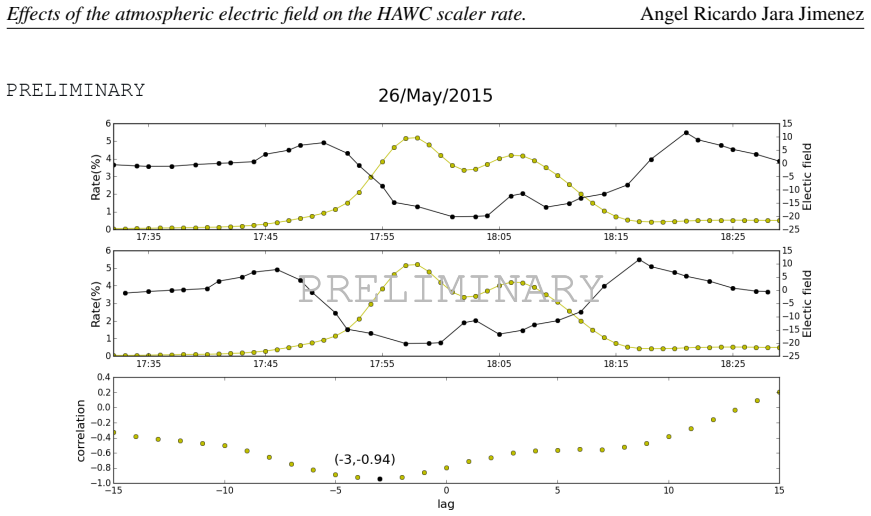
The paper invokes the relativistic runaway electron avalanche (RREA) mechanism, in which energetic seed electrons pushed by a strong field overcome drag and generate bremsstrahlung photons and further runaway electrons, as the physical cause. The operational machinery is the HAWC scaler system and a three-filter event selection: self-normalization of each PMT's count rate, a five-standard-deviation threshold requiring 5+ minutes and 30+ detectors, a 5-to-120-minute duration cut, and the requirement of available electric-field data. The correlation analysis then shifts the electric-field time series by -15 to +15 minutes, takes the best cross-correlation coefficient, and fits the rate against the field to show a negative slope.
What would settle it
Run the same threshold search on thunderstorm-free periods after applying the pressure correction: if comparable 5-to-120-minute rate increases appear, the events are not storm-specific. Alternatively, detrend the 79 event-day rates against local barometric pressure and compare that correlation with the electric-field correlation; a pressure correlation as strong as the field correlation would indicate the effect is barometric, not electric.
Extended reading notes
Core claim
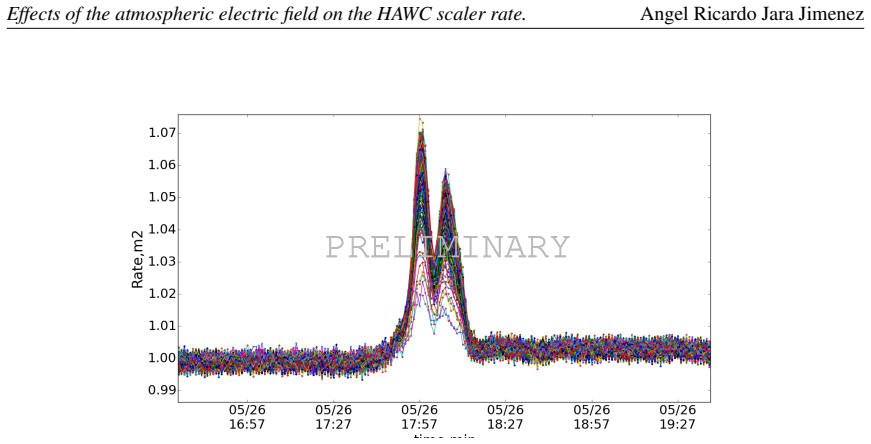
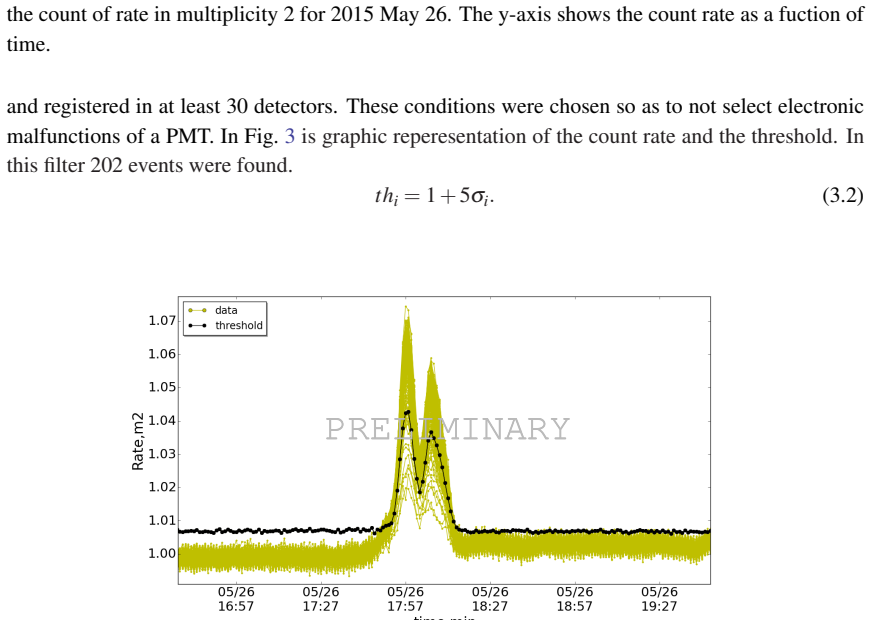
After self-normalizing each detector's per-minute scaler rate to its own mean, the authors set a threshold of one plus five standard deviations and require the normalized rate to exceed it for at least five consecutive minutes in at least 30 detectors. That first filter yields 202 candidate intervals; restricting duration to between 5 and 120 minutes leaves 100, and requiring simultaneous electric-field data leaves 79 events. For those 79, a cross-correlation analysis with time shifts from -15 to +15 minutes shows that the majority of events are strongly correlated with the field intensity, and after pressure correction most are inversely correlated: the rate enhancement occurs as the field decays. The paper's stated conclusion is that these results are evidence for particle acceleration due to the electric field of clouds producing enhancements of the HAWC scaler rate.
Load-bearing premise
The claim rests on the premise that the unpublished pressure correction removes all non-electric weather modulation and that a ground-level field reading represents the in-cloud accelerating field; if either fails, the residual rate increases and their correlations could have a non-electric cause.
Editorial extensions
If this is right
- HAWC's scaler multiplicities can serve as a thunderstorm detector: rate increases lasting 5 to 120 minutes and coinciding with field changes mark particle acceleration by cloud electric fields.
- Because most events show an inverse correlation, the enhancement occurs as the electric field decays, tying the acceleration to the collapse phase of the storm cell.
- Applying the same three-filter method to the other multiplicity channels and later years should yield more events, and with simulations may let the energy of the initiating particles be estimated.
- The method gives a way to separate true atmospheric-electricity enhancements from solar or barometric modulations, which the two-hour duration cut is designed to exclude.
Reading between the lines
- If the ground-level field reading tracks the in-cloud field closely enough, HAWC's scaler system could act as a wide-area, distributed monitor of thunderstorm electrification, complementing lightning-location networks.
- The inverse correlation with field intensity suggests the acceleration happens during field collapse rather than at peak field; this timing could be tested by comparing event onsets with lightning-stroke times from a regional array.
- Because the pressure correction is unpublished, a natural test is to re-analyze the 79 events with a published barometric coefficient; if the correlations weaken, the method's event list depends on that correction.
- The 30-detector minimum may bias the selection toward large, widespread storms, so isolated or small cells producing weaker enhancements would be missed; a single-detector or local-cluster search could find them.
Signed reviews
Editorial analysis
A structured set of objections, weighed in public.
Referee Report
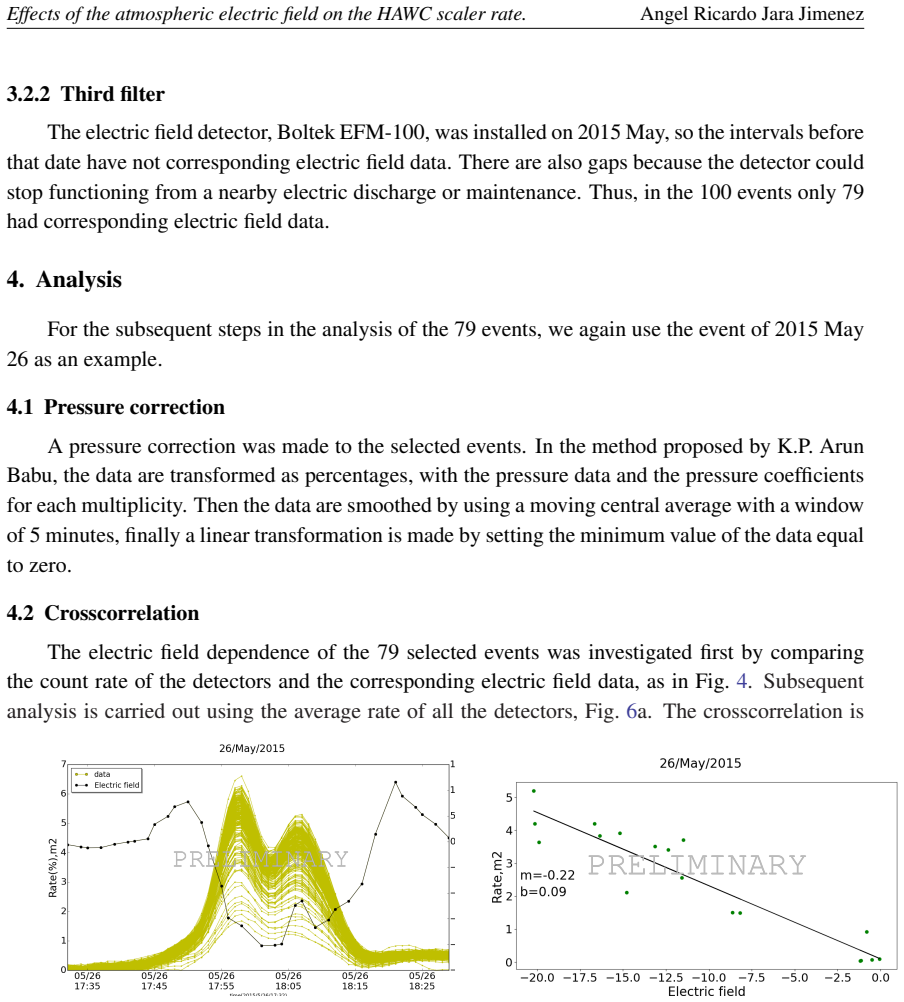
Summary. The paper reports a search for thunderstorm-related increases in the count rates of the HAWC scaler system using data from 2015-2017. The authors apply a three-step selection: self-normalizing each detector to its mean rate, requiring an excess above a threshold defined as 1 + 5σ for at least 5 continuous minutes in at least 30 detectors, then selecting events with duration between 5 and 120 minutes. They find 100 such intervals, of which 79 have matched Boltek EFM-100 electric-field data. For those events the authors apply an unpublished barometric pressure correction, smooth the rates, compute cross-correlations between the average scaled rate and the electric field over time lags of -15 to +15 minutes, and fit a linear relation R(E) = -0.22E + 0.09 using only negative electric-field values. They report that most of the 79 events show an inverse correlation between rate and electric field and interpret this as evidence for particle acceleration by thundercloud electric fields.
Significance. If the central claim is correct, the paper would provide a new, relatively simple method for identifying thunderstorm-correlated count-rate enhancements in HAWC's scaler data and would add to the existing evidence for thunderstorm ground enhancements at high altitude. The use of the scaler multiplicity channels and the cross-correlation with a ground-level electric-field monitor is a reasonable observational strategy, and the authors have made an effort to separate thunderstorm effects from solar and atmospheric modulation by a duration cut. However, the paper does not yet establish the claim quantitatively: the barometric correction is not described in a reproducible way, no significance levels or control periods are provided for the cross-correlations, and the sign-restricted linear fit is not justified. Because these points are directly load-bearing for the Section 5 conclusion, the work is best regarded as a promising method paper whose evidence requires substantial strengthening before it can be taken as a demonstration of particle acceleration.
major comments (4)
- [Section 4.1] The pressure correction is not reproducible: the text states only that the method was 'proposed by K.P. Arun Babu' and that data are transformed as percentages using 'pressure coefficients for each multiplicity,' but no coefficients, formulas, or reference are given. The paper's central conclusion in Section 5 depends on the residual rate after this correction being attributable to electric fields, so an incomplete or incorrect barometric correction could produce exactly the inverse correlations shown in Fig. 7. The authors should specify the correction completely and validate it, for example by showing that fair-weather intervals yield near-zero cross-correlation between rate and electric field after correction.
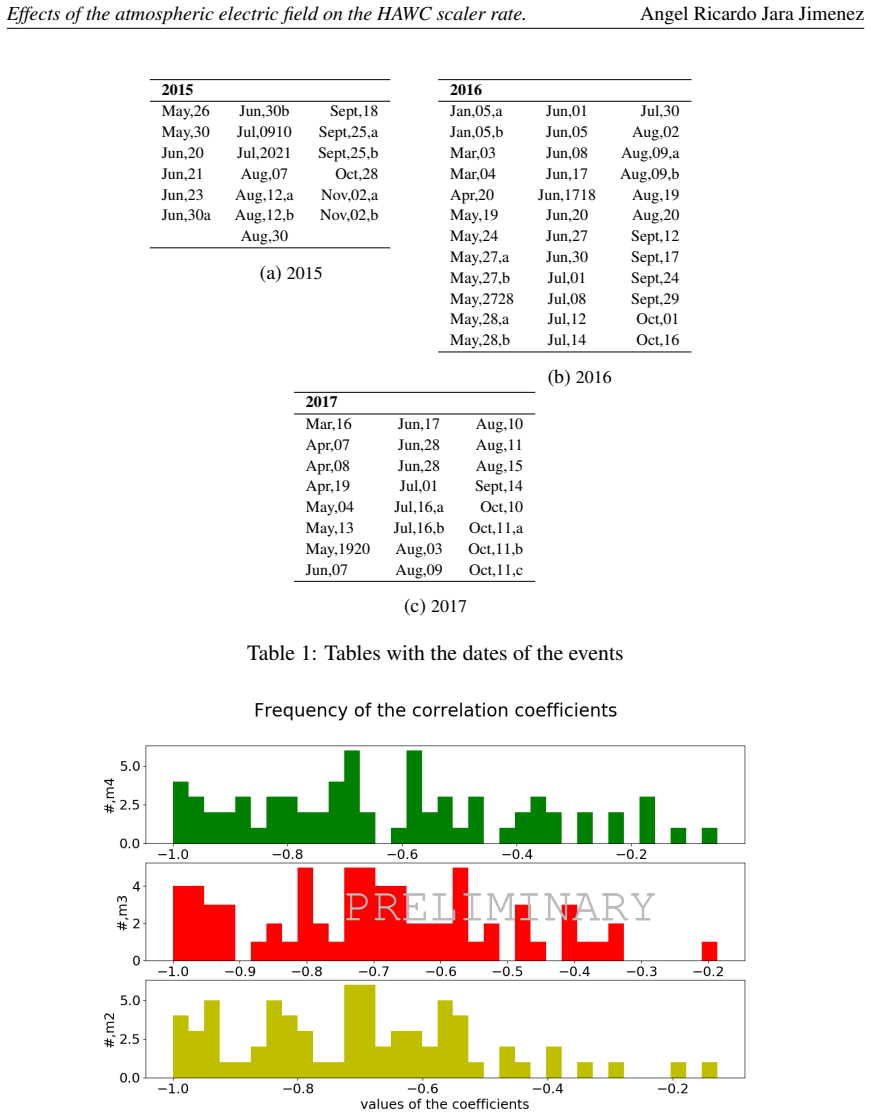
- [Section 4.2 and Fig. 7] No statistical significance is reported for the cross-correlation coefficients, and no control periods are analyzed to show that the correlations exceed chance. With 79 events and a wide scan over time lags from -15 to +15 minutes, some large coefficients are expected by chance alone. The authors should report confidence intervals or p-values for the cross-correlation distribution, compare with shuffled or fair-weather control data, and show the lag distribution of the best fits rather than only a histogram of coefficients.
- [Section 4.2, Eq. (4.1)] The linear fit in Eq. (4.1) is performed only on negative electric-field values, with no stated justification, and the resulting negative slope is used to support the claim of an inverse correlation. This sign restriction is a post hoc data-driven choice; if a two-sided fit over the entire field range gives a different slope or a poor fit, the inference changes. The authors should justify the restriction physically or analyze both signs, and they should report the fit uncertainty and the number of points used.
- [Section 3.2.1 and Section 4.2] The analysis relies on two assumptions that are not tested: that the 5-120 minute duration window separates thunderstorm effects from solar and atmospheric modulation, and that the ground-level Boltek EFM-100 reading represents the in-cloud electric field relevant for particle acceleration. The first assumption affects which events enter the sample, and the second affects the physical interpretation. A robustness check varying the duration window and a brief discussion of the known limitations of ground-level field measurements would substantially increase confidence in the conclusions.
minor comments (5)
- [Throughout] The manuscript contains numerous typographical errors, including 'selfnolmalization', 'fuction', 'reperesentation', 'stadistical', 'seconadary', 'Adquisition', 'accelaration', 'elctric', and 'enhacements'. These should be corrected in a careful revision.
- [Section 3.2, Eq. (3.2)] The threshold in Eq. (3.2) is written as thi = 1 + 5σi, but the text says an event requires the normalized rate to exceed the threshold for 'at least 5 continuous minutes' and in 'at least 30 detectors.' It should be clarified whether σi is the standard deviation of the normalized rate for detector i or of the average, and whether the 30-detector condition applies to every minute of the event.
- [Section 4.1] The smoothing window is described as a 'moving central average with a window of 5 minutes,' but it is not stated whether this is applied before or after the pressure correction and whether the same smoothing is applied to the electric-field data. This affects the cross-correlation results and should be specified.
- [Figure 6] The panel labels in Figure 6 are confusing: the caption reads 'Up to down ,a)Comparison of the average rate with the electric field intensity.b) Comparison of the average rate with the shifted electric field. c)Cross correlation coefficient as a function of time lag.' The panels should be labeled clearly with (a), (b), (c) and the quantities on both axes should be identified.
- [Table 1] Some entries in the event tables contain sublabels such as 'Jun,30b' and 'May,27,a,b', which presumably distinguish multiple events on the same day. The meaning of these sublabels and the criterion for separating same-day events should be explained in the text or table footnote.
Circularity Check
No circularity: the scaler-rate selection is independent of the external electric-field data, and the correlation claim is not constructed from its own output.
full rationale
The paper's event selection (Sec. 3) uses only HAWC scaler rates and a statistical threshold; the Boltek EFM-100 electric-field data are external and are used only after selection for the cross-correlation (Secs. 3.2.2, 4.2). The central result—an inverse correlation between corrected scaler rate and electric-field intensity—is therefore not self-definitional or a fitted input renamed as a prediction. The pressure correction described in Sec. 4.1 is attributed to an unpublished method by coauthor K.P. Arun Babu without coefficients or a reference; this is a transparency/validation weakness and a potential correctness risk, not a circular step, because the correction is not defined in terms of the electric-field correlation it is used to test. The citation [9] to prior HAWC work by an overlapping author (Lara) is background support for previously reported enhancements and is not load-bearing for the present analysis. The paper itself acknowledges in Sec. 5 that further analysis and an inverse verification are needed, which is an explicit limitation rather than a circularity. No equation in the paper reduces to another by construction, and no parameter is fitted to the electric-field data and then claimed as an independent prediction. The correlation coefficients in Fig. 7 are descriptive statistics of the selected events, not outputs derived from the claimed mechanism.
Assumptions & free parameters
free parameters (8)
- threshold coefficient 5 =
5
- minimum duration 5 minutes =
5 min
- maximum duration 120 minutes =
120 min
- minimum detector count 30 =
30 detectors
- cross-correlation lag range =
-15 to +15 minutes
- smoothing window =
5 minutes
- linear-fit sign restriction =
negative E values only
- pressure coefficients per multiplicity =
not stated
assumptions (4)
- domain assumption Relativistic runaway electron avalanche (RREA) accelerates seed electrons in thunderstorm fields.
- domain assumption Boltek EFM-100 electric-field readings are a valid proxy for the in-cloud accelerating field.
- domain assumption The pressure correction removes all barometric modulation from scaler rates.
- ad hoc to paper The 5-120 minute duration cut correctly separates thunderstorm effects from solar and atmospheric modulation.
Cite this review
Pith. "Pith review of Effects of the atmospheric electric field on the HAWC scaler rate." pith.science (2026). https://pith.science/paper/NATVMLBS
@misc{pith2026190807484,
  author       = {Pith},
  title        = {Pith review of: Effects of the atmospheric electric field on the HAWC scaler rate},
  year         = {2026},
  howpublished = {\url{https://pith.science/paper/NATVMLBS}},
  note         = {Machine review of arXiv:1908.07484}
}
read the original abstract
Strong electric fields in thunderclouds have long been known to accelerate secondary charged particles. We investigate this effect using three years (2015-2017) of data from the scalar system of the High Altitude Water Cherenkov (HAWC) observatory, which is an air shower array deployed 4100 m a.s.l. in central Mexico. The experimental site is frequently affected by strong thunderstorms, and the detector's high altitude, large area, and high sensitivity to cosmic-ray air showers make it ideal for investigating particle acceleration due to the electric fields present inside the thunder storm clouds. In particular, the scaler system of HAWC records the output of each one of the 1200 PMTs as well as the 2, 3, and 4-fold multiplicities (logic AND in a time window of 30 ns) of each water Cherenkov detectors (WCD) with a sampling rate of 40 Hz. Using data from this scaler system, we identify approximately 100 increases in the scaler rate which is in time coincidence with thunderstorms. These events show high cross correlation between the scaler rate and the electric field, hence can be produced by the acceleration of secondary particle by the thunderstorm electric fields. In this work we present the method of identification of these events and their general characteristics.
Figures

Figures from the paper (3 more)
Reference graph
Works this paper leans on
-
[9]
Lara, Alejandro and Raga, Graciela and Enríquez-Rivera for the HAWC collaboration, Olivia HAWC response to atmospheric electricity activity, in proceedings of 35th International Cosmic Ray Conference,arXiv:1711.04202 [astro-ph.IM]
-
[1]
C T R Wilson, The electric field of a thundercloud and some of its effects, in proceedings of The Physical Society of London,1924
work page 1924
-
[2]
Coleman, L. M. and Dwyer, J. R., Propagation speed of runaway electron avalanches, Geophysical Research Letters,[2006]
work page 2006
-
[3]
Dwyer, Joseph and M. Smith, David and Cummer, Steven, High-Energy Atmospheric Physics: Terrestrial Gamma-Ray Flashes and Related Phenomena,Space Science Reviews,[2012]
work page 2012
-
[4]
Gurevich, A.V . and Milikh, G.M. and Roussel-Dupre, Robert Runaway electron mechanism of air breakdown and preconditioning during a thunderstorm Physics Letters A,[1992]
work page 1992
-
[5]
Shaw, Glenn E., Background cosmic count increase associated with thunderstorms,Journal of Geophysical Research,[1997]
work page 1997
-
[6]
G. J. Fishman et al., Discovery of Intense Gamma-Ray Flashes of Atmospheric Origin,Science,[1994]
work page 1994
-
[7]
Chilingarian, Ashot, Thunderstorm Ground Enhancements (TGEs) - New High-Energy Phenomenon Originated in the Terrestrial Atmosphere,Journal of Physics Conference Series,[2013]
work page 2013
Show all 13 references
-
[8]
et al., Ground-based observations of thunderstorm-correlated fluxes of high-energy electrons, gamma rays, and neutrons Phys
Chilingarian, A. et al., Ground-based observations of thunderstorm-correlated fluxes of high-energy electrons, gamma rays, and neutrons Phys. Rev. D,[2010]
2010
-
[10]
Abeysekara et al., On the sensitivity of the HAWC observatory to gamma-ray bursts, Astroparticle Physics,[2012]
A.U. Abeysekara et al., On the sensitivity of the HAWC observatory to gamma-ray bursts, Astroparticle Physics,[2012]
2012
-
[11]
Abeysekara et al., Data acquisition architecture and online processing system for the HAWC gamma-ray observatory, Nuclear Instruments and Methods in Physics Research A,[2018]
A.U. Abeysekara et al., Data acquisition architecture and online processing system for the HAWC gamma-ray observatory, Nuclear Instruments and Methods in Physics Research A,[2018]
2018
-
[12]
R. P. Feynman and R.B. Leighton and M. Sands, The Feynman Lecutures on Physics, Mainly Electromagnetism and Matter, Addison-Wesley, 1963
1963
-
[13]
of the HAWC Collaboration,The Calibration System of the HAWC Gamma-Ray Observatory,in proceedings of The 34th International Cosmic Ray Conference,[2016]
Ayala Solares,et al. of the HAWC Collaboration,The Calibration System of the HAWC Gamma-Ray Observatory,in proceedings of The 34th International Cosmic Ray Conference,[2016]. 7
2016
Reviewed August 14, 2026 · model on record in the stance chip above.
Discussion (0). Continue with ORCID to comment.