REVIEW 3 major objections 5 minor 1 cited by
Fractal dimension of critical curves in the $O(n)$-symmetric $\phi^4$-model and crossover exponent at 6-loop order: Loop-erased random walks, self-avoiding walks, Ising, XY and Heisenberg models
T0 review · 3 major / 5 minor · reviewed 2026-08-14 · deepseek-v4-flash
Pith's one-line read A traceless operator insertion gives the fractal dimension of critical curves in the O(n) $\phi^4$ model, matching LERW, SAW, Ising and XY simulations.
desk verdict The six-loop RG calculation is real and worth refereeing, but the geometric interpretation for n>0 is not supported: the reported backbone dimension exceeds the dimension of the all-lines set, and Eq. (40) states mutually incompatible expectations. read the letter →
The pith
A machine-rendered reading of the paper's core claim, the machinery that carries it, and where it could break.
The reading
What carries the argument
The load-bearing object is the renormalized traceless bilinear operator $\tilde E_{ij}=\phi_i\phi_j-\delta_{ij}E$, equivalently its integrated difference form $\tilde E=\frac12\int_y(\phi_1^2-\phi_2^2)$, which acts as a geometric filter: inserted on a propagator line it reproduces the mass-operator insertion, while inserted on a loop it gives zero. Its renormalization factor $Z_{\tilde E}$ defines $\gamma_{\tilde E}=\beta\partial_g\ln Z_{\tilde E}$, and the identity $d_f=2+\gamma_{\tilde E}(g_*)-\eta$ carries the whole argument. The quantitative engine is the six-loop expansion of $\gamma_{\tilde E}$ and of the crossover exponent $\phi_c$, together with a newly proposed self-consistent resummation that fits the asymptotic ratios $b_n/b_{n-1}$ to $a+be^{-cn}$; combining that with the location of $d=2$ singularities fixes the best variables for extrapolation to $d=3$.
What would settle it
A decisive test would be a Monte Carlo measurement of the fractal dimension of the propagator lines of the 3D XY model with error below $10^{-3}$: the paper predicts $d_f=1.7644(10)$, and a statistically significant deviation would falsify the operator-to-geometry identification. A second falsifier is a seven-loop computation of $\gamma_{\tilde E}$: if the resummed value moves away from the six-loop result instead of stabilizing, the series or the correspondence is wrong.
Extended reading notes
Core claim
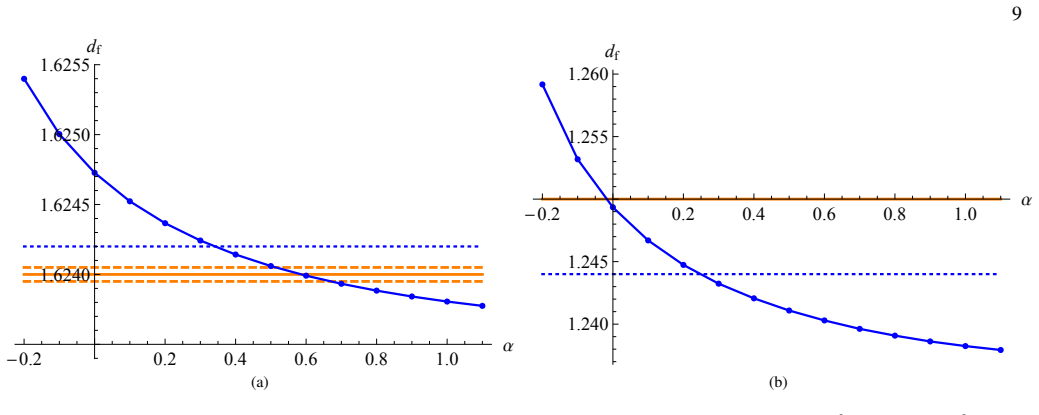
The central claim is a precise operator-to-geometry dictionary. In the renormalized O(n) $\phi^4$ theory, insert the integrated traceless tensor $\tilde E=\frac12\int_y(\phi_1^2-\phi_2^2)$ into a propagator line with a fixed component index: this weights the backbone line exactly as the mass operator does, while on a closed loop, where all indices are summed, it vanishes. The anomalous dimension of $\tilde E$ therefore measures the fractal dimension of the backbone through $d_f=2+\gamma_{\tilde E}(g_*)-\eta$, and the total set of lines, backbone plus loops, has dimension $1/\nu$, so $\phi_c=\nu d_f$ is both a ratio of fractal dimensions and the crossover exponent of a mass anisotropy. The paper evaluates $\gamma_{\tilde E}(g_*)$ explicitly to six-loop order in Eq. (41) and $\phi_c$ to the same order in Eq. (56). In $d=3$, the predictions are $d_f=1.6243(10)$ for loop-erased random walks ($n=-2$), $1.7027(10)$ for self-avoiding walks ($n=0$), $1.7353(10)$ for Ising lines ($n=1$), and $1.7644(10)$ for XY lines ($n=2$), each consistent with high-precision simulations. In $d=2$, independent resummations bracket the exact CFT values such as $5/4$ for LERW, and the paper uses those exact values to choose resummation variables that improve the $d=3$ estimates.
Load-bearing premise
The entire identification of $d_f$ with a field-theory anomalous dimension rests on the assumption that the traceless operator insertion marks exactly the backbone curve and ignores the loops; if that geometric reading fails in three dimensions, the six-loop agreement with simulations would be coincidental.
Editorial extensions
If this is right
- Loop-erased random walks in three dimensions acquire a field-theoretic prediction, $d_f=1.6243(10)$, matching the precise numerical value $1.62400(5)$, so the non-Markovian loop-erasing process is captured by a local $\phi^4$ theory at $n=-2$.
- For self-avoiding walks, backbone and total lines coincide, so $d_f=1/\nu$; the paper's $\nu=0.5874(2)$ is within about $3\times10^{-4}$ of the best simulations.
- The crossover exponent comes out as $\phi_c=1.089(1)$ for Ising ($n=1$) and $1.180(4)$ for XY ($n=2$) in $d=3$, in line with experiments on anisotropic magnets and structural phase transitions.
- Resumming $1/\nu^3$ and $1/\phi_c^{13/4}$, the variables suggested by $d=2$ singularities, yields sharper $d=3$ estimates for $\eta$ and $\omega$ as well as for $d_f$.
Reading between the lines
- The same operator filter could be applied to other nonlocal geometric observables, such as loop-length distributions, intersection counts, or the size of erased loops, by inserting different composite operators into the same six-loop diagrams; the paper does not carry this out.
- Because the paper identifies $\phi_c$ with $\nu d_f$, every experimental or Monte Carlo measurement of the crossover exponent in an anisotropic magnet is implicitly a measurement of the backbone fractal dimension; using the published experimental values collected in the paper would give independent checks of $d_f$ for $n=2,3$.
- The $\epsilon$-expansion extrapolations to $d=2$ scatter by about 0.05 around the exact CFT values; a resummation that builds in the square-root singularity at $n=\pm2$ in the $(d,n)$ plane should collapse that scatter, and the paper lists this as a direction for future work.
Signed reviews
Editorial analysis
A structured set of objections, weighed in public.
Referee Report
Summary. This paper computes the six-loop renormalization-group function γ_\tilde{E} for the traceless bilinear operator in the O(n)-symmetric φ^4 theory in d = 4−ε (Eq. (41)), proposes d_f = 2 + γ_\tilde{E}(g*) − η as the fractal dimension of the 'propagator' or 'backbone' line of critical curves (Eq. (37)), and evaluates d_f for n = −2, 0, 1, 2 in d = 3, claiming agreement with simulations of loop-erased random walks, self-avoiding walks, and Ising and XY propagator lines. The same operator is used to define the crossover exponent φ_c = ν d_f = d_f / d_tot^f with d_tot^f = 1/ν (Eqs. (39), (54)-(55)). A new self-consistent Borel-type resummation (SC) is introduced and combined with the KP17 resummation. The results are cross-checked against the large-n expansion (Section VIII) and against exact d=2 conformal field theory results (Section VI), yielding improved d=3 estimates for d_f, ν, η, ω and φ_c.
Significance. If correct, the paper provides a unified six-loop description of the fractal geometry of O(n) critical lines, and the numerical agreement with independent high-precision simulations is genuinely impressive: LERW 1.6243(10) vs 1.62400(5), SAW 1.7027(10) vs 1.701847(2), Ising 1.7353(10) vs 1.7349(65), XY 1.7644(10) vs 1.7655(20). The verification of the ε-expansion of φ_c against the known O(1/n²) large-n result (Section VIII) is a strong and non-trivial consistency check, as is the stated agreement with Kirkham's four-loop result. The d=2 comparison (5/4, 4/3, 11/8, 3/2) shows that the ε-expansion, pushed to ε=2, captures the correct qualitative trend. The SC scheme is heuristic, but it is cross-validated by the independent KP17 method and by the explicit α-bounds in Fig. 7, and the authors are honest about its limitations. The paper makes falsifiable predictions for d_f and φ_c in d=3 that are directly comparable to simulation and experiment. These strengths make the paper worth publishing, provided the interpretive inconsistency identified below is resolved.
major comments (3)
- [§I, Eqs. (34), (37), (39)-(40), Fig. 2, Table VI] The stress-test concern that the claimed backbone dimension exceeds the all-lines dimension lands, and it is verifiable from the paper's own numbers. Eq. (34) identifies d_tot^f = 1/ν with the fractal dimension of 'all lines' (backbone plus loops), Eq. (37) gives the backbone dimension d_f = 2 + γ_\tilde{E}(g*) − η, and the text before Eq. (40) asserts that the backbone is contained in the union of backbone plus loops. Monotonicity of the fractal dimension then requires d_f ≤ d_tot^f. The reported values violate this for every n>0: for n=1, d_f = 1.7353(10) (Fig. 2) while 1/ν = 1.5883(8) (Table VI); for n=2, d_f = 1.7644(10) while 1/ν = 1.4912(5); equivalently φ_c = νd_f > 1 (Table IV: 1.089(1), 1.180(4), 1.265(5) for n=1,2,3), which is d_f/d_tot^f > 1. This is not a resummation artifact: from the leading term of Eq. (41), γ_\tilde{E} = −2ε/(n+8) + O(ε²), and the standard ν^{-1} = 2 − (n+2)ε/(n+8) + O(ε²), one obtains d_f − d_tot^f = γ_\tilde{E}(g*) − γ_1(g*) = nε/(n+8) + O(ε²) > 0 for n>0 already at one loop. The manuscript is also internally contradictory: Eq. (40) asserts both 'd_tot^f > d_f' and 'φ'_c(n) > 0' with φ_c(0)=1, but since φ_c = d_f/d_tot^f, the first statement implies φ_c < 1 and hence φ'_c(0) < 0. The exact d=2 results are likewise inconsistent with the subset interpretation (Ising: d_f = 11/8 > 1/ν = 1; XY: d_f = 3/2 while ν diverges, Fig. 11). The authors must state which identification, (34) or (37), fails for n>0, explain what geometric object (if any) has dimension 1/ν for n>0, and correct Eq. (40). Until then, the interpretation of d_f for the Ising and XY cases as a geometric fractal dimension of the backbone is unsupported, even though the d_f values themselves agree impressively with the simulations.
- [§II, Eq. (41) and §III] The six-loop function (41) is the central new technical object of the paper, but it is presented without a derivation: no diagram-by-diagram count, no integration method, and no supplementary material is provided for the coefficients involving ζ3,5, ζ5, ζ7 and ζ9. The stated agreement with Kirkham's four-loop result and with the O(1/n²) large-n expansion (Section VIII) checks only low orders and a partial large-n sector, so the ε⁵ and ε⁶ terms at fixed n, which are the genuinely new content, cannot currently be verified from the manuscript. I request that the authors supply the computation in reproducible form (a diagram list with symmetry factors, or a code and data supplement), or at minimum a documented derivation of the non-trivial constants such as the ζ3,5 and ζ3² coefficients.
- [§III, Figs. 2 and 7] The headline d=3 error bars (for example d_f(SAW) = 1.7027(10), d_f(Ising) = 1.7353(10), d_f(XY) = 1.7644(10) in Fig. 2) are produced by the new SC scheme, whose status is explicitly qualified in §III: the text says the error bars 'have to be taken with a grain of salt', and for the LERW case the α-scan yields only a range d_f ∈ [1.62378, 1.6254] from which the central value 1.62426 is taken as the mean (Fig. 7). The paper should specify exactly how the reported uncertainties are derived from the α-bounds (mean, midpoint, or spread), and should discuss whether the d=3 error bars could be underestimated in the same way that the d=2 values are, where different resummation schemes scatter by about 0.05 (Fig. 3). The agreement with simulation is robust enough that this does not change the main conclusions, but the quoted precision currently overstates the rigor of the method.
minor comments (5)
- [Abstract and §I] The abstract ('in agreement with numerical simulations') and the statement in §I that the agreement 'firmly establishes that the appropriate operator was identified' are too strong while the d_f > d_tot^f issue of Major 1 is unresolved; please qualify these claims.
- [§I, Eq. (35) and §IV, Eq. (51)] The symbol \tilde{E} denotes three different objects: the traceless tensor of Eq. (29), the integrated φ_1²−φ_2² insertion of Eq. (35), and the anisotropic mass combination of Eq. (51). The authors acknowledge this, but distinct notations would substantially improve readability.
- [References] References [1], [2], [13] and [22] contain garbled strings ('V olume', 'exponants'); please correct the bibliography entries.
- [Fig. 3] The table in Fig. 3 quotes single-scheme values with single-scheme errors (for example 1.416(1) for Ising in d=2), while the caption states that the overall error is of order 0.05; please make the displayed errors reflect the global estimate, or mark the values clearly as scheme-specific.
- [§VI A and Fig. 13] The discussion of ω is acknowledged to be inconclusive ('It is not even clear whether this is a question which can be answered via CFT'), yet Table VII reports ω values with errors as small as 0.004; a sentence clarifying that ω is not part of the paper's central claims would help prevent overinterpretation.
Circularity Check
No circularity found: the six-loop RG function γ_tildeE is computed independently and the claimed d_f values are benchmarked against external simulations and exact results.
full rationale
The central new quantity, γ_tildeE, is obtained by a standard six-loop renormalization calculation in Eq. (41) from the O(n)-symmetric φ^4 action. The relation d_f = 2 + γ_tildeE(g*) − η in Eq. (37) follows from the multiplicative renormalization of the traceless bilinear insertion in Eqs. (35)–(36) together with the geometric statement that this insertion vanishes when placed on a loop. No parameter is fitted to the predicted fractal dimensions: the self-consistent resummation fits only the assumed large-order form of the already-computed series coefficients in Eqs. (43)–(46), not any target exponent or simulation value. The n = −2 LERW identification cites the authors' earlier work [43,44], but that mapping is not the only evidence: in d = 2 it is independently known via SLE/integrability, and in d = 3 the prediction is checked against the external numerical value d_f = 1.62400(5) of Wilson [45]. The self-citation is therefore not an unverified load-bearing premise. The comparisons to CFT, conformal bootstrap, Monte Carlo data, experiments, and the large-n expansion are all external benchmarks. The possible geometric inconsistency d_f > 1/ν for n > 0 would be a correctness or interpretation concern, not a circular reduction: γ_tildeE is not defined as d_f, and Eq. (37) is an identification that could fail empirically rather than a tautology. Thus no equation or fitted parameter makes a 'prediction' equal to its own input by construction.
Assumptions & free parameters
free parameters (2)
- SC resummation parameters a, b, c =
not tabulated
- SC resummation exponent alpha =
scanned over the range where the exponential fit exists
assumptions (7)
- domain assumption The O(n) symmetric phi^4 theory is perturbatively renormalizable in d=4-epsilon and the IR fixed point controls critical behavior.
- domain assumption Analytic continuation in n to n=-2 and n=0 is valid for the O(n) model.
- ad hoc to paper The traceless bilinear operator tilde E is multiplicatively renormalizable and its insertion counts the backbone line.
- ad hoc to paper Series coefficients of critical exponents have the asymptotic form b_n = c_0 a^n n! n^alpha with delta a(n) = b exp(-c n).
- domain assumption The d=2 exact results from CFT, Eqs. (99)-(102), are valid and can serve as benchmarks.
- domain assumption The mapping n=-2 to loop-erased random walks in all dimensions is correct.
- standard math The large-n expansion of the crossover exponent to O(1/n^2) is correct.
Cite this review
Pith. "Pith review of Fractal dimension of critical curves in the $O(n)$-symmetric $\phi^4$-model and crossover exponent at 6-loop order: Loop-erased random walks, self-avoiding walks, Ising, XY and Heisenberg models." pith.science (2026). https://pith.science/paper/QOE6SANT
@misc{pith2026190807502,
  author       = {Pith},
  title        = {Pith review of: Fractal dimension of critical curves in the $O(n)$-symmetric $\phi^4$-model and crossover exponent at 6-loop order: Loop-erased random walks, self-avoiding walks, Ising, XY and Heisenberg models},
  year         = {2026},
  howpublished = {\url{https://pith.science/paper/QOE6SANT}},
  note         = {Machine review of arXiv:1908.07502}
}
abstract
We calculate the fractal dimension $d_{\rm f}$ of critical curves in the $O(n)$ symmetric $(\vec \phi^2)^2$-theory in $d=4-\varepsilon$ dimensions at 6-loop order. This gives the fractal dimension of loop-erased random walks at $n=-2$, self-avoiding walks ($n=0$), Ising lines $(n=1)$, and XY lines ($n=2$), in agreement with numerical simulations. It can be compared to the fractal dimension $d_{\rm f}^{\rm tot}$ of all lines, i.e. backbone plus the surrounding loops, identical to $d_{\rm f}^{\rm tot} = 1/\nu$. The combination $\phi_{\rm c}= d_{\rm f}/d_{\rm f}^{\rm tot} = \nu d_{\rm f}$ is the crossover exponent, describing a system with mass anisotropy. Introducing a novel self-consistent resummation procedure, and combining it with analytic results in $d=2$ allows us to give improved estimates in $d=3$ for all relevant exponents at 6-loop order.
Figures


Figures from the paper (10 more)




Forward citations
Cited by 1 Pith paper
-
Depinning transition of charge-density waves: mapping onto $O(n)$ symmetric $\phi^4$ theory with $n\to -2$ and loop-erased random walks
The depinning of charge-density waves and loop-erased random walks are both shown to be governed by O(n=-2) phi^4 theory, giving a high-precision dynamic exponent.
Reference graph
Works this paper leans on
-
[1]
outsider
The thick black line is a line of first-order phase transi- tions. 1 2 3 4 d 0.2 0.4 0.6 0.8 ϕc′(0) FIG. 9. Slope of the crossover exponent at n = 0 for dimensions 0≤d≤ 4. The black cross is the analytic result from Eq. (102) in d = 2. sion and numerics are φSC c (d = 3,n = 1) = 1.089(1) (62) φSC c (d = 3,n = 2) = 1.180(4) (63) φSC c (d = 3,n = 3) = 1.265(...
-
[2]
Itzykson and J.-M
C. Itzykson and J.-M. Drouffe, Statistical Field Theory , V ol- ume 1 of Cambridge Monographs on Mathematical Physics , Cambridge University Press, 1989
1989
-
[3]
Itzykson and J.-M
C. Itzykson and J.-M. Drouffe, Statistical Field Theory , V ol- ume 2 of Cambridge Monographs on Mathematical Physics , Cambridge University Press, 1989
1989
-
[4]
H. Arisue and T. Fujiwara, New algorithm of the high- temperature expansion for the Ising model in three dimensions, Nucl. Phys. B Proc. Suppl. 119 (2003) 855–857
work page 2003
- [5]
-
[6]
P. Butera and M. Comi, Extended high-temperature series for the n-vector spin models on three-dimensional bipartite lattices, Phys. Rev. B 52 (1995) 6185–6188
work page 1995
-
[7]
P. Butera and M. Comi, Extension to order β23 of the high- temperature expansions for the spin- 1 2 Ising model on simple cubic and body-centered cubic lattices, Phys. Rev. B 62 (2000) 14837–14843
work page 2000
-
[8]
P. Butera and M. Comi, Critical specific heats of the N-vector spin models on the simple cubic and bcc lattices, Phys. Rev. B 60 (1999) 6749–6760
work page 1999
Show all 83 references
-
[9]
Batkovich, K.G
D.V . Batkovich, K.G. Chetyrkin and M.V . Kompaniets,Six loop analytical calculation of the field anomalous dimension and the critical exponentη inO(n)-symmetricϕ4 model, Nucl. Phys. B 906 (2016) 147, arXiv:1601.01960
2016 arXiv
-
[10]
Kompaniets and E
M.V . Kompaniets and E. Panzer, in Proceedings of Loops and Legs in Quantum Field Theory , Sissa Medialab, 2016, arXiv:1606.09210
2016 arXiv
-
[11]
Kompaniets and E
M.V . Kompaniets and E. Panzer,Minimally subtracted six-loop renormalization ofO(n)-symmetricφ4 theory and critical ex- ponents, Phys. Rev. D 96 (2017) 036016, arXiv:1705.06483
2017 arXiv
-
[12]
Amit and V
D.J. Amit and V . Martin-Mayor, Field Theory, the Renormal- ization Group, and Critical Phenomena, World Scientific, Sin- gapore, 3rd edition, 1984
1984
-
[13]
Zinn-Justin, Quantum Field Theory and Critical Phenomena, Oxford University Press, Oxford, 1989
J. Zinn-Justin, Quantum Field Theory and Critical Phenomena, Oxford University Press, Oxford, 1989
1989
-
[14]
Vasil’ev, The Field Theoretic Renormalization Group in Critical Behavior Theory and Stochastic Dynamics , Chapman & Hall/CRC, New York, 2004
A.N. Vasil’ev, The Field Theoretic Renormalization Group in Critical Behavior Theory and Stochastic Dynamics , Chapman & Hall/CRC, New York, 2004
2004
-
[15]
Chetyrkin, A.L
K.G. Chetyrkin, A.L. Kataev and F.V . Tkachov, Five-loop cal- culations in thegϕ4 model and the critical indexη, Phys. Lett. B 99 (1981) 147–150
1981
-
[16]
K. G. Chetyrkin, A. L. Kataev and F. V . Tkachov,Errata, Phys. Lett. B 101 (1981) 457–458
1981
-
[17]
K. G. Chetyrkin, S. G. Gorishny, S. A. Larin and F. V . Tka- chov, Five-loop renormalization group calculations in thegϕ4 theory, Phys. Lett. B 132 (1983) 351–354
1983
-
[18]
D. I. Kazakov, The method of uniqueness, a new powerful tech- nique for multiloop calculations, Phys. Lett. B 133 (1983) 406– 410
1983
-
[19]
Kleinert, J
H. Kleinert, J. Neu, V . Schulte-Frohlinde, K.G. Chetyrkin and S.A. Larin, Five-loop renormalization group functions ofO(n)- symmetricφ4-theory andϵ-expansions of critical exponents up toϵ5, Phys. Lett. B 272 (1991) 39–44, hep-th/9503230. 16
1991 arXiv
-
[20]
Schnetz, Numbers and functions in quantum field theory , Phys
O. Schnetz, Numbers and functions in quantum field theory , Phys. Rev. D 97 (2018) 085018
2018
-
[21]
Parisi, Statistical Field Theory , Frontiers in Physics, Addison-Wesley, 1988
G. Parisi, Statistical Field Theory , Frontiers in Physics, Addison-Wesley, 1988
1988
-
[22]
Baker, B.G
G.A. Baker, B.G. Nickel, M.S. Green and D.I. Meiron, Ising- model critical indices in three dimensions from the Callan- Symanzik equation, Phys. Rev. Lett. 36 (1976) 1351–1354
1976
-
[23]
Guida and J
R. Guida and J. Zinn-Justin, Critical exponts of the N-vector model, J.Phys. A 31 (1998) 8103, cond-mat/9803240
1998 arXiv
-
[24]
Clisby, Scale-free Monte Carlo method for calculating the critical exponentγ of self-avoiding walks, J
N. Clisby, Scale-free Monte Carlo method for calculating the critical exponentγ of self-avoiding walks, J. Phys. A 50 (2017) 264003, arXiv:1701.08415
2017 arXiv
-
[25]
Clisby and B
N. Clisby and B. D ¨unweg, High-precision estimate of the hy- drodynamic radius for self-avoiding walks , Phys. Rev. E 94 (2016) 052102
2016
-
[26]
Campostrini, M
M. Campostrini, M. Hasenbusch, A. Pelissetto and E. Vicari, Theoretical estimates of the critical exponents of the superfluid transition in 4He by lattice methods , Phys. Rev. B 74 (2006) 144506, cond-mat/0605083
2006 arXiv
-
[27]
Hasenbusch and E
M. Hasenbusch and E. Vicari, Anisotropic perturbations in three-dimensionalO(N)-symmetric vector models, Phys. Rev. B 84 (2011) 125136, 1108.0491
2011 arXiv
-
[28]
Deng, Bulk and surface phase transitions in the three- dimensionalO(4) spin model, Phys
Y . Deng, Bulk and surface phase transitions in the three- dimensionalO(4) spin model, Phys. Rev. E 73 (2006) 056116
2006
-
[29]
Nienhuis, Coulomb Gas Formulation of Two-dimensional Phase Transitions, V olume11 of Phase Transitions and Critical Phenomena, Academic Press, London, 1987
B. Nienhuis, Coulomb Gas Formulation of Two-dimensional Phase Transitions, V olume11 of Phase Transitions and Critical Phenomena, Academic Press, London, 1987
1987
-
[30]
Henkel, Conformal Invariance and Critical Phenomena , Springer, Berlin, Heidelberg, 1999
M. Henkel, Conformal Invariance and Critical Phenomena , Springer, Berlin, Heidelberg, 1999
1999
-
[31]
Di Francesco, P
P. Di Francesco, P. Mathieu and D. S ´en´echal, Conformal Field Theory, Springer, New York, 1997
1997
-
[32]
Nishimori and G
H. Nishimori and G. Ortiz, Elements of phase transitions and critical phenomena, Oxford University Press, 2011
2011
-
[33]
Poland, S
D. Poland, S. Rychkov and A. Vichi, The conformal boot- strap: Theory, numerical techniques, and applications , Rev. Mod. Phys. 91 (2019) 015002
2019
-
[34]
F. Kos, D. Poland, D. Simmons-Duffin and A. Vichi, Precision islands in the Ising and O(N) models, JHEP 08 (2016) 036, arXiv:1603.04436
2016 arXiv
-
[35]
El-Showk, M
S. El-Showk, M. F. Paulos, D. Poland, S. Rychkov, D. Simmons-Duffin and A. Vichi, Solving the 3d Ising model with the conformal bootstrap ii.c-minimization and pre- cise critical exponents , J. Stat. Phys. 157 (2014) 869–914, arXiv:1403.4545
2014 arXiv
-
[36]
Castedo Echeverri, B
A. Castedo Echeverri, B. von Harling and M. Serone, The ef- fective bootstrap, JHEP 09 (2016) 097, arXiv:1606.02771
2016 arXiv
-
[37]
Guttmann
A.J. Guttmann. V olume 13 of Phase Transitions and Critical Phenomena, Academic Press, London, 1987
1987
-
[38]
Zinn-Justin, Precise determination of critical exponents and equation of state by field theory methods, Phys
J. Zinn-Justin, Precise determination of critical exponents and equation of state by field theory methods, Phys. Rep. 344 (2001) 159–178
2001
-
[39]
’t Hooft and M
G. ’t Hooft and M. Veltman, Regularization and renormaliza- tion of gauge fields, Nucl. Phys. B 44 (1972) 189 – 213
1972
-
[40]
Lawler, A self-avoiding random walk , Duke Math
G.F. Lawler, A self-avoiding random walk , Duke Math. J. 47 (1980) 655–693
1980
-
[41]
Falconer, The Geometry of Fractal Sets, Cambridge Uni- versity Press, Cambridge, U.K., 1986
K.J. Falconer, The Geometry of Fractal Sets, Cambridge Uni- versity Press, Cambridge, U.K., 1986
1986
-
[42]
Lawler, O
G.F. Lawler, O. Schramm and W. Werner, Conformal invariance of planar loop-erased random walks and uni- form spanning trees , Ann. Probab. 32 (2004) 939–995, arXiv:math/0112234
2004 arXiv
-
[43]
De Gennes, Exponents for the excluded volume problem as derived by the Wilson method, Phys
P.-G. De Gennes, Exponents for the excluded volume problem as derived by the Wilson method, Phys. Lett. A 38 (1972) 339– 340
1972
-
[44]
Wiese and A.A
K.J. Wiese and A.A. Fedorenko, Field theories for loop- erased random walks , Nucl. Phys. B 946 (2019) 114696, arXiv:1802.08830
2019 arXiv
-
[45]
Wiese and A.A
K.J. Wiese and A.A. Fedorenko, Depinning transition of charge-density waves: Mapping onto O(n) symmetricφ4 the- ory with n→− 2 and loop-erased random walks, Phys. Rev. Lett. 123 (2019) 197601, arXiv:1908.11721
2019 arXiv
-
[46]
Wilson, Dimension of the loop-erased random walk in three dimensions , Phys
D.B. Wilson, Dimension of the loop-erased random walk in three dimensions , Phys. Rev. E 82 (2010) 062102, arXiv:1008.1147
2010 arXiv
-
[47]
Winter, W
F. Winter, W. Janke and A.M.J. Schakel, Geometric properties of the three-dimensional Ising and XY models, Phys. Rev. E 77 (2008) 061108, arXiv:0803.2177
2008 arXiv
-
[48]
Hausdorff di- mension of critical fluctuations in Abelian gauge theories
N. Prokof’ev and B. Svistunov, Comment on “Hausdorff di- mension of critical fluctuations in Abelian gauge theories” , Phys. Rev. Lett. 96 (2006) 219701
2006
-
[49]
Kirkham, Calculation of crossover exponent from Heisen- berg to Ising behaviour using the fourth-order ϵ expansion, J
J.E. Kirkham, Calculation of crossover exponent from Heisen- berg to Ising behaviour using the fourth-order ϵ expansion, J. Phys. A 14 (1981) L437–L442
1981
-
[50]
J. A. Gracey, Crossover exponent in O(N) ϕ4 theory at O(1/N2), Phys. Rev. E 66 (2002) 027102
2002
-
[51]
Shimada and S
H. Shimada and S. Hikami, Fractal dimensions of self-avoiding walks and Ising high-temperature graphs in 3d conformal boot- strap, J. Stat. Phys 165 (2016) 1006–1035, arXiv:1509.04039
2016 arXiv
-
[52]
Kleinert, Variational resummation forϵ-expansions of crit- ical exponents of nonlinear O(n)-symmetricσ-model in 2 +ϵ dimensions, Phys
H. Kleinert, Variational resummation forϵ-expansions of crit- ical exponents of nonlinear O(n)-symmetricσ-model in 2 +ϵ dimensions, Phys. Lett. A 264 (2000) 357–365
2000
-
[53]
Kiskis, R
J. Kiskis, R. Narayanan and P. Vranas, The Hausdorff dimen- sion of random walks and the correlation length critical expo- nent in Euclidean field theory, J. Stat. Phys. 73 (1993) 765–774
1993
-
[54]
Rohrer and Ch
H. Rohrer and Ch. Gerber, Bicritical and tetracritical behavior of GdAlO3, Phys. Rev. Lett. 38 (1977) 909–912
1977
-
[55]
Domann, Optical measurements on TbPO4 near the bicrit- ical point, J
G. Domann, Optical measurements on TbPO4 near the bicrit- ical point, J. Magn. Magn. Mater. 13 (1979) 163–166
1979
-
[56]
Majkrzak, J.D
C.F. Majkrzak, J.D. Axe and A.D. Bruce, Critical behavior at the incommensurate structural phase transition in K2SeO4, Phys. Rev. B 22 (1980) 5278–5283
1980
-
[57]
Walisch, J
R. Walisch, J. M. Perez-Mato and J. Petersson, NMR determi- nation of the nonclassical critical exponentsβ and ¯β in incom- mensurate Rb2ZnCl4, Phys. Rev. B 40 (1989) 10747–10752
1989
-
[58]
Young, Y
Lei Wu, M.J. Young, Y . Shao, C.W. Garland, R.J. Birgeneau and G. Heppke, Critical behavior of the second harmonic in a density wave system, Phys. Rev. Lett. 72 (1994) 376–379
1994
-
[59]
Shapira and N
Y . Shapira and N. F. Oliveira, Crossover behavior of the magnetic phase boundary of the isotropic antiferromagnet RbMnF3 from ultrasonic measurements , Phys. Rev. B 17 (1978) 4432–4443
1978
-
[60]
A. R. King and H. Rohrer, Spin-flop bicritical point in MnF2, Phys. Rev. B 19 (1979) 5864–5876
1979
-
[61]
Zhang, A unified theory based on SO(5) symmetry of su- perconductivity and antiferromagnetism , Science 275 (1997) 1089–1096
S.-C. Zhang, A unified theory based on SO(5) symmetry of su- perconductivity and antiferromagnetism , Science 275 (1997) 1089–1096
1997
-
[62]
Hu, Bicritical and tetracritical phenomena and scaling properties of the SO(5) theory , Phys
X. Hu, Bicritical and tetracritical phenomena and scaling properties of the SO(5) theory , Phys. Rev. Lett. 87 (2001) 057004
2001
-
[63]
Hu, Hu replies, Phys
X. Hu, Hu replies, Phys. Rev. Lett. 88 (2002) 059704
2002
-
[64]
Bicritical and tetracritical phenom- ena and scaling properties of the SO(5) theory
A. Aharony, Comment on “Bicritical and tetracritical phenom- ena and scaling properties of the SO(5) theory” , Phys. Rev. Lett. 88 (2002) 059703
2002
-
[65]
Pfeuty, D
P. Pfeuty, D. Jasnow and M.E. Fisher, Crossover scaling func- tions for exchange anisotropy, Phys. Rev. B 10 (1974) 2088– 2112
1974
-
[66]
Calabrese, A
P. Calabrese, A. Pelissetto and E. Vicari, Critical structure fac- tors of bilinear fields in O(N) vector models, Phys. Rev. E 65 17 (2002) 046115
2002
-
[67]
Eichhorn, D
A. Eichhorn, D. Mesterh ´azy and M.M. Scherer, Multicriti- cal behavior in models with two competing order parameters , Phys. Rev. E 88 (2013) 042141
2013
-
[68]
Sapozhnikov and D
A. Sapozhnikov and D. Shiraishi, On Brownian motion, simple paths, and loops, Probab. Th. Rel. Fields 172 (2018) 615–662, arXiv:1512.04864
2018 arXiv
-
[69]
Nienhuis, Exact critical point and critical exponents ofO(n) models in two dimensions , Phys
B. Nienhuis, Exact critical point and critical exponents ofO(n) models in two dimensions , Phys. Rev. Lett. 49 (1982) 1062– 1065
1982
-
[70]
Duplantier, Loop-erased self-avoiding walks in two dimen- sions: exact critical exponents and winding numbers , Physica A 191 (1992) 516–522
B. Duplantier, Loop-erased self-avoiding walks in two dimen- sions: exact critical exponents and winding numbers , Physica A 191 (1992) 516–522
1992
-
[71]
Lyklema, C
J.W. Lyklema, C. Evertsz and L. Pietronero, The Laplacian random walk, EPL 2 (1986) 77
1986
-
[72]
Lawler, The Laplacian-b random walk and the Schramm- Loewner evolution, Illinois J
G.F. Lawler, The Laplacian-b random walk and the Schramm- Loewner evolution, Illinois J. Math. 50 (2006) 701–746
2006
-
[73]
Cardy, SLE for theoretical physicists, Annals of Physics 318 (2005) 81–118, cond-mat/0503313v2
J. Cardy, SLE for theoretical physicists, Annals of Physics 318 (2005) 81–118, cond-mat/0503313v2
2005 arXiv
-
[74]
Belavin, A.M
A.A. Belavin, A.M. Polyakov and A.B. Zamolodchikov,Infinite conformal symmetry in two-dimensional quantum field theory , Nucl. Phys. B 241 (1984) 333–380
1984
-
[75]
Vl. S. Dotsenko, S´erie de cours sur la th ´eorie conforme, Lec- ture notes, Universit´es Paris VI and VII
-
[76]
Janke and A.M.J
W. Janke and A.M.J. Schakel, Holographic interpretation of two-dimensional O(N) models coupled to quantum gravity , (2010), arXiv:1003.2878
2010 arXiv
-
[77]
Rushkin, E
I. Rushkin, E. Bettelheim, I.A. Gruzberg and P. Wiegmann, Critical curves in conformally invariant statistical systems , J. Phys. A 40 (2007) 2165–2195, cond-mat/0610550
2007 arXiv
-
[78]
Bl ¨ote, Y .M.M
H.W.J. Bl ¨ote, Y .M.M. Knops and B. Nienhuis, Geometrical aspects of critical Ising configurations in 2 dimensions , Phys. Rev. Lett. 68 (1992) 3440–3443
1992
-
[79]
Barouch, B.M
E. Barouch, B.M. McCoy and T.T. Wu,Zero-field susceptibility of the two-dimensional ising model nearTc, Phys. Rev. Lett.31 (1973) 1409–1411
1973
-
[80]
Calabrese, M
P. Calabrese, M. Caselle, A. Celi, A. Pelissetto and E. Vi- cari, Non-analyticity of the Callan-Symanzikβ-function of two- dimensionalO(N) models, J. Phys. A 33 (2000) 8155–8170
2000
-
[81]
Cardy, TT deformations of non-Lorentz invariant field theo- ries, JHEP 10 (2018) 186, arXiv:1809.07849
J. Cardy, TT deformations of non-Lorentz invariant field theo- ries, JHEP 10 (2018) 186, arXiv:1809.07849
2018 arXiv
-
[82]
Belohorec, Renormalization group calculation of the uni- versal critical exponents of a polymer molecule , PhD thesis, University of Guelph, Ontario, Canada, 1997
P. Belohorec, Renormalization group calculation of the uni- versal critical exponents of a polymer molecule , PhD thesis, University of Guelph, Ontario, Canada, 1997
1997
-
[83]
Campostrini, M
M. Campostrini, M. Hasenbusch, A. Pelissetto, P. Rossi and E. Vicari, Critical exponents and equation of state of the three- dimensional Heisenberg universality class , Phys. Rev. B 65 (2002) 144520, cond-mat/0110336
2002 arXiv
Reviewed August 14, 2026 · model on record in the stance chip above.
Discussion (0). Continue with ORCID to comment.