REVIEW 3 major objections 5 minor 2 cited by
Long-Range Prethermal Phases of Nonequilibrium Matter
T0 review · 3 major / 5 minor · reviewed 2026-08-14 · deepseek-v4-flash
Pith's one-line read Long-range periodically driven systems can host prethermal phases of matter for any power-law exponent $\alpha>d$, including a disorder-free one-dimensional prethermal time crystal.
desk verdict Real new construction, solid numerics; abstract overstates what is proven for d<alpha<2d. read the letter →
The pith
A machine-rendered reading of the paper's core claim, the machinery that carries it, and where it could break.
The reading
What carries the argument
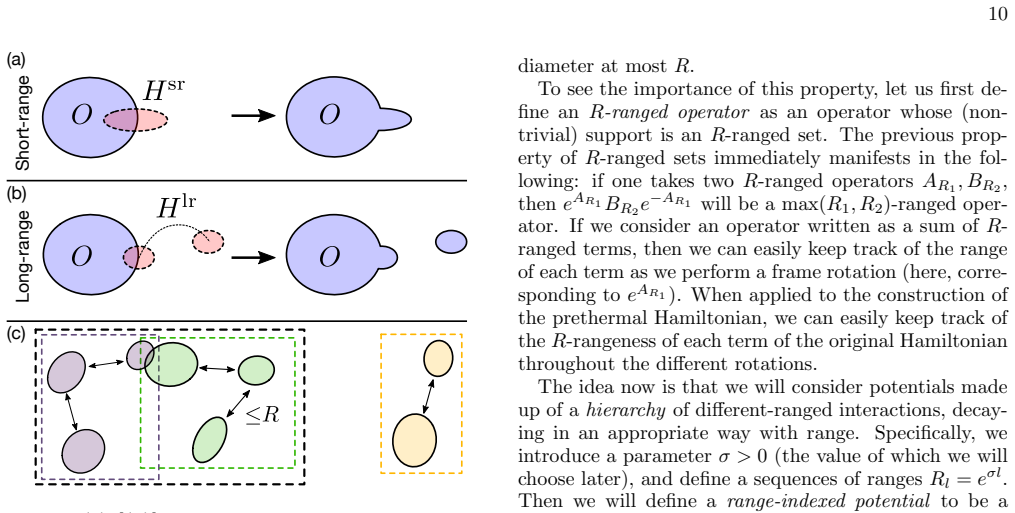
The load-bearing object is a class of range-indexed potentials built from $R$-ranged sets: a set of lattice sites is $R$-ranged if any two of its sites can be joined by a chain of in-set hops of length at most $R$. Hamiltonian terms are organized by range $R_l=e^{\sigma l}$ and weighted by a two-parameter norm that penalizes support size exponentially and spatial range as a power law. Iterating the frame-rotation construction for prethermalization while tracking this norm shows that $D^*$, $E^*$, and $V^*(t)$ inherit the original power-law decay, so the prethermal Hamiltonian stays local in the relevant sense. For $\gamma>d$, this makes a power-law-light-cone Lieb-Robinson bound applicable, which is what upgrades energy conservation to genuine approximation of local observables. For $\gamma<d$, only a short-time estimate follows, and the phase argument rests on the assumption that the system thermalizes to the canonical ensemble of $D^*$.
What would settle it
Prepare the one-dimensional long-range Floquet spin chain described in the paper with $1<\alpha<2$, choose an initial state below the ferromagnetic critical energy density, and measure the period-doubling magnetization and a local observable's evolution for times up to $e^{\omega/J}$. If the exact Floquet dynamics deviate from the evolution generated by $D^*$ on a time scale much shorter than the heating time, or if the period-doubling order decays at the prethermalization time instead of surviving to $\tau_*\sim e^{\omega/J}$, the central claim is falsified. More directly, compare the local reduced state at intermediate times with the canonical ensemble of $D^*$ at the initial energy density; a mismatch in the $d<\alpha<2d$ regime disproves the assumed relaxation.
Extended reading notes
Core claim
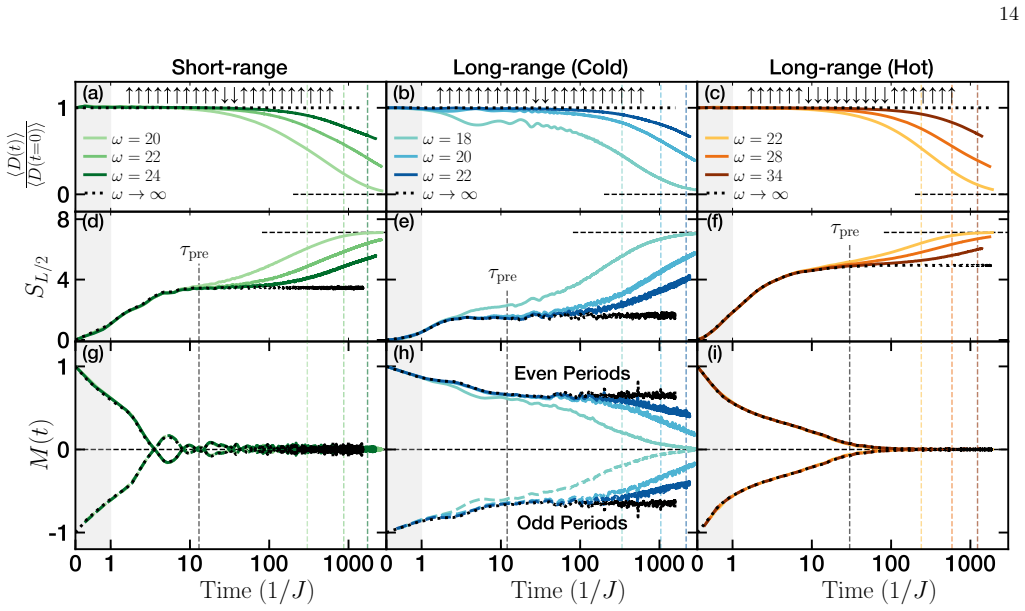
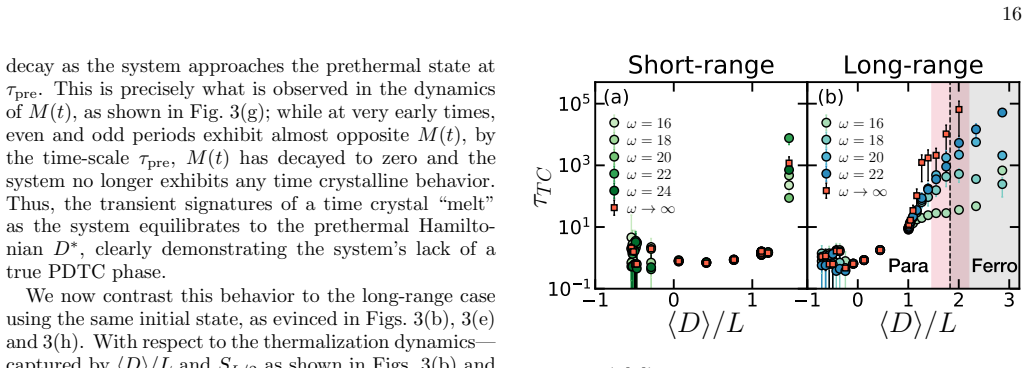
The central claim is that Floquet prethermalization extends to long-range power-law interacting systems: for $\alpha>d$, the system possesses a prethermal Hamiltonian $D^*$ whose energy is conserved for an exponentially long time, and which, for $\alpha>2d$, also correctly generates the dynamics of local observables throughout the prethermal window. For $d<\alpha<2d$, the paper proves only short-time accuracy of local dynamics and assumes that local observables relax to the canonical ensemble of $D^*$ because that state maximizes entropy under the conserved energy. Under that assumption, prethermal phases exist for all $\alpha>d$. The paper further predicts that in one dimension with $1<\alpha<2$, where the prethermal Hamiltonian has a finite-temperature ferromagnetic transition, the driven system realizes a disorder-free prethermal discrete time crystal whose period-doubling order survives until the heating time $\tau_*\sim e^{\omega/J}$, rather than melting at the prethermalization time.
Load-bearing premise
The load-bearing premise is that, for $d<\alpha<2d$, local observables in the prethermal window relax to the thermal equilibrium state of the prethermal Hamiltonian because that state maximizes entropy under the conserved energy; the paper proves only short-time accuracy in this regime, so if that relaxation fails, the existence proof for these phases, including the one-dimensional disorder-free prethermal time crystal, does not go through.
Editorial extensions
If this is right
- For $\alpha>2d$, long-range Floquet systems will host prethermal phases whose local dynamics are generated by $D^*$ for exponentially long times, with no disorder or many-body localization required.
- In finite-size systems, the paper proves prethermal phases for every $\alpha>d$ without the relaxation assumption, provided the drive frequency is large compared with the logarithm of the system volume.
- A one-dimensional spin chain with interactions $\propto |i-j|^{-\alpha}$, $1<\alpha<2$, should show period doubling that survives until the heating time whenever the initial state has energy density below the ferromagnetic critical value.
- The prethermal time crystal and the trivial phase are separated by a sharp transition in initial energy density, unlike the MBL time crystal, which exists for generic initial states.
- Platforms with power-law interactions, such as trapped-ion-style spin chains, can in principle observe the prethermal time crystal without introducing disorder.
Reading between the lines
- If the assumed relaxation in the $d<\alpha<2d$ window is confirmed, the same range-indexed construction should carry other prethermal phases, including symmetry-protected topological order, to long-range interactions.
- The same technique extends to undriven static systems with a near-integer spectral operator, so a prethermal continuous time crystal should also exist in long-range interacting systems.
- One clean test of the assumption is to compare the reduced density matrix of a small subsystem under exact Floquet evolution with the canonical ensemble of $D^*$ at the same energy density; agreement only for $\alpha>2d$ and breakdown in $1<\alpha<2$ would mark exactly where the proof relies on unproven relaxation.
- The two-parameter norm may be useful beyond driven systems, wherever few-body terms act across arbitrarily large distances and one needs separate control of support size and spatial range.
Editorial analysis
A structured set of objections, weighed in public.
Referee Report
Summary. The paper develops an analytic construction of a prethermal Floquet Hamiltonian D* for periodically driven, long-range interacting systems, while keeping track of the spatial locality of the interactions. Theorem 1 provides a locality-preserving rotation such that the driven evolution is exponentially well approximated by X exp(-iD*T). Theorem 2 proves that local observables follow D* throughout the prethermal window when the effective range exponent satisfies gamma* > d, which for two-body power-law interactions corresponds to alpha > 2d. Theorem 3 gives a short-time approximation for d < alpha < 2d, and the paper argues that in this regime local observables should relax to the Gibbs state of D* by entropy maximization under approximate energy conservation. The authors also present Krylov-subspace numerics for a one-dimensional long-range spin chain, reporting a disorder-free prethermal discrete time crystal for 1 < alpha < 2, together with quantum Monte Carlo estimates of the energy-density transition. The abstract and conclusion claim a proof of prethermal phases for all alpha > d.
Significance. If the analytic results are correct, this is a substantial step: it extends the emergent-symmetry framework for prethermal Floquet phases from short-range to long-range interactions, and it explains why a disorder-free one-dimensional prethermal discrete time crystal can exist. The paper's strengths include the explicit R-ranged operator formalism, the improved short-range iteration with n* free of logarithmic corrections, the detailed bounds in Appendices A-D, and the large-scale numerical study with independent QMC input. However, the rigorous proof of local-dynamics approximation is confined to alpha > 2d; the flagship 1 < alpha < 2 prediction rests on an explicitly stated but unproved entropy-maximization/Gibbs-relaxation assumption. The manuscript would be fully appropriate for publication once the claims are restated precisely and the conditional nature of the d < alpha < 2d phase is acknowledged in the abstract and conclusion.
major comments (3)
- [Abstract; Sec. II.3; Sec. III.4.3; Conclusion] The headline claim "we prove the existence of non-equilibrium phases ... with power-law exponent alpha > d" is not supported by the theorems as stated. Theorem 2 (Sec. III.4.2, Eq. (40)) requires gamma* > d, which for two-body power-law interactions corresponds to alpha > 2d. In the complementary regime d < alpha < 2d, Theorem 3 (Sec. III.4.3, Eq. (41)) bounds local observables only for m lambda <= C7, i.e. a few periods, and the extension to the full prethermal window explicitly invokes the unproven assumption that local observables relax to the Gibbs state of D* (Sec. II.3; star in Fig. 1(c)). The 1D PDTC prediction lives precisely in 1 < alpha < 2, so the abstract and conclusion overstate the rigorous content. I recommend rewording the claim to "prove for alpha > 2d and predict, under a stated entropy-maximization assumption, for d < alpha < 2d."
- [Sec. II.1 and Sec. III.4.3] Even granting the Gibbs-relaxation assumption, the argument that the system exhibits period-doubled magnetization until tau* requires that the prethermal dynamics select a single symmetry-breaking sector of D*. The paper asserts this in Sec. II.1 ("rho can instead approach the equilibrium state within a particular symmetry-breaking sector"), but supplies no argument for why the driven dynamics, which has the symmetric Gibbs state as a fixed point of X exp(-iD*T), breaks this symmetry in the thermodynamic limit within the prethermal window. Since this sector selection is the mechanism underlying the PDTC, it should be explicitly identified as part of the conjecture for d < alpha < 2d rather than presented as an immediate consequence of energy conservation.
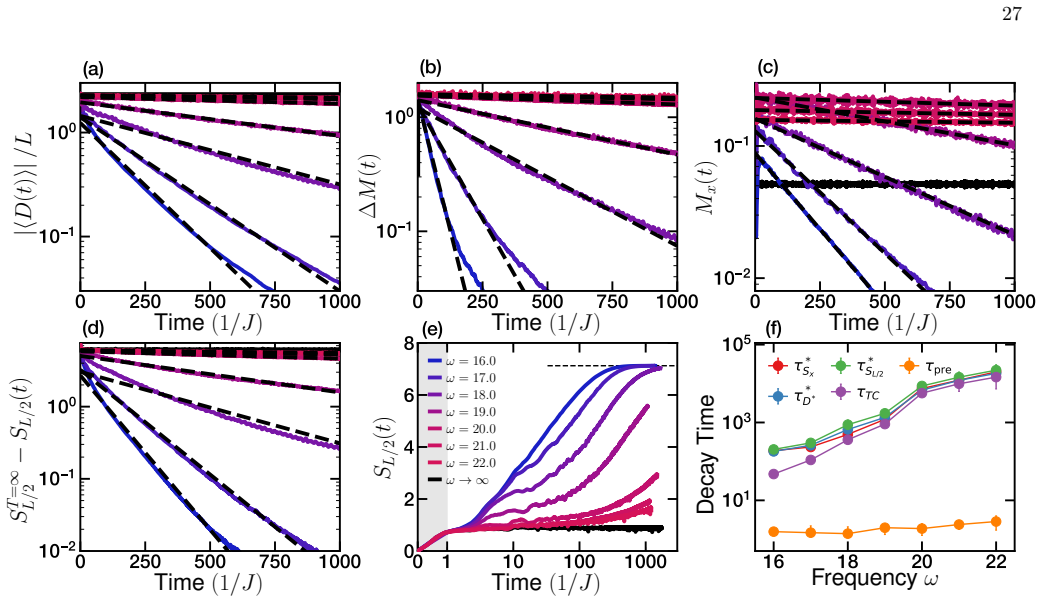
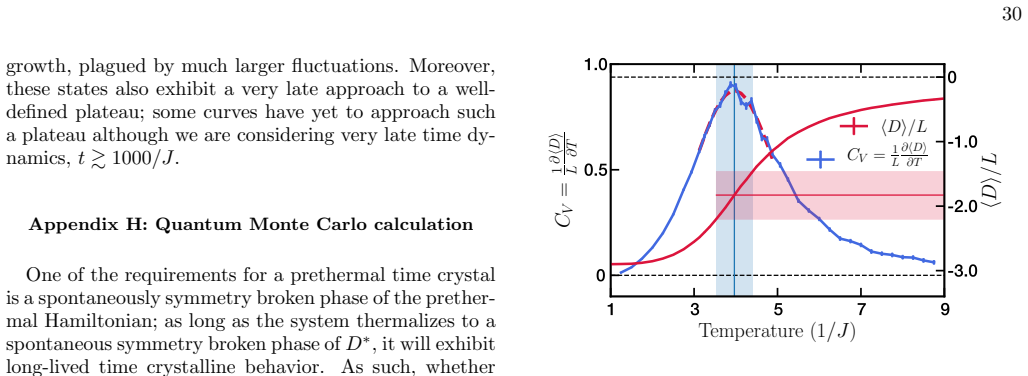
- [Sec. IV.3; Appendix H; Fig. 4] The numerical inference of an energy-density phase transition in the PDTC is indirect. The quantum Monte Carlo estimate in Appendix H computes the transition for the zeroth-order Hamiltonian D, not for the full frequency-dependent D*, and uses sign-flipped couplings and a modified long-range profile (Eq. (H2)). The comparison in Fig. 4(b) therefore tests whether the onset of exponential tau_TC tracks the transition of D, which is plausible only to the extent that D* is close to D. The paper does not provide a direct numerical construction or estimate of D*'s transition, so the statement that the observed crossover matches the D* transition should be softened or supplemented with a D*-based check.
minor comments (5)
- [Appendix A, Eqs. (A32)-(A33)] The bounds on ||V*|| and ||E*|| are written as mu (1/2)^{-n*}, which grows exponentially in n*; from the surrounding text and Eq. (A46) the intended exponent is (1/2)^{n*}.
- [Sec. III.2, Eq. (27)] In the geometric-series evaluation following Eq. (26), a factor e^{sigma(gamma - alpha + d)} appears to be missing in the numerator; the numerical value of the bound should be checked.
- [Appendix A, Eq. (A14)] Theorem 4 states a bound with norm ||.||_{kappa*,gamma*} although the short-range norm introduced in this appendix has only a kappa parameter; this appears to be a typographical carryover from Theorem 1.
- [Sec. IV.2; Fig. 3] The caption and text report that the extracted J_local is larger in the long-range model, but no explicit values or fitting ranges are given; stating the extracted J_local would make the exponential scaling in Fig. 3 quantitatively reproducible.
- [Sec. III.4.3, Eq. (41)] The statement "for small enough lambda, m_max > 1, so one can at least accurately describe the dynamics ... during a single driving period" is correct but should be accompanied by the observation that this window is parametrically shorter than the prethermal window tau* ~ 2^{n*}, since otherwise the reader may overestimate what Theorem 3 establishes.
Circularity Check
No significant circularity: the derivation is self-contained and the d < alpha < 2d limitation is explicitly flagged, not assumed into existence.
full rationale
I walked the derivation chain and found no step in which a predicted quantity is equivalent by construction to a fitted input, or in which a load-bearing premise is justified solely by a self-citation. The central analytic result, Theorem 1, constructs D* from the Floquet Hamiltonian via an iterative frame rotation; Theorem 2 then uses long-range Lieb-Robinson bounds to show that local observables follow D* for alpha > 2d. Although the Lieb-Robinson bound is cited to the authors' own prior work (Ref. [80]), that bound is a parameter-free mathematical theorem whose assumptions (finite two-parameter norm with gamma > d) do not include the prethermal result, so it qualifies as independent support rather than circular self-citation. The numerical PDTC lifetime is not fitted to the period-doubling data; it is compared with the independently extracted heating time tau*, and the phase-boundary location is computed separately by quantum Monte Carlo on D (Appendix H), not inferred from Delta M(t). The only significant gap is the regime d < alpha < 2d that contains the 1D PDTC. There the paper explicitly states a limitation rather than hiding it: Sec. II.3 says 'we are not be able to directly invoke such power-law-light-cone Lieb-Robinson bounds' and 'one expects that the approximate conservation of energy density means that local observables still relax to the Gibbs state of D*... Under this assumption, we show...', and Fig. 1(c) marks the row with a star. Theorem 3 in this regime only bounds local dynamics for m lambda <= C7, i.e. a few drive periods, so the existence of prethermal phases for d < alpha < 2d is conditional on the Gibbs-relaxation assumption. That is an openly acknowledged assumption and an overstatement in the abstract's unconditional wording, but it is not a circular reduction: the assumption is not defined in terms of the predicted time crystal, and the paper does not claim to have proven the assumption. Correctness risk from the unproven Gibbs-relaxation step is real and should be weighed separately, but under the circularity rubric the derivation is not circular.
Assumptions & free parameters
assumptions (3)
- standard math The Lieb-Robinson bound for many-body power-law Hamiltonians from Ref. [80] applies to the range-indexed potentials generated by the construction.
- domain assumption For d < alpha < 2d, local observables relax to the Gibbs state of the prethermal Hamiltonian D* during the prethermal regime, by entropy maximization subject to conserved energy density.
- domain assumption D* possesses a finite-temperature spontaneous symmetry breaking phase in 1D for 1 < alpha < 2, inherited from D (the long-range Ising model with additional generic terms).
Cite this review
Pith. "Pith review of Long-Range Prethermal Phases of Nonequilibrium Matter." pith.science (2026). https://pith.science/paper/TRE6VTOI
@misc{pith2026190807530,
  author       = {Pith},
  title        = {Pith review of: Long-Range Prethermal Phases of Nonequilibrium Matter},
  year         = {2026},
  howpublished = {\url{https://pith.science/paper/TRE6VTOI}},
  note         = {Machine review of arXiv:1908.07530}
}
abstract
We prove the existence of non-equilibrium phases of matter in the prethermal regime of periodically-driven, long-range interacting systems, with power-law exponent $\alpha > d$, where $d$ is the dimensionality of the system. In this context, we predict the existence of a disorder-free, prethermal discrete time crystal in one dimension -- a phase strictly forbidden in the absence of long-range interactions. Finally, using a combination of analytic and numerical methods, we highlight key experimentally observable differences between such a prethermal time crystal and its many-body localized counterpart.
Figures

Figures from the paper (8 more)



Forward citations
Cited by 2 Pith papers
-
Prethermalization without temperature
An emergent approximate conservation of magnetization creates a long-lived prethermal time-crystal regime at infinite temperature, and tuning the drive field can exponentially extend the NMR time-crystal signal.
-
Locality and Heating in Periodically Driven, Power-law Interacting Systems
Power-law interacting, periodically driven systems exhibit heating times exponential in drive frequency for alpha > D in linear response and alpha > 2D in general, with the gap attributed to the absence of tight Lieb-...
Reference graph
Works this paper leans on
-
[1]
bad part
The iteration Following Ref. [36], the idea is to construct the neces- sary rotations iteratively. At stepn of the iteration, there is a slightly rotated frame where the Floquet evolution operator Uf is in the form U† nUfUn =U(n) f =XT exp ( −i ∫ T 0 dtHn(t) ) , (A15) with XN = 1. (A16) We are interested in performing a unitary transforma- tion, such that...
-
[2]
Our first result is Lemma 1, a slightly modified form of Theorem 4 (Theorem 4 itself will eventually arise as a collorary), in which the constants more explicitly stated
Analysis of bounds Now we prove bounds on the result of the iteration. Our first result is Lemma 1, a slightly modified form of Theorem 4 (Theorem 4 itself will eventually arise as a collorary), in which the constants more explicitly stated. Lemma 1. There are order 1 constants u and v (not depending on any other parameters) with the following properties. S...
-
[3]
Let Uj(t) =T exp [ −i ∫t 0 Φj(t) ] be the corresponding time evolutions, and define ∆(t) = Φ1(t)− Φ2(t). Then, the difference in time evolved local operator O (initially support on the set X⊆ Λ) under Φ1 and Φ2 is bounded by: ‖‖‖U† 1(t)OU1(t)−U† 2(t)OU2(t)] ‖‖‖≤|X|‖O‖‖∆‖0,0t × { K3(1 +τd/(1−η))|X| +K4(τ +τβ)|X|n∗+2 } , (C19) where we defined ‖∆‖0,0 = 1 t ∫ t...
-
[4]
cold” initial state in the long-range model (b), (e), (h) and (k), and a “hot
(C25) Integrating this result, we obtain: U1(t)U† 2(t)OU2(t)U† 1(t)−O = (C26) −i ∫ t 0 ds U1(s)[∆(s),U† 2(s)OU2(s)]U† 1(s), (C27) and, thus, ‖U† 1(t)OU1(t)−U† 2(t)OU2(t)‖ (C28) ≤ ∫ t 0 ds‖[∆(s),U† 2(s)OU2(s)]‖ (C29) ≤ ∫ t 0 ds ∑ Z ‖[∆Z(s),U† 2(s)OU2(s)]‖, (C30) 24 where we defined ∆Z(s) =∑∞ l=0 ∆Z,l(s). Now to bound the commutator we consider ∫ t 0 ∑ Z ‖[∆...
-
[5]
Ap- proach to high-resolution nmr in solids,
J. S. Waugh, L. M. Huber, and U. Haeberlen, “Ap- proach to high-resolution nmr in solids,” Phys. Rev. Lett. 20, 180 (1968)
1968
-
[6]
Symmetrized pulse sequences in high res- olution nmr in solids,
P Mansfield, “Symmetrized pulse sequences in high res- olution nmr in solids,” J. Phys. C: Solid State Phys. 4, 1444 (1971)
1971
-
[7]
Analysis of multiple pulse nmr in solids,
W-K. Rhim, D. D. Elleman, and R. W. Vaughan, “Analysis of multiple pulse nmr in solids,” The Jour- nal of Chemical Physics 59, 3740 (1973)
1973
-
[8]
D Jaksch and P Zoller, “Creation of effective magnetic fields in optical lattices: the hofstadter butterfly for cold neutral atoms,” New J. Phys. 5, 56 (2003), arXiv:quant- ph/0304038
arXiv 2003
Show all 107 references
-
[9]
Experimental realization of strong effective magnetic fields in an optical lattice,
M. Aidelsburger, M. Atala, S. Nascimb` ene, S. Trotzky, Y.-A. Chen, and I. Bloch, “Experimental realization of strong effective magnetic fields in an optical lattice,” Phys. Rev. Lett. 107, 255301 (2011), arXiv:1110.5314
2011 arXiv
-
[10]
Floquet topological insulator in semiconductor quan- tum wells,
Netanel H. Lindner, Gil Refael, and Victor Galitski, “Floquet topological insulator in semiconductor quan- tum wells,” Nature Phys7, 490 (2011), arXiv:1008.1792
2011 arXiv
-
[11]
Four-body ring-exchange interac- tions and anyonic statistics within a minimal toric- code hamiltonian,
Han-Ning Dai, Bing Yang, Andreas Reingruber, Hui Sun, Xiao-Fan Xu, Yu-Ao Chen, Zhen-Sheng Yuan, and Jian-Wei Pan, “Four-body ring-exchange interac- tions and anyonic statistics within a minimal toric- code hamiltonian,” Nature Phys 13, 1195 (2017), arXiv:1602.05709
2017 arXiv
-
[12]
Equilibration and or- der in quantum floquet matter,
R. Moessner and S. L. Sondhi, “Equilibration and or- der in quantum floquet matter,” Nature Phys 13, 424 (2017), arXiv:1701.08056
2017 arXiv
-
[13]
Discrete time crystals,
Dominic V. Else, Christopher Monroe, Chetan Nayak, and Norman Y. Yao, “Discrete time crystals,” (), arXiv:1905.13232
1905 arXiv
-
[14]
Topology and broken symmetry in floquet sys- tems,
Fenner Harper, Rahul Roy, Mark S. Rudner, and S. L. Sondhi, “Topology and broken symmetry in floquet sys- tems,” arXiv:1905.01317
1905 arXiv
-
[15]
Time evolution of a quantum many- body system: Transition from integrability to ergodicity in the thermodynamic limit,
Tomaˇ z Prosen, “Time evolution of a quantum many- body system: Transition from integrability to ergodicity in the thermodynamic limit,” Phys. Rev. Lett. 80, 1808 (1998), arXiv:cond-mat/9707180
1998 arXiv
-
[16]
Ergodic properties of a generic nonin- tegrable quantum many-body system in the thermody- namic limit,
Tomaˇ z Prosen, “Ergodic properties of a generic nonin- tegrable quantum many-body system in the thermody- namic limit,” Phys. Rev. E 60, 3949 (1999), arXiv:cond- mat/9808150
1999
-
[17]
Many- body energy localization transition in periodically driven systems,
Luca D’Alessio and Anatoli Polkovnikov, “Many- body energy localization transition in periodically driven systems,” Annals of Physics 333, 19 (2013), arXiv:1210.2791
2013 arXiv
-
[18]
Equilibrium states of generic quantum systems subject to periodic driving,
Achilleas Lazarides, Arnab Das, and Roderich Moess- ner, “Equilibrium states of generic quantum systems subject to periodic driving,” Phys. Rev. E 90, 012110 (2014), arXiv:1403.2946
2014 arXiv
-
[19]
Long-time behav- ior of isolated periodically driven interacting lattice sys- tems,
Luca D’Alessio and Marcos Rigol, “Long-time behav- ior of isolated periodically driven interacting lattice sys- tems,” Phys. Rev. X 4, 041048 (2014), arXiv:1402.5141
2014 arXiv
-
[20]
Universal high-frequency behavior of periodically driven systems: from dynamical stabi- lization to floquet engineering,
Marin Bukov, Luca D’Alessio, and Anatoli Polkovnikov, “Universal high-frequency behavior of periodically driven systems: from dynamical stabi- lization to floquet engineering,” Advances in Physics 64, 139 (2015), arXiv:1407.4803
2015 arXiv
-
[21]
Periodically driven ergodic and many-body localized quantum systems,
Pedro Ponte, Anushya Chandran, Z. Papi´ c, and Dmitry A. Abanin, “Periodically driven ergodic and many-body localized quantum systems,” Annals of Physics 353, 196 (2015), arXiv:1403.6480
2015 arXiv
-
[22]
Prethermal floquet steady states and instabilities in the periodically driven, weakly in- teracting bose-hubbard model,
Marin Bukov, Sarang Gopalakrishnan, Michael Knap, and Eugene Demler, “Prethermal floquet steady states and instabilities in the periodically driven, weakly in- teracting bose-hubbard model,” Phys. Rev. Lett. 115, 205301 (2015), arXiv:1507.01946
2015 arXiv
-
[23]
Periodically driv- ing a many-body localized quantum system,
Pranjal Bordia, Henrik L¨ uschen, Ulrich Schneider, Michael Knap, and Immanuel Bloch, “Periodically driv- ing a many-body localized quantum system,” Nature Phys 13, 460 (2017), arXiv:1607.07868
2017 arXiv
-
[24]
Floquet prethermalization and regimes of heating in a period- ically driven, interacting quantum system,
Simon A. Weidinger and Michael Knap, “Floquet prethermalization and regimes of heating in a period- ically driven, interacting quantum system,” Sci Rep 7, 45382 (2017), arXiv:1609.09089
2017 arXiv
-
[25]
Absence of dynamical localization in inter- acting driven systems,
David J. Luitz, Yevgeny Bar Lev, and Achilleas Lazarides, “Absence of dynamical localization in inter- acting driven systems,” SciPost Phys. 3, 029 (2017), arXiv:1706.09429
2017 arXiv
-
[26]
On- set of floquet thermalization,
Asmi Haldar, Roderich Moessner, and Arnab Das, “On- set of floquet thermalization,” Phys. Rev. B 97, 245122 (2018), arXiv:1803.10331
2018 arXiv
-
[27]
Dicke time crystals in driven-dissipative quantum many-body systems,
Bihui Zhu, Jamir Marino, Norman Yao, Mikhail D Lukin, and Eugene Demler, “Dicke time crystals in driven-dissipative quantum many-body systems,” New Journal of Physics (2019)
2019
-
[28]
Many-body localization and thermalization in quantum statistical mechanics,
Rahul Nandkishore and David A. Huse, “Many-body localization and thermalization in quantum statistical mechanics,” Annu. Rev. Condens. Matter Phys. 6, 15 (2015), arXiv:1404.0686
2015 arXiv
-
[29]
Colloquium : Many-body local- ization, thermalization, and entanglement,
Dmitry A. Abanin, Ehud Altman, Immanuel Bloch, and Maksym Serbyn, “Colloquium : Many-body local- ization, thermalization, and entanglement,” Rev. Mod. Phys. 91, 021001 (2019), arXiv:1804.11065
2019 arXiv
-
[30]
Many-body localization in period- ically driven systems,
Pedro Ponte, Z. Papi´ c, Fran¸ cois Huveneers, and Dmitry A. Abanin, “Many-body localization in period- ically driven systems,” Phys. Rev. Lett. 114, 140401 (2015), arXiv:1410.8518
2015 arXiv
-
[31]
Theory of many-body localization in pe- riodically driven systems,
Dmitry A. Abanin, Wojciech De Roeck, and Fran¸ cois Huveneers, “Theory of many-body localization in pe- riodically driven systems,” Annals of Physics 372, 1 (2016), arXiv:1412.4752
2016 arXiv
-
[32]
Phase structure of driven quan- tum systems,
Vedika Khemani, Achilleas Lazarides, Roderich Moess- ner, and S. L. Sondhi, “Phase structure of driven quan- tum systems,” Phys. Rev. Lett. 116, 250401 (2016), arXiv:1508.03344
2016 arXiv
-
[33]
Phase struc- ture of one-dimensional interacting floquet systems. i. abelian symmetry-protected topological phases,
C. W. von Keyserlingk and S. L. Sondhi, “Phase struc- ture of one-dimensional interacting floquet systems. i. abelian symmetry-protected topological phases,” Phys. Rev. B 93, 245145 (2016), arXiv:1602.02157
2016 arXiv
-
[34]
Phase struc- ture of one-dimensional interacting floquet systems. ii. symmetry-broken phases,
C. W. von Keyserlingk and S. L. Sondhi, “Phase struc- ture of one-dimensional interacting floquet systems. ii. symmetry-broken phases,” Phys. Rev. B 93, 245146 (2016), arXiv:1602.06949
2016 arXiv
-
[35]
Absolute stability and spatiotemporal long- range order in floquet systems,
C. W. von Keyserlingk, Vedika Khemani, and S. L. Sondhi, “Absolute stability and spatiotemporal long- range order in floquet systems,” Phys. Rev. B 94, 085112 (2016), arXiv:1605.00639
2016 arXiv
-
[36]
Classification of topological phases in periodically driven inter- acting systems,
Dominic V. Else and Chetan Nayak, “Classification of topological phases in periodically driven inter- acting systems,” Phys. Rev. B 93, 201103 (2016), 32 arXiv:1602.04804
2016 arXiv
-
[37]
Classification of interacting topological floquet phases in one dimension,
Andrew C. Potter, Takahiro Morimoto, and Ashvin Vishwanath, “Classification of interacting topological floquet phases in one dimension,” Phys. Rev. X 6, 041001 (2016), arXiv:1602.05194
2016 arXiv
-
[38]
Floquet time crystals,
Dominic V. Else, Bela Bauer, and Chetan Nayak, “Floquet time crystals,” Phys. Rev. Lett. 117, 090402 (2016), arXiv:1603.08001
2016 arXiv
-
[39]
Discrete time crystals: Rigidity, criticality, and realizations,
N. Y. Yao, A. C. Potter, I.-D. Potirniche, and A. Vish- wanath, “Discrete time crystals: Rigidity, criticality, and realizations,” Phys. Rev. Lett. 118, 030401 (2017), arXiv:1608.02589
2017 arXiv
-
[40]
Prethermal phases of matter protected by time- translation symmetry,
Dominic V. Else, Bela Bauer, and Chetan Nayak, “Prethermal phases of matter protected by time- translation symmetry,” Phys. Rev. X 7, 011026 (2017), arXiv:1607.05277
2017 arXiv
-
[41]
Exponentially slow heating in periodically driven many-body systems,
Dmitry A. Abanin, Wojciech De Roeck, and Fran¸ cois Huveneers, “Exponentially slow heating in periodically driven many-body systems,” Phys. Rev. Lett. 115, 256803 (2015), arXiv:1507.01474
2015 arXiv
-
[42]
Floquet–magnus theory and generic transient dynam- ics in periodically driven many-body quantum systems,
Tomotaka Kuwahara, Takashi Mori, and Keiji Saito, “Floquet–magnus theory and generic transient dynam- ics in periodically driven many-body quantum systems,” Annals of Physics 367, 96 (2016), arXiv:1508.05797
2016 arXiv
-
[43]
Rigorous bound on energy absorption and generic re- laxation in periodically driven quantum systems,
Takashi Mori, Tomotaka Kuwahara, and Keiji Saito, “Rigorous bound on energy absorption and generic re- laxation in periodically driven quantum systems,” Phys. Rev. Lett. 116, 120401 (2016), arXiv:1509.03968
2016 arXiv
-
[44]
A rigorous theory of many-body prethermalization for periodically driven and closed quantum systems,
Dmitry Abanin, Wojciech De Roeck, Wen Wei Ho, and Fran¸ cois Huveneers, “A rigorous theory of many-body prethermalization for periodically driven and closed quantum systems,” Commun. Math. Phys. 354, 809 (2017), arXiv:1509.05386
2017 arXiv
-
[45]
Effective hamiltonians, prethermalization, and slow energy absorption in peri- odically driven many-body systems,
Dmitry A. Abanin, Wojciech De Roeck, Wen Wei Ho, and Fran¸ cois Huveneers, “Effective hamiltonians, prethermalization, and slow energy absorption in peri- odically driven many-body systems,” Phys. Rev. B 95, 014112 (2017), arXiv:1510.03405
2017 arXiv
-
[46]
Bounds on energy absorption and prethermalization in quantum systems with long-range interactions,
Wen Wei Ho, Ivan Protopopov, and Dmitry A. Abanin, “Bounds on energy absorption and prethermalization in quantum systems with long-range interactions,” Phys. Rev. Lett. 120, 200601 (2018), arXiv:1706.07207
2018 arXiv
-
[47]
Experimental realization of the topological haldane model with ultracold fermions,
Gregor Jotzu, Michael Messer, R´ emi Desbuquois, Mar- tin Lebrat, Thomas Uehlinger, Daniel Greif, and Tilman Esslinger, “Experimental realization of the topological haldane model with ultracold fermions,” Na- ture 515, 237 (2014), arXiv:1406.7874
2014 arXiv
-
[48]
Floquet engineering of correlated tunneling in the bose-hubbard model with ultracold atoms,
F. Meinert, M. J. Mark, K. Lauber, A. J. Daley, and H.- C. N¨ agerl, “Floquet engineering of correlated tunneling in the bose-hubbard model with ultracold atoms,” Phys. Rev. Lett. 116, 205301 (2016), arXiv:1602.02657
2016 arXiv
-
[49]
Floquet engineering of quantum materials,
Takashi Oka and Sota Kitamura, “Floquet engineering of quantum materials,” Annu. Rev. Condens. Matter Phys. 10, 387 (2019), arXiv:1804.03212
2019 arXiv
-
[50]
Prethermal quantum many-body kapitza phases of periodically driven spin systems,
Alessio Lerose, Jamir Marino, Andrea Gambassi, and Alessandro Silva, “Prethermal quantum many-body kapitza phases of periodically driven spin systems,” Phys. Rev. B 100, 104306 (2019), arXiv:1803.04490
2019 arXiv
-
[51]
Floquet symmetry- protected topological phases in cold-atom systems,
I.-D. Potirniche, A. C. Potter, M. Schleier-Smith, A. Vishwanath, and N. Y. Yao, “Floquet symmetry- protected topological phases in cold-atom systems,” Phys. Rev. Lett. 119, 123601 (2017), arXiv:1610.07611
2017 arXiv
-
[52]
Anomalous floquet-anderson insulator as a nonadiabatic quantized charge pump,
Paraj Titum, Erez Berg, Mark S. Rudner, Gil Refael, and Netanel H. Lindner, “Anomalous floquet-anderson insulator as a nonadiabatic quantized charge pump,” Phys. Rev. X 6, 021013 (2016), arXiv:1506.00650
2016 arXiv
-
[53]
Radical chiral floquet phases in a periodically driven kitaev model and beyond,
Hoi Chun Po, Lukasz Fidkowski, Ashvin Vishwanath, and Andrew C. Potter, “Radical chiral floquet phases in a periodically driven kitaev model and beyond,” Phys. Rev. B 96, 245116 (2017), arXiv:1701.01440
2017 arXiv
-
[54]
Floquet hopf insulators,
Thomas Schuster, Snir Gazit, Joel E. Moore, and Nor- man Y. Yao, “Floquet hopf insulators,” Phys. Rev. Lett. 123, 266803 (2019), arXiv:1903.02558
2019 arXiv
-
[55]
Anomalous floquet insulators,
Frederik Nathan, Dmitry Abanin, Erez Berg, Ne- tanel H. Lindner, and Mark S. Rudner, “Anomalous floquet insulators,” Phys. Rev. B 99, 195133 (2019), arXiv:1712.02789
2019 arXiv
-
[56]
Quantum simula- tions with trapped ions,
Rainer Blatt and Christian F Roos, “Quantum simula- tions with trapped ions,” Nature Physics 8, 277 (2012)
2012
-
[57]
Localization goes long,
Chris R. Laumann and Norman Y. Yao, “Localization goes long,” Nature Phys 12, 894 (2016)
2016
-
[58]
Critical thermalization of a disordered dipolar spin system in diamond,
G. Kucsko, S. Choi, J. Choi, P. C. Maurer, H. Zhou, R. Landig, H. Sumiya, S. Onoda, J. Isoya, F. Jelezko, E. Demler, N. Y. Yao, and M. D. Lukin, “Critical thermalization of a disordered dipolar spin system in diamond,” Phys. Rev. Lett. 121, 023601 (2018), arXiv:1609.08216
2018 arXiv
-
[59]
Observation of a symmetry-protected topo- logical phase of interacting bosons with rydberg atoms,
Sylvain de L´ es´ eleuc, Vincent Lienhard, Pascal Scholl, Daniel Barredo, Sebastian Weber, Nicolai Lang, Hans Peter B¨ uchler, Thierry Lahaye, and Antoine Browaeys, “Observation of a symmetry-protected topo- logical phase of interacting bosons with rydberg atoms,” Science 365,...
2019 arXiv
-
[60]
New frontiers for quantum gases of polar molecules,
Steven A. Moses, Jacob P. Covey, Matthew T. Miec- nikowski, Deborah S. Jin, and Jun Ye, “New frontiers for quantum gases of polar molecules,” Nature Phys 13, 13 (2016), arXiv:1610.07711
2016 arXiv
-
[61]
Observa- tion of a discrete time crystal,
J. Zhang, P. W. Hess, A. Kyprianidis, P. Becker, A. Lee, J. Smith, G. Pagano, I.-D. Potirniche, A. C. Potter, A. Vishwanath, N. Y. Yao, and C. Monroe, “Observa- tion of a discrete time crystal,” Nature 543, 217 (2017), arXiv:1609.08684
2017 arXiv
-
[62]
Observation of dipolar spin-exchange interactions with lattice-confined polar molecules,
Bo Yan, Steven A. Moses, Bryce Gadway, Jacob P. Covey, Kaden R. A. Hazzard, Ana Maria Rey, Deb- orah S. Jin, and Jun Ye, “Observation of dipolar spin-exchange interactions with lattice-confined polar molecules,” Nature 501, 521 (2013), arXiv:1305.5598
2013 arXiv
-
[63]
Prob- ing many-body dynamics on a 51-atom quantum simu- lator,
Hannes Bernien, Sylvain Schwartz, Alexander Keesling, Harry Levine, Ahmed Omran, Hannes Pichler, Soon- won Choi, Alexander S. Zibrov, Manuel Endres, Markus Greiner, Vladan Vuleti´ c, and Mikhail D. Lukin, “Prob- ing many-body dynamics on a 51-atom quantum simu- lator,” Nature ...
2017 arXiv
-
[64]
Observation of discrete time- crystalline order in a disordered dipolar many-body sys- tem,
Soonwon Choi, Joonhee Choi, Renate Landig, Georg Kucsko, Hengyun Zhou, Junichi Isoya, Fedor Jelezko, Shinobu Onoda, Hitoshi Sumiya, Vedika Khemani, Curt von Keyserlingk, Norman Y. Yao, Eugene Demler, and Mikhail D. Lukin, “Observation of discrete time- crystalline order in a d...
2017 arXiv
-
[65]
Observation of discrete-time-crystal signatures in an ordered dipolar many-body system,
Jared Rovny, Robert L. Blum, and Sean E. Barrett, “Observation of discrete-time-crystal signatures in an ordered dipolar many-body system,” Phys. Rev. Lett. 120, 180603 (2018), arXiv:1802.00126
2018 arXiv
-
[66]
Quantum statistical mechanics in a closed system,
J. M. Deutsch, “Quantum statistical mechanics in a closed system,” Phys. Rev. A 43, 2046 (1991)
1991
-
[67]
Chaos and quantum thermalization,
Mark Srednicki, “Chaos and quantum thermalization,” Phys. Rev. E 50, 888 (1994), arXiv:cond-mat/9403051. 33
1994 arXiv
-
[68]
Thermalization and its mechanism for generic iso- lated quantum systems,
Marcos Rigol, Vanja Dunjko, and Maxim Olshanii, “Thermalization and its mechanism for generic iso- lated quantum systems,” Nature 452, 854 (2008), arXiv:0708.1324
2008 arXiv
-
[69]
Counter-examples of this broad phenomenology are in- tegrable models or those displaying a many-body local- ized phase
-
[70]
Throughout this work we work in natural units ℏ = 1 and thus frequency carries units of energy
-
[71]
An example occurs in models with near integer spectrum [36, 40, 101–103]
In special cases, however, it can depend exponentially on the ratio of the energy scales. An example occurs in models with near integer spectrum [36, 40, 101–103]
-
[72]
Floquet prethermalization in periodi- cally driven classical spin systems,
Takashi Mori, “Floquet prethermalization in periodi- cally driven classical spin systems,” Phys. Rev. B 98, 104303 (2018), arXiv:1804.02165
2018 arXiv
-
[73]
In the former, proofs exist for short [36, 38, 40] and long-range inter- acting systems with power-law α >2d [38]
Previous proofs that the dynamics of local observables are correctly captured by the prethermal Hamiltonian (within the prethermal regime) can be divided into two categories: those applicable in prethermal regimes with no emergent symmetry, and those applicable in prether- mal...
-
[74]
As long as τpre diverges at most algebraically near the transition, we are guaranteed (owing to the exponential scaling of τ∗) that the transition will be exponentially sharp in the frequency of the drive
-
[75]
Or a disorder-like potential such as a quasi-periodic po- tential
-
[76]
Spectral features of a many-body- localized system weakly coupled to a bath,
Rahul Nandkishore, Sarang Gopalakrishnan, and David A. Huse, “Spectral features of a many-body- localized system weakly coupled to a bath,” Phys. Rev. B 90, 064203 (2014), arXiv:1402.5971
2014 arXiv
-
[77]
Many-body localization in dipolar systems,
N. Y. Yao, C. R. Laumann, S. Gopalakrishnan, M. Knap, M. M¨ uller, E. A. Demler, and M. D. Lukin, “Many-body localization in dipolar systems,” Phys. Rev. Lett. 113, 243002 (2014), arXiv:1311.7151
2014 arXiv
-
[78]
Stability and instability towards delocalization in many-body lo- calization systems,
Wojciech De Roeck and Fran¸ cois Huveneers, “Stability and instability towards delocalization in many-body lo- calization systems,” Phys. Rev. B 95, 155129 (2017), arXiv:1608.01815
2017 arXiv
-
[79]
Existence of a phase-transition in a one-dimensional ising ferromagnet,
Freeman J. Dyson, “Existence of a phase-transition in a one-dimensional ising ferromagnet,” Commun.Math. Phys. 12, 91 (1969)
1969
-
[80]
This is a crucial point when attempting to describe phases of matter within the prethermal regime, because without it, one cannot precisely determine the equilib- rium properties of the system during prethermalization
-
[81]
Nearly linear light cones in long-range interacting quantum systems,
Michael Foss-Feig, Zhe-Xuan Gong, Charles W. Clark, and Alexey V. Gorshkov, “Nearly linear light cones in long-range interacting quantum systems,” Phys. Rev. Lett. 114, 157201 (2015), arXiv:1410.3466
2015 arXiv
-
[82]
Improving the lieb–robinson bound for long-range interactions,
Takuro Matsuta, Tohru Koma, and Shu Nakamura, “Improving the lieb–robinson bound for long-range interactions,” Ann. Henri Poincar´ e 18, 519 (2016), arXiv:1604.05809
2016 arXiv
-
[83]
Locality and digital quantum simulation of power-law interactions,
Minh C. Tran, Andrew Y. Guo, Yuan Su, James R. Gar- rison, Zachary Eldredge, Michael Foss-Feig, Andrew M. Childs, and Alexey V. Gorshkov, “Locality and digital quantum simulation of power-law interactions,” Phys. Rev. X 9, 031006 (2019), arXiv:1808.05225
2019 arXiv
-
[84]
An improved lieb-robinson bound for many-body hamiltonians with power-law interac- tions,
Dominic V. Else, Francisco Machado, Chetan Nayak, and Norman Y. Yao, “An improved lieb-robinson bound for many-body hamiltonians with power-law interac- tions,” (), arXiv:1809.06369
-
[85]
Spectral gap and exponential decay of correlations,
Matthew B. Hastings and Tohru Koma, “Spectral gap and exponential decay of correlations,” Commun. Math. Phys. 265, 781 (2006), arXiv:math-ph/0507008
2006 arXiv
-
[86]
Non-local propagation of correlations in quantum systems with long-range interactions,
Philip Richerme, Zhe-Xuan Gong, Aaron Lee, Crys- tal Senko, Jacob Smith, Michael Foss-Feig, Spyridon Michalakis, Alexey V. Gorshkov, and Christopher Mon- roe, “Non-local propagation of correlations in quantum systems with long-range interactions,” Nature 511, 198 (2014), arXiv...
2014 arXiv
-
[87]
Uni- versal scaling laws for correlation spreading in quantum systems with short- and long-range interactions,
Lorenzo Cevolani, Julien Despres, Giuseppe Carleo, Luca Tagliacozzo, and Laurent Sanchez-Palencia, “Uni- versal scaling laws for correlation spreading in quantum systems with short- and long-range interactions,” Phys. Rev. B 98, 024302 (2018), arXiv:1706.00838
2018 arXiv
-
[88]
Exponentially slow heating in short and long-range interacting floquet systems,
Francisco Machado, Gregory D. Kahanamoku-Meyer, Dominic V. Else, Chetan Nayak, and Norman Y. Yao, “Exponentially slow heating in short and long-range interacting floquet systems,” Phys. Rev. Research 1, 033202 (2019), arXiv:1708.01620
2019 arXiv
-
[89]
Emergent locality in systems with power-law interactions,
David J. Luitz and Yevgeny Bar Lev, “Emergent locality in systems with power-law interactions,” Phys. Rev. A 99, 010105 (2019), arXiv:1805.06895
2019 arXiv
-
[90]
Finite speed of quantum scrambling with long range interactions,
Chi-Fang Chen and Andrew Lucas, “Finite speed of quantum scrambling with long range interactions,” Phys. Rev. Lett. 123, 250605 (2019), arXiv:1907.07637
2019 arXiv
-
[91]
For more information, see https://zenodo.org/ record/3606826
-
[92]
Roman, and Vicente Vidal, “Slepc,” ACM Trans
Vicente Hernandez, Jose E. Roman, and Vicente Vidal, “Slepc,” ACM Trans. Math. Softw. 31, 351 (2005)
2005
-
[93]
J. E. Roman, C. Campos, E. Romero, and A. Tomas, SLEPc Users Manual , Tech. Rep. DSIC-II/24/02 - Re- vision 3.7 (D. Sistemes Inform` atics i Computaci´ o, Uni- versitat Polit` ecnica de Val` encia, 2016)
2016
-
[94]
Efficient management of parallelism in object oriented numerical software li- braries,
Satish Balay, William D. Gropp, Lois Curfman McInnes, and Barry F. Smith, “Efficient management of parallelism in object oriented numerical software li- braries,” in Modern Software Tools in Scientific Com- puting, edited by E. Arge, A. M. Bruaset, and H. P. Langtangen (Birkh¨ au...
1997
-
[95]
Average entropy of a subsystem,
Don N. Page, “Average entropy of a subsystem,” Phys. Rev. Lett. 71, 1291 (1993), arXiv:gr-qc/9305007
1993 arXiv
-
[96]
We then choose the limit of Tx→ 0 (the global π-pulse is infinitely fast) where Ttot → T and the drive-frequency becomes ω = 2π/T
Although the period of the evolution is given by Ttot = T +Tx, the evolution of the system does not depend on our choice of Tx. We then choose the limit of Tx→ 0 (the global π-pulse is infinitely fast) where Ttot → T and the drive-frequency becomes ω = 2π/T
-
[97]
We slightly modify the long-range profile of the inter- action to match the system’s periodicity by replacing |i−j|−α with [(L/π) sin|i−j|π/L]−α
-
[98]
Owing to our choice of antiferromagnetic coupling, the ferromagnetic phase exists at the top of the spectrum
-
[99]
Prethermal time crystals in a one-dimensional periodically driven flo- quet system,
Tian-Sheng Zeng and D. N. Sheng, “Prethermal time crystals in a one-dimensional periodically driven flo- quet system,” Phys. Rev. B 96, 094202 (2017), arXiv:1707.00404
2017 arXiv
-
[100]
Discrete time crystal in globally driven interacting quantum systems without disorder,
Wing Chi Yu, Jirawat Tangpanitanon, Alexander W. Glaetzle, Dieter Jaksch, and Dimitris G. Angelakis, “Discrete time crystal in globally driven interacting quantum systems without disorder,” Phys. Rev. A 99, 34 033618 (2019), arXiv:1807.07738
2019 arXiv
-
[101]
High-frequency expansion for floquet prethermal phases with emergent symmetries: Application to time crystals and floquet engineering,
Kaoru Mizuta, Kazuaki Takasan, and Norio Kawakami, “High-frequency expansion for floquet prethermal phases with emergent symmetries: Application to time crystals and floquet engineering,” Phys. Rev. B 100, 020301 (2019), arXiv:1902.01126
2019 arXiv
-
[102]
Locality and heating in periodically driven, power-law- interacting systems,
Minh C. Tran, Adam Ehrenberg, Andrew Y. Guo, Paraj Titum, Dmitry A. Abanin, and Alexey V. Gorshkov, “Locality and heating in periodically driven, power-law- interacting systems,” Phys. Rev. A 100, 052103 (2019), arXiv:1908.02773
2019 arXiv
-
[103]
Specifically, [36] neglected to take into account that their modified definition of norm for time-dependent po- tentials – the time-average of the instantaneous norm rather than the supremum – necessitates an additional factor of 2 in the first equation of Section 4.2 in Ref. [40]
-
[104]
Emergent hydrodynamics in floquet quantum sys- tems,
Bingtian Ye, Francisco Machado, Christopher David White, Roger S. K. Mong, and Norman Y. Yao, “Emergent hydrodynamics in floquet quantum sys- tems,” arXiv:1902.01859
1902 arXiv
-
[105]
Long coherence times for edge spins,
Jack Kemp, Norman Y Yao, Christopher R Lau- mann, and Paul Fendley, “Long coherence times for edge spins,” J. Stat. Mech. 2017, 063105 (2017), arXiv:1701.00797
2017 arXiv
-
[106]
Prethermal strong zero modes and topological qubits,
Dominic V. Else, Paul Fendley, Jack Kemp, and Chetan Nayak, “Prethermal strong zero modes and topological qubits,” Phys. Rev. X 7, 041062 (2017), arXiv:1704.08703
2017 arXiv
-
[107]
Topologically protected long edge coherence times in symmetry-broken phases,
Daniel E. Parker, Romain Vasseur, and Thomas Scaf- fidi, “Topologically protected long edge coherence times in symmetry-broken phases,” Phys. Rev. Lett. 122, 240605 (2019), arXiv:1808.07485
2019 arXiv
Reviewed August 14, 2026 · model on record in the stance chip above.
Discussion (0). Continue with ORCID to comment.