REVIEW 2 major objections 4 minor 48 references
Isometric Tensor Network representation of string-net liquids
T0 review · 2 major / 4 minor · reviewed 2026-08-14 · deepseek-v4-flash
Pith's one-line read String-net liquid ground states admit exact isometric tensor-network representations, and finite-depth circuits preserve them.
desk verdict A genuinely new result: exact isoTNS representations for Levin-Wen string-nets and finite-depth circuit deformations, with the proof solid for the isotopy-invariant class but the claimed generalization to Ref. [24] non-abelian models not actually proven. read the letter →
The pith
A machine-rendered reading of the paper's core claim, the machinery that carries it, and where it could break.
The reading
What carries the argument
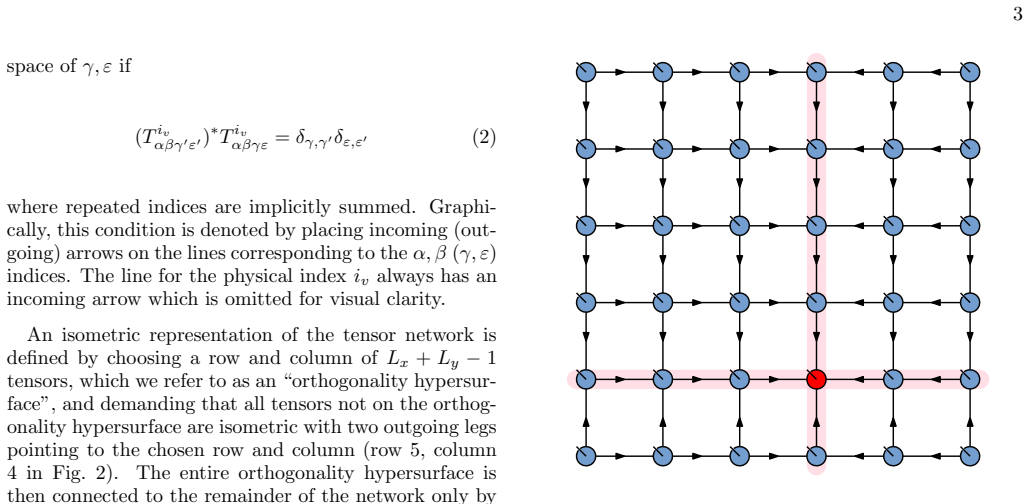
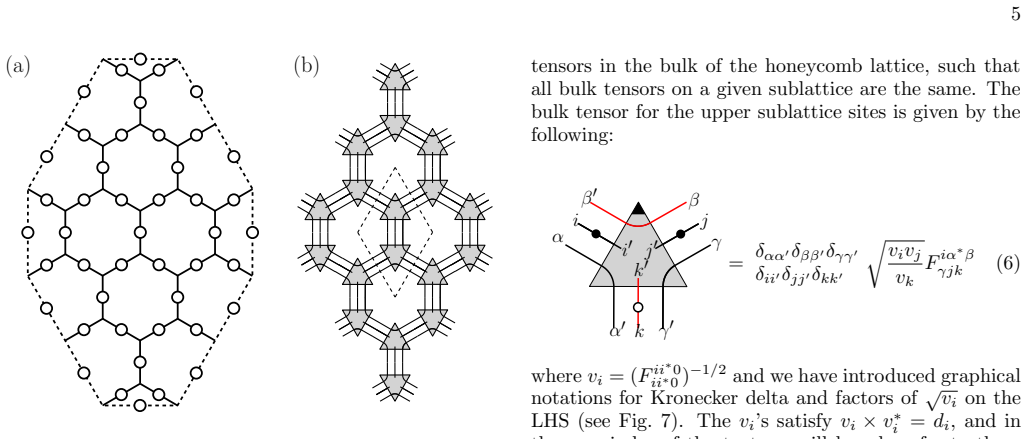
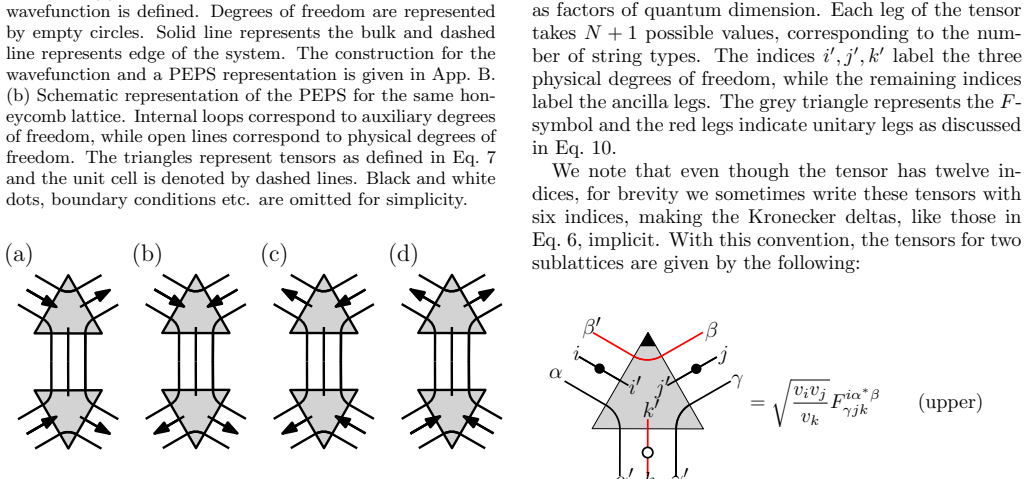
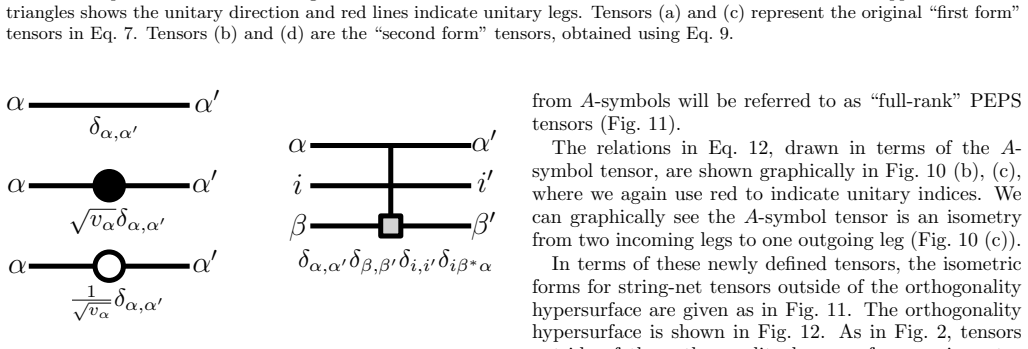
The load-bearing device is the A-symbol tensor, defined by splitting the F-symbol into a full-rank part and the fusion constraints: $F^{ijm}_{kln}=A^{ijm}_{kln}\delta_{ijm}\delta_{klm^*}$, with the full-rank part required to be unitary, $\sum_n (A^{ijm}_{kln})^* A^{ijm'}_{kln}=\delta_{m,m'}$. Since the A-symbol tensor is itself an isometry from two incoming legs to one outgoing leg, PEPS tensors rebuilt from A-symbols automatically satisfy the isoTNS isometry conditions once the fusion constraints have been pushed onto the orthogonality hypersurface and center. The paper supplies an explicit construction of the A-symbols: the constrained unitary block of the F-symbol is padded with an identity block in the forbidden sector, and the toric-code and non-abelian examples are written out.
What would settle it
Find a string-net-like model within the generalized class whose recoupling data violate the tetrahedral symmetry or constrained-subspace unitarity identities, and show its fixed-point ground state cannot be written as an exact finite-bond-dimension isometric tensor network; alternatively, prove a rigorous lower bound showing the required bond dimension of any exact isoTNS grows with system size for such a state.
Extended reading notes
Core claim
The paper's central discovery is that the fixed-point ground states of string-net liquids are not just representable as general projected entangled pair states (PEPS) but are exactly representable in the isometric subclass. The obstacle to isometric form is that the F-symbols are unitary only inside the subspace selected by fusion constraints, the branching rules that restrict which string types may meet at a vertex. The paper removes the constraints by defining full-rank A-symbol tensors that extend this partial unitarity to the whole ancilla space, moves all fusion constraints onto the orthogonality hypersurface and its center, and verifies by graphical contraction that every tensor outside that hypersurface satisfies the local isometry condition. The resulting tensor network is exactly equivalent to the original string-net wavefunction, not through gauge transformations alone but through a controlled stripping off and re-insertion of fusion constraints. The same isometric property is preserved under any finite-depth local circuit by coarse-graining around each unitary, applying it, and fine-graining back, with bond dimension growing by a system-size-independent factor per layer.
Load-bearing premise
The construction assumes the recoupling data of the model are symmetric enough that their partial unitarity can be extended to a full isometry; models without that symmetry, including non-abelian generalizations outside the original string-net class, are not covered.
Editorial extensions
If this is right
- All bosonic abelian topological orders with gappable edges, which fall in the generalized string-net class of Ref. [24], have exact finite-bond-dimension isoTNS representations.
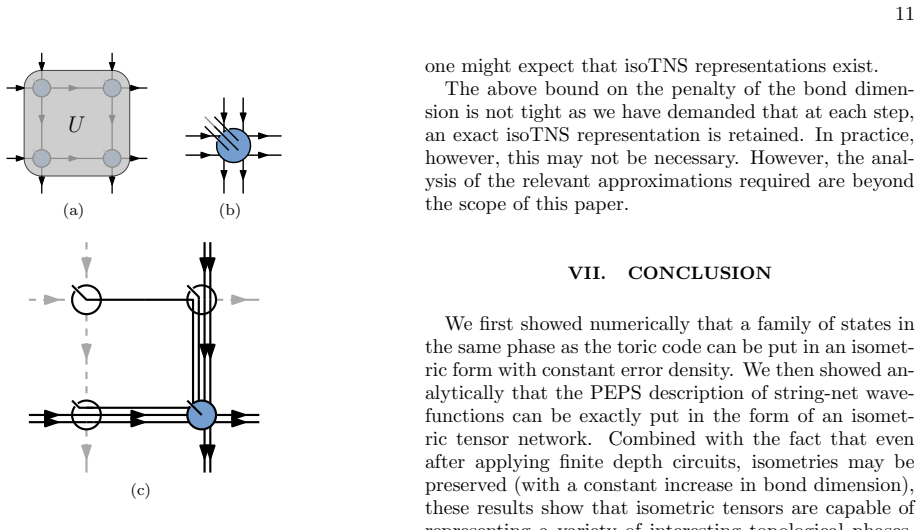
- The isometric form is stable under finite-depth local circuits: applying a depth-$D$ circuit increases the bond dimension by a factor that depends only on the depth and local Hilbert space dimension, not on system size.
- Local observables supported on or near the orthogonality hypersurface can be evaluated without contracting the off-hypersurface tensors, so the computational simplification of isoTNS applies to an entire class of topologically ordered states.
- Chiral topological orders such as integer quantum Hall states and their fractional counterparts are not covered, consistent with the expectation that exponentially correlated tensor networks cannot represent them.
Reading between the lines
- If the widely believed statement that every two-dimensional bosonic gapped phase with a gappable edge has a string-net description is true, then the proof implies exact isoTNS representations for all of that phase class, making the ansatz essentially universal there.
- The lifting trick suggests a general principle: the obstruction to isometric form in a tensor network is constrained-subspace non-unitarity rather than topological order, so other constrained tensor networks, such as gauge-invariant PEPS, may be isometrizable by similar enlargements of the local Hilbert space.
- The stated bond-dimension growth under circuits is an upper bound from insisting on exact isometry at every layer; in numerical practice, approximate preservation may require far smaller bond dimensions, and this is directly testable on the interpolating toric-code family treated in the numerics.
- A natural next test is to apply the construction to non-abelian generalized string-net models that lack tetrahedral symmetry; the answer would sharpen the boundary of the isoTNS ansatz.
Editorial analysis
A structured set of objections, weighed in public.
Referee Report
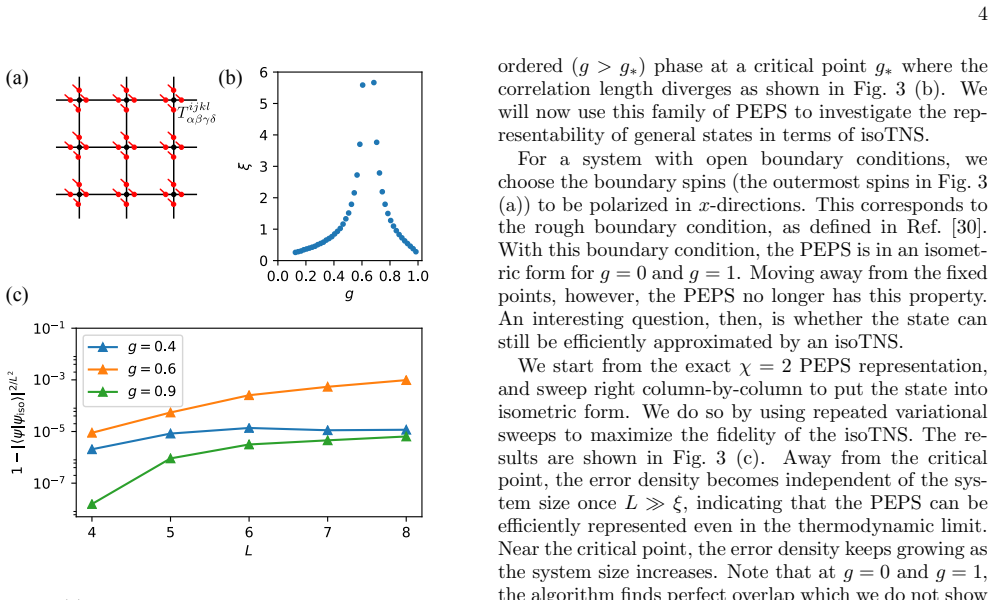
Summary. This paper studies whether long-range entangled states can be represented by isometric tensor network states (isoTNS). The authors first present a numerical study of a one-parameter family of PEPS in the toric-code phase, showing that away from the critical point the states are well approximated by an isoTNS with constant error density. They then prove analytically that fixed-point ground states of Levin-Wen string-net models admit exact isoTNS representations with finite bond dimension. The central construction defines 'full-rank' A-symbol tensors that lift the constrained unitarity of the F-symbols to an unconstrained isometry, using tetrahedral symmetry and gauge transformations to arrange four isometry directions, and places all fusion constraints on the orthogonality hypersurface. They further argue that any state obtainable from such a fixed point by a finite-depth local quantum circuit also admits an exact isoTNS representation with a constant increase in bond dimension. Appendices contain the A-symbol construction with toric-code and Ising examples, a treatment of abelian generalizations, an entanglement-spectrum consistency check, and a quasiadiabatic-evolution justification for the finite-depth-circuit assumption.
Significance. If the main theorem holds, the result is significant: it directly addresses the open question of which quantum phases admit an isoTNS representation, showing that long-range entanglement does not by itself obstruct the isometric canonical form. This matters for numerical tensor-network algorithms, since isoTNS allow cheaper contractions. The proofs are analytical and parameter-free; the A-symbols are constructed explicitly (App. D) with concrete examples, and the F-symbol data are taken as inputs from the string-net literature, so the argument is not circular. The entanglement-spectrum consistency check in App. F is a useful nontrivial verification. The principal caveat, discussed below, is that the stated scope of the theorem for generalized string-net models of Ref. [24] is broader than the proof actually supplied.
major comments (2)
- [Introduction, Sec. V, App. E] The opening theorem in the Introduction and Abstract claims that 'for every string-net liquid model as defined in [23] and generalized in [24]' an exact isoTNS representation exists. This is not established for non-abelian models of Ref. [24]. The main-text construction relies on the tetrahedral symmetry Eq. (9) and the constrained-subspace unitarity Eq. (10), properties verified in App. B only for the isotopy-invariant Levin-Wen string-nets of Ref. [23]. The paper itself states in Sec. V that generalizations in Ref. [24] need a different treatment, and App. E supplies that treatment only for abelian string-net models, where separate A-, B-, and C-symbols are introduced precisely because tetrahedral symmetry is not assumed. App. C also notes that the tetrahedral and mirror symmetries 'may not hold for the most general UFCs.' The Conclusion's caveat about Ref. [34] does not repair this gap. The authors should either extend the proof to non-abelian models of Ref. [24] or explicitly restrict the theorem's statement to the Levin-Wen models of Ref. [23] plus the abelian cases covered in App. E.
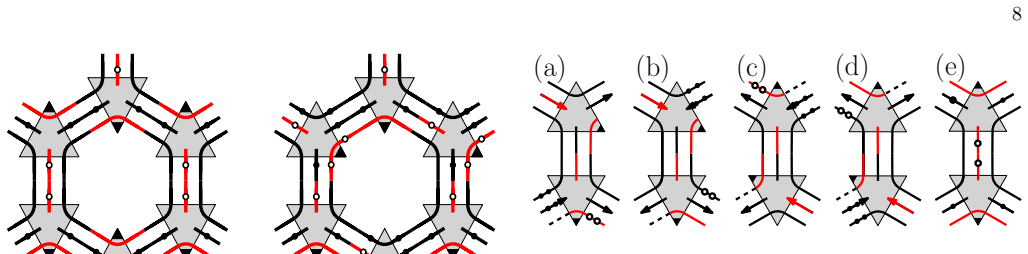
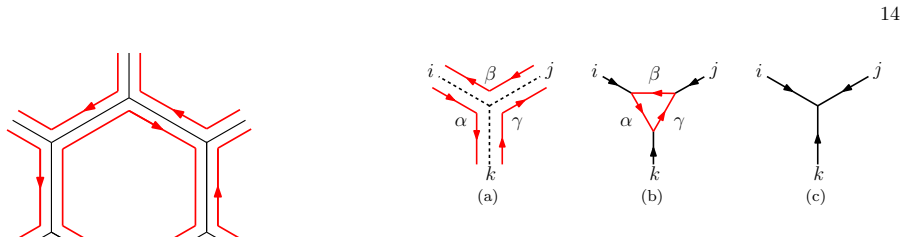
- [Sec. V.D, Fig. 11, Fig. 12] The isometry proof is carried out explicitly for only one of the four bulk direction tensors (tensor (a) in Fig. 11). The text states that the other directions and the tensors on the orthogonality hypersurface are 'done similarly,' but the mechanism that would make the other directions follow from the same argument is the tetrahedral symmetry Eq. (9), and no explicit demonstration is given that this symmetry rotates the App. D completion into the gauge choices of Figs. 11(b)-(d) and into the orthogonality-hypersurface tensors of Fig. 12. The latter are isometries from three incoming legs to one outgoing leg, a condition different from the two-in/two-out condition proved in Fig. 14. For the generalized models of Ref. [24], which lack Eq. (9), the 'similarly' is especially consequential. The paper should spell out the verification for all four directions and for the orthogonality-hypersurface tensors, or state explicitly which symmetry assumptions permit the reduction to the one proved case.
minor comments (4)
- [Sec. V.C, Fig. 13] The proof that the full-rank tensor network equals the original constrained network is presented graphically with the factors of quantum dimensions omitted. Since this equality is part of the argument that the isoTNS represents the same wavefunction, the authors should either display the factors explicitly in the figure or provide an algebraic statement in an appendix that tracks all quantum-dimension factors, rather than saying only that they are omitted for simplicity.
- [Sec. VI, Fig. 16] The coarse-graining and fine-graining moves are described graphically, but the fine-graining step is not defined algebraically. A precise definition of the four split tensors and of the index grouping would make the claimed bond-dimension increase chi -> chi^2 d^2 verifiable by the reader; currently one must infer the construction from the figure.
- [App. D] The symbol delta_{ijkl} is defined as the number of allowed intermediate channels, but the text does not explicitly note that it equals the dimension of both the row and column subspaces of the constrained F-matrix. A one-sentence explanation would improve clarity, as this equality is what makes the A-symbol completion square and unitary.
- [General] There are several minor typographical and grammatical issues, for example 'The resulting tensor network defines wavefunction as' (missing 'the'), 'a orthogonality hypersurface' for 'an orthogonality hypersurface', and 'are the same tensors as' for 'are the same as'. These should be corrected in a final pass.
Circularity Check
No significant circularity: the isoTNS construction is derived from stated F-symbol identities and verified by explicit diagrammatic proofs.
full rationale
The paper's central claim is that string-net fixed-point wavefunctions admit exact isoTNS representations. The derivation does not reduce to its inputs by construction: the A-symbol tensors are explicitly constructed in Appendix D by completing the constrained unitary F-matrices to full unitaries (Eq. D4), and the equivalence to the original constrained tensor network is then proved diagrammatically via Eq. 12 and Figs. 13-14. The isometry proof in Sec. V.D uses only the stated F-symbol identities, Eq. 9 (tetrahedral symmetry), Eq. 10 (subspace unitarity), and Eq. 11 (quantum-dimension relation), all derived in Appendix B from the Levin-Wen input data. There is no fitted parameter that is later renamed as a prediction, and no uniqueness theorem is imported to force the choice of ansatz. The only self-citation is the definition of isoTNS from Ref. [21] by two of the present authors, but that definition is not a representability claim and is restated and explained self-contained in Sec. II and Appendix A; the target result is proved rather than assumed from the citation. The finite-depth circuit extension in Sec. VI is an independent construction using coarse-graining, application of the unitary, and fine-graining, with a bond-dimension increase computed explicitly. The acknowledged limitation that non-abelian generalizations of Ref. [24] are not covered, with only the abelian case treated in Appendix E, is a scope/correctness gap rather than a circular step, because the paper itself states that those cases need a different treatment. No step in the derivation chain exhibits self-definition, fitted-input-as-prediction, or an ansatz smuggled in via citation.
Assumptions & free parameters
assumptions (6)
- domain assumption Levin-Wen string-net F-symbols satisfy unitarity in the constrained fusion subspace, Eq. (10), and tetrahedral symmetry, Eq. (9).
- domain assumption String-net ground states have an exact PEPS representation in terms of F-symbols, as reviewed in Appendix B and based on Refs. [31,32].
- domain assumption Fusion constraints are associative and quantum dimensions satisfy Eq. (11), equivalently Eq. (B10).
- standard math A partial isometry can be completed to a full unitary by filling the orthogonal complement with identity, as done in Appendix D.
- domain assumption Quasi-adiabatic evolution under a local gapped Hamiltonian can be approximated by an O(1)-depth local quantum circuit, Theorem 1 in Appendix G.
- domain assumption All bosonic gapped phases with gappable edges have a string-net representation.
invented entities (1)
-
A-symbols, and the B- and C-symbol analogues for abelian models
Cite this review
Pith. "Pith review of Isometric Tensor Network representation of string-net liquids." pith.science (2026). https://pith.science/paper/SXXIKYJN
@misc{pith2026190807545,
  author       = {Pith},
  title        = {Pith review of: Isometric Tensor Network representation of string-net liquids},
  year         = {2026},
  howpublished = {\url{https://pith.science/paper/SXXIKYJN}},
  note         = {Machine review of arXiv:1908.07545}
}
read the original abstract
Recently, a class of tensor networks called isometric tensor network states (isoTNS) was proposed which generalizes the canonical form of matrix product states to tensor networks in higher dimensions. While this ansatz allows for efficient numerical computations, it remained unclear which phases admit an isoTNS representation. In this work, we show that two-dimensional string-net liquids, which represent a wide variety of topological phases including discrete gauge theories, admit an exact isoTNS representation. We further show that the isometric form can be preserved after applying a finite depth local quantum circuit. Taken together, these results show that long-range entanglement by itself is not an obstruction to isoTNS representation and suggest that all two-dimensional gapped phases with gappable edges admit an isoTNS representation.
Figures

Figures from the paper (16 more)







Reference graph
Works this paper leans on
-
[24]
need a different treatment, as discussed in App. E. A. F -symbol identities We briefly summarize some properties of the F - symbols that are necessary for constructing the new ten- sors and proving their isometry. We show in App. B that these properties are satisfied by isotopy-invariant string- nets. First, F -symbols satisfy so-called “branching rules” or ...
-
[23]
Corboz, Variational optimization with infinite pro- jected entangled-pair states, Phys
P. Corboz, Variational optimization with infinite pro- jected entangled-pair states, Phys. Rev. B 94, 035133 (2016)
work page 2016
-
[34]
Dubail and N
J. Dubail and N. Read, Tensor network trial states for chiral topological phases in two dimensions and a no- go theorem in any dimension, Phys. Rev. B 92, 205307 (2015)
2015
-
[1]
For every string-net liquid model as defined in [23] and generalized in [24], there exists an exact repre- sentation of the fixed-point ground state wavefunc- tion as an isoTNS with finite bond dimension, such that the orthogonality hypersurface may be placed anywhere
-
[2]
Isometric Tensor Network representation of string-net liquids
All wavefunctions which may be transformed to string-net liquid fixed points by local unitary cir- cuits of finite depth also admit exact isoTNS rep- resentations of finite bond dimension. The states generated by finite-depth circuits acting on string-net wavefunctions include a large class of 2D quan- tum phases, including (but not limited to) all bosonic ab...
work page Pith review arXiv 1908
-
[3]
Branching: Not all configurations of strings are valid. One constraint on configurations that may appear are determined by which strings may meet at a vertex. These are referred to as “branching rules” or “fusion constraints”, indicated by a sym- bol δijk which is 0 if strings ijk are forbidden from meeting at a vertex or 1 if permitted. By defi- nition, fus...
-
[4]
Strings are generally oriented so that i∗ denotes a string oriented opposite i
String Types: Each edge carries one ofN +1 pos- sible strings numbered s = 1...N or no string at all, numbered s = 0. Strings are generally oriented so that i∗ denotes a string oriented opposite i. A string is unoriented if i =i∗
-
[5]
Quantum Dimension: Each string type s has a valueds > 0 associated to it, termed the “quantum dimension”. The total quantum dimension D is defined asD =∑ sd2 s
Show all 48 references
-
[6]
Vidal, Efficient simulation of one-dimensional quan- tum many-body systems, Phys
G. Vidal, Efficient simulation of one-dimensional quan- tum many-body systems, Phys. Rev. Lett. 93, 040502 (2004)
2004
-
[7]
unitarity
F symbols: The F -symbol is a six-index tensor describing how to recouple a string-net configura- tion. It defines how coefficients in the many body wavefunction Φ(X) differ between two configura- tions X and X′ which differ by a local recoupling of strings. In Eq. B3 below, we mean ...
-
[8]
The corresponding fusion constraints are given by δ000 =δ110 = 1 (D5) Other combinations of indices that are not permutations of the above two are all zero
N = 1 string model We will look at the simplest string-net model, which only has a vacuum string (0) and one non-trivial string (1). The corresponding fusion constraints are given by δ000 =δ110 = 1 (D5) Other combinations of indices that are not permutations of the above two a...
-
[9]
strip off
The Ising anyon model As a more non-trivial example, we look at the Ising string-net model. The model has two non-trivial string types, 1 2, 1, in addition to the vacuum string 0. Non-zero fusion constraints are given by δ000 =δ110 =δ 1 2 1 2 0 =δ 1 2 1 2 1 = 1 (D9) and their ...
-
[10]
M. B. Hastings, An area law for one-dimensional quan- tum systems, Journal of Statistical Mechanics: Theory and Experiment 2007, P08024 (2007)
2007
-
[11]
I. Arad, Z. Landau, and U. Vazirani, Improved one- dimensional area law for frustration-free systems, Phys. Rev. B 85, 195145 (2012)
2012
-
[12]
S. R. White, Density matrix formulation for quantum renormalization groups, Phys. Rev. Lett.69, 2863 (1992)
1992
-
[13]
Schollw¨ ock, The density-matrix renormalization group in the age of matrix product states, Annals of Physics 326, 96 (2011), arXiv:1008.3477
U. Schollw¨ ock, The density-matrix renormalization group in the age of matrix product states, Annals of Physics 326, 96 (2011), arXiv:1008.3477
2011 arXiv
-
[14]
Vidal, Efficient classical simulation of slightly entan- gled quantum computations, Phys
G. Vidal, Efficient classical simulation of slightly entan- gled quantum computations, Phys. Rev. Lett. 91, 147902 (2003)
2003
-
[15]
Vanderstraeten, J
L. Vanderstraeten, J. Haegeman, P. Corboz, and F. Ver- straete, Gradient methods for variational optimization of projected entangled-pair states, Phys. Rev. B 94, 155123 (2016)
2016
-
[16]
Haegeman, J
J. Haegeman, J. I. Cirac, T. J. Osborne, I. Pizorn, H. Ver- schelde, and F. Verstraete, Time-dependent variational principle for quantum lattices, Phys. Rev. Lett. 107, 070601 (2011)
2011
-
[17]
I. Arad, Z. Landau, U. Vazirani, and T. Vidick, Rigorous rg algorithms and area laws for low energy eigenstates in 1d, Communications in Mathematical Physics 356, 65 (2017)
2017
-
[18]
Nishino and K
T. Nishino and K. Okunishi, Corner transfer ma- trix renormalization group method, Journal of the Physical Society of Japan 65, 891 (1996), https://doi.org/10.1143/JPSJ.65.891
1996 doi
-
[19]
Verstraete and J
F. Verstraete and J. I. Cirac, Renormalization algorithms for Quantum-Many Body Systems in two and higher di- mensions, arXiv e-prints , cond-mat/0407066 (2004)
2004 arXiv
-
[20]
Schuch, M
N. Schuch, M. M. Wolf, F. Verstraete, and J. I. Cirac, Computational complexity of projected entangled pair states, Phys. Rev. Lett. 98, 140506 (2007)
2007
-
[21]
R. J. Baxter, Dimers on a rectangular lattice, Journal of Mathematical Physics 9, 650 (1968)
1968
-
[22]
Orus and G
R. Orus and G. Vidal, Simulation of two-dimensional quantum systems on an infinite lattice revisited: Cor- ner transfer matrix for tensor contraction, Phys. Rev. B 80, 094403 (2009)
2009
-
[25]
Jordan, R
J. Jordan, R. Or´ us, G. Vidal, F. Verstraete, and J. I. Cirac, Classical simulation of infinite-size quantum lat- tice systems in two spatial dimensions, Phys. Rev. Lett. 101, 250602 (2008)
2008
-
[26]
Levin and C
M. Levin and C. P. Nave, Tensor renormalization group approach to two-dimensional classical lattice models, Phys. Rev. Lett. 99, 120601 (2007)
2007
-
[27]
Z. Y. Xie, H. C. Jiang, Q. N. Chen, Z. Y. Weng, and T. Xiang, Second renormalization of tensor-network states, Phys. Rev. Lett. 103, 160601 (2009)
2009
-
[28]
Evenbly and G
G. Evenbly and G. Vidal, Tensor network renormaliza- tion, Phys. Rev. Lett. 115, 180405 (2015)
2015
-
[29]
Yang, Z.-C
S. Yang, Z.-C. Gu, and X.-G. Wen, Loop optimization for tensor network renormalization, Phys. Rev. Lett. 118, 20 110504 (2017)
2017
-
[30]
M. P. Zaletel and F. Pollmann, Isometric Tensor Network States in Two Dimensions (2019), arXiv:1902.05100
2019 arXiv
-
[31]
Haghshenas, M
R. Haghshenas, M. J. O’Rourke, and G. K.-L. Chan, Canonicalization of projected entangled pair states (2019), arXiv: 1903.03843
2019 arXiv
-
[32]
M. A. Levin and X.-G. Wen, String-net condensation: A physical mechanism for topological phases, Phys. Rev. B 71, 045110 (2005)
2005
-
[33]
Lin and M
C.-H. Lin and M. Levin, Generalizations and limitations of string-net models, Phys. Rev. B 89, 195130 (2014)
2014
-
[35]
T. B. Wahl, H.-H. Tu, N. Schuch, and J. I. Cirac, Pro- jected entangled-pair states can describe chiral topologi- cal states, Phys. Rev. Lett. 111, 236805 (2013)
2013
-
[36]
Levin, Protected edge modes without symmetry, Phys
M. Levin, Protected edge modes without symmetry, Phys. Rev. X 3, 021009 (2013)
2013
-
[37]
Kitaev, Fault-tolerant quantum computation by anyons, Annals of Physics 303, 2 (2003)
A. Kitaev, Fault-tolerant quantum computation by anyons, Annals of Physics 303, 2 (2003)
2003
-
[38]
X. Chen, B. Zeng, Z.-C. Gu, I. L. Chuang, and X.-G. Wen, Tensor product representation of a topological or- dered phase: Necessary symmetry conditions, Phys. Rev. B 82, 165119 (2010)
2010
-
[39]
Kitaev and L
A. Kitaev and L. Kong, Models for gapped boundaries and domain walls (2011), arXiv: 1104.5047
2011 arXiv
-
[40]
Z.-C. Gu, M. Levin, B. Swingle, and X.-G. Wen, Tensor- product representations for string-net condensed states, Phys. Rev. B 79, 085118 (2009)
2009
-
[41]
Buerschaper, M
O. Buerschaper, M. Aguado, and G. Vidal, Explicit ten- sor network representation for the ground states of string- net models, Phys. Rev. B 79, 085119 (2009)
2009
-
[42]
M. B. Hastings and X.-G. Wen, Quasiadiabatic contin- uation of quantum states: The stability of topological ground-state degeneracy and emergent gauge invariance, Phys. Rev. B 72, 045141 (2005)
2005
-
[43]
Lan and X.-G
T. Lan and X.-G. Wen, Topological quasiparticles and the holographic bulk-edge relation in (2 + 1)-dimensional string-net models, Phys. Rev. B 90, 115119 (2014)
2014
-
[44]
Bonderson, K
P. Bonderson, K. Shtengel, and J. Slingerland, Interfer- ometry of non-abelian anyons, Annals of Physics 323, 2709 (2008)
2008
-
[45]
Levin and X.-G
M. Levin and X.-G. Wen, Detecting topological order in a ground state wave function, Phys. Rev. Lett. 96, 110405 (2006)
2006
-
[46]
E. H. Lieb and D. W. Robinson, The finite group velocity of quantum spin systems, Comm. Math. Phys. 28, 251 (1972)
1972
-
[47]
Nachtergaele and R
B. Nachtergaele and R. Sims, Lieb-robinson bounds and the exponential clustering theorem, Communications in Mathematical Physics 265, 119 (2006)
2006
-
[48]
M. B. Hastings and T. Koma, Spectral gap and expo- nential decay of correlations, Communications in Math- ematical Physics 265, 781 (2006)
2006
Reviewed August 14, 2026 · model on record in the stance chip above.
Discussion (0). Continue with ORCID to comment.