REVIEW 3 major objections 6 minor 68 references
How kinesin waits for ATP affects the nucleotide and load dependence of the stepping kinetics
T0 review · 3 major / 6 minor · reviewed 2026-08-14 · deepseek-v4-flash
Pith's one-line read The randomness parameter of kinesin's stepping has opposite ATP- and force-dependence depending on whether the motor waits for ATP with both heads bound or with one head detached, and measuring it can settle which waiting state is real.
desk verdict Solid two-state kinesin model and a clever randomness discriminator, but the monotonic-vs-minimum signature evaporates if a slow ATP-independent state is added; needs a robustness check before the 'unambiguous' claim stands. read the letter →
The pith
A machine-rendered reading of the paper's core claim, the machinery that carries it, and where it could break.
The reading
What carries the argument
The central object is a two-state chemical-kinetic scheme in which the motor alternates between a state with both heads bound to the microtubule (2HB) and a state with one head bound (1HB); forward stepping, backward stepping, and detachment occur from the 1HB state. ATP dependence enters either the 2HB→1HB transition (2HB model) or the stepping and detachment rates (1HB model), with Michaelis-Menten kinetics, and load dependence enters through Bell-model exponentials on the load-bearing rates. The analytical solution yields closed forms for the stationary fluxes, the run-length distribution $P(n)$, the velocity distribution $P(v)$ (involving modified Bessel functions), and the chemical randomness parameter $r_C = (k^2 + (k_+ + k_- + \gamma)^2)/(k + k_+ + k_- + \gamma)^2$, where $k$ is the 2HB→1HB rate and $k_+$, $k_-$, $\gamma$ are the forward, backward, and detachment rates. The qualitative difference between models arises from which rate changes with [T] and load, producing or suppressing a crossover in the rate-limiting step.
What would settle it
Measure the randomness parameter of kinesin-1 at zero load across ATP concentrations from about 10 µM to 1 mM using a high-resolution dark-field or iSCAT assay: a clear minimum near 100 µM would support the both-heads-bound waiting state, whereas a monotonic decrease would support the one-head-bound state. Repeating the measurement at 4–6 pN of resistive load would test the predicted near-flat versus force-dependent behavior.
Extended reading notes
Core claim
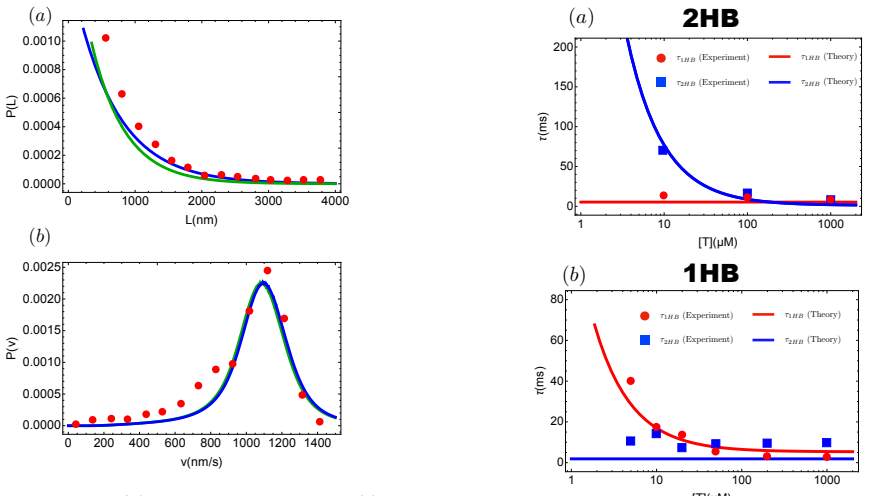
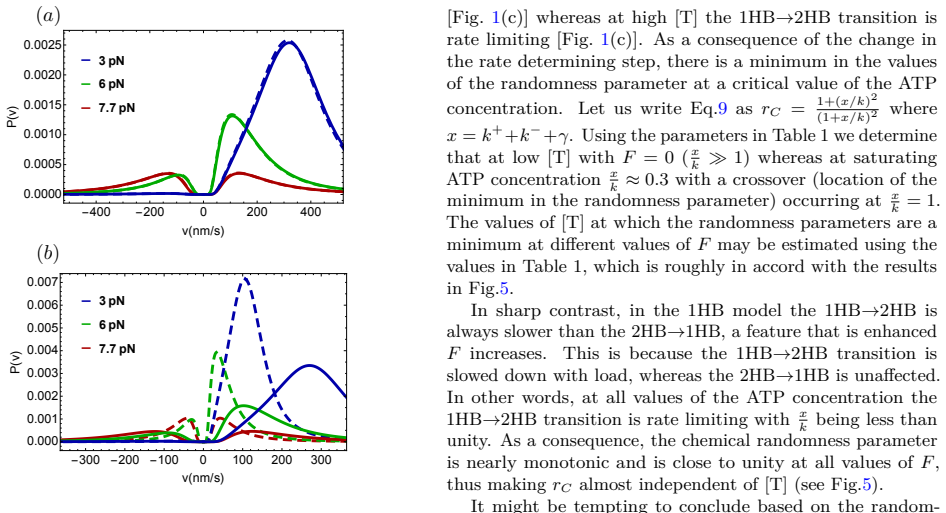
On the authors' own terms, the discovery is that the waiting state of kinesin for ATP is encoded in the [T]- and F-dependence of the randomness parameter. In the 2HB model, where ATP binds to the leading head while both heads are on the microtubule, the randomness parameter is non-monotonic in ATP concentration with a minimum near [T] = 100 µM at all forces studied; in the 1HB model, where ATP binds only after the trailing head has detached, it decreases monotonically and is nearly flat as force increases. The difference arises because in the 2HB model the rate-limiting step switches from ATP binding at low [T] to the stepping transition at high [T], while in the 1HB model the stepping transition is always rate-limiting and is only slowed further by load. Run-length distributions, by contrast, are predicted to be insensitive to the waiting state, and velocity distributions are bimodal under load in both models, differing only quantitatively at low ATP.
Load-bearing premise
The predictions rest on the assumption that the rate of the both-heads-bound to one-head-bound transition is independent of external load; if load changes that rate, the predicted force contrast between the two waiting states would be altered.
Editorial extensions
If this is right
- A measurement of the randomness parameter over ATP concentrations from roughly 10 µM to 1 mM at zero load can discriminate the waiting states: a minimum near 100 µM supports the both-heads-bound model, a monotonic decrease supports the one-head-bound model.
- The predicted bimodality of the velocity distribution under load is present in both models at both low and high ATP, so this signature can be tested without first resolving the waiting-state question.
- The run-length distribution is predicted to be independent of ATP concentration in both models, consistent with existing data above about 10 µM, so run lengths cannot serve as the discriminating observable.
- Because the 1HB model keeps the randomness parameter close to one and nearly flat with force, while the 2HB model produces a force-dependent dip, repeating the measurement at 4–6 pN would provide a second, independent discriminator.
Reading between the lines
- An extension the authors do not spell out: the same two-state discrimination could be tried on other processive motors, such as myosin V or dynein, where a non-monotonic versus monotonic randomness parameter would likewise reveal when ATP binds relative to partner-head detachment.
- A direct test of the model's load-bearing assumption would be to measure the lifetime of the both-heads-bound state as a function of load; if that lifetime changes with force, the predicted force contrast between the waiting states would need revision.
- Because the model compresses many ATP-independent internal states into one, it likely overestimates the absolute level of the randomness parameter; the most decisive experimental comparison is therefore the shape of r([T]) and r(F) curves, not their absolute values.
Signed reviews
Editorial analysis
A structured set of objections, weighed in public.
Referee Report
Summary. The paper develops a two-state kinetic model for kinesin-1 stepping in which the ATP-waiting state is either one-head-bound (1HB) or two-heads-bound (2HB) to the microtubule. For each scenario the authors derive closed-form expressions for the run-length distribution, the velocity distribution, and the chemical and mechanical randomness parameters as functions of ATP concentration [T] and resistive load F. The parameters are fitted to published run-length, velocity, and force-velocity data, while the dwell-time data of the two conflicting single-molecule experiments (Mickolajczyk et al. and Isojima et al.) are deliberately not used in the fit; the model reproduces those dwell times well. The central prediction is that the randomness parameter as a function of [T] and F is qualitatively different in the two models: the 2HB model shows a clear minimum in the randomness parameter as [T] is varied, whereas the 1HB model shows a monotonic decrease that is almost flat with increasing force. The paper proposes that measuring the randomness parameter would discriminate between the two waiting states and resolve the controversy.
Significance. If the central prediction were robust, the paper would give experimentalists a straightforward, low-bias observable with which to resolve the long-standing disagreement about kinesin's ATP-waiting state. The work has real strengths: the analytical derivations in the SI are internally consistent; the comparison of the predicted 1HB and 2HB dwell times to the two conflicting experiments is a genuine not-fitted check; the prediction that P(n) is [T]-independent is consistent with existing experiments; and the authors test a variant of the 1HB model with a [T]-independent backward-step rate, showing that some qualitative features survive that modification. However, the central claim rests on the two-state compression of the kinetic cycle, and the manuscript does not establish that the qualitative monotonic-versus-minimum randomness signature survives the inclusion of additional ATP-independent internal states. The significance must therefore be considered conditional on that robustness.
major comments (3)
- [Discussion, 'Randomness parameters are dramatically different between the two waiting states'] The robustness argument against the two-state compression is not generally correct. For a dwell time that is the sum of an ATP-dependent exponential with rate x([T]) and an ATP-independent exponential with rate c, the chemical randomness is r = (c^{-2}+x^{-2})/(c^{-1}+x^{-1})^2, which has a minimum at x = c. In the fitted 1HB model (Table 2), k = 538 s^{-1} and the maximal ATP-dependent sum x_max = k_+^0 + k_-^0 + γ^0 ≈ 188 s^{-1}, so the two-state r_C decreases monotonically with [T]. If a single slow internal state with c ≈ 20 s^{-1} is added, the minimum occurs at a finite [T] (roughly 2.5 µM), making the 1HB r_C non-monotonic. Thus the claimed 'monotonic in 1HB, minimum in 2HB' signature is demonstrably an artifact of the collapsed state count, and the assertion that the qualitative difference 'should be amenable to experimental verification' is unsupported by the manuscript as written.
- [Fig. 5 and accompanying text] The comparison of the predicted randomness parameters to the experimental data of Verbrugge et al. (47) and Visscher et al. (13) is only qualitative, and the two-state model has a hard lower bound r ≥ 0.5. In Fig. 5(a) several reported experimental values appear to fall below 0.5, which the model cannot reproduce. The paper acknowledges this and proposes an ad hoc vertical rescaling, but the rescaling is not derived from the model. Since the paper proposes the randomness parameter as the key discriminator between waiting states, the model must at least reproduce the experimental magnitudes in the region of the predicted minimum before the qualitative prediction can be considered quantitatively testable.
- [Main text after Fig. 1] The assumption that the 2HB→1HB transition rate k is independent of load is used to generate the force dependence of the randomness parameters that the paper contrasts between the two models. If k itself is load-dependent (e.g., k(F) = k_0 exp(δF/k_B T)), the predicted near-flatness of the 1HB r_C as a function of F could be altered, and the qualitative contrast with the 2HB model might change. The paper states the assumption but gives no physical justification or sensitivity analysis. Because the force dependence is part of the central predictive claim, this missing analysis is a load-bearing gap.
minor comments (6)
- [Eq. (2)] The symbol kT is used for the total rate k + k_+ + k_- + γ, which is easily confused with k_B T used elsewhere in the same paragraph; please use a distinct symbol such as K_T or k_tot.
- [Main text, parameter definitions] The definition of d± is garbled in the sentence 'd±= d±‖F‖/F and the load Fd = (|F|kBT)/(F⊥dγ)'; the notation for the parallel and perpendicular components of the load should be rewritten clearly.
- [Introduction] The name 'Micolajczky et al.' is misspelled; it should be 'Mickolajczyk et al.'.
- [Abstract] The phrase 'observables quantities' should be 'observable quantities'.
- [Fig. 3 caption] The caption labels panels (a) and (b) as 2HB and 1HB, but the text above says the upper panel is for the 2HB model and the lower panel is for the 1HB model; the caption and text are inconsistent.
- [SI Sections III.B and VI] The main text says 'we found analytical expressions for rC and rM', but rM is actually computed numerically by truncating the sums in Eq. (S31)-(S32) at a finite time t = 0.5 s. Please clarify that only rC is obtained in closed form and describe the numerical convergence of rM.
Circularity Check
No significant circularity: the randomness-parameter predictions are out-of-sample consequences of a two-state model fit to run-length, velocity, and force-velocity data, not to randomness data.
full rationale
The paper's central prediction is that the chemical and mechanical randomness parameters as functions of [T] and F are qualitatively different between the 2HB and 1HB waiting-state models. The model parameters were obtained by fitting the run-length distribution, the zero-load velocity distribution, and the load dependence of the average velocity (Walter et al. 2012; Nishiyama et al. 2002), with the explicit statement that the Mickolajczyk and Isojima dwell-time data were not used for fitting and with the randomness data of Visscher et al. and Verbrugge et al. only overlaid for comparison after the fit. The qualitative contrast is therefore not a fitted-input-called-prediction: no randomness measurement enters the parameter estimation. Nor is it self-definitional. The two models differ by which transition carries the Michaelis-Menten ATP dependence, but the predicted shapes of rC([T], F) are not identical to that modeling choice. For the 2HB model the minimum occurs only because the fitted k0 = 787 s^-1 exceeds the ATP-independent sum k+0 + k-0 + gamma0 = 188.7 s^-1, so the crossing k = x at which rC has its minimum is reached at finite [T]; for the 1HB model the fitted k = 538 s^-1 exceeds the maximal ATP-dependent sum 187.8 s^-1, so x < k for all [T] and rC decreases monotonically. These predictions depend on fitted parameter values and could have been different, so they carry independent content. The self-citations to Vu et al. supply the prior modeling framework and the value Fd = 3 pN, but the present derivations of P(n), P(v), and the randomness parameters are carried out in the paper and SI, and the cited prior work is not invoked as an external uniqueness theorem or to preclude alternative models. The acknowledged simplifications — the two-state compression, the lower bound rC >= 0.5, and the load-independence of the 2HB->1HB rate — are modeling limitations that bear on quantitative robustness and falsifiability, not on circularity. No step in the derivation reduces to its own input by construction.
Assumptions & free parameters
free parameters (17)
- k0 (2HB) =
787.0 s^-1
- k+0 (2HB) =
185.5 s^-1
- k-0 (2HB) =
0.8 s^-1
- gamma0 (2HB) =
2.4 s^-1
- KT (2HB) =
594.0 uM
- d+ (2HB) =
1.6 nm
- d- (2HB) =
1.3 nm
- Fd (2HB) =
3.0 pN
- k0 (1HB) =
538.0 s^-1
- k+0 (1HB) =
184 s^-1
- k-0 (1HB) =
0.8 s^-1
- gamma0 (1HB) =
3.0 s^-1
- KT (1HB) =
21.0 uM
- d+ (1HB) =
1.9 nm
- d- (1HB) =
1.0 nm
- Fd (1HB) =
3.0 pN
- SI 1HB variant parameter set =
k0=244 s^-1, k+0=303.1 s^-1, k-0=1.3 s^-1, gamma0=2.4 s^-1, KT=16 uM, d+=2.2 nm, d-=0.7 nm, Fd=3 pN
assumptions (7)
- domain assumption Michaelis-Menten kinetics for ATP binding
- domain assumption Bell model for load dependence
- domain assumption One ATP hydrolyzed per 8.2 nm step and hand-over-hand stepping
- ad hoc to paper Two-state reduction of the four-state cycle
- domain assumption Detachment occurs only from the 1HB state
- ad hoc to paper The 2HB to 1HB transition rate k is independent of load
- standard math Residue calculus and Bessel function identities
Cite this review
Pith. "Pith review of How kinesin waits for ATP affects the nucleotide and load dependence of the stepping kinetics." pith.science (2026). https://pith.science/paper/YYK2AJQG
@misc{pith2026190807570,
  author       = {Pith},
  title        = {Pith review of: How kinesin waits for ATP affects the nucleotide and load dependence of the stepping kinetics},
  year         = {2026},
  howpublished = {\url{https://pith.science/paper/YYK2AJQG}},
  note         = {Machine review of arXiv:1908.07570}
}
read the original abstract
Dimeric molecular motors walk on polar tracks by binding and hydrolyzing one ATP per step. Despite tremendous progress, the waiting state for ATP binding in the well-studied kinesin that walks on microtubule (MT), remains controversial. One experiment suggests that in the waiting state both heads are bound to the MT, while the other shows that ATP binds to the leading head after the partner head detaches. To discriminate between these two scenarios, we developed a theory to calculate accurately several experimentally measurable quantities as a function of ATP concentration and resistive force. In particular, we predict that measurement of the randomness parameter could discriminate between the two scenarios for the waiting state of kinesin, thereby resolving this standing controversy.
Figures

Figures from the paper (2 more)


Reference graph
Works this paper leans on
-
[1]
The solution of Eq.(1) gives P1HB = k k+k++k−+γ. The stationary fluxes for forward stepping (J +), backward stepping (J−), and detachment (Jγ) are computed by multiplying the steady-state probability of being in state 1HB (P1HB) times k+, k−, andγ(38, 39), J±= k kT k±, J γ= k kT γ, [2] where kT =k +k+ +k−+γ. The average velocity and run length are given by...
work page 2019
-
[2]
Mickolajczyk KJ, et al. (2015) Kinetics of nucleotide-dependent structural transitions in the kinesin-1 hydrolysis cycle.Proceedings of the National Academy of Sciences112(52):E7186– E7193
work page 2015
-
[3]
Nature chemical biology 12(4):290
Isojima H, Iino R, Niitani Y , Noji H, Tomishige M (2016) Direct observation of intermediate states during the stepping motion of kinesin-1. Nature chemical biology 12(4):290
work page 2016
-
[4]
SVOBODA K, SCHMIDT C, SCHNAPP B, BLOCK S (1993) Direct Observation Of Kinesin Stepping by BY Optical Trapping Interferometry. Nature 365(6448):721–727
work page 1993
-
[5]
Asbury CL, Fehr AN, Block SM (2003) Kinesin moves by an asymmetric hand-over-hand mechanism. Science 302(5653):2130–2134
work page 2003
-
[6]
Block SM (2007) Kinesin motor mechanics: Binding, stepping, tracking, gating and limping. Biophys. J. 92:2986–2995
work page 2007
-
[7]
Mori T, Vale RD, Tomishige M (2007) How kinesin waits between steps. Nature 450(7170):750
work page 2007
-
[8]
Yildiz A, Tomishige M, Vale RD, Selvin PR (2004) Kinesin walks hand-over-hand. Science 303(5658):676–678
work page 2004
Show all 68 references
-
[9]
Trends in Cell Biology 15(9):467 – 476
Miki H, Okada Y , Hirokawa N (2005) Analysis of the kinesin superfamily: insights into structure and function. Trends in Cell Biology 15(9):467 – 476
2005
-
[10]
Nature 377(6548):448
Hackney DD (1995) Highly processive microtubule-stimulated atp hydrolysis by dimeric ki- nesin head domains. Nature 377(6548):448
1995
-
[11]
Molecular Biology of the Cell 17(4):2057–2068
Pilling AD, Horiuchi D, Lively CM, Saxton WM (2006) Kinesin-1 and dynein are the primary motors for fast transport of mitochondria in drosophila motor axons. Molecular Biology of the Cell 17(4):2057–2068
2006
-
[12]
Cell 134(6):1030–1041
Yildiz A, Tomishige M, Gennerich A, Vale RD (2008) Intramolecular strain coordinates kinesin stepping behavior along microtubules. Cell 134(6):1030–1041
2008
-
[13]
PLoS ONE 7(8):e42218
Walter WJ, Beránek V, Fischermeier E, Diez S (2012) Tubulin acetylation alone does not affect kinesin-1 velocity and run length in vitro. PLoS ONE 7(8):e42218
2012
-
[14]
Nature 400(6740):184
Visscher K, Schnitzer MJ, Block SM (1999) Single kinesin molecules studied with a molecular force clamp. Nature 400(6740):184
1999
-
[15]
Nature 435(7040):308
Carter NJ, Cross R (2005) Mechanics of the kinesin step. Nature 435(7040):308
2005
-
[16]
Vu HT, Chakrabarti S, Hinczewski M, Thirumalai D (2016) Discrete step sizes of molecular motors lead to bimodal non-gaussian velocity distributions under force.Physical review letters 117(7):078101
2016
-
[17]
Proceedings of the National Academy of Sciences 114(46):E9838–E9845
Zhang Z, Goldtzvik Y , Thirumalai D (2017) Parsing the roles of neck-linker docking and tethered head diffusion in the stepping dynamics of kinesin. Proceedings of the National Academy of Sciences 114(46):E9838–E9845
2017
-
[18]
Structure 20(4):628 – 640
Zhang Z, Thirumalai D (2012) Dissecting the kinematics of the kinesin step. Structure 20(4):628 – 640
2012
-
[19]
Nature 388(6640):386
Schnitzer MJ, Block SM (1997) Kinesin hydrolyses one atp per 8-nm step. Nature 388(6640):386
1997
-
[20]
Nature structural & molecular biology 13(7):648
Asenjo AB, Weinberg Y , Sosa H (2006) Nucleotide binding and hydrolysis induces a disorder- order transition in the kinesin neck-linker region. Nature structural & molecular biology 13(7):648
2006
-
[21]
Proceedings of the National Academy of Sciences 98(14):7748–7753
Fisher ME, Kolomeisky AB (2001) Simple mechanochemistry describes the dynamics of ki- nesin molecules. Proceedings of the National Academy of Sciences 98(14):7748–7753
2001
-
[22]
Physical review letters 98(25):258102
Liepelt S, Lipowsky R (2007) Kinesin’s network of chemomechanical motor cycles. Physical review letters 98(25):258102
2007
-
[23]
The journal of physical chemistry letters8(1):250– 256
Hwang W, Hyeon C (2016) Quantifying the heat dissipation from a molecular motor’s transport properties in nonequilibrium steady states. The journal of physical chemistry letters8(1):250– 256
2016
-
[24]
The journal of physical chemistry letters 9(3):513–520
Hwang W, Hyeon C (2018) Energetic costs, precision, and transport efficiency of molecular motors. The journal of physical chemistry letters 9(3):513–520
2018
-
[25]
Scientific reports 7(1):1163
Sumi T (2017) Design principles governing chemomechanical coupling of kinesin. Scientific reports 7(1):1163
2017
-
[26]
Wagoner JA, Dill KA (2016) Molecular Motors: Power Strokes Outperform Brownian Ratchets. J. Phys. Chem. B 120(26):6327–6336
2016
-
[27]
Proceedings of the National Academy of Sciences 111(39):14136–14140
Milic B, Andreasson JO, Hancock WO, Block SM (2014) Kinesin processivity is gated by phos- phate release. Proceedings of the National Academy of Sciences 111(39):14136–14140
2014
-
[28]
(2015) Examining kinesin processivity within a general gating frame- work
Andreasson JO, et al. (2015) Examining kinesin processivity within a general gating frame- work. Elife 4:e07403
2015
-
[29]
Current Opinion in Cell Biology 21(1):59 – 67
Gennerich A, Vale RD (2009) Walking the walk: how kinesin and dynein coordinate their steps. Current Opinion in Cell Biology 21(1):59 – 67. Cell structure and dynamics
2009
-
[30]
Nature Structural & Molecular Biology 10(10):836
Asenjo AB, Krohn N, Sosa H (2003) Configuration of the two kinesin motor domains during atp hydrolysis. Nature Structural & Molecular Biology 10(10):836
2003
-
[31]
Science 291(5504):667–669
Kawaguchi K, Ishiwata S (2001) Nucleotide-dependent single-to double-headed binding of kinesin. Science 291(5504):667–669
2001
-
[32]
Proceedings of the National Academy of Sciences 106(14):5657–5662
Asenjo AB, Sosa H (2009) A mobile kinesin-head intermediate during the atp-waiting state. Proceedings of the National Academy of Sciences 106(14):5657–5662
2009
-
[33]
Takaki et al
Alhadeff R, Warshel A (2017) Reexamining the origin of the directionality of myosin V. Takaki et al. PNAS | August 22, 2019 | vol. XXX | no. XX | 9 Proc.Natl. Acad. Sci. 114(39):10426–10431
2017
-
[34]
Mukherjee S, Alhadeff R, Warshel A (2017) Simulating the dynamics of the mechanochemical cycle of myosin-V. Proc. Natl. Acad. Sci. 114(9):2259–2264
2017
-
[35]
Hyeon C, Onuchic JN (2011) A Structural Perspective on the Dynamics of Kinesin Motors. Biophys. J. 101:2749–2759
2011
-
[36]
Hyeon C, Onuchic JN (2007) Internal strain regulates the nucleotide binding site of the kinesin leading head. Proc. Natl. Acad. Sci. U. S. A. 104:2175–2180
2007
-
[37]
Hyeon C, Onuchic JN (2007) Mechanical control of the directional stepping dynamics of the kinesin motor. Proc. Natl. Acad. Sci. U. S. A. 104:17382–17387
2007
-
[38]
Sindelar CV, Liu D (2017) Tracking down kinesin’s achilles heel with balls of gold.Biophysical journal 112(12):2454–2456
2017
-
[39]
(Springer)
Hill T (1989) Free Energy Transduction and Biochemical Cycle Kinetics. (Springer)
1989
-
[40]
Proceedings of the National Academy of Sciences 85(9):2879–2883
Hill TL (1988) Interrelations between random walks on diagrams (graphs) with and without cycles. Proceedings of the National Academy of Sciences 85(9):2879–2883
1988
-
[41]
The Journal of Physical Chemistry B 122(13):3272–3279
Zhang Y , Kolomeisky AB (2017) Theoretical investigation of distributions of run lengths for biological molecular motors. The Journal of Physical Chemistry B 122(13):3272–3279
2017
-
[42]
Nature Cell Biology 4(10):790
Nishiyama M, Higuchi H, Y anagida T (2002) Chemomechanical coupling of the forward and backward steps of single kinesin molecules. Nature Cell Biology 4(10):790
2002
-
[43]
Organelle-Specific Pharmaceutical Nanotechnology pp
Müller MJI, Berger F , Klumpp S, Lipowsky R (2010) Cargo transport by teams of molecular motors: Basic mechanisms for intracellular drug delivery. Organelle-Specific Pharmaceutical Nanotechnology pp. 289–309
2010
-
[44]
Biophysics 4:11–18
Taniguchi Y , Y anagida T (2008) The forward and backward stepping processes of kinesin are gated by atp binding. Biophysics 4:11–18
2008
-
[45]
(Cold Spring Harbor Laboratory Press), Vol
Schnitzer MJ, Block S (1995) Statistical kinetics of processive enzymes in Cold spring harbor symposia on quantitative biology. (Cold Spring Harbor Laboratory Press), Vol. 60, pp. 793– 802
1995
-
[46]
Biophysical journal 89(4):2277–2285
Shaevitz JW, Block SM, Schnitzer MJ (2005) Statistical kinetics of macromolecular dynamics. Biophysical journal 89(4):2277–2285
2005
-
[47]
The Journal of Physical Chemistry B 112(19):6025–6044
Chemla YR, Moffitt JR, Bustamante C (2008) Exact solutions for kinetic models of macro- molecular dynamics. The Journal of Physical Chemistry B 112(19):6025–6044
2008
-
[48]
Biophysical journal 97(8):2287–2294
Verbrugge S, Van den Wildenberg SM, Peterman EJ (2009) Novel ways to determine kinesin-1’s run length and randomness using fluorescence microscopy. Biophysical journal 97(8):2287–2294
2009
-
[49]
Biophysical journal 84(3):1642–1650
Kolomeisky AB, Fisher ME (2003) A simple kinetic model describes the processivity of myosin-v. Biophysical journal 84(3):1642–1650
2003
-
[50]
Nature structural & molecular biology 18(9):1020
Clancy BE, Behnke-Parks WM, Andreasson JO, Rosenfeld SS, Block SM (2011) A universal pathway for kinesin stepping. Nature structural & molecular biology 18(9):1020
2011
-
[51]
Hyeon C, Klumpp S, Onuchic JN (2009) Kinesin’s backsteps under mechanical load.Physical Chemistry Chemical Physics 11(24):4899–4910
2009
-
[52]
Nature 468(7320):72
Kodera N, Y amamoto D, Ishikawa R, Ando T (2010) Video imaging of walking myosin v by high-speed atomic force microscopy. Nature 468(7320):72. 10 | Takaki et al. Supplementary Information How kinesin waits for ATP affects the nucleotide and load dependence of the stepping kinet...
2010 arXiv
-
[53]
With these assumptions, the expressions for the fluxes are given by, J2HB→1HB = k12[T]k0 23 k12 +k21 + [T]k0 23 , J1HB→2HB = k34k41 γ +k34 +k41 +k43 , Jγ = γk34 γ +k34 +k41 +k43 , (S61) in the 2HB mdoel. The analogous expressions in the 1HB model are, J2HB→1HB = k12k23 k12 +k21...
-
[54]
Abramowitz and I
M. Abramowitz and I. A. Stegun, Handbook of Mathematical Functions with Formulas, Graphs, and Mathematical Tables (Dover, New York, 1964)
1964
-
[55]
Verbrugge, S
S. Verbrugge, S. M. Van den Wildenberg, and E. J. Peterman, Biophysical journal 97, 2287 (2009)
2009
-
[56]
Visscher, M
K. Visscher, M. J. Schnitzer, and S. M. Block, Nature 400, 184 (1999)
1999
-
[57]
NIST Handbook of Mathematical Functions Hardback and CD-ROM (Cambridge University Press, 2010)
2010
-
[58]
Svoboda, P
K. Svoboda, P. P. Mitra, and S. M. Block, Proceedings of the National Academy of Sciences 91, 11782 (1994)
1994
-
[59]
M. J. Schnitzer and S. Block, in Cold spring harbor symposia on quantitative biology , Vol. 60 (Cold Spring Harbor Laboratory Press, 1995) pp. 793–802
1995
-
[60]
J. W. Shaevitz, S. M. Block, and M. J. Schnitzer, Biophysical journal 89, 2277 (2005)
2005
-
[61]
Y. R. Chemla, J. R. Moffitt, and C. Bustamante, The Journal of Physical Chemistry B 112, 6025 (2008)
2008
-
[62]
Hill, Free Energy Transduction and Biochemical Cycle Kinetics (Springer, 1989)
T. Hill, Free Energy Transduction and Biochemical Cycle Kinetics (Springer, 1989)
1989
-
[63]
T. L. Hill, Proceedings of the National Academy of Sciences 85, 2879 (1988)
1988
-
[64]
Nishiyama, H
M. Nishiyama, H. Higuchi, and T. Yanagida, Nature Cell Biology 4, 790 (2002)
2002
-
[65]
N. J. Carter and R. Cross, Nature 435, 308 (2005)
2005
-
[66]
W. J. Walter, V. Ber´ anek, E. Fischermeier, and S. Diez, PLoS ONE 7, e42218 (2012)
2012
-
[67]
M. J. I. M¨ uller, F. Berger, S. Klumpp, and R. Lipowsky, Organelle-Specific Pharmaceutical Nanotechnology , 289 (2010)
2010
-
[68]
H. T. Vu, S. Chakrabarti, M. Hinczewski, and D. Thirumalai, Physical review letters 117, 078101 (2016). 23
2016
Reviewed August 14, 2026 · model on record in the stance chip above.
Discussion (0). Continue with ORCID to comment.