REVIEW 3 major objections 6 minor 47 references
Connection probabilities in the double-dimer model -- the case of two connectivity patterns
T0 review · 3 major / 6 minor · reviewed 2026-08-14 · deepseek-v4-flash
Pith's one-line read This paper claims that in the continuum limit the double-dimer hook-up probability on a rectangle is 2k/(1+k^2), identical to the 4SLE4 and conditioned CLE4 connection probabilities.
desk verdict A Grassmannian derivation of a known double-dimer hook-up probability, with exact finite-lattice formulas worth having, but the continuum step is asserted rather than proved. read the letter →
The pith
A machine-rendered reading of the paper's core claim, the machinery that carries it, and where it could break.
The reading
What carries the argument
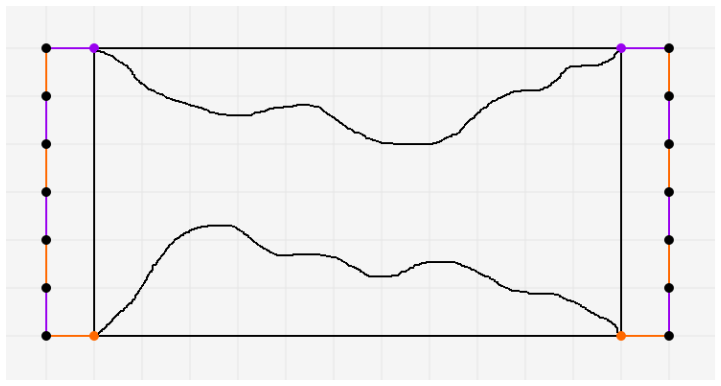
The machinery is the Grassmannian (fermionic) representation of the dimer partition function, equivalent to Kasteleyn's Pfaffian method. After a one-direction Fourier transform, the rectangle splits into independent strips indexed by mode q, each contributing a Chebyshev polynomial U_M(cos(πq/(N+1))). Two-monomer insertions at the corners give Z and Z_I as squares of such sums. The continuum limit keeps only modes with cos(πq/(N+1))≈0, where U_M(q)≈$\cosh$((M/N)πk); Poisson summation identities and complete elliptic integral relations turn the resulting hyperbolic sums into Y(L)=2k K(k)K'(k)/$π^{2}$, and the ratio of pure partition functions collapses to H(L)=2k/(1+$k^{2}$).
What would settle it
Compute the exact lattice hook-up probability from equations (10) and (11) for growing M,N with M/N=L, without the asymptotic replacement, and compare with 2k/(1+$k^{2}$), where k solves L=K'(k)/K(k); for L=1 the formula predicts approximately 0.9428. A finite-size sequence that does not approach this value would refute the asymptotic claim.
Extended reading notes
Core claim
The central claim is that for the two connectivity patterns of the double-dimer model with wired/free/wired/free boundary conditions on an M×N rectangle, the normalized pure partition functions Z and Z_I have continuum limits Z(L)=4L(∑_{k≥1}2/$\cosh$(Lπk)+1)^2 and Z_I(L)=4L(∑_{k≥1}2(-1)^{k+1}/$\cosh$(Lπk)-1)^2, from which the hook-up probability is H(L)=(Z-Z_I)/(Z+Z_I). Using Poisson summation and elliptic-integral identities, the authors reduce these sums to Y(L)=2k K(k)K'(k)/$π^{2}$, verify the self-consistency relation Z_I(L)=Y(1/L), and arrive at H(L)=2k/(1+$k^{2}$)=(1-x)/(1+x). They then identify x=(1-k)^2/(1+k)^2 as the cross-ratio of the four marked boundary points and note that this equals the corresponding connection probability for 4SLE4 and conditioned CLE4 obtained in the cited literature.
Load-bearing premise
The load-bearing premise is that in the scaling limit the exact sums are dominated by Fourier modes with cos(πq/(N+1)) near zero, so that the Chebyshev factors can be replaced by cosh((M/N)πk); the paper does not give error bounds for the neglected modes.
Editorial extensions
If this is right
- The hook-up probability for two connectivity patterns in the double-dimer model becomes, in the continuum, the conformally invariant function H(L)=2k/(1+k^2), equivalently (1-x)/(1+x) in the cross-ratio x.
- With θ=2, the rectangle result satisfies the commutation-relation representation H(L)=Y(L)/(Y(L)+θY(1/L)), matching the O(n) parameter n=2 at κ=4.
- The identity Z_I(L)=Y(1/L) confirms the self-consistency of the pure partition functions under the aspect-ratio inversion L↔1/L.
- The Grassmannian two-monomer method extends to 2m marked points for rainbow/self-surrounding arch patterns, giving their pure partition functions directly.
Reading between the lines
- A concrete test the authors do not run: on a square, the formula predicts H(1)=2√2/3≈0.943, which a Monte Carlo or exact enumeration of double-dimer configurations on large rectangles could check directly.
- If the unproved dominance of the q≈(N+1)/2 modes were established with error bounds, the same Fourier-mode reduction would likely yield rigorous scaling limits for multi-point connection probabilities for more than four boundary points.
- The equality with CLE4/4SLE4 connection probabilities supports, but does not prove, convergence of double-dimer loop ensembles to CLE4; a proof would additionally require tightness of the loop measures.
Signed reviews
Editorial analysis
A structured set of objections, weighed in public.
Referee Report
Summary. The manuscript studies the double-dimer model on a square lattice rectangle with wired/free/wired/free boundary conditions, using the Grassmannian representation of the dimer model. The authors derive exact finite-lattice expressions for the symmetric and pure partition functions Z and ZI corresponding to the two connectivity patterns of four corner monomers. They then pass to the continuum by approximating the lattice sums with mode-concentration near q = (N+1)/2, use Schwarz-Christoffel maps and elliptic integral identities, and obtain the hook-up probability H(L) = 2k/(1+k^2) = (1-x)/(1+x), which coincides with known 4SLE4 and conditioned CLE4 results. The paper also derives a reciprocal-aspect symmetry and outlines a generalization to rainbow patterns.
Significance. If the derivation can be made rigorous, the paper provides a direct computation of double-dimer connection probabilities from a Grassmann representation, lending strong support to the conjectured link between double-dimer loop ensembles and CLE4/GFF level lines. The exact discrete formulas (10) and (11) are explicit and parameter-free, and the final probability is a concrete falsifiable prediction. The Poisson-summation identities in Appendix B are standard and appear to be applied correctly. However, the heuristic nature of the continuum limit limits the current proof to a consistency check.
major comments (3)
- [Section 3, 'The continuum limit', Eqs. (10)-(17)] The replacement of the exact finite sums (10) and (11) by the infinite sums (16) and (17) is not controlled. The assertion that the sums concentrate on q-modes with cos(pi q/(N+1)) near zero and that U_M(q) can be approximated by cosh((M/N) pi k) is made without error estimates. This absence is load-bearing because the hook-up probability in (13) is a ratio involving Y = Z - ZI, which for large aspect ratio L is exponentially small relative to Z and ZI; a relative error of order 1/L in either partition function could change the limiting value of H. To make the continuum claim rigorous, the authors need to supply bounds on the error in (16) and (17), or explicitly state that the continuum limit is conjectural.
- [Section 3, footnote on page 8, and the identification with CLE4] The identification of the discrete Type II event with the CLE4 hook-up event is not proved. The footnote on page 8 acknowledges that defining a wired CLE may require more care and that there are delicacies concerning boundary conditions in the dimer model. Since the final equality H(L) = 2k/(1+k^2) is interpreted as a CLE4 connection probability, the paper should either provide a convergence argument for the interfaces or make clear that this equality is a consistency check relying on the unproven double-dimer/CLE4 conjecture.
- [Section 3, Eq. (15) and the derivation of the symmetry] The verification of the identity ZI(L) = Y(1/L) in Eq. (15) is performed after the approximations (16) and (17) have been introduced; it is not an identity at the level of the exact lattice sums. Because this symmetry is used to derive the final expression (29), the derivation of (29) inherits the uncontrolled nature of the continuum approximation. The paper should clarify that the symmetry and the final formula are consequences of the heuristic continuum limit rather than exact results.
minor comments (6)
- [Abstract and throughout] The phrase 'continuum of the result' should read 'continuum limit of the result' for clarity.
- [Eq. (13)] Equation (13) would benefit from parentheses: P(Type II) = (Z - ZI)/(Z + ZI).
- [Eq. (15)] The chain Z(1/L)-ZI(1/L) = ZI(L) = Y(1/L) in Eq. (15) is confusing; the authors should define Y(1/L) explicitly and state which equalities are conjectural.
- [Page 8, footnote 3] The caveat about wired CLE and boundary delicacies in the dimer model should be moved from the footnote into the main text where the CLE identification is made.
- [Throughout] The manuscript contains numerous typos and grammatical errors (e.g., 'sitution' on page 2, 'correspnding' on page 7, 'obtaind' on page 10) and needs careful proofreading.
- [References] Reference [35] is to the authors' previous arXiv preprint; if it has been published in the meantime, the citation should be updated.
Circularity Check
No circular dependence: the lattice sums are independent inputs, and the CLE4 formula is used only as a comparative benchmark.
full rationale
The derivation chain is not circular. The starting point is an exact Grassmannian/Kasteleyn computation: equations (10) and (11) are explicit sums for the double-dimer pure partition functions on a finite rectangle, and the hook-up probability is defined in (13) as a ratio of these quantities. The continuum limit (16)-(17) is obtained by a stated asymptotic concentration of the sums near cos(pi q/(N+1))=0, with U_M(q) approximately cosh((M/N) pi k). This step lacks error bounds and is therefore a convergence-gap risk, but it is not a fit to the target: no parameter is adjusted to force H(L)=2k/(1+k^2). The CLE4 formula is used as a benchmark after the fact; equation (15) is phrased as an expectation, but the authors then prove the needed symmetry ZI(L)=Y(1/L) using the residue identity (24) and the Poisson-summation identities (35)-(38), rather than importing it. The self-citations to [35] supply only parameter-free Chebyshev/Poisson identities and a similar method; these are not the target observable and are not fitted. The footnote in Section 3 explicitly flags that wired-CLE boundary conditions require more care, which is an honest limitation about the scaling-limit identification, not circularity. Hence no step in the paper reduces, by construction or by self-citation, to its own inputs.
Assumptions & free parameters
assumptions (5)
- domain assumption The Grassmannian representation of the close-packed dimer partition function is equivalent to Kasteleyn's Pfaffian solution.
- domain assumption The continuum limit of the double-dimer loop ensemble is described by CLE4 (conjectured, not proved).
- standard math The series identities (35)-(38) and (32) are valid as stated.
- standard math The Schwarz-Christoffel relation (25) between the rectangle aspect ratio L and the cross-ratio x is correct.
- ad hoc to paper In the continuum limit, only Fourier q-modes near cos(pi q/(N+1)) = 0 contribute, and U_M(q) can be replaced by cosh((M/N) pi k).
Cite this review
Pith. "Pith review of Connection probabilities in the double-dimer model -- the case of two connectivity patterns." pith.science (2026). https://pith.science/paper/VOWTII5E
@misc{pith2026190807595,
  author       = {Pith},
  title        = {Pith review of: Connection probabilities in the double-dimer model -- the case of two connectivity patterns},
  year         = {2026},
  howpublished = {\url{https://pith.science/paper/VOWTII5E}},
  note         = {Machine review of arXiv:1908.07595}
}
abstract
We apply the Grassmannian representation of the dimer model, an equivalent approach to Kasteleyn's solution to the close-packed dimer problem, to calculate the connection probabilities for the double-dimer model with wired/free/wired/free boundary conditions, on a rectangular subdomain of the square lattice with four marked boundary points at the corners. Using some series identities related to Schwarz-Christoffel transformations, we show that the continuum of the result is consistent with the corresponding one in the upper half-plane (previously obtained by Kenyon-Wilson), which is in turn identical to the connection probabilities for 4SLE$_4$ emanating from the boundary, or equivalently, to a conditioned version of CLE$_4$ with wired/free/wired/free boundary conditions in the context of conformal loop ensembles.
Figures



Figures from the paper (3 more)


Reference graph
Works this paper leans on
- [1]
-
[2]
Selected Works of Oded Schramm
Lawler, G.F., Schramm, O., Werner, W.: Conformal invariance of planar loop-erased random walks and uniform spanning trees. Selected Works of Oded Schramm. Springer, New York, NY, 931-987 (2011)
work page 2011
-
[3]
In Lectures on probability theory and statistics , vol
Werner, W.: Random planar curves and Schramm-Loewner evolutions. In Lectures on probability theory and statistics , vol. 1840 of Lecture Notes in Math., Springer, Berlin, 107-195 (2004)
work page 2004
-
[4]
Kager, W., Nienhuis, B.: A guide to stochastic Loewner evolution and its applications. J. Stat. Phys. 115, 1149 (2004)
work page 2004
-
[5]
Rohde, S., Schramm, O.: Basic properties of SLE. Ann. of Math., 161(2), 883924 (2005)
work page 2005
-
[6]
Journal of Physics A: Mathematical and General, 36(24), L379 (2003)
Cardy, J.: Stochastic Loewner evolution and Dyson’s circular ensembles. Journal of Physics A: Mathematical and General, 36(24), L379 (2003)
work page 2003
-
[7]
Journal of statistical physics, 120(5-6), 1125-1163 (2005)
Bauer, M., Bernard, D., Kytl, K.: Multiple SchrammLoewner evolutions and statistical mechanics martingales. Journal of statistical physics, 120(5-6), 1125-1163 (2005)
work page 2005
-
[8]
Dubdat, J.: Commutation relations for SchrammLoewner evolutions. Communications on Pure and Applied Mathematics: A Journal Issued by the Courant Institute of Mathematical Sciences 60.12, 1792-1847 (2007)
work page 2007
Show all 47 references
-
[9]
arXiv preprint arXiv:1801.07699 (2018)
Beffara, V., Peltola, E., Wu, H.: On the uniqueness of global multiple SLEs. arXiv preprint arXiv:1801.07699 (2018)
2018 arXiv
-
[10]
arXiv preprint arXiv:1702.03261 (2017)
Karrila, A., Kytl, K., Peltola, E.: Boundary correlations in planar LERW and UST. arXiv preprint arXiv:1702.03261 (2017)
2017 arXiv
-
[11]
Communications in Mathematical Physics 366.2, 469-536 (2019)
Peltola, E., Wu, H.: Global and Local Multiple SLEs for κ≤ 4 and Connection Probabilities for Level Lines of GFF. Communications in Mathematical Physics 366.2, 469-536 (2019)
2019
-
[12]
Werner, W.: The conformally invariant measure on self-avoiding loops. J. Amer. Math. Soc. 21, 137-169 (2008)
2008
-
[13]
Duke Math
Sheffield, S.: Exploration trees and conformal loop ensembles. Duke Math. J. 147, 79-129 (2009)
2009
-
[14]
Sheffield, S., Werner, W.: Conformal loop ensembles: the Markovian characterization and the loop-soup construction. Ann. Math. 176, 1827-1917 (2012)
2012
-
[15]
in Phase transitions and critical phenomena , 11, Domb, C., Lebowitz, J.L., eds
Nienhuis, B.: Coulomb gas formulation of two-dimensional phase transitions. in Phase transitions and critical phenomena , 11, Domb, C., Lebowitz, J.L., eds. Academic (1987)
1987
-
[16]
Acta Math
Schramm, O., Sheffield, S.: Contour lines of the two-dimensional discrete gaussian free field. Acta Math. 202(1), 21137 (2009)
2009
-
[17]
Sheffield, S.: Gaussian free fields for mathematicians. Probab. Theory Related Fields, 139(3-4), 521541 (2007)
2007
-
[18]
Kenyon, R.: Conformal invariance of domino tiling. Ann. Probab., 28(2), 759795 (2000)
2000
-
[19]
Kenyon, R.: Dominos and the Gaussian free field. Ann. Probab., 29(3), 11281137 (2001)
2001
-
[20]
Kenyon, R.: Conformal invariance of loops in the double-dimer model. Commun. Math. Phys. 326, 477497 (2014)
2014
-
[21]
arXiv preprint arXiv:1403.6076 (2014) 13
Dubedat, J.: Double dimers, conformal loop ensembles and isomonodromic deformations. arXiv preprint arXiv:1403.6076 (2014) 13
2014 arXiv
-
[22]
arXiv preprint arXiv:1809.00690 (2018)
Basok, M., Chelkak, D.: Tau-functions ´ a la Dub´ edat and probabilities of cylindrical events for double-dimers and CLE (4). arXiv preprint arXiv:1809.00690 (2018)
2018 arXiv
-
[23]
Physics Letters B, 541(3-4), 384-389 (2002)
Arguin, L.P., Saint-Aubin, Y.: Non-unitary observables in the 2d critical Ising model. Physics Letters B, 541(3-4), 384-389 (2002)
2002
-
[24]
Izyurov, K.: Critical Ising interfaces in multiply-connected domains. Probab. Theory Related Fields, 167(1-2), 379415 (2017)
2017
-
[25]
arxiv preprint arXiv:1703.02022 (2017)
Wu, H.: Hypergeometric SLE and convergence of critical planar Ising interface. arxiv preprint arXiv:1703.02022 (2017)
2017 arXiv
-
[26]
arXiv preprint arXiv:1704.02823 (2017)
Kemppainen, A., Smirnov, S.: Configurations of FK Ising interfaces and hypergeometric SLE. arXiv preprint arXiv:1704.02823 (2017)
2017 arXiv
-
[28]
Uni- versality and renormalization
Kozdron, M.J., Lawler, G.F.: The configurational measure on mutually avoiding SLE paths. Uni- versality and renormalization. Proceedings of the workshops ”Percolation, SLE and related topics” (2005)
2005
-
[29]
Journal of Physics A: Mathematical and General, 25(4), L201 (1992)
Cardy, J.L.: Critical percolation in finite geometries. Journal of Physics A: Mathematical and General, 25(4), L201 (1992)
1992
-
[30]
Comptes Rendus de l’Acadmie des Sciences-Series I-Mathematics, 333(3), 239-244 (2001)
Smirnov, S.: Critical percolation in the plane: conformal invariance, Cardy’s formula, scaling limits. Comptes Rendus de l’Acadmie des Sciences-Series I-Mathematics, 333(3), 239-244 (2001)
2001
-
[31]
Kenyon, R.W., Wilson, D.B.: Boundary partitions in trees and dimers. Trans. Amer. Math. Soc., 363(3), 13251364 (2011)
2011
-
[32]
Electron
Kenyon, R.W., Wilson, D.B.: Double-dimer pairings and skew Young diagrams. Electron. J. Com- bin., 18(1), 130142 (2011)
2011
-
[33]
arXiv preprint arXiv:1808.09438 (2018)
Peltola, E., Wu, H.: Crossing probabilities of multiple Ising interfaces. arXiv preprint arXiv:1808.09438 (2018)
2018 arXiv
-
[34]
Communications in Mathematical Physics, 362(2), 415-453 (2018)
Miller, J., Werner, W.: Connection probabilities for conformal loop ensembles. Communications in Mathematical Physics, 362(2), 415-453 (2018)
2018
-
[35]
arXiv preprint arXiv:1805.03930 (2018)
Ghodratipour, N., Rouhani, S.: The expectation value of the number of loops and the left-passage probability in the double-dimer model. arXiv preprint arXiv:1805.03930 (2018)
2018 arXiv
-
[36]
Hayn, R., Plechko, V.N.: Grassmann Variable Analysis for Dimer Problems in Two Dimensions. J. Phys. A, 27(14), 4753-4760 (1994)
1994
-
[37]
In School and Conference on Probability Theory, ICTP Lect
Kenyon, R.: An introduction to the dimer model. In School and Conference on Probability Theory, ICTP Lect. Notes, XVII, 267304 (2004)
2004
-
[38]
Fowler, R.H., Rushbrooke, G.S.: An attempt to extend the statistical theory of perfect solutions. Trans. Faraday Soc. 33, 1272-1294 (1937)
1937
-
[39]
Kasteleyn, P.W.: The statistics of dimers on a lattice. I. The number of dimer arrangements on a quadratic lattice. Physica (Amsterdam) 27, 1209-1225 (1961)
1961
-
[40]
Temperley, W., Fisher, M.: Dimer problem in statistical mechanics-an exact result. Philos. Mag. (8)6, 1061-1063 (1961)
1961
-
[41]
Kasteleyn, P.W.: Dimer statistics and phase transitions. J. Math. Phys., 4, 287293 (1963)
1963
-
[42]
Fisher, M.E.: On the dimer solution of planar Ising models. J. Math. Phys., 7, 17761781 (1966) 14
1966
-
[43]
Physical Review E 95(5), 052146 (2017)
Kenyon, R., Miller, J., Sheffield, S., Wilson, D.B.: Six-vertex model and Schramm-Loewner evolu- tion. Physical Review E 95(5), 052146 (2017)
2017
-
[44]
Academic Press, London (1982)
Baxter, R.J.: Exactly solved models in statistical mechanics. Academic Press, London (1982)
1982
-
[45]
Samuel, S.: The use of anticommuting variable integrals in statistical mechanics. I. The compu- tation of partition functions. Journal of Mathematical Physics, 21(12), 2806-2814 (1980)
1980
-
[46]
”Elliptic Integral.” From MathWorld–A Wolfram Web Resource
Weisstein, E.W. ”Elliptic Integral.” From MathWorld–A Wolfram Web Resource. http://mathworld.wolfram.com/EllipticIntegral.html
-
[47]
I: Elementary Func- tions., Gordon and Breach, New York (1986)
Prudnikov, A.P., Brychkov, Yu.A., Marichev, O.I.: Integrals and Series, Vol. I: Elementary Func- tions., Gordon and Breach, New York (1986)
1986
-
[48]
Princeton University Press (2003) 15
Stein, E.M., Shakarchi, R.: Complex Analysis. Princeton University Press (2003) 15
2003
Reviewed August 14, 2026 · model on record in the stance chip above.
Discussion (0). Continue with ORCID to comment.