REVIEW 3 major objections 6 minor 38 references
Vortex Shear Banding Transitions in Superconductors with Inhomogeneous Pinning Arrays
T0 review · 3 major / 6 minor · reviewed 2026-08-14 · deepseek-v4-flash
Pith's one-line read A uniform angled drive makes vortices in a pin-free channel depin in discrete shear bands, producing steplike velocity-force curves and a transistor-like flow switch.
desk verdict Solid simulation study of quantized vortex shear bands in a missing-row pinning array; the main caveat is that the quantization mechanism is asserted, not tested, and the zero-flow FET state is a single-run result. read the letter →
The pith
A machine-rendered reading of the paper's core claim, the machinery that carries it, and where it could break.
The reading
What carries the argument
The central object is a pin-free channel formed by removing half the rows from a square pinning lattice, populated so that the vortices match the full-lattice filling and therefore sit in an ordered arrangement. The mechanism that carries the argument is the triangular ordering of vortices inside the channel: the moving assembly behaves like a sheared triangular solid that breaks along its easy shear direction, which is what converts the velocity-force curve into a staircase of individually depinned rows.
What would settle it
Plot the velocity-force curve at a fixed angled drive in the same geometry but with increasing amounts of quenched disorder in the pin positions (or a non-commensurate vortex filling); the central claim predicts the jumps weaken and eventually vanish as the channel's triangular order is destroyed. A cleaner check is to double the channel width at fixed filling and count the steps: the quantization claim requires roughly twice as many jumps, not smoother curves.
Extended reading notes
Core claim
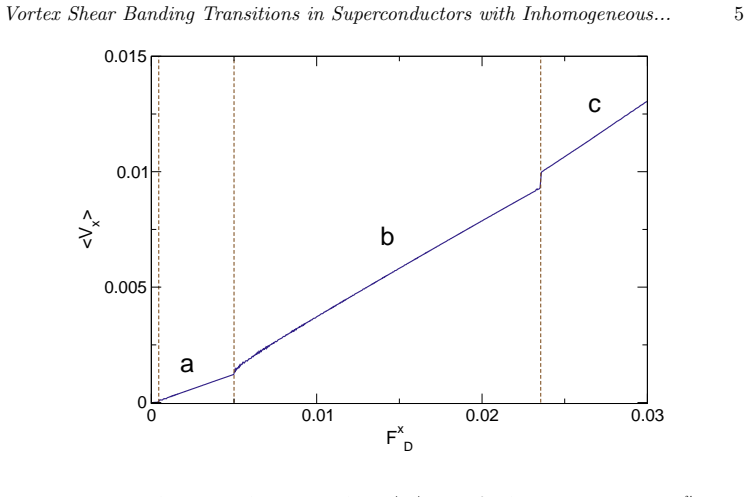
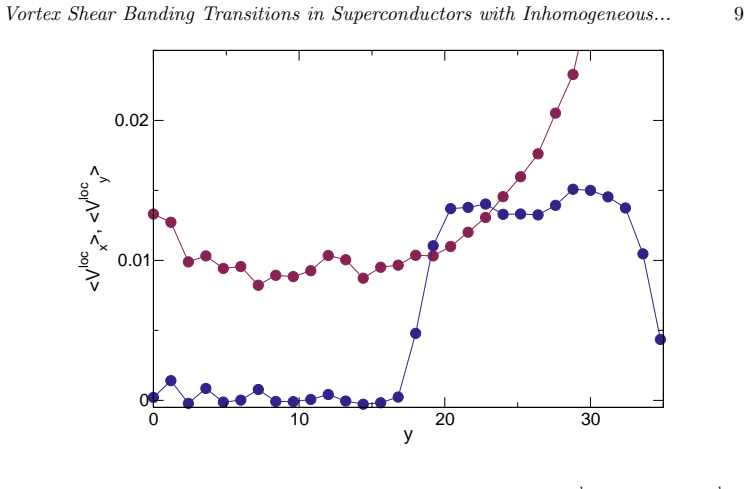
The central claim is that a uniform drive at an angle to a pin-free channel in a square pinning array produces a sequence of quantized shear-banding transitions: the vortex velocity increases in jumps as successive rows of vortices in the channel begin to flow, rather than in a smooth curve. The spatial velocity profile shows sharp steps between flowing and immobile rows, with the flowing band widening from the center toward the pinned edges as the drive grows. When the parallel drive is held constant and a perpendicular drive is increased, the number of immobile rows grows, the longitudinal velocity falls in steps, and in denser pinning arrays the flow can be driven to zero, so the perpendicular drive acts like a gate that switches the vortex current off.
Load-bearing premise
The staircase behavior depends on the vortices in the pin-free channel forming an ordered triangular solid that breaks along its easy shear direction; if disorder, a liquid-like arrangement, or a different channel width erases that order, the discrete steps would smooth into a continuous velocity gradient.
Editorial extensions
If this is right
- Depinning begins in the center of the pin-free channel and spreads outward, so the width of the moving band is controlled by the drive magnitude.
- Each newly depinned vortex row produces a jump in the velocity-force curve and a step in the spatial velocity profile, making the number of moving rows a quantized observable.
- Increasing the perpendicular drive at fixed parallel drive increases the number of immobile rows, producing downward steps in longitudinal velocity.
- With denser pinning, an increasing perpendicular drive can reduce the longitudinal velocity to zero, creating a transistor-like off state over a wide drive range.
- The same shear-banding scenario should appear in other particle systems with inhomogeneous pinning, including colloids and skyrmions.
Reading between the lines
- A testable extension not made in the paper: increasing the channel width at fixed filling should produce more discrete velocity steps, with the jump spacing set by the easy-shear direction; if the steps instead smear into a continuous gradient, the triangular-order explanation would be wrong.
- As an editorial inference, the transistor-like switch suggests a possible vortex-based gating device if the pin array geometry is tuned so the zero-flow phase spans a wide perpendicular-drive range.
- The reported absence of a two-immobile-row phase hints that the quantization rule depends on how triangular rows pack across the channel, which could be checked by varying the channel width or orientation.
Signed reviews
Editorial analysis
A structured set of objections, weighed in public.
Referee Report
Summary. The manuscript presents molecular dynamics simulations of superconducting vortices interacting with a square pinning array in which a contiguous band of pinning sites is removed, creating a pin-free channel. The authors find that under a drive applied at an angle to the channel, depinning initiates in the channel interior and proceeds through a sequence of quasi-one-dimensional shear bands. As the parallel drive increases, additional vortex rows depin one at a time, producing jumps in the velocity-force curve and steps in the spatial velocity profile. The resulting phases are classified by the number of immobile rows (phases I, III, IV, V, M, and R), and a dynamic phase diagram in the parallel-versus-perpendicular drive plane is constructed. When a constant parallel drive is combined with an increasing perpendicular drive, the longitudinal velocity drops in discrete steps as rows become immobilized, and for a denser pinning array at low parallel drive the longitudinal velocity can drop to zero, which the authors describe as a field-effect-transistor-like state. The results are argued to be generic for particle systems with inhomogeneous pinning, such as colloids and skyrmions.
Significance. If the central claim holds, the paper introduces a simple and experimentally accessible route to quantized shear banding in vortex systems without a Corbino geometry, with clear transport signatures that can be tested in artificial pinning arrays. The model is standard and directly simulated, with no fitted parameters in the central observation, and the predictions are specific and falsifiable. The main limitations are that the interpretation relies on an untested triangular-ordering assumption for the channel vortices, and the quantization is characterized only for a single system size and a single realization at zero temperature; these gaps leave the universality of the discrete phases insufficiently established.
major comments (3)
- [Sec. 3, Fig. 4] The interpretation of the discrete velocity steps as shear-banding of a triangular vortex solid is asserted rather than demonstrated. The authors state that the behavior 'is probably a result of the triangular ordering of the vortices within the pin-free channel, which causes the system to behave like a sheared triangular solid breaking along its easy shear direction,' but no orientational order parameter, structure factor, or defect-density diagnostic is reported for the channel vortices in any of the phases. Without such a diagnostic, the distinction between a genuinely solid-like sheared state and a row-commensuration effect of the finite channel remains unclear. Please add a quantitative measure of in-channel ordering for the moving and immobile phases, and for the phase R state.
- [Sec. 3, Fig. 8] The phase diagram and velocity-force curves are all obtained for a single system size and a single channel width. The text itself notes that 'for finer intervals of FyD or a larger system, there will likely be additional phases corresponding to six, seven, and higher numbers of immobile vortex rows,' which indicates that the number of observed steps is tied to the finite channel width. Without at least one additional system size (e.g., a wider channel with more rows, or a narrower channel), the data cannot distinguish a universal shear-banding transition from a finite-size commensuration effect. Please provide results for a second channel width and show that the step structure and phase boundaries scale consistently, or explicitly discuss the expected scaling.
- [Sec. 4, Fig. 10(b)] The field-effect-transistor-like state, in which ⟨Vx⟩ drops exactly to zero as the perpendicular drive increases, is demonstrated at a single Fx, a single pinning density, at T=0, and with no error bars or fluctuation statistics. This is a load-bearing claim because the complete suppression of longitudinal flow is central to the transistor analogy. Please provide an estimate of the steady-state averaging uncertainty for the reported velocities, at least one additional realization or independent initialization, and a finite-temperature calculation showing that the zero-velocity plateau survives (or stating the temperature range over which it is observable).
minor comments (6)
- [Sec. 2, Eq. (1)] The drive is written as FD = FxD xhat − FyD yhat, while Fig. 1 shows both arrows pointing in positive coordinate directions; please clarify the sign convention.
- [Sec. 4, Fig. 10(b)] The Fig. 10(b) caption states FxD = 0.00025, whereas the text in Sec. 4 states FxD = 0.0025 for the same panel; one of these is a typo and should be corrected.
- [Sec. 2] The text says 'µ0 is the permittivity'; this should be the vacuum permeability.
- [Sec. 2] In the pinning-force expression, the trap radius is introduced as Rp = 0.35λ and then used as rp; please use a single symbol throughout.
- [Sec. 3] The phase names (P, I, III, IV, V, M, R) are introduced in the text but not collected in a table or consolidated legend; adding a small summary would improve readability.
- [Sec. 3, Fig. 4] The drop in ⟨Vloc_x⟩ at large y is attributed to the pinned region on the other side of the periodic boundary; a brief explanatory note in the caption or text would help the reader.
Circularity Check
Direct simulation observations; no circular derivation found.
full rationale
The central claims are numerical observations generated by integrating the overdamped equation of motion (Eq. 1) with fixed, stated inputs (Fp = 0.75, B/Bphi = 2.0, Bcomplete = 0.4/lambda^2, relaxed initial configurations). The velocity-force curves (Figs. 2, 5, 9, 10) and spatial velocity profiles (Figs. 4, 7) are direct outputs of the simulation, not derived from fitted constants or from the phase labels. The phase names P, I, III, IV, V, M, and R are descriptive labels read off the observed trajectories and velocity steps, so the classification does not impose the predicted quantization by construction. The interpretive sentence about triangular ordering ('This is probably a result of the triangular ordering of the vortices within the pin-free channel...') is explicitly presented as a probable explanation rather than as an input used to derive the transitions. Self-citations to prior uses of the same simulation model (Refs. [34,36,37,38]) are background references and are not load-bearing for the new results. The authors themselves note that finer drive intervals or larger systems would likely reveal additional immobile-row phases, which is a finite-size robustness caveat but not a circular step. No equation is shown to reduce to another by definition, and no fitted parameter is renamed as a prediction. The paper is therefore self-contained as a numerical study, and no significant circularity is present.
Assumptions & free parameters
free parameters (2)
- Pinning strength Fp =
0.75 F0
- Pinning density Bcomplete_phi =
0.4/lambda^2 and 0.6/lambda^2
assumptions (4)
- domain assumption Overdamped London-model dynamics with point vortices and modified Bessel interactions (Eq. 1)
- domain assumption Parabolic pinning traps with radius Rp=0.35 lambda
- domain assumption Periodic boundary conditions and a finite sample with one pin-free channel
- domain assumption Simulated annealing to T=0 produces the ground-state vortex configuration
Cite this review
Pith. "Pith review of Vortex Shear Banding Transitions in Superconductors with Inhomogeneous Pinning Arrays." pith.science (2026). https://pith.science/paper/MNDNEAWQ
@misc{pith2026190807606,
  author       = {Pith},
  title        = {Pith review of: Vortex Shear Banding Transitions in Superconductors with Inhomogeneous Pinning Arrays},
  year         = {2026},
  howpublished = {\url{https://pith.science/paper/MNDNEAWQ}},
  note         = {Machine review of arXiv:1908.07606}
}
read the original abstract
We numerically examine the flow of superconducting vortices in samples containing square pinning arrays in which a band of pins is removed. When a drive is applied at an angle with respect to the band orientation, we find that the vortex depinning initiates in the pin-free channel. The moving vortices form a series of quasi-one-dimensional shear bands that begin flowing in the bulk of the pin-free channel, and the motion gradually approaches the edge of the pinned region. The consecutive depinning of each shear band appears as a series of jumps in the velocity-force curves and as sharp steps in the spatial velocity profiles. When a constant drive is applied parallel to the pin-free channel along with a gradually increasing perpendicular drive, the net vortex velocity decreases in a series of steps that correspond to the immobilization of bands of vortices, and in some cases the flow can drop to zero, creating a field effect transistor phenomenon. These results should also be relevant to other types of systems that exhibit depinning in the presence of inhomogeneous pinning.
Figures


Figures from the paper (8 more)




Reference graph
Works this paper leans on
-
[1]
Beer F, Johnston R, Dewolf J and Mazurek D 2009 Mechanics of Materials (McGraw-Hill, New York)
work page 2009
- [2]
-
[3]
Regev I, Lookman T and Reichhardt C 2013 Phys. Rev. E 88(6) 062401
work page 2013
-
[4]
Cohen I, Davidovitch B, Schofield A B, Brenner M P and W eitz D A 2006 Phys. Rev. Lett. 97(21) 215502
work page 2006
-
[5]
Alix-Williams D D and Falk M L 2018 Phys. Rev. E 98(5) 053002
work page 2018
-
[6]
Fisher D S 1998 Phys. Rep. 301(1-3) 113–150
work page 1998
-
[7]
Reichhardt C and Reichhardt C J O 2017 Rep. Prog. Phys. 80(2) 026501
work page 2017
-
[8]
L´ opez D, Kwok W K, Safar H, Olsson R J, Petrean A M, Paulius L and Crabtree G W 1999 Phys. Rev. Lett. 82(6) 1277–1280
work page 1999
Show all 38 references
-
[9]
Benetatos P and Marchetti M C 2002 Phys. Rev. B 65(13) 134517
2002
-
[10]
2(7) 477–481
Miguel M C and Zapperi S 2003 Nature Mater. 2(7) 477–481
2003
-
[11]
Furukawa A and Nisikawa Y 2006 Phys. Rev. B 73(6) 064511
2006
-
[12]
Okuma S, Yamazaki Y and Kokubo N 2009 Phys. Rev. B 80(22) 220501
2009
-
[13]
Cabral L R E, de Aquino B R C H T, Silva C C d S, Miloˇ sevi´ c M V and Peeters F M 2016 Phys. Rev. B 93(1) 014515
2016
-
[14]
Miguel M C, Mughal A and Zapperi S 2011 Phys. Rev. Lett. 106(24) 245501
2011
-
[15]
Lin N S, Misko V R and Peeters F M 2009 Phys. Rev. Lett. 102(19) 197003
2009
-
[16]
Kawamura Y, Matsumura Y, Yamazaki Y, Kaneko S, Kokubo N a nd Okuma S 2015 Supercond. Sci. Technol. 28(4) 045002
2015
-
[17]
Rosen Y J, Gu´ enon S and Schuller I K 2013 Phys. Rev. B 88(17) 174511
2013
-
[18]
Reichhardt C and Reichhardt C J O 2010 Phys. Rev. B 81(10) 100506
2010
-
[19]
Marchetti M C and Nelson D R 1999 Phys. Rev. B 59(21) 13624–13627
1999
-
[20]
Marchetti M C and Nelson D R 2000 Physica C 330(3-4) 105–129
2000
-
[21]
Buttinoni I, Zell Z A, Squires T M and Isa L 2015 Soft Matter 11(42) 8313–8321
2015
-
[22]
12(1) 98–U134
Williams I, Oguz E C, Speck T, Bartlett P, L¨ owen H and Roy all C P 2016 Nature Phys. 12(1) 98–U134
2016
-
[23]
Ortiz-Ambriz A, Gerloff S, Klapp S H L, Ortin J and Tierno P 2018 Soft Matter 14(24) 5121– 5129
2018
-
[24]
Baert M, Metlushko V V, Jonckheere R, Moshchalkov V V and Bruynseraede Y 1995 Phys. Rev. Lett. 74 3269–3272
1995
-
[25]
Mart ´ ın J I, V´ elez M, Nogu´ es J and Schuller I K 1997Phys. Rev. Lett. 79(10) 1929–1932 Vortex Shear Banding Transitions in Superconductors with I nhomogeneous... 14
1929
-
[26]
9(9) 710–715
Trastoy J, Malnou M, Ulysse C, Bernard R, Bergeal N, Fain i G, Lesueur J, Briatico J and Villegas J E 2014 Nature Nanotechnol. 9(9) 710–715
2014
-
[27]
W ang Y L, Latimer M L, Xiao Z L, Divan R, Ocola L E, Crabtree G W and Kwok W K 2013 Phys. Rev. B 87(22) 220501
2013
-
[28]
Banerjee S S, Soibel A, Myasoedov Y, Rappaport M, Zeldov E, Menghini M, Fasano Y, de la Cruz F, van der Beek C J, Konczykowski M and Tamegai T 2003 Phys. Rev. Lett. 90(8) 087004
2003
-
[29]
Besseling R, Niggebrugge R and Kes P H 1999 Phys. Rev. Lett. 82(15) 3144–3147
1999
-
[30]
10(11) 851–856
Guillam´ on I, C´ ordoba R, Ses´ e J, De Teresa J M, Ibarra M R, Viera S and Suderow H 2014 Nature Phys. 10(11) 851–856
2014
-
[31]
Dobrovolskiy O, Bevz V, Begun E, Sachser R, Vovk R and Hut h M 2019 Phys. Rev. Applied 11(5) 054064
2019
-
[32]
Dobrovolskiy O V, Shklovskij V A, Hanefeld M, Z¨ orb M, K¨ ohs L and Huth M 2017 Supercond. Sci. Technol. 30(8) 085002
2017
-
[33]
Dobrovolskiy O V, Hanefeld M, Z¨ orb M, Huth M and Shklovs kij V A 2016 Supercond. Sci. Technol. 29(6) 065009
2016
-
[34]
Ray D, Olson Reichhardt C J, Jank´ o B and Reichhardt C 201 3 Phys. Rev. Lett. 110(26) 267001
-
[35]
Guenon S, Rosen Y J, Basaran A C and Schuller I K 2013 Appl. Phys. Lett. 102(25) 252602
2013
-
[36]
Reichhardt C and Reichhardt C J O 2007 Phys. Rev. B 76(6) 064523
2007
-
[37]
Reichhardt C and Reichhardt C J O 2007 Phys. Rev. B 76(9) 094512
2007
-
[38]
Reichhardt C and Olson Reichhardt C J 2008 Phys. Rev. B 78(18) 180507
2008
Reviewed August 14, 2026 · model on record in the stance chip above.
Discussion (0). Continue with ORCID to comment.