REVIEW 3 major objections 5 minor 1 cited by
On Object Symmetries and 6D Pose Estimation from Images
T0 review · 3 major / 5 minor · reviewed 2026-08-14 · deepseek-v4-flash
Pith's one-line read Symmetrical objects make 6D pose estimation ill-posed, and the paper's rotation-normalization scheme restores a well-defined learning target and splits rotation space to keep the mapping continuous.
desk verdict A genuinely useful Map operator for single-axis and continuous symmetries, with an unproved and untested two-axis generalization. read the letter →
The pith
A machine-rendered reading of the paper's core claim, the machinery that carries it, and where it could break.
The reading
What carries the argument
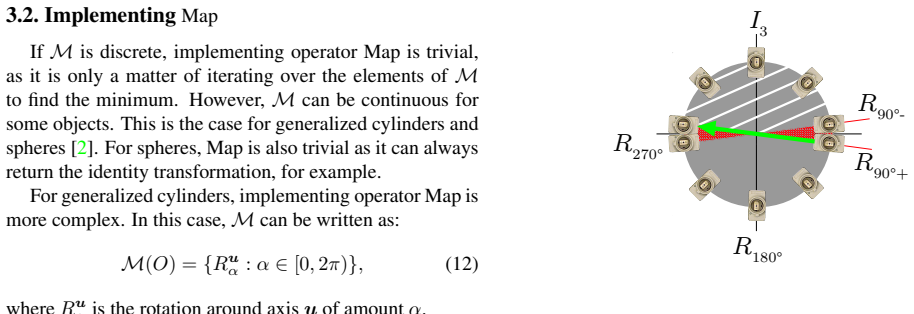
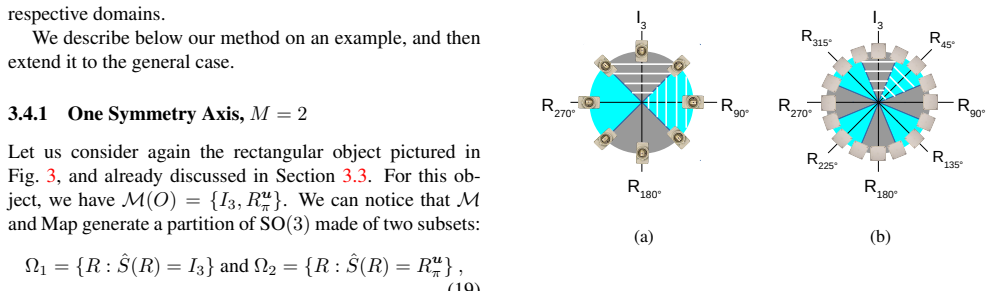
The load-bearing object is the Map operator: a nearest-neighbor projection of a rotation onto the object's proper symmetry group $M(O)$, minimized in Frobenius norm, followed by multiplication by the inverse of the chosen symmetry. For a generalized cylinder the minimizer is continuous and has the closed form $\hat{\alpha}=\operatorname{atan2}(R_{21}-R_{12},\,R_{11}+R_{22})$, so a single regressor suffices. For discrete groups the companion construction is the square-root group $\sqrt{M}=\{R_u^{m\pi/M}\}$, whose cells partition $SO(3)$ so that no cell contains a discontinuity of the mapped pose; the method then trains two regressors--or four, for two symmetry axes--together with classifier $C$ to pick the appropriate one.
What would settle it
Render an object with a four-fold symmetry axis (rotations by $0^\circ$, $90^\circ$, $180^\circ$, $270^\circ$) and compute $\mathrm{Map}'$ at rotations just inside one cell of the $\sqrt{M}$ partition, for example $R_z(45^\circ+\varepsilon)$ and $R_z(45^\circ-\varepsilon)$. If the target rotation assigned to the same regressor jumps as $\varepsilon\to 0$, a cell contains a discontinuity and the central construction fails. More broadly, an exhaustive search over finite subgroups of $SO(3)$ for a cell containing a discontinuity would settle the claim.
Extended reading notes
Core claim
The central claim is Proposition 1. For a proper symmetry group $M(O)$, define $\mathrm{Map}(R)=\hat{S}^{-1}R$ with $\hat{S}=\arg\min_{S\in M(O)}\|S^{-1}R-I_3\|_F$. Then $\mathrm{Map}(R_1)=\mathrm{Map}(R_2)$ if and only if $R_1$ and $R_2$ are visually ambiguous rotations of the object. Equivalent poses therefore share one canonical rotation, which turns the image-to-pose mapping back into a well-defined function. Because this mapping is discontinuous when $M(O)$ is discrete, the paper constructs a partition of $SO(3)$ from the square-root group $\sqrt{M}$, assigns each cell a separate regressor, and trains a classifier to choose the regressor at inference time; near cell boundaries the classifier may err without harm because the regressors predict nearly the same pose there.
Load-bearing premise
The load-bearing assumption is that for any discrete symmetry group, the half-angle partition divides rotation space into cells on which the normalized pose varies continuously; this is demonstrated for one example and then assumed for all other groups and for coupled symmetry axes.
Editorial extensions
If this is right
- Any 6D pose estimator that regresses rotations can be made symmetry-aware by adding the Map or Map' normalization, independent of the pose representation and network backbone.
- Without normalization, training on symmetric objects converges to a degenerate solution with keypoints collapsed to the object center; with normalization, the training loss converges.
- The two-regressor scheme restores continuity for discrete symmetries, and classifier mistakes near cell boundaries are harmless because both regressors output nearly equal poses there.
- The method also applies to almost-symmetrical objects, where a small detail breaks the symmetry, preventing the network from averaging over near-identical appearances.
- On the T-Less evaluation, the approach reports higher VSD recall than the latent-embedding baseline on a majority of object classes at the 20 mm threshold.
Reading between the lines
- Inference: the square-root partition is a general recipe for finite symmetry subgroups, but the number of regressors doubles per symmetry axis, so objects with many axes (such as a golf ball) may need a learned or adaptive partition instead.
- Inference: the Map operator is effectively a projection of $SO(3)$ onto the quotient by the symmetry group, and the discontinuity problem is a topological feature of that quotient; the square-root construction may be understood as a lift to a double cover, which could be made rigorous and extended to other group actions.
- Inference: the claim that classifier errors at boundaries are harmless can be stress-tested by measuring pose error as a function of angular distance to the cell boundary, especially under occlusion or lighting variation.
- Inference: because the normalization acts only on rotation, combining it with depth-aware translation regression or z-supervision may remove the translation error the paper reports.
Signed reviews
Editorial analysis
A structured set of objections, weighed in public.
Referee Report
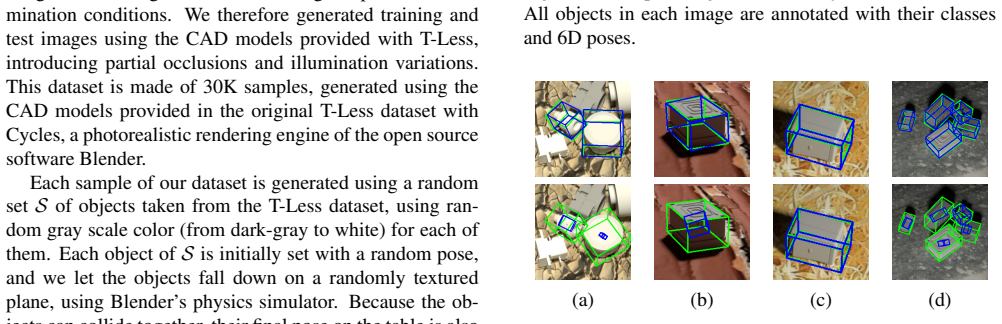
Summary. The paper studies the ambiguity caused by object symmetries in learning 6D object pose from images. It defines the proper symmetry group M(O) of an object, proposes a Map operator that sends each rotation to a canonical rotation by minimizing the Frobenius distance to the identity over M(O) (Eqs. 3-4), and proves in Proposition 1 that this operator maps two rotations to the same value exactly when the rotations are visually indistinguishable. The paper then shows that Map is discontinuous for discrete symmetry groups and proposes a partition of SO(3) based on a so-called square-root group sqrt(M), using two (or four) pose regressors together with a classifier that selects the correct regressor at test time. The method is implemented on top of Faster-RCNN by regressing 2D bounding-box corner projections, and it is evaluated on a new synthetic dataset SyntheT-Less as well as on real T-Less sequences.
Significance. If the main claims hold, the paper offers an elegant and general preprocessing step for symmetry-aware pose estimation that can be plugged into arbitrary detection and pose regression pipelines. Proposition 1 is a real formal contribution, and the closed-form solution for generalized cylinders is a useful practical ingredient. The one-axis construction is plausible and well illustrated. However, the key discontinuity-free partition is rigorously established only for the M=2 example; the extension to arbitrary M and to two coupled symmetry axes is asserted rather than proved, and the experiments do not cover the two-axis case. The practical evaluation also has important limitations, notably the use of ground-truth depth in the T-Less comparison and single-run reporting. With these gaps addressed, the paper would be a solid contribution to the pose-estimation literature.
major comments (3)
- [§3.4.3, Eq. (27)-(28)] The two-axis generalization is not proven. The set sqrt(M) defined in Eq. (27) is not generally a subgroup of SO(3) when the symmetry axes u and v do not commute, so the change-of-variable argument used in Proposition 1 does not transfer to the partition induced by Eq. (27). The four cases in Eq. (28) cover only the identity, the two half-step rotations, and one combined shift; all other elements of sqrt(M) are lumped into the 'otherwise' branch, and no argument shows that each cell Omega_{i,j} is free of discontinuities of Map'. Since the absence of discontinuities inside regressor cells is the central mechanism for handling discrete symmetries, this is a load-bearing gap. The authors should either provide a rigorous proof for general finite symmetry groups (or at least for non-commuting two-axis groups) or restrict the claimed contribution to single-axis symmetries and remove or clearly qualify the two-axis statements. If the general claim is kept, an experiment on an object with two non-commuting symmetry axes is also needed.
- [§3.1, Eq. (4)] The tie-breaking rule for the argmin in Eq. (4) is unspecified. At rotations equidistant from two or more elements of M(O), the minimizer is not unique, and the proof of Proposition 1 implicitly requires a selection rule that is equivariant with respect to the symmetry group. Without a precise tie-break, the claimed equivalence Map(R1)=Map(R2) iff R1~R2 is only defined up to choices that may break the property exactly at Voronoi boundaries. The same issue affects the definition of the cells in Section 3.4. This is fixable by stating a deterministic rule, for example based on a fixed ordering of M(O) or on a fundamental domain with explicit boundary conventions.
- [§5.3, Table 2] The comparison with Sundermeyer et al. is not a full 6D pose evaluation: the text states that 'we keep the ground truth of the translation along z-axis in our pose predictions', which means the reported VSD recall does not reflect complete 6D pose estimation. Combined with the architectural differences between the methods, this undermines the claim that the approach outperforms [26]. In addition, all experimental numbers appear to come from a single run, with no error bars or ablations (e.g., with and without the classifier, different numbers of regressors, or sensitivity to the boundary behavior). The authors should either report full-pose results, clearly label the current numbers as an upper-bound study, or provide additional controlled experiments that isolate the effect of the proposed normalization.
minor comments (5)
- [§3.2, Eq. (14) and (16)] Eq. (14) and Eq. (16) mix the Frobenius norm and its square: the correct identity is ||S^{-1}R - I3||_F^2 = 6 - 2 Tr(S^T R), with the factor 2. The missing factor does not change the argmin, but the notation should be corrected for clarity.
- [§3.4.3, Eq. (27)] In Eq. (27), the second factor of the product should be Rv_{n\pi/N}, not Ru_{n\pi/N}; as written, the expression uses the same axis twice and obscures the intended two-axis construction.
- [§3.4.2, Eq. (24)] Eq. (24) has an indexing inconsistency: the set is written as { (Ru_{pi/M})^m }_{k in N} on the left but uses m on the right. The subscript should be m.
- [Abstract and §5] The abstract states that the method is 'also beneficial for objects that are almost symmetrical', but the experiments do not include any quasi-symmetric object or ablation that isolates this case. The claim should either be supported by an experiment or explicitly deferred to future work.
- [§5.1] The name of the synthetic dataset is written as 'SyntheT-Less' in Table 1 and elsewhere, but the text sometimes uses the spelling 'SynthT-Less'; the terminology should be made consistent.
Circularity Check
No circular derivation: the symmetry-normalization map is derived from the stated symmetry group and does not reduce to a fitted value or self-citation chain.
full rationale
The paper's central claim, Proposition 1 in Section 3.1, derives Map(R) = S_hat^{-1} R with S_hat defined as the minimizer of ||S^{-1}R - I_3||_F over the proper symmetry group M(O). The proof is a change of variables that uses only the fact that M(O) is a subgroup of SE(3), and it establishes the equivalence Map(R1) = Map(R2) iff R1 ~ R2 from that group structure. This is a genuine derivation from stated inputs, not a self-definition: the canonical rotation is a function of the input rotation and the known symmetry group, and no parameter is fitted to data and then renamed as a prediction. The discontinuity analysis in Section 3.4 is also derived from the same symmetry group, with the partition into sqrt(M) cells defined explicitly. The two-axis generalization in Eq. 27-28 may be under-proved or potentially incorrect, but that is a mathematical rigor concern, not circularity. Self-citations to [2], [12], and [23] are contextual and not load-bearing for the derivation. The synthetic SyntheT-Less dataset is generated from the same CAD models used for evaluation, but the method does not fit its parameters to this dataset, and the real T-Less evaluation provides an external benchmark. No circular step satisfying the required quote-and-reduction standard is present.
Assumptions & free parameters
free parameters (1)
- quasi-symmetry tolerance
assumptions (6)
- standard math The set M(O) of appearance-preserving rigid motions is a subgroup of SE(3).
- domain assumption Rendering is deterministic and ignores lighting, so identical geometry under different poses yields identical images.
- domain assumption For a single-axis discrete symmetry, the symmetry group is exactly the cyclic group {R_u^{2mπ/M}}.
- standard math Deep networks can approximate continuous functions but fail or learn averages in the presence of discontinuities.
- ad hoc to paper The partition induced by sqrt(M) has no discontinuities within each cell.
- domain assumption When classifier C mispredicts near cell boundaries, both regressors predict similar poses.
Cite this review
Pith. "Pith review of On Object Symmetries and 6D Pose Estimation from Images." pith.science (2026). https://pith.science/paper/4IEDWLMB
@misc{pith2026190807640,
  author       = {Pith},
  title        = {Pith review of: On Object Symmetries and 6D Pose Estimation from Images},
  year         = {2026},
  howpublished = {\url{https://pith.science/paper/4IEDWLMB}},
  note         = {Machine review of arXiv:1908.07640}
}
read the original abstract
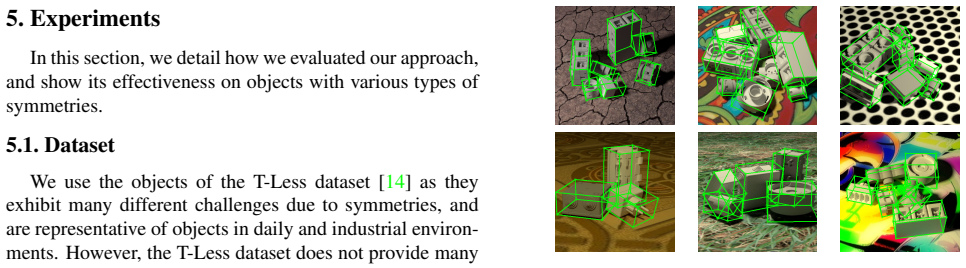
Objects with symmetries are common in our daily life and in industrial contexts, but are often ignored in the recent literature on 6D pose estimation from images. In this paper, we study in an analytical way the link between the symmetries of a 3D object and its appearance in images. We explain why symmetrical objects can be a challenge when training machine learning algorithms that aim at estimating their 6D pose from images. We propose an efficient and simple solution that relies on the normalization of the pose rotation. Our approach is general and can be used with any 6D pose estimation algorithm. Moreover, our method is also beneficial for objects that are 'almost symmetrical', i.e. objects for which only a detail breaks the symmetry. We validate our approach within a Faster-RCNN framework on a synthetic dataset made with objects from the T-Less dataset, which exhibit various types of symmetries, as well as real sequences from T-Less.
Figures


Figures from the paper (6 more)



Forward citations
Cited by 1 Pith paper
-
Equivariant symmetry-aware head pose estimation for fetal MRI
E(3)-Pose regresses 6-DoF fetal head pose with an E(3)-equivariant CNN whose pseudovector output encodes left-right symmetry, improving generalization to clinical navigator MRI.
Reference graph
Works this paper leans on
-
[26]
M. Sundermeyer, Z. Marton, M. Durner, M. Brucker, and R. Triebel. Implicit 3D Orientation Learning for 6D Object Detection from RGB Images. In European Conference on Computer Vision, 2018. 1, 2, 8
work page 2018
-
[1]
E. Brachmann, F. Michel, A. Krull, M. Yang, and S. Gumhold. Uncertainty-Driven 6D Pose Estimation of Ob- jects and Scene. In Conference on Computer Vision and Pat- tern Recognition, 2016. 2
work page 2016
-
[2]
R. Br ´egier, F. Devernay, L. Leyrit, and J. L. Crowley. Defining the Pose of Any 3D Rigid Object and an Associ- ated Distance. International Journal of Computer Vision , 126(6):571–596, June 2018. 1, 2, 4
work page 2018
- [3]
-
[4]
A. Crivellaro, M. Rad, Y . Verdie, K. M. Yi, P. Fua, and V . Lepetit. Robust 3D Object Tracking from Monocular Im- ages Using Stable Parts. IEEE Transactions on Pattern Anal- ysis and Machine Intelligence, 2018. 2
work page 2018
-
[5]
G. Cybenko. Approximations by Superpositions of Sig- moidal Functions. Mathematics of Control, Signals, and Sys- tems, (4):303–314, 1989. 4
work page 1989
-
[6]
T. Do, M. Cai, T. Pham, and I. Reid. Deep-6DPose: Recov- ering 6D Object Pose from a Single RGB Image. In arXiv Preprint, 2018. 2
work page 2018
- [7]
Show all 30 references
-
[8]
B. Hanin. Universal Function Approximation by Deep Neu- ral Nets with Bounded Width and ReLU Activations. In arXiv Preprint, 2017. 4
2017
-
[9]
Hartley and A
R. Hartley and A. Zisserman. Multiple Views Geometry in Computer Vision. Cambridge University Press, 2000. 6
2000
-
[10]
K. He, G. Gkioxari, P. Dollar, and R. Girshick. Mask R- CNN. In International Conference on Computer Vision ,
-
[11]
Henderson and V
P. Henderson and V . Ferrari. Learning to generate and re- construct 3d meshes with only 2d supervision. In British Machine Vision Conference (BMVC), 2018. 3
2018
-
[12]
Hinterstoisser, V
S. Hinterstoisser, V . Lepetit, S. Ilic, S. Holzer, G. Bradski, K. Konolige, and N. Navab. Model Based Training, De- tection and Pose Estimation of Texture-Less 3D Objects in Heavily Cluttered Scenes. In Asian Conference on Computer Vision, 2012. 1, 3
2012
-
[13]
Hoda ˇn, F
T. Hoda ˇn, F. Michel, E. Brachmann, W. Kehl, A. G. Buch, D. Kraft, B. Drost, J. Vidal, S. Ihrke, X. Zabulis, C. Sahin, F. Manhardt, F. Tombari, T.-K. Kim, J. Matas, and C. Rother. BOP: Benchmark for 6D Object Pose Estimation. In Euro- pean Conference on Computer Vision , page...
2018
-
[14]
Hoda ˇn, P
T. Hoda ˇn, P. Haluza, S. Obdr ˇza´lek, J. Matas, M. Lourakis, and X. Zabulis. T-LESS: An RGB-D Dataset for 6D Pose Estimation of Texture-Less Objects. In IEEE Winter Confer- ence on Applications of Computer Vision (WACV), 2017. 6, 7
2017
-
[15]
K. Hornik. Approximation Capabilities of Multilayer Feed- forward Networks. Neural Networks, 4(2):251–257, 1991. 4
1991
-
[16]
O. H. Jafari, S. K. Mustikovela, K. Pertsch, E. Brachmann, and C. Rother. IPose: Instance-Aware 6D Pose Estimation of Partly Occluded Objects. CoRR, abs/1712.01924, 2017. 1, 2
2017 arXiv
-
[17]
W. Kehl, F. Manhardt, F. Tombari, S. Ilic, and N. Navab. SSD-6D: Making RGB-Based 3D Detection and 6D Pose Estimation Great Again. In International Conference on Computer Vision, 2017. 1, 2
2017
-
[18]
W. Liu, D. Anguelov, D. Erhan, C. Szegedy, S. E. Reed, C.- Y . Fu, and A. C. Berg. SSD: Single Shot Multibox Detector. In European Conference on Computer Vision, 2016. 2
2016
-
[19]
Manhardt, D
F. Manhardt, D. M. Arroyo, C. Rupprecht, B. Busam, N. Navab, and F. Tombari. Explaining the Ambiguity of Object Detection and 6D Pose from Visual Data. CoRR, abs/1812.00287, 2018. 1, 2
2018 arXiv
-
[20]
Manhardt, D
F. Manhardt, D. M. Arroyo, C. Rupprecht, B. Busam, N. Navab, and F. Tombari. Explaining the Ambiguity of Object Detection and 6D Pose from Visual Data. In arXiv Preprint, 2019. 2
2019
-
[21]
Oberweger, M
M. Oberweger, M. Rad, and V . Lepetit. Making Deep Heatmaps Robust to Partial Occlusions for 3D Object Pose Estimation. In European Conference on Computer Vision ,
-
[22]
S. Peng, Y . Liu, Q. Huang, X. Zhou, and H. Bao. PVNet: Pixel-Wise V oting Network for 6DoF Pose Estimation. In Conference on Computer Vision and Pattern Recognition ,
-
[23]
Rad and V
M. Rad and V . Lepetit. BB8: A Scalable, Accurate, Robust to Partial Occlusion Method for Predicting the 3D Poses of Challenging Objects Without Using Depth. In International Conference on Computer Vision, pages 3848–3856, 2017. 1, 2, 6
2017
-
[24]
Redmon, S
J. Redmon, S. Divvala, R. Girshick, and A. Farhadi. You Only Look Once: Unified, Real-Time Object Detection. In Conference on Computer Vision and Pattern Recognition ,
-
[25]
S. Ren, K. He, R. Girshick, and J. Sun. Faster R-CNN: Towards Real-Time Object Detection with Region Proposal Networks. In Advances in Neural Information Processing Systems, 2015. 6
2015
-
[27]
Tekin, S
B. Tekin, S. N. Sinha, and P. Fua. Real-Time Seamless Single Shot 6D Object Pose Prediction. InConference on Computer Vision and Pattern Recognition, 2018. 1, 2, 6
2018
-
[28]
Tremblay, T
J. Tremblay, T. To, B. Sundaralingam, Y . Xiang, D. Fox, and S. Birchfield. Deep Object Pose Estimation for Semantic Robotic Grasping of Household Objects. In Conference on Robot Learning (CoRL), 2018. 6
2018
-
[29]
Xiang, T
Y . Xiang, T. Schmidt, V . Narayanan, and D. Fox. PoseCNN: A Convolutional Neural Network for 6D Object Pose Esti- mation in Cluttered Scenes. Robotics: Science and Systems Conference, 2018. 1, 2
2018
-
[30]
Zakharov, I
S. Zakharov, I. Shugurov, and S. Ilic. DPOD: Dense 6D Pose Object Detector in RGB Images. In arXiv Preprint, 2019. 2
2019
Reviewed August 14, 2026 · model on record in the stance chip above.
Discussion (0). Continue with ORCID to comment.