REVIEW 4 major objections 6 minor 12 references
An Expert System Approach for determine the stage of UiTM Perlis Palapes Cadet Performance and Ranking Selection
T0 review · 4 major / 6 minor · reviewed 2026-08-14 · deepseek-v4-flash
Pith's one-line read A rule-based expert system ranks Palapes cadets for promotion from standard test scores, mapping twelve weighted tests to four performance stages.
desk verdict Encoding an existing score rubric as IF-THEN rules is not a research contribution; the system is described but never shown to work. read the letter →
The pith
A machine-rendered reading of the paper's core claim, the machinery that carries it, and where it could break.
The reading
What carries the argument
The central object is the 'stage of cadet performance' classification, a four-level ranking generated from the cadet's total score on the organization's standard testing scheme. The machinery that carries the argument is a rule-based knowledge base: rules such as 'IF Grade = HIGH (80-100) THEN promote for rank (Corporal, Sergeant, SUO, JUO)' are stored in the system, and the inference engine applies them with forward and backward chaining. The thresholds 50, 60, and 80 are the dividing lines, and the twelve test weights in Table 1 are the inputs that produce the percentage. This rule base is what lets the system generate both the promotion decision and a human-readable explanation of how the result was reached.
What would settle it
Follow a cohort of cadets promoted by this system and compare their later performance, disciplinary records, or supervisor ratings in the higher rank with the stage they were assigned; if HIGH-stage cadets do not outperform AVERAGE-stage cadets, or if cadets just above a cutoff do no better than those just below, the central claim that the system selects the right people for promotion is falsified.
Extended reading notes
Core claim
On the paper's own terms, the discovery is that cadet promotion readiness can be reduced to a single weighted test score followed by a four-band threshold rule: 80-100 percent means HIGH and eligibility for corporal, sergeant, senior uniform officer (SUO), or junior uniform officer (JUO); 60-79 percent means AVERAGE and eligibility for corporal or sergeant; 50-59 percent means LOW and no promotion; below 50 percent is FAIL and no promotion. The expert system stores these mappings as IF-THEN rules in a knowledge base and uses forward and backward chaining to determine and explain the stage. The author's stated expectation is that the system 'will correctly choose a person who can be promoted to higher rank' from information supplied by the expert cadet officer, replacing the complicated manual assessment. In other words, the claim is that the expertise of trainers and officers can be captured in these rules without losing the accuracy of their judgments.
Load-bearing premise
The entire system rests on the assumption that the fixed test weights and the 50/60/80 percent cutoffs from the existing Palapes scheme are a valid measure of leadership readiness and promotion suitability—if those numbers do not predict who actually succeeds in the higher rank, the expert system will simply automate an invalid judgment at scale.
Editorial extensions
If this is right
- A total score below 50 percent produces a FAIL stage and automatic non-promotion, while 50-59 percent produces LOW and also no promotion.
- Scores of 60-79 percent open promotion only to corporal and sergeant, while 80-100 percent also open the higher ranks of SUO and JUO.
- The system's explanation facility shows cadets and trainers exactly which scores produced the result, replacing the opaque manual process.
- Coach observation notes act as a tie-breaker when two cadets land in the same performance stage.
- The same evaluation scheme and rule base could be reused by other Palapes units or defense training groups using identical testing percentages.
Reading between the lines
- A direct extension the paper leaves untested: follow a cohort of promoted cadets and check whether the HIGH/AVERAGE band predicts later performance in the higher rank better than the raw score alone.
- Because the thresholds and weights are inherited from the existing scheme without validation, automating them could scale any built-in bias; an audit design would compare system decisions against independent officer judgment for a held-out set of cadets.
- The tie-break via coach notes is the one subjective step left in the system; making those notes structured and logged would allow fairness audits.
- The explanation facility is the most transferable part of the design; any rule-based personnel grading system could borrow the pattern of giving cadets a traceable reason for their stage.
Signed reviews
Editorial analysis
A structured set of objections, weighed in public.
Referee Report
Summary. The paper proposes an expert system for classifying UiTM Perlis Palapes cadet performance into stages (HIGH, AVERAGE, LOW, FAIL) and for recommending promotion ranks based on weighted standard testing scores and coach observation notes. The authors describe knowledge acquisition through interviews, a rule-based knowledge representation, and a user interface with explanation facilities. The manuscript claims in Section 1 that the system 'will correctly choose a person who can be promoted to higher rank,' but it presents no test results, no dataset, no comparison with actual promotion decisions, and no error analysis. The core of the system is a set of IF-THEN rules that map the same score thresholds (50, 60, 80) used to define the stages in Table 2 directly onto promotion recommendations.
Significance. If the central claim were demonstrated, the contribution would be a transparent, automation-friendly tool for cadet promotion decisions, with potential time savings and consistency benefits for the Palapes organization. The paper also gives some credit for identifying a concrete domain, for specifying a weighted testing scheme in Table 1, and for including a coach-observation tie-breaking mechanism in the design. However, the system is essentially a lookup table whose recommendations are derived from the same unvalidated thresholds that define the stages; no evidence is provided that these thresholds or weights predict promotion suitability. Since the manuscript contains no evaluation and no external validation, the scientific contribution as presented is minimal and the central claim remains entirely unsupported.
major comments (4)
- [Section 4 (Result and Discussion)] The central claim in Section 1 that the expert system 'will correctly choose a person who can be promoted to higher rank' is not supported anywhere in the manuscript. Section 4 contains only interface descriptions and screen captures; there are no test cases, no dataset, no comparison with the actual promotion decisions made by Palapes officers, and no error or sensitivity analysis. Without an evaluation that defines what 'correctly choose' means and measures the system's output against that definition, the central claim is asserted rather than demonstrated.
- [Section 3.1, Table 2, and Fig. 3] The IF-THEN rules in Fig. 3 use exactly the same score thresholds and stage boundaries that appear in Table 2, so the system's promotion recommendation is a direct restatement of the input classification. Because the stage definitions are themselves generated from the same 50/60/80 thresholds, the system has no independent source of predictive validity. The manuscript does not validate the thresholds or the Table 1 test weights against actual promotion outcomes, expert consensus, or any external benchmark; thus the system replicates the existing scheme's assumptions without evidence that those assumptions are correct.
- [Section 3.1, text vs. Table 2 and Figs. 2 and 3] The knowledge base is internally inconsistent. The narrative text in Section 3.1 states that a HIGH stage corresponds to '80% to 90%', while Table 2 defines HIGH as '80 - 100'. Additionally, Fig. 2 lists the HIGH-stage promotion ranks as Corporal, Sergeant, and SUO, omitting JUO, whereas the rule in Fig. 3 for the same HIGH grade includes JUO along with Corporal, Sergeant, and SUO. These contradictions make it impossible to determine the intended promotion logic and undermine the reliability of the proposed system.
- [Section 1 and Section 4] The manuscript never operationally defines the ground-truth outcome for the claim that the system 'will correctly choose' a promoted cadet. No definition is given in terms of actual historical promotions, expert officer judgment, or downstream performance of promoted cadets. As a result, the central claim is not testable from the manuscript as written, and the paper provides no way for a reader to assess whether the system improves on or even matches the existing manual process.
minor comments (6)
- [Title and Abstract] The phrase 'for determine the stage' is grammatically incorrect and should be 'for determining the stage'; similar language issues appear throughout the manuscript.
- [Section 1] The sentence 'physical fitness us tested' contains a typographical error and should read 'physical fitness is tested'.
- [Section 3.1, Fig. 3] The rule text contains repeated spelling errors: 'Dot not Promote for Rank' should be 'Do not Promote for Rank', appearing twice in the displayed rule set.
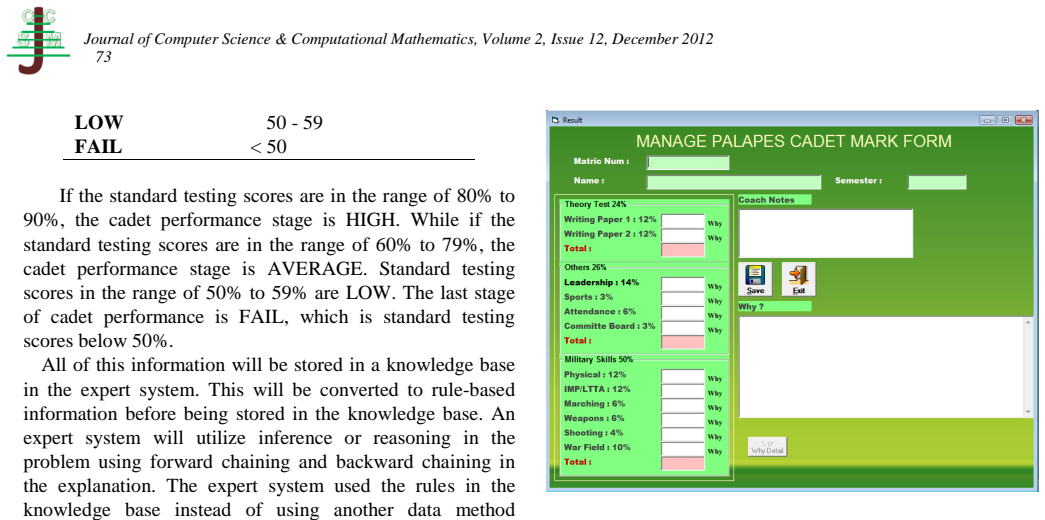
- [Section 4] The figures are referenced inconsistently: the text says 'as show in Fig. 5' and 'As show in Fig. 6' instead of 'as shown'; also, Fig. 4 and Fig. 5 are described but no quantitative or qualitative results from the system are presented in the text.
- [References] Reference [3] and reference [5] are the same work by Shu-Hsien Liao (2005); duplicate citations should be consolidated, and each entry should follow a consistent citation format.
- [Section 3] The manuscript mentions that the system uses forward chaining and backward chaining in the inference engine, but no details are provided about how either mechanism is implemented or how the inference network in Fig. 2 is processed; adding this information would make the expert-system architecture complete.
Circularity Check
No significant circularity: the expert system is a direct rule-based encoding of the stated score thresholds; the unsupported 'correctly choose' claim is an evidential gap, not a circular derivation.
full rationale
The paper describes a conventional expert system: Table 2 defines performance stages by score intervals, and the rules in Fig. 3 use those exact intervals to issue promotion recommendations. This is a faithful encoding of a predetermined classification scheme, not a derivation in which an output is secretly identical to an input or fitted parameter. The system's output is definitionally the same as the encoded thresholds, but that is the intended behavior of any rule-based classifier; it does not constitute circularity unless the paper claims to validate or predict something independent of those thresholds. The sentence 'The system will correctly choose a person who can be promoted to higher rank' is an unvalidated assertion about the expert-sourced rules, not a result derived from them. The paper provides no external benchmark or ground-truth validation, but the absence of such validation is a correctness and evidence concern, not a logical circularity. No self-citations are load-bearing, and no fitted-input-called-prediction pattern is present. Therefore the circularity score is 0.
Assumptions & free parameters
free parameters (2)
- Stage score thresholds (LOW/AVERAGE/HIGH) =
50, 60, 80 percent
- Standard testing weights =
See Table 1 (e.g., Leadership 14%, Theory Paper 1 12%, etc.)
assumptions (3)
- domain assumption Cadet readiness for promotion is accurately measured by the weighted sum of standard testing scores in Table 1.
- domain assumption The stage score boundaries (80, 60, 50) correctly map scores to promotion categories.
- domain assumption Knowledge acquired through interviews with a domain expert is complete and correct.
Cite this review
Pith. "Pith review of An Expert System Approach for determine the stage of UiTM Perlis Palapes Cadet Performance and Ranking Selection." pith.science (2026). https://pith.science/paper/4ZNHWHUJ
@misc{pith2026190807651,
  author       = {Pith},
  title        = {Pith review of: An Expert System Approach for determine the stage of UiTM Perlis Palapes Cadet Performance and Ranking Selection},
  year         = {2026},
  howpublished = {\url{https://pith.science/paper/4ZNHWHUJ}},
  note         = {Machine review of arXiv:1908.07651}
}
read the original abstract
The palapes cadets are one of the uniform organizations in UiTM Perlis for extra-curricular activities. The palapes cadets arrange their organization in a hierarchy according to grade. Senior uniform officer (SUO) is the highest rank, followed by a junior uniform officer (JUO), sergeant, corporal, lance corporal, and lastly, cadet officer, which is the lowest rank. The palapes organization has several methods to measure performance toward promotion to a higher rank, whether individual performance or in a group. Cadets are selected for promotion based on demonstrated leadership abilities, acquired skills, physical fitness, and comprehension of information as measured through standardized testing. However, this method is too complicated when manually assessed by a trainer or coach. Therefore, this study will propose an expert system, which is one of the artificial intelligence techniques that can recognize the readiness and progression of a palapes cadet.
Figures


Reference graph
Works this paper leans on
-
[1]
Palapes Cadet Measurement In military organizations, transparent and fair appraisal of personnel is essential for decisions pertaining to promotions and operations [1]. Currently, there is a manual process to measure Palapes UiTM cadet performance to increase their rank. The cadet officers in the Palapes organization are abundant. In addition, they all ha...
-
[2]
Objective The main purpose of this study is to implement a n expert system that facilitates the process of measuring Palapes cadet performance and identify which cadets are best fit for promotion or the next higher rank. The other objectives are as follows: To ensure that all eligible cadets receive full and equitable opportunity to compete for promotio...
-
[3]
Expert systems have provided solutions to multiple problems in companies of all types [2]
Expert System The creation of an expert system normally requires specific technical knowledge and concepts of artificial intelligence (AI). Expert systems have provided solutions to multiple problems in companies of all types [2]. However, developing an expert system based on these tools becomes a very difficult task for users without specific training in...
work page 2012
-
[4]
Therefore, the next phase is a discussion of the result s obtained from this study
Result And Discussion This study is a summary of an expert system that can be applied to measure Palapes cadet performance to select which cadet to promotion to the next rank. Therefore, the next phase is a discussion of the result s obtained from this study. Figure 4. Manage Palapes cadet marks form Fig. 4 shows the interface of this expert system to mea...
work page 2012
-
[5]
Cadets’ grades will be corroborated with the necessary information
Conclusion This study shows an expert system developed with the ability to identify cadet level s for decision makers, according to their grade s and coach observation, and to integrate the decisions with self-explanatory functions. Cadets’ grades will be corroborated with the necessary information . T his system mainly is design for UiTM Perlis Palapes b...
-
[6]
Acknowledgement The study presented is supported directly and indirect ly by the Palapes Uitm Perlis organization to complete this expert system
-
[7]
C. Moon, J. Lee, S. Lim, A performance appraisal and promotion ranking system based on fuzzy logic: An implementation case in military organizations . Applied Soft Computing, vol. 10, no. 2, pp. 512–519, 2010
work page 2010
-
[8]
Ruiz-Mezcua, et al., An expert system development tool for non-AI experts
B. Ruiz-Mezcua, et al., An expert system development tool for non-AI experts . Expert Systems with Applications, vol. 38, no. 1, pp. 597–609, 2011
work page 2011
Show all 12 references
-
[9]
Shu-Hsien, Expert system methodologies and applications—a decade review from 1995 to 2004
L. Shu-Hsien, Expert system methodologies and applications—a decade review from 1995 to 2004. Expert Systems with Applications, vol. 28, no. 1, pp. 93– 103, 2005
1995
-
[10]
Castellanos, et al., Failure analysis expert system for onshore pipelines
V. Castellanos, et al., Failure analysis expert system for onshore pipelines. Part I: Structured database and knowledge acquisition . Expert Systems with Applications, vol. 38, no. 9, pp. 11085-11090, 2011
2011
-
[11]
Liao, Expert system methodologies and applications—a decade review from 1995 to 2004
S.-H. Liao, Expert system methodologies and applications—a decade review from 1995 to 2004. Expert Systems with Applications , vol. 28, pp. 93–103, 2005
1995
-
[12]
H. Dong, G. Xu, An expert system for bridge crane graining system based on virtual reality. Artificial Intelligence and Computation al Intelligence (AICI), 2010 International Conference on, 30–33
2010
Reviewed August 14, 2026 · model on record in the stance chip above.
Discussion (0). Continue with ORCID to comment.