REVIEW 5 major objections 4 minor 1 cited by
Denoising and Verification Cross-Layer Ensemble Against Black-box Adversarial Attacks
T0 review · 5 major / 4 minor · reviewed 2026-08-14 · deepseek-v4-flash
Pith's one-line read MODEF, a cross-layer ensemble that denoises inputs and verifies outputs with diverse models, reports 94% average defense success across eleven black-box attacks on MNIST and CIFAR-10.
desk verdict A plausible cross-layer ensemble defense with a clear write-up, but the kappa-diversity mechanism is supported by one MNIST draw and the attack-independence claim outruns the evidence. read the letter →
The pith
A machine-rendered reading of the paper's core claim, the machinery that carries it, and where it could break.
The reading
What carries the argument
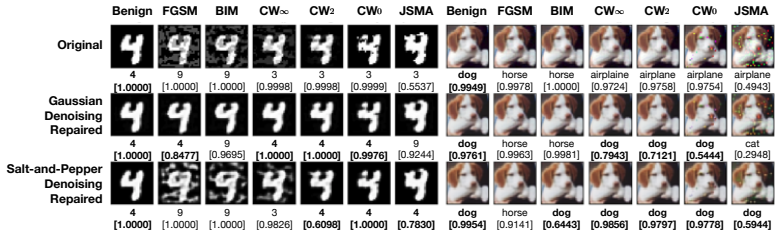
The load-bearing mechanism is the $\kappa$ diversity metric: for each pair of candidate members, the paper computes Cohen's kappa on benign test examples (Equation 3), which measures agreement beyond chance; low $\kappa$ means the two models are often wrong on different examples. MODEF ranks all possible teams by average pairwise $\kappa$, keeps teams below a threshold, and picks one at runtime. Around this selector, the framework builds a front-end ensemble of denoising autoencoders trained with different noise corruptions (Gaussian and salt-and-pepper) and a back-end verification ensemble of pretrained classifiers with accuracy close to the target model, combining their soft votes and, in the cross-layer version, feeding every denoised version through the verifiers and taking the most confident prediction.
What would settle it
Measure pairwise $\kappa$ among verifiers on adversarial examples that actually fool several of them; if ensembles ranked low on benign $\kappa$ show high $\kappa$ on adversarial inputs (meaning the same adversarial examples fool all members), the diversity proxy fails and the defense should degrade to random-team performance.
Extended reading notes
Core claim
On its own terms, MODEF's central claim is that robustness against unknown black-box attacks can be achieved by combining two complementary diversity principles: denoising autoencoders push corrupted inputs back toward the natural-data manifold, and a verification ensemble exploits the weak spots of attack transferability because adversarial examples that fool the target model often fail to fool a diverse team of other classifiers. The framework selects each team by average pairwise $\kappa$ agreement, keeping ensembles whose members disagree strongly on benign test examples, on the theory that disagreement signals failure-independence. The paper reports that the cross-layer ensemble reaches an average defense success rate of 0.94 on both MNIST and CIFAR-10 over eleven attacks, with a small standard deviation, and that it outperforms the three comparison defenses on almost every attack while maintaining near-baseline benign accuracy.
Load-bearing premise
The ranking's value rests on $\kappa$ agreement computed from benign test images being a good proxy for how independently the models will fail on adversarial inputs; if low $\kappa$ on benign data does not carry over to adversarial disagreements, the strategic teaming adds nothing over random selection.
Editorial extensions
If this is right
- If model diversity as measured by $\kappa$ is a reliable proxy for failure-independence, then any pool of high-accuracy classifiers can be converted into an adversarial defense without retraining the target model.
- Because MODEF does not use attack-specific thresholds, it should generalize to new attacks such as PGD; the authors note they could not include PGD experiments.
- The cross-layer design implies that defenses can be layered: inputs that survive denoising but fool the target model can still be caught by the verification vote, and vice versa.
- The reported low standard deviation of defense success rates suggests the defense is stable across attack types, unlike distillation and adversarial training, which vary widely.
- By randomizing which diverse team is selected at runtime, the framework also aims to harden attacks that would otherwise exploit a fixed defense structure.
Reading between the lines
- A likely testable extension is to replace the $\kappa$ threshold with a learned diversity objective calibrated on a small set of adversarial examples; if benign-data disagreement is not perfectly predictive, such calibration could sharpen the team ranking.
- The one-to-many and many-to-many cross-layer variants define a cost-robustness spectrum, and the paper does not analyze the trade-off between sending every denoised version (higher computation) and sending only the voted output (risk of propagating front-end errors).
- The paper does not consider adaptive attackers who know the ensemble selection mechanism; a natural follow-up would be to generate attacks against the full MODEF pipeline and measure how much the defense success rate drops.
- Since the verification ensemble draws on pretrained public models, the framework could be deployed without modifying the target model itself, a practical consequence the authors only implicitly suggest.
Signed reviews
Editorial analysis
A structured set of objections, weighed in public.
Referee Report
Summary. The paper proposes MODEF, a defense framework that combines a denoising autoencoder ensemble (front-end input repair) with a verification model ensemble (back-end output verification), where ensemble members are chosen according to a kappa diversity metric meant to capture failure independence. The method is evaluated on MNIST and CIFAR-10 against eleven attacks, using defense success rate (DSR), prevention success rate (PSR), detection success rate (TSR), and false positive rate (FP). The paper claims that MODEF is attack-independent and achieves an average DSR of about 0.94 on both datasets, outperforming adversarial training, defensive distillation, and ensemble input transformation.
Significance. If the central claims were fully supported, MODEF would be a practically interesting defense that improves robustness without attack-specific tuning, and the kappa-diversity selection mechanism would be a useful design principle for ensemble defenses. The manuscript has genuine strengths: a fairly broad attack suite, comparisons against three representative baselines, a decomposition of repair versus detection behavior, and a transferability analysis showing that adversarial examples generated on the target model do not transfer uniformly to the verifier pool. However, the load-bearing claim that benign-data kappa diversity selects failure-independent ensembles under adversarial attack is supported only by a single illustrative comparison, and the evaluation lacks adaptive attacks, confidence intervals, and a specified kappa threshold. The significance is therefore conditional: the framework is plausible and the in-paper variant comparisons are informative, but the attack-independence and strategic-teaming claims are not yet established.
major comments (5)
- [IV-A, Eq. (3), Table VIII] The central mechanism of the paper, that kappa diversity measured on benign test examples selects verifier teams that are failure-independent under adversarial inputs, is not established. Equation (3) is computed on benign test examples, and the only supporting evidence is Table VIII, a single MNIST draw comparing one Best-kappa team (V5,V6,V9), one Rand-kappa team (V3,V4,V10), and one random team (V1,V2,V4,V7,V10). No confidence intervals, repeated sampling, or CIFAR-10 analogue are reported, and the apparent advantage could stem from member strength rather than low intra-team kappa: V9 alone has an average DSR of 0.88, which is nearly as high as the Best-kappa team's 0.89. Without a direct test of the benign-to-adversarial transfer of kappa, for example by comparing teams matched on member accuracy but differing in kappa, the claim that strategic teaming outperforms random ensemble selection is unsupported.
- [V-A, Tables V-VIII] The adversarial evaluation uses only the first 100 correctly classified test images per dataset (10 per class), and all DSR/PSR/TSR values in Tables V, VI, and VIII are point estimates without confidence intervals or significance tests. With 100 examples per attack, the reported differences of 0.02 to 0.05 between MODEF and baselines, and between ensemble teamings, are within the sampling noise of a binomial proportion; for instance, a 0.94 versus 0.89 difference corresponds to about 94 versus 89 successes, with a standard error near 0.03. The headline claim of an average DSR of 0.94 and the comparisons to existing defenses therefore require either a larger adversarial test set or interval estimates over repeated sampling.
- [II, Table IX] The stated threat model is black-box attacks that query only the target model, and the transferability analysis in Table IX confirms that all adversarial examples are generated against the undefended target model. However, the paper claims that MODEF is attack-independent and hardens black-box attacks. Under standard adversarial-defense evaluation, the adversary should at least be given knowledge of the defense structure, including the denoising and verification layers, so that adaptive attacks such as BPDA through the full pipeline, or transfer attacks through a surrogate of the cross-layer ensemble, can be tested. No such adaptive attack is reported, and the paper itself notes in Section VI that PGD was excluded due to space constraints. Without these experiments, the attack-independence claim remains a correctness risk rather than an established result.
- [III-B, V-A] The kappa-based strategic teaming of denoisers advertised in the abstract and introduced in Section III-B is never evaluated. Section V-A states that the experiments use a fixed team of two DNN denoisers (Gaussian noise and salt-and-pepper noise), and Tables V, VI, and VIII always use this fixed pair. The kappa-ranked list is applied only to verification ensembles (Section IV-A and Table VIII). Consequently, the paper provides no evidence that kappa diversity improves denoising-ensemble selection, which is a core novelty relative to prior denoising defenses. An ablation that varies the denoiser pool and compares kappa-selected versus random denoiser teams is needed.
- [V-A] The kappa-diversity threshold is a free parameter but is never specified: Section V-A describes a 'system-defined threshold' and states that the factors impacting its decision are omitted. Because this threshold determines which teams enter the kappa-ranked list and therefore which teams are used in Tables V, VI, and VIII, omitting it prevents reproduction and makes it impossible to assess the sensitivity of the results to this choice. The paper should report the threshold values and a sensitivity analysis, for example DSR as a function of the kappa threshold.
minor comments (4)
- [Figure 2, Table VIII] There are several typographical errors, including 'CIRAR-10' in the Figure 2 caption and 'Denosing-Veriï¬cation' in the Table VIII header; these should be corrected.
- [II] The paper defines 'Detection Success Rate (TSR)', but the abbreviation TSR is not derived from the phrase; please clarify the terminology or rename the metric to match the abbreviation.
- [III-B and IV-A] Equation (3) is introduced twice with slightly different verbal descriptions, first for denoiser pairs and then for verifier pairs; a single formal definition with explicit notation for the pairwise disagreement counts would improve clarity.
- [Table VI] The FP values in the Model Denoising Ensemble Defense block, such as 0.55 for CW-infinity ML on MNIST, are not discussed in the text; a brief explanation of why FP can be high even when TSR is zero would help the reader interpret the detection-repair trade-off.
Circularity Check
No significant circularity: MODEF's kappa-based ensemble ranking is a heuristic selection criterion, not a quantity fitted from the claimed DSR outcomes.
full rationale
The paper's derivation chain is self-contained in the sense relevant to circularity. The denoising and verification ensembles are assembled from standard trained models, with the kappa diversity metric (Eq. 3) computed as pairwise prediction disagreement on test inputs and used as a ranking heuristic; no parameter of Eq. 3 is fitted to the DSR values in Tables V, VI, or VIII. The soft-voting rule (Eq. 4) is a standard averaging operation, and the majority-vote probability calculation in Section V-C is the textbook binomial formula cited to [32]; it is motivating context, not the engine that produces MODEF's empirical DSRs. The reported defense success rates are measured on adversarial examples generated by eleven external attack algorithms, so the outcome metric is not an algebraic consequence of the selection criterion. Two evaluation concerns are worth flagging but are not circular. First, the claim that low kappa on benign inputs transfers to failure-independence on adversarial inputs is supported only by a single Rand-kappa-vs-Rand draw on MNIST; this is an empirical-validity weakness, not a by-construction equivalence. Second, the Best-kappa team in Table VIII is described as the team 'with the highest prediction accuracy'; if that accuracy is measured on the same adversarial test set whose DSR is then reported, that particular comparison would be selection-biased, but the kappa-vs-random comparison and the independent baselines in Table V do not reduce to this selection. Self-citations [21] and [23] support only generic statements about training diversity and are not load-bearing. The paper also explicitly omits threshold-setting details and PGD experiments, which are completeness limitations rather than circular inputs.
Assumptions & free parameters
free parameters (5)
- Gaussian noise volume =
0.3 (MNIST), 0.01 (CIFAR-10)
- Salt-and-pepper corruption ratio =
0.1
- Regularization hyperparameter lambda =
1e-9
- Kappa diversity threshold =
omitted (system-defined)
- Verification ensemble size ZV =
3 (MNIST), 10 (CIFAR-10)
assumptions (3)
- domain assumption Natural high-dimensional data lie near a low-dimensional manifold, and adversarial perturbations move inputs off it; denoisers trained on uniformly corrupted examples can map adversarial inputs back to the manifold.
- domain assumption Kappa diversity computed on benign examples transfers to failure independence on adversarial examples.
- domain assumption Adversarial examples generated against the target model are representative of black-box attacks against the full MODEF defense.
Cite this review
Pith. "Pith review of Denoising and Verification Cross-Layer Ensemble Against Black-box Adversarial Attacks." pith.science (2026). https://pith.science/paper/3U5IQKC2
@misc{pith2026190807667,
  author       = {Pith},
  title        = {Pith review of: Denoising and Verification Cross-Layer Ensemble Against Black-box Adversarial Attacks},
  year         = {2026},
  howpublished = {\url{https://pith.science/paper/3U5IQKC2}},
  note         = {Machine review of arXiv:1908.07667}
}
read the original abstract
Deep neural networks (DNNs) have demonstrated impressive performance on many challenging machine learning tasks. However, DNNs are vulnerable to adversarial inputs generated by adding maliciously crafted perturbations to the benign inputs. As a growing number of attacks have been reported to generate adversarial inputs of varying sophistication, the defense-attack arms race has been accelerated. In this paper, we present MODEF, a cross-layer model diversity ensemble framework. MODEF intelligently combines unsupervised model denoising ensemble with supervised model verification ensemble by quantifying model diversity, aiming to boost the robustness of the target model against adversarial examples. Evaluated using eleven representative attacks on popular benchmark datasets, we show that MODEF achieves remarkable defense success rates, compared with existing defense methods, and provides a superior capability of repairing adversarial inputs and making correct predictions with high accuracy in the presence of black-box attacks.
Figures

Forward citations
Cited by 1 Pith paper
-
Deep Neural Network Ensembles against Deception: Ensemble Diversity, Accuracy and Robustness
Selecting DNN ensemble teams by low Kappa disagreement is presented as a defense against adversarial examples, but the evidence is preliminary and incomplete.
Reference graph
Works this paper leans on
-
[1]
Explaining and harnessing adversarial examples,
I. J. Goodfellow, J. Shlens, and C. Szegedy, “Explaining and harnessing adversarial examples,” in ICLR, 2015
2015
-
[2]
Towards deep learning models resistant to adversarial attacks,
A. Madry, A. Makelov, L. Schmidt, D. Tsipras, and A. Vladu, “Towards deep learning models resistant to adversarial attacks,” in ICLR, 2018
2018
-
[3]
Adversarial examples in the physical world,
A. Kurakin, I. Goodfellow, and S. Bengio, “Adversarial examples in the physical world,” arXiv preprint arXiv:1607.02533 , 2016
arXiv 2016
-
[4]
Ensemble adversarial training: Attacks and defenses,
F. Tram `er, A. Kurakin, N. Papernot, I. Goodfellow, D. Boneh, and P. McDaniel, “Ensemble adversarial training: Attacks and defenses,” in ICLR, 2018
2018
-
[5]
Magnet: a two-pronged defense against adver- sarial examples,
D. Meng and H. Chen, “Magnet: a two-pronged defense against adver- sarial examples,” in CCS, 2017
work page 2017
-
[6]
Feature squeezing: Detecting adversarial examples in deep neural networks,
W. Xu, D. Evans, and Y . Qi, “Feature squeezing: Detecting adversarial examples in deep neural networks,” in NDSS, 2018
work page 2018
-
[7]
Defense-gan: Protecting classifiers against adversarial attacks using generative models,
P. Samangouei, M. Kabkab, and R. Chellappa, “Defense-gan: Protecting classifiers against adversarial attacks using generative models,” in ICLR, 2018
work page 2018
-
[8]
Distillation as a defense to adversarial perturbations against deep neural networks,
N. Papernot, P. McDaniel, X. Wu, S. Jha, and A. Swami, “Distillation as a defense to adversarial perturbations against deep neural networks,” in S&P, 2016
work page 2016
Show all 32 references
-
[9]
Practical black-box attacks against machine learning,
N. Papernot, P. McDaniel, I. Goodfellow, S. Jha, Z. B. Celik, and A. Swami, “Practical black-box attacks against machine learning,” in ASIACCS, 2017
2017
-
[10]
Towards evaluating the robustness of neural networks,
N. Carlini and D. Wagner, “Towards evaluating the robustness of neural networks,” in S&P, 2017
2017
-
[11]
Semi-supervised learning (chapelle, o. et al., eds.; 2006)[book reviews],
O. Chapelle, B. Scholkopf, and A. Zien, “Semi-supervised learning (chapelle, o. et al., eds.; 2006)[book reviews],” IEEE Trans. Neural Netw., vol. 20, no. 3, 2009
2006
-
[12]
Combatting adversarial attacks through denoising and dimensionality reduction: A cascaded autoencoder approach,
R. Sahay, R. Mahfuz, and A. El Gamal, “Combatting adversarial attacks through denoising and dimensionality reduction: A cascaded autoencoder approach,” in CISS, 2019
2019
-
[13]
Defense against adversarial attacks using high-level representation guided denoiser,
F. Liao, M. Liang, Y . Dong, T. Pang, X. Hu, and J. Zhu, “Defense against adversarial attacks using high-level representation guided denoiser,” in CVPR, 2018
2018
-
[14]
Deepfool: a simple and accurate method to fool deep neural networks,
S.-M. Moosavi-Dezfooli, A. Fawzi, and P. Frossard, “Deepfool: a simple and accurate method to fool deep neural networks,” in CVPR, 2016
2016
-
[15]
The limitations of deep learning in adversarial settings,
N. Papernot, P. McDaniel, S. Jha, M. Fredrikson, Z. B. Celik, and A. Swami, “The limitations of deep learning in adversarial settings,” in EuroS&P, 2016
2016
-
[16]
Densely connected convolutional networks,
G. Huang, Z. Liu, L. Van Der Maaten, and K. Q. Weinberger, “Densely connected convolutional networks,” in CVPR, 2017
2017
-
[17]
Extracting and composing robust features with denoising autoencoders,
P. Vincent, H. Larochelle, Y . Bengio, and P.-A. Manzagol, “Extracting and composing robust features with denoising autoencoders,” in ICML, 2008
2008
-
[18]
Image denoising and inpainting with deep neural networks,
J. Xie, L. Xu, and E. Chen, “Image denoising and inpainting with deep neural networks,” in NIPS, 2012
2012
-
[19]
Adaptive multi-column deep neural networks with application to robust image denoising,
F. Agostinelli, M. R. Anderson, and H. Lee, “Adaptive multi-column deep neural networks with application to robust image denoising,” in NIPS, 2013
2013
-
[20]
Stacked denoising autoencoders: Learning useful representations in a deep network with a local denoising criterion,
P. Vincent, H. Larochelle, I. Lajoie, Y . Bengio, and P.-A. Manzagol, “Stacked denoising autoencoders: Learning useful representations in a deep network with a local denoising criterion,” JMLR, vol. 11, no. Dec, pp. 3371–3408, 2010
2010
-
[21]
Adversarial examples in deep learning: Characterization and divergence,
W. Wei, L. Liu, S. Truex, L. Yu, and M. E. Gursoy, “Adversarial examples in deep learning: Characterization and divergence,” arXiv preprint arXiv:1807.00051, 2018
2018 arXiv
-
[22]
Snapshot ensembles: Train 1, get m for free,
G. Huang, Y . Li, G. Pleiss, Z. Liu, J. E. Hopcroft, and K. Q. Weinberger, “Snapshot ensembles: Train 1, get m for free,” in ICLR, 2017
2017
-
[23]
A comparative measurement study of deep learning as a service framework,
Y . Wu, L. Liu, C. Pu, W. Cao, S. Sahin, W. Wei, and Q. Zhang, “A comparative measurement study of deep learning as a service framework,” arXiv preprint arXiv:1810.12210 , 2018
2018 arXiv
-
[24]
Perceptual losses for real-time style transfer and super-resolution,
J. Johnson, A. Alahi, and L. Fei-Fei, “Perceptual losses for real-time style transfer and super-resolution,” in ECCV, 2016
2016
-
[25]
Simple sparsification improves sparse denoising autoencoders in denoising highly corrupted images,
K. Cho, “Simple sparsification improves sparse denoising autoencoders in denoising highly corrupted images,” in ICML, 2013
2013
-
[26]
Interrater reliability: the kappa statistic,
M. L. McHugh, “Interrater reliability: the kappa statistic,” Biochemia medica: Biochemia medica , vol. 22, no. 3, 2012
2012
-
[27]
What regularized auto-encoders learn from the data-generating distribution,
G. Alain and Y . Bengio, “What regularized auto-encoders learn from the data-generating distribution,” JMLR, vol. 15, no. 1, 2014
2014
-
[28]
Transferability in ma- chine learning: from phenomena to black-box attacks using adversarial samples,
N. Papernot, P. McDaniel, and I. Goodfellow, “Transferability in ma- chine learning: from phenomena to black-box attacks using adversarial samples,” arXiv preprint arXiv:1605.07277 , 2016
2016 arXiv
-
[29]
Imagenet classification with deep convolutional neural networks,
A. Krizhevsky, I. Sutskever, and G. E. Hinton, “Imagenet classification with deep convolutional neural networks,” in NIPS, 2012
2012
-
[30]
Intriguing properties of neural networks,
C. Szegedy, W. Zaremba, I. Sutskever, J. Bruna, D. Erhan, I. Goodfellow, and R. Fergus, “Intriguing properties of neural networks,” inICLR, 2014
2014
-
[31]
Countering adversarial images using input transformations,
C. Guo, M. Rana, M. Cisse, and L. van der Maaten, “Countering adversarial images using input transformations,” in ICLR, 2018
2018
-
[32]
Introduction to ensemble learning,
T. Holloway, “Introduction to ensemble learning,” 2007
2007
Reviewed August 14, 2026 · model on record in the stance chip above.
Discussion (0). Continue with ORCID to comment.