REVIEW 1 major objections 5 minor 143 references
The Complementary Information Principle of Quantum Mechanics
T0 review · 1 major / 5 minor · reviewed 2026-08-14 · deepseek-v4-flash
Pith's one-line read The information gained from the first of two incompatible measurements fixes the tightest possible majorization bounds on the outcome distribution of the second, and those bounds can be computed by semidefinite programming.
desk verdict A genuinely new conditional majorization approach to uncertainty regions, but the one-step flatness formula for the upper bound does not obviously produce a valid probability vector and needs to be fixed. read the letter →
The pith
A machine-rendered reading of the paper's core claim, the machinery that carries it, and where it could break.
The reading
What carries the argument
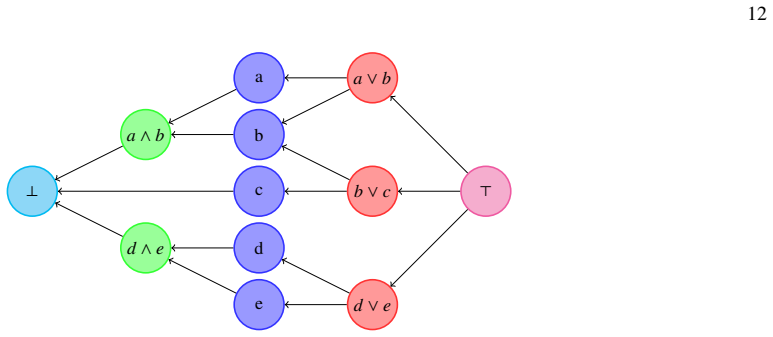
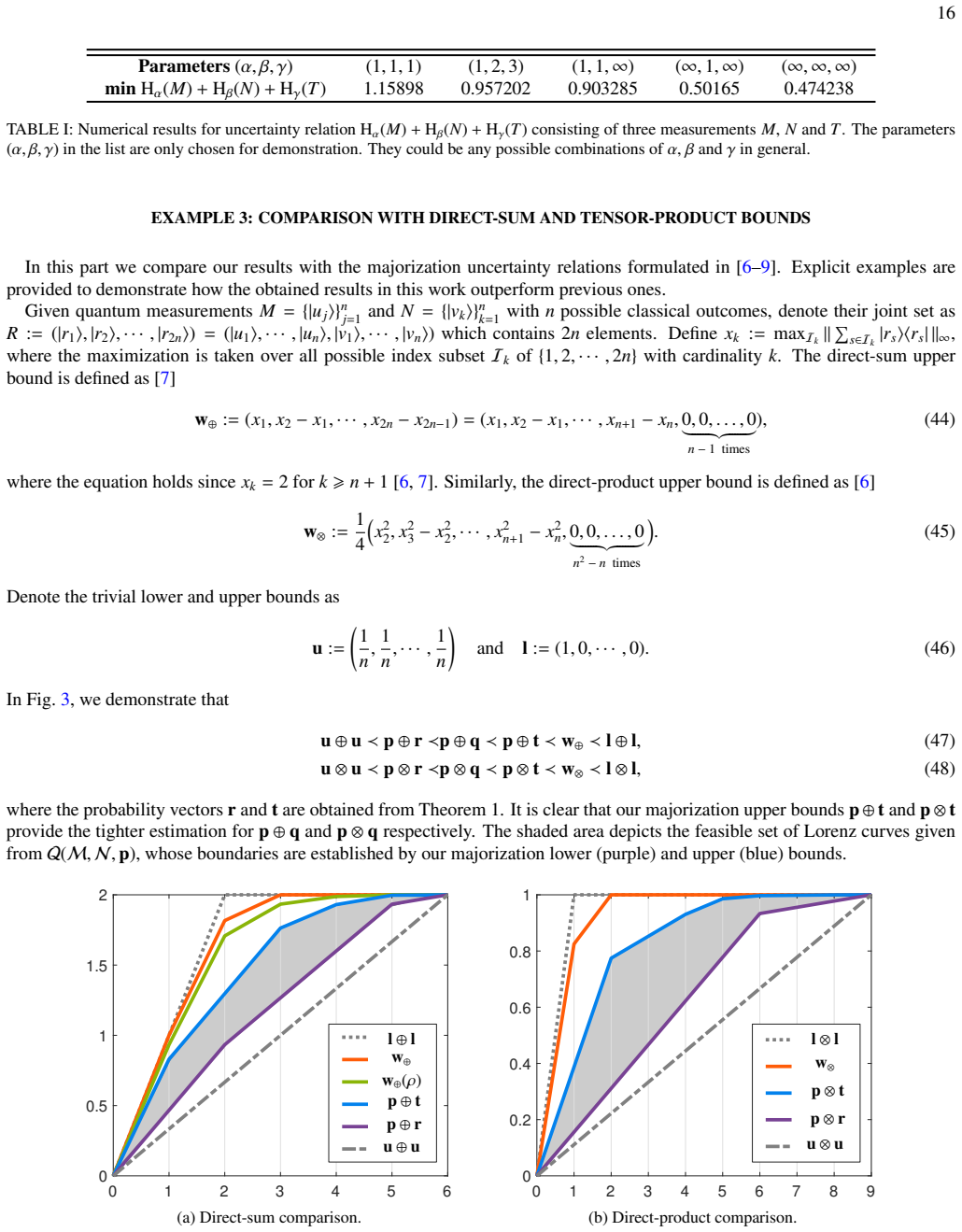
Majorization is the ordering that carries the argument: for probability vectors x and y, x≺y when the sum of the k largest entries of x does not exceed that of y for every k, equivalently the Lorenz curve of x lies below that of y. Comparison is done via marginal majorization, which fixes the pre-test vector p and orders post-test outcomes by majorization. The set of n-outcome probability vectors under this order is a complete lattice—every subset has a unique infimum and supremum—which is why r and t exist. The semidefinite programs compute, for each k, the smallest and largest possible value of the sum of the k largest post-test probabilities over all states satisfying the pre-test Born-rule constraints; these produce the lower envelope r and a raw upper envelope s. Because s need not be concave, the flatness process replaces it by the least concave curve above it, giving the optimal upper bound t.
What would settle it
Concretely, prepare a known state ρ, compute p from the Born rule, solve the two SDP families to obtain r and t, then measure N on many fresh copies and estimate the empirical post-test vector q; if the empirical Lorenz curve ever falls outside the envelope r≺q≺t beyond sampling error, the claimed bounds are wrong for that scenario.
Extended reading notes
Core claim
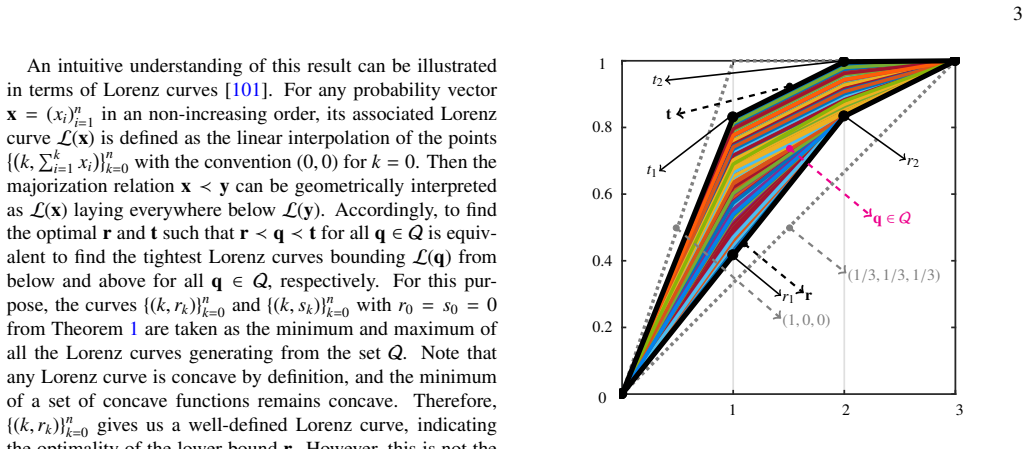
The central discovery is Theorem 2: for a fixed pre-test measurement M and outcome distribution p, the set Q of post-test probability vectors has a unique greatest lower bound r and unique least upper bound t under majorization, so every q in Q satisfies r≺q≺t. Geometric language makes this vivid: the Lorenz curve of every admissible post-test distribution lies between the Lorenz curves of r and t, and the two curves form the tightest envelope allowed by the pre-test data. The lower bound r comes from minimizing, over all states compatible with p, the maximal sum of the k largest post-test probabilities for every k, while the upper bound t is obtained by taking the corresponding maxima and then applying a flatness procedure that restores the concavity a Lorenz curve must have. The paper presents this result as a complementary information principle: the classical information gained in the pre-test confines the uncertainty of the post-test in the tightest possible way, generalizing Heisenberg's complementarity.
Load-bearing premise
The argument assumes the black box produces independent, identically distributed copies of one quantum state and that the pre-test and post-test are performed on fresh copies, so the first measurement never disturbs the system that is later measured.
Editorial extensions
If this is right
- For any pair of rank-one projective measurements and any pre-test outcome p, the post-test distribution of every compatible state lies in the majorization interval [r,t], and this interval is computable by parallel semidefinite programs.
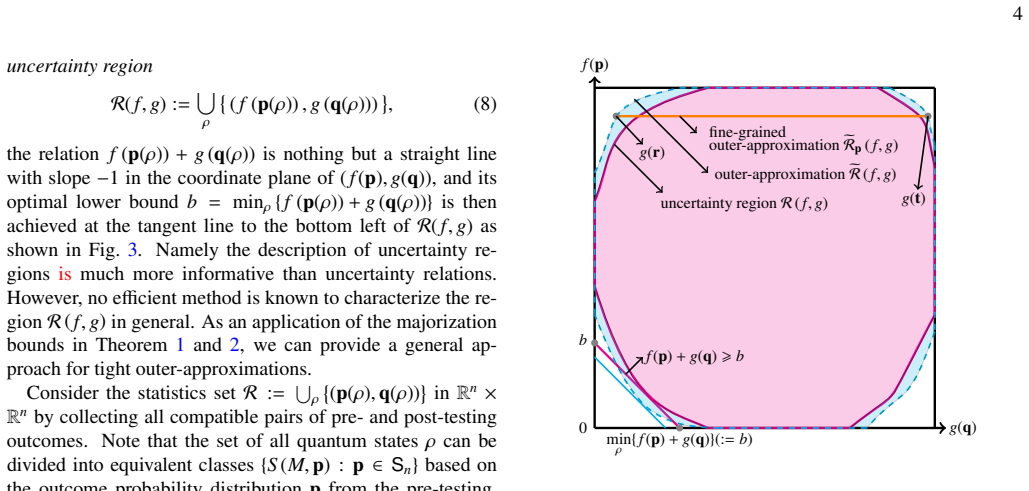
- The union of these intervals over all p yields an explicit outer approximation of the full uncertainty region for every non-negative Schur-concave uncertainty measure, and for qubits the approximation coincides with the true region.
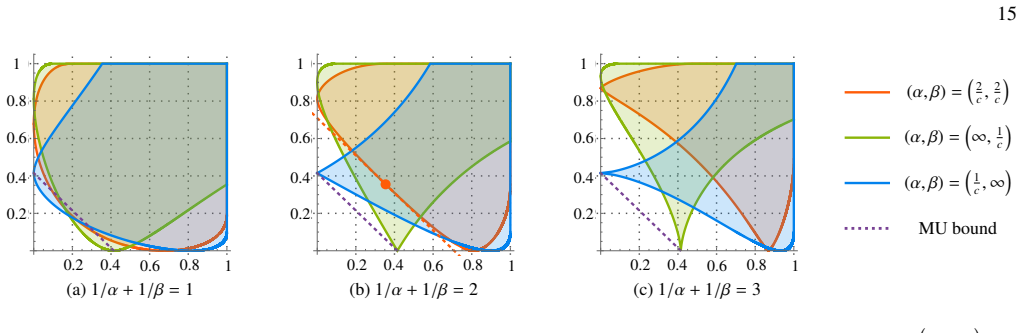
- Every joint uncertainty measure that is non-negative and monotone under doubly stochastic relabeling has state-independent lower and upper bounds given by the paper's formulas, tight for qubits.
- The bounds extend to multiple post-test measurements and to POVMs, and give sufficient conditions for resource-theoretic state transformations, such as entanglement and coherence, when only partial information about the state is available.
Reading between the lines
- A natural next step, not taken in the paper, is to use the gap between r and t as a quantitative measure of remaining complementarity and to study how it shrinks as the pre-test measurement becomes more informative; this could sharpen information-causality statements beyond the two extreme cases the paper discusses.
- Because the bounds are computed by semidefinite programs, they can serve as a common benchmark for the many published uncertainty relations: any candidate relation is at least as loose as the projection of [r,t], so the projection gives a fair way to compare different entropy-based bounds on one scale.
- The flatness process shows the least upper bound is generally not attained by a physical state; characterizing the gap between t and the achievable set Q, and identifying the states that come closest to it, is an open convex-geometric question.
Signed reviews
Editorial analysis
A structured set of objections, weighed in public.
Referee Report
Summary. The paper introduces a 'complementary information principle' for sequential black-box testing of two incompatible measurements. For a fixed pre-test measurement M with outcome distribution p, the set S(M,p) of states compatible with p defines a set Q of post-test probability vectors for measurement N. The authors claim that Q has a unique greatest lower bound r and least upper bound t under majorization, that both can be computed by semidefinite programs (Theorem 1), and that they are optimal because the majorization lattice is complete (Theorem 2). They then use r and t to outer-approximate uncertainty regions for arbitrary Schur-concave uncertainty measures, prove exactness for qubits, and derive state-independent bounds on general joint uncertainty measures, with comparisons to Maassen-Uffink and direct-sum/direct-product majorization bounds.
Significance. If the main theorem is correct, the paper provides a measure-independent characterization of conditional post-test uncertainty and a general method for outer-approximating uncertainty regions, with exact qubit results. The explicit SDP formulations, the analytic qubit bounds, and the detailed comparisons with Maassen-Uffink and direct-sum/direct-product majorization relations are useful and go beyond previous work that fixes a particular uncertainty measure. The conceptual move of conditioning on partial pre-test information instead of assuming full state knowledge is also worthwhile. However, the constructive specification of the optimal upper bound t is not fully justified as written, and this is load-bearing for Theorem 2 and all subsequent applications.
major comments (1)
- [Main text, Eq. (7); Supplemental Material, proof of Theorem 2] The one-step flatness construction in Eq. (7) does not, in general, produce a non-increasing probability vector, so the proof of Theorem 2 is incomplete for the t defined there. For example, applied to S=(0.4,0.1,0.2,0.3,0), the stated rule gives j=3, i=2, a=0.15, and hence T=(0.4,0.15,0.15,0.3,0), which is not in P_n. The proof of Theorem 2 uses t in P_n as a non-increasing vector and as the least concave majorant of the partial sums; it also asserts t=⋁Q only after arguing that t∈P_n. No argument is given that the particular s_k values arising from the quantum SDPs in Eq. (6) avoid this phenomenon for n≥4. The fix is local: the flatness step should be iterated until the vector is non-increasing, or the authors should prove that one pass is terminal for the special class of s_k from Eq. (6). Until then, the optimality of t, and therefore the universal uncertainty region and joint-uncertainty bounds that rely on t, are not established.
minor comments (5)
- [Main text, paragraph after Theorem 2] The claim that the bounds 'can be efficiently computed' and that s_k 'can still be solved efficiently via parallel computations even for large dimension n' is an overstatement: computing all s_k requires solving sum_{k=1}^n binom(n,k)=2^n-1 independent SDPs, and parallelization does not reduce the total computational work. The complexity statement should be restated honestly; this does not affect the mathematical validity of the bounds.
- [Supplemental Material, Remark 2] The printed s vector in the n=4 example sums to 1.0001 rather than 1; the rounding should be cleaned up or the numerical precision stated.
- [Main text, Eq. (12)] The simplification ~R_p(f,g)={(f(p),y)| g(t)≤y≤g(r)} is presented as an equality, but it implicitly assumes that every intermediate uncertainty value between g(t) and g(r) is achieved by some q with r≺q≺t. As written this is an outer approximation; a short justification or an explicit inclusion sign would be clearer.
- [Main text, opening of the framework] The phrase 'two independent and identically distributed resources ρ' is potentially confusing; it should be 'two independent copies of the same state ρ', since the derivation assumes the pre-test and post-test are performed on fresh copies rather than sequentially on one physical system.
- [Supplemental Material, proof of Theorem 2] In the contradiction argument, the proof writes inequalities for '∀l∈{1,...,i−1}' and '∀l∈{j,...,n}' even though l was fixed; this quantifier sloppiness should be corrected for readability.
Circularity Check
No circularity: the SDP bounds are exact optimizations over the stated compatible-state set, and the claimed optimality rests on external lattice results rather than on fitted inputs or author-unique premises.
full rationale
Score 0. Theorem 1 computes each r_k as a minimization and each s_k as a maximization over the explicitly defined set S(M,p), with p fixed by Born's rule; no parameter is fitted to the post-test set Q and no predicted quantity is defined as the fitted value. The optimality claim in Theorem 2 is obtained from the external completeness of the majorization lattice (Rapat [103]; Bondar [104]; Bosyk et al. [105]) and the external flatness construction of Cicalese and Vaccaro [106], so it is not imported from a self-citation chain. The self-citations that appear ([13], [63], [88], [110], [113]) are used for background, benchmarks, definitions, a resource-theory review, or an in-preparation experimental claim; none carries the proof of Theorems 1-2, so under the stated rules they are normal citations and do not constitute circularity. Per the review rule, I explicitly flag two non-circular missing-support items. First, the main text (Eq. (7)) and the Supplemental Material 'Proof of Theorem 2' assert that a single flatness pass 'suffices' to construct the optimal upper bound t, but no proof is given that one pass yields a non-increasing probability vector or that no new violation appears; the construction can leave a vector outside P_n (e.g., increments (0.4,0.1,0.2,0.3,0) flatten once to (0.4,0.15,0.15,0.3,0)). Second, the statement 'The experimental data and our theoretical results fit well [113]' cites a paper 'in preparation' by overlapping authors, so that confirmation is not yet independently verifiable. Both are correctness or completeness concerns, not reductions of the claimed results to their inputs, so they do not affect the circularity score.
Assumptions & free parameters
assumptions (4)
- standard math The probability simplex with majorization forms a complete lattice (Rapat 1991; Cicalese and Vaccaro 2002).
- standard math Hardy-Littlewood-Pólya theorem: x≺y if and only if x = Dy for some doubly stochastic matrix D.
- domain assumption The pre-test and post-test measurements are rank-one projective measurements on an n-dimensional Hilbert space, and the state set S(M,p) contains all density matrices with the fixed pre-test marginals p.
- standard math Born rule: p_j = <u_j|ρ|u_j> for the pre-test measurement outcomes.
Cite this review
Pith. "Pith review of The Complementary Information Principle of Quantum Mechanics." pith.science (2026). https://pith.science/paper/BL3XJ7LE
@misc{pith2026190807694,
  author       = {Pith},
  title        = {Pith review of: The Complementary Information Principle of Quantum Mechanics},
  year         = {2026},
  howpublished = {\url{https://pith.science/paper/BL3XJ7LE}},
  note         = {Machine review of arXiv:1908.07694}
}
read the original abstract
The uncertainty principle bounds the uncertainties about incompatible measurements, clearly setting quantum theory apart from the classical world. Its mathematical formulation via uncertainty relations, plays an irreplaceable role in quantum technologies. However, neither the uncertainty principle nor uncertainty relations can fully describe the complementarity between quantum measurements. As an attempt to advance the efforts of complementarity in quantum theories, we formally propose a complementary information principle, significantly extending the one introduced by Heisenberg. First, we build a framework of black box testing consisting of pre- and post-testing with two incompatible measurements, introducing a rigorous mathematical expression of complementarity with definite information causality. Second, we provide majorization lower and upper bounds for the complementary information by utilizing the tool of semidefinite programming. In particular, we prove that our bounds are optimal under majorization due to the completeness of the majorization lattice. Finally, as applications to our framework, we present a general method to outer-approximating all uncertainty regions and also establish fundamental limits for all qualified joint uncertainties.
Figures

Figures from the paper (4 more)

Reference graph
Works this paper leans on
-
[1]
Heisenberg, ¨Uber den anschaulichen Inhalt der quantenthe- oretischen Kinematik und Mechanik, Z
W. Heisenberg, ¨Uber den anschaulichen Inhalt der quantenthe- oretischen Kinematik und Mechanik, Z. Phys. 43, 172 (1927)
1927
-
[2]
E. H. Kennard, Zur quantenmechanik einfacher bewe- gungstypen, Z. Phys. 44, 326 (1927)
1927
-
[3]
Weyl, Gruppentheorie und Quantenmechanik (Hirzel, Leipzig, 1928) [English translation, H.P
H. Weyl, Gruppentheorie und Quantenmechanik (Hirzel, Leipzig, 1928) [English translation, H.P. Robertson, The The- ory of Groups and Quantum Mechanics (Dover, New York, 1931)]
1928
-
[4]
H. P. Robertson, The uncertainty principle, Phys. Rev. 34, 163 (1929)
1929
-
[5]
Schr ¨odinger, Uber die kraftefreie bewegung in der relativis- tishen quantenmechanik, Ber
E. Schr ¨odinger, Uber die kraftefreie bewegung in der relativis- tishen quantenmechanik, Ber. Kgl. Akad. Wiss. Berlin 24, 296 (1930)
1930
-
[6]
Huang, Variance-based uncertainty relations, Phys
Y . Huang, Variance-based uncertainty relations, Phys. Rev. A 86, 024101 (2012)
2012
-
[7]
Maccone and A
L. Maccone and A. K. Pati, Stronger uncertainty relations for all incompatible observables, Phys. Rev. Lett. 114, 039902 (2015). 6
2015
-
[8]
Y . Xiao, N. Jing, X. Li-Jost, and S.-M. Fei, Weighted uncer- tainty relations, Sci.Rep. 6, 23201 (2016)
2016
Show all 143 references
-
[9]
Y . Xiao, C. Guo, F. Meng, N. Jing, and M.-H. Yung, Incompat- ibility of observables as state-independent bound of uncertainty relations, arXiv:1706.05650
-
[10]
de Guise, L
H. de Guise, L. Maccone, B. C. Sanders, and N. Shukla, State- independent preparation uncertainty relations, Phys. Rev. A 98, 042121 (2018)
2018
-
[11]
Białynicki-Birula and J
I. Białynicki-Birula and J. Mycielski, Uncertainty relations for information entropy in wave mechanics, Commun. Math. Phys. 44, 129 (1975)
1975
-
[12]
M. H. Partovi, Majorization formulation of uncertainty in quan- tum mechanics, Phys. Rev. A 84, 052117 (2011)
2011
-
[13]
Friedland, V
S. Friedland, V . Gheorghiu, and G. Gour, Universal Uncertainty Relations, Phys. Rev. Lett. 111, 230401 (2013)
2013
-
[14]
Puchała, Ł
Z. Puchała, Ł. Rudnicki, and K. ˙Zyczkowski, Majorization en- tropic uncertainty relations, J. Phys. A 46, 272002 (2013)
2013
-
[15]
Rudnicki, Z
Ł. Rudnicki, Z. Puchała, and K. ˙Zyczkowski, Strong majoriza- tion entropic uncertainty relations, Phys. Rev. A 89, 052115 (2014)
2014
-
[16]
despite the spectrum of density operator is utilized when constructing their bound. Compared to the universal uncer- tainty relations in [13–16] which can be used to provide lower bounds for f (p⊗ q) and f (p⊕ q), our universal uncertainty region works more generally for any a...
-
[17]
Puchała, Ł
Z. Puchała, Ł. Rudnicki, A. Krawiec, and K. ˙Zyczkowski, Ma- jorization uncertainty relations for mixed quantum states, J. Phys. A 51, 175306 (2018)
2018
-
[18]
Y . Yuan, Y . Xiao, Z. Hou, S.-M. Fei, G. Gour, G.-Y . Xi- ang, C.-F. Li, G.-C. Guo, Experimental investigation of ma- jorization uncertainty relations in the high-dimensional sys- tems, arXiv:1901.00853
1901 arXiv
-
[19]
Busch, T
P. Busch, T. Heinonen, and P. Lahti, Heisenberg’s uncertainty principle, Phys. Rep 452, 155 (2007)
2007
-
[20]
Wehner and A
S. Wehner and A. Winter, Entropic uncertainty relations–a sur- vey, New J. Phys 12, 025009 (2010)
2010
-
[21]
P. J. Coles, M. Berta, M. Tomamichel, and S. Wehner, Entropic uncertainty relations and their applications,Rev. Mod. Phys.89, 015002 (2017)
2017
-
[22]
Bohr, The Quantum Postulate and the Recent Development of Atomic Theory, Nature (London) 121, 580 (1928)
N. Bohr, The Quantum Postulate and the Recent Development of Atomic Theory, Nature (London) 121, 580 (1928)
1928
-
[23]
P. J. Coles, J. Kaniewski, and S. Wehner, Equivalence of wave– particle duality to entropic uncertainty, Nat. Commun 5, 5814 (2014)
2014
-
[24]
Horodecki and P
R. Horodecki and P. Horodecki, Quantum redundancies and lo- cal realism, Phys. Lett. A 194, 147 (1994)
1994
-
[25]
Giovannetti, Separability conditions from entropic uncer- tainty relations, Phys
V . Giovannetti, Separability conditions from entropic uncer- tainty relations, Phys. Rev. A 70, 012102 (2004)
2004
-
[26]
G ¨uhne and M
O. G ¨uhne and M. Lewenstein, Entropic uncertainty relations and entanglement, Phys. Rev. A 70, 022316 (2004)
2004
-
[27]
G ¨uhne and G
O. G ¨uhne and G. T´oth, Entanglement detection, Phys. Rep 474, 1 (2009)
2009
-
[28]
Y . Xiao, Y . Xiang, Q. He, and B. C. Sanders, Quasi-Fine- Grained Uncertainty Relations, arXiv:1807.07829
-
[29]
Rutkowski, A
A. Rutkowski, A. Buraczewski, P. Horodecki, and M Stobi´nska, Quantum steering inequality with tolerance for measurement- setting errors: Experimentally feasible signature of unbounded violation, Phys. Rev. Lett. 118, 020402 (2017)
2017
-
[30]
Riccardi, C
A. Riccardi, C. Macchiavello, and L. Maccone, Multipartite steering inequalities based on entropic uncertainty relations, Phys. Rev. A 97, 052307 (2018)
2018
-
[31]
A. C. S. Costa, R. Uola, and O. G ¨uhne, Entropic Steering Cri- teria: Applications to Bipartite and Tripartite Systems, Entropy 20, 763 (2018)
2018
-
[32]
A. C. S. Costa, R. Uola, and O. G ¨uhne, Steering criteria from general entropic uncertainty relations, Phys. Rev. A 98, 050104(R) (2018)
2018
-
[33]
R. Uola, A. C. S. Costa, H. C. Nguyen, and O. G¨uhne, Quantum Steering, arXiv:1903.06663
1903 arXiv
-
[34]
M. J. W. Hall, Information Exclusion Principle for Complemen- tary Observables, Phys. Rev. Lett. 74, 3307 (1995)
1995
-
[35]
N. J. Cerf, M. Bourennane, A. Karlsson, and N. Gisin, Secu- rity of Quantum Key Distribution Usingd-Level Systems,Phys. Rev. Lett. 88, 127902 (2002)
2002
-
[36]
J. M. Renes and J.-C. Boileau, Conjectured Strong Comple- mentary Information Tradeo ff, Phys. Rev. Lett. 103, 020402 (2009)
2009
-
[37]
Renner, Security of Quantum Key Distribution, Ph.D
R. Renner, Security of Quantum Key Distribution, Ph.D. thesis (ETH Zurich)
-
[38]
Deutsch, Uncertainty in quantum measurements, Phys
D. Deutsch, Uncertainty in quantum measurements, Phys. Rev. Lett. 50, 631 (1983)
1983
-
[39]
M. H. Partovi, Entropic formulation of uncertainty for quantum measurements, Phys. Rev. Lett. 50, 1883 (1983)
1983
-
[40]
Kraus, Complementary observables and uncertainty rela- tions, Phys
K. Kraus, Complementary observables and uncertainty rela- tions, Phys. Rev. D 35, 3070 (1987)
1987
-
[41]
Maassen and J
H. Maassen and J. B. M. U ffink, Generalized entropic uncer- tainty relations, Phys. Rev. Lett. 60, 1103 (1988)
1988
-
[42]
I. D. Ivanovic, An in equality for the sum of entropies of unbi- ased quantum measurements, J. Phys. A 25, L363 (1992)
1992
-
[43]
S ´anchez, Entropic uncertainty and certainty relations for complementary observables, Phys
J. S ´anchez, Entropic uncertainty and certainty relations for complementary observables, Phys. Lett. A 173, 233 (1993)
1993
-
[44]
M. A. Ballester and S. Wehner, Entropic uncertainty relations and locking: tight bounds for mutually unbiased bases, Phys. Rev. A 75, 022319 (2007)
2007
-
[45]
S. Wu, S. Yu, and K. Mølmer, Entropic uncertainty relation for mutually unbiased bases, Phys. Rev. A 79, 022104 (2009)
2009
-
[46]
Berta, M
M. Berta, M. Christandl, R. Colbeck, J. M. Renes, and R. Ren- ner, The uncertainty principle in the presence of quantum mem- ory, Nature Phys. 6, 659 (2010)
2010
-
[47]
Li, J.-S
C.-F. Li, J.-S. Xu, X.-Y . Xu, K. Li, and G.-C. Guo, Experi- mental investigation of the entanglement-assisted entropic un- certainty principle, Nat. Phys. 7, 752 (2011)
2011
-
[48]
Prevedel, D
R. Prevedel, D. R. Hamel, R. Colbeck, K. Fisher, and K. J. Resch, Experimental investigation of the uncertainty principle in the presence of quantum memory and its application to wit- nessing entanglement, Nat. Phys. 7, 757 (2011)
2011
-
[49]
Huang, Entropic uncertainty relations in multidimensional position and momentum spaces, Phys
Y . Huang, Entropic uncertainty relations in multidimensional position and momentum spaces, Phys. Rev. A 83, 052124 (2011)
2011
-
[50]
Tomamichel and R
M. Tomamichel and R. Renner, Uncertainty relation for smooth entropies, Phys. Rev. Lett. 106, 110506 (2011)
2011
-
[51]
P. J. Coles, R. Colbeck, L. Yu, and M. Zwolak, Uncertainty relations from simple entropic properties, Phys. Rev. Lett. 108, 210405 (2012)
2012
-
[52]
P. J. Coles and M. Piani, Improved entropic uncertainty re- lations and information exclusion relations, Phys. Rev. A 89, 022112 (2014)
2014
-
[53]
Kaniewski, M
J. Kaniewski, M. Tomamichel, and S. Wehner, Entropic uncer- tainty from effective anticommutators, Phys. Rev. A 90, 012332 (2014)
2014
-
[54]
Furrer, M
F. Furrer, M. Berta, M. Tomamichel, V . B. Scholz, and M. Chri- standl, Position-momentum uncertainty relations in the pres- ence of quantum memory, J. Math. Phys. 55, 122205 (2014)
2014
-
[55]
Berta, S
M. Berta, S. Wehner, and M. M. Wilde, Entropic uncertainty and measurement reversibility,New J. Phys.18, 073004 (2016)
2016
-
[56]
Y . Xiao, N. Jing, S.-M. Fei, T. Li, X. Li-Jost, T. Ma, and Z.-X. Wang, Strong entropic uncertainty relations for multiple mea- surements, Phys. Rev. A 93, 042125 (2016)
2016
-
[57]
Y . Xiao, N. Jing, S.-M. Fei, and X. Li-Jost, Improved uncer- tainty relation in the presence of quantum memory, J. Phys. A 49, 49LT01 (2016)
2016
-
[58]
Y . Xiao, N. Jing, and X. Li-Jost, Uncertainty under quantum measures and quantum memory, Quantum Inf. Proc. 16, 104 7 (2017)
2017
-
[59]
Huang, W.-C
J.-L. Huang, W.-C. Gan, Y . Xiao, F.-W. Shu, and M.-H. Yung, Holevo bound of entropic uncertainty in Schwarzschild space- time, Eur. Phys. J. C 78, 545 (2018)
2018
-
[60]
Z. Chen, Z. Ma, Y . Xiao, and S.-M. Fei, Improved quantum entropic uncertainty relations, Phys. Rev. A 98, 042305 (2018)
2018
-
[61]
P. J. Coles, V . Katariya, S. Lloyd, I. Marvian, and M. M. Wilde, Entropic Energy-Time Uncertainty Relation, Phys. Rev. Lett. 122, 100401 (2019)
2019
- [62]
-
[63]
D. Saha, M. Oszmaniec, L. Czekaj, M. Horodecki, and R. Horodecki, Operational foundations for complementarity and uncertainty relations, arXiv:1809.03475
-
[64]
Narasimhachar, A
V . Narasimhachar, A. Poostindouz, and G. Gour, Uncertainty, joint uncertainty, and the quantum uncertainty principle,New J. Phys. 18 033019 (2016)
2016
-
[65]
Abdelkhalek, R
K. Abdelkhalek, R. Schwonnek, H. Maassen, F. Furrer, J. Duhme, P. Raynal, B.-G. Englert, and R. F. Werner, Optimal- ity of entropic uncertainty relations, Int. J. Quantum Inf. 13, 1550045 (2015)
2015
-
[66]
Li and C.-F
J.-L. Li and C.-F. Qiao, Reformulating the Quantum Uncer- tainty Relation, Sci.Rep. 5, 12708 (2015)
2015
-
[67]
A. A. Abbott, P.-L. Alzieu, M. J. W. Hall, and C. Branciard, Tight State-Independent Uncertainty Relations for Qubits, Mathematics 4, 8 (2016)
2016
-
[68]
Schwonnek, L
R. Schwonnek, L. Dammeier, and R. F. Werner, State- Independent Uncertainty Relations and Entanglement Detec- tion in Noisy Systems, Phys. Rev. Lett. 119, 170404 (2017)
2017
-
[69]
Busch and O
P. Busch and O. Reardon-Smith, On Quantum Uncertainty Re- lations and Uncertainty Regions, arXiv:1901.03695
1901 arXiv
-
[70]
See Supplemental Material for full proofs and mathematical de- tails of our theorems, three examples, one more application in practical quantum resource theories, and visualization of uncer- tainty principle, uncertainty relations, and uncertainty regions, as well as Refs [70–99]
-
[71]
Riesz, Sur les maxima des formes bilin´eaires et sur les fonc- tionnelles lin´eaires Acta Math
M. Riesz, Sur les maxima des formes bilin´eaires et sur les fonc- tionnelles lin´eaires Acta Math. 49, 465 (1926)
1926
-
[74]
Streltsov, G
A. Streltsov, G. Adesso, and M. B. Plenio, Colloquium: Quan- tum coherence as a resource, Rev. Mod. Phys. 89, 041003 (2017)
2017
-
[75]
C. H. Bennett, G. Brassard, S. Popescu, B. Schumacher, J. A. Smolin, and W. K. Wootters, Purification of Noisy Entangle- ment and Faithful Teleportation via Noisy Channels,Phys. Rev. Lett. 76, 722 (1996)
1996
-
[79]
Horodecki, P
M. Horodecki, P. Horodecki, and R Horodecki, Asymptotic Manipulations of Entanglement Can Exhibit Genuine Irre- versibility, Phys. Rev. Lett. 84, 4260 (2000)
2000
-
[80]
E. M. Rains, A semidefinite program for distillable entangle- ment, IEEE Trans. Inf. Theory 47, 2921 (2001)
2001
-
[83]
Chitambar, A
E. Chitambar, A. Streltsov, S. Rana, M. N. Bera, G. Adesso, and M. Lewenstein, Assisted Distillation of Quantum Coherence, Phys. Rev. Lett. 116, 070402 (2016)
2016
-
[84]
Regula, K
B. Regula, K. Fang, X. Wang, and G. Adesso, One-Shot Coher- ence Distillation, Phys. Rev. Lett. 121, 010401 (2018)
2018
-
[85]
Chitambar, Dephasing-covariant operations enable asymp- totic reversibility of quantum resources, Phys
E. Chitambar, Dephasing-covariant operations enable asymp- totic reversibility of quantum resources, Phys. Rev. A 97, 050301(R) (2018)
2018
-
[86]
K. Fang, X. Wang, L. Lami, B. Regula, and G. Adesso, Prob- abilistic Distillation of Quantum Coherence, Phys. Rev. Lett. 121, 070404 (2018)
2018
-
[88]
F. G. S. L. Brand˜ao and N. Datta, One-Shot Rates for Entangle- ment Manipulation Under Non-entangling Maps, IEEE Trans. Inf. Theory 57, 1754 (2011)
2011
-
[90]
Qi Zhao, Yunchao Liu, Xiao Yuan, Eric Chitambar, and Xiongfeng Ma, One-Shot Coherence Dilution, Phys. Rev. Lett. 120, 070403 (2018)
2018
-
[94]
M. A. Nielsen, Conditions for a Class of Entanglement Trans- formations, Phys. Rev. Lett. 83, 436 (1999)
1999
-
[95]
Winter and D
A. Winter and D. Yang, Operational Resource Theory of Co- herence, Phys. Rev. Lett. 116, 120404 (2016)
2016
-
[96]
H. Zhu, Z. Ma, Z. Cao, S.-M. Fei, and V . Vedral, Operational one-to-one mapping between coherence and entanglement mea- sures, Phys. Rev. A 96, 032316 (2017)
2017
-
[97]
G. M. Bosyk, G. Sergioli, H. Freytes, F. Holik, and G. Bellomo, Approximate transformations of bipartite pure-state entangle- ment from the majorization lattice, Physica A 473, 403 (2017)
2017
-
[98]
F. G. S. L. Brand˜ao, M. Horodecki, N. H. Y . Ng, J. Oppenheim, and S. Wehner, The second laws of quantum thermodynamics, Proc. Natl. Acad. Sci. USA 112, 3275 (2015)
2015
-
[99]
G. Gour, M. P. M¨uller, V . Narasimhachar, R. W. Spekkens, N. Y . Halpern, The resource theory of informational nonequilibrium in thermodynamics, Phys. Rep 583, 1 (2015)
2015
-
[100]
Streltsov, H
A. Streltsov, H. Kampermann, S. W ¨olk, M. Gessner, and D. Bruß, Maximal coherence and the resource theory of purity, New J. Phys. 20, 053058 (2018)
2018
-
[101]
Kraus, States, E ffects, and Operations Fundamental No- tions of Quantum Theory, Springer-Verlag, Berlin(1983)
K. Kraus, States, E ffects, and Operations Fundamental No- tions of Quantum Theory, Springer-Verlag, Berlin(1983)
1983
-
[102]
Albert W., O
M. Albert W., O. Ingram, and B. C. Arnold, Inequalities: Theory of Majorization and Its Applications (2nd Edition), Springer Series in Statistics (Springer, New York, 2011)
2011
-
[103]
J. M. Renes, Relative submajorization and its use in quantum resource theories, J. Math. Phys. 57, 122202 (2016)
2016
-
[104]
R. B. Rapat, Majorization and singular values. III, Linear Al- gebra Its Appl. 145, 59 (1991)
1991
-
[105]
J. V . Bondar, Comments on and complements to Inequali- ties: Theory of majorization and its applications: by Albert W. Marshall and Ingram Olkin, Linear Algebra Its Appl. 199, 115 (1994)
1994
-
[107]
Cicalese and U
F. Cicalese and U. Vaccaro, Supermodularity and Subadditiv- ity Properties of the Entropy on the Majorization Lattice, IEEE Trans. Inf. Theory 48, 933 (2002)
2002
-
[108]
Pawłowski, T
M. Pawłowski, T. Paterek, D. Kaszlikowski, V . Scarani, A. Winter, and M. ˙Zukowski, Information causality as a physical principle, Nature 461, 1101 (2009)
2009
-
[109]
Bengtsson and K
I. Bengtsson and K. ˙Zyczkowski, Geometry of Quantum States: An Introduction to Quantum Entanglement (2nd Edi- tion), (Cambridge University Press, UK, 2017)
2017
-
[110]
Hardy, J
G.H. Hardy, J. E. Littlewood, and G. P ´olya, Some simple in- equalities satisfied by convex functions, Mess. Math. 58, 145 (1929)
1929
-
[112]
Sugiyama, P
T. Sugiyama, P. S. Turner, and M. Murao, Precision- Guaranteed Quantum Tomography, Phys. Rev. Lett. 111, 160406 (2013)
2013
-
[113]
C. T. Chubb, M. Tomamichel, and K. Korzekwa, Moderate deviation analysis of majorization-based resource interconver- sion, Phys. Rev. A 99, 032332 (2019)
2019
-
[114]
←” stands for “≺
Y . Yuan, Y . Xiao, K. Fang, G. Gour, B. C. Sanders, G.-Y . Xiang, C.-F. Li, and G.-C. Guo, Experimental Realization of Complementary Information Relation, in preparation, (2019). 9 Supplemental Material: Complementary Information Principle and Universal Uncertainty Regions Re...
2019
-
[115]
(39) If (λ− 1
cot(2θ)⩽−√λ(1−λ), we have γ2>γ1 for all feasible x, then r1 =γ2 ( − √ λ(1−λ) ) = (√ λ sinθ− √ 1−λ cosθ )2 . (39) If (λ− 1
-
[116]
(40) If−√λ(1−λ)⩽ (λ− 1
cot(2θ)>√λ(1−λ), we haveγ2⩽γ1 for all feasible x, then r1 =γ1 (√ λ(1−λ) ) = (√ 1−λ sinθ− √ λ cosθ )2 . (40) If−√λ(1−λ)⩽ (λ− 1
-
[117]
NMinimize
cot(2θ)⩽√λ(1−λ), the value r1 is taken at the intersection point ofγ1(x) =γ2(x) and we will always have r1 = 1 2. □ Remark 3 Note that for the probability vectors (λ, 1−λ) and (1−λ,λ ), we will have exactly the same result of s1 and r1. To illustrate the connection of our unce...
-
[118]
R. B. Rapat, Majorization and singular values. III, Linear Algebra Its Appl. 145, 59 (1991)
1991
-
[119]
Cicalese and U
F. Cicalese and U. Vaccaro, Supermodularity and Subadditivity Properties of the Entropy on the Majorization Lattice, IEEE Trans. Inf. Theory 48, 933 (2002)
2002
-
[120]
G. M. Bosyk, G. Bellomo, F. Holik, H. Freytes, and G. Sergioli, Optimal common resource in majorization-based resource theories, arXiv:1902.01836
1902 arXiv
-
[121]
Maassen and J
H. Maassen and J. B. M. U ffink, Generalized entropic uncertainty relations, Phys. Rev. Lett. 60, 1103 (1988)
1988
-
[122]
Riesz, Sur les maxima des formes bilin ´eaires et sur les fonctionnelles lin´eaires Acta Math
M. Riesz, Sur les maxima des formes bilin ´eaires et sur les fonctionnelles lin´eaires Acta Math. 49, 465 (1926)
1926
-
[123]
Friedland, V
S. Friedland, V . Gheorghiu, and G. Gour, Universal Uncertainty Relations,Phys. Rev. Lett. 111, 230401 (2013)
2013
-
[124]
Puchała, Ł
Z. Puchała, Ł. Rudnicki, and K. ˙Zyczkowski, Majorization entropic uncertainty relations, J. Phys. A 46, 272002 (2013)
2013
-
[125]
Puchała, Ł
Z. Puchała, Ł. Rudnicki, A. Krawiec, and K. ˙Zyczkowski, Majorization uncertainty relations for mixed quantum states, J. Phys. A 51, 175306 (2018)
2018
-
[126]
Rudnicki, Z
Ł. Rudnicki, Z. Puchała, and K. ˙Zyczkowski, Strong majorization entropic uncertainty relations, Phys. Rev. A 89, 052115 (2014)
2014
-
[127]
Chitambar and G
E. Chitambar and G. Gour, Quantum resource theories, Rev. Mod. Phys. 91, 025001 (2019)
2019
-
[128]
M. B. Plenio and S. Virmani, An introduction to entanglement measures, Quant.Inf.Comput. 7, 1 (2007)
2007
-
[129]
Horodecki, P
R. Horodecki, P. Horodecki, M. Horodecki, and K. Horodecki, Quantum entanglement, Rev. Mod. Phys. 81, 865 (2009)
2009
-
[130]
Streltsov, G
A. Streltsov, G. Adesso, and M. B. Plenio, Colloquium: Quantum coherence as a resource, Rev. Mod. Phys. 89, 041003 (2017)
2017
-
[131]
C. H. Bennett, G. Brassard, S. Popescu, B. Schumacher, J. A. Smolin, and W. K. Wootters, Purification of Noisy Entanglement and Faithful Teleportation via Noisy Channels, Phys. Rev. Lett. 76, 722 (1996)
1996
-
[132]
C. H. Bennett, H. J. Bernstein, S. Popescu, and B. Schumacher, Concentrating partial entanglement by local operations, Phys. Rev. A 53, 2046 (1996)
1996
-
[133]
E. M. Rains, Rigorous treatment of distillable entanglement, Phys. Rev. A 60, 173 (1999)
1999
-
[134]
E. M. Rains, Bound on distillable entanglement, Phys. Rev. A 60, 179 (1999)
1999
-
[135]
Horodecki, P
M. Horodecki, P. Horodecki, and R Horodecki, Asymptotic Manipulations of Entanglement Can Exhibit Genuine Irreversibility, Phys. Rev. Lett. 84, 4260 (2000)
2000
-
[136]
E. M. Rains, A semidefinite program for distillable entanglement, IEEE Trans. Inf. Theory 47, 2921 (2001)
2001
-
[137]
Waeldchen, J
S. Waeldchen, J. Gertis, E. T. Campbell, and J. Eisert, Renormalizing Entanglement Distillation, Phys. Rev. Lett. 116, 020502 (2016)
2016
-
[138]
K. Fang, X. Wang, M. Tomamichel, and R. Duan, Non-asymptotic entanglement distillation, arXiv:1706.06221
-
[139]
Chitambar, A
E. Chitambar, A. Streltsov, S. Rana, M. N. Bera, G. Adesso, and M. Lewenstein, Assisted Distillation of Quantum Coherence,Phys. Rev. Lett. 116, 070402 (2016)
2016
-
[140]
Regula, K
B. Regula, K. Fang, X. Wang, and G. Adesso, One-Shot Coherence Distillation, Phys. Rev. Lett. 121, 010401 (2018)
2018
-
[141]
Chitambar, Dephasing-covariant operations enable asymptotic reversibility of quantum resources, Phys
E. Chitambar, Dephasing-covariant operations enable asymptotic reversibility of quantum resources, Phys. Rev. A 97, 050301(R) (2018)
2018
-
[142]
K. Fang, X. Wang, L. Lami, B. Regula, and G. Adesso, Probabilistic Distillation of Quantum Coherence, Phys. Rev. Lett. 121, 070404 (2018)
2018
-
[143]
Lami, Completing the Grand Tour of asymptotic quantum coherence manipulation, arXiv:1902.02427
L. Lami, Completing the Grand Tour of asymptotic quantum coherence manipulation, arXiv:1902.02427
1902 arXiv
-
[144]
Sugiyama, P
T. Sugiyama, P. S. Turner, and M. Murao, Precision-Guaranteed Quantum Tomography,Phys. Rev. Lett. 111, 160406 (2013)
2013
-
[145]
F. G. S. L. Brand ˜ao and N. Datta, One-Shot Rates for Entanglement Manipulation Under Non-entangling Maps, IEEE Trans. Inf. Theory 57, 1754 (2011)
2011
-
[146]
Gour, Quantum resource theories in the single-shot regime, Phys
G. Gour, Quantum resource theories in the single-shot regime, Phys. Rev. A 95, 062314 (2017)
2017
-
[147]
Qi Zhao, Yunchao Liu, Xiao Yuan, Eric Chitambar, and Xiongfeng Ma, One-Shot Coherence Dilution, Phys. Rev. Lett. 120, 070403 20 (2018)
2018
-
[148]
Qi Zhao, Yunchao Liu, Xiao Yuan, Eric Chitambar, and Andreas Winter, One-Shot Coherence Distillation: Towards Completing the Picture, arXiv:1808.01885
-
[149]
X. Wang, M. M. Wilde, and Y . Su, Efficiently computable bounds for magic state distillation, arXiv:1812.10145
-
[150]
Z.-W. Liu, K. Bu, R. Takagi, One-shot operational quantum resource theory, arXiv:1904.05840
1904 arXiv
-
[151]
M. A. Nielsen, Conditions for a Class of Entanglement Transformations, Phys. Rev. Lett. 83, 436 (1999)
1999
-
[152]
Winter and D
A. Winter and D. Yang, Operational Resource Theory of Coherence, Phys. Rev. Lett. 116, 120404 (2016)
2016
-
[153]
H. Zhu, Z. Ma, Z. Cao, S.-M. Fei, and V . Vedral, Operational one-to-one mapping between coherence and entanglement measures,Phys. Rev. A 96, 032316 (2017)
2017
-
[154]
G. M. Bosyk, G. Sergioli, H. Freytes, F. Holik, and G. Bellomo, Approximate transformations of bipartite pure-state entanglement from the majorization lattice, Physica A 473, 403 (2017)
2017
-
[155]
F. G. S. L. Brand ˜ao, M. Horodecki, N. H. Y . Ng, J. Oppenheim, and S. Wehner, The second laws of quantum thermodynamics, Proc. Natl. Acad. Sci. USA 112, 3275 (2015)
2015
-
[156]
G. Gour, M. P. M ¨uller, V . Narasimhachar, R. W. Spekkens, N. Y . Halpern, The resource theory of informational nonequilibrium in thermodynamics, Phys. Rep 583, 1 (2015)
2015
-
[157]
Streltsov, H
A. Streltsov, H. Kampermann, S. W¨olk, M. Gessner, and D. Bruß, Maximal coherence and the resource theory of purity,New J. Phys. 20, 053058 (2018)
2018
Reviewed August 14, 2026 · model on record in the stance chip above.
Discussion (0). Continue with ORCID to comment.