REVIEW 5 major objections 6 minor 19 references
Disentangling Latent Emotions of Word Embeddings on Complex Emotional Narratives
T0 review · 5 major / 6 minor · reviewed 2026-08-14 · deepseek-v4-flash
Pith's one-line read A valence-trained linear projection of GloVe vectors creates an emotion space in which Joy plus Trust approximates Love and opposite feelings separate.
desk verdict A plausible but under-controlled sketch: the valence-trained projection may explain the emotion-arithmetic result trivially, so the paper needs null controls before the central claim is credible. read the letter →
The pith
A machine-rendered reading of the paper's core claim, the machinery that carries it, and where it could break.
The reading
What carries the argument
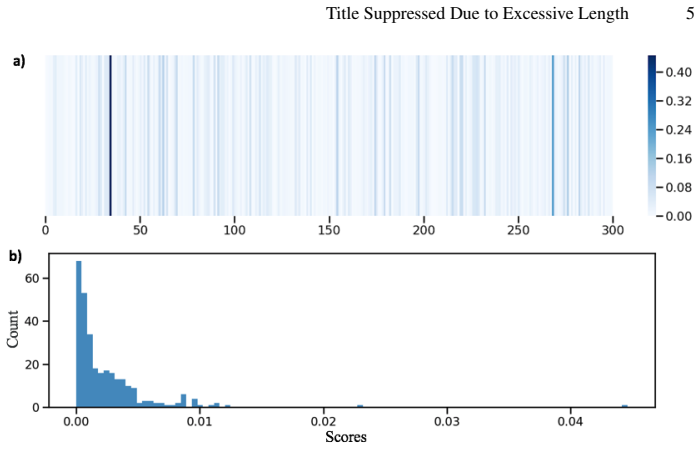
The carrying object is the 300x300 weight matrix Wv learned by the autoregressive valence-prediction model, used as a linear projection from raw GloVe vectors into the emotion space. The same matrix feeds the paper's dimension-scoring algorithm, which combines Wv with the output-layer weight across dimensions and ranks the 300 dimensions by emotional expressivity, isolating the 34th dimension as the strongest; the top two such dimensions already separate unseen positive and negative words drawn from an affective word list. The claim that emotion arithmetic is preserved rests on cosine similarity measured in this Wv-projected space.
What would settle it
Retrain the projection on valence ratings with the temporal order of each transcript shuffled, or on random ratings, and recompute the Joy + Trust versus Love similarity; if the .36 self-similarity and -.19 opposition to Remorse survive a chance-trained projection, the reported emotion arithmetic is not evidence of an emotion space.
Extended reading notes
Core claim
The paper's central claim is stated directly: through the proposed emotion space, arithmetic of emotions is preserved in the word vectors. Concretely, when GloVe vectors are projected with the learned matrix, the vector sum Joy + Trust behaves like Love: in raw GloVe the cosine self-similarity of this constructed Love vector is only .10, while after projection it rises to .36, and its similarity to the opposite feeling Remorse drops to -.19. The same comparisons across eight EmoLex emotion categories show that same-valence emotion pairs move closer together in the projection while opposite-valence pairs separate, which the paper reads as evidence that the projected space disentangles emotions better than raw GloVe alone.
Load-bearing premise
The load-bearing premise is that a matrix learned to predict positive-versus-negative valence ratings produces a space where all eight basic emotion categories and their vector sums are meaningfully positioned, rather than merely reflecting one good-bad axis.
Editorial extensions
If this is right
- Emotion words can be placed on a continuous affective map directly from embeddings, without requiring hand-built sentiment lexicons for each target domain.
- Missing or compound emotion labels can be generated by adding basic emotion vectors; the study constructs Love, Optimism, Submission, and Awe from pairs of EmoLex emotion vectors.
- A single valence-trained projection improves separation of same-valence emotion pairs, so polarity-sensitive downstream tasks may benefit from projecting embeddings before classification.
- Because only a few embedding dimensions carry most emotional signal, emotion models could be made sparser and more interpretable by attending to those dimensions.
- The clustering result on out-of-sample words suggests the projection transfers beyond the narrative training vocabulary.
Reading between the lines
- The paper does not test whether the projection separates emotions that share valence, such as Joy versus Trust versus Anticipation; a natural extension would measure intra-valence separation to see whether the emotion space is more than a one-dimensional good-bad axis.
- If the same arithmetic survives in other distributional embedding families, including context-sensitive embeddings, it would suggest emotion compositionality is a general property of distributional semantics rather than a quirk of GloVe; this is testable with the paper's projection recipe.
- A practical extension the authors do not pursue is using the emotion directions for controlled text generation or rewriting, where adding a Joy direction to a sentence embedding would be expected to shift its perceived affect.
Signed reviews
Editorial analysis
A structured set of objections, weighed in public.
Referee Report
Summary. The paper proposes a method for probing emotions in GloVe word embeddings. The authors train an autoregressive linear model to predict continuous valence ratings from the Stanford Emotional Narratives Dataset (SEND), then interpret the learned weights to rank GloVe dimensions by emotional importance. They project GloVe vectors through the learned matrix Wv to define an 'emotion space,' visualize word clusters by polarity, and evaluate whether EmoLex emotion categories are 'disentangled' in this space. Their main claim is that the projected space preserves Plutchik-style emotion arithmetic, e.g., Love = Joy + Trust, with similarity between the constructed Love vector and the Love centroid rising from 0.10 in raw GloVe to 0.36 in the projected space, while similarity to the opposite feeling Remorse falls to -0.19.
Significance. If the central claim were established, the paper would offer a simple, interpretable linear projection for emotion semantics in word embeddings, with potential applications in affective NLP. The manuscript is clearly written, uses public datasets (SEND, EmoLex, GloVe, LIWC), reports model performance in terms of CCC, and makes its scoring algorithm explicit (Alg. 1). These are genuine strengths. However, the key empirical claims are not yet secured: the projection is trained solely on valence, no null or control model is tested, and the evaluation lacks error bars or significance tests. The manuscript is best seen as a preliminary study whose headline claim outruns the evidence, but the gap is addressable with additional controls and statistical reporting.
major comments (5)
- [Sec. 6.4, Fig. 4] The central claim that 'arithmetic of emotions is preserved in the word vectors' is not supported against the simplest alternative explanation: Wv is trained only to predict valence on SEND (Eqs. (3)-(5)), and Plutchik's categories are strongly valenced. A projection that reweights dimensions by valence importance will tend to increase within-valence similarity and decrease cross-valence similarity, which is exactly the block structure in Fig. 3 and the Love versus Remorse separation in Fig. 4. The report gives no random-projection baseline, no permutation test, and no comparison to a map fitted on a non-emotional target. As written, the reported 0.10-to-0.36 rise and -0.19 opposite-feeling similarity cannot be attributed to emotion arithmetic rather than to valence reweighting. Please add at least one control: a random projection matched in scale, a permutation of Wv's rows, or a projection fitted to a non-emotional regression target, and report whether the effect size changes.
- [Sec. 6.3, Eq. (3)] There is an unresolved inconsistency in the definition of the projection. Eq. (3) defines Wv as a 300x300 matrix with the output o_t in R^{300}, while Sec. 6.3 says the projection is computed by 'element-wise multiplication of the weight Wv' with raw word vectors. If the actual operation is a per-dimension scaling, the projected space is even more clearly a single valence reweighting, and the interpretation of Wv as a general emotion geometry is weakened. Please specify exactly whether the projection is a full linear map or a diagonal scaling, and correct the dimension of the bias term in Eq. (3) (bh is given as R^{600x300} but should be compatible with the 300-dimensional output). This point is load-bearing because the 'emotion space' is defined by the projection matrix.
- [Secs. 6.3-6.4] The quantitative results are reported as point estimates with no variance or significance testing. The analysis says word pairs were 'randomly selected' and 'average cosine similarity scores' were computed, but there is no standard error, confidence interval, bootstrap, or significance test on the reported differences (e.g., 0.10 to 0.36 or -0.19). Because the number of word pairs and the sampling procedure are not described precisely, the reader cannot tell whether these differences are stable or would be expected from random sampling within EmoLex. Please report the number of pairs, the sampling procedure, and uncertainty measures, and provide a permutation or bootstrap test for the key comparisons.
- [Sec. 6.2, Fig. 1] The 2D visualization in Fig. 1 selects the top 19 words 'ranked by their gradients of forward propagation' using the model's own scoring, and the top 2 dimensions are also selected by the same model. This selection procedure introduces a circularity: the words and dimensions are chosen to be separable by the model's weights, so the resulting cluster separation is expected by construction. To support the claim that emotional polarity is discoverable from GloVe dimensions, the evaluation should use an independent or pre-specified set of words (e.g., all LIWC emotion words, or a held-out list) and should report the separation achieved by the same two dimensions on words not used in selection.
- [Sec. 6.1, Alg. 1] The claim that 'only a few dimensions of the word vectors contributed to expressing emotions' relies on an ad-hoc score defined as abs(sum_i Wv_i * Wo_i) and on the assumption that individual GloVe dimensions are separately meaningful. This assumption is not justified in the paper and is known to be questionable for dense embeddings such as GloVe, where semantic information is distributed across dimensions. Please provide a validity check for the dimension-scoring method, for example by ablating the top-ranked dimensions from the word vectors and measuring the change in valence prediction, or by comparing the selected dimensions against a random selection in a prediction task. Without such a check, the 'important dimension' finding is not established.
minor comments (6)
- [Abstract and Sec. 6.4] There is a typo in the abstract: 'with the the embedded vector' should read 'with the embedded vector.'
- [Sec. 4] The text says GloVe were 'pre-trained on wikipages'; please give the exact GloVe version and corpus (e.g., Wikipedia 2014 + Gigaword 5, 300d).
- [Fig. 2] The two panels of Fig. 2 are not described in the caption; please add enough caption text to make the heatmap and the score distribution self-explanatory.
- [Sec. 6.3] The phrase 'element-wise multiplication of the weight Wv' is ambiguous; if it is meant as a matrix-vector product, the text should say so, and if it is a Hadamard product, the dimension of Wv should be stated accordingly.
- [Eq. (3)] The bias vector bh is declared as R^{600x300}; it should be a vector of dimension 300 (or as consistent with the equation's output). Please correct the notation.
- [References] Reference [12] is marked 'Invited Revision to Journal' and appears to be unpublished; please update to the published version or give a preprint DOI.
Circularity Check
One non-central selection step is circular; the EmoLex emotion-space evaluation is external but valence-confounded.
-
fitted input called prediction
[Sec. 6.2, Fig. 1]
"We used out-of-sample words from LIWC 2007 [14] from which we selected top 19 words ranked by their gradients of forward propagation for positive and negative polarities, respectively. Figure 1 shows that words with positive meaning are well separated from words with negative meaning in this space."
The positive/negative LIWC words are chosen by ranking each word's gradient in the already-trained valence model, and the 2-d plot uses the same model's top-scoring dimensions (Alg. 1). Thus the separation in Fig. 1 is an artifact of the selection criterion: the selected words are, by construction, extremes of the model's valence signal, so re-plotting them in model-derived coordinates cannot fail to show polarity separation. The paper presents this as evidence that 'words can be clustered by emotional polarity,' but the clustering was induced by the same model used to evaluate it rather than discovered independently.
full rationale
The paper's central projection claim (Secs. 6.3-6.4) is not definitionally circular: Wv is trained on SEND valence ratings (Eqs. 3-5), while the disentanglement and emotion-arithmetic tests use EmoLex/Plutchik categories, a benchmark external to the training labels. The SEND dataset and CCC metric are introduced via self-citations ([12], [19]), but these are ordinary dataset/method citations and are not the load-bearing step that makes the central claim true. The one clear circular step is in Sec. 6.2: the LIWC words displayed in Fig. 1 are selected by the model's own gradients and then projected using the same model's dimensions, so the resulting polarity clustering is forced by the selection. The main emotion-arithmetic result has a genuine correctness risk rather than a circularity: because Wv is a valence-trained projection and EmoLex categories are strongly valenced, the reported Love/Remorse separation and within-positive similarity increases may be valence reweighting, but this is a missing-control/interpretation problem, not an identity with the training target.
Assumptions & free parameters
free parameters (3)
- sigma (autoregressive smoothing weight) =
0.84
- Projection matrix Wv =
Learned 300x300 matrix
- Top-2 dimension selection and top-19 word selection =
2 and 19
assumptions (4)
- ad hoc to paper GloVe dimensions are individually meaningful, so ranking them by model weights identifies emotion-relevant dimensions.
- domain assumption The valence-trained projection Wv transfers to all eight discrete Plutchik emotions.
- domain assumption Plutchik's wheel of emotions, e.g. Joy+Trust=Love, is an appropriate ground truth for embedding arithmetic.
- domain assumption SEND continuous valence ratings, interpolated per word, are reliable enough to train an interpretable emotion projection.
invented entities (1)
-
Emotion space (projected vector space defined by Wv)
Cite this review
Pith. "Pith review of Disentangling Latent Emotions of Word Embeddings on Complex Emotional Narratives." pith.science (2026). https://pith.science/paper/A7HDM2X2
@misc{pith2026190807817,
  author       = {Pith},
  title        = {Pith review of: Disentangling Latent Emotions of Word Embeddings on Complex Emotional Narratives},
  year         = {2026},
  howpublished = {\url{https://pith.science/paper/A7HDM2X2}},
  note         = {Machine review of arXiv:1908.07817}
}
read the original abstract
Word embedding models such as GloVe are widely used in natural language processing (NLP) research to convert words into vectors. Here, we provide a preliminary guide to probe latent emotions in text through GloVe word vectors. First, we trained a neural network model to predict continuous emotion valence ratings by taking linguistic inputs from Stanford Emotional Narratives Dataset (SEND). After interpreting the weights in the model, we found that only a few dimensions of the word vectors contributed to expressing emotions in text, and words were clustered on the basis of their emotional polarities. Furthermore, we performed a linear transformation that projected high dimensional embedded vectors into an emotion space. Based on NRC Emotion Lexicon (EmoLex), we visualized the entanglement of emotions in the lexicon by using both projected and raw GloVe word vectors. We showed that, in the proposed emotion space, we were able to better disentangle emotions than using raw GloVe vectors alone. In addition, we found that the sum vectors of different pairs of emotion words successfully captured expressed human feelings in the EmoLex. For example, the sum of two embedded word vectors expressing Joy and Trust which express Love shared high similarity (similarity score .62) with the embedded vector expressing Optimism. On the contrary, this sum vector was dissimilar (similarity score -.19) with the the embedded vector expressing Remorse. In this paper, we argue that through the proposed emotion space, arithmetic of emotions is preserved in the word vectors. The affective representation uncovered in emotion vector space could shed some light on how to help machines to disentangle emotion expressed in word embeddings.
Figures


Figures from the paper (1 more)

Reference graph
Works this paper leans on
-
[1]
In: Joint European conference on machine learning and knowledge discov- ery in databases
Bordes, A., Weston, J., Usunier, N.: Open question answering with weakly supervised em- bedding models. In: Joint European conference on machine learning and knowledge discov- ery in databases. pp. 165–180. Springer (2014)
work page 2014
-
[2]
In: Proceedings of the IEEE conference on computer vision and pattern recogni- tion
Donahue, J., Anne Hendricks, L., Guadarrama, S., Rohrbach, M., Venugopalan, S., Saenko, K., Darrell, T.: Long-term recurrent convolutional networks for visual recognition and de- scription. In: Proceedings of the IEEE conference on computer vision and pattern recogni- tion. pp. 2625–2634 (2015)
work page 2015
-
[3]
In: Proceedings of the 2015 ACM on International Conference on Multimodal Interaction
Ebrahimi Kahou, S., Michalski, V ., Konda, K., Memisevic, R., Pal, C.: Recurrent neural net- works for emotion recognition in video. In: Proceedings of the 2015 ACM on International Conference on Multimodal Interaction. pp. 467–474. ACM (2015)
work page 2015
-
[4]
Faruqui, M., Dyer, C.: Improving vector space word representations using multilingual cor- relation. In: Proceedings of the 14th Conference of the European Chapter of the Association for Computational Linguistics. pp. 462–471 (2014)
work page 2014
-
[5]
arXiv preprint arXiv:1711.02281 (2017)
Gu, J., Bradbury, J., Xiong, C., Li, V .O., Socher, R.: Non-autoregressive neural machine translation. arXiv preprint arXiv:1711.02281 (2017)
arXiv 2017
-
[6]
Ji, Y ., Eisenstein, J.: Representation learning for text-level discourse parsing. In: Proceedings of the 52nd Annual Meeting of the Association for Computational Linguistics (V olume 1: Long Papers). vol. 1, pp. 13–24 (2014)
work page 2014
-
[7]
arXiv preprint arXiv:1506.01066 (2015)
Li, J., Chen, X., Hovy, E., Jurafsky, D.: Visualizing and understanding neural models in nlp. arXiv preprint arXiv:1506.01066 (2015)
arXiv 2015
-
[8]
IEEE Transactions on Affective Computing 8(4), 443–456 (2017)
Li, M., Lu, Q., Long, Y ., Gui, L.: Inferring affective meanings of words from word embed- ding. IEEE Transactions on Affective Computing 8(4), 443–456 (2017)
work page 2017
Show all 19 references
-
[9]
Biometrics pp
Lin, L.I.K.: A concordance correlation coefficient to evaluate reproducibility. Biometrics pp. 255–268 (1989)
1989
-
[10]
arXiv preprint arXiv:1301.3781 (2013)
Mikolov, T., Chen, K., Corrado, G., Dean, J.: Efficient estimation of word representations in vector space. arXiv preprint arXiv:1301.3781 (2013)
2013 arXiv
-
[11]
Proceedings of the National Academy of Sciences 114(37), 9843–9847 (2017) Title Suppressed Due to Excessive Length 9
Morelli, S.A., Ong, D.C., Makati, R., Jackson, M.O., Zaki, J.: Empathy and well-being cor- relate with centrality in different social networks. Proceedings of the National Academy of Sciences 114(37), 9843–9847 (2017) Title Suppressed Due to Excessive Length 9
2017
-
[12]
Ong, D.C., Wu, Z., Zhi-Xuan, T., Reddan, M., Kahhale, I., Mattek, A., Zaki, J.: Modeling emotion in complex stories: the Stanford Emotional Narratives Dataset (Invited Revision to Journal)
-
[13]
Cognition 143, 141–162 (2015)
Ong, D.C., Zaki, J., Goodman, N.D.: Affective cognition: Exploring lay theories of emotion. Cognition 143, 141–162 (2015)
2015
-
[14]
Mahway: Lawrence Erlbaum Associates 71(2001), 2001 (2001)
Pennebaker, J.W., Francis, M.E., Booth, R.J.: Linguistic inquiry and word count: Liwc 2001. Mahway: Lawrence Erlbaum Associates 71(2001), 2001 (2001)
2001
-
[15]
In: Proceedings of the 2014 conference on empirical methods in natural language processing (EMNLP)
Pennington, J., Socher, R., Manning, C.: Glove: Global vectors for word representation. In: Proceedings of the 2014 conference on empirical methods in natural language processing (EMNLP). pp. 1532–1543 (2014)
2014
-
[16]
In: Theories of emotion, pp
Plutchik, R.: A general psychoevolutionary theory of emotion. In: Theories of emotion, pp. 3–33. Elsevier (1980)
1980
-
[17]
Behavioral and Brain Sciences 25(1), 1–20 (2002)
Preston, S.D., De Waal, F.B.: Empathy: Its ultimate and proximate bases. Behavioral and Brain Sciences 25(1), 1–20 (2002)
2002
-
[18]
In: The Thirtieth International Flairs Conference (2017)
Seyeditabari, A., Zadrozny, W.: Can word embeddings help find latent emotions in text? preliminary results. In: The Thirtieth International Flairs Conference (2017)
2017
-
[19]
IEEE Affective Computing and Intelligent Interaction (ACII) (2019)
Wu, Z., Zhang, X., Zhi-Xuan, T., Zaki, J., Ong, D.C.: Attending to emotional narratives. IEEE Affective Computing and Intelligent Interaction (ACII) (2019)
2019
Reviewed August 14, 2026 · model on record in the stance chip above.
Discussion (0). Continue with ORCID to comment.