REVIEW 3 major objections 4 minor 44 references
Multilayered Vortices
T0 review · 3 major / 4 minor · reviewed 2026-08-14 · deepseek-v4-flash
Pith's one-line read In Maxwell-Higgs theory, adding a second symmetry turns the standard single-hump vortex into a stable multilayered structure of concentric rings while preserving flux and topological charge.
desk verdict A solid model-building paper showing how dielectric-function oscillations give multilayered BPS vortices, but a load-bearing typo in Eq. (7) and a Lorentz-breaking radial potential need fixing before I'd trust the details. read the letter →
The pith
A machine-rendered reading of the paper's core claim, the machinery that carries it, and where it could break.
The reading
What carries the argument
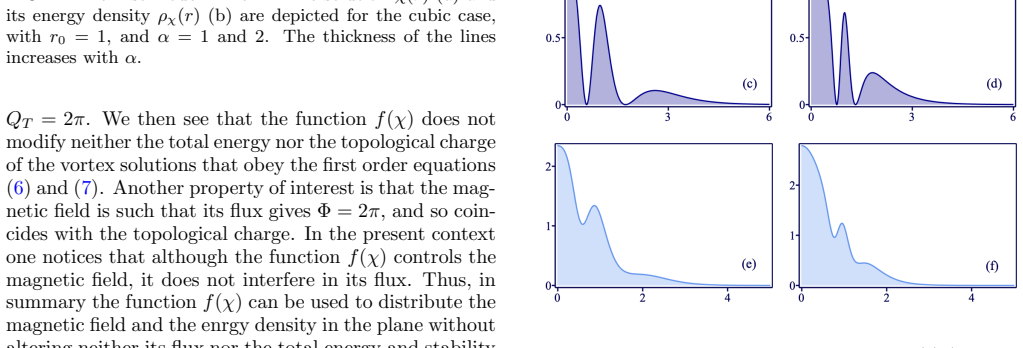
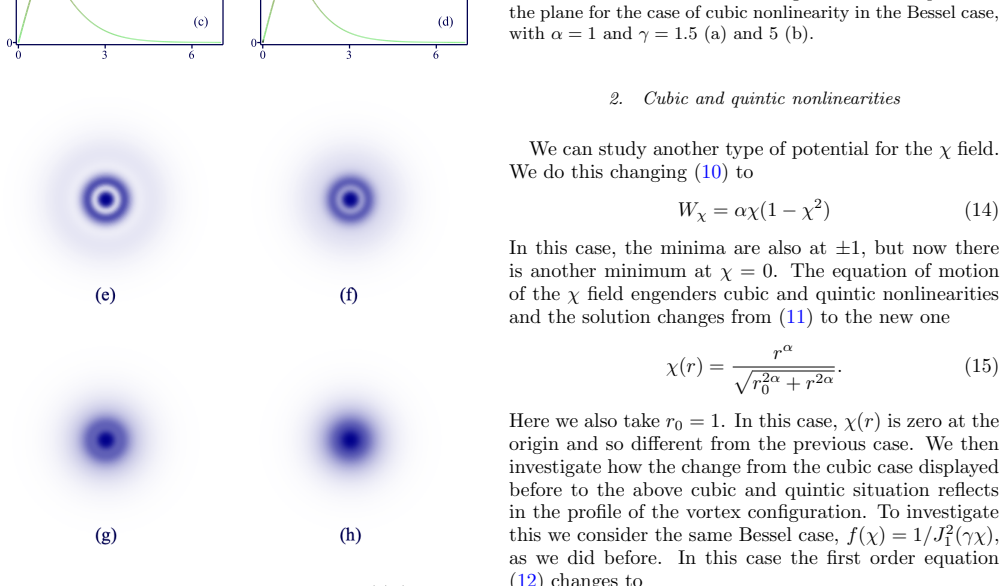
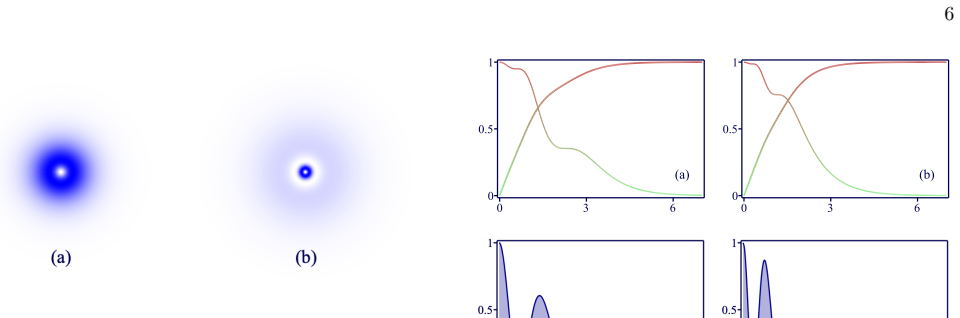
The engine is a pair of first-order energy-minimizing equations obtained from a potential engineered with an auxiliary function W(χ) in the first model and with a second vortex sector in the second model. The magnetic-permeability function f(χ) = (1+$λ^{2}$)/($λ^{2}$+$cos^{2}$(mπχ)), or a Bessel-square form 1/$J_1^{2}$(γχ), is the dial: it multiplies the magnetic-field term in the energy, redistributing B(r) and the energy density into rings while leaving the flux and topological charge untouched. The kink-like profile of χ, or the auxiliary vortex profile in the second model, supplies the spatial constriction that entraps the original vortex.
What would settle it
Numerically solve the full second-order equations of motion, without imposing the first-order equations, for the U(1) × Z2 model with the 1/$r^{2}$ potential term removed; if no finite-energy shell-structured vortex survives, the multilayered form comes from the external radial background rather than from the symmetry enhancement. For the U(1) × U(1) model, a calculation of the fluctuation spectrum about the numerical solution at q = 0.5, m = 2 would settle the stability claim: a negative eigenvalue would disprove it.
Extended reading notes
Core claim
The paper establishes that a relativistic Maxwell-Higgs vortex, normally a single hump, can be reshaped into a central core surrounded by concentric shells by enlarging the gauge symmetry from U(1) to U(1) × Z2 or U(1) × U(1). In the first construction a neutral real scalar field χ, governed by the Z2 symmetry, forms a kink whose profile is fed into a magnetic-permeability function f(χ); in the second, a second complex scalar field with its own gauge field forms an auxiliary Nielsen-Olesen vortex. In both cases first-order energy-minimizing equations give solutions that are linearly stable, and the magnetic field displays a central disk with 2m rings (first model) or m rings (second model), with sizes controlled by m, α, q, and λ. In the first model the total energy depends on α but not on m or λ, while in the second model the total energy is fixed at 2π(1+$w^{2}$) and independent of q and m; in both models the magnetic flux stays Φ = 2πn and the topological charge stays Q_T = 2πn.
Load-bearing premise
The first model's multilayered vortices depend on accepting a potential with an explicit 1/$r^{2}$ term that makes the theory depend on the radial coordinate and breaks Lorentz invariance; if that term is not an acceptable way to model a geometric constriction, the U(1) × Z2 construction does not by itself entrap the vortex.
Editorial extensions
If this is right
- The multilayered vortex solutions inherit linear stability from the first-order energy minimization, so the shell structure is not a small-fluctuation artifact.
- Adding shells does not change the vortex quantum numbers: the magnetic flux stays 2πn and the topological charge stays 2πn in both models.
- In the U(1) × Z2 model, m fixes 2m outer rings and α sets the radius of the central disk, while λ interpolates between the layered profile and the ordinary Nielsen-Olesen vortex.
- In the U(1) × U(1) model, the auxiliary vortex shrinks or expands with q, producing m rings around the core, and both m and q leave the total energy fixed.
- Choosing different permeability functions, such as cosine-squared or Bessel-square modulations, redistributes the magnetic field into different ring patterns with identical energy and flux.
Reading between the lines
- If the same first-order construction is applied to Chern-Simons vortices, a testable prediction is that the electric-charge constraint will force the multilayered rings to carry a radially varying charge density alongside the magnetic shells.
- The magnetic-permeability modulation used here can be exported to nonlinear Schrödinger and Gross-Pitaevskii equations as a spatially periodic trapping potential, which would produce analogous ring-layered vortices in optical or condensate systems.
- Because the first model relies on a 1/r^2 potential term, a sharper conceptual test is to compare it with a pure U(1) model carrying only that radial potential; if the rings persist without the Z2 sector, the discrete symmetry is not the operative entrapment mechanism.
Signed reviews
Editorial analysis
A structured set of objections, weighed in public.
Referee Report
Summary. The manuscript proposes two Maxwell-Higgs models with enhanced symmetry, U(1)×Z2 and U(1)×U(1), in which a dielectric/permeability function f(χ) couples the additional scalar field to the Maxwell term. For static rotationally symmetric configurations the authors derive first-order BPS equations, choose f(χ) with oscillatory dependence on the kink profile χ(r), and integrate the equations numerically. They find vortex solutions whose magnetic field and energy density form a central core surrounded by rings, while the total energy, magnetic flux, and topological charge remain those of the standard Nielsen-Olesen vortex. In the second model a second gauge field provides a Nielsen-Olesen profile h_st(qr) that controls the ring structure through the argument 2πm h_st.
Significance. The construction is potentially interesting as a model-building tool: it suggests a route to redistribute the magnetic field and energy density of a BPS vortex into a multilayered profile without changing the quantized flux, topological charge, or BPS energy. The first-order framework with explicit analytic kink profiles is a practical strength, and the numerical figures do demonstrate the claimed shell structures. However, the manuscript contains a systematic reciprocal inconsistency in the displayed first-order BPS equations, and the first model relies on an explicitly radial-dependent potential that must be justified as an external constriction. Both issues affect the reliability of the central claim and require attention.
major comments (3)
- [II.A, Eq. (7); II.B, Eq. (22)] The displayed first-order equations for a(r) are inconsistent with the quoted f(χ) definitions and with the equations actually solved. For f(χ)=(1+λ²)/(λ²+cos²(mπχ)), Eq. (7) as printed gives −a′/r=(1−g²)/cos²(mπχ) at λ=0, whereas Eq. (12) and Figs. 2–4 are based on −a′/r=cos²(mπχ)(1−g²), the reciprocal. The same mismatch appears for the Bessel case (Eq. (13) versus the stated f=1/J₁²) and for the second model (Eq. (25) versus Eq. (22)). Completion of squares in Eq. (4) with the potential (5) shows that the BPS equation should be −a′/r=(1−g²)/f(χ), and similarly −a′/r=(1−g²)/f(h) in Eq. (22). Since no code or data are provided, the paper leaves unclear which system was integrated. This must be corrected and the numerical results confirmed against the corrected equations.
- [II.A, Eq. (5)] The first model's potential contains an explicit 1/r² term, W_χ²/(2r²), which makes the field theory explicitly coordinate-dependent and breaks Lorentz/translation invariance. The authors motivate this as modeling a geometric constriction, but the text also claims that the Z2 symmetry is responsible for entrapping the vortex. As it stands, the confinement mechanism in Model 1 relies on the externally imposed radial background rather than on the Z2 symmetry alone. The two effects should be disentangled and the claim stated more carefully. This is not a problem for the U(1)×U(1) model of II.B, which is Lorentz invariant.
- [II.A, Figs. 2–4; II.B, Figs. 8–10] The ring count is a direct consequence of choosing f(χ) to be an oscillating function with m oscillations across the kink profile, not an emergent property of the dynamics. The authors are explicit about this in most places, but the discussion and abstract present the multilayered structure as the main result of the symmetry enhancement. I recommend rephrasing these statements so that the construction is described as a family of models in which the oscillatory permeability is chosen by hand, rather than as a prediction of ring numbers.
minor comments (4)
- [II.B, below Eq. (23)] The sentence 'allows us to write the energy density (4) in the form' should refer to Eq. (20), which is the energy density of the second model.
- [II.A, after Eq. (16)] The phrase 'the first order equation (12)' should be 'the first order equations (12)' or 'the first order equation for a(r)', since Eq. (12) contains two equations.
- [Numerical procedure] The numerical solutions are presented without any description of the method, grid, or boundary handling at large r. A short numerical-procedure paragraph would improve reproducibility.
- [Acknowledgments] There is a typo in 'suported'; it should read 'supported'.
Circularity Check
Ring count in both models is put in by the chosen cos²(mπχ) dielectric function; the multilayered 'prediction' reduces to the ansatz, though flux/energy/topological invariants are independent.
-
self definitional
[Sec. II.A.1, first model, around Eq. (12) and Figs. 2–4]
"We use the above solution as a source for the function that controls the magnetic permeability, which we take as f(χ) = (1 + λ²)/(λ² + cos²(mπχ)), m∈ N and λ∈ R. ... We see that the magnetic field of the vortex engender substructures associated to these parameters: a single central disk and 2m external rings."
The number of rings is an input, not a derived consequence. With the corrected first-order form, Eq. (12) makes B = −a′/r = cos²(mπχ(r))(1−g²), and χ(r) is a monotone kink scanning [−1,1]. The function cos²(mπχ) has exactly 2m zeros by definition, so the reported 'single central disk and 2m external rings' is a restatement of the chosen f(χ). The U(1)×Z2 symmetry provides the kink profile, but the ring count is fixed by the ansatz for the magnetic permeability, not by the symmetry enhancement or by any independent vorticity argument.
-
self definitional
[Sec. II.B, second model, Eq. (25) and Fig. 10]
"To investigate how the aforementioned solutions modify the other vortex structure, we also consider f(|χ|) = (1 + λ²)/(λ² + cos²(2πm|χ|)), m∈ N and λ∈ R. ... In Fig. 10, we depict the magnetic field in the plane, displaying a central disk and m rings around it, which are also controlled by q."
Again the ring structure is chosen by hand. Equation (25) gives B = −a′/r = cos²(2πm h_st(qr))(1−g²), where h_st(qr) is the standard Nielsen–Olesen profile running from 0 to 1. The zeros of cos²(2πm h_st) are the rings, and their number is fixed by the integer m inserted into f(|χ|). Thus the 'central disk and m rings' is geometrically equivalent to the chosen dielectric function; it is not an emergent prediction of the U(1)×U(1) enhancement. The invariant flux/energy statements are independent of this ring structure, but the multilayered shape itself is an ansatz output.
full rationale
The derivation contains two logically separate parts. The BPS energy bound, flux quantization, and topological-charge invariance are genuine: Eqs. (6)–(7) imply E = 2π + 2π|W(χ(∞))−W(χ(0))| independent of f(χ), and QT = 2π follows from the boundary conditions. These statements are self-contained and would not by themselves raise the circularity score. The advertised multilayered vortex, however, is not an emergent consequence of the enhanced symmetry: the authors choose f(χ) with m oscillations (cos²(mπχ) in the first model, cos²(2πm|χ|) in the second, and J1² Bessel analogues) and then solve first-order equations in which B = −a′/r is proportional to the same oscillating function. Hence the observed 'central disk plus 2m rings' or 'central disk plus m rings' is, by construction, the number of oscillations put into f; it is an ansatz output, not a prediction. The invariant flux/energy results are independent of the ring structure but do not rescue the ring-count claim from circularity. I also note that, as printed, Eq. (7) has −a′/r = (1−g²)f(χ), while Eqs. (12), (13), and (25) use the reciprocal; completing the square for the potential in Eq. (5) gives the reciprocal, so Eq. (7) appears to contain a typo. That is a correctness issue, not circularity. No load-bearing self-citation was found: the BPS framework cited from the authors' earlier work is directly verifiable from the Lagrangian and does not rest on an unproved uniqueness claim.
Assumptions & free parameters
free parameters (6)
- alpha =
1, 2
- r0 =
1
- m =
1, 2, 3
- lambda =
0, 0.5, 1, 2, 4
- gamma =
1.5, 5
- q =
0.5, 1
assumptions (5)
- standard math Bogomolny bound for the energy is saturated by the first-order equations (6)-(7) and (22)-(23).
- domain assumption Regular finite-energy solutions to the first-order ODEs exist for the chosen f(chi).
- domain assumption The radially symmetric ansatz (2) gives the minimum-energy vortex.
- domain assumption Minimum-energy BPS solutions are linearly stable.
- ad hoc to paper An explicit 1/r^2 potential term is an acceptable way to model a geometric constriction.
Cite this review
Pith. "Pith review of Multilayered Vortices." pith.science (2026). https://pith.science/paper/7PNDXN5S
@misc{pith2026190807871,
  author       = {Pith},
  title        = {Pith review of: Multilayered Vortices},
  year         = {2026},
  howpublished = {\url{https://pith.science/paper/7PNDXN5S}},
  note         = {Machine review of arXiv:1908.07871}
}
read the original abstract
Vortices are localized planar structures that attain topological stability and can be used to describe collective behavior in a diversity of situations of current interest in nonlinear science. In high energy physics, vortices engender integer winding number and appear under the presence of a local Abelian symmetry. In this work we study vortices in a Maxwell-Higgs model, in which the gauge symmetry is enhanced to accommodate additional symmetries, responsible to generate localized structures to be used to constrain the vortex structure in a given region in the plane. The main aim is to examine how the vortex profile changes when it inhabits a limited region, an issue of current interest to the study of vortices at the nanometric scale.
Figures


Figures from the paper (6 more)



Reference graph
Works this paper leans on
-
[1]
Cubic nonlinearity Let us investigate the case in which the χ field engen- ders cubic nonlinearity in the equation of motion. For the model under investigation, this is implemented with the choice W (χ) =αχ−αχ3/3, such that Wχ =α(1−χ2), (10) which vanishes at the values ±1, determining the min- ima and the values χ0 and χ∞ to be used to define the solution ...
-
[2]
Cubic and quintic nonlinearities We can study another type of potential for the χ field. We do this changing (10) to Wχ =αχ(1−χ2) (14) In this case, the minima are also at ±1, but now there is another minimum at χ = 0. The equation of motion of the χ field engenders cubic and quintic nonlinearities and the solution changes from (11) to the new one χ(r) = rα...
-
[3]
H. B. Nielsen and P. Olesen, Nucl. Phys. B 61, 45 (1973)
1973
-
[4]
A. A. Abrikosov, Zh. Eksp. Teor. Fiz. 32, 1442 (1957); Sov. Phys. JETP 5, 1174 (1957)
work page 1957
-
[5]
V. L. Ginzburg and L. D. Landau, Zh. Eksp. Teor. Fiz. 20, 1064 (1950)
1950
- [6]
-
[7]
and by nanoscale channels [8], which can greatly al- ter the phase diagram by stabilizing broken symmetry phases not observed in bulk samples. Vortices also ap- pear in specific arrangements of living systems [9, 10], in particular in small droplets of dense bacterial suspen- sions [9], where the influence of global confinement on collective motion was also ...
work page Pith review arXiv 1908
-
[8]
Shinjo, T
T. Shinjo, T. Okuno, R. Hassdorf, K. Shigeto, and T. Ono, Science 289, 930 (2000)
2000
Show all 44 references
-
[9]
Wachowiak, J
A. Wachowiak, J. Wiebe, M. Bode, O. Pietzsch, M. Mor- genstern, and R. Wiesendanger, Science 289, 577 (2002)
2002
-
[10]
L. V. Levitin, R. G. Bennett, A. Casey, B. Cowan, J. Saunders, D. Drung, Th. Schurig, and J. M. Parpia, Sci- ence 340, 841 (2013)
2013
-
[11]
J. J. Wiman and J. A. Sauls, Phys. Rev. B 92, 144515 (2015)
2015
-
[12]
Wioland, F
H. Wioland, F. G. Woodhouse, J. Dunkel, J. O. Kessler, and R. E. Goldstein, Phys. Rev. Lett. 110, 268102 (2013)
2013
-
[13]
Wioland, F
H. Wioland, F. G. Woodhouse, J. Dunkel, and R. E. Goldstein, Nat. Phys. 12, 341 (2016)
2016
-
[14]
U. K. R¨ ossler, A. N. Bogdanov, and C. Pfleiderer, Nature 442, 797 (2006)
2006
-
[15]
Janson, I
O. Janson, I. Rousochatzakis, A. A. Tsirlin, M. Belesi, A. A. Leonov, U. K. R¨ oßler, J. van den Brink, and H. Rosner, Nat. Commun. 5, 5376 (2014)
2014
-
[16]
A. Fert, N. Reyren and V. Cros, Nat. Rev. Mater. 2, 17031 (2017)
2017
- [17]
-
[18]
Witten, Nucl
E. Witten, Nucl. Phys. B 249, 557 (1985)
1985
-
[19]
Shifman, Phys
M. Shifman, Phys. Rev. D 87, 025025 (2013)
2013
-
[20]
Bazeia, M.A
D. Bazeia, M.A. Marques, and R. Menezes, Phys Lett. B 780, 485 (2018)
2018
-
[21]
Zhou and M
Y. Zhou and M. Ezawa, Nat. Commun. 5, 4652 (2014)
2014
-
[22]
Jiang, P
W. Jiang, P. Upadhyaya, W. Zhang, G. Yu, M. B. Jungeisch, F. Y. Fradin, J. E. Pearson, Y. Tserkovnyak, K. L. Wang, O. Heinonen, S. G. E. te Velthuis, and A. Homann, Science 349, 283 (2015)
2015
-
[23]
A. F. Sch¨ affer, L. R´ ozsa, J. Berakdar, E. Y. Vedme- denko, and R. Wiesendanger, Communications Physics 2, 72 (2019)
2019
-
[24]
Dzyaloshinsky, J
I. Dzyaloshinsky, J. Phys. Chem. Solids 4, 241 (1958)
1958
-
[25]
Moriya, Phys
T. Moriya, Phys. Rev. 120, 91 (1960)
1960
-
[26]
T. H. R. Skyrme, Nucl. Phys. 31, 556 (1962)
1962
-
[27]
Bazeia, M
D. Bazeia, M. A. Marques, and D. Melnikov, Phys. Lett. B 785, 454 (2018)
2018
-
[28]
Bazeia, J
D. Bazeia, J. Menezes and R. Menezes, Phys. Rev. Lett. 91, 241601 (2003)
2003
-
[29]
Y. V. Kartashov, V. A. Vysloukh, and L. Torner, Phys. Rev. Lett. 94, 043902 (2005)
2005
-
[30]
Bazeia, L
D. Bazeia, L. Losano, M. A. Marques, and R. Menezes, Adv. High Energy Phys. 2019, 3187289 (2019)
2019
-
[31]
L´ opez-Ortega, M
A. L´ opez-Ortega, M. Estrader, G. Salazar-Alvarez, A. G. Roca, and J. Nogu´ es, Phys. Rep. 553, 1 (2015)
2015
-
[32]
Jackiw and E
R. Jackiw and E. Weinberg, Phys. Rev. Lett. 64, 2234 (1990)
1990
-
[33]
Bazeia, M.A
D. Bazeia, M.A. Marques, and Gonzalo J. Olmo, Phys. Rev. D 98, 025017 (2018)
2018
-
[34]
Bazeia, M
D. Bazeia, M. A. Marques, and R. Menezes, Phys. Rev. D 98, 065003 (2018)
2018
-
[35]
Arias, E
P. Arias, E. Ireson, C. Nu nes, and F. Schaposnik, J. High Energy Phys. 1502, 156 (2015)
2015
-
[36]
Jaeckel and A
J. Jaeckel and A. Ringwald, Ann. Rev. Nucl. Part. Sci. 60, 405 (2010)
2010
-
[37]
A. S. Desyatnikov, Y. S. Kivshar, and L. Torner, Optical vortex and vortex solitons. Progress in Optics, Vol. 47, Chapter 5 (North-Holland, 2005)
2005
-
[38]
C. J. Pethick and H. Smith, Bose–Einstein Condensation in Dilute Gases. (Cambridge University Press, 2008)
2008
-
[39]
Garc´ es-Ch´ avez, D
V. Garc´ es-Ch´ avez, D. McGloin, H. Melville, W. Sibbett, and K. Dholakia, Nature 419, 145 (2002)
2002
-
[40]
Y. V. Kartashov, V. A. Vysloukh, and L. Torner, Phys. Rev. Lett. 93, 093904 (2004)
2004
-
[41]
Y. V. Kartashov, A. Ferrando, A. A. Egorov, and L. Torner, Phys. Rev. Lett. 95, 123902 (2005)
2005
-
[42]
M. R. Matthews, B. P. Anderson, P. C. Haljan, D. S. Hall, C. E. Wieman, and E. A. Cornell Phys. Rev. Lett. 83, 2498 (1999)
1999
-
[43]
Theocharis, D
G. Theocharis, D. J. Frantzeskakis, P. G. Kevrekidis, B. A. Malomed, and Y. S. Kivshar, Phys. Rev. Lett. 90, 120403 (2003)
2003
-
[44]
Z.-M. He, L. Wen, Y.-J. Wang, G. P. Chen, R.-B. Tan, C.-Q. Dai, and X.-F. Zhang, Phys. Rev. E 99, 062216 (2019)
2019
Reviewed August 14, 2026 · model on record in the stance chip above.
Discussion (0). Continue with ORCID to comment.