REVIEW 3 major objections 4 minor 50 references
Towards Better Understanding of Spontaneous Conversations: Overcoming Automatic Speech Recognition Errors With Intent Recognition
T0 review · 3 major / 4 minor · reviewed 2026-08-14 · deepseek-v4-flash
Pith's one-line read Fuzzy intent search over ASR lattices finds 25.1% more intents than the top transcript alone.
desk verdict Worth refereeing as an engineering contribution, but the headline 25.1% intent gain is not backed by the reported evaluation, which measures precision only on rescored intents and never quantifies baseline intents lost. read the letter →
The pith
A machine-rendered reading of the paper's core claim, the machinery that carries it, and where it could break.
The reading
What carries the argument
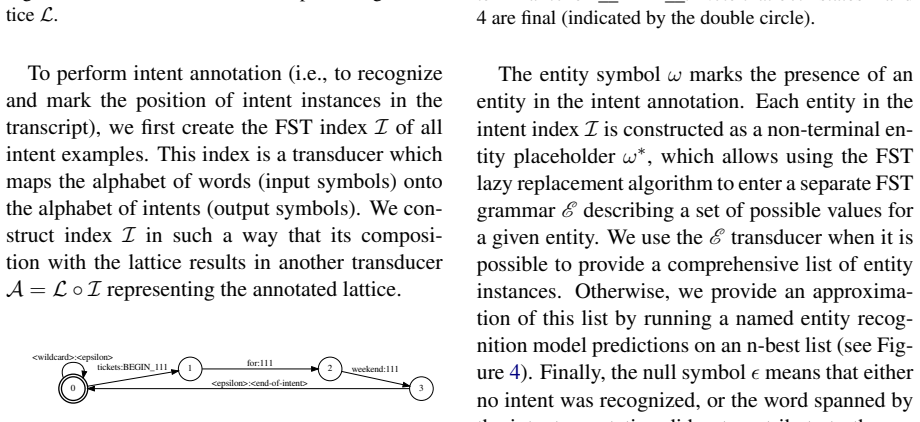
The central objects are the word confusion network lattice $L$, which encodes alternative ASR hypotheses as a graph, and the intent index $I$, a finite state transducer that maps word sequences to intent symbols. Fuzzy matching is enabled by wildcard arcs that accept up to a blank-quota number of filler words, and entities are embedded through non-terminal placeholders expanded by an entity grammar. Composition $L \circ I$ produces an annotated lattice, and a linear-time depth-first pruning pass cuts paths where the blank quota is exceeded. Best-path selection then applies sequential heuristics -- longest intent annotation, most annotations, longest span, then highest original ASR likelihood -- so that semantically important phrases, not raw word probabilities, guide the final transcript.
What would settle it
Run the pipeline on conversations with oracle transcripts from careful human transcription and compare rescored words against the oracle: if the rescored words match the oracle in substantially fewer than 77% of cases, the reported accuracy is not representative. Alternatively, reverse the path-selection heuristic to prefer the shortest intent annotation; if intent recall does not drop below the best-path baseline, the length assumption is not what is driving the 25.1% gain.
Extended reading notes
Core claim
The paper claims that fuzzy intent matching against the lattice recovers intent phrases that the best hypothesis drops. Its algorithm composes a word confusion network with an FST intent index containing wildcard arcs for filler words and non-terminal entity placeholders, prunes paths that exceed a blank quota, and then selects the best transcript variant using intent-aware heuristics: longest annotation, most annotations, longest span, and finally ASR likelihood. Over 70,000 conversations, intent recognition rose from 526,356 to 658,549 recognized intents, with half the intent classes improving by at least 35.7%. Manual evaluation of 500 rescored intents found accuracy monotone in intent length, and the paper therefore recommends that one- and two-word annotations be ignored, yielding an estimated 77% rescoring accuracy.
Load-bearing premise
The load-bearing premise is that a longer matched intent phrase is stronger evidence for a transcript path because it is less likely to occur by chance; the paper states this without a probabilistic model, and the manual accuracy estimate rests on 500 subjectively judged cases with no inter-annotator agreement.
Editorial extensions
If this is right
- Rescoring by intents increases recognized intent coverage from 3.3% to 4.1% of all words across 70,000 conversations, making more conversations available for downstream dialog analytics and compliance monitoring.
- Accuracy scales with intent length; applying a two-word minimum span filter raises estimated rescoring accuracy to 77%, while a four-word minimum would reach 87.7%, giving users a precision-recall dial.
- The method adapts an ASR system to a new domain by supplying an intent example library; no acoustic-model retraining or in-domain speech data is required.
- Because lattice segmentation separates linear and parallel regions, the rescoring cost stays linear in lattice size, so near-real-time call processing is feasible.
Reading between the lines
- The length-based evidence heuristic could be replaced by a formal prior, such as a language-model probability of the intent span; if the heuristic is just a proxy for that prior, ranking by span likelihood instead of length may improve calibration of the rescoring decision.
- The same FST composition could be applied to other pattern-matching tasks on lattices, such as named-entity tagging, disfluency detection, or detecting compliance-sensitive phrases, since none of the core steps are intent-specific.
- The wide per-intent improvement spread, with 20% of intents improving at least 83.5%, suggests the gains are not uniform; analyzing which intent classes benefit most could reveal systematic ASR failure modes worth targeting separately.
- A testable extension is to compare lattice-rescored transcripts against human transcriptions of the same conversations: if rescored words agree with oracle transcripts significantly less often than the 77% estimate, the manual sample of 500 may not represent the full 70k corpus.
Signed reviews
Editorial analysis
A structured set of objections, weighed in public.
Referee Report
Summary. This paper proposes a finite-state-transducer (FST) based intent-indexing and lattice-rescoring method for spontaneous human-human conversations. The system composes a word confusion network (the ASR lattice) with an intent index that supports fuzzy matching via wildcard arcs and blank quotas, then applies a pruning algorithm and a set of path-selection heuristics to choose a rescored transcript biased toward recognized intents. The method is evaluated on more than 70,000 US English phone conversations with a 313-intent library. The central reported result is a 25.1% increase in the total number of recognized intents compared to a best-path baseline (658,549 vs. 526,356). The paper also reports an accuracy estimate of 77% for rescored intents after applying a length>=3 heuristic, based on 500 manually judged examples from the cancellations and refunds domain.
Significance. If the central claim were rigorously supported, this would be a practically valuable contribution: it offers a way to inject domain knowledge into ASR without retraining, operates in near real time, and addresses a real problem in exploiting spontaneous conversation transcripts. The paper's strengths include the novel combination of FST composition with sigma-matchers for fuzzy lattice search, a linear-time pruning algorithm, a large-scale industrial evaluation, and concrete examples of successful rescoring (Table 1). The length-accuracy trend in Table 2 provides some empirical support for the proposed path-selection heuristics. However, the current evaluation does not substantiate the 25.1% figure as a net gain in correct intents, because the raw count increase is not accompanied by precision measurements on the baseline output or on the intents that the method may lose.
major comments (3)
- [Section 4, intent counts] The central claim that the method yields a 25.1% increase in recognized intents is based on raw counts, not on the number of correct intents. Let O be the intents found by both systems, M the intents newly added by the proposed method, and L the intents found by the baseline but lost by the method. The reported increase is M-L=132,193, but the net change in correct intents is p_M*M - p_L*L, where p_M is the precision of newly added intents and p_L is the precision of lost baseline intents. The paper estimates p_M at roughly 0.77 for the rescored subset, but L and p_L are never reported. Without these quantities, the true net effect could be zero or even negative if the method discards a substantial number of high-precision baseline intents. A fair comparison requires measuring precision (or a recall-precision pair) on the full baseline output and the full proposed output, not only on the rescored intents.
- [Section 4, Table 2 and threshold selection] The length>=3 heuristic is introduced after inspecting the accuracy numbers on the same 500 rescored intents that are used to report the 77% figure. Because the threshold is selected post hoc on the evaluation data, the 77% estimate is not a validated out-of-sample accuracy; it is an optimistic fit to the sample. No confidence interval or significance test is reported, and after excluding length-1 and length-2 examples the estimate is based on only 336 examples. The statement that 'every result above 50% indicates an improvement' is also insufficient, because even a high accuracy on newly rescored intents does not account for baseline intents that may be lost, as explained above. The threshold should be validated on held-out data or with a properly defined evaluation protocol.
- [Section 4, manual evaluation sample] The manual evaluation of 500 rescored intents is limited in two ways that affect the reliability of the reported accuracy. First, the sample is drawn from a single domain (cancellations and refunds), so it is unclear whether the length-accuracy pattern transfers to the other domains covered by the 70,000-conversation corpus. Second, the two annotators each labeled 250 disjoint examples, and no inter-annotator agreement is reported, so the consistency of the 'correct intent' judgment is unknown. Additionally, the lenient criterion that counts a technically incorrect rescored word as correct whenever the intended intent is recognized may inflate the accuracy estimate relative to a stricter word-level or intent-level correctness measure. The authors should report agreement statistics and, ideally, sample from multiple domains.
minor comments (4)
- [Section 4, counts] Please clarify whether the reported counts of 658,549 and 526,356 intents already incorporate the length>=3 heuristic, since the text states that the heuristic is used in further experiments immediately before presenting these counts.
- [Section 3.4, heuristics] The probabilistic argument that 'a priori longer intent examples are less likely to appear in the latticeA purely by chance' is stated without a formal model. Table 2 gives some empirical support, but the paper would benefit from an explicit statement of the assumed distribution and from ablation experiments that isolate the contribution of each of the four heuristics (a)-(d).
- [Table 2] The accuracy for length-1 intents is computed from only 25 occurrences; reporting a confidence interval or a significance test would prevent overinterpretation of the 32.0% and 39.5% figures for the shortest intents.
- [Section 3.3, blank quota] The blank quota n is a free parameter of the method, but the paper does not state what value of n was used in the experiments or how sensitive the results are to this choice.
Circularity Check
No derivation-level circularity: the headline count increase is raw lattice-match arithmetic, but the length threshold and 77% accuracy estimate are fit and evaluated on the same 500-annotation sample.
-
fitted input called prediction
[Section 4, Table 2 and following paragraph]
"These results also lead us to a practical heuristic, that an intent annotation which spans only one or two words should not be considered for rescoring. Application of this heuristic results in an estimated accuracy of 77%. We use this heuristic in further experiments."
The length threshold is chosen after inspecting Table 2, which reports accuracy by intent length on the same 500 rescored annotations; the 77% figure is then computed by applying that threshold to the same sample. The threshold is therefore a parameter fit to the evaluation set, and the reported 77% is a within-sample re-description of Table 2 rather than an independent estimate. This is a mild fitted-input-as-prediction loop. However, it affects only the accuracy estimate. The headline 25.1% increase (658,549 vs. 526,356 intents) is an unadjusted count of lattice matches over 70,000 conversations and is not mathematically derived from the 77% estimate, so the central claim is not forced by this loop.
full rationale
The core derivation chain is self-contained: the annotated lattice A = L composed with I is produced by standard finite-state transducer composition and pruning, and the path selection heuristics are evaluated against human judgment of 500 rescored intents rather than against the algorithm's own outputs. The main claim, a 25.1% raw increase in recognized intent matches, is an arithmetic comparison of two counts produced by the same intent library under two decoding strategies; it is not defined in terms of itself. The cited reference to the authors' earlier punctuation work (Zelasko et al., 2018) is contextual and not load-bearing. The paper's unverified inference that 'every result above 50% indicates an improvement' and the lack of precision measurement on baseline intents are evaluation-validity concerns, not circular reductions. The only near-circular element is the post hoc length threshold applied to the same 500 annotations used to estimate its accuracy, which is a minor self-evaluation bias and does not undermine the independence of the count comparison.
Assumptions & free parameters
free parameters (2)
- Blank quota n (filler word allowance) =
Not reported
- Minimum intent span threshold =
3 words (stricter option: 4 words)
assumptions (4)
- domain assumption Closed ASR vocabulary assumption
- domain assumption Longer intent sequences are stronger evidence
- domain assumption Annotator labels are ground truth
- domain assumption Lattice and WCN adequately represent ASR uncertainty
Cite this review
Pith. "Pith review of Towards Better Understanding of Spontaneous Conversations: Overcoming Automatic Speech Recognition Errors With Intent Recognition." pith.science (2026). https://pith.science/paper/TWNNQT7T
@misc{pith2026190807888,
  author       = {Pith},
  title        = {Pith review of: Towards Better Understanding of Spontaneous Conversations: Overcoming Automatic Speech Recognition Errors With Intent Recognition},
  year         = {2026},
  howpublished = {\url{https://pith.science/paper/TWNNQT7T}},
  note         = {Machine review of arXiv:1908.07888}
}
read the original abstract
In this paper, we present a method for correcting automatic speech recognition (ASR) errors using a finite state transducer (FST) intent recognition framework. Intent recognition is a powerful technique for dialog flow management in turn-oriented, human-machine dialogs. This technique can also be very useful in the context of human-human dialogs, though it serves a different purpose of key insight extraction from conversations. We argue that currently available intent recognition techniques are not applicable to human-human dialogs due to the complex structure of turn-taking and various disfluencies encountered in spontaneous conversations, exacerbated by speech recognition errors and scarcity of domain-specific labeled data. Without efficient key insight extraction techniques, raw human-human dialog transcripts remain significantly unexploited. Our contribution consists of a novel FST for intent indexing and an algorithm for fuzzy intent search over the lattice - a compact graph encoding of ASR's hypotheses. We also develop a pruning strategy to constrain the fuzziness of the FST index search. Extracted intents represent linguistic domain knowledge and help us improve (rescore) the original transcript. We compare our method with a baseline, which uses only the most likely transcript hypothesis (best path), and find an increase in the total number of recognized intents by 25%.
Figures


Figures from the paper (2 more)


Reference graph
Works this paper leans on
-
[1]
URL: " 'urlintro :=
ENTRY address author booktitle chapter edition editor howpublished institution journal key month note number organization pages publisher school series title type volume year eprint doi pubmed url lastchecked label extra.label sort.label short.list INTEGERS output.state before.all mid.sentence after.sentence after.block STRINGS urlintro eprinturl eprintpr...
-
[2]
write newline
" write newline "" before.all 'output.state := FUNCTION n.dashify 't := "" t empty not t #1 #1 substring "-" = t #1 #2 substring "--" = not "--" * t #2 global.max substring 't := t #1 #1 substring "-" = "-" * t #2 global.max substring 't := while if t #1 #1 substring * t #2 global.max substring 't := if while FUNCTION word.in bbl.in capitalize " " * FUNCT...
-
[3]
Cyril Allauzen, Michael Riley, Johan Schalkwyk, Wojciech Skut, and Mehryar Mohri. 2007. Openfst: A general and efficient weighted finite-state transducer library. In International Conference on Implementation and Application of Automata, pages 11--23. Springer
work page 2007
-
[4]
Arturo Argueta and David Chiang. 2018. Composing finite state transducers on gpus. In Proceedings of the 56th Annual Meeting of the Association for Computational Linguistics (Volume 1: Long Papers), volume 1, pages 2697--2705
work page 2018
-
[5]
Łukasz Augustyniak, Piotr Szymański, Tomasz Kajdanowicz, and Włodzimierz Tuligłowicz. 2016. https://doi.org/10.3390/e18010004 Comprehensive study on lexicon-based ensemble classification sentiment analysis . Entropy, 18(1)
-
[6]
Nguyen Bach, Mohamed Noamany, Ian R. Lane, and Tanja Schultz. 2007. Handling oov words in arabic asr via flexible morphological constraints. In INTERSPEECH
work page 2007
-
[7]
Corinna Cortes, Patrick Haffner, and Mehryar Mohri. 2003. Lattice kernels for spoken-dialog classification. In 2003 IEEE International Conference on Acoustics, Speech, and Signal Processing, 2003. Proceedings.(ICASSP'03)., volume 1, pages I--628. IEEE
work page 2003
-
[8]
Junlan Feng and Srinivas Bangalore. 2009. Effects of word confusion networks on voice search. In Proceedings of the 12th Conference of the European Chapter of the Association for Computational Linguistics, pages 238--245. Association for Computational Linguistics
work page 2009
Show all 50 references
-
[9]
Markus Forsberg and Mans Hulden. 2016. Learning transducer models for morphological analysis from example inflections. In Proceedings of the SIGFSM Workshop on Statistical NLP and Weighted Automata, pages 42--50
2016
-
[10]
Nathalie Friburger and Denis Maurel. 2004. Finite-state transducer cascades to extract named entities in texts. Theoretical Computer Science, 313(1):93--104
2004
-
[11]
Sadaoki Furui. 2002. https://doi.org/10.1109/MMSP.2002.1203294 Recent progress in spontaneous speech recognition and understanding . In Proceedings of 2002 IEEE Workshop on Multimedia Signal Processing, MMSP 2002
2002 arXiv
-
[12]
Mauro Gaio and Ludovic Moncla. 2017. Extended named entity recognition using finite-state transducers: An application to place names. In The Ninth International Conference on Advanced Geographic Information Systems, Applications, and Services (GEOProcessing 2017)
2017
-
[13]
Raghav Goyal, Marc Dymetman, and Eric Gaussier. 2016. Natural language generation through character-based rnns with finite-state prior knowledge. In Proceedings of COLING 2016, the 26th International Conference on Computational Linguistics: Technical Papers, pages 1083--1092
2016
-
[14]
Roberto Gretter and Giuseppe Riccardi. 2001. On-line learning of language models with word error probability distributions. In 2001 IEEE International Conference on Acoustics, Speech, and Signal Processing. Proceedings (Cat. No. 01CH37221), volume 1, pages 557--560. IEEE
2001
-
[15]
Seongjun Hahm, Iroro Orife, Shane Walker, and Jason Flaks. 2018. The marchex 2018 english conversational telephone speech recognition system. arXiv preprint arXiv:1811.02058
2018 arXiv
-
[16]
Dilek Hakkani-T \"u r, Asli Celikyilmaz, Larry Heck, Gokhan Tur, and Geoff Zweig. 2014. Probabilistic enrichment of knowledge graph entities for relation detection in conversational understanding. In Fifteenth Annual Conference of the International Speech Communication Association
2014
-
[17]
Dilek Hakkani-Tur and Giuseppe Riccardi. 2003. A general algorithm for word graph matrix decomposition. In 2003 IEEE International Conference on Acoustics, Speech, and Signal Processing, 2003. Proceedings.(ICASSP'03)., volume 1, pages I--I. IEEE
2003
-
[18]
Dilek Hakkani-Tür, Frédéric Béchet, Giuseppe Riccardi, and Gokhan Tur. 2006. https://doi.org/https://doi.org/10.1016/j.csl.2005.07.005 Beyond asr 1-best: Using word confusion networks in spoken language understanding . Computer Speech and Language, 20(4):495 -- 514
2006 doi
-
[19]
Kyu J Han, Akshay Chandrashekaran, Jungsuk Kim, and Ian Lane. 2017. The capio 2017 conversational speech recognition system. arXiv preprint arXiv:1801.00059
2017 arXiv
-
[20]
Jennifer Hill, W Randolph Ford, and Ingrid G Farreras. 2015. Real conversations with artificial intelligence: A comparison between human--human online conversations and human--chatbot conversations. Computers in Human Behavior, 49:245--250
2015
-
[21]
Takaaki Hori, I Lee Hetherington, Timothy J Hazen, and James R Glass. 2007. Open-vocabulary spoken utterance retrieval using confusion networks. In 2007 IEEE International Conference on Acoustics, Speech and Signal Processing-ICASSP'07, volume 4, pages IV--73. IEEE
2007
-
[22]
Glorianna Jagfeld and Ngoc Thang Vu. 2017. Encoding word confusion networks with recurrent neural networks for dialog state tracking. In Proceedings of the Workshop on Speech-Centric Natural Language Processing, pages 10--17
2017
-
[23]
Anjishnu Kumar, Arpit Gupta, Julian Chan, Sam Tucker, Bjorn Hoffmeister, Markus Dreyer, Stanislav Peshterliev, Ankur Gandhe, Denis Filiminov, Ariya Rastrow, et al. 2017. Just ask: building an architecture for extensible self-service spoken language understanding. arXiv preprin...
2017 arXiv
-
[24]
Gakuto Kurata, Nobuyasu Itoh, Masafumi Nishimura, Abhinav Sethy, and Bhuvana Ramabhadran. 2012. https://doi.org/https://doi.org/10.1016/j.specom.2011.11.002 Leveraging word confusion networks for named entity modeling and detection from conversational telephone speech . Speech...
2012 doi
-
[25]
Maider Lehr and Izhak Shafran. 2011. Learning a discriminative weighted finite-state transducer for speech recognition. IEEE Transactions on Audio, Speech, and Language Processing, 19(5):1360--1367
2011
-
[26]
Lidia Mangu, Eric Brill, and Andreas Stolcke. 2000. Finding consensus in speech recognition: word error minimization and other applications of confusion networks. Computer Speech & Language, 14(4):373--400
2000
-
[27]
Ryo Masumura, Yusuke Ijima, Taichi Asami, Hirokazu Masataki, and Ryuichiro Higashinaka. 2018. Neural confnet classification: Fully neural network based spoken utterance classification using word confusion networks. In 2018 IEEE International Conference on Acoustics, Speech and...
2018
-
[28]
Marek Maziarz, Maciej Piasecki, Ewa Rudnicka, Stan Szpakowicz, and Paweł Kędzia. 2016. http://www.aclweb.org/anthology/C16-1213 P l W ord N et 3.0 -- a C omprehensive L exical- S emantic R esource . In COLING 2016, 26th International Conference on Computational Linguistics, Pr...
2016
-
[29]
George A. Miller. 1995. Wordnet: A lexical database for english. COMMUNICATIONS OF THE ACM, 38:39--41
1995
-
[30]
Sarah Moeller, Ghazaleh Kazeminejad, Andrew Cowell, and Mans Hulden. 2018. A neural morphological analyzer for arapaho verbs learned from a finite state transducer. In Proceedings of the Workshop on Computational Modeling of Polysynthetic Languages, pages 12--20
2018
-
[31]
Mehryar Mohri. 2004. Weighted finite-state transducer algorithms. an overview. In Formal Languages and Applications, pages 551--563. Springer
2004
-
[32]
Mehryar Mohri, Fernando Pereira, and Michael Riley. 2002. Weighted finite-state transducers in speech recognition. Computer Speech & Language, 16(1):69--88
2002
-
[33]
Darren Moore, John Dines, Mathew Magimai Doss, Jithendra Vepa, Octavian Cheng, and Thomas Hain. 2006. Juicer: A weighted finite-state transducer speech decoder. In International Workshop on Machine Learning for Multimodal Interaction, pages 285--296. Springer
2006
-
[34]
David Nadeau and Satoshi Sekine. 2007. A survey of named entity recognition and classification. Lingvisticae Investigationes, 30(1):3--26
2007
-
[35]
Ogawa , T
A. Ogawa , T. Hori , and A. Nakamura . 2012. https://doi.org/10.1109/ICASSP.2012.6289024 Error type classification and word accuracy estimation using alignment features from word confusion network . In 2012 IEEE International Conference on Acoustics, Speech and Signal Processi...
2012
-
[36]
Daniel Povey, Arnab Ghoshal, Gilles Boulianne, Lukas Burget, Ondrej Glembek, Nagendra Goel, Mirko Hannemann, Petr Motlicek, Yanmin Qian, Petr Schwarz, et al. 2011. The K aldi speech recognition toolkit. In IEEE 2011 workshop on automatic speech recognition and understanding, E...
2011
-
[37]
Daniel Povey, Vijayaditya Peddinti, Daniel Galvez, Pegah Ghahremani, Vimal Manohar, Xingyu Na, Yiming Wang, and Sanjeev Khudanpur. 2016. Purely sequence-trained neural networks for asr based on lattice-free mmi. In Interspeech, pages 2751--2755
2016
-
[38]
Emmanuel Roche and Yves Schabes. 1995. Deterministic part-of-speech tagging with finite-state transducers. Computational linguistics, 21(2):227--253
1995
-
[39]
Emmanuel Roche and Yves Schabes. 1997. Finite-state language processing. MIT press
1997
-
[40]
Robyn Speer and Catherine Havasi. 2012. http://www.lrec-conf.org/proceedings/lrec2012/pdf/1072_Paper.pdf Representing general relational knowledge in conceptnet 5 . In Proceedings of the Eighth International Conference on Language Resources and Evaluation (LREC-2012). European...
2012
-
[41]
Moritz Stiefel and Ngoc Thang Vu. 2017. Enriching asr lattices with pos tags for dependency parsing. In Proceedings of the Workshop on Speech-Centric Natural Language Processing, pages 37--47
2017
-
[42]
A Stolcke. 2002. Srilm--an extensible language modeling toolkit, in proceedings of international conference on spoken language processing. Denver, Colorado, September, pages 16--20
2002
-
[43]
Andreas Stolcke, Klaus Ries, Noah Coccaro, Elizabeth Shriberg, Rebecca Bates, Dan Jurafsky, Paul Taylor, Rachel Martin, Carol Van Ess-Dykema , and Marie Meteer. 2000. https://doi.org/10.1162/089120100561737 Dialogue act modeling for automatic tagging and recognition of convers...
-
[44]
Gokhan Tur, Jerry Wright, Allen Gorin, Giuseppe Riccardi, and Dilek Hakkani-T \"u r. 2002. Improving spoken language understanding using word confusion networks. In Seventh International Conference on Spoken Language Processing
2002
-
[45]
Leonid Velikovich, Ian Williams, Justin Scheiner, Petar Aleksic, Pedro Moreno, and Michael Riley. 2018. https://www.isca-speech.org/archive/Interspeech_2018/pdfs/2453.pdf Semantic lattice processing in contextual automatic speech recognition for google assistant . pages 2222--2226
2018
-
[46]
Wayne Ward. 1991. Understanding spontaneous speech: The phoenix system. In [Proceedings] ICASSP 91: 1991 International Conference on Acoustics, Speech, and Signal Processing, pages 365--367. IEEE
1991
-
[47]
Wayne Xiong, Lingfeng Wu, Fil Alleva, Jasha Droppo, Xuedong Huang, and Andreas Stolcke. 2018. The microsoft 2017 conversational speech recognition system. In 2018 IEEE International Conference on Acoustics, Speech and Signal Processing (ICASSP), pages 5934--5938. IEEE
2018
-
[48]
Haihua Xu, Daniel Povey, Lidia Mangu, and Jie Zhu. 2011. Minimum bayes risk decoding and system combination based on a recursion for edit distance. Computer Speech & Language, 25(4):802--828
2011
-
[49]
Piotr \.Z elasko, Piotr Szyma \'n ski, Jan Mizgajski, Adrian Szymczak, Yishay Carmiel, and Najim Dehak. 2018. Punctuation prediction model for conversational speech. Proc. Interspeech 2018, pages 2633--2637
2018
-
[50]
Pengyuan Zhang, Jian Shao, Qingwei Zhao, and Yonghong Yan. 2007. Keyword spotting based on syllable confusion network. In Third International Conference on Natural Computation (ICNC 2007), volume 2, pages 656--659. IEEE
2007
Reviewed August 14, 2026 · model on record in the stance chip above.
Discussion (0). Continue with ORCID to comment.