REVIEW 6 minor 55 references
Nonreciprocity and Unidirectional Invisibility in Cavity Magnonics
T0 review · 0 major / 6 minor · reviewed 2026-08-14 · deepseek-v4-flash
Pith's one-line read In an open cavity magnonic system, the interference of coherent and dissipative magnon-photon couplings yields linear, tunable nonreciprocal microwave transmission, and at zero-damping conditions one hybridized mode becomes completely…
desk verdict A solid experimental letter: coherent-dissipative interference gives a new, tunable nonreciprocity mechanism in cavity magnonics, and the one genuinely soft input — the assumed π phase flip between ports — is partially self-certifying through the mirror-symmetric zeros. read the letter →
The pith
A machine-rendered reading of the paper's core claim, the machinery that carries it, and where it could break.
The reading
What carries the argument
The central object is the non-Hermitian Hamiltonian $\hat H/\hbar=\tilde\omega_c\hat a^\dagger\hat a+\tilde\omega_m\hat b^\dagger\hat b+(J-i\Gamma e^{i\Theta})(\hat a^\dagger\hat b+\hat b\hat a^\dagger)$, where $\tilde\omega_c=\omega_c-i\beta$ and $\tilde\omega_m=\omega_m-i\alpha$ contain the intrinsic dampings, $J$ is the coherent coupling rate, $\Gamma$ is the dissipative coupling rate, and $\Theta$ is the relative phase between the two couplings. The phase $\Theta$ is $0$ for port 1 and $\pi$ for port 2. In the input-output transmission formula, the coherent and dissipative paths interfere through a term proportional to $-2iJ\Gamma e^{i\Theta}$, which is the source of nonreciprocity. The zero-damping condition is the point where the imaginary part of a hybridized eigenvalue vanishes; at such points the transmission zeros of Eq. (3a) produce unidirectional invisibility.
What would settle it
The cleanest check is to tune the bias field through the zero-damping condition at $J=\Gamma$ and record $S_{21}$ and $S_{12}$: the central claim fails if the sharp dip in $|S_{21}(\omega_-)|$ is matched by an equally deep dip in $|S_{12}(\omega_-)|$, or if the residual transmission at the zero is measurably above the noise floor.
Extended reading notes
Core claim
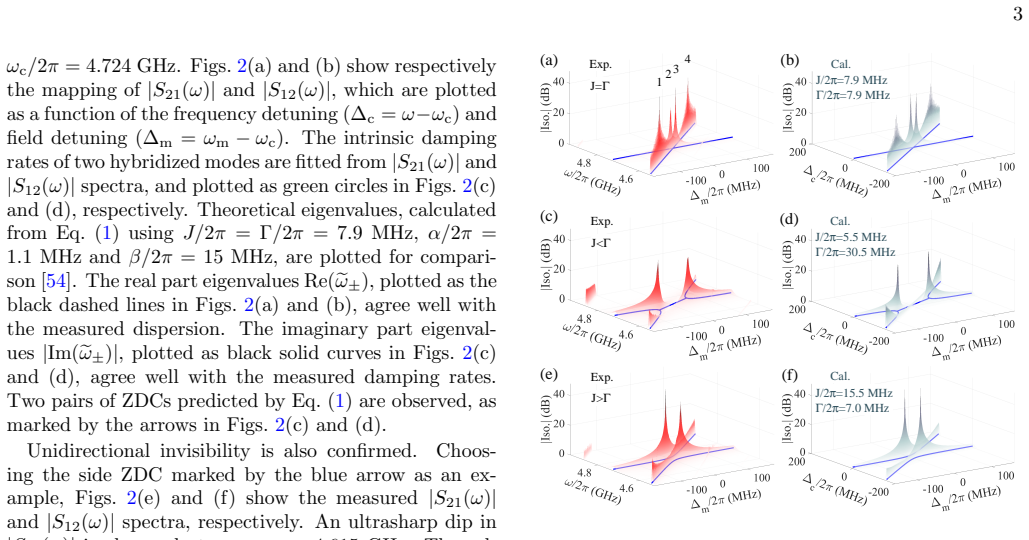
The paper claims that when both coherent coupling (rate $J$) and dissipative coupling (rate $\Gamma$) act between cavity photons and magnons, the relative phase between the two couplings differs by $\pi$ for signals launched from opposite ports. This direction-dependent phase produces an interference term in the transmission coefficient, and at the zero-damping conditions, where one hybridized mode's intrinsic damping vanishes, the system exhibits unidirectional invisibility: $|S_{21}(\omega_-)|=|S_{12}(\omega_+)|=0$ while $|S_{12}(\omega_-)|=|S_{21}(\omega_+)|>0$, so one propagation direction is completely blocked at one hybridized-mode frequency and the opposite direction is blocked at the other. The authors verify this experimentally with a 1-mm yttrium iron garnet sphere in a cross-line microwave cavity, observing sharp one-way transmission dips at 4.615 GHz and 4.833 GHz, isolation ratios above 30 dB, and good agreement between their model and measurements over a broad parameter range.
Load-bearing premise
The argument assumes the relative phase between the coherent and dissipative couplings differs by exactly $\pi$ for signals launched from opposite ports, because the traveling-wave field phase at the YIG sphere reverses with propagation direction; if the phase difference is not exactly $\pi$ or drifts with frequency, the perfect one-way zeros in Eq. (3a) become partial.
Editorial extensions
If this is right
- At a zero-damping condition, one hybridized mode is completely dark to one port while the other direction passes, so a single compact device can act as a two-frequency one-way microwave blocker.
- The nonreciprocity is linear and vanishes if either $J$ or $\Gamma$ is zero, showing that the effect is purely an interference of coherent and dissipative couplings rather than a nonlinear or Faraday-rotation mechanism.
- Isolation ratio and insertion loss can be optimized together: the paper identifies a parameter region with isolation above 20 dB and insertion loss below 4 dB by choosing external damping rates $\kappa$ and $\gamma$.
- The qualitative dispersion changes from level repulsion when $J>\Gamma$ to level attraction when $J<\Gamma$, and the isolation pattern follows the same competition between coupling strengths.
- Because the interference mechanism is generic, the same scheme should produce nonreciprocity in any system where coherent and dissipative couplings can be engineered, potentially including superconducting circuits without an external magnetic field.
Reading between the lines
- If the relative phase $\Theta$ were continuously tunable rather than fixed at $0$ or $\pi$, the isolation ratio should vary smoothly with $\Theta$; a phase-controlled experiment would directly test the interference picture and could yield an electrically tunable isolator.
- The zero-damping condition is a point where the imaginary parts of the eigenvalues vanish, which is reminiscent of exceptional-point physics; this might be exploited for sensitive detection or for lossless mode selection beyond the two modes studied here.
- The paper's final remark suggests a superconducting-circuit realization; if that works, the same coherent-dissipative interference could provide on-chip microwave nonreciprocity in the quantum regime, where linear isolators are especially scarce.
Signed reviews
Editorial analysis
A structured set of objections, weighed in public.
Referee Report
Summary. This paper presents an experimental and theoretical study of nonreciprocal microwave transmission in an open cavity magnonic system, in which a YIG sphere is coupled to a cross-line cavity supporting both standing and traveling waves. The authors model the system with a non-Hermitian Hamiltonian containing coherent coupling J and dissipative coupling Γ whose relative phase depends on whether the microwave field is launched from port 1 or port 2. From input-output theory they derive an analytic expression for S21 and S12 and show that at zero-damping conditions one of the hybridized modes yields a perfect transmission zero in one propagation direction only (Eq. 3). Measured S-parameter maps, hybridized-mode damping rates, and isolation-ratio maps are reported for balanced (J=Γ), dissipative-dominated (J<Γ), and coherent-dominated (J>Γ) regimes, and the model reproduces the data with fitted parameters J, Γ, α, β, κ, and γ. The unidirectional transmission dips at 4.615 and 4.833 GHz and the mirror-symmetric pattern predicted by Eq. (3) are the key experimental findings.
Significance. The result is significant as a compact, linear, magnetically tunable nonreciprocal microwave device based on a qualitatively different mechanism from Faraday-rotation isolators: interference between coherent and dissipative couplings. If correct, it also provides a generic route to nonreciprocity in other hybrid systems. Strengths include the analytic input-output derivation, the clear identification of zero-damping conditions as the locus of unidirectional invisibility, the systematic comparison across J<Γ, J=Γ, J>Γ, and the measurement of both isolation ratio and insertion loss, including a parameter regime with >20 dB isolation and <4 dB insertion loss. The model's predicted mirror-symmetric zero pattern is nontrivial and is confirmed by the data.
minor comments (6)
- [Experimental results, Figs. 2(e)-(h)] The statement that microwave transmission from port 1 to port 2 is 'completely blocked' should be quantified, because the measured dips are finite and limited by the VNA background; please report the noise floor or the minimum measured |S21|/|S12| at the dips.
- [Fig. 3 caption] The caption labels '(a) J = Γ, (b) J < Γ, and (c) J > Γ' do not match the actual panels, which are (a), (c), (e) for the measured maps and (b), (d), (f) for the calculated maps; correct the caption.
- [Eq. (2)] The compressed notation S21(12) and Θ1(2) should be expanded, for example as 'S21 uses Θ1=0 and S12 uses Θ2=π', to remove ambiguity about the direction convention.
- [System and model] The sentence invoking Ampère's law for the π phase difference would be clearer if it cited the supplementary derivation at that point and noted that the condition is an idealization for a perfect traveling wave; the standing-wave component of the cross-line circuit will modify the phase.
- [Supplementary material] The arXiv version references supplementary material [54] that is not included; ensure the supplement is uploaded for referees.
- [Fig. 2 caption] The '∼' symbols in the caption appear to be leftover LaTeX artifacts and should be removed.
Circularity Check
The unidirectional-invisibility 'prediction' is a postdiction from parameters fitted to the same spectra; the assumed π phase difference carries the nonreciprocity.
-
fitted input called prediction
[Experimental results, discussion of Figs. 2(c)-(h) and 3]
"Two pairs of ZDCs predicted by Eq. (1) are observed, as marked by the arrows in Figs. 2(c) and (d). ... The calculated result using κ/2π = 880 MHz and γ/2π = 0.071 MHz, based on fitting Eq. (2) to the measured spectrum [54], is plotted as the thin curves for comparison."
The ZDC 'prediction' and the calculated transmission curves used to 'confirm' unidirectional invisibility are generated from parameters (J, Γ, α, β, κ, γ) that are themselves fitted to the same measured S-parameter spectra that display the ZDC dips and the S21/S12 asymmetry. The fitted eigenvalue curves enforce the zero crossings, and κ,γ are adjusted to make Eq. (2) reproduce the measured dip spectra, so the agreement is a postdiction. The direction-dependent phase difference (Θ1=0, Θ2=π) is an assumed input, not a fitted parameter; the qualitative nonreciprocal asymmetry therefore has independent content. But the quantitative prediction of exact zeros is not independently tested.
full rationale
The analytic chain from the non-Hermitian Hamiltonian Eq. (1) to the transmission formula Eq. (2) and to the zero-transmission conditions Eq. (3) is mathematically self-contained; the zeros are consequences of the input Hamiltonian, not restatements of it. The central nonreciprocity does depend on the assumed direction-dependent relative phase (Θ=0 for port 1, Θ=π for port 2), which is physically motivated by Ampère's law but not independently measured. Because all other parameters are fitted to the same spectra that exhibit the ZDC dips, the quantitative 'confirmation' of unidirectional invisibility is a postdiction rather than an a priori prediction. This is a partial fit-to-data circularity, but the qualitative effect (the asymmetric zeros and the mirror symmetry between S21 and S12) is a nontrivial consequence of the model, so the paper is not wholly circular.
Assumptions & free parameters
free parameters (6)
- J (coherent magnon-photon coupling rate) =
7.9 MHz in balanced case; 5.5 MHz and 15.5 MHz in other configurations
- Gamma (dissipative magnon-photon coupling rate) =
7.9 MHz in balanced case; 30.5 MHz and 7.0 MHz in other configurations
- alpha (intrinsic magnon damping rate) =
1.1 MHz
- beta (intrinsic cavity damping rate) =
15 MHz
- kappa (external damping rate of cavity mode) =
880 MHz
- gamma (external damping rate of magnon mode) =
0.071 MHz
assumptions (4)
- standard math Input-output theory gives the transmission coefficient S21(12) from the non-Hermitian Hamiltonian (Eq. 2).
- domain assumption The system is described by one cavity mode and one uniform magnon (Kittel) mode; higher-order magnetostatic modes are neglected.
- domain assumption The coupling is modeled by the complex coefficient J - iΓe^{iΘ} in Eq. (1).
- domain assumption The relative phase Θ differs by π between the two propagation directions, based on Ampère's law.
Cite this review
Pith. "Pith review of Nonreciprocity and Unidirectional Invisibility in Cavity Magnonics." pith.science (2026). https://pith.science/paper/LXKPW5RU
@misc{pith2026190807907,
  author       = {Pith},
  title        = {Pith review of: Nonreciprocity and Unidirectional Invisibility in Cavity Magnonics},
  year         = {2026},
  howpublished = {\url{https://pith.science/paper/LXKPW5RU}},
  note         = {Machine review of arXiv:1908.07907}
}
read the original abstract
We reveal the cooperative effect of coherent and dissipative magnon-photon couplings in an open cavity magnonic system, which leads to nonreciprocity with a considerably large isolation ratio and flexible controllability. Furthermore, we discover unidirectional invisibility for microwave propagation, which appears at the zero-damping condition for hybrid magnon-photon modes. A simple model is developed to capture the generic physics of the interference between coherent and dissipative couplings, which accurately reproduces the observations over a broad range of parameters. This general scheme could inspire methods to achieve nonreciprocity in other systems.
Figures


Reference graph
Works this paper leans on
-
[1]
D. F. Walls and G. J. Milburn, Quantum Optics (Springer, Berlin, 2008)
2008
-
[2]
losing generality, we choose Θ = 0 and π for microwaves loaded from port 1 and 2, respectively
(b)(c) Schematic diagram showing magnon-photon cou- pling and nonreciprocal microwave transmission at the zero- damping conditions (ZDCs). losing generality, we choose Θ = 0 and π for microwaves loaded from port 1 and 2, respectively. The eigenvalues of Eq. (1), ~ω± = [ ~ωc + ~ωm ±√ (~ωc−~ωm)2 + 4(J−ieiΘΓ)2] /2, correspond to two hy- bridized modes that h...
- [3]
-
[4]
B. J. Chapman, E. I. Rosenthal, J. Kerckhoff, B. A. Moores, L. R. Vale, J. A. B. Mates, G. C. Hilton, K. Lalumi` ere, A. Blais, and K. W. Lehnert, Widely Tun- able On-Chip Microwave circulator for superconducting quantum circuits, Phys. Rev. X 7, 041043 (2017)
work page 2017
-
[5]
N. R. Bernier, L. D. T´ oth, A. Koottandavida, M. A. Ioan- nou, D. Malz, A. Nunnenkamp, A. K. Feofanov, and T. J. Kippenberg, Nonreciprocal reconfigurable microwave 5 optomechanical circuit, Nat. Comms. 8 604 (2017)
work page 2017
-
[6]
G. A. Peterson, F. Lecocq, K. Cicak, R. W. Simmonds, J. Aumentado, and J. D. Teufel, Demonstration of effi- cient nonreciprocity in a microwave optomechanical cir- cuit, Phy. Rev. X 7, 031001 (2017)
work page 2017
- [7]
-
[8]
M. Shalaby, M. Peccianti, Y. Ozturk, and R. Morandotti, A magnetic non-reciprocal isolator for broadband tera- hertz operation, Nat. Comms. 4, 1558 (2013)
work page 2013
Show all 55 references
-
[9]
M.-A. Miri, F. Ruesink, E. Verhagen, and A. Al` u, Optical nonreciprocity based on optomechanical coupling, Phys. Rev. Applied 7, 064014 (2017)
2017
-
[10]
D. L. Sounas and A. Al` u, Non-reciprocal photonics based on time modulation, Nat. Phot. 11, 774 (2017)
2017
-
[11]
Ramezani, P
H. Ramezani, P. K. Jha, Y. Wang, and X. Zhang, Non- reciprocal localization of photons, Phys. Rev. Lett. 120, 043901 (2018)
2018
-
[12]
K. Fang, J. Luo, A. Metelmann, M. H. Matheny, F. Marquardt, A. A. Clerk, and O. Painter, Generalized non-reciprocity in an optomechanical circuit via synthetic magnetism and reservoir engineering, Nat. Phys. 13, 465 (2017)
2017
-
[13]
Shen, Y.-L
Z. Shen, Y.-L. Zhang, Y. Chen, C.-L. Zou, Y.-F. Xiao, X.-B. Zou, F.-W. Sun, G.-C. Guo, and C.-H. Dong, Ex- perimental realization of optomechanically induced non- reciprocity, Nat. Phot. 10 657 (2016)
2016
-
[14]
Goulon, A
J. Goulon, A. Rogalev, C. Goulon-Ginet, G. Benayoun, L. Paolasini, C. Brouder, C. Malgrange, and P. A. Met- calf, First observation of nonreciprocal X-Ray gyrotropy, Phys. Rev. Lett. 85, 4385 (2000)
2000
-
[15]
Fleury, D
R. Fleury, D. L. Sounas, C. F. Sieck, M. R. Haberman, and A. Al` u, Sound isolation and giant linear nonreciproc- ity in a compact acoustic circulator, Science 343, 516 (2014)
2014
-
[16]
Walker, A
E. Walker, A. Neogi, A. Bozhko, Yu. Zubov, J. Arriaga, H. Heo, J. Ju, and A. A. Krokhin, Nonreciprocal linear transmission of sound in a viscous environment with bro- ken P symmetry, Phys. Rev. Lett. 120, 204501 (2018)
2018
-
[17]
Y. Wang, B. Yousefzadeh, H. Chen, H. Nassar, G. Huang, and C. Daraio, Observation of nonreciprocal wave prop- agation in a dynamic phononic lattice, Phys. Rev. Lett. 121, 194301 (2018)
2018
-
[18]
Torrent, O
D. Torrent, O. Poncelet, and J.-C. Batsale, Nonreciprocal thermal material by spatiotemporal modulation, Phys. Rev. Lett. 120, 125501 (2018)
2018
-
[19]
Faraday, in Faraday’s Diary, edited by T
M. Faraday, in Faraday’s Diary, edited by T. Martin (George Bell and Sons, 1933), Vol. IV, Nov. 12, 1839C, June 26, 1847
1933
-
[20]
C. L. Hogan, The ferromagnetic faraday effect at mi- crowave frequencies and its applications, Rev. Mod. Phys. 25, 253 (1953)
1953
-
[21]
J. H. Rowen, Ferrites in microwave applications, Bell Syst. Tech. J., 32 1333 (1953)
1953
-
[22]
J. D. Adam, L. E. Davis, G. F. Dionne, E. F. Schloemann, and S. N. Stizer, Ferrite devices and materials, IEEE Transactions on Microwave Theory and Techniques 50, 721 (2002)
2002
-
[23]
B. K. Kuanr, V. Veerakumar, R. Marson, S. R. Mishra, R. E. Camley, Z. Celinski, Nonreciprocal microwave de- vices based on magnetic nanowires, Appl. Phys. Lett. 94 202505 (2009)
2009
-
[24]
Metelmann and A
A. Metelmann and A. A. Clerk, Nonreciprocal photon transmission and amplification via reservoir engineering, Phys. Rev. X 5, 021025 (2015)
2015
-
[25]
Ranzani, and J
L. Ranzani, and J. Aumentado, A geometric description of nonreciprocity in coupled two-mode systems, New J. Phys. 16, 103027 (2014)
2014
-
[26]
Y. Shi, Z. Yu, and S. Fan, Limitations of nonlinear optical isolators due to dynamic reciprocity, Nat. Photon. 9, 388 (2015)
2015
-
[27]
Huebl, C
H. Huebl, C. W. Zollitsch, J. Lotze, F. Hocke, M. Greifen- stein, A. Marx, R. Gross, and S. T. B. Goennenwein, High cooperativity in coupled microwave resonator ferri- magnetic insulator hybrids, Phys. Rev. Lett.111, 127003 (2013)
2013
-
[28]
Tabuchi, S
Y. Tabuchi, S. Ishino, T. Ishikawa, R. Yamazaki, K. Usami, and Y. Nakamura, Hybridizing ferromagnetic magnons and microwave photons in the quantum limit, Phys. Rev. Lett. 113, 083603 (2014)
2014
-
[29]
Zhang, C.-L
X. Zhang, C.-L. Zou, L. Jiang, and H. X. Tang, Strongly coupled magnons and cavity microwave photons, Phys. Rev. Lett. 113, 156401 (2014)
2014
-
[30]
Goryachev, W
M. Goryachev, W. G. Farr, D. L. Creedon, Y. Fan, M. Kostylev, and M. E. Tobar, High-cooperativity cavity QED with magnons at microwave frequencies, Phys. Rev. Appl. 2, 054002 (2014)
2014
-
[31]
L. Bai, M. Harder, Y. P. Chen, X. Fan, J. Q. Xiao, and C.-M. Hu, Spin pumping in electrodynamically coupled magnon-photon systems, Phys. Rev. Lett. 114, 227201 (2015)
2015
-
[32]
Y. Cao, P. Yan, H. Huebl, S. T. B. Goennenwein, and G. E. W. Bauer, Exchange magnon-polaritons in microwave cavities, Phys. Rev. B 91, 094423 (2015)
2015
-
[33]
L. Bai, M. Harder, P. Hyde, Z. Zhang, C.-M. Hu, Y. P. Chen, and J. Q. Xiao, Cavity mediated manipulation of distant spin currents using a cavity-magnon-polariton, Phys. Rev. Lett. 118, 217201 (2017)
2017
-
[34]
Zhang, Xiao-Qing Luo, Yi-Pu Wang, T.-F Li, and J
D. Zhang, Xiao-Qing Luo, Yi-Pu Wang, T.-F Li, and J. Q. You, Observation of the exceptional point in cavity magnon-polaritons, Nat. Comms. 8 1368 (2017)
2017
-
[35]
Tabuchi, S
Y. Tabuchi, S. Ishino, A. Noguchi, T. Ishikawa, R. Ya- mazaki, K. Usami, and Y. Nakamura, Coherent coupling between a ferromagnetic magnon and a superconducting qubit, Science 349, 405 (2015)
2015
-
[36]
Lachance-Quirion, Y
D. Lachance-Quirion, Y. Tabuchi, S. Ishino, A. Noguchi, T. Ishikawa, R. Yamazaki, and Y. Nakamura, Resolving quanta of collective spin excitations in a millimeter-sized ferromagnet, Sci. Adv. 3, e1603150 (2017)
2017
-
[37]
Osada, R
A. Osada, R. Hisatomi, A. Noguchi, Y. Tabuchi, R. Ya- mazaki, K. Usami, M. Sadgrove, R. Yalla, M. Nomura, and Y. Nakamura, Cavity optomagnonics with spin-orbit coupled photons, Phys. Rev. Lett. 116, 223601 (2016)
2016
-
[38]
Zhang, N
X. Zhang, N. Zhu, C.-L. Zou, and H. X. Tang, Opto- magnonic whispering gallery microresonators, Phys. Rev. Lett. 117, 123605 (2016)
2016
-
[39]
J. A. Haigh, A. Nunnenkamp, A. J. Ramsay, and A. J. Ferguson, Triple-resonant Brillouin light scattering in magneto-optical cavities, Phys. Rev. Lett. 117, 133602 (2016)
2016
-
[40]
Hisatomi, A
R. Hisatomi, A. Osada, Y. Tabuchi, T. Ishikawa, A. Noguchi, R. Yamazaki, K. Usami, and Y. Nakamura, Bidirectional conversion between microwave and light via ferromagnetic magnons, Phys. Rev. B 93, 174427 (2016)
2016
-
[41]
Braggio, G
C. Braggio, G. Carugno, M. Guarise, A. Ortolan, and G. 6 Ruoso, Optical manipulation of a magnon-photon hybrid system, Phys. Rev. Lett. 118, 107205 (2017)
2017
-
[42]
Zhang, C.-L
X. Zhang, C.-L. Zou, N. Zhu, F. Marquardt, L. Jiang, H. X. Tang, Magnon dark modes and gradient memory, Nat. Comms. 6 8914 (2015)
2015
-
[43]
Dany Lachance-Quirion, Yutaka Tabuchi, Arnaud Gloppe, Koji Usami, and Yasunobu Nakamura, Hybrid quantum systems based on magnonics, Applied Physics Express 12, 070101 (2019)
2019
-
[44]
Michael Harder and Can-Ming Hu, Cavity Spintronics: An Early Review of Recent Progress in the Study of Magnon-Photon Level Repulsion, Solid State Physics, 69, 47-121 (2018). R. Stamps and R. Camley (Ed.), Aca- demic Press
2018
-
[45]
Harder, Y
M. Harder, Y. Yang, B. M. Yao, C. H. Yu, J. W. Rao, Y. S. Gui, R. L. Stamps, and C.-M. Hu, Level attraction due to dissipative magnon-photon coupling, Phys. Rev. Lett. 121, 137203 (2018)
2018
-
[46]
V. L. Grigoryan, K. Shen, and K. Xia, Synchronized spin- photon coupling in a microwave cavity, Phys. Rev. B 98, 024406 (2018)
2018
-
[47]
B. Bhoi, B. Kim, S.-H. Jang, J. Kim, J. Yang, Y.-J. Cho, and S.-K. Kim, Abnormal anticrossing effect in photon- magnon coupling, Phys. Rev. B 99, 134426 (2019)
2019
-
[48]
Y. Yang, J. W. Rao, Y. S. Gui, B. M. Yao, W. Lu, and C.-M. Hu, Control of the magnon-photon level attraction in a planar cavity, Phys. Rev. Applied11, 054023 (2019)
2019
-
[49]
Rao, C.H Yu, Y.T Zhao, Y.S
J.W. Rao, C.H Yu, Y.T Zhao, Y.S. Gui, X.L. Fan, D.S. Xue, and C.-M. Hu, Level attraction and level repulsion of magnon coupled with a cavity anti-resonance, New J. Phys. 21, 065001 (2019)
2019
-
[50]
Boventer, C
I. Boventer, C. D¨ orflinger, T. Wolz, R. Macˆ edo, R. Le- brum, M. Kl¨ aui, and Martin Weides, Control of the cou- pling strength and linewidth of a cavity-magnon polari- ton, arXiv:1904.00393
1904 arXiv
-
[51]
Igor Proskurin, Rair Macedo, Robert L Stamps, Micro- scopic origin of level attraction for a coupled magnon- photon system in a microwave cavity, arXiv:1904.11570
1904 arXiv
-
[52]
Blanter, Microscopic mechanism of level attraction from coherence-dissipation competition, arXiv:1906.12142
Bimu Yao, Tao Yu, Xiang Zhang, Wei Lu, Yongsheng Gui, Can-Ming Hu, Yaroslav M. Blanter, Microscopic mechanism of level attraction from coherence-dissipation competition, arXiv:1906.12142
1906 arXiv
-
[53]
Weichao Yu, Jiongjie Wang, H. Y. Yuan, and Jiang Xiao, Realization of Attractive Level Crossing via a Dissipative Mode, arXiv:1907.06222
1907 arXiv
-
[54]
L. D. T´ oth, N. R. Bernier, A. Nunnenkamp, A. K. Fe- ofanov, and T. J. Kippenberg, A dissipative quantum reservoir for microwave light using a mechanical oscilla- tor, Nat. Phys. 13, 787 (2017)
2017
-
[55]
See supplementary at
Reviewed August 14, 2026 · model on record in the stance chip above.
Discussion (0). Continue with ORCID to comment.