REVIEW 3 major objections 5 minor 33 references
Consistent large-scale shell-model analysis of the two-neutrino $\beta\beta$ and single $\beta$ branchings in $^{48}\rm Ca$ and $^{96}\rm Zr$
T0 review · 3 major / 5 minor · reviewed 2026-08-14 · deepseek-v4-flash
Pith's one-line read A consistent shell-model treatment now predicts measurable single-beta branches in 48Ca and 96Zr.
desk verdict A serious shell-model paper with a genuinely new 96Zr NME and a clean SSD confirmation; the beta branchings are useful estimates but rest on an untested assumption about gA transfer. read the letter →
The pith
A machine-rendered reading of the paper's core claim, the machinery that carries it, and where it could break.
The reading
What carries the argument
The load-bearing object is the interacting nuclear shell model expanded to large valence spaces, with all intermediate $1^+$ states included in the $2\nu\beta\beta$ matrix-element sum (9470 states for $^{48}$Sc, 5894 for $^{96}$Nb). The $^{48}$Ca space is the full $fp$ shell; the $^{96}$Zr space adds the proton $f_{5/2}$, $p_{3/2}$, $p_{1/2}$, $g_{9/2}$ and neutron $g_{7/2}$, $d_{5/2}$, $d_{3/2}$, $s_{1/2}$ orbitals. The central identity is the matrix-element formula that sums Gamow-Teller transitions through intermediate $1^+$ states with energy denominators; inverting the half-life relation fixes the effective $g_A$, which is then reused in the single-$\beta$ shape factors. The 'single-state dominance' pattern, where one first $1^+$ state supplies essentially the entire $M_{2\nu}$, is what makes the $^{96}$Zr result particularly clean.
What would settle it
Measure the $5^+$ single-$\beta$ branch of $^{96}$Zr: the paper predicts roughly $18.4\%$ (or about $16.7\%$ if the first $1^+$ state of $^{96}$Nb is at 694.6 keV), so a measured branch clearly outside this range would falsify the claim that the double-$\beta$-derived coupling transfers to the single-$\beta$ channel.
Extended reading notes
Core claim
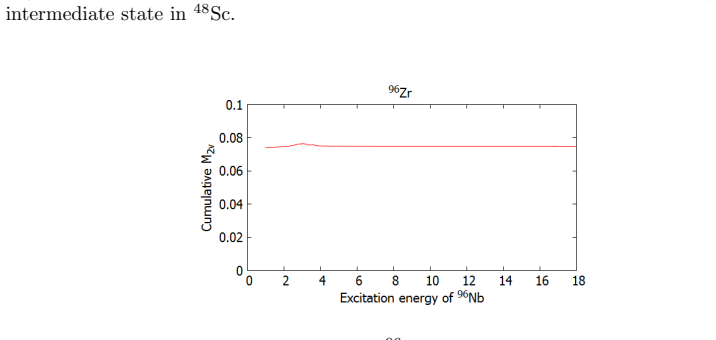
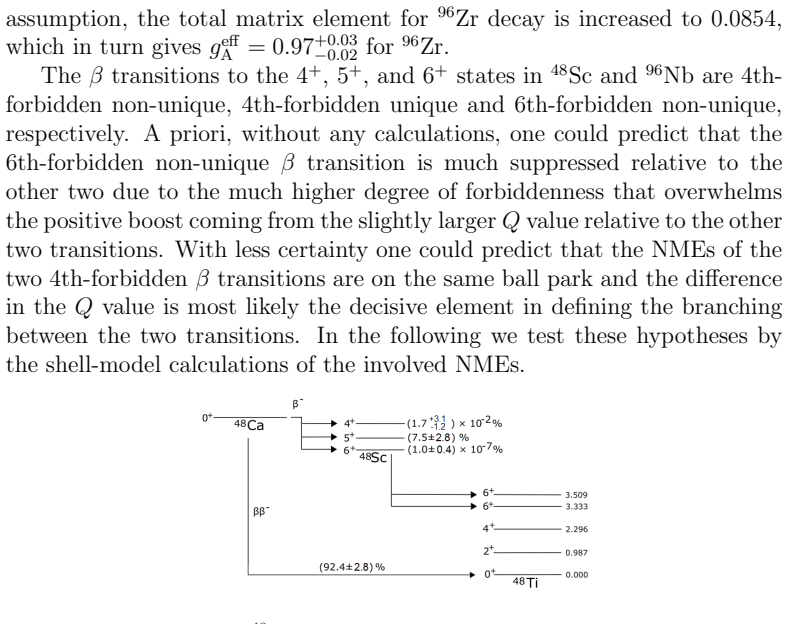
The paper's central claim is that a consistent large-space shell-model treatment produces the $2\nu\beta\beta$ matrix element and the competing single-$\beta$ branches of $^{48}$Ca and $^{96}$Zr using one effective axial-vector coupling. For $^{48}$Ca the calculated matrix element is $M_{2\nu}=0.0511$, 5.5% smaller than the earlier value of 0.0539; for $^{96}$Zr it gives $M_{2\nu}=0.0747$, with essentially the whole value coming from a single intermediate $1^+$ state, confirming the extreme single-state dominance seen in charge-exchange data. If the first $1^+$ state of $^{96}$Nb lies at 694.6 keV, the $^{96}$Zr matrix element rises to 0.0854. Extracting the axial coupling from the measured half-lives gives $g_A=0.80\pm0.04$ for $^{48}$Ca and $g_A=1.04^{+0.03}_{-0.02}$ for $^{96}$Zr, and using these same couplings to evaluate the $\beta$ shape factors yields total single-$\beta$ branchings of $(7.5\pm2.8)\%$ and $(18.4\pm0.09)\%$, both larger than earlier predictions.
Load-bearing premise
The prediction stands on the assumption that the same quenched axial-vector coupling extracted from the measured double-beta half-lives also governs the highly forbidden single-beta transitions, because both are low-momentum-exchange processes.
Editorial extensions
If this is right
- The $^{96}$Zr $2\nu\beta\beta$ matrix element becomes the first obtained in a large-scale shell-model space, and its extreme single-state dominance independently supports the earlier charge-exchange measurement.
- The predicted single-beta branches of $7.5\%$ and $18.4\%$ are large enough that dedicated underground detectors could plausibly observe them, offering a new experimental handle on the axial-vector coupling.
- The extracted effective couplings, about $0.80$ for $^{48}$Ca and about $1.04$ for $^{96}$Zr, give a consistent input for computing other low-momentum weak-transition rates in these model spaces.
- If the first $1^+$ state of $^{96}$Nb is at 694.6 keV, the $^{96}$Zr matrix element becomes $0.0854$ and the $5^+$ single-beta branch drops to about $17\%$, still within reach of detection.
Reading between the lines
- An independent test: a dedicated experiment measuring the $5^+$ single-beta branch of $^{96}$Zr can invert the measured half-life to extract its own $g_A$; agreement with the double-beta-derived value would confirm the consistency assumption, and disagreement would break it.
- Because the $^{48}$Ca branching uncertainty is dominated by the 5 keV Q-value error, a precise mass measurement of the $^{48}$Ca-$^{48}$Sc pair would tighten the $7.5\%$ prediction without new nuclear-structure input.
- The same consistent-coupling procedure could be applied to other double-beta emitters with competing single-beta branches, turning branching-ratio measurements into a systematic scan of axial quenching across the mass table.
Signed reviews
Editorial analysis
A structured set of objections, weighed in public.
Referee Report
Summary. The manuscript reports large-space shell-model calculations of the two-neutrino double-beta-decay matrix elements M2ν for 48Ca and 96Zr, using the GXPF1A interaction in the full fp space for 48Ca and the glekpn interaction in an extended model space for 96Zr. All intermediate 1+ states are included. The computed M2ν values are 0.0511 for 48Ca and 0.0747 for 96Zr (0.0854 if the first 1+ state in 96Nb lies at 694.6 keV). The 96Zr calculation shows extreme single-state dominance, in agreement with the high-resolution charge-exchange experiment of Thies et al. Combining these matrix elements with measured 2νββ half-lives yields effective axial couplings geff_A = 0.80 ± 0.04 (48Ca) and 1.04^{+0.03}_{-0.02} (96Zr), which are then used to predict single-β branchings to the 4+, 5+, and 6+ states. The predicted total β branchings are 7.5 ± 2.8% for 48Ca and 18.4 ± 0.9% for 96Zr, substantially larger than earlier estimates, motivating dedicated experimental searches.
Significance. The 96Zr calculation is, as far as I am aware, the first large-space shell-model evaluation of M2ν for that nucleus, and the single-state-dominance result provides a theory-side confirmation of the experimental finding of Thies et al. The paper is transparent in its methodology: the NMEs are computed from the Hamiltonian rather than fitted to half-life data, the extraction of geff_A from Eq. (5) is a one-parameter step, and the gA dependence of the branchings is shown explicitly. The inclusion of all intermediate 1+ states in both nuclei is a clear improvement over earlier truncated calculations. However, the central experimental-motivation claim rests on an unquantified assumption about the renormalization of the axial coupling in highly forbidden β transitions, and the 96Zr NME carries an unquantified systematic uncertainty from the unmeasured 1+ spectrum. These issues do not affect the internal consistency of the shell-model matrix elements, but they do affect the reliability of the headline branching fractions.
major comments (3)
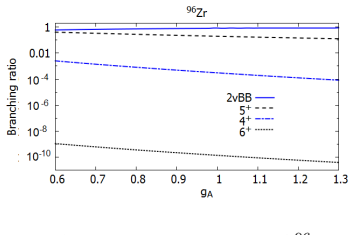
- [Table 1 and the paragraph following Fig. 2] The branchings are conditional on transferring a single geff_A extracted from the 2νββ Gamow-Teller channel to the forbidden β-decay shape factors. The 2νββ operator is an allowed Gamow-Teller operator, whereas the dominant 5+ branch is a 4th-forbidden unique transition whose leading axial multipole has rank five, and the 4+ and 6+ branches involve several interfering axial and vector multipoles. The sentence after Table 1 — 'This we consider to be a consistent approach since the 2νββ and β decays are low-momentum-exchange processes and thus the related axial couplings are expected to be quenched by a similar amount' — is a plausible physical statement but not a quantitative justification. Because the branching ratio is λβ/(λβ + λ2νββ), a 10–20% shift in the β partial half-life changes the 96Zr branching by several percentage points, comparable to the quoted ±0.9%. I request a sensitivity study in which the axial renormalization for the β operators is varied independently (for example, by rescaling the axial form factors in the range geff_A = 0.8–1.27 while keeping the 2νββ-derived value fixed) or, alternatively, a clear statement in the abstract and conclusion that the predicted branchings are model-dependent with respect to this assumption.
- [Table 1 and the paragraph following Fig. 2] The central value M2ν = 0.0747 for 96Zr is quoted without a systematic uncertainty reflecting the unmeasured 1+ spectrum in 96Nb. The paper itself shows that placing the lowest 1+ state at 694.6 keV changes M2ν to 0.0854, a 14% shift, and the 5+ branching from 18.4% to 16.7%. Since no 1+ states in 96Nb are known experimentally, Table 1 and the abstract should either adopt one scenario as the central value with the other included in the error budget, or present both values with equal prominence. As written, the precision implied by '0.0747' in Table 1 overstates what is known, and the same caveat propagates to the extracted geff_A.
- [Abstract and Table 1] The quoted NMEs carry no estimate of model uncertainty. The 48Ca result differs by 5.5% from the earlier shell-model value of Horoi et al., and the 96Zr value changes by 14% under the alternative 1+ scenario, yet the errors quoted in Table 1 and in the branching fractions reflect only experimental half-life and Q-value uncertainties. The authors should add an explicit statement that M2ν and geff_A do not include uncertainties from the shell-model truncation, the choice of Hamiltonian, or the unknown 1+ energies, and, where possible, estimate the spread using the interaction/model-space variants already at hand.
minor comments (5)
- [Conclusion] The uncertainty for the 96Zr total β branching is printed as '18.4 ± 0.09%' in the abstract and conclusion but as '18.4 ± 0.9%' in Section 3; the latter is consistent with the experimental half-life uncertainty and should be used throughout.
- [Eq. (6)] The denominator of Eq. (6) is ambiguous: the symbols E(1+_m), M_i, and the role of the excitation energy relative to the initial or final ground state should be defined explicitly, since the paper later discusses shifting the 1+ spectrum in 48Sc to the experimental 2200 keV.
- [Section 3, comparison with Ref. [7]] The statement that 'the β decay might be up to 2.3 times faster than predicted by the older QRPA calculations in [7]' is not backed by an explicit comparison; please specify which half-life or branching ratio is compared and how the factor 2.3 is obtained.
- [Figures 4–5 and 7–8] The gA-dependence figures are central to the argument, but the captions do not state the range of gA displayed or the meaning of the vertical lines; please add this information so the reader can judge the sensitivity at the extracted geff_A values.
- [Conclusion] Minor typographical issues: 'firs 1 + state' in the conclusion should read 'first 1+ state'.
Circularity Check
No circularity: the gA extraction is transparent calibration, and the beta-branch predictions rest on independently computed shell-model matrix elements.
full rationale
The shell-model 2νββ matrix elements M2ν are computed from the Hamiltonians and model spaces (GXPF1A for 48Ca, glekpn for 96Zr) without using the measured half-lives as input; they are then compared with previous calculations and with the Thies et al. experimental SSD result. The effective gA values in Table 1 are openly obtained as one-parameter solutions of Eq. (5) from the measured 2νββ half-lives, so those gA values are calibrated inputs rather than predictions. The beta-decay branching ratios use separately computed beta-decay matrix elements for the 4+, 5+, and 6+ transitions, and the branchings are not algebraically forced to equal the fitted half-life or the fitted gA. The consistency assumption that gA quenching is similar for the low-momentum-transfer 2νββ and β channels is an external-validity assumption, supported only by a plausibility argument and self-citations [26,27]; it is a legitimate physics concern and a potential source of systematic error, but it does not make any equation in the derivation reduce to its own input. Since no claimed prediction is equivalent by construction to a fitted parameter or to a self-citation, the paper shows no significant circularity.
Assumptions & free parameters
free parameters (4)
- geff_A (48Ca) =
0.80 ± 0.04
- geff_A (96Zr) =
1.04+0.03-0.02
- geff_A (96Zr, alt scenario) =
0.97+0.03-0.02
- First 1+ energy of 96Nb (alternative scenario) =
694.6 keV
assumptions (6)
- domain assumption GXPF1A is a valid Hamiltonian for the full fp-shell description of 48Ca and 48Sc.
- domain assumption glekpn is a valid interaction for the chosen model space around 96Zr.
- domain assumption The impulse approximation and Behrens-Buhring formalism map beta-decay form factors to shell-model NMEs.
- ad hoc to paper The axial-vector coupling extracted from 2νββ applies equally to the single-beta-decay branches.
- domain assumption Intermediate 1+ state energies in 96Nb are given by the shell model, or by the 694.6 keV alternative.
- domain assumption Truncation of the intermediate-state sums at 60 MeV in 48Sc and about 18 MeV in 96Nb is sufficient.
Cite this review
Pith. "Pith review of Consistent large-scale shell-model analysis of the two-neutrino $\beta\beta$ and single $\beta$ branchings in $^{48}\rm Ca$ and $^{96}\rm Zr$." pith.science (2026). https://pith.science/paper/FM3MBFAJ
@misc{pith2026190807911,
  author       = {Pith},
  title        = {Pith review of: Consistent large-scale shell-model analysis of the two-neutrino $\beta\beta$ and single $\beta$ branchings in $^48\rm Ca$ and $^96\rm Zr$},
  year         = {2026},
  howpublished = {\url{https://pith.science/paper/FM3MBFAJ}},
  note         = {Machine review of arXiv:1908.07911}
}
abstract
Two-neutrino double-beta-decay matrix elements $M_{2\nu}$ and single beta-decay branching ratios were calculated for $^{48}$Ca and $^{96}$Zr in the interacting nuclear shell model using large single-particle valence spaces with well-tested two-body Hamiltonians. For $^{48}$Ca the matrix element $M_{2\nu}=0.0511$ is obtained, which is 5.5\% smaller than the previously reported value of 0.0539. For $^{96}$Zr this work reports the first large-scale shell-model calculation of the nuclear matrix element, yielding a value $M_{2\nu}=0.0747$ with extreme single-state dominance. If the scenario where the first $1^+$ state in $^{96}$Nb is at 694.6 keV turns out to be correct, the matrix element is increased to 0.0854. These matrix elements, combined with the available $\beta\beta$-decay half-life data, yield effective values of the weak axial coupling which in turn are used to produce in a consistent way the $\beta$-decay branching ratios of $(7.5\pm2.8)$ % for $^{48}$Ca and $(18.4\pm0.09)$ % for $^{96}$Zr. These are larger than obtained in previous studies, implying that the detection of the $\beta$-decay branches could be possible in dedicated experiments sometime in the (near) future.
Figures

Figures from the paper (6 more)



Reference graph
Works this paper leans on
- [1]
- [2]
- [3]
- [4]
-
[5]
A. Bakalyarov, A. Balysh, A. Barabash, C. Brianon, V. Brudanin, et al., Nucl. Phys. A 700 (2002) 17
work page 2002
- [6]
-
[7]
H. Heiskanen, M. T. Mustonen, J. Suhonen, J. Phys. G: Nucl. Part. Phys. 34 (2007) 837
work page 2007
-
[8]
M. Alanssari, D. Frekers, T. Eronen, L. Canete, J. Dilling, et al., Phys. Rev. Lett. 116 (2016) 072501. 11
work page 2016
Show all 33 references
-
[9]
Arnold, C
R. Arnold, C. Augier, A. M. Bakalyarov, J. D. Baker, A. S. Barabash, et al. (NEMO-3 Collaboration), Phys. Rev. D 93 (2016) 112008
2016
-
[10]
Argyriades, R
J. Argyriades, R. Arnold, C. Augier, J. Baker, A. Barabash, et al., Nucl. Phys. A 847 (2010) 168
2010
-
[11]
National Nuclear Data Center, Brookhaven National Laboratory, www.nndc.bnl.gov
-
[12]
A. S. Barabash, R. Gurriarn, F. Hubert, P. Hubert, J. L. Reyss, J. Suhonen, V. I. Umatov, J. Phys. G: Nucl. Part. Phys. 22 (1996) 487
1996
-
[13]
Behrens and W
H. Behrens and W. B¨ uhring, Electron Radial Wave Functions and Nu- clear Beta Decay, Clarendon, Oxford, 1982
1982
-
[14]
Haaranen, J
M. Haaranen, J. Kotila, J. Suhonen, Phys. Rev. C 95 (2017) 024327
2017
-
[15]
Suhonen, O
J. Suhonen, O. Civitarese, Phys. Rep. 300 (1998) 123
1998
-
[16]
J. C. Hardy, I. S. Towner, V. Koslowsky, E. Hagberg, H. Schmeing, Nucl. Phys. A 509 (1990) 429
1990
-
[17]
Haaranen, P
M. Haaranen, P. C. Srivastava, J. Suhonen, Phys. Rev. C 93 (2016) 034308
2016
-
[18]
Kostensalo, M
J. Kostensalo, M. Haaranen, J. Suhonen, Phys. Rev. C 95 (2017) 044313
2017
-
[19]
B. A. Brown, W. D. M. Rae, Nucl. Data Sheets 120 (2014) 115
2014
-
[20]
Horoi, S
M. Horoi, S. Stoica, B. A. Brown, Phys. Rev. C 75 (2007) 034303
2007
-
[21]
Honma, T
M. Honma, T. Otsuka, B. A. Brown, T. Mizusaki, Phys. Rev. C 69 (2004) 034335
2004
-
[22]
Honma, T
M. Honma, T. Otsuka, B. A. Brown, T. Mizusaki, Eur. Phys. J. A 25 (2005) 499
2005
-
[23]
H. Mach, E. K. Warburton, R. L. Gill, R. F. Casten, J. A. Becker, B. A. Brown, J. A. Winger, Phys. Rev. C 41 (1990) 226
1990
-
[24]
D. H. Gloeckner, Nucl. Phys. A253 (1975) 301
1975
-
[25]
Neacsu, M
A. Neacsu, M. Horoi, Adv. High Energy Phys. 2016 (2016) 7486712. 12
2016
-
[26]
Suhonen, Front
J. Suhonen, Front. Phys. 5 (2017) 55
2017
-
[27]
Suhonen, J
J. Suhonen, J. Kostensalo, Front. Phys. 7 (2019) 29
2019
-
[28]
Civitarese, J
O. Civitarese, J. Suhonen, Phys. Rev. C 58 (1998) 1535
1998
-
[29]
Civitarese, J
O. Civitarese, J. Suhonen, Nucl. Phys. A 653 (1999) 321
1999
-
[30]
J. H. Thies, P. Puppe, T. Adachi, M. Dozono, H. Ejiri, et al., Phys. Rev. C 86 (2012) 054323
2012
-
[31]
Barea, J
J. Barea, J. Kotila, F. Iachello, Phys. Rev. C 87 (2013) 014315
2013
-
[32]
Neacsu, M
A. Neacsu, M. Horoi, Phys. Rev. C 91 (2015) 024309
2015
-
[33]
Horoi and A
M. Horoi and A. Neacsu, Phys. Rev. C 93 (2016) 024308. 13
2016
Reviewed August 14, 2026 · model on record in the stance chip above.
Discussion (0). Continue with ORCID to comment.