REVIEW 3 major objections 5 minor 3 references
Inverse Structural Design of Graphene/Boron Nitride Hybrids by Regressional GAN
T0 review · 3 major / 5 minor · reviewed 2026-08-14 · deepseek-v4-flash
Pith's one-line read A regressional GAN can design graphene/boron-nitride hybrid structures with requested bandgaps, with DFT-validated errors near 10%.
desk verdict Useful inverse-design demonstration with genuine external DFT checks, but the paper never explains how the regressor loss backpropagates through binarized structures—so the advertised mechanism is unsupported as written. read the letter →
The pith
A machine-rendered reading of the paper's core claim, the machinery that carries it, and where it could break.
The reading
What carries the argument
The load-bearing mechanism is the regressor's latent-feature vector $\pi$. After the regressor, a modified Inception V2 convolutional network, processes either a generated or a real structure, $\pi$ is concatenated with the corresponding bandgap to form the discriminator input, so the discriminator judges authenticity and label consistency together. The generator loss adds a regularizer $\lambda = 25$ times the L2 error between the predicted bandgap of the generated structure and the requested bandgap to the least-squares GAN loss; this term is what steers the generator toward the target property. The generator's output matrices are binarized to $-1$ (C-C) and $+1$ (BN) before they enter the regressor.
What would settle it
Take the trained RGAN, request a batch of structures at a chosen bandgap, recompute their bandgaps with DFT, and compare the fractional mean absolute error; if it is not near the reported 10% level or the structures collapse to a few duplicate layouts, the inverse-design claim fails.
Extended reading notes
Core claim
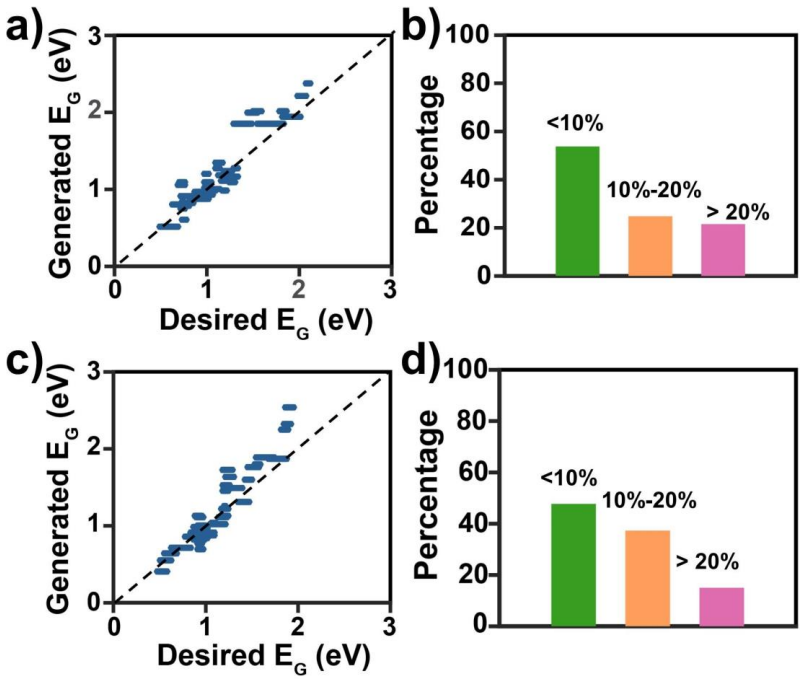
The central claim is that an RGAN can autonomously perform inverse structural design of graphene/BN hybrids for requested continuous bandgap values. The regressor, trained on DFT-computed real structures, outputs both a predicted bandgap and a latent feature vector; the generator's objective combines a least-squares adversarial term with an L2 regularization term that penalizes the difference between the regressor's predicted bandgap for the generated structure and the desired bandgap. After the generator's continuous outputs are binarized to $-1$/$+1$ atomic labels, DFT validation on the generated $4\times4$ and $5\times5$ structures yields fractional mean absolute errors of 9.67% and 11.6% respectively, with $R^2$ values of 0.82 and 0.87. PCA and MLLE of the latent features show that generated structures follow the statistical distribution of the real structures and trace the physical trend that bandgap rises with BN concentration.
Load-bearing premise
The target-steering loop depends on the bandgap error being able to guide the discrete -1/1 layout of the generated structure through the rounding step that turns continuous outputs into atomic labels, and the paper does not describe how the gradient crosses that step.
Editorial extensions
If this is right
- For a requested bandgap inside the trained range, the generator returns multiple distinct graphene/BN topographies, so inverse design can enumerate candidate structures rather than a single guess.
- The same architecture can be retrained for other layered or 2D material families whenever a fast differentiable property predictor and a labeled structure dataset are available.
- The $5\times5$ case works with only 0.24% of all possible configurations sampled, so the approach scales to chemical spaces too large for exhaustive DFT screening.
- The latent-space analysis indicates the generator has internalized the structure-property relationship, meaning the learned latent axes can be inspected to extract design rules beyond the training labels.
Reading between the lines
- If the latent axes really encode physical descriptors, then moving along the PCA or MLLE directions could let a user steer correlated properties such as BN concentration or domain morphology, though the paper does not test this.
- The same RGAN recipe should transfer to other continuous labels such as formation energy, magnetic moment, or work function whenever a regressor of comparable accuracy can be trained; the paper only demonstrates bandgap.
- The regressor's accuracy is reported on real test structures, so a conservative check before using the RGAN for discovery would probe generated structures outside the training bandgap range, where the regressor's predictions are extrapolation.
Signed reviews
Editorial analysis
A structured set of objections, weighed in public.
Referee Report
Summary. The manuscript presents a 'regressional GAN' (RGAN) that couples a least-squares GAN with a pre-trained CNN regressor to generate graphene/boron-nitride hybrid structures (4x4 and 5x5 supercells) with specified bandgaps. The generator receives noise and a desired bandgap; the regressor predicts the bandgap of the generated structure and provides latent features that, concatenated with the bandgap, are fed to the discriminator. The generator's loss combines the LSGAN adversarial term with the regressor's L2 error (Eq. 3). The authors report DFT-validated bandgaps of generated structures with MAEF of 9.67% (4x4) and 11.6% (5x5), and use PCA/MLLE to suggest the latent space is shared between generated and real structures.
Significance. If the training mechanism is sound, this is a valuable contribution: it demonstrates inverse design for a continuous property in a 2D materials system with external DFT validation, and the use of regressor latent features to condition the discriminator is a plausible architecture that could transfer to other structure-property problems. However, the central mechanism for passing gradients through the discrete structure encoding is not specified, and the validation lacks baselines and uncertainty estimates. The latent-space analysis is partly circular. These concerns are fixable in revision but currently limit confidence in the main claim.
major comments (3)
- [Supporting Information Note 1; Eq. (3)] The manuscript does not specify how gradients flow from the regressor's L2 loss in Eq. (3) back to the generator through the binarization step described in Supplementary Note 1. After the tanh layer, values below 0 are set to -1 and above 0 to 1; this piecewise-constant mapping has zero derivative almost everywhere. Unless a straight-through estimator, Gumbel-softmax relaxation, or similar mechanism is used, the regularization term in Eq. (3) provides no gradient to the generator, so the reported conditioning on Y would have to arise from the discriminator path alone, which is not demonstrated. The authors should state the exact gradient mechanism and provide evidence (e.g., a training curve showing the regressor loss on generated structures decreasing, or an ablation with the regressor term removed).
- [Results and Discussion, Fig. 3] The central quantitative claim (MAEF of 9.67% for 4x4 and 11.6% for 5x5) is based on an unreported number of DFT-validated generated structures, with no confidence intervals or error bars. In addition, no baseline or comparison experiments are reported (e.g., random structure generation, unconditional GAN, or direct optimization with the regressor alone), so it is unclear whether the RGAN's accuracy exceeds what a simpler method would achieve. The authors should specify N for each validation, report the distribution across desired bandgaps, and compare against at least one baseline.
- [Results and Discussion, Fig. 4] The PCA and MLLE analyses of latent features are partially circular: the regressor used to encode both real and generated structures was trained on real structures, and the discriminator receives exactly these latent features (concatenated with labels). The overlap in Fig. 4a/e therefore partly reflects the objective the generator was optimized against, not necessarily an independent discovery of physical structure-property relations. The claim that the generator 'caught the physical law' (Fig. 4b-c) should be softened or supported by an analysis on a feature representation that was not part of the training loss.
minor comments (5)
- [Abstract and Fig. 4 caption] 'Principle component analysis' should be 'principal component analysis' throughout.
- [Results and Discussion, Fig. 3] The shorthand 'MAEF' is used in the main text before it is defined in Supplementary Note 2; please define at first use.
- [Eqs. (3) and (4)] The notation for π, E, and the subscripted expectations is garbled in the submitted PDF; please ensure all symbols are defined and rendered correctly.
- [References] Reference [32] (Szegedy et al.) is cited as 'Inception V2' in the text, but the reference is to the GoogLeNet/Inception v1 paper; please correct the version name and citation.
- [Supporting Information Note 1] Hyperparameters (e.g., λ=25, learning rate 1e-4, L2 regularization 0.5, batch size 105) are scattered in the text; a summary table would improve reproducibility.
Circularity Check
DFT-validated bandgaps keep the main inverse-design claim non-circular; the PCA/MLLE latent-feature analysis is a minor self-referential check.
-
self definitional
[Results and Discussion, PCA/MLLE paragraph (Fig. 4); Eqs. 3-4; Supplementary Note 1]
"They are highly overlapped, suggesting that the RGAN has successfully learned the distribution of the latent features from the real structures when synthesizing new structures."
The 'latent features' in this analysis are exactly the regressor features pi that the generator was trained to match. Eq. 3 penalizes the regressor's bandgap error on generated structures, and Eq. 4 feeds the discriminator with (pi, Y) vectors from real and generated structures. Overlap between real and generated pi distributions in PCA/MLLE is therefore substantially a restatement of the GAN/discriminator training objective, not an independent confirmation that the generator learned the physical structure distribution. The DFT-validated bandgap MAEF claim is external and unaffected by this circularity, but the PCA/MLLE 'working mechanism' evidence is partly self-referential.
full rationale
The central quantitative claim—RGAN-generated graphene/BN hybrids whose DFT-calculated bandgaps lie within about 9.67% (4x4) and 11.6% (5x5) fractional mean absolute error of the requested labels—is checked against external DFT calculations, not against the regressor used during training. The regressor is itself trained on DFT bandgaps of real structures, and using it as a differentiable surrogate inside Eq. 3 is not circular because the final evaluation uses new DFT values. Self-citations to the authors' prior bandgap-prediction work supply training data and the regressor protocol, but they are not invoked to forbid alternatives or to define the central result; the reported 98% regressor test accuracy and the DFT validation provide independent content. The only partially circular element is the PCA/MLLE analysis of regressor latent features: since the generator is trained to minimize the regressor's bandgap error and to fool a discriminator that consumes (latent feature, bandgap) vectors, overlap between real and generated latent distributions is largely the training objective, not a newly discovered physical law. This minor self-referential analysis lowers the score slightly but does not make the main inverse-design claim circular. The missing specification of gradients through the -1/1 binarization in Supplementary Note 1 is a technical correctness risk rather than a circularity.
Assumptions & free parameters
free parameters (3)
- lambda (generator regularization weight) =
25
- Binarization threshold =
0
- Training hyperparameters =
learning rate 1e-4, batch size 105, epochs 256
assumptions (4)
- domain assumption Bandgaps computed with PBE-DFT in QUANTUM ESPRESSO are the ground truth for structure-property mapping.
- domain assumption Every binary matrix of C-C (-1) and BN (1) entries encodes a physically valid graphene/BN hybrid supercell structure.
- domain assumption The randomly sampled 4x4 and 5x5 training subsets are representative of the full configurational space.
- domain assumption The regressor generalizes accurately to generated structures.
Cite this review
Pith. "Pith review of Inverse Structural Design of Graphene/Boron Nitride Hybrids by Regressional GAN." pith.science (2026). https://pith.science/paper/RFUOBN2J
@misc{pith2026190807959,
  author       = {Pith},
  title        = {Pith review of: Inverse Structural Design of Graphene/Boron Nitride Hybrids by Regressional GAN},
  year         = {2026},
  howpublished = {\url{https://pith.science/paper/RFUOBN2J}},
  note         = {Machine review of arXiv:1908.07959}
}
read the original abstract
Inverse design of materials with desired properties is currently laborious and heavily relies on intuition of researchers through a trial-and-error process. The massive combinational spaces due to the constituent elements and their structural configurations are too overwhelming to be all searched even by high-throughput computations. Herein, we demonstrated a novel regressional generative adversarial network (RGAN) for inverse design of representative two-dimensional materials, graphene and boron-nitride (BN) hybrids. A significant novelty of the proposed RGAN is that it combines the supervised and regressional convolutional neural network (CNN) with the traditional unsupervised GAN, thus overcoming the common technical barrier in the traditional GANs, which cannot generate data associated with given continuous quantitative labels. The proposed RGAN enables to autonomously generate graphene/BN hybrids with any given bandgaps. Moreover, the generated structures exhibit high fidelity, yielding bandgaps within ~ 10% MAEF of the desired bandgaps as cross-validated by density functional theory (DFT) calculations. Further analysis by principle component analysis (PCA) and modified locally linear embedding (MLLE) methods on the latent features encoded by the regressor reveals that the generator has successfully generated structures that followed the statistical distribution of the real structures. It implies the possibility of the RGAN in recognizing physical rules hidden in the high-dimensional data. This new inverse design methodology would speed up the discovery and development of other 2D materials and beyond.
Figures
Reference graph
Works this paper leans on
-
[1]
1 Butler, K. T., Davies, D. W., Cartwright, H., I sayev, O. & Walsh, A. Machine learning for molecular and materials science. Nature 559, 547-555 (2018). 2 Curtarolo, S. et al. The high -throughput highway to computational materials design. Nature Materials 12, 191-201 (2013). 3 Hachmann, J. et al. The Har vard clean energy project: large -scale computati...
arXiv 2018
-
[3]
-1” represents a carbon-carbon pair and the element “1
Principal component analysis (PCA) and Modified Locally Linear Embedding (MLLE) The principal component analysis (PCA) performs an orthogonal linear transformation on data to pursuit the greatest variance on its principle component s. It is commonly used in many machine learning studies for dimension reduction, variable interpretation , and data visualiza...
work page 2015
-
[70]
2642-2651 (2017). 19 27 Rezagholiradeh, M. & Haidar, M. A. Reg -Gan: Semi -Supervised Learning Based on Generative Advers arial Networks for Regression. IEEE Interna tional Conference on Acoustics, Speech and Signal Processing. 2806-2810 (2018). 28 Hä se, F., Roch, L. M. & Aspuru-Guzik, A. Next -generation experimentation with self - driving laboratories....
arXiv 2017
Reviewed August 14, 2026 · model on record in the stance chip above.
Discussion (0). Continue with ORCID to comment.