REVIEW 2 major objections 4 minor 34 references
A tree-based radial basis function method for noisy parallel surrogate optimization
T0 review · 2 major / 4 minor · reviewed 2026-08-14 · deepseek-v4-flash
Pith's one-line read ProSRS, a tree-based radial-basis surrogate method, provably reaches near-global minima at far lower cost than Bayesian optimization.
desk verdict ProSRS is a genuinely useful method with a compelling cost story, but Theorem 1's proof has a real gap in the Type-II-only candidate phase. read the letter →
The pith
A machine-rendered reading of the paper's core claim, the machinery that carries it, and where it could break.
The reading
What carries the argument
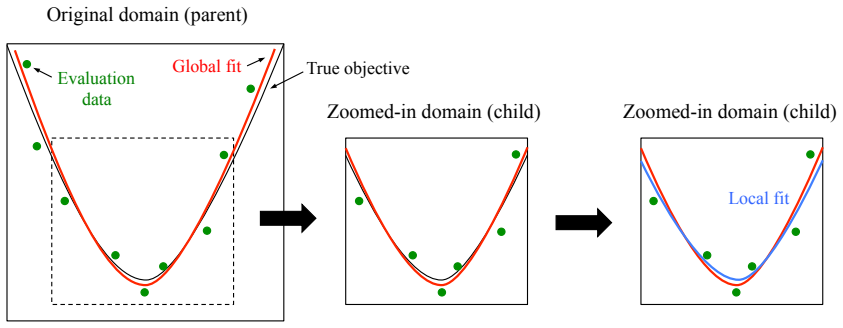
The load-bearing machinery is a weighted multiquadric radial-basis surrogate fitted by L2-regularized, exploitively weighted regression, paired with a stochastic response surface (SRS) candidate generator that mixes uniform Type-I points with Gaussian perturbations around the current surrogate best (Type-II). The tree-based zoom strategy shrinks the domain around the current best point by a factor rho and creates a child node; zoom-out happens with small probability beta, and a restart fires when the zoom level would make the domain resolution finer than r. The proof works because the zoom level is bounded by the restart rule and because, at every level, candidate generation is assumed to give a lower-bounded probability of hitting a small ball around the global minimizer.
What would settle it
Run ProSRS on a smooth noisy benchmark with a unique global minimizer, such as Ackley10 with the paper's noise level, and record for a fixed epsilon whether, over many runs, the best noisy evaluation enters the epsilon-ball around the global minimizer and whether the empirical frequency tends to one; alternatively, compute the minimum over iterations of the probability that a proposed point falls in that ball under the algorithm's own candidate dynamics. If that probability drops to zero for some epsilon, the imported lower-bound assumption fails.
Extended reading notes
Core claim
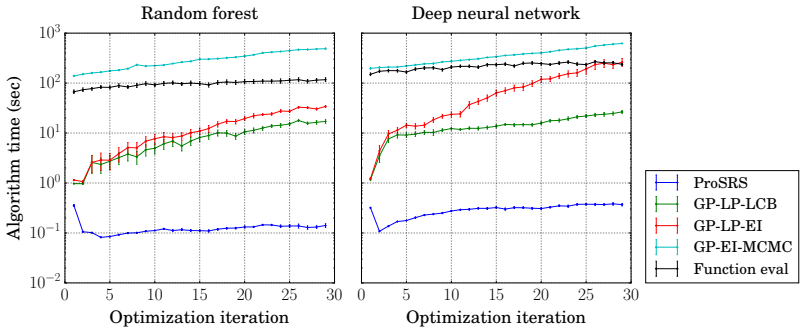
The paper's core claim is Theorem 1: for a continuous objective with a unique global minimizer, the best evaluated point (measured by the true function) converges almost surely to that minimizer. The proof combines a bounded tree depth, forced by the restart resolution parameter, with a positive lower bound on the chance that an iteration's candidate pool contains a point near the optimum. The practical companion claim is that this convergence comes at very low computational price: weighted radial-basis regression and discrete candidate scoring keep per-iteration cost nearly flat, whereas Gaussian-process training and acquisition maximization grow quickly with evaluation count.
Load-bearing premise
The convergence proof assumes that in every iteration a candidate point has at least a fixed positive probability of landing inside a small ball around the global minimizer, and that this guarantee is not destroyed by the zoom tree, the Type-II-only phase, or restarts.
Editorial extensions
If this is right
- With enough iterations, ProSRS is guaranteed to have evaluated a point arbitrarily close to the global minimum, making it a viable fallback for noisy expensive problems where random search is the only competitor.
- The per-iteration cost stays roughly constant over time because zooming and restarting keep the local evaluation set small, which is what makes the algorithm one to four orders of magnitude cheaper than GP-based parallel Bayesian optimization.
- Because multiple points are proposed per iteration and evaluated in parallel, wall-clock progress is not limited by the surrogate fitting step.
- The cross-validation procedure for the RBF regularization lets the surrogate adapt to data without Gaussian-process prior assumptions, which the paper argues explains much of the performance gain.
Reading between the lines
- The theorem concerns the best point by the true expected function, whereas the algorithm returns the point with lowest noisy value; the paper itself notes that a posterior ranking-and-selection step is needed, so the practical guarantee for the returned point is weaker than the theorem.
- The proof gives no convergence rate, so the paper's finite-budget advantage rests entirely on the empirical benchmarks; one should not infer that the zoom tree accelerates convergence in the asymptotic regime.
- The same zoom-on-demand idea could be grafted onto other surrogate families, such as local Gaussian-process fits, which might inherit the cost savings while keeping Bayesian uncertainty estimates; this is an extension the paper does not test.
- If the one-to-four-orders-of-magnitude cost gap holds in practice, it suggests that for many hyperparameter-tuning pipelines the surrogate's own compute, not the model training, is the real bottleneck.
Signed reviews
Editorial analysis
A structured set of objections, weighed in public.
Referee Report
Summary. The paper introduces ProSRS, a parallel surrogate optimization algorithm for noisy expensive black-box problems. ProSRS combines a tree-based 'zoom strategy' that recursively restricts attention to subdomains, a weighted radial-basis-function regression surrogate, and a stochastic response-surface candidate-generation step mixing uniform (Type I) and Gaussian-perturbation (Type II) points. The authors prove a convergence theorem (Theorem 1) claiming that, with probability converging to one, the best point among all evaluations by iteration n approaches the global minimizer. They also report numerical experiments on twelve benchmark functions and two hyperparameter-tuning problems, comparing ProSRS with three parallel Bayesian optimization methods (GP-EI-MCMC, GP-LP-LCB, GP-LP-EI) and claiming significantly faster convergence per iteration and one to four orders of magnitude lower computational cost.
Significance. If Theorem 1 and the empirical results hold, ProSRS would be a practically attractive alternative to Gaussian-process Bayesian optimization for expensive noisy parallel problems, especially when surrogate-building cost matters. The paper contributes a concrete algorithmic design, an explicit convergence theorem, public code, and a broad benchmark suite including real hyperparameter-tuning tasks. The central theoretical claim, however, depends on a bound imported from earlier work that is not re-derived for ProSRS's specific dynamics, and the proof's zoom-out argument has an unaccounted interruption mechanism. These issues are substantial but appear repairable, so the result is not yet established as stated.
major comments (2)
- [Appendix A, proof of Theorem 1, first paragraph after the definition of δ(ε)] The proof asserts that 'the probability that a candidate point generated in the root node (of either Type I or Type II) is located within the domain B(x_opt,δ(ε))∩D can be shown to be bounded from below by some positive ν(ε)' and cites Section 2 of Regis and Shoemaker [25]. This is the engine of the block argument leading to Eq. (8), but it is not established for ProSRS's actual candidate-generation dynamics. When p<0.1, Algorithm 2 generates zero Type I candidates and all candidates are Type II Gaussian perturbations around the current best x*, with σ potentially as low as σ_crit before a zoom/restart decision, and x* can be any evaluated point in the domain. A lower bound uniform over all such states and over root nodes reached after zoom-out is not derived in the manuscript. If the bound fails in any reachable state, the inequality P(A_i | A_1∩...∩A_{i-1}) ≤ 1−h(ε) is unsupported and Theorem 1 is not proven. I recommend adding an explicit lemma that derives a uniform positive lower bound for Type-II candidate distributions over all reachable (σ, x*) pairs, or modifying the algorithm so that a constant positive fraction of Type I points is always maintained.
- [Appendix A, case E2] In the E2 case, the proof lower-bounds the probability of reaching the root node by (β_min)^{z_{i-1}}, assuming the algorithm 'decide[s] to zoom out' for z_{i-1} consecutive iterations and that this returns it to the root. However, a zoom-out decision at Line 21 does not by itself decrease the zoom level if a zoom-in occurred earlier in the same iteration (Lines 12–17): zoom-in followed by zoom-out leaves the current node unchanged. The proof does not lower-bound the probability of avoiding such interruptions for z_{i-1} consecutive iterations, so the claimed bound P(A_i | ... ∩ E2) ≥ L(ε)(β_min)^{z_{i-1}} is not justified as written. This is a second load-bearing gap in the proof of Theorem 1.
minor comments (4)
- [Section 2.3, candidate-point mixture] The phrase 'a fraction of 1/10⌊10p⌋' is ambiguous; it should be written as (1/10)⌊10p⌋ or equivalent. As typeset, it could be read as 1/(10⌊10p⌋), which would contradict the later statement that all candidate points are Type II when p<0.1.
- [Section 3 and abstract] Theorem 1 concerns x_n, the point with the minimum true objective F among evaluations, whereas Algorithm 1 returns the point with the lowest noisy y. The authors acknowledge this gap in Section 3 and suggest posterior selection, but the abstract's phrase 'at least one point among all the evaluations' should be kept consistently in the conclusion as well, to avoid implying a guarantee on the returned point.
- [Section 4.1 and 4.2] The empirical claim of 'significantly faster' convergence is not supported by statistical significance tests or confidence intervals beyond standard-deviation error bars; adding a paired test or a similar comparison would strengthen the claim.
- [Section 2.5, restart condition (Eq. 4)] The restart condition is written inline and is easy to misread; presenting it as a displayed equation with the exact definition of l_i(Ω) and the role of n would improve clarity.
Circularity Check
No significant circularity: the convergence result is an imported-exploration theorem with an external proof, and the empirical comparisons are against external baselines; the identified proof gap is a correctness concern, not a circular reduction.
full rationale
Walking the derivation chain: Theorem 1 (Section 3/Appendix A) is proved by importing a lower bound ν(ε) from Regis and Shoemaker [25] for the probability that a candidate point in the root node falls in B(xopt,δ)∩D, then using block arguments and the zoom-out probability to show that with probability tending to 1 some block contains an iteration whose candidates all lie in that ball. This is an externally sourced stochastic-exploration condition, not an assumption equivalent to the theorem's conclusion, and it is not fitted to the benchmark data. The paper's own Section 3 explicitly disclaims that the returned point (lowest noisy y) is the x_n of the theorem, which is an acknowledged limitation/gap in the practical guarantee rather than a definitional circle. The numerical section compares ProSRS against GP-EI-MCMC, GP-LP-LCB, and GP-LP-EI on standard benchmark functions and two public machine-learning tuning tasks; the algorithm constants in Table 1 are hand-chosen, but there is no exhibited equation where a fitted parameter is renamed as a prediction or where the 'prediction' is the fit by construction. No load-bearing self-citation chain is present: [25] and [26] are prior work by different authors. The main legitimate concern—whether ν(ε) remains uniformly positive in ProSRS's p<0.1 pure-Type-II phase and after zooming—is an unverified assumption in the proof, properly classified as a correctness/verification risk, not circularity.
Assumptions & free parameters
free parameters (9)
- m: number of DOE samples =
ceil(3/Npar) * Npar
- Sinit: initial exploitation strengths (gamma, p, sigma) =
(0, 1, 0.1)
- sigma_crit =
0.025
- beta_init and beta_min =
0.02 and 0.01
- rho: zoom-in factor =
0.4
- r: restart resolution =
0.01
- Cfail =
max(ceil(d/Npar), 2)
- Delta_gamma =
2
- Benchmark noise standard deviations =
varies by function, e.g., Ackley10 = 1, Griewank10 = 2
assumptions (5)
- domain assumption F is continuous on a compact hyperrectangle and has a unique global minimizer with the near-optimal property that inf F outside any ball around xopt exceeds F(xopt).
- domain assumption In every iteration, the candidate-point generation has a positive lower-bounded probability nu(epsilon) of placing a candidate inside the target ball around the global minimizer.
- domain assumption Candidate points are generated independently across iterations and within an iteration.
- domain assumption Evaluations are noisy observations whose expectation is F, and the algorithm does not observe F directly.
- standard math The RBF surrogate with L2 regularization and cross-validated lambda has a unique solution.
Cite this review
Pith. "Pith review of A tree-based radial basis function method for noisy parallel surrogate optimization." pith.science (2026). https://pith.science/paper/OEU5HZ3B
@misc{pith2026190807980,
  author       = {Pith},
  title        = {Pith review of: A tree-based radial basis function method for noisy parallel surrogate optimization},
  year         = {2026},
  howpublished = {\url{https://pith.science/paper/OEU5HZ3B}},
  note         = {Machine review of arXiv:1908.07980}
}
read the original abstract
Parallel surrogate optimization algorithms have proven to be efficient methods for solving expensive noisy optimization problems. In this work we develop a new parallel surrogate optimization algorithm (ProSRS), using a novel tree-based "zoom strategy" to improve the efficiency of the algorithm. We prove that if ProSRS is run for sufficiently long, with probability converging to one there will be at least one point among all the evaluations that will be arbitrarily close to the global minimum. We compare our algorithm to several state-of-the-art Bayesian optimization algorithms on a suite of standard benchmark functions and two real machine learning hyperparameter-tuning problems. We find that our algorithm not only achieves significantly faster optimization convergence, but is also 1-4 orders of magnitude cheaper in computational cost.
Figures


Figures from the paper (5 more)



Reference graph
Works this paper leans on
-
[25]
R. G. Regis and C. A. Shoemaker. A stochastic radial basis function method for the global optimization of expensive functions.INFORMS Journal on Computing, 19(4):497–509, 2007
work page 2007
-
[1]
URL https://www.tensorflow.org/versions/r1.1/get_started/mnist/ beginners
Tensorflow tutorial. URL https://www.tensorflow.org/versions/r1.1/get_started/mnist/ beginners
-
[2]
S. Amaran, N. V. Sahinidis, B. Sharda, and S. J. Bury. Simulation optimization: a review of algorithms and applications. Annals of Operations Research, 240(1):351–380, May 2016. 13 100 101 102 Total time (min) 0.135 0.140 0.145 0.150 0.155 0.160 Cross-validation error Random forest 101 102 Total time (min) 0.02 0.04 0.06 0.08 0.10 0.12 Validation error De...
work page 2016
- [3]
-
[4]
J. Bergstra and Y. Bengio. Random search for hyper-parameter optimization.Journal of Machine Learning Research, 13(2):281–305, 2012
work page 2012
- [5]
-
[6]
A. Carpentier and M. Valko. Simple regret for infinitely many armed bandits. InInternational Conference on Machine Learning, pages 1133–1141, 2015
work page 2015
-
[7]
X. M. Chen, L. Zhang, X. He, C. Xiong, and Z. Li. Surrogate-based optimization of expensive-to- evaluate objective for optimal highway toll charges in transportation network.Computer-Aided Civil and Infrastructure Engineering, 29(5):359–381, 2014
work page 2014
Show all 34 references
-
[8]
A. R. Conn, K. Scheinberg, and Ph. L. Toint. Recent progress in unconstrained nonlinear optimization without derivatives.Mathematical Programming, 79(1):397–414, 1997
1997
-
[9]
Contal, D
E. Contal, D. Buffoni, A. Robicquet, and N. Vayatis. Parallel Gaussian process optimization with upper confidence bound and pure exploration. InJoint European Conference on Machine Learning and Knowledge Discovery in Databases, pages 225–240. Springer, 2013
2013
-
[10]
Desautels, A
T. Desautels, A. Krause, and J. W. Burdick. Parallelizing exploration-exploitation tradeoffs in Gaussian process bandit optimization.The Journal of Machine Learning Research, 15(1):3873–3923, 2014
2014
-
[11]
Dheeru and E
D. Dheeru and E. Karra Taniskidou. UCI machine learning repository, 2017. URLhttps://archive. ics.uci.edu/ml
2017
-
[12]
González, Z
J. González, Z. Dai, P. Hennig, and N. Lawrence. Batch Bayesian optimization via local penalization. In Artificial Intelligence and Statistics, pages 648–657, 2016. URLhttps://github.com/SheffieldML/ GPyOpt
2016
-
[13]
R. T. Haftka, D. Villanueva, and A. Chaudhuri. Parallel surrogate-assisted global optimization with expensive functions–a survey.Structural and Multidisciplinary Optimization, 54(1):3–13, 2016
2016
-
[14]
Köchel and U
P. Köchel and U. Nieländer. Simulation-based optimisation of multi-echelon inventory systems.Interna- tional Journal of Production Economics, 93:505–513, 2005. 14
2005
-
[15]
LeCun, C
Y. LeCun, C. Cortes, and C. J. C. Burges. The MNIST database of handwritten digits. URL http://yann.lecun.com/exdb/mnist/
-
[16]
Li and Y
H. Li and Y. Xia. Infinitely many-armed bandits with budget constraints. InThirty-First AAAI Conference on Artificial Intelligence, 2017
2017
-
[17]
B. L. Nelson, J. Swann, D. Goldsman, and W. Song. Simple procedures for selecting the best simulated system when the number of alternatives is large.Operations Research, 49(6):950–963, 2001
2001
-
[18]
E. C. Ni, S. R. Hunter, and S. G. Henderson. Ranking and selection in a high performance computing environment. InSimulation Conference (WSC), 2013 Winter, pages 833–845. IEEE, 2013
2013
-
[19]
Osorio and M
C. Osorio and M. Bierlaire. A simulation-based optimization approach to perform urban traffic control. In TRISTAN VII, Triennial Symposium on Transportation Analysis, number EPFL-TALK-152410, 2010
2010
-
[20]
Prakash, G
P. Prakash, G. Deng, M. C. Converse, J. G. Webster, D. M. Mahvi, and M. C. Ferris. Design optimization of a robust sleeve antenna for hepatic microwave ablation.Physics in Medicine and Biology, 53(4):1057, 2008
2008
-
[21]
Quinonero-Candela and C
J. Quinonero-Candela and C. E. Rasmussen. Analysis of some methods for reduced rank Gaussian process regression. InSwitching and Learning in Feedback Systems, pages 98–127. Springer, 2005
2005
-
[22]
Rakshit, A
P. Rakshit, A. Konar, and S. Das. Noisy evolutionary optimization algorithms – a comprehensive survey. Swarm and Evolutionary Computation, 2016
2016
-
[23]
C. E. Rasmussen and C. K. I. Williams.Gaussian Processes for Machine Learning, volume 1. MIT Press Cambridge, 2006
2006
-
[24]
R. G. Regis. Trust regions in Kriging-based optimization with expected improvement.Engineering Optimization, 48(6):1037–1059, 2016
2016
-
[26]
R. G. Regis and C. A. Shoemaker. Parallel stochastic global optimization using radial basis functions. INFORMS Journal on Computing, 21(3):411–426, 2009
2009
-
[27]
P. A. Romero, A. Krause, and F. H. Arnold. Navigating the protein fitness landscape with Gaussian processes. Proceedings of the National Academy of Sciences, 110(3):E193–E201, 2013
2013
-
[28]
Shah and Z
A. Shah and Z. Ghahramani. Parallel predictive entropy search for batch global optimization of expensive objective functions. InAdvances in Neural Information Processing Systems, pages 3330–3338, 2015
2015
-
[29]
Snoek, H
J. Snoek, H. Larochelle, and R. P. Adams. Practical Bayesian optimization of machine learning algorithms. In Advances in Neural Information Processing Systems, pages 2951–2959, 2012. URL https://github.com/JasperSnoek/spearmint
2012
-
[30]
J. C. Spall.Introduction to Stochastic Search and Optimization: Estimation, Simulation, and Control, volume 65. John Wiley & Sons, 2005
2005
-
[31]
Wang, J.-Y
Y. Wang, J.-Y. Audibert, and R. Munos. Algorithms for infinitely many-armed bandits. InAdvances in Neural Information Processing Systems, pages 1729–1736, 2009
2009
-
[32]
Wu and P
J. Wu and P. Frazier. The parallel knowledge gradient method for batch Bayesian optimization. In Advances in Neural Information Processing Systems, pages 3126–3134, 2016
2016
-
[33]
J. Wu, M. Poloczek, A. G. Wilson, and P. Frazier. Bayesian optimization with gradients. InAdvances in Neural Information Processing Systems, pages 5267–5278, 2017. 15
2017
-
[34]
J. Xie, P. I. Frazier, S. Sankaran, A. Marsden, and S. Elmohamed. Optimization of computationally expensive simulations with Gaussian processes and parameter uncertainty: Application to cardiovascular surgery. InCommunication, Control, and Computing (Allerton), 2012 50th Annua...
2012
Reviewed August 14, 2026 · model on record in the stance chip above.
Discussion (0). Continue with ORCID to comment.