REVIEW 4 major objections 6 minor 35 references
Glitching pulsars: unraveling the interactions of general relativity with quantum fields in the strong field regimes
T0 review · 4 major / 6 minor · reviewed 2026-08-14 · deepseek-v4-flash
Pith's one-line read This paper argues that glitching pulsars contain an incompressible superfluid core embedded in flat spacetime, surrounded by ordinary matter in Schwarzschild spacetime, and that each glitch is a discrete growth event of the core.
desk verdict Imaginative unification of glitches and the mass gap, but the flat-core claim contradicts the paper's own Einstein equations and rests on a false premise about GR. read the letter →
The pith
A machine-rendered reading of the paper's core claim, the machinery that carries it, and where it could break.
The reading
What carries the argument
The load-bearing machinery is a bimetric spacetime decomposition: a Minkowski metric inside the core and a Schwarzschild metric outside, with the Tolman-Oppenheimer-Volkoff equation solved in the outer region using a total enclosed mass that includes the SuSu-core. Discreteness of growth comes from the Onsager-Feynman quantization condition $\oint \mathbf{v}\cdot d\boldsymbol{\ell}=2\pi\hbar N/m^*$, and the rate is set by an energy-conservation estimate for the rotating core, $\delta R_{\mathrm{BL}}/R \approx (2/5)(\delta\Omega/\Omega)$, which yields boundary-layer widths growing from $O(10^{-7})$ cm at birth to $O(1)$ cm at ten million years. The strong nuclear force, transmitted by vector mesons and the gluon cloud of the super-baryon, is the agent that drives the equation of state toward $P=\varepsilon$ and changes the spacetime topology in the boundary layer.
What would settle it
Solve the TOV equation for a spherically symmetric star whose core obeys the paper's incompressible equation of state $P=\varepsilon$ and ask whether a regular curved interior solution with finite central pressure exists. The standard interior Schwarzschild solution for a uniform-density star already provides a curved interior for incompressible matter, so its existence is a concrete check: if a regular curved solution exists for the stated equation of state, the causal argument that forces the core to be flat is false.
Extended reading notes
Core claim
The central claim is that the spacetime around glitching pulsars is bimetric: flat Minkowski spacetime inside the SuSu-core and Schwarzschild spacetime outside. The paper argues that this split follows from causality because an incompressible, zero-entropy superfluid cannot sustain spatial stratification, and because general relativity is said to be unable to model gravitationally bound incompressible matter. The SuSu-core grows discretely as its boundary layer merges with it, expelling quantized vortices into the ambient medium, with each expulsion corresponding to an observed glitch. The growth is governed by the Onsager-Feynman condition, and the strong nuclear force, acting through the gluon cloud of a super-baryon, drives both the phase transition and the topology change. By the end of the pulsar's luminous lifetime, the Schwarzschild radius approaches the object's radius and the remnant becomes observationally indistinguishable from a black hole, which the paper connects to the mass gap and to the GW170817 merger.
Load-bearing premise
The entire construction rests on the premise that general relativity cannot describe gravitationally bound incompressible matter, so any incompressible core must live in flat spacetime; if that premise fails, the proposed split between a flat core and a curved outer spacetime loses its justification.
Editorial extensions
If this is right
- Each glitch becomes a discrete core-growth event: the boundary layer merges with the core and vortices are expelled on timescales below $10^{-10}$ s, after slow accumulation over roughly two years.
- The boundary-layer width grows from $O(10^{-7})$ cm at pulsar birth to $O(1)$ cm after about ten million years, giving a quantitative sequence that can be compared with Crab and Vela glitches.
- As the SuSu-core grows, the gravitational redshift of the object increases, and the final remnant has a radius nearly equal to its Schwarzschild radius, making it invisible from afar.
- The model predicts that neither neutron stars nor black holes should be observed in the roughly $2\text{--}5\,M_\odot$ range, because such objects would already have metamorphosed into invisible SuSu remnants; the ambiguous classification of the GW170817 remnant is cited as supporting evidence.
Reading between the lines
- A testable extension the authors do not compute is a junction-condition analysis: if the flat core is real, the boundary between flat and Schwarzschild spacetime must be matchable through a thin transition layer with specific surface stresses, and constructing that layer would give a clean consistency check.
- The model implies that old pulsars in the mass gap should be invisible except gravitationally, so searches for gravitational lensing or for dark companions in binaries could turn up SuSu remnants even though no electromagnetic signal is predicted.
- Because the boundary-layer width reaches $O(1)$ cm by ten million years, future gravitational-wave observatories with sensitivity far beyond current ones might see transient bursts at glitches, whereas the paper only states that current detectors are not sensitive enough.
- One could also test the predicted geometric spacing of glitch events: if core growth follows the $\{\alpha_c^n\}$ sequence, the fractional frequency jumps of successive glitches should follow a stationary pattern across many glitches, which long pulsar timing datasets could check.
Signed reviews
Editorial analysis
A structured set of objections, weighed in public.
Referee Report
Summary. The paper proposes a modification of the authors' earlier model of pulsar glitches. It posits that pulsars contain an embryonic core of 'purely incompressible superconducting gluon-quark superfluid' (SuSu-core) that grows discretely over time as the pulsar cools and spins down. The central new claim is that the spacetime around a glitching pulsar is bimetric: the SuSu-core is embedded in flat Minkowski spacetime, while the surrounding compressible baryonic matter is described by Schwarzschild spacetime. The paper argues that this split is required because, in its view, general relativity cannot model gravitationally bound incompressible matter and causality forbids stratification of incompressible superfluids. The growth of the core is tied to the Onsager-Feynman quantization of circulation, and the strong nuclear force is claimed to change the topology of spacetime in the boundary layer, with its effective length scale increasing with pulsar age. The authors present numerical solutions of the TOV equation with a modified mass term, compare boundary-layer widths with Vela and Crab glitch observations, and conclude that old pulsars become invisible 'dark energy objects' indistinguishable from stellar black holes.
Significance. The scenario described in this manuscript is original and ambitious: it connects pulsar glitches to the growth of an incompressible quark-gluon superfluid core embedded in flat spacetime, with the strong nuclear force allegedly acting as a spacetime-topology-changing agent on macroscopic scales. If the construction were correct, it would have implications for the neutron-star equation of state, for the existence of a stellar-mass black-hole mass gap, and for gravitational-wave emission during glitches. These are interesting questions, and the paper contains a concrete, falsifiable phenomenological picture. However, the manuscript does not provide a valid derivation of its central claim: the flat-core assumption violates the very Einstein equations it adopts, the premise about GR and incompressible matter is contradicted by the standard Schwarzschild interior solution, and the quantitative outputs are largely imported from the authors' prior self-cited works or fitted to the Vela and Crab data. The paper therefore does not establish its claimed results, and its present significance as a scientific contribution is low.
major comments (4)
- [Sec. I.A, Eqs. (1), (4), (7)] The core construction contradicts the field equations the paper sets out to solve. Equation (1) states G_μν = κ T_μν, but the proposed SuSu-core is embedded in the Minkowski metric of Eq. (4), whose Einstein tensor is identically zero, while the core is assigned a non-vanishing energy density ε_tot = 2ε_0 > 0 and zero pressure. Equation (7) confirms that the core carries mass by integrating (ε_b + ε_φ) over the core volume, so it is not a vacuum region. The paper offers no modified field equations or alternative action that would allow a non-vacuum stress-energy tensor in flat spacetime; hence the flat-core condition is imposed rather than derived, and the central bimetric construction is not a solution of the stated theory.
- [Sec. I.A (premise on incompressible matter)] The load-bearing premise that 'GR is incapable of modeling gravitationally bound incompressible matter' is factually incorrect. The Schwarzschild interior solution for a constant-density star (ε = const) is the standard GR model of an incompressible stellar fluid; it satisfies the TOV equation (3) and possesses a finite central pressure for R > (9/8) r_s. The additional causality claim that flat spacetime is required for a zero-entropy incompressible superfluid is asserted without derivation. No calculation in the paper shows that a zero-entropy superfluid escapes the Einstein equations, and even a zero-entropy perfect fluid has a non-vanishing stress-energy tensor that must curve spacetime. Since this premise is the sole justification for the bimetric split, the central claim collapses if it is false.
- [Sec. II (topology change and SNF)] The statement that 'the topological change of spacetime is derived by the strong nuclear force' is not supported by any equation or quantitative calculation in the manuscript. The paper does not specify how the strong force, whose natural range is the nucleon scale, could change the topology or metric of spacetime in the boundary layer, nor does it derive the growth of the operating length scale to O(1) cm. The values in Eq. (10) are, by the authors' own admission, 'chosen to enable partial comparison with observations of the glitch events of Vela and Crab pulsars,' and the values in Eq. (12) are extrapolations from these choices and from the sequence {α_n^c} of Ref. [18]. The macroscopic SNF length scale is therefore an input fitted to observations, not a prediction of the model.
- [Sec. II (testability and circularity)] The quantitative content of the model is largely imported from the authors' previous works rather than derived within the present framework. The core radii used in the calculations (0.333, 0.525, 0.78525, 0.8575) are taken from Refs. [14-16], the glitch sequence {α_n^c} and the Vela-Crab inertia relation of Eq. (11) come from Ref. [18], and the initial conditions (M = 1.33 M_sun, α_s = 1/2, ρ_c = 3ρ_0, polytropic EOS) are set without independent justification. As a result, the claimed consistency with Vela and Crab glitch observations does not constitute an independent test of the bimetric-spacetime hypothesis; the model reproduces inputs rather than generating testable predictions from first principles.
minor comments (6)
- [Abstract] The abstract contains the ungrammatical phrase 'The model presented here model is in line with the recent radio and GW observations of pulsars and NSs,' with a duplicated word 'model'; the claimed agreement with observations is also not substantiated in the body of the paper.
- [References] Reference [18] is listed twice with different article numbers (jmp.2018.94038 and jmp.2018.94037); the bibliography should be renumbered and each entry reported consistently.
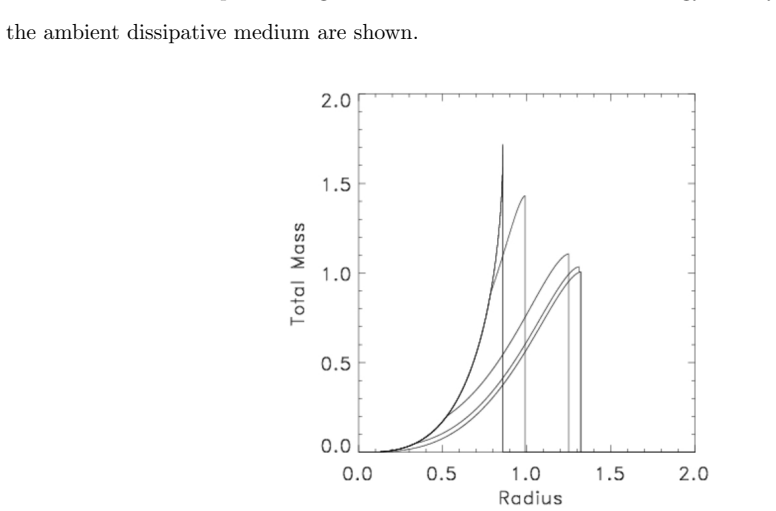
- [Secs. I.A.1 and I.2] The core-radius sequence is inconsistent: Sec. I.A.1 lists R_SuSu = 0.333, 0.525, 0.78525, 0.8575, while Sec. I.2 states RSB = 0.333, 0.525, 0.78525 and 0.7875; Fig. 4 mentions six epochs while the text describes five runs, and Fig. 10 refers to Profile '6' although only five profiles are presented.
- [Eq. (7) and Sec. I.A] Equation (7) writes m_tot = ∫ (ε_b + ε_φ) dr without the 4π r^2 volume factor and without specifying the integration limits; the earlier expression for m(r) in Sec. I.A also omits the dr in the integrand '∫ ρ r^2 dr'.
- [Eqs. (2)-(4)] The metric in Eq. (4) is written with an explicit c^2 dt^2 term while the rest of the paper uses geometric units (c = 1) in Eqs. (1)-(3); the notation should be made consistent. Also, 'Schwartzschild' is misspelled in several places.
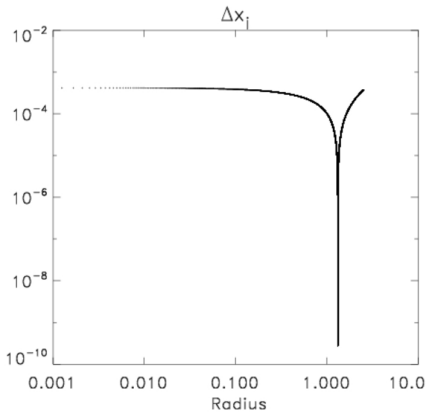
- [Figs. 9 and 10] Figs. 9 and 10 are said to be obtained from direct numerical computations, but no numerical scheme, discretization, or code is described other than the qualitative EAMR description; this makes the reported profiles irreproducible.
Circularity Check
Boundary-layer widths and the glitch/core-size sequence are chosen from prior papers or for Vela/Crab, so the headline O(1) cm length-scale growth is an input, not a prediction; the flat-core claim is an asserted ansatz.
-
fitted input called prediction
[Sec. I.A.2, Eqs. (10) and (12)]
"The values at τage = 1000, 10000 yrs and τage = 10 Myr are chosen to enable partial comparison with observations of the glitch events of Vela and Crab pulsars. On the other hand the numerical values have been selected from the sequence {αn c} displayed in Fig.(8) of [18]."
The boundary-layer widths δR^n_BL/R^n_SB in Eq. (10) are not derived predictions; they are explicitly 'chosen' and 'selected' to match Vela and Crab epochs. Eq. (12) converts these same chosen widths into the abstract's headline claim that the strong-nuclear-force length scale 'increase[s] with time to reach O(1) cm.' The O(1) cm final value is therefore an input, not a first-principles result.
-
self citation load bearing
[Sec. I.A.2 and Sec. II; glitch sequence and Eq. (11)]
"Based on the previous study [18], five episodes in the cosmological evolution of pulsars have been selected (see Fig. 4). ... Following the analysis and Eqs. (13, 14, 15) in [18], the correlation of the inertia of the ambient dissipative media, IAM, of the Crab and Vela pulsars reads: IVelaAM ≈ 10−2ICrabAM, (11)"
Every epoch-dependent input—the core radii R_SuSu = 0.333, 0.525, 0.78525, 0.8575, the glitch sequence {α^n_c}, and the Vela/Crab inertia relation—is taken from Hujeirat's own prior papers [14, 15, 16, 18]. The paper then presents the resulting discrete core growth and glitch events as the model's predictions. This is a load-bearing self-citation chain: the predicted sequence is the imported sequence, with no independent derivation in the present work.
1 more flagged steps
-
other
[Sec. I.A, Eq. (4) and boundary conditions]
"Recalling that GR is incapable of modeling gravitationally bound incompressible matter, then the spacetime embedding pulsars may be decomposed into two separate domains: a flat spacetime that embeds the SuSu-core and a surrounding Schwartzschild spacetime that embeds the ambient media as mentioned above. The decomposition of the domain is motivated by relativistic causality which prohibits fluid stratification or spatial variation of the density of purely incompressible fluids; hence the spacetime embedding the core must have zero-curvature, i.e. purely flat."
The flatness of the core is not derived from Eq. (1); it is the content of the prior assertion that GR cannot model incompressible matter. The paper defines the SuSu-core as having zero spatial variation and then presents zero curvature as a consequence. Moreover, with ε_tot = 2ε0 and P_tot = 0, the flat metric cannot solve G_μν = κT_μν (Einstein tensor zero, stress-energy nonzero), so the bimetric split is an imposed ansatz, not a derived result.
full rationale
The derivation chain collapses at three points. First, Eq. (10) is the load-bearing 'prediction' of the abstract—the growth of the strong-nuclear-force length scale to O(1) cm—but the numbers in Eq. (10) are explicitly chosen and selected from the authors' own [18] sequence, so the O(1 cm) value is an input, not a derived outcome. Second, the discrete core growth, the glitch sequence {α^n_c}, and the Vela/Crab inertia relation are imported from [14, 15, 16, 18] without independent derivation; the paper's predicted evolution is the self-cited sequence. Third, the central bimetric claim that the SuSu-core is flat is asserted via 'GR is incapable of modeling gravitationally bound incompressible matter' and a causality argument, which is contradicted by the paper's own Eq. (1): a Minkowski core with ε_tot = 2ε0 and P_tot = 0 violates G = κT. The standard Schwarzschild interior solution for constant-density stars shows GR can model incompressible cores, so the premise is unsupported. These are not merely stylistic self-citations; they bear the central claims. The score is 6 because the headline prediction reduces to fitted and imported inputs, although some algebraic pieces, such as Eqs. (8)-(9) from rotational-energy conservation, are self-contained derivations.
Assumptions & free parameters
free parameters (7)
- Initial pulsar mass =
1.33 M_sun
- Initial compactness alpha_s =
0.5
- Critical density rho_c =
3 rho_0
- Polytropic EOS constants K and gamma =
Adapted
- SuSu-core radii at selected epochs =
0.333, 0.525, 0.78525, 0.8575 in units of R-tilde
- Scalar field potential V(phi) =
epsilon_0, giving P_tot = 0
- Initial glitch ratio, spin, and magnetic field =
alpha_c = 3.5e-10, Omega = 1400/s, B = 1e13 G
assumptions (7)
- standard math Einstein field equations and the TOV equation describe the compressible ambient medium.
- domain assumption Onsager-Feynmann quantization of circulation applies to the SuSu-core.
- ad hoc to paper A purely incompressible superfluid cannot be embedded in curved spacetime; causality requires flat spacetime.
- ad hoc to paper General relativity cannot model gravitationally bound incompressible matter.
- ad hoc to paper The strong nuclear force can operate on macroscopic length scales and change spacetime topology.
- ad hoc to paper The scalar field phi is constant inside the core, with V(phi) representing quark deconfinement energy.
- domain assumption High-density equations of state converge to P = epsilon, corresponding to incompressible matter.
invented entities (3)
-
SuSu-core (incompressible superconducting gluon-quark superfluid core)
-
Super-baryon / global gluon cloud
-
Dark energy object (final invisible SuSu object)
Cite this review
Pith. "Pith review of Glitching pulsars: unraveling the interactions of general relativity with quantum fields in the strong field regimes." pith.science (2026). https://pith.science/paper/A6F4EW7G
@misc{pith2026190807986,
  author       = {Pith},
  title        = {Pith review of: Glitching pulsars: unraveling the interactions of general relativity with quantum fields in the strong field regimes},
  year         = {2026},
  howpublished = {\url{https://pith.science/paper/A6F4EW7G}},
  note         = {Machine review of arXiv:1908.07986}
}
read the original abstract
We present a modification of our previous model for the mechanisms underlying the glitch phenomena in pulsars and young neutron stars. Accordingly, pulsars are born with embryonic cores comprising of purely incompressible superconducting gluon-quark superfluid (henceforth SuSu-cores). As the ambient medium cools and spins down due to emission of magnetic dipole radiation, the mass and size of SuSu-cores are set to grow discretely with time, in accordance with the Onsager-Feynmann analysis of superfluidity. Presently, we propose that the spacetime embedding glitching pulsars is dynamical and of bimetric nature: inside SuSu-cores the spacetime must be flat, whereas the surrounding region, where the matter is compressible and dissipative, the spacetime is Schwarzschild. It is further proposed that the topological change of spacetime is derived by the strong nuclear force, whose operating length scales is found to increase with time to reach O(1) cm at the end of the luminous lifetimes of pulsars. The model presented here model is in line with the recent radio and GW observations of pulsars and NSs.
Figures


Figures from the paper (8 more)




Reference graph
Works this paper leans on
-
[18]
(2007), Special and General Relativity
Glendenning, N. (2007), Special and General Relativity. Springer, Berlin https://doi.org/10.1007/978- 0-387-47109-9
doi:10.1007/978- 2007
-
[1]
The observed spin-down of UCSs results from the loss of magnetic and rotational energies that 2 are estimated to be of order 10 38 erg/s. This would imply complete exhaustion of the stored removable energies 1 inside pulsars within about ten million years, provided that the heat conductivity operates on length scales that are larger than the nuclear ones....
-
[2]
The rest of thermal, kinetic and magnetic energies that are left from the collapse of the progenitors of UCSs are transported outwards into the outer shells and subsequently liberated away. In the absence of nuclear energy generation, the Tolman-Oppenheimer-Volkoff equation (TOV-equation) may still accept a positive gradient of the thermal energy, turning ...
-
[3]
However, this state corresponds to pure incompressible fluids [14]
Theoretical studies show that in the regime of nuclear density and beyond, almost all EOSs used for modeling state of matter in the interiors of UCSs tend to converge to the limiting case ε = P (see [6] and the references therein). However, this state corresponds to pure incompressible fluids [14]. Due to causality and stability reasons, except rest energy...
-
[4]
Based on astronomical observations, there appears to be a gab in the mass spectrum of ultra- compact objects: neither black holes nor NSs have ever been observed in the mass range [2M⊙ <M < 5M⊙]. Moreover, intensive astronomical observations of the newly detected NS-merger GW170817 [1] failed to unambiguously classify whether the resulting object is a ste...
-
[5]
Initial and boundary conditions The present scenario is based on a previous model for the origin of glitches in pulsars. Accordingly, pulsars and young neutron stars are expected to undergo billions of glitch events during their luminous lifetimes before ending as ultra-compact and invisible dark energy objects. In the present study, we select several epo...
-
[6]
Model-0: The pulsar is made of purely baryonic matter. Here, the TOV-equation is solved for the pressure starting from a given P (r = 0) =P0 up to a radius, where the pressure vanishes
-
[7]
Combined-models: The pulsar models are made both of SuSu-cores surrounded by dissipative and compressible quantum fluid.The radii of the cores are: RSuSu = 0.333, 0.525, 0.78525, 0.8575. The total mass of the core is calculated through the integra- tion: mtot(r =Rcore) = ∫ Rcore 0 (εb +εφ)dr. (7) The solutions here are based on adapting the parameters K an...
Show all 35 references
-
[8]
and MSuSu ≈ MSchw
The ultimate final phase: Here the radius and mass of the SuSu-core are roughly equal to the critical values: RSuSu = 0.859≈ RSchw. and MSuSu ≈ MSchw.. Here the initial pulsar must have metamorphosed entirely into an invisible SuSu-object
-
[9]
Results For enhancing the spatial accuracy of the calculations, an explicit adaptive mesh refinement (EAMR) has been developed, in which the aspect ratio, drmax/drmin, may reach 100 million. Unlike dynamic adaptive mesh refinement (AMR), EAMR is based on a posteriori refining the...
-
[10]
The values at τage = 1000, 10000 yrs and τage = 10 Myr are chosen to enable partial comparison with observations of the glitch events of Vela and Crab pulsars
for further details). The values at τage = 1000, 10000 yrs and τage = 10 Myr are chosen to enable partial comparison with observations of the glitch events of Vela and Crab pulsars. On the other hand the numerical values have been selected from the sequence {αn c} displayed in...
-
[11]
(2007), Progress in Particle and Nuclear Physics, 351, 58
Bethke, S. (2007), Progress in Particle and Nuclear Physics, 351, 58
2007
-
[12]
Abbott, B.P. et al. (2017), GW170817, Phys. Rev. Lett., Band 119, S. 161101
2017
-
[13]
& Yakovlev, D.G
Haensel, P., Potekhin, A.Y. & Yakovlev, D.G. (2007) ”Neutron stars 1”, Springer
2007
-
[14]
(2011) MNRAS, 414, 1679
Espinoza, C.M., Lyne, A.G., Stappers, B.W., Kramer, C. (2011) MNRAS, 414, 1679. https://doi.org/10.1111/j.1365-2966.2011.18503.x
2011
-
[15]
(2014) Int
Eya, I.O., Urama, J.O. (2014) Int. J. of Astrophysics and Space Science, 2, 16
2014
-
[16]
LHCb Collaboration (2015) Physical Review Letters, 115, Article ID: 072001
2015
-
[17]
(2007), Compact Objects in Astrophysics, Springer, Heidelberg
Camenzind, M. (2007), Compact Objects in Astrophysics, Springer, Heidelberg
2007
-
[19]
Hujeirat, A.A., Thielemann, F-K., (2009) MNRAS, 400, 903 https://doi.org/10.1111/j.1365- 2966.2009.15498.x
2009
-
[20]
(1979) , Phys
Yarmchuk, E.J., Gordon, M.J.V & Packard R.E. (1979) , Phys. Rev. Lett., 43,214 18
1979
-
[21]
(1999) A&A, 344, 151
Haensel, P., Lasota, J.P., Zdunik, J.L. (1999) A&A, 344, 151
1999
-
[22]
(2007), Phys Rev Lett 99(26):265302
Walmsley PM, Golov AI, et al. (2007), Phys Rev Lett 99(26):265302
2007
-
[23]
(1994) ApJ Letters, 423, L117
Cook, G.B., Shapiro, S.L., Teukolsky, S.A. (1994) ApJ Letters, 423, L117
1994
-
[24]
1” corresponds to the low “Z
and the references therein). Based on the previous study [18], five episodes in the cosmological evolution of pulsars have been selected (see Fig. 4). For each episode, the TOV equation, modified to include dark energy input at the background of the here-presented bimetric scena...
-
[25]
(1984) Physical Review D, Volu
Witten, E. (1984) Physical Review D, Volu. 30, Issue 2
1984
-
[26]
Hujeirat, A.A. (2018). Journal of Modern Physics, 9, 51-69. https://doi.org/10.4236/jmp.2018.91004
2018
-
[27]
(2018), Journal of Modern Physics, 9, 70-83
Hujeirat, A.A. (2018), Journal of Modern Physics, 9, 70-83. https://doi.org/10.4236/jmp.2018.91005
2018
-
[28]
(2012) MNRAS, 423.2893
Hujeirat, A.A. (2012) MNRAS, 423.2893
2012
-
[29]
(2018), Journal of Modern Physics, 9, 4, jmp.2018.94038
Hujeirat, A.A. (2018), Journal of Modern Physics, 9, 4, jmp.2018.94038
2018
-
[30]
(2018), Journal of Modern Physics, 9, 4, jmp.2018.94037
Hujeirat, A.A. (2018), Journal of Modern Physics, 9, 4, jmp.2018.94037
2018
-
[31]
& Yunes, N., (2019) ”The new frontier of gravitational waves”
Miller, M.C. & Yunes, N., (2019) ”The new frontier of gravitational waves”
2019
-
[32]
Tanabashi, M. et al. Particle Data Group (2018), Phys. Rev. D 98, 030001
2018
-
[33]
& Freire, P
Ozel, F. & Freire, P. (2016), Annu. Rev. Astron. Astrophys., 54, 401
2016
-
[34]
PHENIX Collaboration, (2019), Nature Physics, VOL 15, P 214220
2019
-
[35]
Fischer, M., Hujeirat, A.A., (2019), in preparation 19
2019
Reviewed August 14, 2026 · model on record in the stance chip above.
Discussion (0). Continue with ORCID to comment.