REVIEW 5 major objections 6 minor 18 references
Mapping of Local and Global Synapses on Spiking Neuromorphic Hardware
T0 review · 5 major / 6 minor · reviewed 2026-08-14 · deepseek-v4-flash
Pith's one-line read A particle-swarm partitioner for spiking networks cuts global-interconnect energy by 33% and spike latency by 22% on average.
desk verdict Solid engineering paper with a genuinely useful PSO mapping framework, but the headline 33% energy claim is a subset average that overstates the evidence. read the letter →
The pith
A machine-rendered reading of the paper's core claim, the machinery that carries it, and where it could break.
The reading
What carries the argument
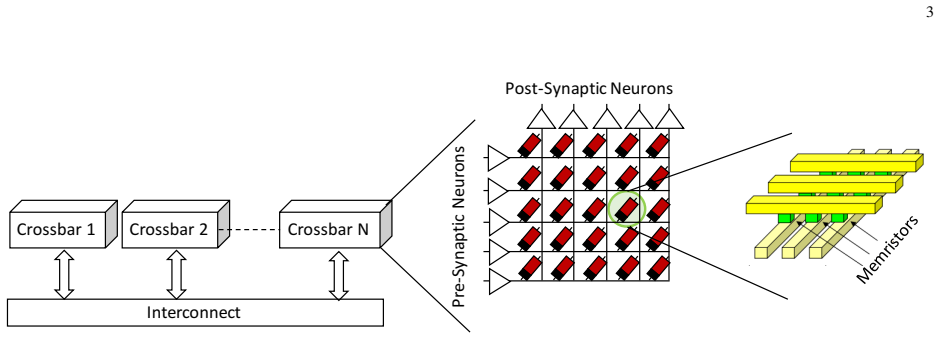
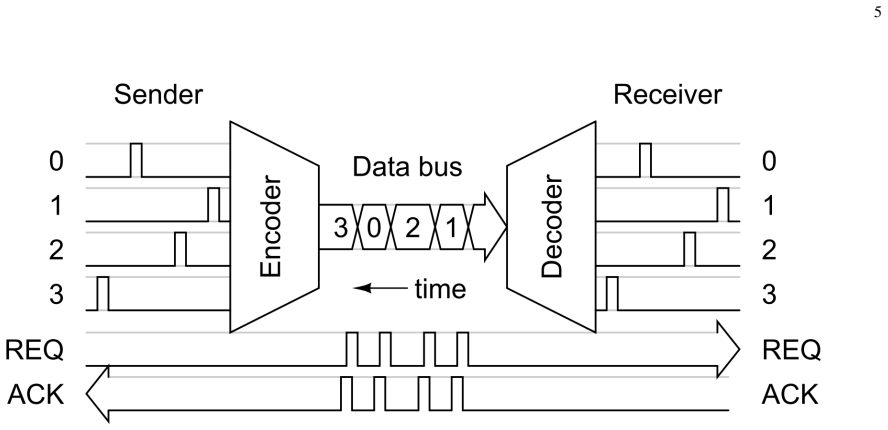
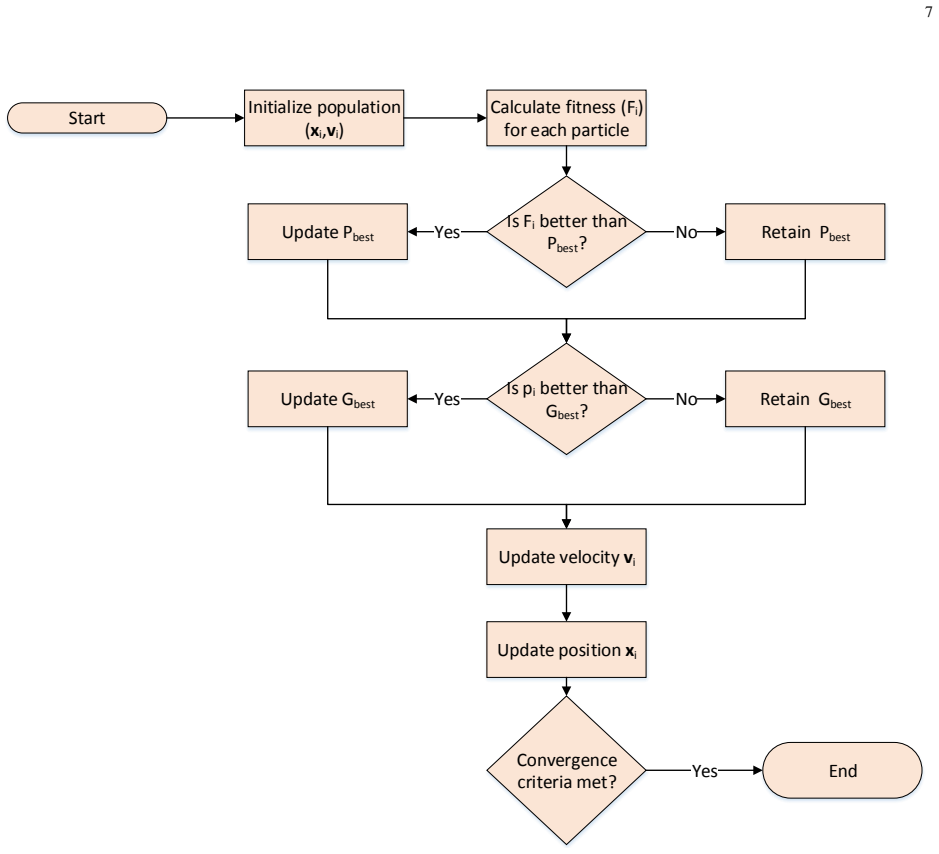
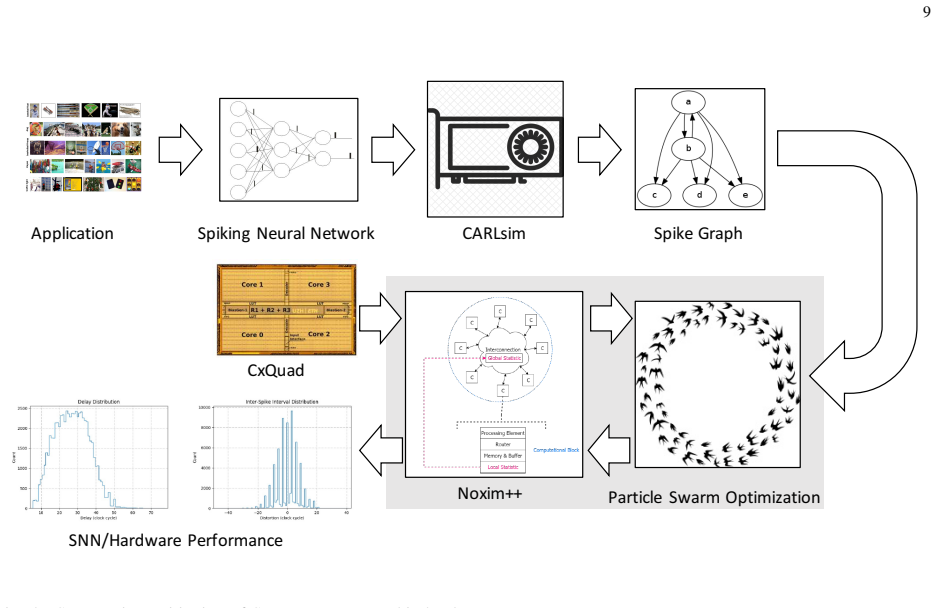
The load-bearing mechanism is a fitness function that sums, over all pairs of crossbars, the spikes that would have to travel between them, with spike counts computed from the recorded spike times attached to each synapse. Particle swarm optimization is a population-based search in which candidate assignments move through the solution space with velocities steered by the best assignment each particle has found and the best assignment the swarm has found; here the real-valued positions are binarized into neuron-to-crossbar choices. The optimizer minimizes the total spike traffic subject to crossbar capacity and one-placement-per-neuron constraints. Around this core, the framework couples a spiking-network simulator that produces the trained spike times with a cycle-accurate network-on-chip simulator that evaluates latency, energy, inter-spike-interval distortion, and disorder count on the address-event interconnect.
What would settle it
Load the optimized partition for a tested application, such as handwritten-digit recognition, onto the actual neuromorphic chip and compare measured interconnect energy and spike latency against the baseline partition. If measured values do not improve, or if the hardware spike pattern differs materially from the recorded spike times used in the fitness function, the central claim would be falsified.
Extended reading notes
Core claim
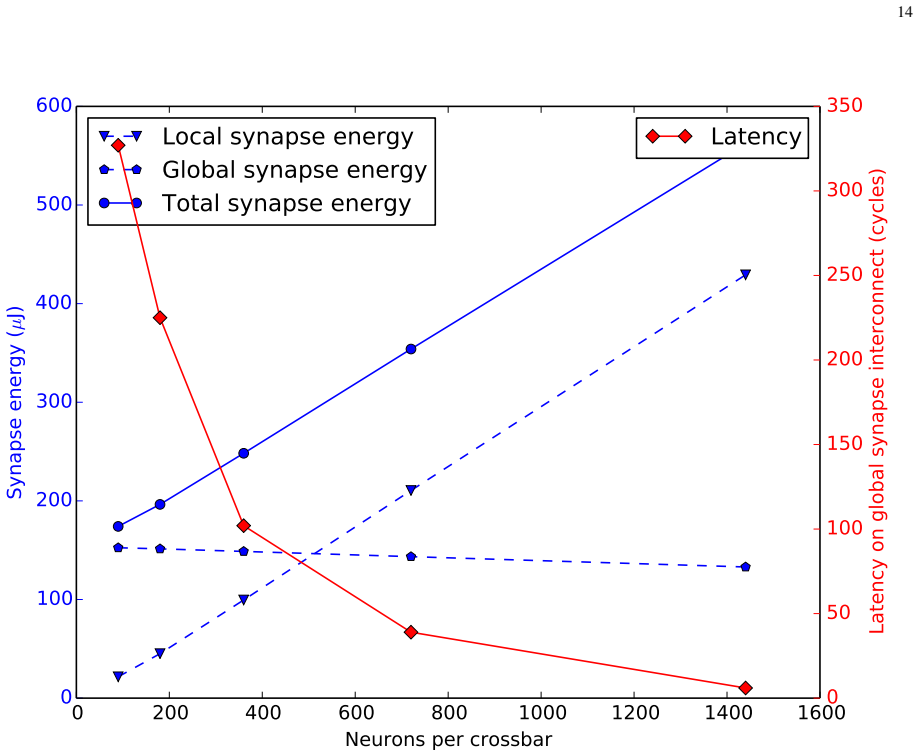
The central discovery is that the local/global synapse partitioning problem can be cast as a binary particle-swarm optimization whose fitness function is simply the total number of spikes exchanged between every pair of crossbars. Given spike times recorded from a trained simulation, the optimizer searches for a neuron-to-crossbar assignment that minimizes that total while respecting the constraints that every neuron lands in exactly one crossbar and no crossbar exceeds its capacity. The authors report that the resulting assignment reduces traffic on the global synapse interconnect enough to cut communication energy by an average of 33% and spike propagation latency by an average of 22% relative to the standard hierarchical mapping technique. It also improves the two SNN-specific metrics the paper introduces: inter-spike-interval distortion falls by an average of 37% and spike disorder count by 63%. The same framework is used to explore architecture choices, showing that an intermediate number of neurons per crossbar balances local energy against global interconnect energy and latency.
Load-bearing premise
The method assumes that the spike times recorded during simulation faithfully predict the spikes that will actually be sent on the target hardware, so a partition optimized on those recorded spikes will reduce real interconnect traffic as predicted.
Editorial extensions
If this is right
- For temporally coded networks, the reported 20% reduction of inter-spike-interval distortion in the heartbeat-estimation application improves estimation accuracy by over 5%, so partitioning choices affect application correctness, not just power.
- The gains are largest for sparse topologies and nearly vanish for very dense ones, indicating the method is most valuable when crossbar-to-crossbar connectivity is limited.
- The architecture exploration identifies an intermediate crossbar size as optimal, so the framework can guide hardware dimensioning for a given application rather than only mapping a fixed design.
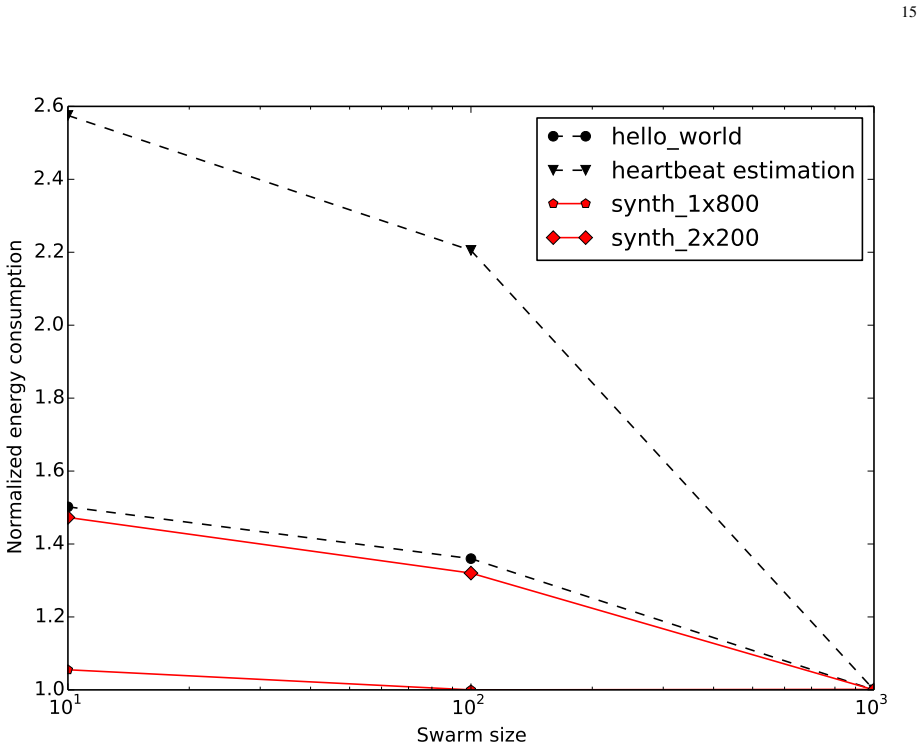
- The offline optimizer takes on average 35 minutes for a 1000-particle swarm, which is acceptable for design-time mapping but not for frequent re-mapping.
Reading between the lines
- Editorial inference: the two introduced metrics, inter-spike-interval distortion and disorder count, could be folded directly into the fitness function rather than measured after partitioning, yielding an optimizer that trades traffic against temporal fidelity explicitly.
- Editorial inference: because the fitness function trusts pre-recorded spike trains, a closed-loop variant that re-measures interconnect traffic on real hardware and re-runs the optimizer would convert the paper's static assumption into a measured correction.
- Editorial inference: the same partitioning objective could be tested against simpler heuristics, such as greedy clustering of neurons by pairwise spike rate; if a lightweight heuristic matches the swarm's results, the 35-minute search may be unnecessary for some networks.
Signed reviews
Editorial analysis
A structured set of objections, weighed in public.
Referee Report
Summary. The paper proposes a particle-swarm-optimization (PSO) based framework for partitioning spiking neural networks (SNNs) into local synapses mapped onto crossbars and global synapses mapped onto a time-multiplexed interconnect. The objective minimized by the PSO is the total number of spikes on the global synapse interconnect (Eq. 8), subject to neuron-to-crossbar assignment and capacity constraints. The framework interfaces CARLsim, which generates spike-time graphs, with an extended Noxim simulator (Noxim++) that models network-on-chip latency, energy, and two introduced SNN-specific metrics: spike disorder count and inter-spike interval (ISI) distortion. The approach is evaluated on four realistic applications and eight synthetic feedforward topologies, and is compared against PACMAN (adapted to CxQuad) and NEUTRAMS. The paper reports average reductions of 33% in communication energy and 22% in spike propagation latency over PACMAN, along with improvements in ISI distortion and disorder count, and presents an architecture exploration study in Section V-C.
Significance. If the claims are fully supported, the PSO-based mapping framework would be a useful contribution to the neuromorphic hardware mapping literature, particularly for clustered crossbar architectures with time-multiplexed interconnects. The introduction of SNN-aware metrics (spike disorder count and ISI distortion) is a positive step, as is the use of a cycle-accurate NoC simulator. The framework's ability to explore the crossbar size trade-off (Section V-C) is a practical strength. However, the central quantitative claims currently rest on incomplete and partly non-representative aggregate statistics, an underspecified baseline adaptation, and a stochastic optimizer presented without statistical validation. These issues must be addressed before the claims can be considered established.
major comments (5)
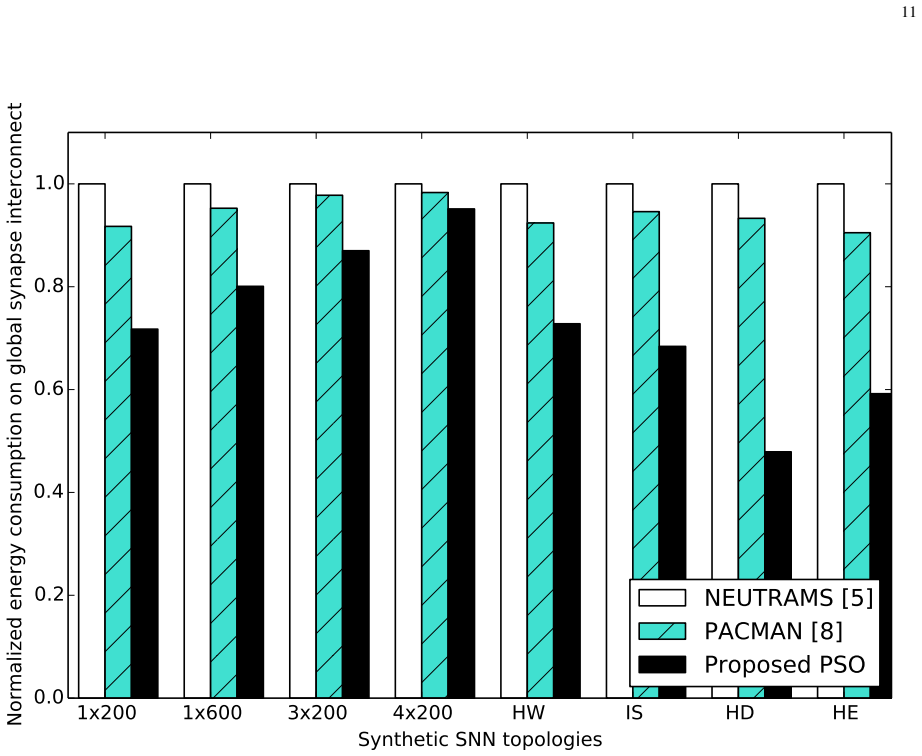
- [Section V-A, Abstract, Section VI] The reported 'average 33%' energy improvement over PACMAN is the average of only the four realistic applications (range 21.2%–48.7%). The eight synthetic topologies have an average improvement of 17.2% (Section V-A). Pooling the twelve benchmarks with equal weight gives (8×17.2 + 4×33)/12 ≈ 22.5%, not 33%. The Abstract and Section VI state the 33% figure without restricting it to realistic applications, overstating the evidence. Please report per-benchmark results and a pooled average with appropriate uncertainty.
- [Section V-B] The '22%' average latency reduction is computed from Table II, which covers only the four realistic applications. The text says improvements are 'consistent for the 8 evaluated synthetic topologies' but does not tabulate or quantify those results. Without the synthetic latency numbers, the pooled latency improvement cannot be verified. Please provide the synthetic latency data or explicitly restrict the latency claim to the realistic benchmarks.
- [Section V, first paragraph] The description 'PACMAN [8], adapted for CxQuad architecture' is not accompanied by any explanation of how PACMAN was adapted. PACMAN is designed for SpiNNaker's ARM-core architecture; adapting it to a CxQuad-like crossbar architecture with local/global synapse distinctions involves non-trivial changes to placement and routing. Without a precise description of the adaptation, the baseline is not reproducible and it is impossible to assess whether the comparison is fair.
- [Section V-A and Figure 5] The PSO is a stochastic optimizer, yet no error bars, standard deviations, or numbers of independent runs are reported. On some topologies (e.g., 4x200), the improvement over PACMAN is stated as less than 2%, which is within the range of random variation for a stochastic search. Without trial-to-trial variability information, the significance of the reported gains cannot be evaluated.
- [Section III, Eq. (8), and Section V-A] The objective minimized by the PSO (Eq. 8) is the total number of spikes on the global synapse interconnect, and the reported energy and latency improvements are for that same interconnect as simulated by Noxim++. Since energy and latency are computed from the interconnect traffic, the improvement over PACMAN in these metrics is a direct consequence of minimizing F. The paper should explicitly separate the algorithmic claim ('PSO finds partitions with lower F than PACMAN') from the hardware claim ('the hardware consumes less energy'), and should disclose the 'power numbers from in-house neuromorphic chips' (Abstract) or cite public power model parameters so the energy results are reproducible.
minor comments (6)
- [Abstract] There is a typo: 'neromorphic' should be 'neuromorphic'.
- [Section I] There is a typo in 'V on-Neumann architecture' — it should be 'von Neumann architecture'.
- [Section III, Eq. (2)] Equation (2) defines sigmoid(v) as 1/(1+e^{-v}) but then equates it to a step function (0 if v<0, 1 otherwise). This is mathematically inconsistent; please either use the sigmoid and then threshold it in a separate equation, or define the binary update correctly.
- [Section V-A] The text says 'We evaluated 8 synthetic topologies (4 are plotted in Figure 5)' but the x-axis of Figure 5 appears to list four synthetic (1x200, 1x600, 3x200, 4x200) and four realistic (HW, IS, HD, HE) benchmarks. Please clarify how many synthetic topologies were evaluated and how many are shown.
- [References] Some reference titles contain typos, e.g., reference [8] 'hierachical' should be 'hierarchical'. Please proofread the reference list.
- [Section IV] The paper states the framework 'will be released upon acceptance of this work' but provides no repository URL or availability statement. Since 'open-source framework' is listed as a contribution, please provide a link or a concrete availability plan.
Circularity Check
No significant circularity: the PSO minimizes a spike-traffic objective and the reported energy/latency reductions are downstream simulation results, not the objective renamed.
full rationale
The derivation chain is an ordinary optimization-plus-simulation pipeline. The PSO objective F (Eq. 8) is the total number of spikes on the global interconnect, and the paper then uses Noxim++ to compute interconnect energy, latency, ISI distortion, and disorder under the resulting partition. The reported energy and latency improvements relative to PACMAN are downstream quantities estimated by a network-on-chip simulator, not restatements of F. The paper does not define interconnect energy as F, nor does it substitute the objective function for the reported metrics; latency in particular depends on arbitration, congestion, and routing, so it is not a forced restatement of spike count. The only self-citation, Das et al. [18], supplies a benchmark application (heartbeat estimation) and is not load-bearing for the partitioning claim. The discrepancy between the 33% realistic-applications average and the 17.2% synthetic average is a representativeness and aggregation issue, not circular reasoning. No equation in the paper equates an output claim to an input by construction.
Assumptions & free parameters
free parameters (3)
- Swarm size =
1000
- Iteration count =
100
- PSO acceleration constants phi1, phi2
assumptions (3)
- domain assumption The spike times generated by CARLsim are representative of the spike activity on the target hardware.
- domain assumption The extension of Noxim and the in-house CxQuad power numbers accurately model interconnect energy and latency.
- domain assumption PACMAN can be fairly adapted to a crossbar architecture with local/global synapses.
Cite this review
Pith. "Pith review of Mapping of Local and Global Synapses on Spiking Neuromorphic Hardware." pith.science (2026). https://pith.science/paper/JBZLRY43
@misc{pith2026190808024,
  author       = {Pith},
  title        = {Pith review of: Mapping of Local and Global Synapses on Spiking Neuromorphic Hardware},
  year         = {2026},
  howpublished = {\url{https://pith.science/paper/JBZLRY43}},
  note         = {Machine review of arXiv:1908.08024}
}
read the original abstract
Spiking Neural Networks (SNNs) are widely deployed to solve complex pattern recognition, function approximation and image classification tasks. With the growing size and complexity of these networks, hardware implementation becomes challenging because scaling up the size of a single array (crossbar) of fully connected neurons is no longer feasible due to strict energy budget. Modern neromorphic hardware integrates small-sized crossbars with time-multiplexed interconnects. Partitioning SNNs becomes essential in order to map them on neuromorphic hardware with the major aim to reduce the global communication latency and energy overhead. To achieve this goal, we propose our instantiation of particle swarm optimization, which partitions SNNs into local synapses (mapped on crossbars) and global synapses (mapped on time-multiplexed interconnects), with the objective of reducing spike communication on the interconnect. This improves latency, power consumption as well as application performance by reducing inter-spike interval distortion and spike disorders. Our framework is implemented in Python, interfacing CARLsim, a GPU-accelerated application-level spiking neural network simulator with an extended version of Noxim, for simulating time-multiplexed interconnects. Experiments are conducted with realistic and synthetic SNN-based applications with different computation models, topologies and spike coding schemes. Using power numbers from in-house neuromorphic chips, we demonstrate significant reductions in energy consumption and spike latency over PACMAN, the widely-used partitioning technique for SNNs on SpiNNaker.
Figures
Figures from the paper (4 more)
Reference graph
Works this paper leans on
-
[8]
A hierachical configuration system for a massively parallel neural hardware platform,
F. Galluppi, S. Davies, A. Rast, T. Sharp, L. A. Plana, and S. Furber, “A hierachical configuration system for a massively parallel neural hardware platform,” in International Conference on Computing Frontiers , 2012. 17
work page 2012
-
[1]
Networks of spiking neurons: the third generation of neural network models,
W. Maass, “Networks of spiking neurons: the third generation of neural network models,” Neural networks, vol. 10, no. 9, pp. 1659–1671, 1997
1997
-
[2]
TrueNorth: Design and tool flow of a 65 mw 1 million neuron programmable neurosynaptic chip,
F. Akopyan, J. Sawada et al., “TrueNorth: Design and tool flow of a 65 mw 1 million neuron programmable neurosynaptic chip,” IEEE transactions on computer-aided design of integrated circuits and systems , vol. 34, no. 10, pp. 1537–1557, 2015
work page 2015
-
[3]
Neuromorphic architectures for spiking deep neural networks,
G. Indiveri, F. Corradi, and N. Qiao, “Neuromorphic architectures for spiking deep neural networks,” in International Electron Devices Meeting (IEDM) . IEEE, 2015
work page 2015
-
[4]
SpiNNaker: mapping neural networks onto a massively-parallel chip multiprocessor,
M. M. Khan, D. R. Lester et al. , “SpiNNaker: mapping neural networks onto a massively-parallel chip multiprocessor,” in International Joint Conference on Neural Networks (IJCNN) . IEEE, 2008
work page 2008
-
[5]
NEUTRAMS: Neural network transformation and co-design under neuromorphic hardware constraints,
Y . Ji, Y . Zhang, S. Li, P. Chi, C. Jiang, P. Qu, Y . Xie, and W. Chen, “NEUTRAMS: Neural network transformation and co-design under neuromorphic hardware constraints,” in International Symposium on Microarchitecture (MICRO). IEEE, 2016
2016
-
[6]
Eyeriss: An energy-efficient reconfigurable accelerator for deep convolutional neural networks,
Y .-H. Chen, T. Krishna, J. S. Emer, and V . Sze, “Eyeriss: An energy-efficient reconfigurable accelerator for deep convolutional neural networks,” IEEE journal of solid-state circuits , vol. 52, pp. 127–138, 2017
work page 2017
-
[7]
R. Serrano-Gotarredona et al., “CA VIAR: A 45k neuron, 5m synapse, 12g connects/s aer hardware sensory–processing– learning–actuating system for high-speed visual object recognition and tracking,” IEEE transactions on neural networks , vol. 20, no. 9, pp. 1417–1438, 2009
work page 2009
Show all 18 references
-
[9]
Scalable energy-efficient, low-latency implementations of trained spiking deep belief networks on spinnaker,
E. Stromatias, D. Neil, F. Galluppi, M. Pfeiffer, S.-C. Liu, and S. Furber, “Scalable energy-efficient, low-latency implementations of trained spiking deep belief networks on spinnaker,” in International Joint Conference on Neural Networks (IJCNN). IEEE, 2015
2015
-
[10]
ConvNets experiments on SpiNNaker,
T. Serrano-Gotarredona, B. Linares-Barranco, F. Galluppi, L. Plana, and S. Furber, “ConvNets experiments on SpiNNaker,” in Circuits and Systems (ISCAS), 2015 IEEE International Symposium on . IEEE, 2015
2015
-
[11]
Real-time computing without stable states: A new framework for neural computation based on perturbations,
W. Maass, T. Natschl ¨ager, and H. Markram, “Real-time computing without stable states: A new framework for neural computation based on perturbations,” Neural computation, vol. 14, pp. 2531–2560, 2002
2002
-
[12]
Hierarchical temporal memory including HTM cortical learning algorithms,
J. Hawkins, S. Ahmad, and D. Dubinsky, “Hierarchical temporal memory including HTM cortical learning algorithms,” Techical report, Numenta, Inc, Palto Alto , 2010
2010
-
[13]
A new optimizer using particle swarm theory,
R. Eberhart and J. Kennedy, “A new optimizer using particle swarm theory,” in International Symposium on Micro Machine and Human Science (MHS) . IEEE, 1995, pp. 39–43
1995
-
[14]
CARLsim 3: A user-friendly and highly optimized library for the creation of neurobiologically detailed spiking neural networks,
M. Beyeler, K. D. Carlson, T.-S. Chou, N. Dutt, and J. L. Krichmar, “CARLsim 3: A user-friendly and highly optimized library for the creation of neurobiologically detailed spiking neural networks,” in International Joint Conference on Neural Networks (IJCNN), 2015
2015
-
[15]
Noxim: An open, extensible and cycle-accurate network on chip simulator,
V . Catania, A. Mineo, S. Monteleone, M. Palesi, and D. Patti, “Noxim: An open, extensible and cycle-accurate network on chip simulator,” in International Conference on Application-specific Systems, Architectures and Processors (ASAP). IEEE, 2015
2015
-
[16]
Communicating neuronal ensembles between neuromorphic chips,
K. A. Boahen, “Communicating neuronal ensembles between neuromorphic chips,” in Neuromorphic systems engineering. Springer, 1998
1998
-
[17]
Unsupervised learning of digit recognition using spike-timing-dependent plasticity,
P. U. Diehl and M. Cook, “Unsupervised learning of digit recognition using spike-timing-dependent plasticity,” Frontiers in computational neuroscience , vol. 9, 2015
2015
-
[18]
Unsupervised heart-rate estimation in wearables with liquid states and a probabilistic readout,
A. Das, P. Pradhapan, W. Groenendaal, P. Adiraju, R. T. Rajan, F. Catthoor, S. Schaafsma, J. L. Krichmar, N. Dutt, and C. Van Hoof, “Unsupervised heart-rate estimation in wearables with liquid states and a probabilistic readout,” arXiv preprint arXiv:1708.05356, 2017
2017 arXiv
Reviewed August 14, 2026 · model on record in the stance chip above.
Discussion (0). Continue with ORCID to comment.