REVIEW 4 major objections 5 minor 43 references
Coarse-to-fine Optimization for Speech Enhancement
T0 review · 4 major / 5 minor · reviewed 2026-08-14 · deepseek-v4-flash
Pith's one-line read The paper claims that scheduling cosine similarity loss from coarse to fine granularities improves speech enhancement in discriminative and generative models, and that dynamic perceptual loss yields the best generative results.
desk verdict Useful but under-controlled empirical claim: no static multi-scale baseline, so the coarse-to-fine mechanism is unproven. read the letter →
The pith
A machine-rendered reading of the paper's core claim, the machinery that carries it, and where it could break.
The reading
What carries the argument
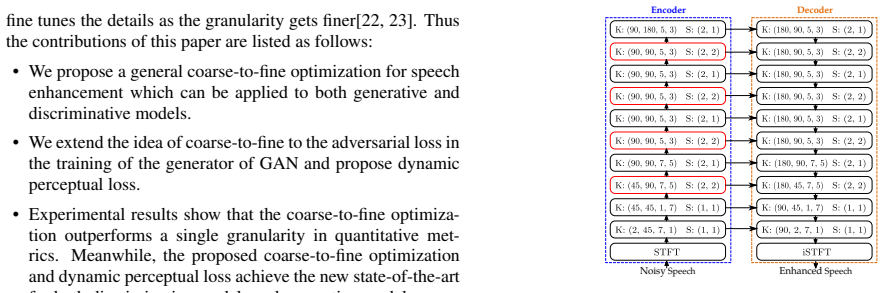
The core mechanism is the slice-wise cosine similarity loss defined in Eq. 6: the signal is divided into $K_i$ vectors of dimension $g_i = \text{dim}(x)/K_i$, and the loss averages cosine similarity over those slices. Training begins with $K_1 = 1$ (the whole $2^{14}$-sample clip), then halves the slice size every 20 epochs until $g_i = 2^6$, so each finer granularity places additional angle constraints on sub-segments of the prediction. For the GAN, dynamic perceptual loss extracts feature maps at layers 9, 7, 5, and 3 of the siamese discriminator and compares the fake and real utterances with L1 at progressively finer resolutions, adding a coarse-to-fine term to the adversarial loss.
What would settle it
Train the same network on the same dataset with a loss that at every epoch sums the cosine similarity loss over all granularities from whole clip to 64-sample chunks, or randomizes the order of granularities. If that model matches the coarse-to-fine model's CSIG, COVL, and PESQ scores, the specific temporal schedule is not the cause of the improvement.
Extended reading notes
Core claim
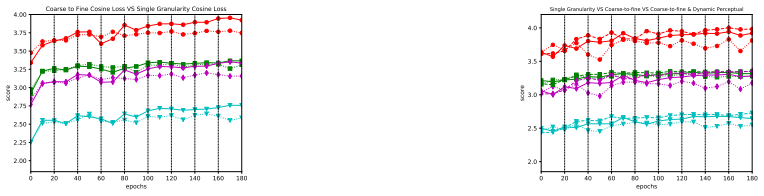
The paper's central claim is that scheduling cosine-similarity loss from coarse to fine granularity improves speech enhancement over a fixed single-granularity loss in both discriminative and generative settings. Concretely, the coarse-to-fine discriminative model reaches CSIG 3.94, CBAK 3.35, COVL 3.33, and PESQ 2.73, versus 3.79, 3.32, 3.20, and 2.62 for the single-scale baseline, while SSNR drops from 9.90 to 9.40. For the GAN, adding dynamic perceptual loss on top of coarse-to-fine training reaches CSIG 4.00, the best among the generative models compared, with COVL 3.34 and PESQ 2.69. The paper attributes these gains to the added constraints from optimizing at multiple granularities over the course of training, and argues the strategy generalizes to any objective whose granularity can be varied, including adversarial losses.
Load-bearing premise
The load-bearing premise is that the temporal coarse-to-fine ordering itself, rather than simply having multiple granularities at every epoch, explains the improved quality; the experiments do not include the control needed to separate the two.
Editorial extensions
If this is right
- Coarse-to-fine training transfers to any model whose loss is computed on the full sequence: the paper demonstrates it on a 20-layer discriminative network and on a conditional GAN generator.
- Perceived-quality metrics that correlate with subjective listening improve under the schedule, while SSNR, which the paper notes correlates poorly with overall quality, gets worse.
- Dynamic perceptual loss gives the best generative results in the comparison, suggesting that intermediate discriminator features at multiple resolutions are a usable adversarial training signal.
- Because dynamic perceptual loss is computed from the siamese discriminator's internal features, it applies to any conditional GAN whose discriminator is built as a siamese network.
- The improvement is not confined to a single final checkpoint: Figures 3 and 4 show coarse-to-fine and dynamic perceptual loss track above single-scale training throughout training.
Reading between the lines
- The paper never runs a control that uses all granularities at every epoch. If such a control matches or beats the schedule, the causal claim about temporal ordering would collapse to multi-scale supervision; the schedule's order would then be a convenience, not the mechanism.
- The schedule parameters (halving every 20 epochs, coefficients 40 and 100) are chosen for the fixed 180-epoch protocol; for other datasets one could make the granularity switch adapt on loss stagnation or validation quality, which would be a direct test of whether the schedule, not just multi-scale loss, is what helps.
- The same granularity-slicing logic applies to cosine losses used outside audio, such as image or embedding similarity; a testable extension is to replace a single global cosine loss with this schedule on a vision reconstruction task and look for the same quality gains.
- The drop in SSNR under the discriminative coarse-to-fine model suggests the method trades exact waveform-level signal-to-noise for perceptually motivated scores; an ablation measuring listening tests or automatic speech recognition word error rate would say whether the trade is worthwhile.
Signed reviews
Editorial analysis
A structured set of objections, weighed in public.
Referee Report
Summary. The paper proposes a coarse-to-fine optimization schedule for the cosine similarity loss in speech enhancement. The enhancement network is trained first with the loss computed on entire utterances and then on progressively shorter segments, down to a fine granularity; the same schedule is applied to the cosine regularization term of a conditional GAN, and a so-called dynamic perceptual loss is added by matching discriminator features at layers 9, 7, 5, and 3 at later stages of training. Experiments on the Valentini dataset compare a discriminative model D (the authors' reimplementation of cRM Rn), D with coarse-to-fine loss (D+M), a GAN baseline (G), G with coarse-to-fine regularization (G+M), and G+M with dynamic perceptual loss (G+M+P). The reported results show consistent improvements on CSIG, CBAK, COVL, and PESQ for D+M over D and for G+M+P over G+M, with the best generative result being CSIG 4.00.
Significance. If the causal claim is correct, the contribution is useful and general: a training-schedule modification that improves both discriminative and generative speech enhancement without changing the architecture or inference procedure. The evaluation is grounded in an external public benchmark with standard objective metrics, and the loss is not constructed from those metrics, so the gains are not circular. The authors also provide a reasonable set of ablations for the generative model (G, G+M, G+M+P) and disclose that the original cRM Rn numbers had a technical error, which is honest and source-credible. The significance is tempered by the fact that the core mechanism, temporal coarse-to-fine scheduling, is not isolated from a plain multi-scale objective, and by the absence of error bars around small metric differences.
major comments (4)
- [§4.2, Table 1] The central claim that the improvement of D+M over D comes from the temporal coarse-to-fine schedule is not isolated. D+M uses a schedule that switches from granularity 2^14 to 2^6 by halving every 20 epochs, while the comparison D uses a single granularity. There is no control trained with all granularities active at every epoch, so the improvement could be due to the multi-scale objective alone rather than to the ordering of scales. A control that averages Eq. (6) over all Ki at each epoch is required to support the stated mechanism; the same control is needed for G+M.
- [§4.3, Eq. (7)] The dynamic perceptual loss (DPL) is underspecified and the claimed benefit of making the feature matching dynamic is not tested. The text says that G+M+P 'start[s] with the original L2 loss ... and every 80 epochs' computes L1 loss on features at layers 9, 7, 5, 3, but it does not state whether layers are added progressively or all at once at the first switch, nor what the feature-loss schedule is after each 80-epoch milestone. Without a static baseline that applies the same multi-layer feature matching from the start of training, the results cannot distinguish the effect of the coarse-to-fine scheduling of the perceptual loss from the effect of adding feature matching at all.
- [Table 1, Figures 3 and 4] The experimental comparisons are single-run and no error bars or repeated-seed statistics are reported. Several of the decisive differences are small, for example CBAK 3.35 vs. 3.32 for D+M vs. D, COVL 3.33 vs. 3.31 for G+M+P vs. G+M, and SSNR 9.40 vs. 9.90 where D+M is worse than the single-scale baseline. Because the claims are quantitative and partly hinge on differences of 0.01-0.08, the paper should report means and variances over at least three seeds and, ideally, paired significance tests on the 824 test utterances.
- [§4.2, §4.3] The schedule hyperparameters are introduced without sensitivity analysis: halving the granularity every 20 epochs, the coefficient 40 for the cosine regularization term, the coefficient 100 for the perceptual loss, the choice of layers 9, 7, 5, 3, and the 80-epoch interval for the perceptual loss are all presented as fixed choices. Since the paper proposes a general optimization strategy, it should at least show that the improvements are not critically dependent on these specific values, or provide a principled justification for them.
minor comments (5)
- [§4.3] The last paragraph of Section 4.3 refers to 'G+M+D' where the context and Table 1 indicate the intended model is 'G+M+P'; please correct this typo.
- [Fig. 1] The caption states that the red blocks are layers 9, 7, 5, 3 'from top to bottom,' but the figure shows an encoder-decoder without explicit layer indices; please clarify whether the numbering is from the encoder input or from the decoder output.
- [§2.2] The text says the loss is computed on the waveform following inverse STFT, but the network output is a complex-valued mask in the frequency domain; please state explicitly that the waveform is reconstructed via differentiable inverse STFT during training so that the gradient flows back to the mask.
- [References] There are several reference formatting errors, including 'Nerual Information Processing' in [16] and the truncated URL-only entries for [5] and [17]; please use a consistent bibliography style and verify titles and venues.
- [§2.1] The motivation that higher-dimensional vectors admit 'more feasible solutions' with the same cosine loss is only heuristic; a short formal argument or a reference to the geometry of the unit sphere would make the motivation more precise.
Circularity Check
No significant circularity: the coarse-to-fine training losses are distinct from the external evaluation metrics, and the paper's central comparison rests on independently measured benchmark results.
full rationale
The paper's derivation chain is not circular. The training objectives are cosine similarity loss, an optional GAN adversarial loss, and an L1 feature loss computed at intermediate discriminator layers; the evaluation uses the external Valentini speech-enhancement benchmark with standard objective metrics (CSIG, CBAK, COVL, PESQ, SSNR). No metric is used as a loss, and no test-set quantity is fitted into the loss definition. The coarse-to-fine schedule and loss coefficients are hand-chosen hyperparameters, not values solved for from the reported evaluation numbers, so the reported improvements are independent measurements rather than renamed inputs. The only self-citation is [22], used as general motivation that coarse-to-fine optimization accelerates convergence and refines details; it is not load-bearing because the paper's own experiments provide the support for the claim. A genuine experimental-design concern exists: there is no control that uses all granularities simultaneously, so the specific causal role of the temporal coarse-to-fine ordering is not fully isolated from a plain multi-scale objective. That is an experimental-control or correctness issue, not a circularity, because the proposed method's objective is not definitionally equivalent to the measured outcome. Accordingly, no circular step can be exhibited from the paper's equations or citations.
Assumptions & free parameters
free parameters (6)
- granularity_schedule =
start 2^14 samples, halve every 20 epochs down to 2^6
- loss_coefficients =
lambda_traditional=40, lambda_adversarial=1, lambda_perceptual=100
- stft_parameters =
window 1024, stride 256
- batch_size =
96 for discriminative, 64 for GAN
- learning_rate_schedule =
4e-4 initial, 0.5 decay at epochs 40/80/120; discriminator 2e-4
- gaussian_noise_variance =
0.01
assumptions (4)
- domain assumption Cosine similarity loss at multiple granularities is a meaningful proxy for perceived speech quality.
- domain assumption The Valentini dataset and the five objective metrics are accepted as valid for comparing speech enhancement systems.
- ad hoc to paper The motivating claim that higher-dimensional cosine loss has a larger set of feasible solutions, and that coarse-to-fine reduces this uncertainty.
- ad hoc to paper The discriminator's deep features at layers 9, 7, 5, and 3 capture useful coarse-to-fine audio structure.
Cite this review
Pith. "Pith review of Coarse-to-fine Optimization for Speech Enhancement." pith.science (2026). https://pith.science/paper/U2S74DQG
@misc{pith2026190808044,
  author       = {Pith},
  title        = {Pith review of: Coarse-to-fine Optimization for Speech Enhancement},
  year         = {2026},
  howpublished = {\url{https://pith.science/paper/U2S74DQG}},
  note         = {Machine review of arXiv:1908.08044}
}
read the original abstract
In this paper, we propose the coarse-to-fine optimization for the task of speech enhancement. Cosine similarity loss [1] has proven to be an effective metric to measure similarity of speech signals. However, due to the large variance of the enhanced speech with even the same cosine similarity loss in high dimensional space, a deep neural network learnt with this loss might not be able to predict enhanced speech with good quality. Our coarse-to-fine strategy optimizes the cosine similarity loss for different granularities so that more constraints are added to the prediction from high dimension to relatively low dimension. In this way, the enhanced speech will better resemble the clean speech. Experimental results show the effectiveness of our proposed coarse-to-fine optimization in both discriminative models and generative models. Moreover, we apply the coarse-to-fine strategy to the adversarial loss in generative adversarial network (GAN) and propose dynamic perceptual loss, which dynamically computes the adversarial loss from coarse resolution to fine resolution. Dynamic perceptual loss further improves the accuracy and achieves state-of-the-art results compared with other generative models.
Figures

Reference graph
Works this paper leans on
-
[1]
Introduction Speech enhancement aims at improving the quality of the speech contaminated by the additive noise. It has quite a few applications including noise cancelling, audio editing, prepro- cessing for speech recognition, just to name a few. Denote the noisy speech as y(t), we have y(t) = x(t) + n(t) (1) where x(t) and n(t) are respectively the clean...
-
[2]
Basics 2.1. Cosine Similarity Loss Cosine similarity loss[1] is widely used to measure the similar- ity between two vectors, which is defined as: T (ˆx, x) =− ˆxT x ||ˆx||2||x||2 (5) It is chosen in our algorithm because 1) it shows better accu- racy than L1/L2 loss even with a single granularity. 2) it can be evaluated in different granularities, as oppos...
-
[3]
The size of the vector decides the granularity how we divide the signal x
Coarse to Fine Optimization The speech signal x can be seen as either a single high dimen- sional vector or the concatenation of multiple low dimensional vectors. The size of the vector decides the granularity how we divide the signal x. As mentioned earlier, computing L1/L2 loss in different granularities makes no difference as L1/L2 loss is evaluated on...
-
[4]
Experiments In this section, the experimental results show that in either dis- criminative models or generative models, the coarse-to-fine op- timization will improve the current state-of-the-art algorithms. Particularly in generative models, the proposed dynamic per- ceptual loss could further improve the accuracy obtained from optimizing the cosine simil...
-
[5]
Conclusion and Discussion In this paper we proposed the coarse-to-fine strategy in optimiz- ing the cosine similarity loss for both discriminative and genera- tive models. Inspired by the coarse-to-fine idea, we further pro- posed the dynamic perceptual loss as the adversarial loss term in the generator training of GAN. Our experiments show the effectivenes...
-
[6]
and [4] have shown that the GAN approach works well only if the traditional loss term T is added in Eq. 3. This observa- tion has also been confirmed in image synthesis[18] using con- ditional GAN, where the training example is a pair of images instead of audios. Note thatT can be by itself used as the loss function in discriminative models. The training o...
work page Pith review arXiv 1908
-
[7]
Triplet loss based cosine similarity metric learning for text-independent speaker recognition,
S. Novoselov, V . Shchemelinin, A. Shulipa, A. Kozlov, and I. Kremnev, “Triplet loss based cosine similarity metric learning for text-independent speaker recognition,” inInternational Speech Communication Association Conference (Interspeech), 2018
work page 2018
-
[8]
Enhancement of speech corrupted by acoustic noise,
M. Berouti, R. Schwartz, and J. Makhoul, “Enhancement of speech corrupted by acoustic noise,” Proc. of the Int. Conf. on Acoustics, Speech, and Signal Processing (ICASS) , vol. 4, pp. 208–211, 1979
work page 1979
Show all 43 references
-
[9]
All-pole modeling of degraded speech,
J. Lim and A. Oppenheim, “All-pole modeling of degraded speech,” IEEE Trans. on Acoustics, Speech, and Signal Process- ing, vol. 26, no. 3, pp. 197–210, 1978
1978
-
[10]
Segan: Speech enhance- ment generative adversarial network,
S. Pascual, A. Bonafonte, and J. Serra, “Segan: Speech enhance- ment generative adversarial network,” in International Speech Communication Association Conference (Interspeech), 2017
2017
-
[11]
Speech denoising with deep feature losses,
F. G. Germain, Q. Chen, and V . Koltun, “Speech denoising with deep feature losses,” inhttps://arxiv.org/abs/1806.10522, 2018
2018 arXiv
-
[12]
Time-frequency masking- based speech enhancement using generative adversarial network,
M. H. Soni, N. Shah, and H. A. Patil, “Time-frequency masking- based speech enhancement using generative adversarial network,” in International Conference on Acoustics, Speech, and Signal Processing (ICASSP), 2018
2018
-
[13]
A convolutional recurrent neural network for real-time speech enhancement,
K. Tan and D. Wang, “A convolutional recurrent neural network for real-time speech enhancement,” inInternational Speech Com- munication Association Conference (Interspeech), 2018
2018
-
[14]
Phase-aware speech enhancement with deep complex u-net,
H.-S. Choi, J.-H. Kim, J. Huh, A. Kim, J.-W. Ha, and K. Lee, “Phase-aware speech enhancement with deep complex u-net,” in International Conference on Learning Representations(ICLR), 2019
2019
-
[15]
End-to-end waveform utterance enhancement for direct evaluation metrics op- timization by fully convolutional neural networks,
S. Fu, T. Wang, Y . Tsao, X. Lu, and H. Kawai, “End-to-end waveform utterance enhancement for direct evaluation metrics op- timization by fully convolutional neural networks,” IEEE/ACM Trans. on Audio, Speech, and Language Processing, vol. 26, no. 9, pp. 1570–1584, 2018
2018
-
[16]
Conditional generative adversarial networks for speech enhancement and noise-robust speaker verifi- cation,
D. Michelsanti and Z.-H. Tan, “Conditional generative adversarial networks for speech enhancement and noise-robust speaker verifi- cation,” inInternational Speech Communication Association Con- ference (Interspeech), 2017
2017
-
[17]
Gener- ative adversarial network based postfilter for stft spectrograms,
T. Kaneko, S. Takaki, H. Kameoka, and J. Yamagishi, “Gener- ative adversarial network based postfilter for stft spectrograms,” in International Speech Communication Association Conference (Interspeech), 2017
2017
-
[18]
A regression ap- proach to speech enhancement based on deep neural networks,
Y . Xu, J. Du, L.-R. Dai, and C.-H. Lee, “A regression ap- proach to speech enhancement based on deep neural networks,” in IEEE/ACM Trans. on Audio, Speech and Language Processing, 2015
2015
-
[19]
Speech enhancement in multiple noise conditions using deep neural networks,
A. Kuman and D. Florencio, “Speech enhancement in multiple noise conditions using deep neural networks,” inInt. Speech Com- munication Association Conf. (Interspeech), 2016
2016
-
[20]
Speech enhancement with lstm recurrent neural networks and its application to noise-robust asr,
F. Weninger, H. Erdogan, S. Watanabe, E. Vincent, J. L. Roux, J. R. Hershey, and B. Schuller, “Speech enhancement with lstm recurrent neural networks and its application to noise-robust asr,” in Int. Conf. on Latent Variable Analysis and Signal Separation , 2015
2015
-
[21]
Speech enhancement based on deep denoising autoencoder,
X. Lu, Y . Tsao, S. Matsuda, and C. Hori, “Speech enhancement based on deep denoising autoencoder,” in International Speech Communication Association Conference (Interspeech), 2013
2013
-
[22]
Generative adver- sarial nets,
I. J. Goodfellow, J. Pouget-Abadie, M. Mirza, B. Xu, D. Warde- Farley, S. Ozair, A. Courville, and Y . Bengio, “Generative adver- sarial nets,” inNerual Information Processing (NIPS), 2014
2014
-
[23]
Conditional generative adversarial nets,
M. Mirza and S. Osindero, “Conditional generative adversarial nets,” inhttps://arxiv.org/pdf/1411.1784.pdf, 2014
2014 arXiv
-
[24]
Image-to-image trans- lation with conditional adversarial networks,
P. Isola, J. Zhu, T. Zhou, and A. A. Efros, “Image-to-image trans- lation with conditional adversarial networks,” in Conference of Computer Vision and Pattern Recognition(CVPR), 2017
2017
-
[25]
Deep multi-scale video prediction beyond mean square error,
M. Mathieu, C. Couprie, and Y . LeCun, “Deep multi-scale video prediction beyond mean square error,” in International Confer- ence on Learning Representations(ICLR), 2016
2016
-
[26]
Generative image modeling using style and structure adversarial networks,
I. J. Goodfellow, J. Pouget-Abadie, M. Mirza, B. Xu, D. Warde- Farley, S. Ozair, A. Courville, and Y . Bengio, “Generative image modeling using style and structure adversarial networks,” in Eu- ropean Conference on Computer Vision(ECCV), 2016
2016
-
[27]
A fully convolutional neural network for speech enhancement,
S. R. Park and J. W. Lee, “A fully convolutional neural network for speech enhancement,” in International Speech Communica- tion Association Conference (Interspeech), 2017
2017
-
[28]
Real-time coarse- to-fine topologically preserving segmentation,
J. Yao, M. Boben, S. Fidler, and R. Urtasun, “Real-time coarse- to-fine topologically preserving segmentation,” in Conference of Computer Vision and Pattern Recognition (CVPR), 2015
2015
-
[29]
Optical flow estimation,
D. J. Fleet and Y . Weiss, “Optical flow estimation,” in http://www.cs.toronto.edu/ fleet/research/Papers/flowChapter05.pdf, 2005
2005
-
[30]
Short term spectral analysis, synthesis, and mod- ification by discrete fourier transform,
J. B. Allen, “Short term spectral analysis, synthesis, and mod- ification by discrete fourier transform,” IEEE Transactions on Acoustics, Speech, Signal Processing , vol. ASSP-25, pp. 235– 238, 1977
1977
-
[31]
Time-frequency masking in the complex domain for speech dereverberation and denoising,
D. S. Williamson and D. Wang, “Time-frequency masking in the complex domain for speech dereverberation and denoising,” IEEE/ACM TRANSACTIONS ON AUDIO, SPEECH, AND LAN- GUAGE PROCESSING, vol. 25, no. 7, 2017
2017
-
[32]
A guide to convolution arithmetic for deep learning,
V . Dumoulin and F. Visin, “A guide to convolution arithmetic for deep learning,” inhttps://arxiv.org/pdf/1603.07285.pdf, 2015
2015 arXiv
-
[33]
Batch normalization: Accelerating deep network training by reducing internal covariate shift,
S. Ioffe and C. Szegedy, “Batch normalization: Accelerating deep network training by reducing internal covariate shift,” in Interna- tional Conference on Machine Learning (ICML) , 2015, pp. 448– 456
2015
-
[34]
Rectifier nonlinear- ities improve neural network acoustic models,
A. L. Maas, A. Y . Hannun, and A. Y . Ng, “Rectifier nonlinear- ities improve neural network acoustic models,” in International Conference on Machine Learning (ICML), 2013, p. 3
2013
-
[35]
Deepface: Closing the gap to human-level performance in face verifica- tion,
Y . Taigman, M. Yang, M. A. Ranzato, and L. Wolf, “Deepface: Closing the gap to human-level performance in face verifica- tion,” in Conference of Computer Vision and Pattern Recogni- tion(CVPR), 2014
2014
-
[36]
A wavenet for speech denois- ing,
D. Rethage, J. Pons, and X. Serra, “A wavenet for speech denois- ing,” in International Conference on Acoustics, Speech, and Sig- nal Processing (ICASSP), 2018
2018
-
[37]
Noisy speech database for training speech enhancement algorithms and tts models,
C. Valentini-Botinhao, “Noisy speech database for training speech enhancement algorithms and tts models,” in University of Edin- burgh. School of Informatics. Centre fro Speech Technology Re- search (CSTR) https://doi.org/10.7488/ds/1356, 2016
-
[38]
The diverse environments multi-channel acoustic noise database: A database of multichan- nel environmental noise recordings,
J. Thiemann, N. Ito, and E. Vincent, “The diverse environments multi-channel acoustic noise database: A database of multichan- nel environmental noise recordings,” The Journal of the Acousti- cal Society of America, vol. 133, no. 5, pp. 3591–3591, 2013
2013
-
[39]
The voice bank corpus: Design, collection and data analysis of a large regional accent speech database,
C. Veaux, J. Yamagishi, and S. King, “The voice bank corpus: Design, collection and data analysis of a large regional accent speech database,” in Int. Conf. Oriental COCOSDA, held jointly with 2013 Conference on Asian Spoken Language Research and Evaluation (O-COCOSDA/CASLRE),...
2013
-
[40]
Evaluation of objective quality measures for speech enhancement,
Y . Hu and P. C. Loizou, “Evaluation of objective quality measures for speech enhancement,”IEEE Trans. on Audio, Speech and Lan- guage Processing, vol. 16, no. 1, pp. 229–238, 2008
2008
-
[41]
P.862.2: Wideband extension to recommendation p. 862 for the assessment of wideband telephone networks and speech codecs,
“P.862.2: Wideband extension to recommendation p. 862 for the assessment of wideband telephone networks and speech codecs,” in Geneva: International Telecommunication Union, 2007
2007
-
[42]
P. C. Loizou, Speech Enhancement: Theory and Practice, 2nd ed. Boca Raton, FL, USA: CRC Press, 2013
2013
-
[43]
Adam: A method for stochastic opti- mization,
D. P. Kingma and J. Ba, “Adam: A method for stochastic opti- mization,” in International Conference for Learning Representa- tion (ICLR), 2015
2015
Reviewed August 14, 2026 · model on record in the stance chip above.
Discussion (0). Continue with ORCID to comment.