REVIEW 1 major objections 5 minor 107 references
Half-integer quantized topological response in quasiperiodically driven quantum systems
T0 review · 1 major / 5 minor · reviewed 2026-08-14 · deepseek-v4-flash
Pith's one-line read For a spin-1/2 driven by two incommensurate tones, the phase-averaged energy-pumping rate at the topological transition equals exactly half the integer-quantized value of the adjacent topological phase.
desk verdict A clean extension of the integer-pumping result to a half-integer rate at the transition, with a plausible but not fully rigorous Landau-Zener cutoff; worth serious peer review. read the letter →
The pith
A machine-rendered reading of the paper's core claim, the machinery that carries it, and where it could break.
The reading
What carries the argument
The load-bearing object is the instantaneous band structure of the driven spin on the two-dimensional torus of drive phases. Treating the two drive phases as synthetic dimensions, the ground-state band is the half-BHZ model; its Berry curvature consists of a smooth part plus a singular, delta-function-like contribution at the Dirac point at $\delta=0$. The topological pump power is the integrated Berry curvature of the dressed band sampled before the spin unlocks. The unlock time is estimated by Landau-Zener and Kibble-Zurek arguments, giving $t_u\sim\sqrt{B_0/\omega^3}$ and an excitation-region radius $\theta^*\sim\sqrt{\omega/B_0}$, which excludes the singular curvature and yields $C_g=1/2$ at $\delta=0$. The scaling functions then encode the universal crossover in the variables $t\omega^{3/2}$ and $\delta\omega^{-1/2}$.
What would settle it
Directly simulate the full time-dependent Schrödinger equation for the model of Eq. (2) at $\delta=0$ with several small frequencies, average over initial phases, and check whether $[P_{1T}]·2\pi/\omega^2$ extrapolates to $1/2$ as $t/t_u\to 0$; a clean extrapolation to $1$, $0$, or an $\omega$-dependent value would contradict the claim.
Extended reading notes
Core claim
The paper's central claim is that the topological contribution to the energy-pumping rate of a spin-$1/2$ driven by two incommensurate circularly polarized drives, after averaging over initial drive phases, is $$[P_{1T}]_{\vec\theta_0}=C_g\,\frac{\omega_1\omega_2}{2\pi},$$ with $C_g=1$ for $\delta<0$, $C_g=1/2$ exactly at $\delta=0$, and $C_g=0$ for $\delta>0$. The argument identifies the transition at $\delta=0$ with a Dirac point in the synthetic band structure and shows that the phase-averaged spin trajectory samples all of the Berry curvature except the singular spike at the Dirac point before the spin unlocks from the dressed ground state. On time scales larger than the unlock time, the prethermal quantization is lost, and the crossover between plateaus is captured by Kibble-Zurek scaling functions in $t\omega^{3/2}$ and $\delta\omega^{-1/2}$.
Load-bearing premise
The exact half-integer value rests on the assumption that, at $\delta=0$, the spin completely stops following its instantaneous ground state inside the excitation region $|\theta|<\theta^*$ before sampling the singular Berry curvature at the Dirac point; if the non-adiabatic dynamics partially samples that spike, the value $1/2$ would be modified.
Editorial extensions
If this is right
- At the transition, the phase-averaged topological power tends to exactly half the integer plateau value as the ratio $t/t_u$ goes to zero.
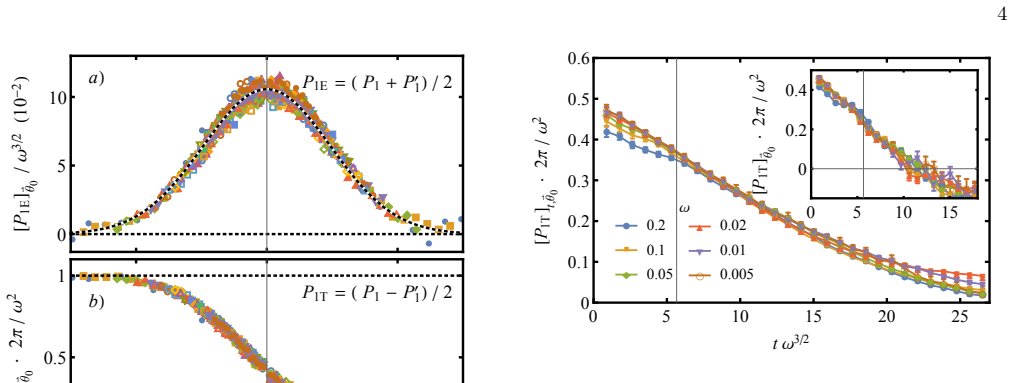
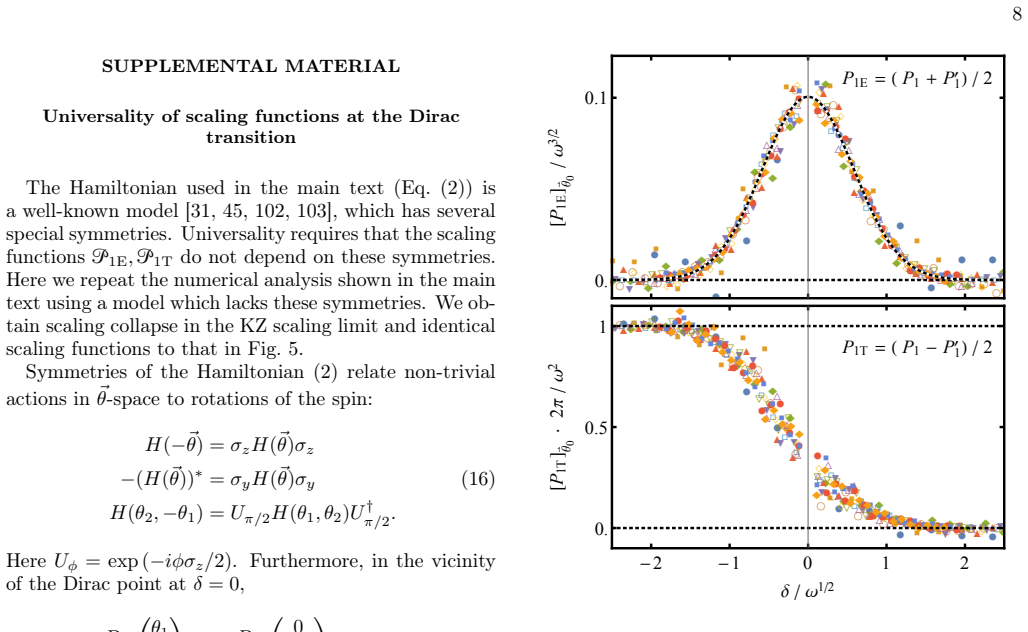
- The same scaling collapse should be seen at different drive frequencies; plotting the power against $t\omega^{3/2}$ and $\delta\omega^{-1/2}$ puts all data on one universal curve.
- Reversing the circular polarization of one drive reverses only the topological contribution, so summing and differencing the two measured powers separates the quantized piece from the excitation-heating piece.
- The quantized pumping exists only before the unlock time; at late times the spin heats and the ensemble-averaged topological power decays to zero.
- The same universal functions also describe the nonlinear response and dielectric breakdown of a clean Dirac material driven by an electric field.
Reading between the lines
- This suggests that the same half-integer quantization should appear at isolated Dirac transitions in other driven few-level systems, including qudits and Floquet platforms, even though only two microscopic models are checked numerically in the paper.
- The exact value $1/2$ is a zero-frequency, short-time limit; finite-frequency experiments should see deviations set by the scaling variables, so the cleanest test extrapolates to $\omega\to 0$ at fixed $\delta/\sqrt{\omega}$ and fixed $t/t_u$.
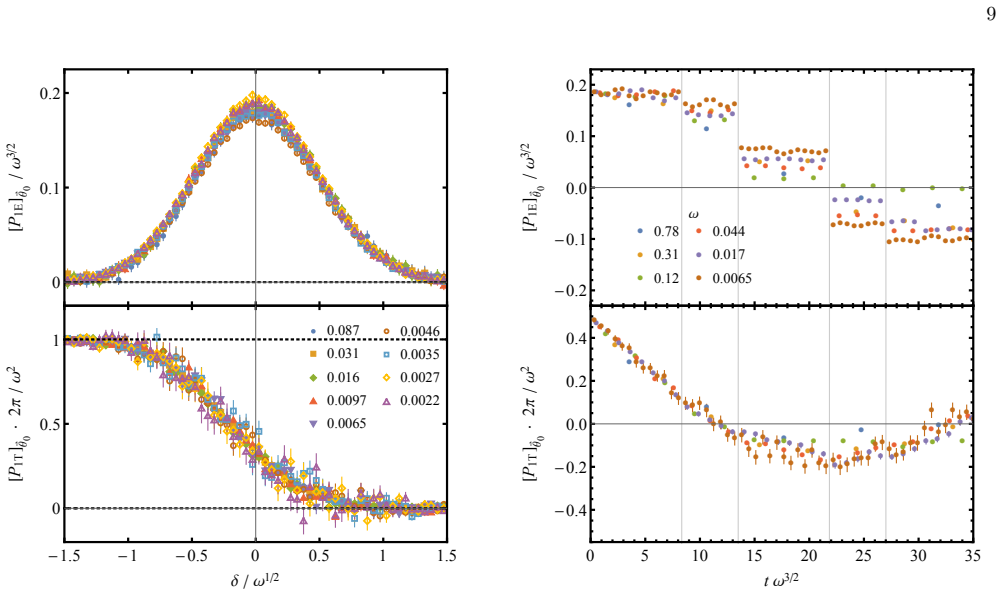
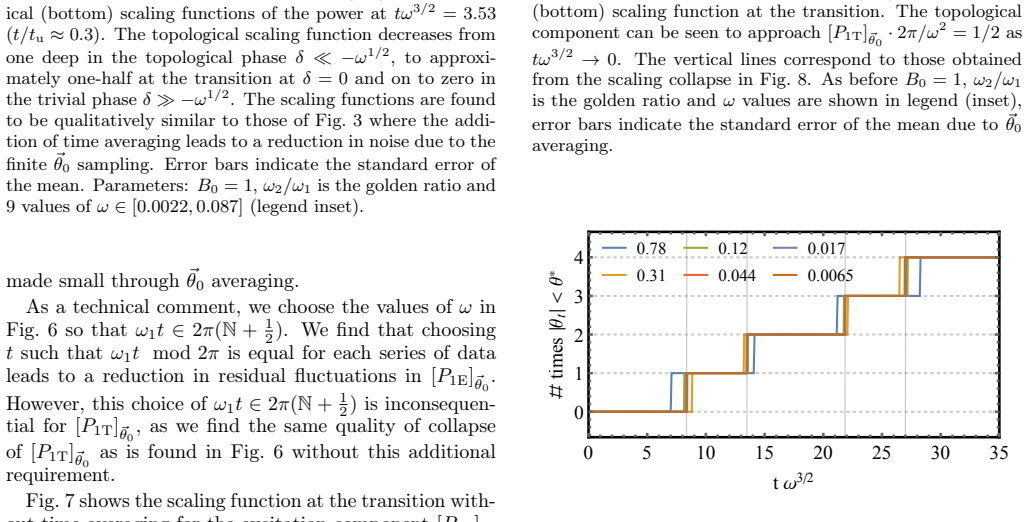
- The step-like features seen in the non-time-averaged excitation scaling function suggest that individual trajectories record discrete repeated visits to the excitation region, which could make the Kibble-Zurek crossover visible in single-shot qubit data rather than only in ensembles.
Signed reviews
Editorial analysis
A structured set of objections, weighed in public.
Referee Report
Summary. The paper studies a spin-1/2 driven by two harmonic drives with incommensurate frequencies, mapping the dynamics onto a synthetic two-dimensional tight-binding model whose instantaneous band structure is the half-BHZ model. It derives the topological contribution to the energy pumping rate between the drives and claims that, in the zero-frequency adiabatic limit and after averaging over initial drive phases, the pumping rate is quantized to an integer in the topological phase, zero in the trivial phase, and exactly half that integer at the transition, where the synthetic band structure has a Dirac point. The paper further proposes universal Kibble-Zurek scaling functions for the crossover and supports the scaling forms with numerical simulations in the main text and in the Supplemental Material, including a second microscopic model to demonstrate universality.
Significance. If the claims hold, the paper provides a striking few-level realization of a dynamical topological phase transition with a quantized half-integer response, and it connects quasiperiodically driven qubits to the universal physics of Dirac points in band insulators. The algebraic derivation of Eq. (9) from the dressed instantaneous state is clear and compelling, and the numerical scaling collapse in Figs. 3-7, together with the universality check against an asymmetric model in the Supplemental Material, gives substantial evidence for the KZ scaling picture. The separation of the topological and excitation contributions via complex conjugation of the Hamiltonian (Eq. (14)) is an elegant and testable idea. The principal weakness is that the exact half-integer value at δ=0 rests on a heuristic Landau-Zener estimate of when the spin unlocks from the instantaneous ground state, without a controlled bound on the possible corrections.
major comments (1)
- [Eq. (9), Eq. (11), Fig. 4] The central claim that [P1T]_θ0 = (1/2) ω1ω2/(2π) at δ=0 (Eq. (9) with Eq. (4)) depends on the assumption that the spin 'unlocks' before sampling the singular component of the Berry curvature concentrated at the Dirac point, where the boundary of the excluded region is set by the heuristic Landau-Zener estimate θ* = sqrt(ω/B0) (Eq. (11)). This is a scale estimate, not a controlled solution of the non-adiabatic dynamics; in the Supplemental Material the same cutoff is used with an arbitrary prefactor (θ* = 3.5√(ω/B0)) to locate the step features in Fig. 8, illustrating that the transition layer is not sharply determined. If the actual transition probability is not a step function in the impact parameter, trajectories passing at distances r ~ θ* can partially sample the near-singular curvature before excitation, and the limiting value of [P1T]_θ0 could differ from 1/2 by a function of ω that the paper does not bound. The numerical scaling collapse in Fig. 4 shows that the scaling function approaches a value close to 1/2 as tω^{3/2}→0 at finite ω, but does not isolate the double limit ω→0, δ=0, t/tu→0 with error bars that rule out a small systematic deviation. Because the half-integer value is the paper's headline result, the authors should either provide a controlled estimate of the correction (e.g., by integrating the Landau-Zener survival probability over impact parameter and showing that the singular contribution vanishes as ω→0) or qualify the claim as an asymptotic result with corrections that require numerical verification at each ω.
minor comments (5)
- [Introduction and Fig. 1] The notation PQ = ω1ω2/(2π) is used in Fig. 1 and in the abstract before it is defined in the text; please define it at first use in the body.
- [Eq. (7)] The statement that the integrated Berry curvature of the dressed band equals that of the instantaneous band is asserted without justification; a sentence explaining that the dressing is a smooth, topologically trivial modification would make the derivation more self-contained.
- [Eq. (13)] The scaling functions P1E and P1T are written without their arguments; please specify the notation explicitly, e.g., P1E(tω^{3/2}; δω^{-1/2}).
- [Supplemental Material, Fig. 6] The technical choice ω1t ∈ 2π(N + 1/2) is explained only in the Supplemental Material; a brief mention in the main text would help readers interpret the data-collection procedure.
- [General] There are minor typographical issues: the abstract and body use ligature characters in words such as 'effect' and 'fulfill', and the equation cross-references are not always consistent (e.g., '(Eq. (4))' refers to the Hamiltonian). These are presentation issues that do not affect the technical content.
Circularity Check
No significant circularity: the half-integer pumping rate is derived from the model's Berry curvature and standard band-geometry input, not fitted or presupposed.
full rationale
The derivation chain is self-contained. Equations (5)-(9) obtain the phase-averaged topological power from first-order adiabatic perturbation theory: P1T is expressed in terms of the Berry curvature of the dressed instantaneous band, and the phase average converts the total-derivative term to zero, leaving the integrated Berry curvature. The Chern values Cg in Eq. (4) are taken from the standard half-BHZ band structure (cited to Refs. [31,45]) and the paper explicitly states the decomposition of the Berry curvature into a smooth piece integrating to pi and a singular piece integrating to -sgn(delta)pi, so the value 1/2 at delta=0 follows from excluding the singular Dirac-point piece. That exclusion is justified by the Kibble-Zurek/Landau-Zener estimate theta* ~ sqrt(omega/B0) in Eq. (11), not by circular reasoning; the skeptical concern that this cutoff is heuristic is a correctness risk, not a circularity. The paper's own supplemental material acknowledges an arbitrary prefactor (theta* = 3.5 sqrt(B0/omega)) in the secondary step-height analysis, but that analysis is illustrative and is not used to set the central quantized value. The numerical section compares exact time evolution to the predicted scaling forms with the predicted exponents omega^{3/2} and delta omega^{-1/2}, and the supplemental asymmetric model provides an independent universality check. Self-citations to Refs. [24,25,30] supply the model and earlier integer quantized-response results, but the new half-integer and scaling claims are derived in this paper from the Hamiltonian and standard band geometry rather than reduced to those citations.
Assumptions & free parameters
assumptions (6)
- domain assumption The spin dynamics before unlock is described by the dressed instantaneous ground state up to corrections of order ω^2 (Eq. (6)).
- domain assumption The Landau-Zener excitation probability formula of Eq. (10), with exponent π|B|^2/|∂tB|, controls the transition to the excited state.
- domain assumption For irrational ω2/ω1, the drive-phase trajectory uniformly samples the two-torus over times t much smaller than tu.
- standard math The half-BHZ band structure has the Berry-curvature decomposition: a smooth piece integrating to π and a singular piece at the Dirac point integrating to -sgn(δ)π.
- standard math The initial-phase average of a total derivative with respect to θ1 vanishes (Eq. (8)).
- domain assumption At times much longer than tu, the spin populations in the dressed instantaneous ground and excited states become equal, so the topological ensemble power tends to zero.
Cite this review
Pith. "Pith review of Half-integer quantized topological response in quasiperiodically driven quantum systems." pith.science (2026). https://pith.science/paper/PIN6K7BP
@misc{pith2026190808062,
  author       = {Pith},
  title        = {Pith review of: Half-integer quantized topological response in quasiperiodically driven quantum systems},
  year         = {2026},
  howpublished = {\url{https://pith.science/paper/PIN6K7BP}},
  note         = {Machine review of arXiv:1908.08062}
}
read the original abstract
A spin strongly driven by two harmonic incommensurate drives can pump energy from one drive to the other at a quantized average rate, in close analogy with the quantum Hall effect. The pumping rate is a non-zero integer in the topological regime, while the trivial regime does not pump. The dynamical transition between the regimes is sharp in the zero-frequency limit and is characterized by a Dirac point in a synthetic band structure. We show that the pumping rate is {\em half-integer} quantized at the transition and present universal Kibble-Zurek scaling functions for energy transfer processes. Our results adapt ideas from quantum phase transitions, quantum information and topological band theory to non-equilibrium dynamics, and identify qubit experiments to observe the universal linear and non-linear response of a Dirac point in synthetic dimensions.
Figures

Figures from the paper (3 more)
Reference graph
Works this paper leans on
-
[1]
dressing
Throughout, [·]x denotes averaging with respect to variablex. In the low frequency limit,P1 is a sum of two terms, one analytic and one non-analytic in ω. The analytic term is completely determined by the instantaneous val- ues of ⃗θt, while the non-analytic terms depend on the entire history of the trajectory. As in the Landau-Zener problem, the analytic...
-
[2]
H. E. Stanley,Phase transitions and critical phenomena (Clarendon Press, Oxford, 1971)
1971
-
[3]
C.DombandM.S.Green, Phase transitions and critical phenomena (Academic Press, 1972)
1972
-
[4]
J. J. Binney, N. J. Dowrick, A. J. Fisher, and M. E. Newman, The theory of critical phenomena: an intro- duction to the renormalization group(OxfordUniversity Press, 1992)
1992
-
[5]
N. D. Goldenfeld,Lectures on phase transitions and the renormalization group(Addison-Wesley, 1992)
1992
-
[6]
P. M. Chaikin and T. Lubensky,Principles of condensed matter physics (Cambridge University Press, 1995)
1995
-
[7]
Sachdev, Quantum Phase Transitions (Cambridge University Press, 2011)
S. Sachdev, Quantum Phase Transitions (Cambridge University Press, 2011)
2011
-
[8]
Y. K. Wang and F. Hioe, Physical Review A 7, 831 (1973)
1973
Show all 107 references
-
[9]
Henkel, H
M. Henkel, H. Hinrichsen, S. Lübeck, and M. Pleimling, Non-equilibrium phase transitions, Vol. 1 (Springer, 2008)
2008
- [10]
-
[11]
Baumann, C
K. Baumann, C. Guerlin, F. Brennecke, and T. Esslinger, Nature464, 1301 (2010)
2010
-
[12]
M. Karl, B. Nowak, and T. Gasenzer, Scientific reports 3, 2394 (2013)
2013
-
[13]
Sieberer, S
L. Sieberer, S. D. Huber, E. Altman, and S. Diehl, Physical review letters110, 195301 (2013)
2013
-
[14]
C. Carr, R. Ritter, C. Wade, C. S. Adams, and K. J. Weatherill, Physical review letters111, 113901 (2013)
2013
-
[15]
U. C. Täuber, Critical dynamics: a field theory ap- proach to equilibrium and non-equilibrium scaling behav- ior (Cambridge University Press, 2014)
2014
-
[16]
Marcuzzi, E
M. Marcuzzi, E. Levi, S. Diehl, J. P. Garrahan, and I. Lesanovsky, Physical review letters 113, 210401 (2014)
2014
-
[17]
Raftery, D
J. Raftery, D. Sadri, S. Schmidt, H. E. Türeci, and A. A. Houck, Physical Review X4, 031043 (2014)
2014
-
[18]
Klinder, H
J. Klinder, H. Keßler, M. Wolke, L. Mathey, and A. Hemmerich, Proceedings of the National Academy of Sciences 112, 3290 (2015)
2015
-
[19]
Marino and S
J. Marino and S. Diehl, Physical review letters 116, 070407 (2016)
2016
-
[20]
U. C. Täuber, Annual Review of Condensed Matter Physics 8, 185 (2017)
2017
-
[21]
Casteels, R
W. Casteels, R. Fazio, and C. Ciuti, Physical Review A 95, 012128 (2017)
2017
-
[22]
Ozawa and H
T. Ozawa and H. M. Price, Nature Reviews Physics1, 349 (2019)
2019
-
[23]
Peng and G
Y. Peng and G. Refael, Physical Review B97, 134303 (2018)
2018
-
[24]
Peng and G
Y. Peng and G. Refael, Physical Review B98, 220509 (2018)
2018
-
[25]
Martin, G
I. Martin, G. Refael, and B. Halperin, Physical Review X 7, 041008 (2017)
2017
-
[26]
P. J. Crowley, I. Martin, and A. Chandran, Physical Review B 99, 064306 (2019)
2019
-
[27]
J. H. Shirley, Physical Review138, B979 (1965)
1965
-
[28]
Sambe, Physical Review A7, 2203 (1973)
H. Sambe, Physical Review A7, 2203 (1973). 6
1973
-
[29]
Ho, S.-I
T.-S. Ho, S.-I. Chu, and J. V. Tietz, Chemical Physics Letters 96, 464 (1983)
1983
-
[30]
Verdeny, J
A. Verdeny, J. Puig, and F. Mintert, Zeitschrift für Naturforschung A 71, 897 (2016)
2016
-
[31]
Nathan, I
F. Nathan, I. Martin, and G. Refael, Physical Review B 99, 094311 (2019)
2019
-
[32]
B. A. Bernevig and T. L. Hughes,Topological insula- tors and topological superconductors(Princeton univer- sity press, 2013)
2013
-
[33]
T. W. Kibble, Journal of Physics A: Mathematical and General 9, 1387 (1976)
1976
-
[34]
W. H. Zurek, Nature317, 505 (1985)
1985
-
[35]
Polkovnikov, Physical Review B72, 161201 (2005)
A. Polkovnikov, Physical Review B72, 161201 (2005)
2005
-
[36]
W. H. Zurek, U. Dorner, and P. Zoller, Physical review letters 95, 105701 (2005)
2005
-
[37]
Dziarmaga, Physical review letters95, 245701 (2005)
J. Dziarmaga, Physical review letters95, 245701 (2005)
2005
-
[38]
S. Deng, G. Ortiz, and L. Viola, EPL (Europhysics Letters) 84, 67008 (2009)
2009
-
[39]
Dziarmaga, Advances in Physics59, 1063 (2010)
J. Dziarmaga, Advances in Physics59, 1063 (2010)
2010
-
[40]
Biroli, L
G. Biroli, L. F. Cugliandolo, and A. Sicilia, Physical Review E 81, 050101 (2010)
2010
-
[41]
De Grandi, A
C. De Grandi, A. Polkovnikov, and A. Sandvik, Phys- ical Review B84, 224303 (2011)
2011
-
[42]
Understanding quan- tum phase transitions,
V. Gritsev and A. Polkovnikov, “Understanding quan- tum phase transitions,” (CRC Press, 2010) Chap. 3, pp. 59–90
2010
-
[43]
Chandran, A
A. Chandran, A. Erez, S. S. Gubser, and S. L. Sondhi, Physical Review B86, 064304 (2012)
2012
-
[44]
Kolodrubetz, B
M. Kolodrubetz, B. K. Clark, and D. A. Huse, Physical review letters 109, 015701 (2012)
2012
-
[45]
A. D. Campo and W. H. Zurek, inSymmetry and Fun- damental Physics: Tom Kibble at 80(World Scientific,
-
[46]
Qi, Y.-S
X.-L. Qi, Y.-S. Wu, and S.-C. Zhang, Physical Review B 74, 085308 (2006)
2006
-
[47]
B. A. Bernevig, T. L. Hughes, and S.-C. Zhang, Science 314, 1757 (2006)
2006
-
[48]
Weinberg, M
P. Weinberg, M. Bukov, L. D’Alessio, A. Polkovnikov, S. Vajna, and M. Kolodrubetz, Physics Reports688, 1 (2017)
2017
-
[49]
Rigolin, G
G. Rigolin, G. Ortiz, and V. H. Ponce, Physical Review A 78, 052508 (2008)
2008
-
[50]
De Grandi and A
C. De Grandi and A. Polkovnikov, inQuantum Quench- ing, Annealing and Computation (Springer, 2010) pp. 75–114
2010
-
[51]
Zener, Proc
C. Zener, Proc. R. Soc. Lond. A137, 696 (1932)
1932
-
[52]
Landau, Phys
L. Landau, Phys. Z. Sowjetunion11, 26 (1937); JETP 7, 1 (1937); Phys. Z. Sowjetunion11, 545 (1937); JETP 7, 627 (1937)
1937
-
[53]
Cardy, Scaling and renormalization in statistical physics, Vol
J. Cardy, Scaling and renormalization in statistical physics, Vol. 5 (Cambridge university press, 1996)
1996
-
[54]
Sachdev, Physics world12, 33 (1999)
S. Sachdev, Physics world12, 33 (1999)
1999
-
[55]
J. Luck, H. Orland, and U. Smilansky, Journal of sta- tistical physics 53, 551 (1988)
1988
-
[56]
Jauslin and J
H. Jauslin and J. Lebowitz, Chaos: An Interdisciplinary Journal of Nonlinear Science1, 114 (1991)
1991
-
[57]
Blekher, H
P. Blekher, H. Jauslin, and J. Lebowitz, Journal of statistical physics 68, 271 (1992)
1992
-
[58]
Jauslin and J
H. Jauslin and J. Lebowitz, inMathematical Physics X (Springer, 1992) pp. 313–316
1992
-
[59]
Kitagawa, T
T. Kitagawa, T. Oka, A. Brataas, L. Fu, and E. Demler, Physical Review B84, 235108 (2011)
2011
-
[60]
N. H. Lindner, G. Refael, and V. Galitski, Nature Physics 7, 490 (2011)
2011
-
[61]
Jiang, T
L. Jiang, T. Kitagawa, J. Alicea, A. Akhmerov, D. Pekker, G. Refael, J. I. Cirac, E. Demler, M. D. Lukin, and P. Zoller, Physical review letters 106, 220402 (2011)
2011
-
[62]
Cayssol, B
J. Cayssol, B. Dóra, F. Simon, and R. Moessner, phys- ica status solidi (RRL)-Rapid Research Letters7, 101 (2013)
2013
-
[63]
Y. T. Katan and D. Podolsky, Physical review letters 110, 016802 (2013)
2013
-
[64]
M. S. Rudner, N. H. Lindner, E. Berg, and M. Levin, Physical Review X3, 031005 (2013)
2013
-
[65]
Iadecola, D
T. Iadecola, D. Campbell, C. Chamon, C.-Y. Hou, R. Jackiw, S.-Y. Pi, and S. V. Kusminskiy, Physical review letters 110, 176603 (2013)
2013
-
[66]
Delplace, Á
P. Delplace, Á. Gómez-León, and G. Platero, Physical Review B 88, 245422 (2013)
2013
-
[67]
Kundu, H
A. Kundu, H. Fertig, and B. Seradjeh, Physical review letters 113, 236803 (2014)
2014
-
[68]
A. G. Grushin, Á. Gómez-León, and T. Neupert, Phys- ical review letters112, 156801 (2014)
2014
-
[69]
Lababidi, I
M. Lababidi, I. I. Satija, and E. Zhao, Physical review letters 112, 026805 (2014)
2014
-
[70]
Chandran and S
A. Chandran and S. L. Sondhi, Physical Review B93, 174305 (2016)
2016
-
[71]
Khemani, A
V. Khemani, A. Lazarides, R. Moessner, and S. L. Sondhi, Physical review letters116, 250401 (2016)
2016
-
[72]
C. W. von Keyserlingk and S. L. Sondhi, Physical Re- view B 93, 245145 (2016)
2016
-
[73]
C. W. von Keyserlingk and S. L. Sondhi, Physical Re- view B 93, 245146 (2016)
2016
-
[74]
Roy and F
R. Roy and F. Harper, Physical Review B94, 125105 (2016)
2016
-
[75]
D. V. Else and C. Nayak, Physical Review B93, 201103 (2016)
2016
-
[76]
Nathan, M
F. Nathan, M. S. Rudner, N. H. Lindner, E. Berg, and G. Refael, Physical review letters119, 186801 (2017)
2017
-
[77]
Roy and F
R. Roy and F. Harper, Physical Review B96, 155118 (2017)
2017
-
[78]
Moessner and S
R. Moessner and S. Sondhi, Nature Physics 13, 424 (2017)
2017
-
[79]
Baum and G
Y. Baum and G. Refael, Physical review letters120, 106402 (2018)
2018
-
[80]
Mondragon-Shem, I
I. Mondragon-Shem, I. Martin, A. Alexandradinata, and M. Cheng, arXiv preprint arXiv:1811.10632 (2018)
2018 arXiv
-
[81]
M. H. Kolodrubetz, F. Nathan, S. Gazit, T. Morimoto, and J. E. Moore, Physical review letters 120, 150601 (2018)
2018
-
[82]
P. T. Dumitrescu, R. Vasseur, and A. C. Potter, Phys- ical review letters120, 070602 (2018)
2018
-
[83]
Peng and G
Y. Peng and G. Refael, Physical Review Letters123, 016806 (2019)
2019
-
[84]
Bauer, T
B. Bauer, T. Pereg-Barnea, T. Karzig, M.-T. Rieder, G. Refael, E. Berg, and Y. Oreg, Physical Review B 100, 041102 (2019)
2019
-
[85]
H. Hu, B. Huang, E. Zhao, and W. V. Liu, arXiv preprint arXiv:1905.03727 (2019)
2019 arXiv
-
[86]
Oka and S
T. Oka and S. Kitamura, Annual Review of Condensed Matter Physics 10, 387 (2019)
2019
-
[87]
A. G. Green and S. L. Sondhi, Physical review letters 95, 267001 (2005)
2005
-
[88]
Jelezko, T
F. Jelezko, T. Gaebel, I. Popa, M. Domhan, A. Gruber, and J. Wrachtrup, Physical Review Letters93, 130501 (2004). 7
2004
-
[89]
Buluta, S
I. Buluta, S. Ashhab, and F. Nori, Reports on Progress in Physics 74, 104401 (2011)
2011
-
[90]
Clarke and F
J. Clarke and F. K. Wilhelm, Nature453, 1031 (2008)
2008
-
[91]
Dobrovitski, G
V. Dobrovitski, G. Fuchs, A. Falk, C. Santori, and D. Awschalom, Annu. Rev. Condens. Matter Phys.4, 23 (2013)
2013
-
[92]
Kloeffel and D
C. Kloeffel and D. Loss, Annu. Rev. Condens. Matter Phys. 4, 51 (2013)
2013
-
[93]
Häffner, C
H. Häffner, C. F. Roos, and R. Blatt, Physics reports 469, 155 (2008)
2008
-
[94]
M. H. Devoret, A. Wallraff, and J. M. Martinis, arXiv preprint cond-mat/0411174 (2004)
2004 arXiv
-
[95]
Langer, R
C. Langer, R. Ozeri, J. D. Jost, J. Chiaverini, B. De- Marco, A. Ben-Kish, R. Blakestad, J. Britton, D. Hume, W. M. Itano,et al., Physical review letters95, 060502 (2005)
2005
-
[96]
Taylor, H.-A
J. Taylor, H.-A. Engel, W. Dür, A. Yacoby, C. Marcus, P. Zoller, and M. Lukin, Nature Physics1, 177 (2005)
2005
-
[97]
Trauzettel, D
B. Trauzettel, D. V. Bulaev, D. Loss, and G. Burkard, Nature Physics 3, 192 (2007)
2007
-
[98]
Gali, Physical Review B79, 235210 (2009)
A. Gali, Physical Review B79, 235210 (2009)
2009
-
[99]
Blatt and C
R. Blatt and C. F. Roos, Nature Physics8, 277 (2012)
2012
-
[100]
Harty, D
T. Harty, D. Allcock, C. J. Ballance, L. Guidoni, H. Janacek, N. Linke, D. Stacey, and D. Lucas, Physical review letters 113, 220501 (2014)
2014
-
[101]
Wendin, Reports on Progress in Physics80, 106001 (2017)
G. Wendin, Reports on Progress in Physics80, 106001 (2017)
2017
-
[102]
Y. Wang, M. Um, J. Zhang, S. An, M. Lyu, J.-N. Zhang, L.-M. Duan, D. Yum, and K. Kim, Nature Photonics 11, 646 (2017)
2017
-
[103]
M.Z.HasanandC.L.Kane,ReviewsofModernPhysics 82, 3045 (2010)
2010
-
[104]
Bansil, H
A. Bansil, H. Lin, and T. Das, Reviews of Modern Physics 88, 021004 (2016)
2016
-
[105]
D. R. Hofstadter, Physical review B14, 2239 (1976). 8 SUPPLEMENT AL MA TERIAL Universality of scaling functions at the Dirac transition The Hamiltonian used in the main text (Eq. (2)) is a well-known model [31, 45, 102, 103], which has several special symmetries. Universality ...
1976
-
[106]
Al- most Mathieu operator
is inconsequen- tial for [P1T]⃗θ0 , as we find the same quality of collapse of [P1T]⃗θ0 as is found in Fig. 6 without this additional requirement. Fig. 7 shows the scaling function at the transition with- out time averaging for the excitation component[P1E]⃗θ0 (upper plot) and ...
-
[107]
The scaling function for [P1E]⃗θ0 exhibits remarkable step-like features
to remove residual fluctuations. The scaling function for [P1E]⃗θ0 exhibits remarkable step-like features. Their origin is as follows. Att = 0, we prepare an ensemble ofN spins in their instantaneous ground states atN values of the initial phase vector that are uniformly distri...
Reviewed August 14, 2026 · model on record in the stance chip above.
Discussion (0). Continue with ORCID to comment.