REVIEW 4 major objections 4 minor 37 references
Primary frequency regulation in power grids with on-off loads: chattering, limit cycles and convergence to optimality
T0 review · 4 major / 4 minor · reviewed 2026-08-14 · deepseek-v4-flash
Pith's one-line read The paper proves that an adapted hysteretic on-off load policy, driven by local frequency and total demand, converges without chattering or limit cycles and reaches power allocations within epsilon of the global optimum.
desk verdict Useful adapted-hysteresis scheme with a real proof gap: the Lyapunov derivative drops the droop coefficient α_j, and the marginal threshold case breaks monotonicity; likely fixable, but not ready as is. read the letter →
The pith
A machine-rendered reading of the paper's core claim, the machinery that carries it, and where it could break.
The reading
What carries the argument
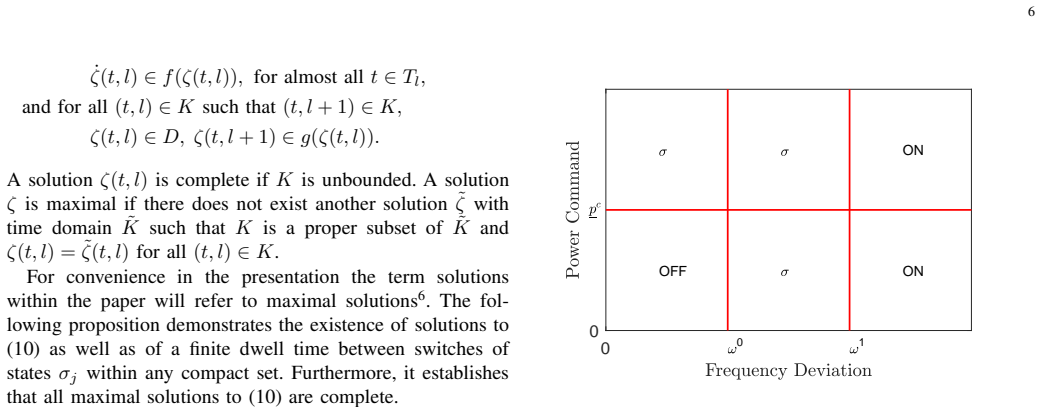
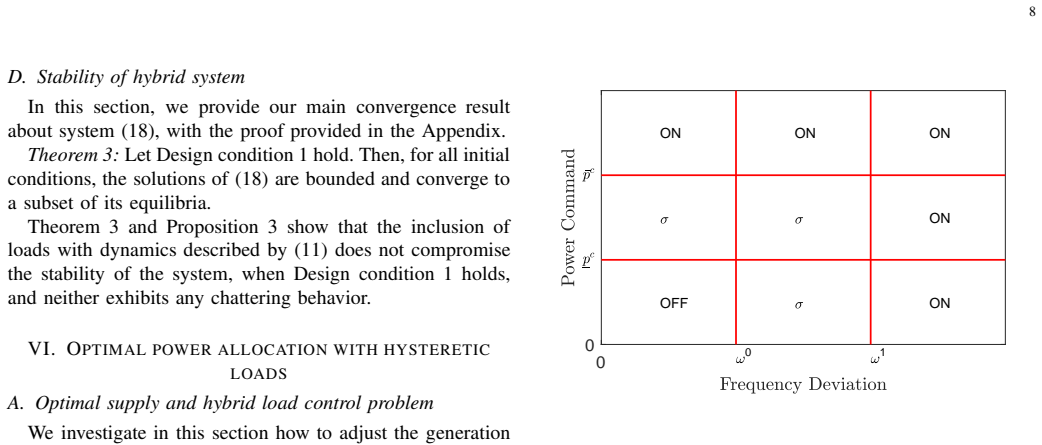
The central object is the adapted hysteretic load policy (21) with power-command signal $p^c = -\ell$ and thresholds specified by Design Condition 2. It gives each load three modes, stay on under high demand, standard hysteresis under low demand, and a one-way switch when demand is intermediate, which prevents chattering and provides a Lyapunov function for the hybrid system. The same thresholds encode the KKT conditions of the continuous relaxation of H-OSLC, so equilibrium cost is forced close to the global optimum.
What would settle it
Run the adapted hysteresis scheme on a test system with a deliberately wrong total-demand signal, say 10% lower than the true value, and check whether the steady-state generation-and-load cost still lies within $\epsilon = \max_j \bar{d}_j^2/(2D)$ of the H-OSLC optimum; Theorem 5 depends on $p^c = -\ell$ exactly, so this directly probes the bound. A second check is to violate $\alpha_j = c_j^{-1}$ and observe whether the equilibrium cost gap exceeds the stated epsilon.
Extended reading notes
Core claim
Under Design Condition 2, the hybrid power-network system with adapted hysteretic on-off loads has bounded solutions that converge to equilibria, and every such equilibrium is epsilon-optimal for the mixed-integer H-OSLC problem with $\epsilon = \frac{1}{2D}\max_j (\bar{d}_j)^2$. The design ranks loads by their cost per unit of demand and aligns that ranking with the KKT conditions of the continuous relaxation of the mixed-integer problem; when the aggregate demand parameter falls between design thresholds, the equilibrium allocation is exactly optimal, and the only suboptimality comes from the single load whose threshold interval contains that parameter.
Load-bearing premise
The optimality guarantee depends on the control scheme knowing the exact total uncontrollable demand $\ell$ and on setting every generator's droop coefficient to the reciprocal of its generation cost; with only bounds on $\ell$ and $D$, the paper says stability remains but the epsilon cost bound does not.
Editorial extensions
If this is right
- Under Design Condition 2, every maximal solution of the hybrid system (27) is bounded and converges to an equilibrium, so limit cycles and chattering are ruled out.
- At every equilibrium, the total cost of generation, uncontrollable demand, and load switching is within $\epsilon = \frac{1}{2D}\max_j (\bar{d}_j)^2$ of the global minimum of the mixed-integer H-OSLC problem.
- When the aggregate demand parameter $p^c$ falls outside all intervals $[p^c_j,\bar{p}^c_j]$, the equilibrium allocation is exactly optimal, not merely epsilon-optimal.
- A simpler design, Design Condition 1, needs only lower bounds on $D$ and retains convergence, but gives no optimality guarantee.
- The convergence properties survive when only an upper bound on $|\ell|$ and a lower bound on $D$ are known, so the scheme is robust to some measurement uncertainty.
Reading between the lines
- Because epsilon does not depend on the number of loads or the network size, the scheme should remain near-optimal as many small on-off devices join, with the largest single device setting the size of the cost gap.
- An operator that cannot obtain exact total demand could use a conservative bound for stability and periodically refine the estimate; the cost penalty should be driven mainly by the mismatch between the true and the used demand signal.
- The ranking by cost per unit demand suggests an immediate extension to heterogeneous loads of different sizes: reducing the largest load magnitude $\bar{d}_j$ would shrink epsilon more effectively than retuning any other single parameter.
Signed reviews
Editorial analysis
A structured set of objections, weighed in public.
Referee Report
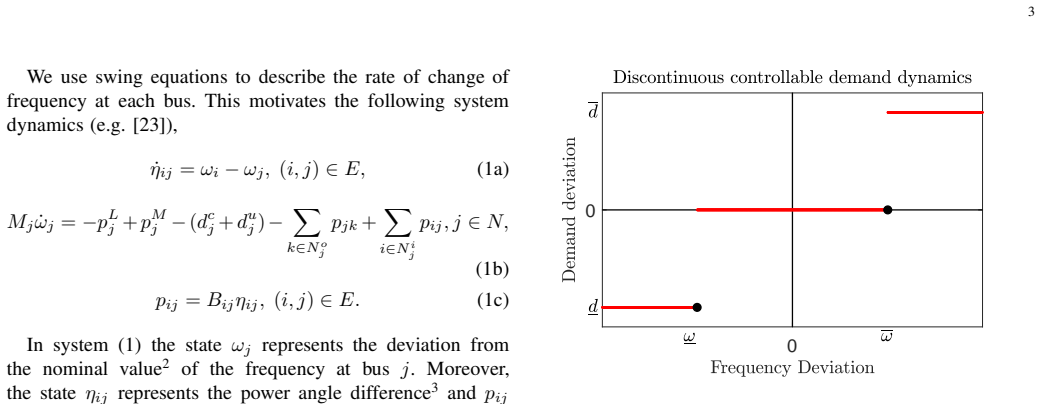
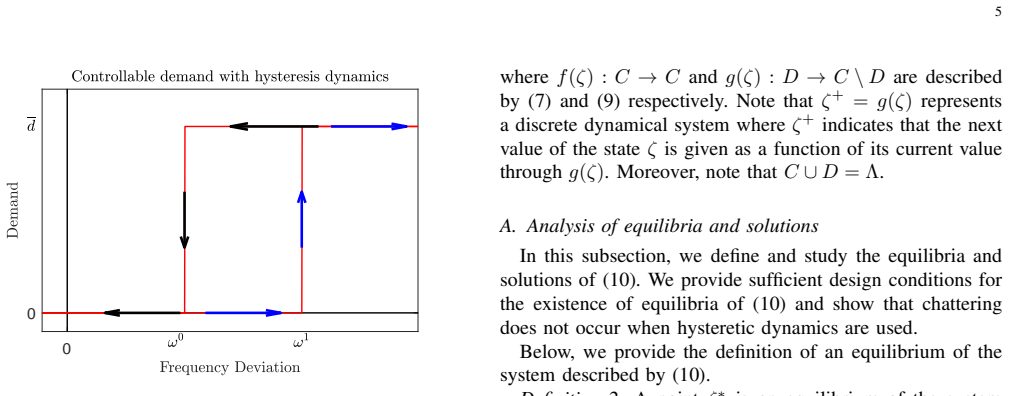
Summary. This paper studies primary frequency regulation in power networks with on-off controllable loads. It first analyzes loads that switch at fixed frequency thresholds, proving convergence of Filippov solutions (Theorem 1) while noting that such schemes can chatter. It then introduces hysteretic switching (Section IV), proves existence of equilibria under a hysteresis-width condition (Theorem 2), and states absence of chattering (Proposition 1), but observes that limit cycles can still occur. The main proposal is an adapted hysteretic scheme (Section V and Section VI) that uses an aggregate-demand power command to prevent further switching for a subset of loads. Under Design Condition 1 the authors claim convergence and no chattering (Theorem 3, Proposition 3); under Design Condition 2 they claim convergence (Theorem 4) and, when the droop coefficients satisfy alpha_j = c_j^{-1}, an epsilon-optimal steady-state allocation for a mixed-integer optimization problem (Theorem 5), with epsilon = (1/(2D)) max_j (bar_d_j)^2. The analytical results are illustrated by simulations on the NPCC 140-bus system.
Significance. If the convergence and optimality results are correct, this is a valuable contribution to demand-side primary frequency control. The paper clearly identifies why naive on-off control chatters, shows how hysteresis removes chattering, and proposes a constructive design whose equilibria are provably close to optimal for an NP-hard mixed-integer allocation problem, with an explicit and plausibly small error bound. The numerical validation on a realistic 140-bus model is a definite strength. However, the current proof of the central Lyapunov estimates contains a parameter-dependent algebraic error, the convergence proof has a gap at the marginal power-command value, and several auxiliary proofs are deferred to a companion paper. These issues must be repaired before the main claims can be regarded as established.
major comments (4)
- [Appendix, proof of Theorem 1, Eq. (32); proof of Theorem 4, Eq. (36a)] The Lyapunov derivative for V_M is computed as if alpha_j = 1. From (2a), tau_j \dot{p}^M_j = -(p^M_j - p^{M,*}_j) - alpha_j(omega_j - omega^*_j), so the derivative of V_M = (1/2) sum tau_j (p^M_j - p^{M,*}_j)^2 contains the cross term -alpha_j (p^M_j - p^{M,*}_j)(omega_j - omega^*_j), not -(p^M_j - p^{M,*}_j)(omega_j - omega^*_j) as written in (32). Consequently the inequalities in (34) and (36a) are not valid for general alpha_j, and Theorem 1, Theorem 3, and Theorem 4 are stated without the restriction alpha_j = 1. The argument can be repaired by taking V_M = (1/2) sum (tau_j/alpha_j)(p^M_j - p^{M,*}_j)^2, which cancels the cross term, but the proof as written is incorrect for the parameter range claimed.
- [Appendix, proof of Theorem 4, part (b), inequality (36a)] The sign assertion (omega_j - omega^*_j)(d^c_j - d^{c,*}_j) >= 0 fails in the marginal case p^c = p^c_j. For a single-bus, single-load network with Design Condition 2 and p^c_1 = D omega^0_1, take the continuous state x equal to the sigma = 0 equilibrium and set sigma = 1. This point is admissible under (24), but the dynamics give dot{omega} = -bar{d}_1/M < 0 at t = 0 while p^M is initially constant. The function V defined in (33) relative to the sigma = 0 equilibrium therefore increases for small t: (omega - omega^*)(d^c - d^{c,*}) is negative because omega < omega^* while d^c - d^{c,*} = bar{d}_1. Part (a) of the proof only fixes sigma for buses in N2, so the argument does not cover this case, which is exactly the case where the epsilon bound in Theorem 5 is active.
- [Appendix, 'Proofs of Propositions 1, 3 and 5'] The proofs of Propositions 1, 3, and 5 are not provided; they are deferred by analogy to Lemma 4 and Proposition 1 of [16]. Since [16] treats secondary frequency control with a different hybrid setup, and Proposition 5 supplies the completeness, finite-dwell-time, and no-chattering properties that are used in Theorem 4 and in the paper's main claims, the analogy is not sufficient. The authors should include self-contained proofs, or at least a precise transfer argument showing that the different flow and jump sets of (10), (18), and (27) do not affect the conclusion.
- [Remark 4 and Section I contribution list] The introduction lists as a contribution a distributed mechanism for obtaining the required demand measurements, and Remark 4 refers to '[30, Appendix B]' for this mechanism. However, [30] is the present manuscript and the current version contains no Appendix B and no other description of the distributed scheme. Either the distributed scheme and the proof that stability and optimality are preserved must be included, or the corresponding contribution claim should be removed.
minor comments (4)
- [Theorem 5 and its proof] The term 'non-conservative' for epsilon is not formally justified: the proof bounds C* - C_opt by hat{q}^2/(2D) and then by epsilon, but it does not demonstrate that some equilibrium attains the bound. Please either provide a tightness argument or soften the wording to 'explicit and small'.
- [Appendix, proof of Theorem 5] In the paragraph after equation (41), the interval notation '[p^c_j, p^c_j]' appears to be a typo; it should presumably be '[p^c_j, p^c_j + bar{d}_j]' to match the surrounding argument and equation (22d).
- [Theorem 5 and Remark 9] The optimality guarantee requires exact aggregate demand ell in (12) and the matching condition alpha_j = c_j^{-1}. Remark 9 correctly notes that replacing exact values by bounds preserves only stability and not optimality, but this limitation should also be stated explicitly in the abstract or theorem statement to avoid overclaiming.
- [Equations (11), (15), (24)] The notation for p^c_j, bar{p}^c_j, and p^c is visually easy to confuse; consistent typesetting of the subscripts and bars would improve readability.
Circularity Check
Main stability and near-optimality theorems are derived, not fitted; the only circularity burden is a minor self-citation for a distributed scheme deferred to the authors' own earlier arXiv version.
-
self citation load bearing
[Remark 4 (Section V), after eq. (12); also contribution bullet in Section I]
"It should further be noted that the requirement for a centrally implemented controller to transmit the total demand in (11), (12) is relaxed in [30, Appendix B], where we present a distributed scheme to evaluate the aggregate demand without compromising the convergence properties of the system."
The distributed mechanism is asserted as a contribution and its stability-preservation property is claimed, but no such scheme or proof appears in the present manuscript; the reader is referred to [30, Appendix B], and [30] is the authors' own earlier arXiv version of this same paper (arXiv:1908.08077). This is a self-citation standing in for missing content. It is not used in the proofs of Theorems 4 or 5, so it is a minor, non-central burden rather than a reduction of the main results.
full rationale
The central derivation is self-contained against the optimization problem and the closed-loop dynamics. Design Condition 2 is a controller synthesis rule, not a fitted parameter: thresholds are set from the H-OSLC data (ω0_k = c_d^k/dbar_k and p^c_k from Dω0_k plus cumulative dbar), and Theorem 5 computes the cost gap C*−Copt = qhat^2/(2D) directly from the equilibrium equations (13) and (29), so the ε-optimality bound is derived rather than assumed. Similarly, Theorem 4's Lyapunov argument uses Design Condition 2 to force the sign condition in (36a); whether that inequality is fully correct in the marginal case pc=p^c_j is a mathematical-correctness question, not a circularity question. The only genuinely self-referential element is Remark 4/[30]: a distributed demand-measurement scheme is claimed but deferred to the authors' own earlier arXiv version of the same manuscript, so that part of the contribution is supported by self-citation rather than by present content. The analogous reproduction of Proposition 5's proof from [16] is an omitted-proof and self-citation burden, but it does not reduce Theorem 4 or Theorem 5 to their own assumptions. Overall, the near-optimality and stability results have independent content, and the circularity score is low.
Assumptions & free parameters
assumptions (5)
- domain assumption The power network is described by swing equations with lossless lines, unit voltage magnitudes, and the small-angle approximation sin(eta) = eta (Assumptions 1 to 4, Section II).
- domain assumption The hybrid systems (10), (18) and (27) satisfy the well-posedness conditions of Goebel et al. [27, Theorem 6.8], and all maximal solutions are complete.
- domain assumption Costs are quadratic for generation, quadratic in frequency deviation for uncontrollable demand, and fixed for load switching (Section VI-A).
- ad hoc to paper For the optimality result, the droop coefficients satisfy alpha_j = c_j^{-1} (Theorem 5).
- domain assumption The exact aggregate demand ell, and hence pc = -ell, is available to the control scheme for the optimality guarantee.
Cite this review
Pith. "Pith review of Primary frequency regulation in power grids with on-off loads: chattering, limit cycles and convergence to optimality." pith.science (2026). https://pith.science/paper/WJ23GUE3
@misc{pith2026190808077,
  author       = {Pith},
  title        = {Pith review of: Primary frequency regulation in power grids with on-off loads: chattering, limit cycles and convergence to optimality},
  year         = {2026},
  howpublished = {\url{https://pith.science/paper/WJ23GUE3}},
  note         = {Machine review of arXiv:1908.08077}
}
abstract
Load side participation can provide valuable support to the power network in case of urgencies. On many occasions, loads are naturally represented by on and off states. However, the use of on-off loads for frequency control can lead to chattering and undesirable limit cycle behavior, which are issues that need to be resolved for such loads to be used for network support. This paper considers the problem of primary frequency regulation with ancillary service from on-off loads in power networks and establishes conditions that lead to convergence guarantees and an appropriate power allocation within the network. In particular, in order to assist existing frequency control mechanisms, we consider loads that switch when prescribed frequency thresholds are exceeded. Such control policies are prone to chattering, which limits their practicality. To resolve this issue, we consider loads that follow a decentralized hysteretic on-off policy, and show that chattering is not observed within such a setting. Hysteretic loads may exhibit, however, limit cycle behavior, which is undesirable. To address this, we propose an adapted hysteretic control scheme for which we provide convergence guarantees. Furthermore, we consider a mixed-integer optimization problem for power allocation and propose a suitable design of the control policy such that the cost incurred at equilibrium is within $\epsilon$ from the optimal cost, providing a non conservative value for $\epsilon$. The practicality of our analytic results is demonstrated with numerical simulations on the Northeast Power Coordinating Council (NPCC) 140-bus system.
Figures
Figures from the paper (4 more)
Reference graph
Works this paper leans on
-
[30]
A. Kasis, N. Monshizadeh, and I. Lestas, “Primary frequ ency regulation in power grids with on-off loads: chattering, limit cycles a nd conver- gence to optimality,” arXiv preprint arXiv:1908.08077 , 2019
work page Pith review arXiv 1908
-
[16]
Secondary frequency control with on-off load side participation in power networks
A. Kasis, N. Monshizadeh, and I. Lestas, “Secondary fre quency control with on-off load side participation in power networks,” to appear in IEEE Transactions on Control of Network Systems (arXiv prep rint arXiv:1708.09351), 2019
work page Pith review arXiv 2019
-
[1]
Stability of pr imary frequency control with on-off load side participation in power networ ks,
A. Kasis, N. Monshizadeh, and I. Lestas, “Stability of pr imary frequency control with on-off load side participation in power networ ks,” in 2018 IEEE Conference on Decision and Control (CDC) , pp. 6818–6823, IEEE, 2018
work page 2018
-
[2]
H. Lund, “Large-scale integration of optimal combinati ons of pv, wind and wave power into the electricity supply,” Renewable energy, vol. 31, no. 4, pp. 503–515, 2006
work page 2006
-
[3]
A. Ipakchi and F. Albuyeh, “Grid of the future,” IEEE power and energy magazine, vol. 7, no. 2, pp. 52–62, 2009
work page 2009
-
[4]
Dece ntralized demand-side contribution to primary frequency control,
A. Molina-Garcia, F. Bouffard, and D. S. Kirschen, “Dece ntralized demand-side contribution to primary frequency control,” IEEE Trans- actions on Power Systems , 2011. 13In particular, for given ℓ, there exist exactly two equilibrium frequencies when pc ∈ F and one otherwise. 16
work page 2011
-
[5]
Primary f requency regulation with load-side participation part i: stability and optimality,
A. Kasis, E. Devane, C. Spanias, and I. Lestas, “Primary f requency regulation with load-side participation part i: stability and optimality,” IEEE Transactions on Power Systems , 2016
work page 2016
-
[6]
Primary fre- quency regulation with load-side participation part ii: Be yond passivity approaches,
E. Devane, A. Kasis, M. Antoniou, and I. Lestas, “Primary fre- quency regulation with load-side participation part ii: Be yond passivity approaches,” IEEE Transactions on Power Systems , vol. 32, no. 5, pp. 3519–3528, 2016
work page 2016
Show all 37 references
-
[7]
Optimal load-side contr ol for frequency regulation in smart grids,
E. Mallada, C. Zhao, and S. Low, “Optimal load-side contr ol for frequency regulation in smart grids,” IEEE Transactions on Automatic Control, vol. 62, no. 12, pp. 6294–6309, 2017
2017
-
[8]
An internal model a pproach to (optimal) frequency regulation in power grids with time- varying voltages,
S. Trip, M. B¨ urger, and C. De Persis, “An internal model a pproach to (optimal) frequency regulation in power grids with time- varying voltages,” Automatica, vol. 64, pp. 240–253, 2016
2016
-
[9]
Distributed optimal load frequ ency control with non-passive dynamics,
S. Trip and C. De Persis, “Distributed optimal load frequ ency control with non-passive dynamics,” IEEE Transactions on Control of Network Systems, vol. 5, no. 3, pp. 1232–1244, 2018
2018
-
[10]
Sta bility and optimality of distributed secondary frequency control sch emes in power networks,
A. Kasis, N. Monshizadeh, E. Devane, and I. Lestas, “Sta bility and optimality of distributed secondary frequency control sch emes in power networks,” IEEE Transactions on Smart Grid , 2017
2017
-
[11]
Conditions f or delay-robust consensus-based frequency control in power systems with se cond-order turbine-governor dynamics,
S. Alghamdi, J. Schiffer, and E. Fridman, “Conditions f or delay-robust consensus-based frequency control in power systems with se cond-order turbine-governor dynamics,” in 2018 IEEE Conference on Decision and Control (CDC), pp. 786–793, IEEE, 2018
2018
-
[12]
Design and stabilit y of load- side primary frequency control in power systems,
C. Zhao, U. Topcu, N. Li, and S. Low, “Design and stabilit y of load- side primary frequency control in power systems,” IEEE Transactions on Automatic Control , 2014
2014
-
[13]
Breakin g the hierar- chy: Distributed control and economic optimality in microg rids,
F. D¨ orfler, J. W. Simpson-Porco, and F. Bullo, “Breakin g the hierar- chy: Distributed control and economic optimality in microg rids,” IEEE Transactions on Control of Network Systems , vol. 3, no. 3, pp. 241–253, 2016
2016
-
[14]
A distributed scheme for secondary frequency control with stability guarantees and optimal power allocation,
A. Kasis, N. Monshizadeh, and I. Lestas, “A distributed scheme for secondary frequency control with stability guarantees and optimal power allocation,” Systems & Control Letters , vol. 144, p. 104755, 2020
2020
-
[15]
Secondary fre quency regula- tion in power networks with on-off load side participation,
A. Kasis, N. Monshizadeh, and I. Lestas, “Secondary fre quency regula- tion in power networks with on-off load side participation, ” in Decision and Control (CDC), 2017 IEEE 56th Annual Conference on , pp. 5702– 5707, IEEE, 2017
2017
-
[17]
Non-disruptive load-s ide control for frequency regulation in power systems,
T. Liu, D. J. Hill, and C. Zhang, “Non-disruptive load-s ide control for frequency regulation in power systems,” IEEE Transactions on Smart Grid, vol. 7, no. 4, pp. 2142–2153, 2016
2016
-
[18]
Stabilizati on of grid frequency through dynamic demand control,
J. A. Short, D. G. Infield, and L. L. Freris, “Stabilizati on of grid frequency through dynamic demand control,” IEEE Transactions on Power Systems, 2007
2007
-
[19]
A stochastic appro ach to “dynamic- demand
D. Angeli and P .-A. Kountouriotis, “A stochastic appro ach to “dynamic- demand” refrigerator control,” IEEE Transactions on control systems technology, vol. 20, no. 3, pp. 581–592, 2012
2012
-
[20]
Frequency regulation with ther mostatic load participation in power networks,
A. Kasis and I. Lestas, “Frequency regulation with ther mostatic load participation in power networks,” in 2019 IEEE 58th Conference on Decision and Control (CDC) , pp. 3279–3284, IEEE, 2019
2019
-
[21]
Economic and environmental benefits of dynamic demand in providing frequency regulation,
M. Aunedi, P .-A. Kountouriotis, J. O. Calderon, D. Ange li, and G. Str- bac, “Economic and environmental benefits of dynamic demand in providing frequency regulation,” IEEE Transactions on Smart Grid , vol. 4, no. 4, pp. 2036–2048, 2013
2013
-
[22]
Schrijver, Theory of linear and integer programming
A. Schrijver, Theory of linear and integer programming . John Wiley & Sons, 1998
1998
-
[23]
A. R. Bergen and V . Vittal, Power Systems Analysis. Prentice Hall, 1999
1999
-
[24]
Primary frequency r egulation in power networks with ancillary service from load-side parti cipation,
A. Kasis, E. Devane, and I. Lestas, “Primary frequency r egulation in power networks with ancillary service from load-side parti cipation,” IF AC-PapersOnLine, vol. 50, no. 1, pp. 4394–4399, 2017
2017
-
[25]
Secant and popov-like co nditions in power network stability,
N. Monshizadeh and I. Lestas, “Secant and popov-like co nditions in power network stability,” Automatica, vol. 101, pp. 258–268, 2019
2019
-
[26]
Discontinuous dynamical systems,
J. Cortes, “Discontinuous dynamical systems,” IEEE Control Systems , vol. 28, no. 3, 2008
2008
-
[27]
Goebel, R
R. Goebel, R. G. Sanfelice, and A. R. Teel, Hybrid Dynamical Systems: modeling, stability, and robustness . Princeton University Press, 2012
2012
-
[28]
Machowski, J
J. Machowski, J. Bialek, and J. Bumby, Power system dynamics: stability and control. John Wiley & Sons, 2011
2011
-
[29]
Gomez-Exposito and A
A. Gomez-Exposito and A. Abur, Power system state estimation: theory and implementation. CRC press, 2004
2004
-
[31]
Reducibility among combinatorial problem s,
R. M. Karp, “Reducibility among combinatorial problem s,” in Complex- ity of computer computations , pp. 85–103, Springer, 1972
1972
-
[32]
Power system toolbox , v 3.0,
K. Cheung, J. Chow, and G. Rogers, “Power system toolbox , v 3.0,” Rensselaer Polytechnic Institute and Cherry Tree Scientifi c Software , 2009
2009
-
[33]
Genetic algorithms an d machine learning,
D. E. Goldberg and J. H. Holland, “Genetic algorithms an d machine learning,” Machine learning , vol. 3, no. 2, pp. 95–99, 1988
1988
-
[34]
Stability and stabiliz ation of discon- tinuous systems and nonsmooth lyapunov functions,
A. Bacciotti and F. Ceragioli, “Stability and stabiliz ation of discon- tinuous systems and nonsmooth lyapunov functions,” ESAIM: Control, Optimisation and Calculus of V ariations , vol. 4, pp. 361–376, 1999
1999
-
[35]
W. M. Haddad and V . Chellaboina, Nonlinear dynamical systems and control: a Lyapunov-based approach . Princeton University Press, 2011
2011
-
[36]
Filippov, Differential Equations with Discontinuous Righthand Side s: Control Systems, vol
A. Filippov, Differential Equations with Discontinuous Righthand Side s: Control Systems, vol. 18. Springer Science & Business Media, 1988
1988
-
[37]
R. T. Rockafellar, Convex analysis. Princeton university press, 2015
2015
Reviewed August 14, 2026 · model on record in the stance chip above.
Discussion (0). Continue with ORCID to comment.