REVIEW 4 major objections 6 minor 52 references
Distinct signature of two local structural motifs of liquid water in the scattering function
T0 review · 4 major / 6 minor · reviewed 2026-08-14 · deepseek-v4-flash
Pith's one-line read The apparent first diffraction peak in liquid water is really two overlapping peaks, one from tetrahedral clusters and one from disordered surroundings — evidence that two local structural motifs coexist.
desk verdict Simulation evidence for two motifs is solid; the experimental doublet proof is model-dependent and overclaimed. read the letter →
The pith
A machine-rendered reading of the paper's core claim, the machinery that carries it, and where it could break.
The reading
What carries the argument
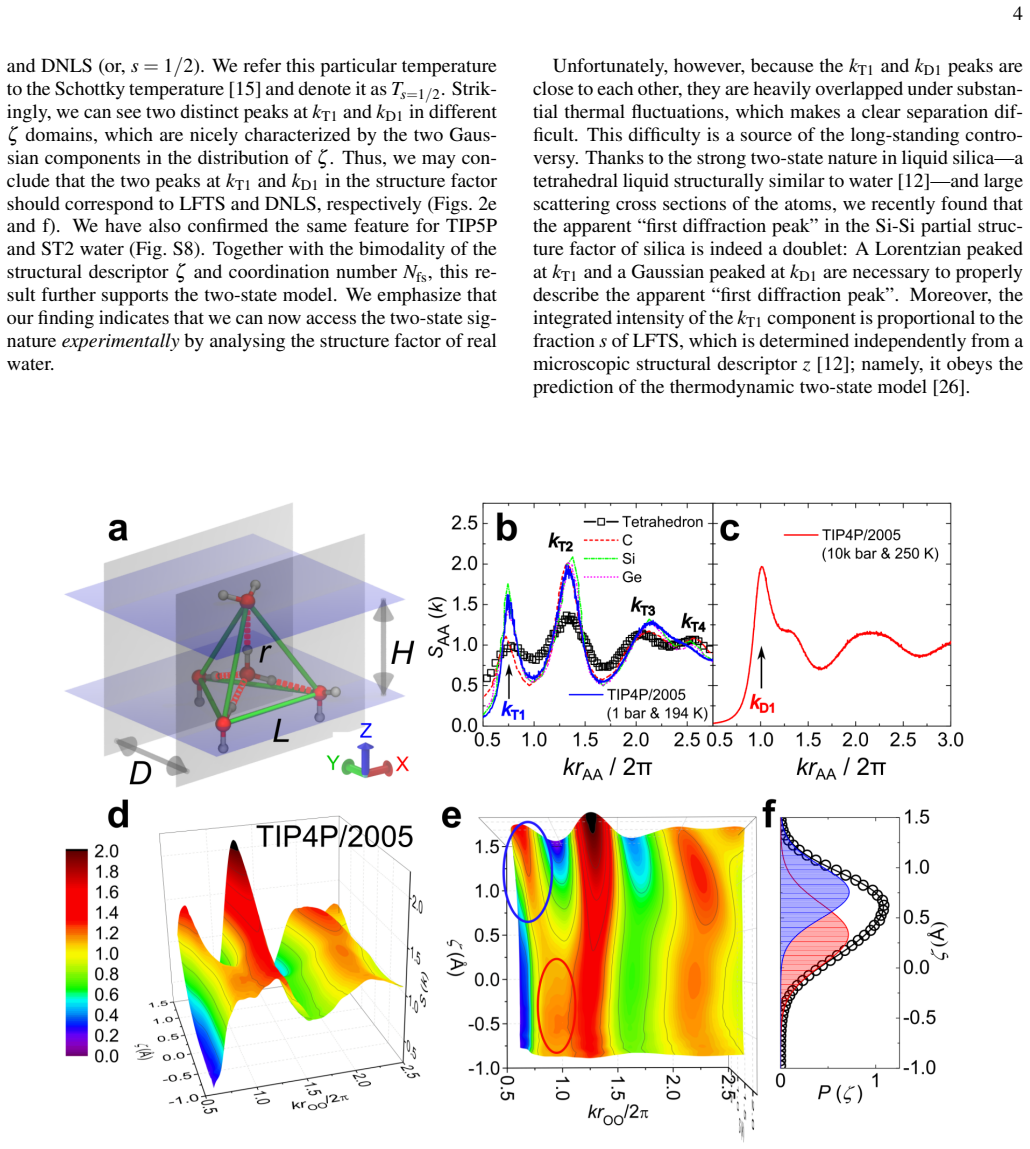
The load-bearing object is a decomposition of the apparent first diffraction peak into a Lorentzian at $k_{T1} \approx 3/4$ and a Gaussian at $k_{D1} \approx 1$, tied to the thermodynamic two-state model through the proportionalities $f_{T1} = a\,s$ and $f_{D1} = b(1-s)$. The Lorentzian represents scattering from the density wave of characteristic wavelength set by the height of a tetrahedral locally favored structure, and its Fourier transform in real space is an exponentially decaying correlation whose decay length is read as the coherence length of tetrahedral ordering; the Gaussian represents the ordinary nearest-neighbor correlation of the disordered component. Supporting this assignment, a Debye-scattering analysis resolves the structure factor by the local structural descriptor $\zeta$ and shows the $k_{T1}$ and $k_{D1}$ peaks arising from different $\zeta$ subpopulations. The whole fitting scheme uses four peak functions across the first three apparent peaks and only about 25 free parameters to describe the temperature series.
What would settle it
One could re-fit the experimental and simulated O–O structure factors below 240 K with a single asymmetric peak or with two Gaussians of free position, and compare models by an information criterion; the two-motif claim would be falsified if the Lorentzian-plus-Gaussian doublet is not clearly preferred and its $k_{T1}$ integrated intensity does not scale with the independently measured fraction of tetrahedral structures across temperature. A second check: resolve $S(k,\zeta)$ by molecular dynamics and verify that the $k_{T1}$ peak appears only in the high-$\zeta$ tetrahedral subpopulation; if the disordered subpopulation contributes comparably at $k_{T1}$, the assignment collapses.
Extended reading notes
Core claim
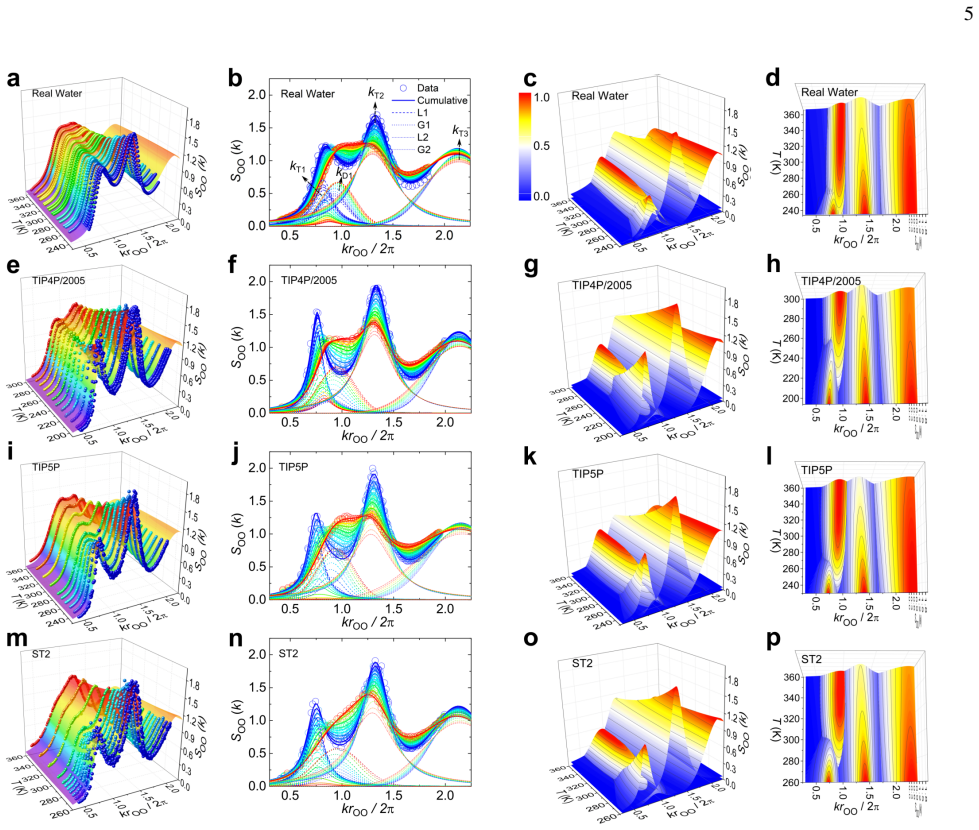
The paper's central claim is that the feature usually labeled the first diffraction peak in the O–O partial structure factor of water is a doublet. A low-wave-number Lorentzian peak at $k_{T1} = k r_{OO}/2\pi \approx 3/4$ is the first sharp diffraction peak of tetrahedral order, produced by the density wave along the height of a tetrahedral locally favored structure; a higher-wave-number Gaussian peak at $k_{D1} \approx 1$ is the ordinary nearest-neighbor peak of disordered normal-liquid structures. Fitting real-water x-ray data and simulations of TIP4P/2005, TIP5P, and ST2 water with this doublet plus two higher peaks, the authors find that the integrated intensity of the $k_{T1}$ component is proportional to the fraction $s$ of tetrahedral structures independently obtained from a structural descriptor and from the coordination-number distribution, and that it follows the thermodynamic two-state equation. Below about 1.1 times the Schottky temperature a single-Gaussian description of the first peak fails while the doublet succeeds, and the same trend collapses across all systems. The paper therefore concludes that the two motifs coexist in liquid water and that the scattering function gives experimental access to both the degree ($s$) and the range (coherence length, from the Lorentzian width) of tetrahedral ordering.
Load-bearing premise
The load-bearing assumption is that the apparent first diffraction peak is exactly a Lorentzian component at $k_{T1}\approx 3/4$ plus a Gaussian component at $k_{D1}\approx 1$, with the Lorentzian's integrated intensity strictly proportional to the tetrahedral fraction $s$; these line shapes and the proportionality constants are assumed and fitted, not derived, so if a single asymmetric peak or a different two-component model describes the same data equally well, the coexistence conclusion does not follow.
Editorial extensions
If this is right
- The integrated intensity of the first sharp diffraction peak becomes a direct experimental order parameter for tetrahedral ordering in liquid water, replacing simulation-only descriptors.
- The width of that peak gives the coherence length of tetrahedral order, which grows on cooling and is bounded between about 2 Å (single tetrahedron) and 6.5 Å (LDA ice), quantifying how short-ranged the ordering is.
- Below roughly $1.1\,T_{s=1/2}$, a one-peak description of the first diffraction peak fails for both real and model water, explaining why the two-state signature is invisible at ambient conditions where $s$ is small.
- The same doublet appears in real water and in three popular models, with model differences showing up as different rates of growth of $s$, meaning the method can rank how over-structured a model is.
- The result supports the two-state picture of water as a mixture of locally favored tetrahedral structures and disordered normal-liquid structures, distinct from macroscopic low-density and high-density liquid phases.
Reading between the lines
- If the decomposition holds, the same Lorentzian-plus-Gaussian analysis could be applied to other tetrahedral liquids and to neutron-scattering data with isotope substitution to test whether the two-motif picture is universal.
- The proportionality between Lorentzian intensity and the two-state fraction implies that the FSDP intensity should track thermodynamic response functions such as the compressibility maximum; checking that correlation in existing data would be a cheap independent test.
- The assumed Lorentzian line shape itself is a testable physical statement: it says tetrahedral order decays exponentially in space. Comparing the fitted real-space correlation with direct pair-correlation analysis from simulations would distinguish it from other decay laws.
- If the two-peak decomposition remains stable under a Bayesian model comparison with asymmetric or alternative two-peak shapes, the coexistence conclusion would be substantially strengthened; the current evidence rests on the chosen line shapes.
Signed reviews
Editorial analysis
A structured set of objections, weighed in public.
Referee Report
Summary. The paper argues that the apparent first diffraction peak in the O-O partial structure factor of water is actually a doublet: a Lorentzian peak at kT1 ≈ 3/4 (in units of k rOO / 2π), attributed to locally favored tetrahedral structures (LFTS), and a Gaussian peak at kD1 ≈ 1, attributed to disordered normal-liquid structures (DNLS). The authors support this with simulations of TIP4P/2005, TIP5P, and ST2 water, using a ζ-resolved Debye scattering function that shows distinct peaks in different ζ domains, and with fits to experimental and simulated S(k) using a two-Lorentzian/two-Gaussian model. From the fits they extract the LFTS fraction s and a coherence length, claiming that this 'unambiguously proves the coexistence of two local structural motifs' in liquid water.
Significance. If the central claim is correct, the paper provides an experimentally accessible order parameter for the two-state model of water and a way to measure the range of tetrahedral ordering, which would be a substantial contribution to the long-standing mixture-versus-continuum debate. The simulation-side evidence—especially the ζ-resolved Debye scattering function in Fig. 2d–e showing two distinct peaks at kT1 and kD1 in different ζ domains—is a genuine and valuable independent demonstration that the two structural motifs produce distinct scattering signatures in the simulated models. The paper also connects water to the prior silica work (Ref. 26) in a physically appealing way. However, the experimental proof rests on a fitting model whose line-shape decomposition and proportionality relations are assumed rather than derived, and the model comparison does not rule out simpler alternatives.
major comments (4)
- [Methods, Eq. S11] The decomposition of the apparent first diffraction peak into a Lorentzian (L1) at kT1 and a Gaussian (G1) at kD1 is assumed in the fitting model, not derived from the data. The comparison in Fig. S12 between Scheme I (one Gaussian for the first peak) and Scheme II (Lorentzian plus Gaussian) does not rule out other line shapes, because the two schemes differ in parameter count (8–9 per temperature versus 25 globally) and no information criterion, cross-validation, or confidence intervals are reported. As written, the experimental evidence for the doublet is conditional on the very model it is meant to prove.
- [Methods, Eqs. S16–S18] The proportionality fT1 = a·s and fD1 = b·(1−s) is imported from liquid silica (Ref. 26) and the constants a and b are fitted to the water data; s itself is determined from the same experimental scattering data via s = 1 − gOO(r_HB) (Methods, 'Fitting formula for the structure factor'). This makes the agreement between the fitted Lorentzian intensity and the two-state fraction (Fig. 4a) partly circular: the model constrains the fit with the quantity it then claims to extract. The paper should provide an independent determination of s (e.g., from simulations of the same models) and test the proportionality with a and b reported with uncertainties.
- [Fig. 3 and Fig. S12] No statistical uncertainties are reported for the fitted peak positions kT1, kD1, widths, or intensities. For heavily overlapped peaks these parameters are strongly covariant, so the claimed separation at kT1 ≈ 3/4 and kD1 ≈ 1 cannot be assessed without confidence intervals or a bootstrap analysis. At minimum, the authors should report error bars from the simultaneous fit, particularly for the experimental water data.
- [Fig. S13] Three experimental temperatures (234.8, 264.0, and 268.1 K) are excluded post hoc as outliers based on their peak/trough heights, and the master-curve collapse in Fig. S12 is shown after this exclusion. Because Scheme II is a global fit, excluding points can change the fitted parameters at all temperatures; the authors should show the fit with and without these points and justify the exclusion a priori rather than after seeing the residuals.
minor comments (6)
- [Abstract] The word 'discontinuosly' should be 'discontinuously', and in the Fig. 4 caption 'propotional' should be 'proportional'.
- [Main text, near Eq. (1)] The phrase 'only board isotropic amorphous halos' should read 'only broad isotropic amorphous halos'.
- [Throughout] There are several typographical errors: 'Lorentizan' and 'Guassian' appear in the Fig. 3 caption and elsewhere, and 'cooresponds' appears in the Fig. 2 caption. These should be corrected.
- [Fig. S5 caption] The threshold value ζc (≃0.5 Å) is mentioned only in the caption; the procedure for choosing this threshold and its effect on s should be described in the Methods, since s depends on it.
- [Methods, Eqs. S12–S15] The statement that 'only 25 free fitting parameters' are necessary is not fully enumerated; the constraints (e.g., setting k̃x2 = 0, fixing kT3, fixing the ratios of k̃T11/k̃D11) should be tabulated so the reader can reproduce the parameter count.
- [Fig. S13] The filled and open symbols in panels a and b are said to correspond to Refs. [29] and [30], respectively, but the figure legend does not state this explicitly; please add a legend or note in the caption.
Circularity Check
The experimental access to s from the FSDP is forced by the fitting constraint fT1 = a·s, and the Nfs Gaussian weights are fixed to s by Eq. S1; only the simulation-side Debye analysis is independent.
-
fitted input called prediction
[Methods, 'Fitting formula for the structure factor', Eqs. S16-S18; Fig. 4a]
"On the other hand, the intensities of T1 and D1 peaks vary significantly with temperature and pressure, corresponding to the change in the fractions of the two structural motifs. In our previous study [26], we found that the integrated intensity fT 1 of FSDP is proportional to the fraction s of LFTS in liquid silica as fT1(T, P) = a· s (S16) ... This knowledge is directly applied to liquid water ... Since D1 peak is exclusively from DNLS, whose fraction is given by (1− s), we can formulate ... fD1(T, P) = b(1− s) (S18)"
The paper advertises Fig. 4a as 'The integrated intensity of FSDP (kT1 peak) as a measure of the degree of local tetrahedral ordering, or the fraction s of LFTS', but Eq. S16 forces fT1 = a·s and Eq. S18 forces fD1 = b(1−s) inside the fit. The reported 'agreement' between the fitted FSDP intensity and the two-state fraction is therefore not an independent check; the plotted s is the same s that was fed into the fitting equations. For real water, s is itself obtained from gOO(r) via s(T)=1−gOO(r=rHB), i.e. from another scattering-derived quantity, so the experimental 'access' to s is a re-display of the fitting constraint rather than a prediction.
-
self definitional
[Methods, 'Fitting formula for the coordination number distribution', Eq. S1; main-text Fig. 1b]
"P (Nfs) = s/(σLFTS√2π) exp[−(Nfs−NLFTS)^2/(2σ^2_LFTS)] + (1−s)/(σDNLS√2π) exp[−(Nfs−NDNLS)^2/(2σ^2_DNLS)] (S1) ... In this equation, s is defined by Eq. S17 and other parameters can be described as follows, ... P(Nfs) and P(ζ) both can be properly characterized by two Gaussian functions (see Methods) with the same fraction s ... following the prediction of the thermodynamic two-state model."
Equation S1 fixes the weights of the two Gaussian components to s and 1−s, with s already prescribed by the two-state equation S17. The statement that the fraction of the two Gaussian components 'agrees well with' the thermodynamic two-state prediction is therefore an identity built into the fitting formula, not a test. The bimodal shape and peak positions are empirical, but the quantitative fraction agreement claimed in Figs. 1 and S2 is imposed by construction.
1 more flagged steps
-
ansatz smuggled in via citation
[Main text, section introducing the silica doublet; Methods, Eq. S16]
"In our previous study [26], we found that the integrated intensity fT 1 of FSDP is proportional to the fraction s of LFTS in liquid silica ... This knowledge is directly applied to liquid water, since they are both characterized by the same two-state features [26]."
The load-bearing relation fT1 = a·s is not re-derived for water; it is adopted from the authors' previous silica work by self-citation and then inserted as a constraint in the water structure-factor fit. The paper subsequently presents the constrained fit as if it independently 'follows the prediction of the two-state model.' Because the cited prior work is not independently reproduced here and the constant a and the two-state parameters are fitted, the citation supplies the ansatz that the same proportionality holds; this self-citation chain is what makes the experimental FSDP intensity interpretable as s.
full rationale
The paper contains genuine independent evidence: the ζ-resolved Debye scattering function S(k,ζ) in Fig. 2 d,e is computed from simulations rather than fitted, and it shows distinct peaks at kT1 and kD1 in different ζ domains. That supports the two-motif picture within the simulated models and prevents a higher circularity score. However, the experimental claim is substantially weaker than presented. The doublet decomposition in Eq. S11 is assumed in the fitting model, and the key proportionality fT1 = a·s (Eq. S16) is imposed, not derived, so Fig. 4a's s is a fitted input renamed as a prediction. The same self-definitional structure appears in Eq. S1, where the Gaussian weights are fixed to s and 1−s. For real water, s is calibrated from gOO(r), which is itself extracted from scattering data, so the scattering-based 'measure' of tetrahedral fraction is partly circular. The residual comparison in Fig. S12 is reported without confidence intervals and does not rule out a single asymmetric peak. Taking all this together, one or more central 'predictions' reduce by construction, while the simulation-side analysis retains independent content; hence score 6.
Assumptions & free parameters
free parameters (7)
- Delta E (energy difference between LFTS and DNLS) =
-1929.0 K (real water), -1802.0 K (TIP4P/2005), -3355.9 K (TIP5P), -4612.5 K (ST2)
- Delta sigma (entropy difference between LFTS and DNLS) =
-8.2845 (real water), -7.5779 (TIP4P/2005), -13.134 (TIP5P), -16.106 (ST2)
- Proportionality constant a in fT1 = a*s =
not reported
- Proportionality constant b in fD1 = b*(1-s) =
not reported
- 25-parameter set for S(k) polynomial fitting =
polynomial coefficients in Eqs. S12-S15
- Threshold zeta_c for macroscopic order parameter =
~0.5 Angstrom
- H-bond cutoff rHB for s(T)=1-gOO(rHB) =
3.5 Angstrom
assumptions (5)
- domain assumption Liquid water is a dynamic mixture of two local structural motifs (LFTS and DNLS) whose fractions follow a two-state thermodynamic model (Eq. S17).
- ad hoc to paper The apparent first diffraction peak is the sum of a Lorentzian from LFTS and a Gaussian from DNLS (Eq. S11).
- ad hoc to paper The integrated intensity of the Lorentzian component is proportional to the fraction of LFTS (Eq. S16), a relation imported from silica.
- domain assumption The structural descriptor zeta from prior work correctly separates the two motifs and shows bimodality.
- domain assumption The experimental O-O partial structure factors derived from x-ray data (Skinner 2014, Pathak 2019) are accurate enough for quantitative decomposition.
Cite this review
Pith. "Pith review of Distinct signature of two local structural motifs of liquid water in the scattering function." pith.science (2026). https://pith.science/paper/FT7SBC3U
@misc{pith2026190808102,
  author       = {Pith},
  title        = {Pith review of: Distinct signature of two local structural motifs of liquid water in the scattering function},
  year         = {2026},
  howpublished = {\url{https://pith.science/paper/FT7SBC3U}},
  note         = {Machine review of arXiv:1908.08102}
}
read the original abstract
Liquids generally become more ordered upon cooling. However, it has been a long-standing debate on whether such structural ordering in liquid water takes place continuously or discontinuosly: continuum vs. mixture models. Here, by computer simulations of three popular water models and analysis of recent scattering experiment data, we show that, in the structure factor of water, there are two overlapped peaks hidden in the apparent "first diffraction peak", one of which corresponds to the neighboring O-O distance as in ordinary liquids and the other to the longest periodicity of density waves in a tetrahedral structure. This unambiguously proves the coexistence of two local structural motifs. Our findings not only provide key clues to settle long-standing controversy on the water structure but also allow experimental access to the degree and range of structural ordering in liquid water.
Figures

Figures from the paper (1 more)

Reference graph
Works this paper leans on
-
[1]
Debenedetti, P. G. Supercooled and glassy water. J. Phys.: Condens. Matter 15, 1669–1726 (2003)
work page 2003
-
[2]
Gallo, P. et al. Water: A tale of two liquids. Chem. Rev. 116, 7463–7500 (2016)
work page 2016
-
[3]
Narten, A. H. & Levy, H. Observed diffraction pattern and proposed models of liquid water. Science 165, 447–454 (1969)
work page 1969
-
[4]
Eisenberg, D. S. & Kauzmann, W. The Structure and Properties of Water (Oxford University Press, Oxford, 2005)
work page 2005
-
[5]
Handle, P. H., Loerting, T. & Sciortino, F. Supercooled and glassy water: Metastable liquid (s), amorphous solid (s), and a no-man’s land. Proc. Natl. Acad. Sci. U. S. A. 201700103 (2017)
work page 2017
-
[6]
Röntgen, W. C. Ueber die constitution des flüssigen wassers. Ann. Phys. 281, 91–97 (1892)
-
[7]
The structure of water (Elsevier, 1959)
Pauling, L. The structure of water (Elsevier, 1959)
work page 1959
-
[8]
Pople, J. A. Molecular association in liquids II. A theory of the structure of water. Proc. Royal Soc. Lond. A 205, 163–178 (1951)
work page 1951
Show all 52 references
-
[9]
Bond orientational order in liquids: Towards a unified description of water-like anomalies, liquid-liquid tran- sition, glass transition, and crystallization
Tanaka, H. Bond orientational order in liquids: Towards a unified description of water-like anomalies, liquid-liquid tran- sition, glass transition, and crystallization. Eur . Phys. J E 35, 113 (2012)
2012
-
[10]
Simple physical model of liquid water
Tanaka, H. Simple physical model of liquid water. J. Chem. Phys. 112, 799–809 (2000)
2000
-
[11]
& Tanaka, H
Russo, J. & Tanaka, H. Understanding water’s anomalies with locally favoured structures. Nat. Commun. 5, 3556 (2014)
2014
-
[12]
& Tanaka, H
Shi, R. & Tanaka, H. Impact of local symmetry breaking on the physical properties of tetrahedral liquids. Proc. Natl. Acad. Sci. U. S. A. 115, 1980–1985 (2018)
2018
-
[13]
& Tanaka, H
Shi, R. & Tanaka, H. Microscopic structural descriptor of liquid water. J. Chem. Phys. 148, 124503 (2018)
2018
-
[14]
& Tanaka, H
Shi, R., Russo, J. & Tanaka, H. Origin of the emergent fragile- to-strong transition in supercooled water. Proc. Natl. Acad. Sci. U. S. A. 115, 9444–9449 (2018)
2018
-
[15]
& Tanaka, H
Shi, R., Russo, J. & Tanaka, H. Common microscopic structural origin for water’s thermodynamic and dynamic anomalies. J. Chem. Phys. 149, 224502 (2018)
2018
-
[16]
T., Molinero, V
Holten, V ., Limmer, D. T., Molinero, V . & Anisimov, M. A. Nature of the anomalies in the supercooled liquid state of the mW model of water. J. Chem. Phys. 138, 174501 (2013)
2013
-
[17]
S., Biddle, J
Singh, R. S., Biddle, J. W., Debenedetti, P. G. & Anisimov, M. A. Two-state thermodynamics and the possibility of a liquid- liquid phase transition in supercooled TIP4P/2005 water. J. Chem. Phys. 144, 144504 (2016)
2016
-
[18]
Biddle, J. W. et al. Two-structure thermodynamics for the TIP4P/2005 model of water covering supercooled and deeply stretched regions. J. Chem. Phys. 146, 034502 (2017)
2017
-
[19]
P., Issenmann, B
Singh, L. P., Issenmann, B. & Caupin, F. Pressure dependence of viscosity in supercooled water and a unified approach for thermodynamic and dynamic anomalies of water. Proc. Natl. Acad. Sci. U. S. A. 114, 4312–4317 (2017)
2017
-
[20]
M., Sanz, E., Joly, L., Valeriani, C
de Hijes, P. M., Sanz, E., Joly, L., Valeriani, C. & Caupin, F. Viscosity and self-diffusion of supercooled and stretched wa- ter from molecular dynamics simulations. J. Chem. Phys. 149, 094503 (2018)
2018
-
[21]
& Tanaka, H
Russo, J., Akahane, K. & Tanaka, H. Water-like anomalies as a function of tetrahedrality. Proc. Natl. Acad. Sci. U. S. A. 115, E3333–E3341 (2018)
2018
-
[22]
Simple physical explanation of the unusual ther- modynamic behavior of liquid water
Tanaka, H. Simple physical explanation of the unusual ther- modynamic behavior of liquid water. Phys. Rev. Lett. 80, 5750 (1998)
1998
-
[23]
& Robertson, J
Gilkes, K., Gaskell, P. & Robertson, J. Comparison of neutron- scattering data for tetrahedral amorphous carbon with structural models. Phys. Rev. B 51, 12303 (1995)
1995
-
[24]
Laaziri, K. et al. High-energy x-ray diffraction study of pure amorphous silicon. Phys. Rev. B 60, 13520 (1999)
1999
-
[25]
Etherington, G. et al. A neutron diffraction study of the struc- ture of evaporated amorphous germanium. J. Non-Cryst. Solids 48, 265–289 (1982)
1982
-
[26]
& Tanaka, H
Shi, R. & Tanaka, H. Distinct signature of local tetrahedral or- dering in the scattering function of covalent liquids and glasses. Sci. Adv. 5, eaav3194 (2019)
2019
-
[27]
Elliott, S. R. Medium-range structural order in covalent amor- phous solids. Nature 354, 445 (1991)
1991
-
[28]
Zerstreuung von röntgenstrahlen
Debye, P. Zerstreuung von röntgenstrahlen. Ann. Phys. 351, 809–823 (1915)
1915
-
[29]
B., Benmore, C., Neuefeind, J
Skinner, L. B., Benmore, C., Neuefeind, J. C. & Parise, J. B. The structure of water around the compressibility minimum. J. Chem. Phys. 141, 214507 (2014)
2014
-
[30]
Pathak, H. et al. Intermediate range O–O correlations in su- percooled water down to 235 K. J. Chem. Phys. 150, 224506 (2019)
2019
-
[31]
Skinner, L. B. et al. Benchmark oxygen-oxygen pair- distribution function of ambient water from x-ray diffraction measurements with a wide Q-range. J. Chem. Phys. 138, 074506 (2013)
2013
-
[32]
Mariedahl, D. et al. X-ray Scattering and O–O Pair-Distribution Functions of Amorphous Ices. J. Phys. Chem. B 122, 7616– 7624 (2018)
2018
-
[33]
F., Morales, G., Hare, D
Xie, Y ., Ludwig Jr, K. F., Morales, G., Hare, D. E. & Sorensen, C. M. Noncritical behavior of density fluctuations in super- cooled water. Phys. Rev. Lett. 71, 2050 (1993)
1993
-
[34]
Huang, C. et al. The inhomogeneous structure of water at ambi- ent conditions. Proc. Natl. Acad. Sci. U.S.A. 106, 15214–15218 (2009)
2009
-
[35]
Kim, K. H. et al. Maxima in the thermodynamic response and correlation functions of deeply supercooled water.Science 358, 1589–1593 (2017). 8
2017
-
[36]
Smith, J. D. et al. Unified description of temperature-dependent hydrogen-bond rearrangements in liquid water. Proc. Natl. Acad. Sci. U. S. A. 102, 14171–14174 (2005)
2005
-
[37]
N., Hura, G
Clark, G. N., Hura, G. L., Teixeira, J., Soper, A. K. & Head- Gordon, T. Small-angle scattering and the structure of ambient liquid water. Proc. Natl. Acad. Sci. U.S.A. 107, 14003–14007 (2010)
2010
-
[38]
Niskanen, J. et al. Compatibility of quantitative x-ray spec- troscopy with continuous distribution models of water at ambi- ent conditions. Proc. Natl. Acad. Sci. U. S. A. 116, 4058–4063 (2019)
2019
-
[39]
Abascal, J. L. & Vega, C. A general purpose model for the condensed phases of water: TIP4P/2005. J. Chem. Phys. 123, 234505 (2005)
2005
-
[40]
& Lindahl, E
Hess, B., Kutzner, C., van der Spoel, D. & Lindahl, E. GRO- MACS 4: Algorithms for highly efficient, load-balanced, and scalable molecular simulation. J. Chem. Theory Comput. 4, 435–447 (2008)
2008
-
[41]
Van Beest, B., Kramer, G. J. & Van Santen, R. Force fields for silicas and aluminophosphates based on ab initio calculations. Phys. Rev. Lett. 64, 1955 (1990)
1990
-
[42]
& Poole, P
Saika-V oivod, I., Sciortino, F. & Poole, P. H. Computer simula- tions of liquid silica: equation of state and liquid–liquid phase transition. Phys. Rev. E 63, 011202 (2000)
2000
-
[43]
Fast parallel algorithms for short-range molecular dynamics
Plimpton, S. Fast parallel algorithms for short-range molecular dynamics. J. Comput. Phys, 117, 1–19 (1995)
1995
-
[44]
Mendelev, M. et al. Development of suitable interatomic po- tentials for simulation of liquid and amorphous cu–zr alloys. Philos. Mag. 89, 967–987 (2009)
2009
-
[45]
& Laage, D
Duboué-Dijon, E. & Laage, D. Characterization of the local structure in liquid water by various order parameters. J. Phys. Chem. B 119, 8406–8418 (2015)
2015
-
[46]
Soper, A. K. Recent water myths. Pure Appl. Chem. 82, 1855– 1867 (2010)
2010
-
[47]
English, N. J. & Tse, J. S. Density fluctuations in liquid water. Phys. Rev. Lett. 106, 037801 (2011)
2011
-
[48]
& Kusunoki, K
Tsumuraya, K., Ishibashi, K. & Kusunoki, K. Statistics of voronoi polyhedra in a model silicon glass. Phys. Rev. B 47, 8552 (1993)
1993
-
[49]
& Parrinello, M
Zhang, Y .-Y ., Niu, H., Piccini, G., Mendels, D. & Parrinello, M. Improving collective variables: The case of crystallization. J. Chem. Phys. 150, 094509 (2019)
2019
-
[50]
Luzar, A., Chandler, D. et al. Hydrogen-bond kinetics in liquid water. Nature 379, 55–57 (1996)
1996
-
[51]
Skinner, L. et al. The structure of liquid water up to 360 MPa from x-ray diffraction measurements using a high Q-range and from molecular simulation. J. Chem. Phys. 144, 134504 (2016)
2016
-
[52]
apparent
Lascaris, E., Hemmati, M., Buldyrev, S. V ., Stanley, H. E. & Angell, C. A. Search for a liquid-liquid critical point in models of silica. J. Chem. Phys. 140, 224502 (2014). METHODS Simulation of water Classical molecular dynamics simulations were performed in a periodic cubic...
2014
Reviewed August 14, 2026 · model on record in the stance chip above.
Discussion (0). Continue with ORCID to comment.