REVIEW 3 major objections 5 minor 42 references
The phase diagram of the Polyakov Nambu Jona-Lasinio approach for finite chemical potentials
T0 review · 3 major / 5 minor · reviewed 2026-08-14 · deepseek-v4-flash
Pith's one-line read The paper predicts a critical end point at T = 110 MeV and $\mu_q = 320$ MeV from a parameter-free extension of the PNJL model.
desk verdict A competent PNJL extension whose mu=0 floor is fitted, leaving the headline CEP a plausible but unvalidated extrapolation. read the letter →
The pith
A machine-rendered reading of the paper's core claim, the machinery that carries it, and where it could break.
The reading
What carries the argument
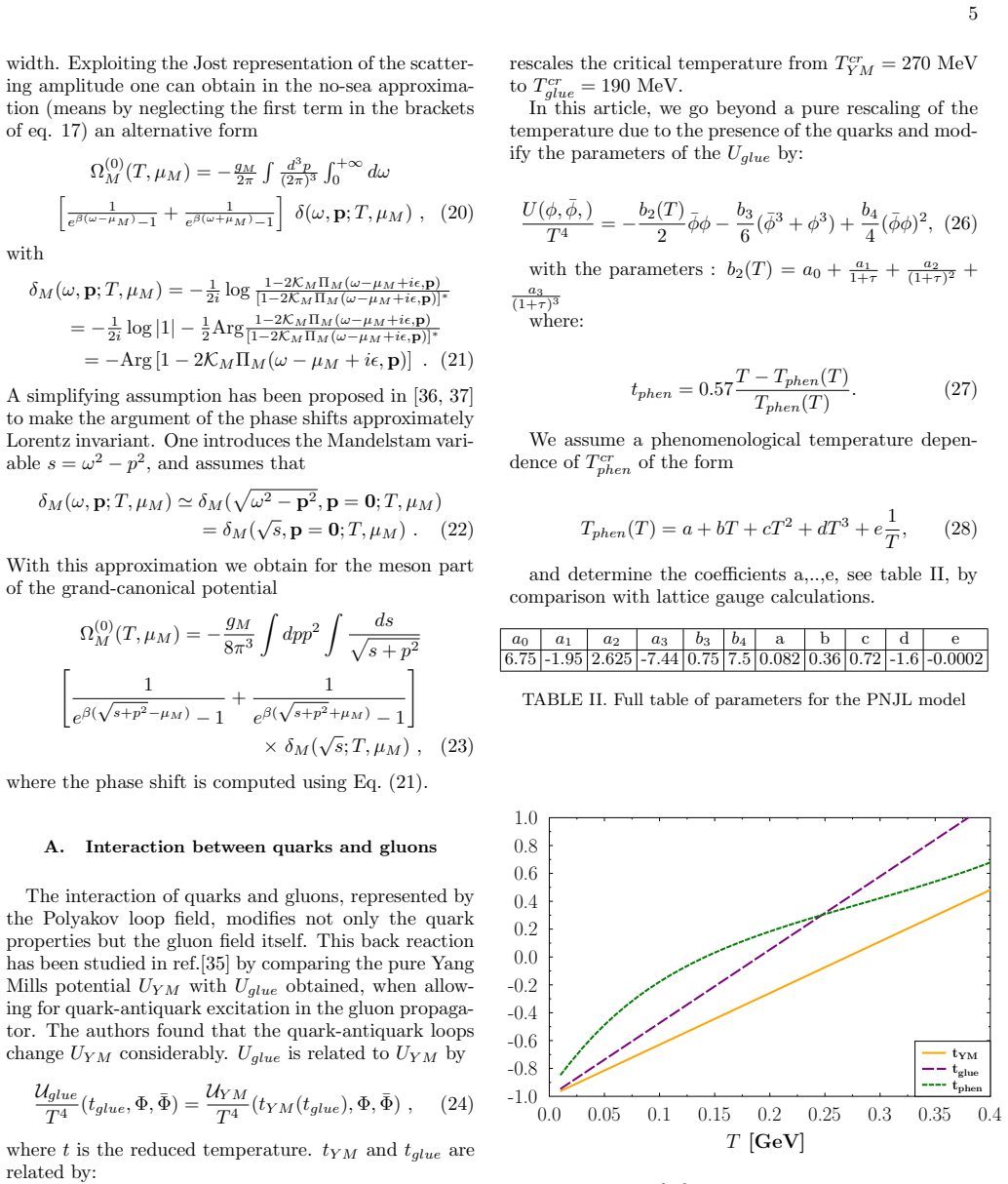
The load-bearing object is the phenomenological temperature-dependent critical temperature $T_{\mathrm{phen}}(T)=a+bT+cT^2+dT^3+e/T$ (Eq. 28), which enters the reduced temperature $t_{\mathrm{phen}}=0.57\,(T-T_{\mathrm{phen}}(T))/T_{\mathrm{phen}}(T)$ in the Polyakov-loop effective potential, thereby modifying the gluon sector beyond a simple constant rescaling of $T_0$. Its coefficients are determined by fitting the lattice equation of state at vanishing chemical potential and are then kept fixed at all $\mu$; because the quark–gluon back-reaction is not otherwise computed, this function carries the entire coupling between the Polyakov loop and the quarks. The second piece is the next-to-leading-order mesonic grand potential (Eqs. (16)–(23)), which adds pion, kaon, $\sigma$, and $a_0$ contributions to the pressure at low temperature, using the quark–antiquark phase shift to encode meson masses and widths.
What would settle it
Compute the model's second-order baryon-number susceptibility and the next Taylor coefficient in $\mu/T$ and compare with lattice results obtained by analytic continuation or higher-order Taylor expansion. If those coefficients disagree with the model at fixed $T_{\mathrm{phen}}$, or if the lattice curvature requires an explicit density dependence in $T_{\mathrm{phen}}$, then the zero-parameter extrapolation to finite density — and the predicted critical end point — would be ruled out. Alternatively, heavy-ion measurements in the 3–10 AGeV beam-energy range that show no non-monotonic behavior in net-proton kurtosis or pion multiplicity across the predicted first-order line would falsify the prediction.
Extended reading notes
Core claim
The central claim is that a modified PNJL model – with the partition function expanded to next-to-leading order in $1/N_c$ so that mesonic (scalar and pseudoscalar) contributions enter the grand potential, and with the Polyakov-loop potential rescaled by a temperature-dependent critical temperature $T_{\mathrm{phen}}(T)$ fitted to lattice data at $\mu=0$ – reproduces the lattice thermodynamics of strongly interacting matter at zero chemical potential. Carrying this same parameter set to finite chemical potential, with no additional input, the model predicts a crossover at small $\mu$ that sharpens into a first-order chiral phase transition for low temperatures, with a critical end point at $T_{\mathrm{CEP}}=110$ MeV and $\mu_q=320$ MeV. The pressure computed at very large $\mu$ agrees with perturbative QCD, and the predicted first-order line lies close to the chemical freeze-out curve extracted from statistical-model fits, suggesting the transition might be probed in heavy-ion collisions at beam energies of order 3–10 AGeV.
Load-bearing premise
The load-bearing premise is that the temperature-dependent interaction strength fitted at zero density stays the same at all densities. If the true quark–gluon coupling depends on baryon density, the predicted phase boundary and critical end point would be off.
Editorial extensions
If this is right
- The model provides an equation of state for the full $(T,\mu)$ plane with no new parameters, ready for use as input to hydrodynamic simulations of ultra-relativistic heavy-ion collisions.
- The first-order transition line lies close to the chemical freeze-out curve, so the chiral transition may be observable in heavy-ion collisions at beam energies around 3–10 AGeV.
- At very large chemical potentials the pressure agrees with perturbative QCD calculations, supporting the use of the equation of state in the density regime relevant for neutron star interiors and mergers.
- Because the speed of sound develops a second minimum below the crossover temperature, the model's predictions for the softest point of the equation of state depend sensitively on the incomplete hadron spectrum and mean-field gap equations.
- The dropping Mott temperatures of pions and kaons with increasing chemical potential trace the chiral/deconfinement boundary and can be compared with future lattice data from analytic continuation.
Reading between the lines
- If the location of the critical end point is robust, the first-order line at low temperature implies a coexistence region in the phase diagram, which could seed density fluctuations and observable signatures in neutron star merger outflows.
- The $T_{\mathrm{phen}}$ parametrization is fitted at $\mu=0$; computing the model's second-order baryon susceptibilities and comparing with lattice Taylor coefficients beyond $\kappa$ would test whether the quark–gluon coupling genuinely remains $\mu$-independent.
- Including vector mesons or the di-quark/baryon sector, which the paper leaves for future work, could shift the critical end point; the values 110 MeV and 320 MeV should therefore be read as a baseline estimate rather than a firm prediction.
Signed reviews
Editorial analysis
A structured set of objections, weighed in public.
Referee Report
Summary. This paper extends the SU(3) Polyakov-Nambu-Jona-Lasinio (PNJL) model in two directions: it includes the next-to-leading order in the 1/Nc expansion, which adds mesonic contributions to the grand potential, and it replaces the constant Polyakov-loop scale T0 with a phenomenological temperature-dependent function T_phen(T)=a+bT+cT^2+dT^3+e/T whose coefficients are fitted to lattice data at zero chemical potential. With this input, the authors report agreement with lattice results for pressure, energy density, entropy density, interaction measure, and speed of sound at μ=0, and with the lattice Taylor-expansion coefficient κ toward finite baryon chemical potential. They then extend the model to finite chemical potential without new parameters, compare with pQCD at large μ, and predict a first-order chiral phase transition ending at a critical endpoint with T_CEP=110 MeV and μ_q=320 MeV. The paper also presents meson and quark masses as functions of T and μ and argues that the first-order transition may be reachable in heavy-ion experiments. The stated goal is to provide an equation of state in the whole (T, μ) plane for applications to heavy-ion collisions and neutron-star physics.
Significance. If the central claim is correct, the paper would deliver a complete, parameter-free-in-μ equation of state that reproduces the μ=0 lattice thermodynamics and the known large-μ pQCD limit, which is a useful input for hydrodynamic simulations and neutron-star modeling. The explicit inclusion of mesonic degrees of freedom at next-to-leading order in Nc and the temperature-dependent quark-gluon coupling are genuine technical improvements over the standard PNJL setup. The finite-μ predictions, including the meson Mott lines and the location of the critical endpoint, are falsifiable against future lattice and experimental data. However, the μ=0 agreement is partly a fit result because the five coefficients of T_phen are tuned to the very lattice curves shown in Figs. 3 and 6, and the paper itself identifies an artifact (the second minimum in the speed of sound) as a limitation of that tuning. The quantitative CEP coordinates rest on the unvalidated assumption that the fitted T_phen function remains valid at all chemical potentials, so the significance of the paper is conditional on addressing that assumption.
major comments (3)
- [§III.A, Eq. (28)] The five coefficients a through e in T_phen(T) are determined by comparison with the same lattice gauge calculations whose agreement is then exhibited in Fig. 3. The agreement at μ=0 is therefore a consistency check of the fit, not an independent prediction. The paper explicitly states that the e/T term does not depend on the quark-gluon interaction and 'compensates partially for the fact that only four types of mesons ... are taken into consideration'. That makes T_phen a μ=0 fudge that absorbs missing hadron species and mean-field defects. The central claim that T_phen is a μ-independent physical property of the gluon sector is asserted without any test. Because the CEP lies at μ_q/T≈2.9, far outside the radius of convergence of the quadratic curvature fitted in Eq. (30) (κ=0.00989), the small-μ lattice comparison does not constrain the endpoint. The authors should provide a concrete test of μ-independence, for example by comparing the model with lattice results at imaginary chemical potential or by computing higher-order Taylor coefficients, and should quantify the sensitivity of the CEP to variations in a-e within their fit uncertainties.
- [§IV.A, Fig. 6] The speed of sound shows a second minimum not present in the lattice data, and the text after Eq. (29) attributes this to the mean-field level of the gap equations and to the incomplete hadron spectrum. This explicitly confirms that T_phen at μ=0 compensates for model defects rather than representing a pure gluon back-reaction. Since the same fitted T_phen is used unchanged at all chemical potentials, the compensation is not guaranteed to survive at finite density, where vector mesons, baryons, and the di-quark sector enter with different density dependencies. The paper should show how sensitive the μ=0 equation of state is to the compensating term, for instance by repeating the calculation with e=0 or with additional hadronic channels, and should discuss how that sensitivity propagates to the finite-μ phase boundary.
- [§IV.D, Eq. (34)] The critical endpoint is quoted as T_CEP=110 MeV and μ_q=320 MeV without any estimate of uncertainty. The solution of the six coupled equations in Eq. (34) depends on the specific parametrization of T_phen, on the restriction to pseudoscalar and scalar mesons, and on the mean-field treatment of the gap equations. The authors themselves state that vector mesons 'may change quantitatively the value of the critical temperatures' and that the di-quark sector 'will become important' at low temperature and high chemical potential. Without a parameter-sensitivity scan or an error estimate propagated from the fit of Eq. (28), the quantitative CEP prediction cannot be assessed against other PNJL-type models or against upcoming beam-energy-scan data. At minimum, the authors should show how T_CEP and μ_CEP vary when a-e are varied within their fit uncertainties and when the e/T compensation term is omitted.
minor comments (5)
- [§IV.D, text after Fig. 13] The phrase 'Suppress this' appears in the middle of a sentence before 'The temperature of the minimum of the speed of sound...' and should be removed; it is a leftover editorial instruction.
- [§IV.C, Fig. 8 caption] The caption says 'pQMD calculations' and 'pQMD approach' in two places, but the text and reference [14] refer to pQCD; these are typographical errors that should be corrected to pQCD.
- [Fig. 13 caption] The caption begins with 'hase diagram' and should read 'Phase diagram'.
- [§II.A, Table I and §III.A, Table II] Several coefficient names (a0, a1, a2, a3, b3, b4, and the new a, b, c, d, e) are reused for different quantities in Tables I and II; the notation would be clearer if the new coefficients in Eq. (28) were given distinct symbols, since this reuse makes the text harder to follow.
- [§I, Introduction] Reference [24] is cited in the introduction for baryon masses, but the same reference is also listed as [41] later; the numbering should be made consistent.
Circularity Check
No significant circularity: the μ=0 equation of state is calibrated, not predicted, and the finite-μ CEP is a genuine extrapolation without refitting.
full rationale
The paper's μ=0 thermodynamic quantities are obtained by fitting the five parameters a,b,c,d,e in T_phen(T) (Eq. 28) to lattice gauge results, and the text says so explicitly: "determine the coefficients a,..,e, see table II, by comparison with lattice gauge calculations." The agreement shown in Fig. 3 is therefore a calibration check, not an independent prediction; the paper calls it "reproduce," not "predict." The genuinely predictive claims — the curvature coefficient κ=0.00989, the speed of sound comparison, and especially the finite-μ first-order line with CEP at T=110 MeV, μ_q=320 MeV — are computed after the model is fixed and involve no refitting of parameters to the CEP or to finite-μ data. The CEP is an extrapolation of a μ-independent T_phen into a region where the authors themselves caution that vector mesons and the di-quark sector may shift critical temperatures; that is a model-validity caveat, not a circular derivation. The self-citations to refs. [16,17,41] supply technical ingredients and do not act as an external "uniqueness theorem" forcing the conclusion. Thus no load-bearing step reduces by construction to its own input.
Assumptions & free parameters
free parameters (5)
- a in T_phen(T) =
0.082
- b in T_phen(T) =
0.36
- c in T_phen(T) =
0.72
- d in T_phen(T) =
-1.6
- e in T_phen(T) =
-0.0002
assumptions (5)
- domain assumption The polynomial parametrization of the Yang-Mills Polyakov potential in Eq. (6) with parameters from Table I is a valid input.
- domain assumption The no-sea approximation and the Jost representation used for the mesonic grand potential in Eqs. (17)-(20) are valid.
- domain assumption The meson phase shift depends only on sqrt(s), as assumed in Eq. (22), so delta(omega,p) is replaced by delta(sqrt(s),0).
- ad hoc to paper The fitted T_phen(T) function, determined at mu=0, remains valid at every chemical potential.
- domain assumption Neglecting vector mesons, axial-vector mesons, and the diquark sector does not change the qualitative phase diagram.
Cite this review
Pith. "Pith review of The phase diagram of the Polyakov Nambu Jona-Lasinio approach for finite chemical potentials." pith.science (2026). https://pith.science/paper/AJZXV5QW
@misc{pith2026190808122,
  author       = {Pith},
  title        = {Pith review of: The phase diagram of the Polyakov Nambu Jona-Lasinio approach for finite chemical potentials},
  year         = {2026},
  howpublished = {\url{https://pith.science/paper/AJZXV5QW}},
  note         = {Machine review of arXiv:1908.08122}
}
abstract
We extend the SU(3) (Polyakov) Nambu Jona-Lasinio in two ways: We introduce the next to leading order contribution (in $N_c$) in the partition function. This contribution contains explicit mesonic terms. We introduce a coupling between the gluon field and the quark degrees of freedom which goes beyond a simple rescaling of the critical temperature. With both these improvements we can reproduce, for vanishing chemical potentials, the lattice results for the thermal properties of a strongly interacting system like pressure, energy density, entropy density, interaction measure and the speed of sound. Also the expansion parameter towards small but finite chemical potentials agrees with the lattice results. Extending the calculations to finite chemical potentials (what does not require any new parameter) we find a first order phase transition up to a critical end point of $T_{CEP}= 110\ MeV$ and $\mu_q = 320\ MeV$. For very large chemical potentials, we find agreement with pQCD calculations. We calculate the mass of mesons and baryons as a function of temperature and chemical potential and the transition between the hadronic and the chirally restored phase. These calculations provide an equation of state in the whole $T,\mu$ plane an essential ingredient for dynamical calculations of ultra-relativistic heavy ion collisions but also for the physics of neutron stars and neutron star collisions.
Figures


Figures from the paper (9 more)


Reference graph
Works this paper leans on
-
[1]
S. Bose, K. Chakravarti, L. Rezzolla, B. S. Sathyaprakash and K. Takami, Phys. Rev. Lett. 120 (2018) no.3, 031102
work page 2018
-
[2]
S. Borsanyi, Z. Fodor, C. Hoelbling, S. D. Katz, S. Krieg and K. K. Szabo, Phys. Lett. B 730, 99 (2014)
work page 2014
-
[3]
Bazavov et al
A. Bazavov et al. [HotQCD Collaboration], Phys. Rev. D 90, 094503 (2014)
2014
-
[4]
P. Braun-Munzinger, V. Koch, T. Sch¨ afer and J. Stachel, Phys. Rept. 621 (2016) 76
work page 2016
-
[5]
J. Stachel, A. Andronic, P. Braun-Munzinger and K. Redlich, J. Phys. Conf. Ser. 509 (2014) 012019
work page 2014
-
[6]
J. Cleymans, H. Oeschler, K. Redlich and S. Wheaton, Phys. Rev. C 73 (2006) 034905
work page 2006
-
[7]
C. Gale, S. Jeon and B. Schenke, Int. J. Mod. Phys. A 28 (2013) 1340011
work page 2013
- [8]
Show all 42 references
-
[9]
Being presently outside of the range of lattice gauge calcula- tion this is the realm of phenomenological models and subject of intensive studies
or an analytical continuation from imaginary chem- ical potentials [10], have been developed to extrapolate the thermodynamical quantities away from the µ = 0 line but the deeper one penetrates into the finite µ region the more one enters unknown territory. Being presently outs...
1908 arXiv
-
[10]
J. N. Guenther, R. Bellwied, S. Borsanyi, Z. Fodor, S. D. Katz, A. Pasztor, C. Ratti and K. K. Szab´ o, Nucl. Phys. A 967 (2017) 720
2017
-
[11]
Bazavov et al., Phys
A. Bazavov et al., Phys. Rev. D 95 (2017) no.5, 054504
2017
-
[12]
M. A. Stephanov, K. Rajagopal and E. V. Shuryak, Phys. Rev. Lett. 81 (1998) 4816
1998
-
[13]
Asakawa and K
M. Asakawa and K. Yazaki, Nucl. Phys. A 504 (1989) 668
1989
-
[14]
Kurkela and A
A. Kurkela and A. Vuorinen, Phys. Rev. Lett. 117 (2016) no.4, 042501
2016
-
[15]
M. A. Stephanov, K. Rajagopal and E. V. Shuryak, Phys. Rev. D 60 (1999) 114028
1999
-
[16]
J. M. Torres-Rincon and J. Aichelin, Phys. Rev. C 96 (2017) no.4, 045205
2017
-
[17]
Vuorinen, EPJ Web Conf
A. Vuorinen, EPJ Web Conf. 137 (2017) 09011
2017
-
[18]
Fukushima, Phys
K. Fukushima, Phys. Lett. B 591 (2004) 277
2004
-
[19]
Equation of state of a quark-Polyakov loop-meson mixture in the PNJL model at finite temperature,
J. M. Torres-Rincon and J. Aichelin, “Equation of state of a quark-Polyakov loop-meson mixture in the PNJL model at finite temperature,” arXiv:1601.01706 [nucl- th]
-
[20]
Ratti, M
C. Ratti, M. A. Thaler and W. Weise, Phys. Rev. D 73 (2006) 014019
2006
-
[21]
Megias, E
E. Megias, E. Ruiz Arriola and L. L. Salcedo, Phys. Rev. D 74 (2006) 065005
2006
-
[22]
Nambu and G
Y. Nambu and G. Jona-Lasinio, Phys. Rev. 124 (1961) 246
1961
-
[23]
Hansen, W
H. Hansen, W. M. Alberico, A. Beraudo, A. Molinari, M. Nardi and C. Ratti, Phys. Rev. D 75 (2007) 065004
2007
-
[25]
I. C. Cloet and C. D. Roberts, Prog. Part. Nucl. Phys. 77 (2014) 1
2014
-
[26]
S. P. Klevansky, Rev. Mod. Phys. 64 (1992) 649. [27]
1992
-
[27]
Vogl and W
U. Vogl and W. Weise, Prog. Part. Nucl. Phys. 27 (1991) 195
1991
-
[28]
G. Y. Shao, M. Di Toro, V. Greco, M. Colonna, S. Plumari, B. Liu and Y. X. Liu. Phase diagrams in the Hadron-PNJL model, Phys.Rev. D84 (2011) 034028
2011
-
[29]
Buballa, Phys
M. Buballa, Phys. Rept. 407 (2005) 205
2005
-
[30]
G. A. Contrera, A. G. Grunfeld and D. B. Blaschke. Phase diagrams in nonlocal PNJL models constrained by Lattice QCD results, Physics of Particles and Nuclei Letters, Vol. 11, No. 4, pp. 342-351 (2014)
2014
-
[31]
Bratovic, Tetsuo Hatsuda and Wolfram Weise
Nino M. Bratovic, Tetsuo Hatsuda and Wolfram Weise. Role of Vector Interaction and Axial Anomaly in the PNJL Modeling of the QCD Phase Diagram, Phys.Lett. B719 (2013) 131-135
2013
-
[32]
C. R. Allton, S. Ejiri, S. J. Hands, O. Kaczmarek, F. Karsch, E. Laermann and C. Schmidt, Phys. Rev. D 68 (2003) 014507. [33]
2003
-
[33]
Do lattice data constrain the vector interaction strength of QCD?, 2014, Phys.Lett
Jan Steinheimer and Stefan Schramm. Do lattice data constrain the vector interaction strength of QCD?, 2014, Phys.Lett. B736 (2014) 241-245; [32, 33]
2014
-
[34]
Bazavov, Tanmoy Bhattacharya, C
A. Bazavov, Tanmoy Bhattacharya, C. DeTar, H. -T. Ding, Steven Gottlieb, Rajan Gupta, P. Hegde, U. M. Heller, F. Karsch, E. Laermann, L. Levkova, Swagato Mukherjee, P. Petreczky, C. Schmidt, C. Schroeder, R. A. Soltz, W. Soeldner, R. Sugar, M. Wagner and P. Vranas. The equatio...
2014
-
[35]
It tends to the pure Yang Mills reduced temperature for high temperatures, as it should, because asymptotically we expect a plasma of noninteracting quarks and gluons
around the phase transition temperature. It tends to the pure Yang Mills reduced temperature for high temperatures, as it should, because asymptotically we expect a plasma of noninteracting quarks and gluons. IV. RESULTS A. Equation of state at vanishing chemical potential As ...
-
[36]
Cheng et al., Phys
M. Cheng et al., Phys. Rev. D 81 (2010) 054504
2010
-
[37]
L. M. Haas, R. Stiele, J. Braun, J. M. Pawlowski and J. Schaffner-Bielich, Phys. Rev. D 87, no. 7, 076004 (2013)
2013
-
[38]
Hufner, S
J. Hufner, S. P. Klevansky, P. Zhuang and H. Voss, An- nals Phys. 234 (1994) 225
1994
-
[39]
Blaschke, M
D. Blaschke, M. Buballa, A. Dubinin, G. Roepke and D. Zablocki, Annals Phys. 348 (2014) 228
2014
-
[40]
Borsanyi, G
S. Borsanyi, G. Endrodi, Z. Fodor, A. Jakovac, S. D. Katz, S. Krieg, C. Ratti and K. K. Szabo, JHEP 1011 (2010) 077 12
2010
-
[41]
A. Biguet, Modeles Nambu-Jona-Lasinio pour l’etude des phases de la chromodynamique quantique - qualites des predictions et phases hautes densites, univeristy of Lyon, 2016, https://tel.archives-ouvertes.fr/tel- 01453184/document
2016
-
[42]
Curvature of the pseudocritical line in QCD: Taylor expansion matches analytic continuation, 2018, Phys
Claudio Bonati, Massimo D’Elia, Francesco Negro, Francesco Sanfilippo and Kevin Zambello. Curvature of the pseudocritical line in QCD: Taylor expansion matches analytic continuation, 2018, Phys. Rev. D 98, 054510 (2018)
2018
-
[43]
J. M. Torres-Rincon, B. Sintes and J. Aichelin, Phys. Rev. C 91 (2015) no.6, 065206
2015
Reviewed August 14, 2026 · model on record in the stance chip above.
Discussion (0). Continue with ORCID to comment.