REVIEW 3 major objections 4 minor 1 cited by
Brown Measures of Free Circular and Multiplicative Brownian Motions with Self-Adjoint and Unitary Initial Conditions
T0 review · 3 major / 4 minor · reviewed 2026-08-14 · deepseek-v4-flash
Pith's one-line read The paper computes explicit densities for the Brown measures of $x_0+c_t$ and $u b_t$.
desk verdict Strong, mostly self-contained computation of Brown measures for circular and multiplicative Brownian motions with non-trivial initial conditions; the multiplicative half rests on a lightly documented regularity step. read the letter →
The pith
A machine-rendered reading of the paper's core claim, the machinery that carries it, and where it could break.
The reading
What carries the argument
The central object is the regularized logarithmic determinant $S(t,\lambda,\varepsilon)=\tau[\log(x_{t,\lambda}^*x_{t,\lambda}+\varepsilon)]$, with $x_{t,\lambda}=\lambda-(x_0+c_t)$ or $\lambda-u b_t$. For each $\lambda$ the paper solves a first-order Hamilton–Jacobi equation, $\partial_t S=\varepsilon(\partial_\varepsilon S)^2$ in the additive case and a higher-dimensional analogue in the multiplicative case, by integrating Hamilton's equations. The lifetime of the Hamiltonian trajectory is tuned by the initial condition $\varepsilon_0$ so that $\varepsilon(t)\to 0$ exactly at the chosen time $t$; the Laplacian of $S(t,\lambda,0)$ then gives the Brown-measure density. The boundary curves $v_t(a)$ and $r_t(\theta)$ are determined by the subordination functions $F_t$ (with left inverse $H_t$) and $\eta_t$ (with left inverse $\Phi_{t,\bar\mu}$), which connect $x_0+s_t$ to $x_0$ and $u^*u_t$ to $u^*$.
What would settle it
Simulate eigenvalues of $U_N G_N(t)$ with $N=2000$ and $U_N$ a unitary matrix whose empirical spectral measure approximates $\frac{1}{3}\delta_{e^{i\pi/3}}+\frac{2}{3}\delta_{e^{4\pi i/5}}$; after binning by argument, compare the radial density to $\frac{1}{r^2}w_t(\theta)$ with $w_t(\theta)=\frac{1}{2\pi t}\frac{d\varphi}{d\theta}$. A systematic departure from the $1/r^2$ scaling inside the predicted support would refute the formula.
Extended reading notes
Core claim
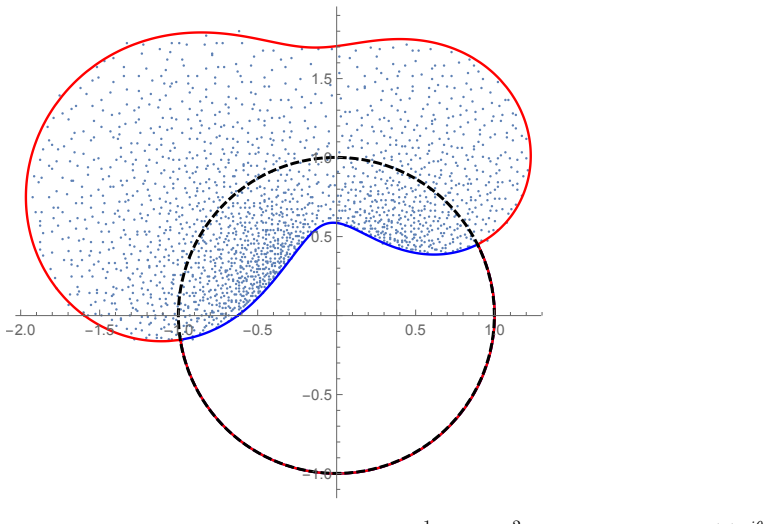
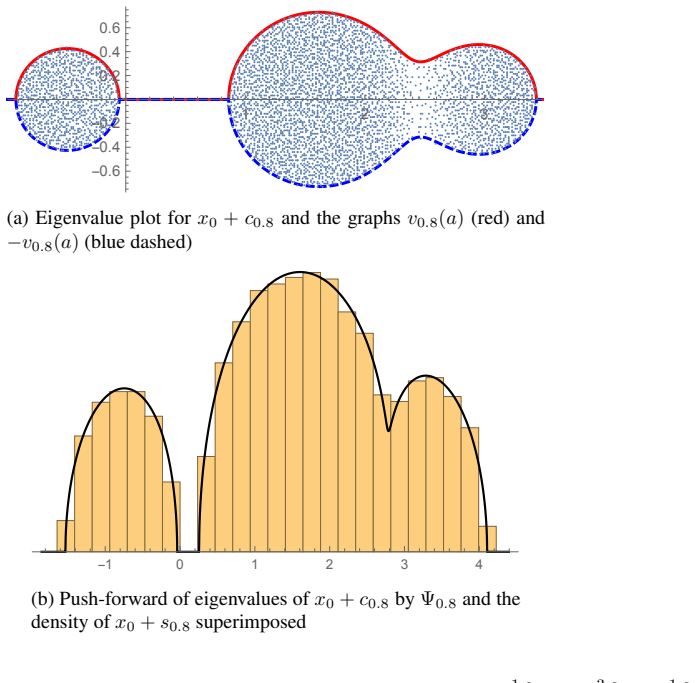
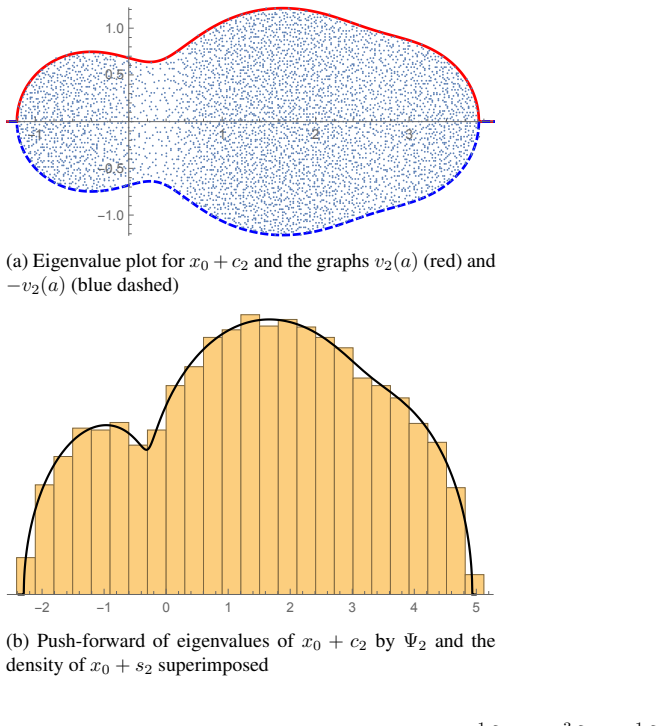
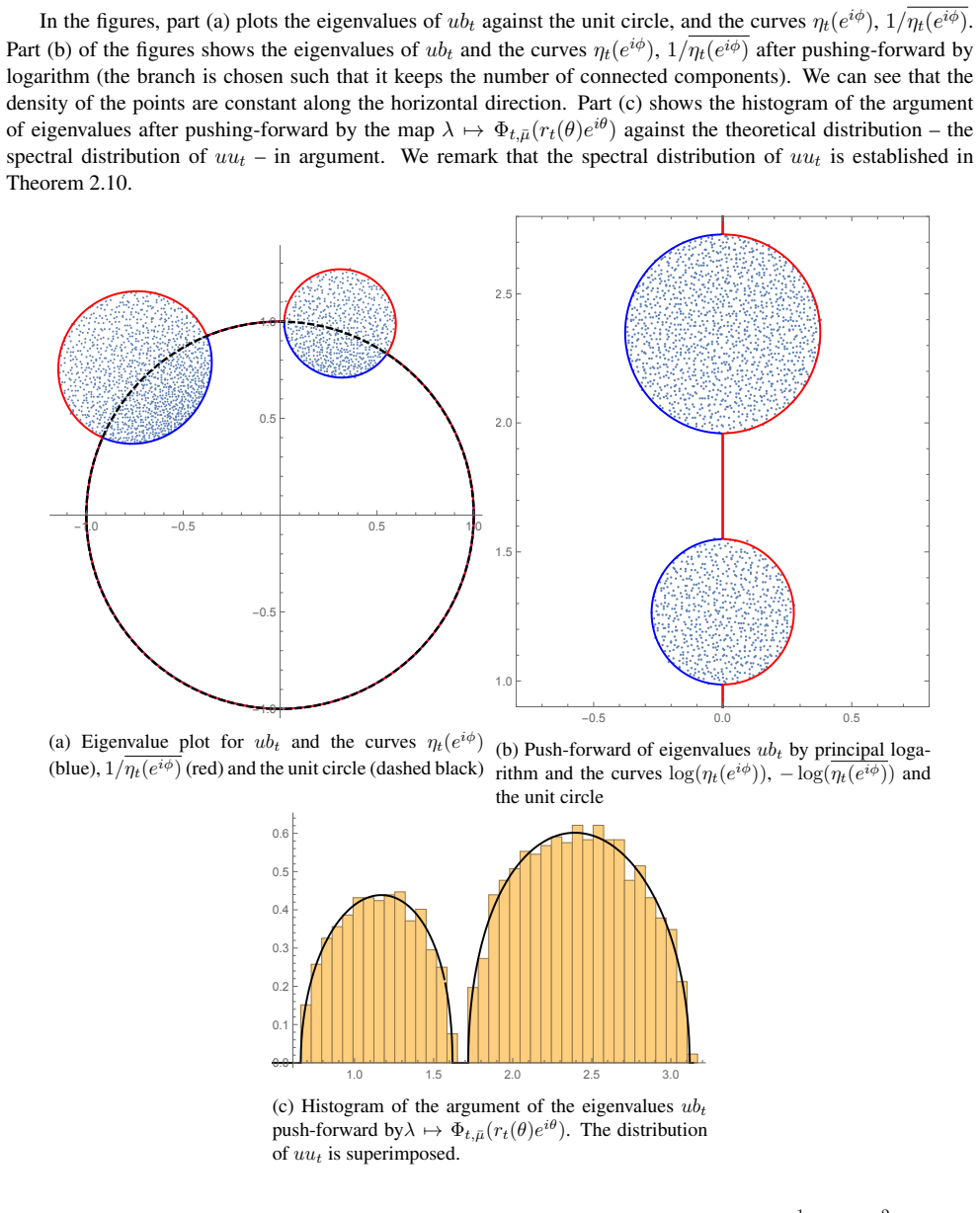
For a self-adjoint $x_0$ with spectral law $\mu$, the Brown measure $\rho_t$ of $x_0+c_t$ is supported on $\overline{\Lambda_t}=\{a+ib:|b|\le v_t(a)\}$, where $v_t(a)$ is the unique positive solution of $\int \frac{d\mu(x)}{(a-x)^2+v^2}=\frac{1}{t}$. Inside the support the density is $w_t(a)\,da\,db$ with $w_t(a)=\frac{1}{\pi t}\psi_t'(a)$, where $\psi_t(a)=H_t(a+iv_t(a))$ and $H_t(z)=z+tG_{x_0}(z)$; the density does not depend on $b$. The map $\Psi_t(a+ib)=H_t(a+iv_t(a))$ pushes $\rho_t$ forward to the law of $x_0+s_t$, and these two properties characterize $\rho_t$ uniquely. For a unitary $u$ with law $\mu$, the Brown measure of $u b_t$ is supported on $\overline{\Delta_{t,\mu}}=\{re^{i\theta}:r_t(\theta)\le r\le 1/r_t(\theta)\}$, where $r_t(\theta)$ is defined through the subordination function for $u^*u_t$. Its density in polar coordinates is $\frac{1}{r^2}w_t(\theta)$, with $w_t(\theta)=\frac{1}{2\pi t}\frac{d\varphi}{d\theta}$, and the push-forward under $\Gamma_t(re^{i\theta})=\Phi_{t,\bar\mu}(r_t(\theta)e^{i\theta})$ is the law of $u u_t$. When $u$ is Haar unitary, the support becomes the annulus $e^{-t/2}\le|z|\le e^{t/2}$ and $w_t(\theta)=\frac{1}{2\pi t}$, giving the annulus law.
Load-bearing premise
The multiplicative computation assumes that the regularized trace $S(t,\lambda,z^2)$ extends real-analytically to a neighborhood of $(t,\lambda,0)$ for every $\lambda$ in the predicted support; if that extension fails, the Laplacian limit might carry extra boundary mass that the explicit density does not count.
Editorial extensions
If this is right
- The Brown measure of $x_0+c_t$ is uniquely pinned down by its support, vertical constancy of the density, and the push-forward to $x_0+s_t$.
- The empirical eigenvalue density of $X_N+\sqrt{t}Z_N$ for a self-adjoint $X_N$ converging to $x_0$ is approximated by $w_t(a)$ in the large-$N$ limit, with the vertical spread governed by $v_t(a)$.
- For unitary initial conditions, the Brown measure of $u b_t$ always satisfies the radial scaling $\rho(re^{i\theta})\propto 1/r^2$ inside each angular sector.
- If $u$ is Haar distributed, the Brown measure is exactly the rotationally invariant annulus law with density $\frac{1}{2\pi t r^2}$.
- The support of the Brown measure of $u b_t$ is symmetric under $z\mapsto 1/\bar z$, and the number of its connected components decreases with $t$.
Reading between the lines
- Inference: the Hamilton–Jacobi route here suggests that the same PDE, with suitable initial conditions, could compute Brown measures of other deformed processes as long as a subordination function is available, since the PDE itself does not depend on the initial law.
- Inference: the explicit annulus law for Haar-initialized $u b_t$ gives a sharp test case for the open convergence problem of empirical eigenvalue distributions of $GL(N)$ Brownian motions, because any discrepancy from the $1/r^2$ profile would show up in simulations.
- Inference: the density formulas reduce Brown-measure computation to evaluating the boundary radius functions $v_t$ or $r_t$; numerical evaluation of those functions could provide a fast proxy for eigenvalue histograms without diagonalizing large matrices.
Signed reviews
Editorial analysis
A structured set of objections, weighed in public.
Referee Report
Summary. The paper computes the Brown measures of two free non-normal processes: the free circular Brownian motion with a self-adjoint initial condition, x0+c_t, and the free multiplicative Brownian motion with an arbitrary unitary initial condition, u b_t. The main results are stated as Theorems 1.1 and 1.2. For x0+c_t, the support is the closure of Λ_t={a+ib: |b|<v_t(a)}, the density is w_t(a) db da with w_t(a)=(1/(πt))ψ_t'(a), and the push-forward under the natural map Ψ_t is exactly the law of x0+s_t. For u b_t, the support is the closure of Δ_{t,μ}={r e^{iθ}: r_t(θ)<r<1/r_t(θ)}, the density has the polar form (1/r²)w_t(θ), and the push-forward under Γ_t is the law of u u_t. In the Haar-unitary case the Brown measure is the annulus law with density 1/(2πt r²). The additive part is derived self-containedly: the Hamilton-Jacobi PDE is obtained by free Itô calculus, the Hamiltonian ODEs are solved explicitly, the Laplacian of S(t,λ,0) is computed both outside and inside Λ_t, and the normalization argument shows that this gives a probability measure. The multiplicative part follows the same strategy but is less self-contained: the real-analytic extension of the regularized trace at ε=0 is taken from Driver-Hall-Kemp [17] and is only sketched in Section 4.4. The push-forward target laws are external and independently known from Biane and from the second author's earlier work, so the Brown measures are computed rather than fitted.
Significance. If the results are correct, the paper provides explicit density formulas for Brown measures in two natural non-normal free processes and reveals a clean relation between these Brown measures and the subordination functions for free additive and multiplicative convolution. The additive part is a clear strength: the PDE derivation, the ODE solution, the Laplacian computation, and the normalization are all present and verifiable. The multiplicative part is a substantial extension of Driver-Hall-Kemp and includes a new Haar-unitary result that is corroborated independently by the R-diagonal/Haagerup-Larsen calculation in the appendix. The push-forward statements are not fitted: the target laws of x0+s_t and u u_t are independent external comparison objects. The main weakness is that the multiplicative proof depends on a real-analytic extension result that the text itself says is only outlined; this is a correctness risk rather than a circularity. The central claims are plausible and the evidence in the paper is strong, but the multiplicative theorems should not be stated unconditionally until the missing analytic regularity step is supplied or explicitly reduced to [17, Theorem 7.4].
major comments (3)
- [§4.4, paragraph before Theorem 4.23] The proof of Theorem 4.23 requires that S̃(t,λ,z)=S(t,λ,z²) extends real-analytically to a neighborhood of (σ,λ,0) for λ∈Δ_{t,μ}. The text describes this as 'the key' and gives an inverse-function-theorem sketch, but the verification is not complete for the arbitrary unitary initial condition (4.17). In particular, the passage from values along Hamiltonian characteristics to the limit ε→0, and the interchange leading to equation (4.60), are not fully justified. Since Theorem 4.23 and hence Theorem 1.2 rest on this extension, this is a load-bearing gap. Please provide a complete proof, or give a precise reduction to [17, Theorem 7.4] that covers the arbitrary unitary initial condition.
- [§4, opening discussion, and §4.4, Lemma 4.22] The statement that 'in the case λ∉Δ_{t,μ}, ΔλS(t,λ,0)=0 and hence the Brown measure is supported in Δ_{t,μ}' is asserted at the start of Section 4 without a proof analogous to the additive Theorem 3.8. The normalization in Lemma 4.22 shows only that the proposed absolutely continuous density has total mass one on Δ_{t,μ}; it does not rule out extra boundary or atomic mass unless one already knows that the Brown measure is supported inside Δ_{t,μ}. This is not a presentation issue: Theorem 4.23's conclusion that the Brown measure of g_t is supported in Δ_{t,μ} depends on this assertion. Please add a proof of harmonicity of S(t,λ,0) outside the candidate support, or state explicitly that Theorem 4.23 is conditional on the analytic extension and on the support-containment argument.
- [§4.3, Proposition 4.18 and Corollary 4.20] The continuous extension of ε0^t from Δ_{t,μ} to Δ_{t,μ}\(∂Δ_{t,μ}∩T), with value zero on (∂Δ_{t,μ}\T), is stated without a proof of the boundary limit. The formula (4.50) is derived for interior points, and the boundary behavior is used in Corollary 4.20 and in Theorem 4.23 to assign initial data on the boundary. Please include the limiting argument, or fold it into the analytic-extension proof requested above, so that the boundary assignment is fully documented.
minor comments (4)
- [Theorem 1.2, point 1] In the statement of Theorem 1.2, 'suppρt' should read 'suppμt' to avoid confusion with the additive case notation.
- [§4.2, below Eq. (4.24)] The text writes 'where λ0=a0+b0'; this should be 'λ0=a0+ib0'.
- [§4.4, last paragraph of proof of Theorem 4.23] The sentence 'the upper bound (4.59) follows from (4.8) and Proposition 4.21' appears to cite the wrong equation: (4.8) is a characterization of U_{t,μ}, while the needed bound dφ/dθ≤2 is Lemma 4.8 (or equation (4.12)). Please correct the reference.
- [§1.2, paragraph on the Haar-unitary case] The phrase 'using using Haagerup-Larsen's formula' contains a duplicated 'using' and should be corrected.
Circularity Check
No circularity: the Brown-measure densities are derived from the Hamilton–Jacobi PDE and compared with independently established free convolution laws, not fitted to them.
full rationale
I walked the derivation chain for both Theorem 1.1 (additive) and Theorem 1.2 (multiplicative). In the additive case, the density wt(a) is obtained by solving the PDE ∂S/∂t = ε(∂S/∂ε)² from free Itô calculus, deriving S(t,λ,0) inside Λt, and then taking the distributional Laplacian (Theorem 3.10 and Theorem 3.13). The push-forward statement is an output of that computation: the calculation shows Ψ*ρt = μ⊞σt by changing variables and using Biane's independent density formula for x0+st (Proposition 2.5). There is no fitted parameter that is later renamed a prediction, and the Brown measure is not used to define the law of x0+st. In the multiplicative case, the density wt(θ)=(1/2πt)dφ/dθ is computed from the solution of the same Hamiltonian system used by Driver–Hall–Kemp, with initial condition (4.17) coming from u. The comparison law uut and the subordination data rt(θ), Φt,¯μ, and the density formula (2.14) are taken from Biane and from Zhong [39]; these are independent prior results, not the Brown measure of ubt. The uniqueness propositions 3.16 and 4.26 characterize the Brown measure by its support, radial/vertical density structure, and push-forward to an independently known law; they do not reduce the density formula to an assumption of that form. The only notable caveat is in §4.4, where the paper states that the regularized trace S̃(t,λ,z)=S(t,λ,z²) 'extends to a real analytic function in a neighborhood of (σ,λ,0)' and says 'we will give the main lines below why it holds', referring to [17, Section 7.4] for details. This is an acknowledged proof gap or regularity assumption, and a potential correctness risk for Theorem 4.23, but it is not circular: it is borrowing a technical mechanism from prior work, not defining the target Brown measure in terms of itself. No equation in the paper reduces to its own input by construction, and no prediction is statistically forced by a fitted quantity. I therefore find no significant circularity.
Assumptions & free parameters
assumptions (5)
- standard math Brown measure is the distributional Laplacian of tau(log|a-lambda|), regularized by traces of log((a-lambda)^*(a-lambda)+epsilon).
- standard math Free Ito calculus rules for free Brownian motions and the free SDEs for c_t, u_t, b_t.
- standard math Existence, conformality and subordination relations for F_t, H_t, eta_t, Phi_t for free additive and multiplicative convolution with semicircular or unitary Brownian motion.
- domain assumption The initial condition x_0 is self-adjoint with law mu, and u is unitary with law mu.
- domain assumption The Hamilton-Jacobi solution S(t,lambda,epsilon) has a real-analytic extension to epsilon=0 in the support, so the limit along Hamiltonian trajectories gives the correct Brown measure.
Cite this review
Pith. "Pith review of Brown Measures of Free Circular and Multiplicative Brownian Motions with Self-Adjoint and Unitary Initial Conditions." pith.science (2026). https://pith.science/paper/ZCBURDMC
@misc{pith2026190808150,
  author       = {Pith},
  title        = {Pith review of: Brown Measures of Free Circular and Multiplicative Brownian Motions with Self-Adjoint and Unitary Initial Conditions},
  year         = {2026},
  howpublished = {\url{https://pith.science/paper/ZCBURDMC}},
  note         = {Machine review of arXiv:1908.08150}
}
abstract
Let $Z_N$ be a Ginibre ensemble and let $A_N$ be a Hermitian random matrix independent from $Z_N$ such that $A_N$ converges in distribution to a self-adjoint random variable $x_0$. For each $t>0$, the random matrix $A_N+\sqrt{t}Z_N$ converges in $\ast$-distribution to $x_0+c_t$, where $c_t$ is the circular variable of variance $t$, free from $x_0$. We use the Hamilton-Jacobi method to compute the Brown measure $\rho_t$ of $x_0+c_t$. The Brown measure has a density that is constant along the vertical direction inside the support. The support of the Brown measure of $x_0+c_t$ is related to the subordination function of the free additive convolution of $x_0+s_t$, where $s_t$ is the semicircular variable of variance $t$, free from $x_0$. Furthermore, the push-forward of $\rho_t$ by a natural map is the law of $x_0+s_t$. Let $G_N(t)$ be the Brownian motion on the general linear group and let $U_N$ be a unitary random matrix independent from $G_N(t)$ such that $U_N$ converges in distribution to a unitary random variable $u$. The random matrix $U_NG_N(t)$ converges in $\ast$-distribution to $ub_t$ where $b_t$ is the free multiplicative Brownian motion, free from $u$. We compute the Brown measure $\mu_t$ of $ub_t$, extending the recent work by Driver-Hall-Kemp, which corresponds to the case $u=I$. The measure has a density of the special form \[\frac{1}{r^2}w_t(\theta)\] in polar coordinates in its support. The support of $\mu_t$ is related to the subordination function of the free multiplicative convolution of $uu_t$ where $u_t$ is the free unitary Brownian motion, free from $u$. The push-forward of $\mu_t$ by a natural map is the law of $uu_t$. We compute the explicit formula for the special case where $u$ is Haar unitary. The support of the Brown measure of $ub_t$ is an annulus; in its support, the density in polar coordinates is given by \[\frac{1}{2\pi t}\frac{1}{r^2}.\]
Figures

Figures from the paper (3 more)

Forward citations
Cited by 1 Pith paper
-
Strong Convergence of Multiplicative Brownian Motions on the General Linear Group
The Driver-Hall-Kemp family of multiplicative Brownian motions on GL_N(C) strongly converges, almost surely and jointly with deterministic matrices, to the free multiplicative Brownian motion as N tends to infinity.
Reference graph
Works this paper leans on
-
[17]
The Brown measure of the free multiplicative Brownian motion
D RIVER , B. K., H ALL , B. C., AND KEMP, T. The Brown measure of the free multiplicative brownian motion. arXiv:1903.11015v2 (2019)
work page Pith review arXiv 2019
-
[1]
A KHIEZER , N. I. The classical moment problem and some related questions in analysis. Translated by N. Kemmer. Hafner Publishing Co., New York, 1965
work page 1965
-
[2]
B ELINSCHI , S. T. The Lebesgue decomposition of the free additive convolution of two probability distri- butions. Probab. Theory Related Fields 142, 1-2 (2008), 125–150
work page 2008
-
[3]
B ELINSCHI , S. T., AND BERCOVICI , H. Partially defined semigroups relative to multiplicative free con- volution. Int. Math. Res. Not., 2 (2005), 65–101
work page 2005
-
[4]
B ELINSCHI , S. T., AND BERCOVICI , H. A new approach to subordination results in free probability. J. Anal. Math. 101 (2007), 357–365
work page 2007
-
[5]
T., NIADY, P., AND SPEICHER , R
B ELINSCHI , S. T., NIADY, P., AND SPEICHER , R. Eigenvalues of non-hermitian random matrices and brown measure of non-normal operators: Hermitian reduction and linearization method. Linear Algebra and its Applications 537 (2018), 48 – 83
work page 2018
-
[6]
B ERCOVICI , H. Free Convolution. in Free probability and operator algebras,V oiculescu, Dan and Stam- meier, Nicolai and Weber, Moritz editors, M¨unster Lectures in Mathematics. European Mathematical Soci- ety (EMS), Z¨urich, 2016. Lecture notes from the masterclass held in M ¨unster, September 2–6, 2013
work page 2016
-
[7]
L ´evy-Hinˇcin type theorems for multiplicative and additive free convolution
B ERCOVICI , H., AND VOICULESCU , D. L ´evy-Hinˇcin type theorems for multiplicative and additive free convolution. Pacific J. Math. 153, 2 (1992), 217–248. 52
work page 1992
Show all 39 references
-
[8]
Regularity questions for free convolution
B ERCOVICI , H., AND VOICULESCU , D. Regularity questions for free convolution. In Nonselfadjoint operator algebras, operator theory, and related topics , vol. 104 of Oper. Theory Adv. Appl. Birkh¨auser, Basel, 1998, pp. 37–47
1998
-
[9]
Free Brownian motion, free stochastic calculus and random matrices
B IANE , P. Free Brownian motion, free stochastic calculus and random matrices. In Free probability theory (Waterloo, ON, 1995), vol. 12 of Fields Inst. Commun. Amer. Math. Soc., Providence, RI, 1997, pp. 1–19
1995
-
[10]
On the free convolution with a semi-circular distribution
B IANE , P. On the free convolution with a semi-circular distribution. Indiana Univ. Math. J. 46, 3 (1997), 705–718
1997
-
[11]
Segal-Bargmann transform, functional calculus on matrix spaces and the theory of semi-circular and circular systems
B IANE , P. Segal-Bargmann transform, functional calculus on matrix spaces and the theory of semi-circular and circular systems. J. Funct. Anal. 144, 1 (1997), 232–286
1997
-
[12]
Processes with free increments
B IANE , P. Processes with free increments. Math. Z. 227, 1 (1998), 143–174
1998
-
[13]
Computation of some examples of Brown’s spectral measure in free proba- bility
B IANE , P., AND LEHNER , F. Computation of some examples of Brown’s spectral measure in free proba- bility. Colloq. Math. 90, 2 (2001), 181–211
2001
-
[14]
Stochastic calculus with respect to free Brownian motion and analysis on Wigner space
B IANE , P., AND SPEICHER , R. Stochastic calculus with respect to free Brownian motion and analysis on Wigner space. Probab. Theory Related Fields 112, 3 (1998), 373–409
1998
-
[15]
Around the circular law
B ORDENAVE , C., AND CHAFA¨I, D. Around the circular law. Probab. Surv. 9(2012), 1–89
2012
-
[16]
B ROWN , L. G. Lidskii’s theorem in the type II case. In Geometric methods in operator algebras (Kyoto, 1983), vol. 123 of Pitman Res. Notes Math. Ser. Longman Sci. Tech., Harlow, 1986, pp. 1–35
1983
-
[18]
E VANS, L. C. Partial Differential Equations, vol. 19 of Graduate Studies in Mathematics . American Mathematical Society, Providence, RI, 1998
1998
-
[19]
F UGLEDE , B., AND KADISON , R. V. Determinant theory in finite factors. Ann. of Math. (2) 55 (1952), 520–530
1952
-
[20]
Statistical Ensembles of Complex, Quaternion and Real Matrices
G INIBRE , J. Statistical Ensembles of Complex, Quaternion and Real Matrices. J. Math. Phys. 6 (1965), 440–449
1965
-
[21]
Brown’s spectral distribution measure for r-diagonal elements in finite von neumann algebras
H AAGERUP , U., AND LARSEN , F. Brown’s spectral distribution measure for r-diagonal elements in finite von neumann algebras. J. Funct. Anal. 176, 2 (2000), 331 – 367
2000
-
[22]
Brown measures of unbounded operators affiliated with a finite von Neumann algebra
H AAGERUP , U., AND SCHULTZ , H. Brown measures of unbounded operators affiliated with a finite von Neumann algebra. Math. Scand. 100, 2 (2007), 209–263
2007
-
[23]
H ALL , B. C. Harmonic analysis with respect to heat kernel measure. Bull. Amer. Math. Soc. (N.S.) 38, 1 (2001), 43–78
2001
-
[24]
H ALL , B. C. PDE methods in random matrix theory. arXiv:1910.09274 (2019)
2019 arXiv
-
[25]
C., AND KEMP, T
H ALL , B. C., AND KEMP, T. Brown measure support and the free multiplicative Brownian motion. Adv. Math. 355 (2019), 106771, 36
2019
-
[26]
The two-parameter free unitary Segal-Bargmann transform and its Biane-Gross-Malliavin iden- tification
H O, C.-W. The two-parameter free unitary Segal-Bargmann transform and its Biane-Gross-Malliavin iden- tification. J. Funct. Anal. 271, 12 (2016), 3765–3817. 53
2016
-
[27]
The large- N limits of Brownian motions on GLN
K EMP, T. The large- N limits of Brownian motions on GLN. Int. Math. Res. Not. IMRN , 13 (2016), 4012–4057
2016
-
[28]
Stochastic integration on the Cuntz algebraO∞
K ¨UMMERER , B., AND SPEICHER , R. Stochastic integration on the Cuntz algebraO∞. J. Funct. Anal. 103, 2 (1992), 372–408
1992
-
[29]
Levy Processes in Lie Groups, vol
L IAO, M. Levy Processes in Lie Groups, vol. 162 of Cambridge tracts in mathematics. Cambridge Univer- sity Press, 2004
2004
-
[30]
A., AND SPEICHER , R
M INGO , J. A., AND SPEICHER , R. Free probability and random matrices , vol. 35 of Fields Institute Monographs. Springer, New York; Fields Institute for Research in Mathematical Sciences, Toronto, ON, 2017
2017
-
[31]
Lectures on the Combinatorics of Free Probability
N ICA , A., AND SPEICHER , R. Lectures on the Combinatorics of Free Probability. London Mathematical Society Lecture Note Series. Cambridge University Press, 2006
2006
-
[32]
Random regularization of Brown spectral measure
´SNIADY, P. Random regularization of Brown spectral measure. J. Funct. Anal. 193, 2 (2002), 291–313
2002
-
[33]
Circular and semicircular systems and free product factors
V OICULESCU , D. Circular and semicircular systems and free product factors. In Operator algebras, unitary representations, enveloping algebras, and invariant theory (Paris, 1989) , vol. 92 of Progr. Math. Birkh¨auser Boston, Boston, MA, 1990, pp. 45–60
1989
-
[34]
Limit laws for random matrices and free products
V OICULESCU , D. Limit laws for random matrices and free products. Invent. Math. 104, 1 (1991), 201–220
1991
-
[35]
The analogues of entropy and of Fisher’s information measure in free probability theory
V OICULESCU , D. The analogues of entropy and of Fisher’s information measure in free probability theory. I. Comm. Math. Phys. 155, 1 (1993), 71–92
1993
-
[36]
The coalgebra of the free difference quotient and free probability
V OICULESCU , D. The coalgebra of the free difference quotient and free probability. Int. Math. Res. Not. 2000, 2 (01 2000), 79–106
2000
-
[37]
W IGNER , E. P. Characteristic vectors of bordered matrices with infinite dimensions. Ann. of Math. (2) 62 (1955), 548–564
1955
-
[38]
Free Brownian motion and free convolution semigroups: multiplicative case
Z HONG , P. Free Brownian motion and free convolution semigroups: multiplicative case. Pacific J. Math. 269 (2014), 219–256
2014
-
[39]
On the free convolution with a free multiplicative analogue of the normal distribution
Z HONG , P. On the free convolution with a free multiplicative analogue of the normal distribution. J. Theoret. Probab. 28, 4 (2015), 1354–1379. 54
2015
Reviewed August 14, 2026 · model on record in the stance chip above.
Discussion (0). Continue with ORCID to comment.